



Abstract
This paper addresses the analysis of chemical reaction for peristaltic movement of electrically conducting Sisko fluid in an asymmetric tapered channel with velocity slip condition. An incompressible Sisko fluid saturates the porous medium. Modified Darcy’s law has been employed for the porous medium effect. The impacts of thermal radiation and viscous dissipation are also taken into account. The resultant non-linear expressions are solved based on the approximation of lubrication theory. Such consideration is significant to predict human physiological characteristics especially in blood flow problems. The analytical outcomes for velocity, streamlines, pressure gradient, and temperature equations are found by utilizing the regular perturbation technique. The graphical illustrations are provided to explain the impressions of numerous emerging parameters on flow fields. The significant results of the current studies are that fluid velocity enhances for Darcy number and Sisko fluid parameter.
Introduction
The peristaltic movement is one of the most important phenomena as a result of its broad applications in different fields like biomedical, chemical industries, physiology, etc. This phenomenon is generally noticed in the human body such as urine bladder, bile carrying tube, cilia movement, and movement of blood through arteries, capillaries, and veins. Various biomedical appliances act on the peristaltic mechanism, for example, heart-lung gadgets, finger and roller pumps, blood pumps, and dialysis. Due to this significant quantity of applications, several investigators evaluated the peristaltic flow with distinct types of physical fluids in various geometries. Numerous inquiries have been done on the peristaltic activity of liquids with different physical implementations and numerous flow geometries. At first, the sinusoidal wall activity of viscous liquid was reported by Latham. 1 Then Shapiro et al. 2 in their article reported a succinct investigation of viscous fluid in the peristaltic movement through a channel and tube under lubrication approximation theory. Abdelsalam and Vafai 3 discussed the blood flow with sinusoidal wall activity by applying lubrication theory through a relatively small flexible artery and found the impact of some parameters in the peristaltic region. After that, Kavitha et al. 4 explored the conveyance of Jeffrey liquid with Newtonian fluid following the peristaltic movement by assuming inertial forces as negligible and small wave number. Hussain et al. 5 scrutinized the thermal radiative aspects of the peristaltic activity of electrically conducting viscous liquid passing through a porous medium. Bhatti et al. 6 examined the theoretical modeling of magnetized Prandtl fluid through an annulus consisting of a porous medium. Rabinowitsch model was adopted with varying liquid properties in an article by Vaidya et al. 7 to investigate the sinusoidal wall analysis under lubrication theory. Rashid et al. 8 discussed the transportation of Williamson liquid through curved annulus having contracting and expanding boundaries. Rajashekhar et al. 9 presented the Rabinowitsch model between two flexible walls obeying peristalsis with the impact of varying liquid properties. Akram et al. 10 scrutinized the heat source/sink aspects of the peristaltic transportation of Prandtl-Eyring nanomaterial through complaint channel walls. They acquired that liquid velocity upsurges by enhancing wall mass and wall tension parameters however velocity shows opposite behavior for wall damping parameter. The significance of activation energy exploration on the radiative peristalsis of Casson liquid in non-uniform tube utilizing lubrication approximation theory was delivered by Abbas et al. 11 Some more significant articles about this topic can be consulted through.12–15
Theoretical modeling of non-Newtonian fluids has key importance for predicting and understanding the behavior of several arising natural processes. Many fluids observed in nature like blood, petroleum, greases, oils, mud, and polymer solutions, show important rheological properties which do not obey the common linear relationship between strain and stress in Newton’s law viscosity. In modern industries and technologies, the performance of non-Newtonian fluids may cause a huge interest in the subject (see Abbas and Rafiq, 16 Rafiq and Abbas 17 ). However, the constitutive expressions involved in modeling such fluids are usually complex and their exact solutions are difficult. One such generalized model predicting the non-Newtonian properties is Sisko fluid model exhibiting the shear thickening and thinning characteristics. The first attempt on Sisko fluid model was done by Sisko 18 in 1958. The concept of Lorentz force on the peristaltic movement of Sisko liquid under the approximation of lubrication theory was analyzed by Wang et al. 19 The homotopy analysis method (HAM) was adopted by Nadeem and Akbar 20 to scrutinize the peristaltic propulsion of the Sisko fluid model inside the tube geometry. Tanveer et al. 21 investigated the curved channel flow of Sisko liquid by claiming the velocity as a declining factor of the index parameter. Hydromagnetic blood flow of Sisko fluid in a non-uniform channel induced by the peristaltic wave was analyzed by Zeeshan et al. 22 Again, Tanveer et al. 23 focused on the modified Darcy’s law in the peristaltic analysis of Sisko liquid in a curved configuration using a long-wavelength approximation.
The analysis of magnetohydrodynamic (MHD) peristaltic motion has acquired tremendous attention from several investigators because of its trending uses in blood pumping, casting process, drug targeting, magnetic resonance imaging, magneto-therapy, hyperthermia, etc. The sinusoidal promulgation of hydromagnetic Williamson liquid in a curved configuration was developed by Rashid et al. 8 Akram et al. 24 scrutinized the transmission of hydromagnetic Prandtl nanomaterials across the non-uniform channel having sinusoidal walls peristaltic utilizing lubrication theory. The impacts of Lorentz force on the peristaltic activity of Jeffrey fluid in a channel under the approximation of lubrication theory were reported by Abbas et al. 25 They found in this exploration that the thermal profile rises by enhancing the Brinkman number. Recently, Abbas et al. 26 investigated the significance of entropy optimization for peristaltic transportation of hydromagnetic viscous liquid in a diverging tube utilizing the approximation of lubrication theory. Furthermore, heat transfer impacts subject to thermal radiation play a substantial role in the industry mainly in industrial and manufacturing equipment that comprise nuclear plants, missiles, space vehicles satellites, gas turbines, etc. Thermal radiation is found efficient in several high-temperature procedures. The radiative features of the peristaltic activity of Eyring-Powell nanomaterial in flexible complaint channel walls were deliberated by Nisar et al. 27 The chief consequence of this research is that the radiative profile diminutions by amplifying the thermal Biot number while it grows for Brownian motion and thermophoresis parameters. The radiative aspects of the peristaltic movement of Rabinowitsch liquid in a channel were reviewed by Imran et al. 28 In addition, the impacts of hall current on the sinusoidal wall transportation of viscous nanomaterials through a channel were developed by Alsaedi et al. 29 Recently, Abbas and Rafiq 30 investigated the thermally radiative peristaltic flow of micropolar-Casson fluid in a symmetric channel under lubrication approximation theory.
Chemical reactions and mass transference interact in various ways, which may be seen in the consumption and synthesis of reactant species at various rates both inside the liquid and during mass transference. In the fields of chemical engineering and metallurgy, such as polymer manufacture and food processing, the study of heat and mass transport with chemical reactions on various fluids has become critical. The first investigations of chemical reactions on interface layer streams were done by Bestman. 31 Several researchers have recently investigated the impact of chemical reactions on different fluid flow patterns across various surfaces.32–35
The novelty of the present investigation is to inspect the significance of the chemically reactive peristaltic flow of electrically conducting Sisko fluid through a porous medium in a two-dimensional tapered asymmetric channel which may be suitable to mimic the movement of intra-uterine liquid through a sagittal cross-section of the uterus. The problem of intrauterine liquid transportation uterus produced by myometrial contractions in a non-pregnant is a peristaltic-type liquid transport and this myometrial contraction may arise in both asymmetric and symmetric directions. In the human body, the transport of various biological fluids can easily be noticed actively to handle various types of diagnostic problems. The peristaltic pumping mechanism is very helpful in transporting different kinds of fluids, such as sanitary fluids, sensitive fluids, noxious fluids, and corrosive fluids. This phenomenon can also be found in a living body such as the gastrointestinal tract. Furthermore, it is scrutinized that the intrauterine transport of liquid in a uterus sagittal cross-section divulges a narrow channel bounded by two moderately similar walls with wave trains taking dissimilar phase differences and amplitudes.36–39 The problem is first modeled and then analyzed by a lubrication approximation theory. The resulting equations are elucidated employing the perturbation technique and the physical attributes of pertinent variables are scrutinized and elaborated through graphs. Simpson’s rule was utilized to estimate the pumping feature such as pressure rise utilizing Mathematica software. To ensure the accuracy of the developed code, obtained results are compared with the results available in the literature and found in excellent agreement.
Problem statement
In this inspection, the radiative peristaltic movement of hydromagnetic Sisko liquid in a tapered channel with systematically contracting as well as relaxing sinusoidal walls has been considered. The geometry is visualized in Figure 1(a) with Cartesian coordinates implemented with the


(a) Geometry of the problem and (b) property geometrical display of tapered channel.
Here due to the low magnetic Reynolds number, induced magnetic impacts are negligible.
Ohm’s law enables attaining the required specific term that aids the MHD effect in curved flow dynamics

The position of the left and right channel walls is specified by


where
The suitable equations that govern the flow are given by 36 :



where
The extra stress tensors for the Sisko fluid model are given by 18 :


where
In Sisko liquid model,

At this point, we will define the porous medium for the Darcy resistance termed as

here

The velocity vector for the current liquid flow analysis is

Utilizing the velocity field given in equation (13), we obtain


where,


Here
The suitable conditions are 23 :

where,
The radiative thermal heat flux

The dimensionless quantities are

where
Utilizing equation (21) with stream functions
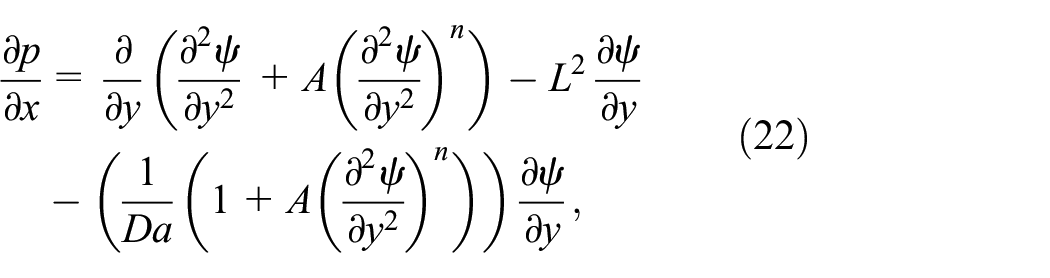

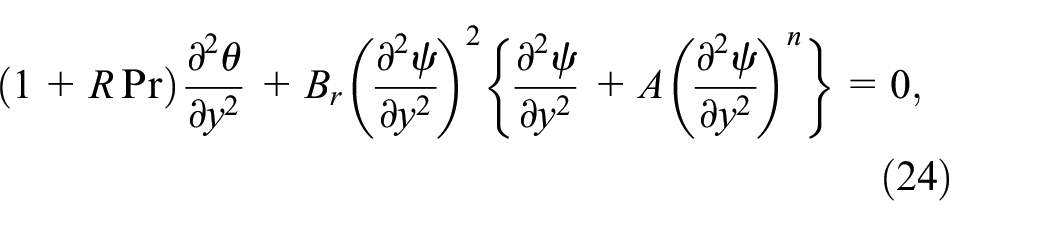

Upon eliminating pressure from equations (22) and (23) we have
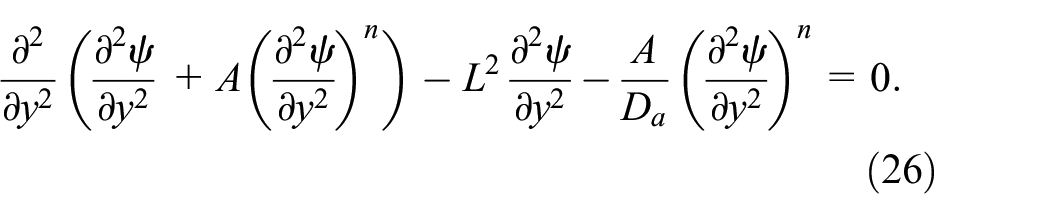
The transformed surface conditions are

The mean flow rate expression is specified by

The instantaneous volumetric flow rate

With
The computations of pressure per wavelength

The skin friction and Nusselt number at the channel’s upper wall in dimensionless form can be written as

Method of solution
The significance of the perturbation method is well established in literature for its ability to provide an approximate analytical solution to nonlinear problems. The outcomes reported for the other comparatively sophisticated approximate analytical methods to nonlinear problems have decent accuracy, but they are more difficult in applications and analysis than perturbation methods. Thus, for many years, the relative simplicity and high precision in the limitation of small parameters have made perturbation methods fascinating tools among the most frequently utilized approximate analytical procedures. Perturbation methods usually use convenient mathematical formulations to provide accurate outcomes for small perturbation parameters. Therefore, the method of perturbation has been implemented to acquire the expressions for velocity, pressure gradient, temperature, and concentration for small values of the Sutterby liquid parameter. For this intention, we expand the flow quantities as follows:

Invoking equation (31) into equations (22) to (27), we acquire the following system
Zeroth order system


with boundary conditions

First-order system
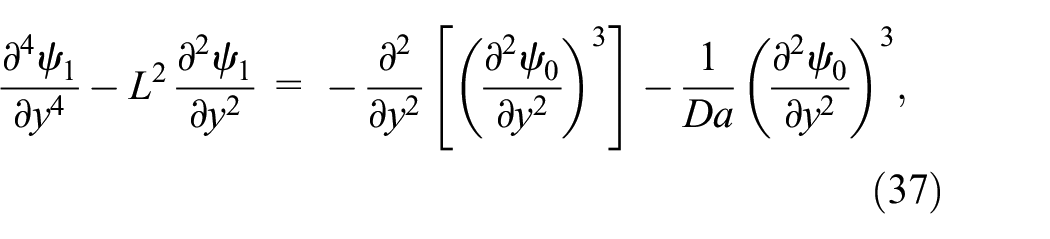



with boundary conditions

Solution for the zeroth order system
The outcomes at zeroth order are


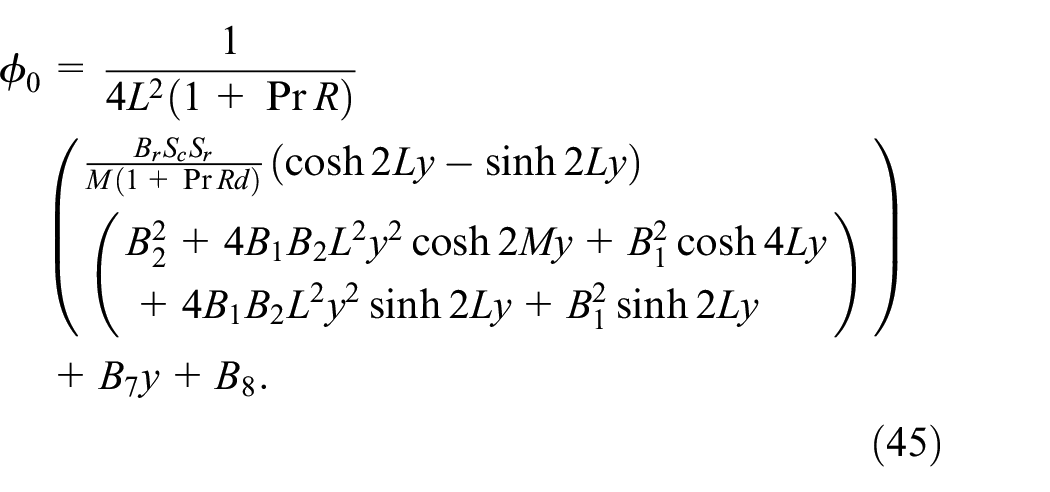
Solution for the first order system
The outcomes at first order are



Results and discussion
This portion characterizes the impacts of sundry variables on the velocity, pressure rise, temperature, concentration, and streamlines through graphical outcomes. Integral specified in equation (29) cannot be resolved analytically so a numerical solution based on a suitable algorithm is required. Therefore, this integral is calculated numerically by employing the composite Simpson’s rule with spatial discretization number for the numerical process taken at 200. The computed convergence criterion was 10−10. In this analysis, the following default parameter values are adopted for computations:
Figure 2(a) to (c) is designed to scrutinize and deliberate the impacts of significant parameters on the momentum profile

Velocity profile for various values of (a) velocity slip parameter
In a human body, the transport of various biological fluids can easily be notice actively to handle various types of diagnostic problems. Peristaltic pumping mechanism is very helpful in transporting different kinds of fluids, such as sanitary fluids, sensitive fluids, noxious fluid, and corrosive fluids. This phenomenon can also be found in a living body such as gastrointestinal tract.5,8,36,39 Figure 3(a) to (c) is outlined to explore the impressions of significant parameters on average pressure rise
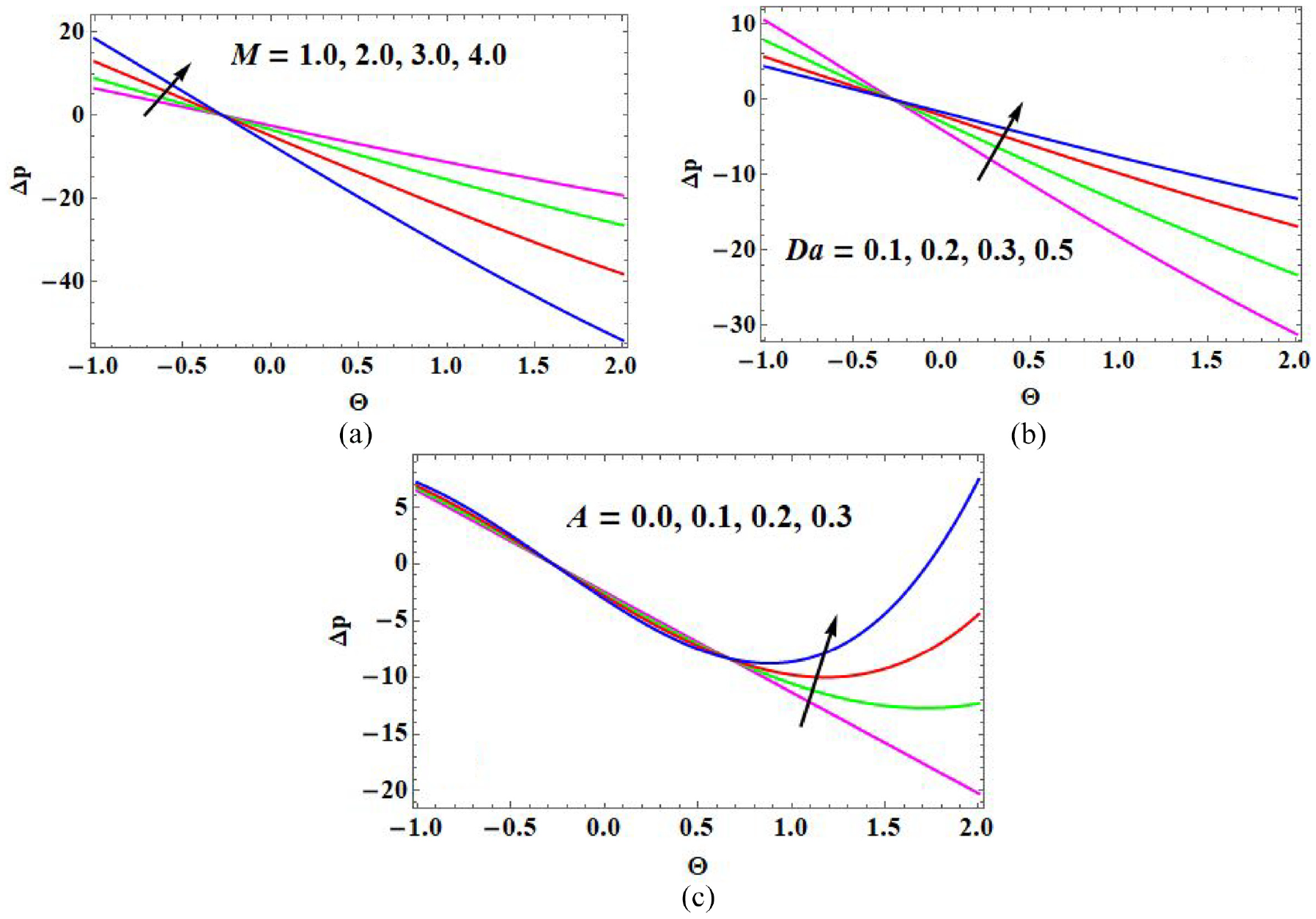
Pressure rise for various of (a) magnetic parameter
The impacts of sundry variables on thermal profile are accessible in Figure 4(a) to (c). In Figure 4(a) we portray the mutual impacts of

Temperature profile for various values of (a) Brinkman number

Concentration profile for various values of (a) Schmidt number
The heat transfer rate

Nusselt number profile against
The development of an internally circulating bolus that transports waves is a very relatable mechanism in fluid dynamics. This phenomenon has physical examples in blood clots and the transportation of food bolus in the gastrointestinal tract. This kind of event is characterized as trapping. The trapping mechanism of the streamlines

Streamlines for various values of magnetic parameter

Streamlines for various values of channel non-uniform parameter

Streamlines for various values of velocity slip parameter
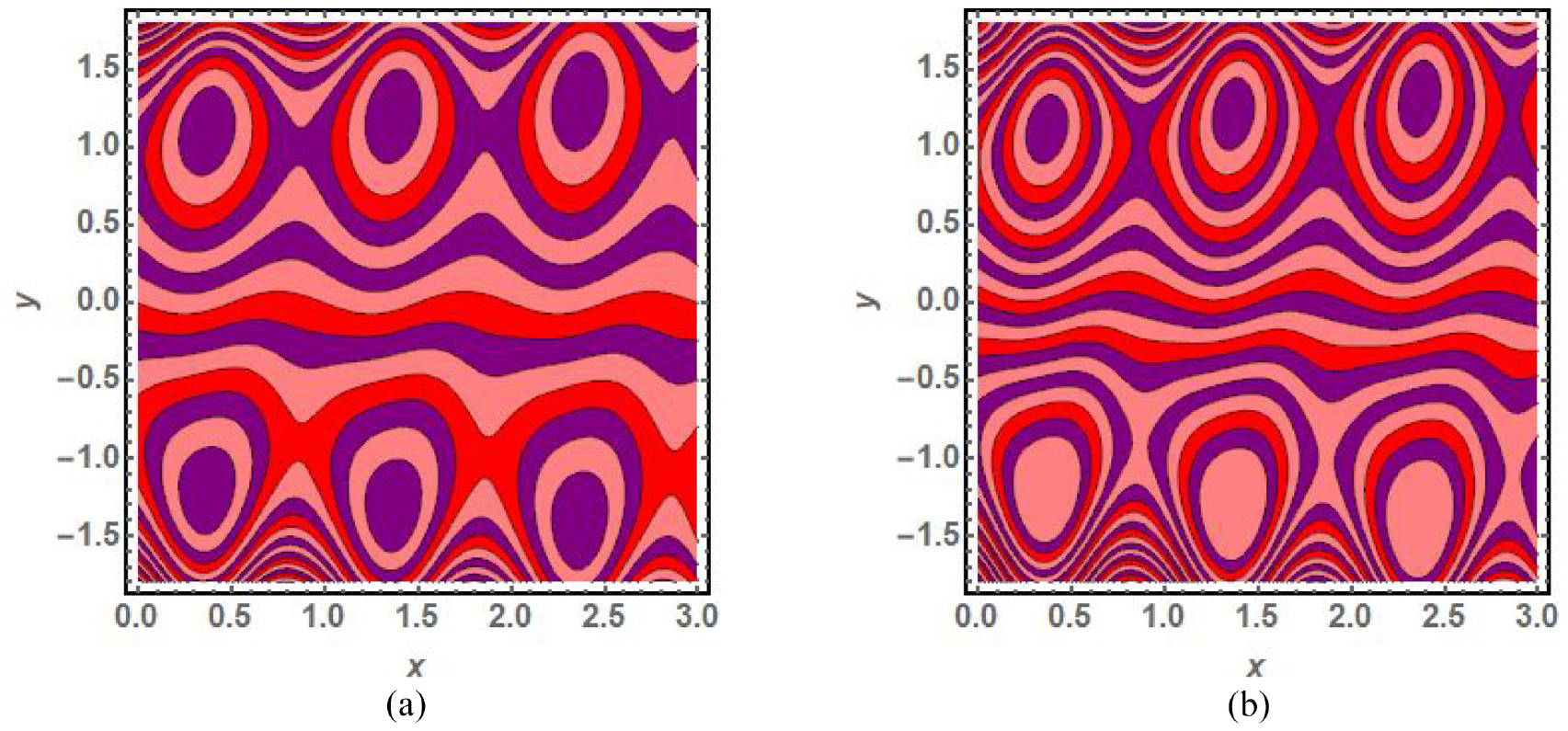
Streamlines for various values of Sisko fluid parameter
Validation
The purpose of this section is to check the accuracy of our outcomes. To verify obtained results, a comparison of limiting case of present investigation for the velocity profile in the absence of Darcy number, velocity slip parameter, and fluid parameter with the results reported by Kothandapaniet al. 36 is provided in the absence of fluid parameter (see Figure 11). This graph indicates that both findings are in good agreement.

Comparison of limiting case of the present study with the results of Kothandapani et al. 36
Conclusions
We have theoretically scrutinized the problem of peristaltic flow of electrically conducting Sisko liquid in a tapered with modified Darcy law. The outcomes are acquired for the flow quantities employing the regular perturbation method for small values of the Sisko liquid parameter. The substantial outcomes from the current model are:
Momentum profile decreased by increasing the values of magnetic and velocity slip parameters while it rises by the Sisko liquid parameter.
Pressure rise is enhanced in the retrograde pumping region by increasing the values of Sisko fluid parameter.
The declining behavior of the thermal profile is viewed by enhancing the radiation parameter while it enhances with the Brinkman number and Sisko liquid parameter.
The bolus size is perceived to reduce with the enhancement of the magnetic parameter.
Footnotes
Acknowledgements
We are thankful to the reviewers for their encouraging comments and constructive suggestions to improve the quality of the manuscript.
Handling Editor: Chenhui Liang
Declaration of conflicting interests
The author(s) declared no potential conflicts of interest with respect to the research, authorship, and/or publication of this article.
Funding
The author(s) received no financial support for the research, authorship, and/or publication of this article.
