Heat flow may be improved using a new form of nanofluid known as ternary hybrid nanofluid. Magnetic field, mass suction, and heat source effects on the stagnation area of ) ternary hybrid nanofluid toward convectively heated stretching/shrinking cylinder with cylindrical shape nanoparticles are studied in this work. There will be an equation modeled under the given assumptions. It is feasible, with the help of similarity transformation, to convert nonlinear partial differential equations that are not quite solvable into ordinary differential equations that can be resolved numerically. The prevailing role of heat transfer and the features of movement of ternary hybrid nanofluids have been found to be significantly affected by the combination of Runge–Kutta-IV and the shotting technique in Mathematica. Many variables, including suction, Reynold number, nanoparticle volume fraction, magnetic field, Biot number, heat source, and stretching/shrinking influenced temperature, velocity, skin friction, and the local heat transfer rate, as shown in the graphs in the study. When magnetic field, suction, and Reynold number are present velocity increases, but inverse is true for nanoparticle volume fraction and stretching/shrinking parameter. The greatest influence on the surface is shown by the ternary hybrid nanofluid. Additionally, the heat transfer rate of the ternary hybrid nanofluid is faster than that of the hybrid and regular nanofluids.
Stretching/shrinking surfaces are used to research heat transfer and flow, the upshot of which is a diverse variety of valuable engineering uses, including heat retention, the production of complex synthetic structures, the production of crystal and other types of subterranean transportation systems. Industrial applications of heat transfer and flow exploration are critical since the quality of a finished product is affected by how quickly heat exchange occurs and how quickly velocity gradients change.1,2 To produce nanofluids, nanoparticles of a size less than 100 nm may be encased in ethylene glycol, oil, polymer, or water. This process is known as encapsulation. Ethylene glycol, oil, polymer, and water are all examples of fluids that have a limited capacity to transmit heat due to their low thermal conductivity. The thermal conductivity of a fluid is a crucial factor to consider when thinking about the movement of heat. The thermal conductivity of common heat transfer fluids may be greatly increased by nanoparticles if they make up less than 1% of the volume of the fluid. This finding comes from research conducted by Choi and Eastman.3 When nanofluids were supplemented with ceramic or metallic nanoparticles, according to the findings of the researchers,4 the nanofluids showed a considerable rise in their thermal conductivity.
Hybrid nanofluid is a novel kind of heat transfer fluid that has the potential to outperform both standard cooling fluids (water and ethylene glycol) and nanofluids (single nanoparticle) in terms of heat transfer performance. It is well documented that hybrid nanoparticles are important in several manufacturing and technological regions and that the synthesis and constancy of hybrid nanoparticles have been studied in numerous review studies.5–10 When it comes to creating a durable hybrid nanofluid, one of the most important elements to consider is choosing an appropriate blend of nanoparticles. Metal nanoparticles , metal oxides , carbon materials (graphite, MWCNTs, CNTs), metal carbide, and metal nitride were the most regularly encountered types of nanoparticles. In addition, the size, form, and solid volume fractions of the nanoparticles are all essential aspects in optimizing the thermal conductivity of the hybrid nanofluid, as is the composition of the nanoparticles. In order to investigate stable incompressible boundary layer flow and heat transfer, Jahan et al.11 investigated the influence of solar radiation and viscous dissipation on a moving thin needle that was saturated with hybrid nanofluid. In the description of boundary layer flow in nanofluid, the mathematical models of Buongiorno12 and Tiwari and Das13 are often utilized. Stretching flow using the Buongiorno model has been the subject of further studies, including.14–16 In the study that was conducted by Ferdows et al.17 the researchers employed a power-law variation fluid that was placed over a moving stretching surface to investigate the effectiveness of nanoparticles. Because of the need in industry, researchers are looking on nanomaterials that can only be created using Newtonian fluids. Tiwari and Das model were updated to include the thermophysical features of hybrid nanofluids described by Devi and Devi.18 Under magnetic field conditions and low suction strength , the heat transfer rate of hybrid nanofluid was larger than that of Cu-water nanofluid.
It is necessary to include consequences in the flow to determine if the impact contributes to the flow providing a good relevance. Suction is one of the effects that researchers are interested in examining more extensively. External flows or energy losses may be reduced by controlling the boundary layers by suction. Boundary layer separation may be prevented or hindered by this technique. The surface must have flaws, crevices, apertures, porosity regions, or perforated in order to provide the suction impact. Use these funnels to draw air from the boundary layer that moves at a slower rate near the wall. A result of this filling is a complete and strong boundary layer velocity curve when separated. For boundary layer management, Hartnett19 identified the need of suction or injection. Reduce drag and attain high elevation values are generally achieved by swiftly impeding boundary-layer separation. Because of this, suction or injection of fluid via a surface may drastically alter the flow field, including in mass transfer cooling Several academics have played an active role in investigations on the effects of suction because of this amazing concept20,21 have examined the impact of suction on a variety of surfaces and fluids.
Stagnation point flow is a term used to describe the flow that separates when it comes into contact with a solid surface. At the manufacturing and technological sectors, this kind of flow has been widely used because it has the best heat transmission, fluid pressure, and mass deposition rate in the stagnation point zone. Stagnation point flow was first described in classical works by Hiemenz22 and Homann.23 Chiam24 was the first to explore the stagnation point flow caused by a stretched flat plate, whereas Wang25 studied a contracting sheet and found two solutions. The experiments on the stagnation point flow near deformable flat plate were afterward undertaken by Nasir et al.26 and Khashi’ie et al.27 employing standard and hybrid nanofluids, correspondingly. Disc, wedge, and cylinder fluid flow have all been studied more thoroughly in recent years because to technological and industrial advancements. Wang28 did some early work on fluid flow toward a stretching cylinder. Ishak and Nazar29 found a solution for laminar boundary layer flow of a viscous fluid along a stretching cylinder that was similar to Wang’s work. MHD slip flow with heat production and outward velocity was investigated by Vinita and Poply30 using Buongiorno’s nanofluids model. When it comes to viscous fluid, Najib et al.31 and Omar et al.32 observed at the stagnation point flow toward an expanding/contracting cylinder. It has recently been shown that Nadeem et al.33 the stagnation point flow over a static cylinder may be analyzed in three dimensions and two solutions have been established.27 hybrid nanofluid has a higher heat transfer rate than Cu-water nanofluid. Waini et al.34 studied the flow of hybrid nanofluids toward a stagnation point on a stretching/shrinking cylinder.
In the sphere of industry, having a fluid that can be heated by electricity in the occurrence of a strong magnetic field, for example during the development of crystals during melting, is absolutely necessary. During the motion of a fluid, the divergence of Lorentz forces is produced as a result of the interplay of electrical currents and magnetic fields. MHD is a description of the hydrodynamics of a conducting fluid in the manifestation of a magnetic field. This description is in agreement with the phenomena known as magnetohydrodynamics. The studies of MHD flow are very important due to the vast amount of applications that involve the magnetic outcome in manufacturing and industrial fields, such as MHD electricity generators, sterilization tools, magnetic resonance graphs, MHD flow meters, and also in granular insulation.35 These applications all have something in common: they all use the magnetic effect. The pace of cooling that takes place during these operations, which is controlled by the usage of a magnetic field and electrically conducting fluids, has a considerable impact on the feature of the final product. The first person to research MHD flow in a Newtonian fluid was Pavlov,36 who looked into the magnetohydrodynamic flow of an impressible viscous fluid that was induced by the deformation of a surface. Pavlov was the first person to study MHD flow in a Newtonian fluid. The research on hydromagnetic flow and heat transmission across a stretched sheet was given a broader scope by Chakrabarti and Gupta.37 Using the Keller-box approach, Lok et al.38 explored the MHD stagnation-point flow near a decreasing sheet. They established the existence of many solutions for the shrinking instance for slight estimates of the magnetic field parameter. Since that time, a significant amount of research that takes MHD into consideration has apparently been carried out, as shown.39–41
Because of their ability to increase thermal performance, oxide nanoparticles such as and are commonly used in heat transfer fluids either as single or hybrid nanofluids. The research on single nanofluids has led to the development of hybrid or composite nanofluids. A substance or a composite that dissolves in a liquid can be used to create these hybrids. As a result, oxides show great promise for thermal applications, and hybrid nanofluids outperform single nanofluids in terms of thermophysical properties. The improvement of balancing the thermal and rheological properties can be done by designing a ternary-hybrid nanofluid. With this motivation further experimental studies are being conducted for ternary-hybrid nanofluid anticipating an improved heat transfer rate. In ternary-hybrid nanofluid, three classes of nanoparticles with different physical and chemical bonds are suspended.
The literature on the aforementioned topics, however, has several gaps and faults. Earlier analyses have not investigated the ternary hybrid nanofluid and MHD flow into a stretching/shrinking convectively heated cylinder with mass suction and heat source impacts. The current investigation is theoretical. There is a great deal of information available on copper nanoparticles, therefore it was decided to use this as a model for our study of what happens when copper iron oxide ), silicon dioxide , and polymer are mixed together as a ternary hybrid nanofluid. Additionally, the model exhibits the innovative and adaptable characteristics of mass suction, and magnetic field, among others. The shooting method is used to do numerical calculations once the modeling and simulations have been completed in computing software MATHEMATICA. The characteristics and thermal traits of nanoparticles are graphically analyzed in a comprehensive manner. It’s possible that this will be valuable in studies done in the future to improve the efficiency of heat transmission in contemporary industrial settings. The primary goals or aims are as follows:
Is it possible to predict the hydrothermal results based on magnetic characteristics, suction, Reynold number, Biot number, and nanoparticle volume fraction?
What factors influence the ternary hybrid nanofluid curves?
When it comes to those characteristics, what effect do skin frictions and Nusselt numbers have?
For mono, hybrid, and ternary hybrid nanofluids, how much variation is observed?
Figure 1 depicts the development of ternary hybrid nanoparticles. All the authors are certain that the current study has not been previously reported in other publications.
Sketch of ternary hybrid nanofluid preparation.
Description of the problem
The current work considers steady, two-dimensional, magnetic field stagnation point flow of incompressible ternary hybrid nanofluid formed by suspended and in polymer as base fluid. Grasp Figure 1 for an illustration of a flow innovator. In this case, the permeable stretching/shrinking convectively heated cylinder is defined by radius , mass suction is calculated around the cylindrical polar coordinates , where is the axial and is the radial length synchronize along the flow direction, correspondingly. It is also presumed that the mass transfer velocity is , where denotes suction and the magnetic field strength is denoted by , correspondingly. The flow is presumed to be symmetric around the plane and also axisymmetric about the z-axis, with the stagnation line is at and The surface velocity of the cylinder is assumed as , where the static cylinder is indicated by , whereas the cylinder is stretched or shrunk when or , correspondingly. In the meantime, the free stream velocity is carried as , where . With a heat transfer coefficient of and a temperature of assumed for the hot , the bottom of the cylinder is convectively heated. The ambient temperature of is constant and kept as . In addition to this, other assumptions pertaining to the physical model are investigated and examined, including the following:
Flow is laminar.
Chemically active species, such as joule heating, thermal radiation, viscosity dissipation, and the hall effect are not considered by this model.
The temperature of the base fluid as well as the nanoparticles is maintained in such a way that they are both in a condition of thermal equilibrium.
The nanoparticles have a cylindrical shape and a size distribution that is consistent across the board for the whole population of nanoparticles.
In order to facilitate the process of fluid suction, the cylinder was constructed to have a permeable surface.
In this way, the flow of ternary hybrid nanofluid is described by the equations34,42,43:
Law of conservation of mass:
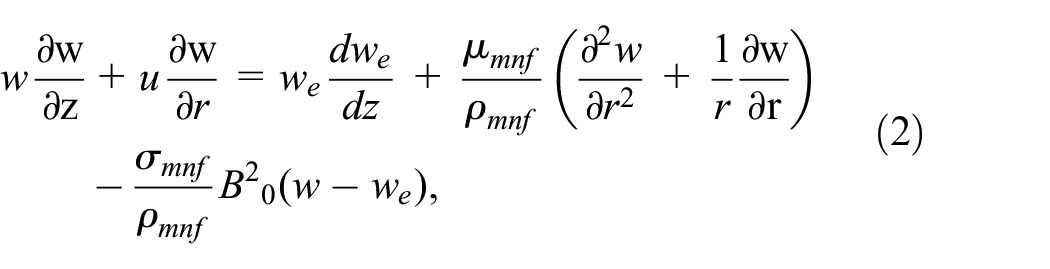
Law of conservation of momentum:
Law of conservation of energy:
and symbolizes the velocity component beside the -and -directions respectively. Next, the boundary conditions are:
The temperature of the ternary hybrid nanofluid is denoted by the symbol , the dynamic viscosity is denoted by the symbol the density is denoted by the symbol , the thermal conductivity is denoted by the symbol , and the heat capacity is denoted by the symbol
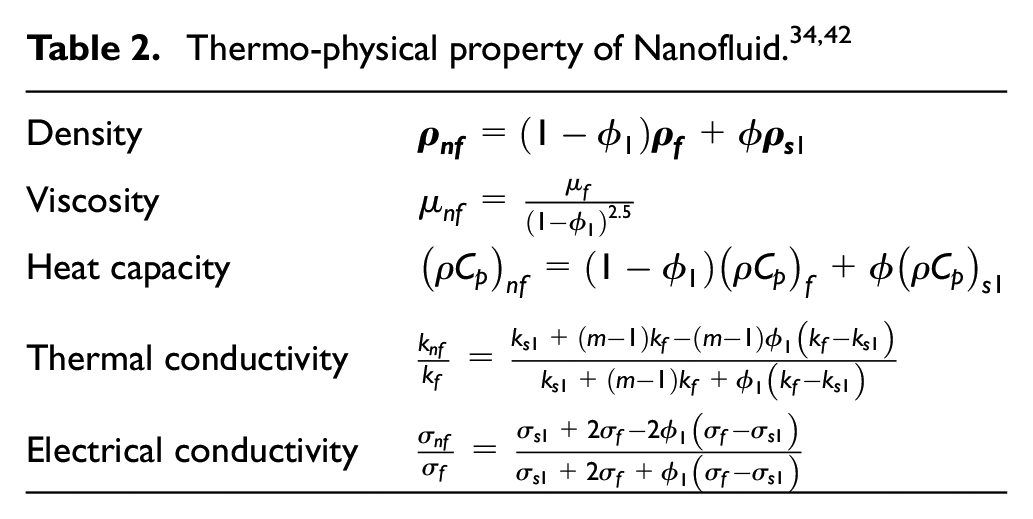
The characteristics of copper, iron oxide, silicon dioxide, and polymer as the base fluid are listed in Table 1, along with various other thermophysical characteristics. Tables 2 to 4 provides a mathematical representation of the thermal descriptions of nanofluid, hybrid nanofluid, and ternary hybrid nanofluid. Furthermore, Table 5 shows the numerical values for different form factors based on the shape characteristics . In Table 1 is volume fraction of is volume fraction of and is volume fraction of nanoparticles. Subscripts and stands for denoting the properties of , and nanoparticles.
Numerical values of polymer base and ternary hybrid nanoparticles.44–46
As a direct result of applying a similarity transformation, which is presently recommended in order to get similarity solutions34 the following is stated:
When differentiated in regard to η, prime denotes change. By adding (1), (2), (3), and (5) in the equations describing the steady state, we may derive the ordinary differential equations that are shown below.
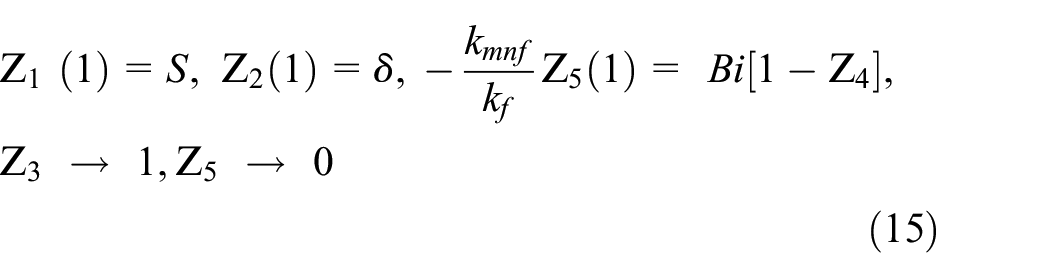
Transformation of boundary conditions (4) into
In the preceding equations, signifies the Reynold number and denotes the Prandtl number. The stretch/shrink parameter , where implies a stretched sheet and signifies a shrinking sheet. denotes magnetic parameter. is the Biot number. is heat source parameter. In addition to the local Nusselt number the friction coefficients are also of great interest in this inquiry.
Equations (6) and (7) and associated boundary conditions eight are linked nonlinear ordinary differential equations, and both are nonlinear in nature. These equations are quite difficult. It is possible to resolve the nonlinear differential equations, which involve the issue with the boundary layer flow, by using any one of a number of distinct strategies. This is because there are several possible solutions. This is something that is not completely out of the question to consider at all. Analytical methods, semi-analytical methods, and numerical methods are all examples of the various types of methods that can be used. Some examples of these methods include the shooting method, the Runge–Kutta–Fehlberg method, Keller Box Techniques, homotopy perturbation method (HPM), Finite difference method, Variational iteration method, Akbari–Ganji (AGM) method, and the bvp4c method in MATLAB.48 Dealing with these problems via a numerical method would be the most effective course of action in my opinion. The combination of RK-IV and shooting techniques allows for the capture of ternary hybrid nanofluid flow routes for a variety of physical factors. Depending on the order in which the self-similar momentum and energy equations (6) and (7) and the boundary domain equations 8 are utilized to begin the process, a few different transformations may be necessary. These transformations are provided within the equation (8). The model was simplified to address a first-order initial value problem as a result of these adjustments, which can then be addressed as follows:
using equations (11, 12) in (6)–(8) and after rearranging equations, we get the following:
In order to resolve the ensuing problem with the starting value, we need to include the values that come from equations (13) and (14) into equations (6)–(8), respectively. In order to get the numerical solutions to (6)–(8), a very competent piece of computational software known as Mathematica 10 is used. It identifies the governing system and then uses the numerical process that is the most appropriate for the system in order to produce correct answers for the system. This is a very unique quality.
Results and discussion
Analysis of results
The shooting technique with RK-IV is used to solve equations (6)–(8) in the computational software Mathematica which we discussed in previous section, figures and tables are used to illustrate the numerical findings. The boundary layer thickness and is fixed except for evaluation as seen in the tables and figures, control characteristics are varying. These values are determined by whether the far-field boundary requirements are met (8). Since nanofluid, hybrid nanofluid, and ternary hybrid nanofluid is supported in this current work, a different set of values fraction is limited in between . Other parameters, such as (suction), (stretching/shrinking), (magnetic parameter), (heat source), (Biot number), and (Reynold number) are selected grounded on the primary citations and the possibilities of results.
In Figure 2, the flow of a ternary hybrid nanofluid is shown as a physical model. A flow chart depicting the model simulation process may be seen in Figure 3. Consequences for velocity, temperature, skin friction, and local heat transfer curves are presented in Figures 4 to 23, which provide a comprehensive picture of the present condition for stretching and shrinking surface.
Flow configuration of physical model with coordinates system for cylinder.
Mathematical demonstration.
Change in with .
Variation in with .
Variation in with
Variation in with
Variation in with
Variation in with
Variation in with
Variation in with
Variation in with
Variation in with
Variation in with
Variation in in contract to toward
Variation in in contract to toward
Variation in in contract to toward .
Variation in in contract to toward .
Variation in in contract to toward .
Variation in in contract to toward .
Variation in in contract to toward .
Variation in in contract to toward .
Variation in in contract to toward .
Discussion of results
In the coming section, graphical comparison of nanofluid, hybrid nanofluid and ternary hybrid nanofluids are discussed.
Velocity and temperature curves for stretching and shrinking cylindrical surface
In this subsection we discussed in detail the impacts of different parameters such as: volume fraction , magnetic field suction stretching/shrinking Reynold number heat source , and Biot number on the axial velocity and temperature curves of nanofluid, hybrid nanofluid, and ternary hybrid nanofluid. For nanofluid case, we consider for hybrid nanofluid , we consider and , while for ternary hybrid nanofluid , we take , and .
As cylinder shrinks, velocity and temperature curves are affected by the volume fractions of copper , iron oxide , and silicon dioxide , as seen in Figures 4 and 5. There is greater space for improved heat conduction in nanofluids with higher volume fractions of nanoparticles, which are found in metal and metal oxide, in hybrid nanofluid, and in ternary hybrid nanofluids. Thus, the nanofluid, hybrid nanofluid, and ternary nanofluid all become hotter as can be shown in Figure 5. This implies that the device’s heat absorption is boosted, ensuring an optimal temperature and a long service life for the appliance. A heat conductor with a photocatalytic nature like metal and metal oxide nanoparticles is more suited to use as a nanofluid or hybrid nanofluid or ternary hybrid nanofluid, since they are better at conducting heat than other types of nanoparticles. Nanofluid, hybrid nanofluid, and ternary hybrid nanofluid are all made more stable by their chemical inertness. It is easy to observe from Figure 4 that the velocity profile decreases as the quantity of the nanoparticle volume percent is raised. This is shown by the graph. The increase in viscosity that results from the influence of nanoparticle volume fraction is the primary factor in the decrease in velocity that is seen. Clearly, one can see that ternary hybrid nanofluid has higher temperature profile as equated to nano and hybrid nanofluid owing to the existence of more nanoparticles.
Using the shrinking scenario as an example, Figure 6 show how the magnetic field affects the velocity curve of the nanofluid, hybrid nanofluid, and tri-hybrid nanofluid. The Lorentz force theoretically might lower velocity due to magnetic parameters, however in the current issue, velocity is increased. A force termed the Lorentz force opposes fluid flow when there is a magnetic field present. This force’s magnitude is directly related to the magnitude of . When a result, as rises, the Lorentz force becomes stronger. With larger levels of , the momentum of the fluid flow decreases as a result of this increased resistance. For Newtonian or Non-Newtonian fluid in a broad variety of physical circumstances, this effect is typical in magnetohydrodynamics. There is no joule heating or viscous dissipation element in the energy equation, therefore has no influence on the thermal distribution graph.
Figures 7 and 8 illustrates the consequence of suction constraint on velocity curve and temperature curve for shrinking cylinder case of the nanofluid, hybrid nanofluid and ternary hybrid nanofluid flow. In Figure 9 velocity curve growth with the expanding values of the suction . This is because the density has grown due to the addition of more particles. By lowering the depth of the momentum barrier layer, suction improves the flow of the stretched and shrinking surface. Temperature variations with suction parameter are revealed in Figure 8 as a function of temperature. Temperature falls when the parameter increases in value. Suction cools the boundary layer flow, which means that suction is also used in many industrial processes, as well as nuclear energy and MHD power plants. The fluid flow owing to a shrinking cylinder does not have a similarity solution. As a result of the constraint of vorticity inside a boundary layer, the diminishing flow is discovered to be physically present.
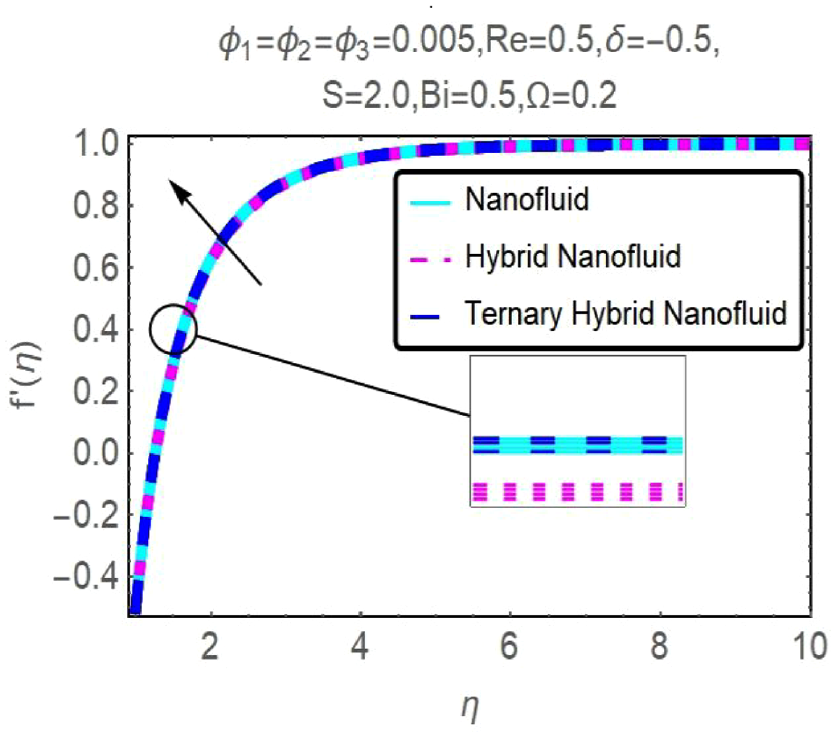
A contrast of nanofluid, hybrid nanofluid and ternary hybrid nanofluid velocity and temperature curves for stretching cylinder case are shown in Figures 9 and 10. When the velocity ratio parameter is increased, fluid velocity drops, but the temperature curve shows the opposite. It has a tangible effect in the sense that an increase in the rate of results in a narrowing of the breadth of the momentum boundary layers as time passes. This is a physical consequence of the phenomenon. It is also vital to take into consideration that the thermal boundary layer will thicken as a sheet will shrink. The velocity gradient is always positive, as can be shown in Figures 9 and 10. The solution profiles swiftly and monotonically approach their asymptotic value. Positive gradients in velocity mean that the fluid is exerting a drag force on the wall surface, whereas negative gradients mean that the fluid is exerting no drag at all. As the mass suction rate rises, so does the velocity penetration into the fluid. Ternary hybrid nanofluid show slight increment for both velocity and temperature curves here.
The effect of on and when , and for nanofluid, hybrid nanofluid, and ternary hybrid nanofluid for shrinking cylinder case are exhibited in Figures 11 and 12. Magnetic parameter supposedly reduces velocity due to Lorentz force, however in this case, the velocity rises due to the Lorentz force. When the Reynolds number Re is augmented, the velocity rises, and as a consequence, the temperature drops after the thermal diffusion is overcome, as seen in the graph. To meet the boundary constraints (8), in Figure 12 the curves start at and approach zero for large . The thickness of the thermal boundary layer decreases linearly with as predicted. Additionally, rises as falls. So modest values allow for more heat penetration at a greater distance from an object’s surface leading edge than larger values.
The higher the temperature of the nanofluid, hybrid nanofluid, or ternary hybrid nanofluid, the more kinetic energy is transformed to heat energy.
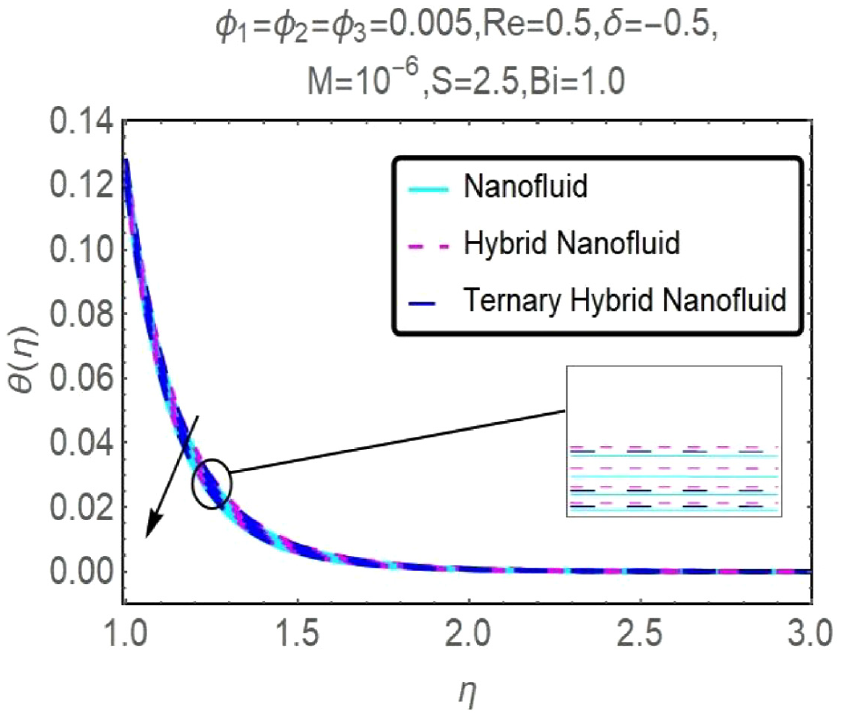
Figure 13 depicts the temperature profile for the shrinking scenario for nanofluid, hybrid, and ternary hybrid nanofluids using different estimates of the heat source parameter. This graphic demonstrates that as grows, the viscosity of the thermal boundary layer upsurges as the temperature profile decreases. By increasing the thickness of the thermal boundary layer physically, it is possible to produce a reduction in the heat flow on the surface, which in turn minimizes the temperature differential.
Figure 14 shows how the temperature distribution profile changes depending on the rate of the Biot number with respect to the convectively heated shrinking cylinder. As the estimates of increases, the temperature distribution outline rises, and high Biot number indicates a greater interior thermal resistance of the cylinder in comparison to the boundary layer thermal resistance. When is employed, all the profiles (Figures 4–14) asymptotically met the boundary requirement (8). It can be shown from these figures that ternary hybrid nanoparticles have a considerable effect on flow and thermal performance when compared to other nanoparticles. It is ternary hybrid nanoparticles that create the greatest amount of thermal energy, rather than hybrid nanoparticles and simple nanoparticles.
Skin friction and heat transfer
This segment shows perception of various factors versus physical metrics such as skin friction and local heat transfer rate . Both the local heat transfer rate and the skin friction are essential characteristics for industrial use. The significance of these data simply cannot be contested because of their widespread use in industry. Skin friction coefficients and local heat transfer rate fluctuate due to changes in parameters.
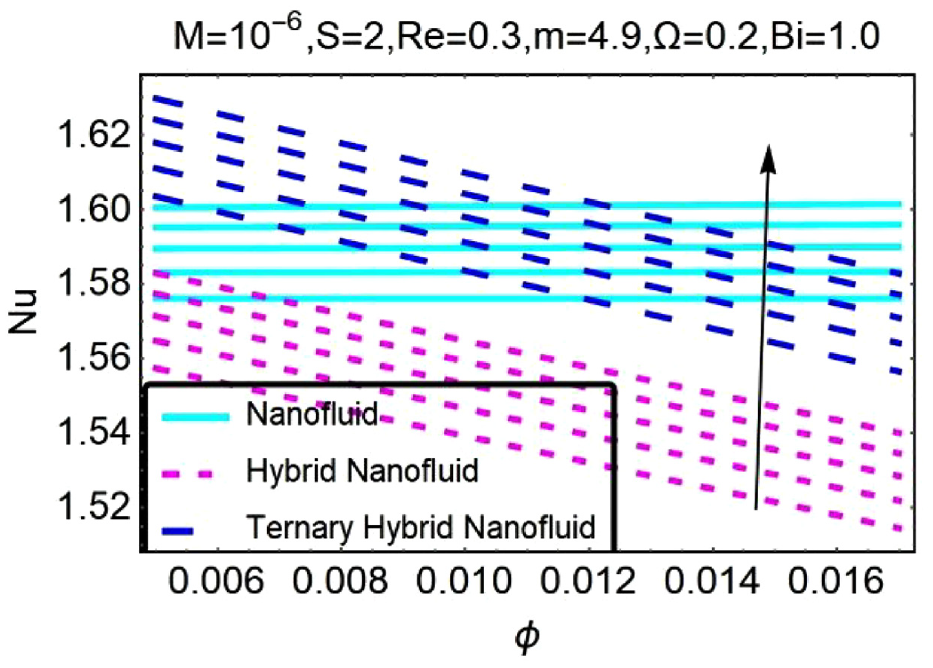
Figures 15 and 16 illustrate the increasing effect of stretching and shrinking parameters toward volume fraction on the and local heat transfer rate of nano, hybrid, and ternary hybrid nanofluid when , and The positive values of provides stretching and negative values of provides shrinking of the cylinder. It is demonstrated in Figures 15 and 16 by various values of with decreasing the and increases . Specifically, larger concentrations of nanoparticles create more kinetic energy than lower concentrations, which increases the heat transmission of fluid particles by increasing their kinetic energy. The surface frictional drag of a typical nanofluid is greater than that of a hybrid or ternary hybrid. Because of this, the surface of ternary hybrid nanofluids is less likely to be altered. Ternary hybrid nanofluid has greatest magnitude in this case for both skin friction and heat transfer rate.
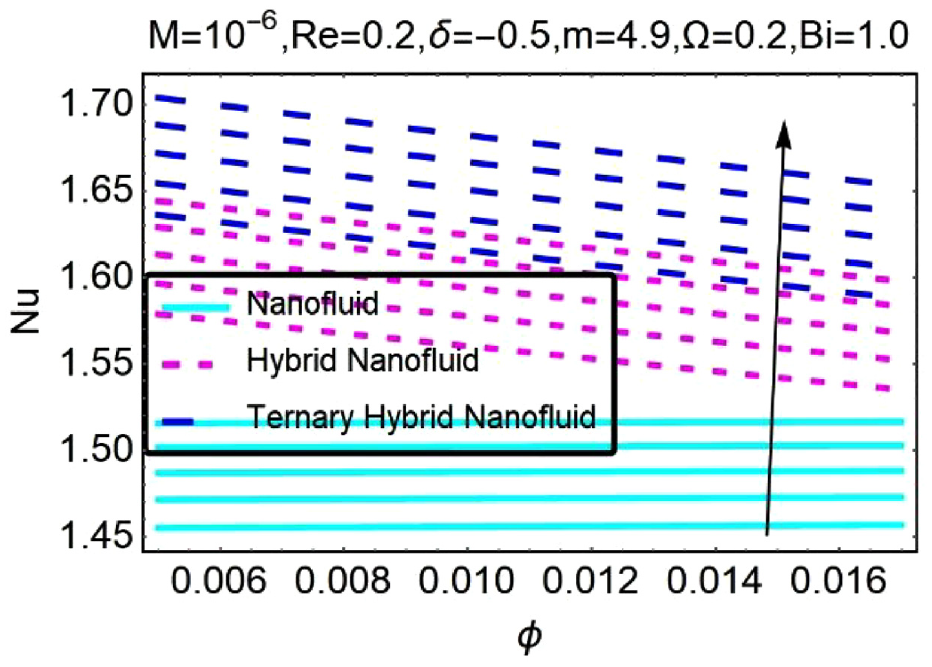
Figures 17 and 18 show the impact of with against skin friction coefficient and of nano, hybrid, and ternary hybrid nanofluid for shrinking cylinder case. For all values of , when and In general, less suction is required as increases. Furthermore, if an impermeable surface or an injection parameter is taken into consideration, no solution is available. When the flow is induced by suction, the boundary layer separation is maintained while the heat transfer rate is increased. Figures 17 and 18 show that for all values, the and rise as the suction parameter increases. In order to improve and , suction is necessary. Suction, on the other hand, is useful in the enhancement of both the skin fraction and the local heat transfer rate. When hot fluid particles are suctioned toward a surface, they move faster and more efficiently, increasing heat transfer. Here ternary hybrid nanofluid has greatest magnitude for skin friction curve. Ternary-hybrid nanofluid has good heat transfer rate than nanofluid and hybrid nanofluid owing to the application of greater suction. This is due to the application of higher suction. In the case of a shrinking/stretching cylinder, however, the current results are conclusive since it is critical to know where the separation point is. A larger suction strength may impact the heat transfer process in this challenge, however ternary-hybrid nanofluid is expected to improve the rate of thermal transfer. However, this suction force is required to activate the ternary hybrid nanofluid flow. These findings will serve as a standard for other researchers who want to look at ways to improve the rate of heat transmission in the shrinking cylinder instance by altering physical parameters or ternary hybrid nanomaterials.
The effect of magnetic field parameter toward on the can be illustrated from Figure 19 for shrinking cylinder of nanofluid, hybrid nanofluid and ternary hybrid nanofluid. For all values of , when and It is clear from these results that raising the boosts. For this reason, an additional amount of energy is transferred into the boundary layer as the Lorentz force grows over time. Ternary hybrid nanofluid has greatest impact on skin fraction curve.
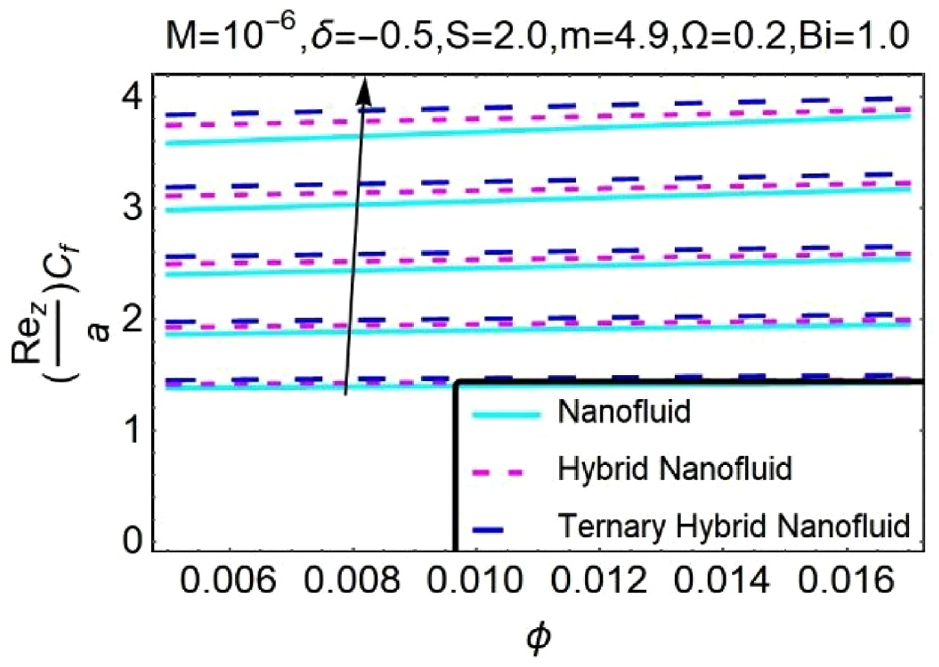
Variations in the skin friction coefficient and the Nusselt number may be seen in Figures 20 and 21 versus Intended for all estimates of , when and An increase in has a comparable impact as a decrease in nanoparticles, hybrid nanoparticles and ternary hybrid nanoparticles on the skin friction . Reynolds number is a physical indicator of the relative importance of the inertial forces relative to the viscous forces. For rising Reynolds numbers, the skin friction coefficient (surface shear-stress) increases. The Nusselt number is boosted by the rise of . In addition, it has been observed that the increase is more prominent in the stretching situation.
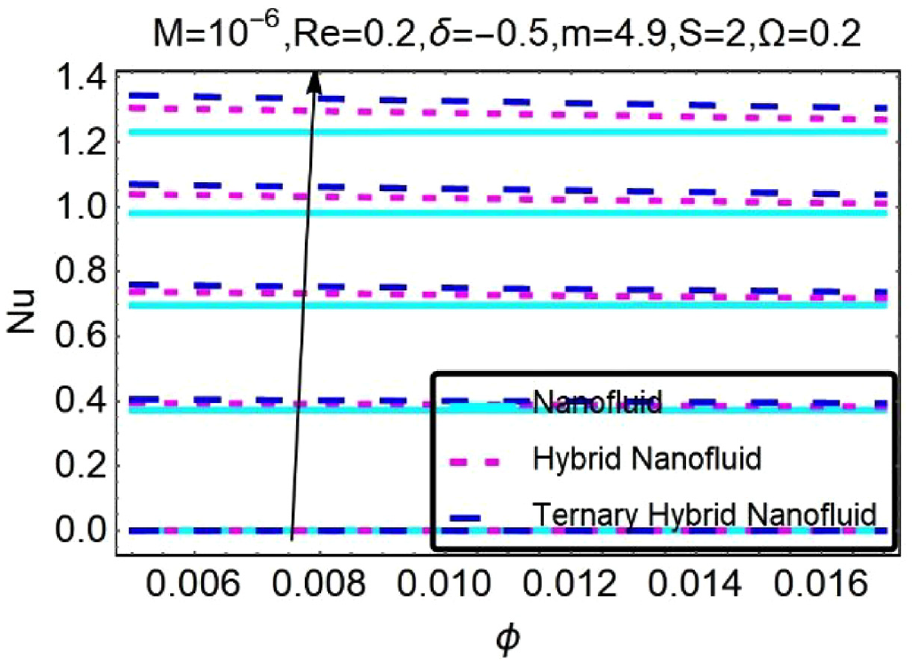
The impact of heat source toward volume fraction of nanofluid, hybrid nanofluid and ternary hybrid nanofluid of convectively heated shrinking cylinder is shown in Figure 22. This figure suggests that the use of a fluid based on polymer should be pursued in order to get the highest possible heat transfer.
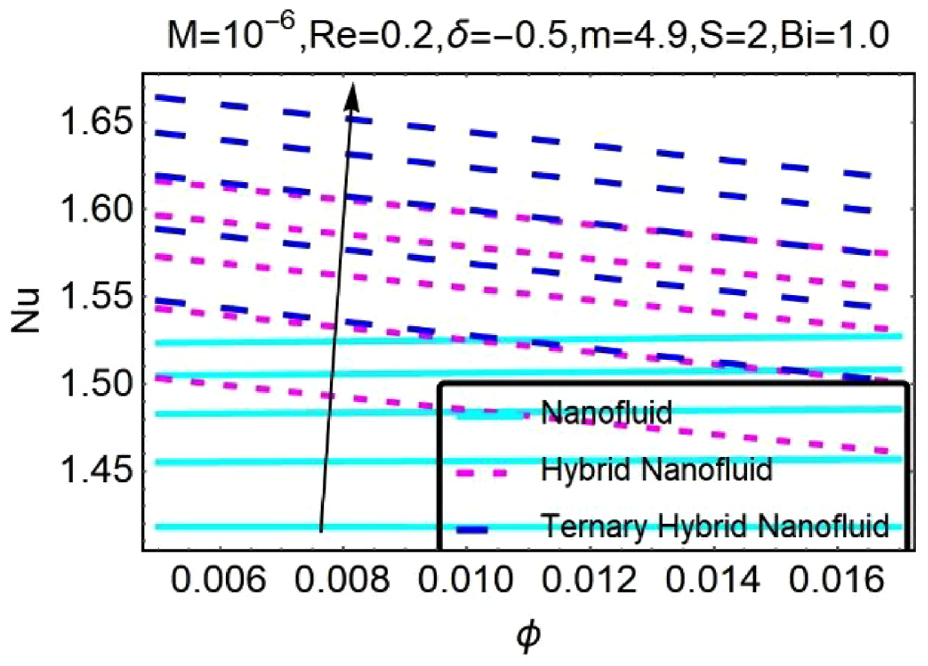
Figure 23 illustrates the numerous ways in which the rate of heat transmission may change depending on the value of the Biot number in relation to the volume fraction of a convectively heated expanding or contracting cylinder. According to the data shown in this figure, an upward trend in the heat transfer rate can be seen in the solutions with an increase in the Bi values. The Biot number represents the proportion of the cylinder’s internal conduction resistance that is equal to the convection resistance of the cylinder. It is important to keep in mind, however, that the Biot number has a direct relationship with the coefficient of heat transfer denoted by . As a result, it has an inverse relationship with the thermal resistance of the issue at hand.
Table discussion
Table 6 shows comparisons between the current study’s numerical findings and those from Waini et al.34 for various values of for normal fluid when to verify the validity of the current study’s numerical technique. The hybrid nanofluid fluid issue was previously addressed by Waini et al.34 research, however the current work used a ternary hybrid nanofluid. This research employed the Runge-Kutta-IV technique in Mathematica, whereas Waini et al.34 used bvpc4c in MATLAB. These findings are found to be in accord with the previously found; thus, this gives us confidence that the computational structure to scrutinize the ternary hybrid nanofluid flow behaviors and heat transfer in this study can be employed with significant assurance. The arrangement of suitable single/hybrid and ternary nanofluids is the most important factor in defining nanofluid flow behavior and heat transfer efficiency.
Estimates of and produces results for specific values of .
A comparative analysis of polymer based ternary hybrid nanofluid with cylindrical shape features has been utilized to flow across a permeable convectively heated stretching/shrinking cylindrical surface with mass suction, heat source and Lorentz force to find a two-dimensional Stagnation point. The material that was accessible was combed through to get the thermophysical properties that were then utilized in this experiment. In order to accurately express basic governance equations, partial differential equations (PDEs) were employed. These PDEs were then turned into a set of ordinary differential equations (ODEs), which could subsequently be used to perform transformations and optimizations. To discover a solution, we made advantage of the most effective shooting strategies, together with the Runge Kutta-IV algorithm included in the computer program Mathematica. The influence of the various factors on the velocity, temperature, skin friction, and Nusselt number is shown via the use of graphs. From the information shown up above, we may draw the following conclusions:
The nanoparticles concentration have opposite effect on fluid velocity and temperature curves for shrinking cylinder. Ternary hybrid nanofluid has slightly lower velocity and temperature curves compared to hybrid and nanofluid for nanoparticles concentration but greater for magnetic parameter.
Magnetic parameter shows increasing behavior of velocity profile of nanofluid, hybrid nanofluid and ternary hybrid nanofluid.
Variation in suction parameter increases velocity profiles and opposite behavior shown in temperature profile for shrinking cylinder. Ternary hybrid nanofluid for shrinking cylinder has highest magnitude in this case compared to hybrid and traditional nanofluid.
Both velocity field and temperature field for shrinking cylinder have opposite impacts for larger values of Ternary hybrid nanofluid has higher velocity and temperature curves compared to hybrid and nanofluid.
Heat source parameter increases both temperature and nusselt number profiles. Ternary hybrid nanofluid has slightly higher profile compared to others two.
Biot number shows increasing impact on temperature and nusselt number curves.
Both skin friction and heat transfer rate coefficients boosts due to the augmentation of both and for shrinking cylinder. ternary hybrid nanofluid has greater magnitude for skin friction heat transfer as compared to hybrid nanofluid and nanofluid.
The augmentation in nanoparticle volume concentration with stretching/shrinking parameter decreases skin friction and increases local heat transfer curves. ternary reveals the lowest impact on skin friction and highest to heat transfer as compared to nanofluid and hybrid nanofluid for this problem.
An improvement in the suction constraint intensity can boost both the local skin friction and heat transfer rate for shrinking cylinder. ternary hybrid nanofluid provides the highest magnitude for skin friction whereas nanofluid for heat transfer in this case.
As the stretching/shrinking parameter is increased, the velocity decreased whereas temperature increased. ternary hybrid nanofluid provides higher temperature in this case.
Increasing values of with surge up both the curves for skin fraction and local heat transfer rate for shrinking cylinder. Ternary hybrid nanofluid have the highest impact for skin friction in this case.
Contributions to current research and suggestions for the future
Polymer sheets, crystal mass production, things passing between feed rollers and the extrusion of metal, the cooling of metallic baths, and the cooling of a large metallic plate are just a few examples of the many processes that can benefit society as a whole using current mathematical modeling. It’s also possible that the models might be applied to a wide range of other aspects of daily life. In the future, there are several possibilities.
Others in a variety of fields might benefit from this research, which focuses on how to change (increase or decrease) the heat transfer rate by changing parameters or computer skills (mathematics, mechanical, and physics).
What has been discovered so far is only relevant in conjunction with and .
Alternatively, other researchers may use a different kind of classical or hybrid or tri-hybrid or other physical property of nanofluid to get the desired result for them as well.
The researcher may continue to utilize the model which is currently working with while applying the slip conditions.
Additionally, new liquids and nanofluids may be used in industrial applications, as well as hybrid fluids and tri-hybrids, in this study. Possibly, the present work might be broadened to encompass the unstable situation in the future.
Footnotes
Appendix
Handling Editor: Chenhui Liang
Declaration of conflicting interests
The author(s) declared no potential conflicts of interest with respect to the research, authorship, and/or publication of this article.
Funding
The author(s) disclosed receipt of the following financial support for the research, authorship, and/or publication of this article: The authors extend their appreciation to the Deputyship for Research & Innovation, Ministry of Education in Saudi Arabia for funding this research work through the project numbering “IF_2020_NBU_452.”
ORCID iDs
Zahoor Iqbal
Umar Khan
Data availability
The dataset used during the current study are available from the corresponding author on reasonable request.
References
1.
TianM-WRostamiSAghakhaniS, et al. A techno-economic investigation of 2D and 3D configurations of fins and their effects on heat sink efficiency of MHD hybrid nanofluid with slip and non-slip flow. Int J Mech Sci2021; 189: 105975.
2.
WainiIIshakAGroşanT, et al. Mixed convection of a hybrid nanofluid flow along a vertical surface embedded in a porous medium. Int Commun Heat Mass Transf2020; 114: 104565.
3.
ChoiSEastmanJ.Enhancing thermal conductivity of fluids with nanoparticles (No. ANL/MSD/CP-84938; CONF-951135-29). Argonne, IL: Argonne National Lab. (ANL), 1995.
4.
LeeSChoiSUSLiS, et al. Measuring thermal conductivity of fluids containing oxide nanoparticles. Journal of Heat Transfer1999; 121: 280–289.
5.
KumarMDRajuCSSajjanK, et al. Linear and quadratic convection on 3D flow with transpiration and hybrid nanoparticles. Int Commun Heat Mass Transf2022; 134: 105995.
6.
UpadhyaSMRajuSVRRajuCS, et al. Importance of entropy generation on Casson, micropolar and hybrid magneto-nanofluids in a suspension of cross diffusion. Chin J Phys2022; 77: 1080–1101.
7.
Al-KouzWAbderrahmaneAShamshuddinM, et al. Heat transfer and entropy generation analysis of water-Fe3O4/CNT hybrid magnetic nanofluid flow in a trapezoidal wavy enclosure containing porous media with the Galerkin finite element method. Eur Phys J Plus2021; 136: 1184.
8.
BinMizanMRFerdowsMShamshuddinM, et al. Computation of ferromagnetic/nonmagnetic nanofluid flow over a stretching cylinder with induction and curvature effects. Heat Transf2021; 50: 5240–5266.
9.
RahmanMFerdowsMShamshuddinMD, et al. Aiding (opponent) flow of hybrid copper–aluminum oxide nanofluid towards an exponentially extending (lessening) sheet with thermal radiation and heat source (sink) impact. J Pet Sci Eng2022; 215: 110649.
10.
SalawuSOShamshuddinMAnwar BégO.Influence of magnetization, variable viscosity and thermal conductivity on Von Karman swirling flow of H2O-Fe3O4 and H2O-Mn-ZNFe2O4 ferromagnetic nanofluids from a spinning DISK: smart spin coating simulation. Mater Sci Eng B2022; 279: 115659.
11.
JahanSFerdowsMShamshuddinM, et al. Radiative mixed convection flow over a moving needle saturated with non-isothermal hybrid nanofluid. J Adv Res Fluid Mech Therm Sci2021; 88: 81–93.
12.
BuongiornoJ.Convective transport in nanofluids. J Heat Transf2006; 128: 240–250.
13.
TiwariRKDasMK.Heat transfer augmentation in a two-sided lid-driven differentially heated square cavity utilizing nanofluids. Int J Heat Mass Transf2007; 50: 2002–2018.
14.
Reza-E-RabbiSAhmmedSFArifuzzamanSM, et al. Computational modelling of multiphase fluid flow behaviour over a stretching sheet in the presence of nanoparticles. Eng Sci Technol Int J2020; 23: 605–617.
15.
RanaBMArifuzzamanSMReza-E-RabbiS, et al. Energy and magnetic flow analysis of Williamson micropolar nanofluid through stretching sheet. Int J Heat Technol2019; 37: 487–496.
16.
KhanMSRahmanMMArifuzzamanSM, et al. Williamson fluid flow behaviour of MHD convective-radiative Cattaneo–Christov heat flux type over a linearly stretched-surface with heat generation and thermal-diffusion. Front Heat Mass Transf2017; 9: 1.
17.
FerdowsMShamshuddinMDSalawuSO, et al. Thermal cooling performance of convective non-Newtonian nanofluid flowing with variant power-index across moving extending surface. Sci Rep2022; 12: 8714.
18.
DeviSPADeviSSU. Numerical investigation of hydromagnetic hybrid Cu – Al2O3/water nanofluid flow over a permeable stretching sheet with suction. Int J Nonlinear Sci Numer Simul2016; 17: 249–257.
19.
RohsenowWMHartnettJPGanicEN.Handbook of heat transfer applications. New York: McGRAW-HILL, 1985.
20.
MasadJANayfehAH.Effects of suction and wall shaping on the fundamental parametric resonance in boundary layers. Phys Fluids A Fluid Dyn1992; 4: 963–974.
21.
RosaliHIshakAPopI.Micropolar fluid flow towards a stretching/shrinking sheet in a porous medium with suction. Int Commun Heat Mass Transf2012; 39: 826–829.
22.
HiemenzK.Die grenzschicht an einem in den gleichformigen Flussigkeitsstrom eingetauchten geraden Kreiszylinder. Dinglers Polytech. J1911; 326: 321–324.
23.
HomannF.Der Einfluß großer Zähigkeit bei der Strömung um den Zylinder und um die Kugel. ZAMM J Appl Math Mech für Angew Math und Mech1936; 16: 153–164.
24.
C. ChiamT. Stagnation-point flow towards a stretching plate. J Phys Soc Jpn1994; 63: 2443–2444.
25.
WangCY.Stagnation flow towards a shrinking sheet. Int J Non Linear Mech2008; 43: 377–382.
26.
NasirNIshakAPopI.Stagnation-point flow past a permeable stretching/shrinking sheet. Adv Sci Lett2017; 23: 11040–11043.
27.
Khashi’ieNSHafidzuddinEHArifinNM, et al. Stagnation point flow of hybrid nanofluid over a permeable vertical stretching/shrinking cylinder with thermal stratification effect. CFD Lett2020; 12: 80–94.
28.
WangCY.Fluid flow due to a stretching cylinder. Phys Fluids1988; 31: 466–468.
29.
IshakANazarR.Laminar boundary layer flow along a stretching cylinder. Eur J Sci Res2009; 36: 22–29.
30.
VinitaVPoplyV.Impact of outer velocity MHD slip flow and heat transfer of nanofluid past a stretching cylinder. Mater Today Proc2020; 26: 3429–3435.
31.
NajibNBachokNArifinNM, et al. Stagnation point flow and mass transfer with chemical reaction past a stretching/shrinking cylinder. Sci Rep2014; 4: 4178–4187.
32.
OmarNSBachokNArifinNM.Stagnation point flow over a stretching or shrinking cylinder in a copper-water nanofluid. Indian J Sci Technol2015; 8: 1–7.
33.
NadeemSAbbasNKhanAU.Characteristics of three dimensional stagnation point flow of hybrid nanofluid past a circular cylinder. Results Phys2018; 8: 829–835.
34.
WainiIIshakAPopI.Hybrid nanofluid flow towards a stagnation point on a stretching/shrinking cylinder. Sci Rep2020; 10: 9296.
35.
DanielYSAzizZAIsmailZ, et al. Double stratification effects on unsteady electrical MHD mixed convection flow of nanofluid with viscous dissipation and Joule heating. J Appl Res Technol2017; 15: 464–476.
36.
PavlovKB.Magnetohydrodynamic flow of an incompressible viscous fluid caused by deformation of a plane surface. Magn. Gidrodin1974; 4: 146–147.
37.
ChakrabartiAGuptaAS.Hydromagnetic flow and heat transfer over a stretching sheet. Q Appl Math1979; 37: 73–78.
38.
LokYYIshakAPopI.MHD stagnation-point flow towards a shrinking sheet. Int J Numer Methods Heat Fluid Flow2011; 21: 61–72.
39.
Ge-JiLeHShahNAMahrousYM, et al. Radiated magnetic flow in a suspension of ferrous nanoparticles over a cone with brownian motion and thermophoresis. Case Stud Therm Eng2021; 25: 100915.
40.
KavyaSNagendrammaVAhammadNA, et al. Magnetic-hybrid nanoparticles with stretching/shrinking cylinder in a suspension of MoS4 and copper nanoparticles. Int Commun Heat Mass Transf2022; 136: 106150.
41.
ShamshuddinMMaboodFBégOA.Thermomagnetic reactive ethylene glycol-metallic nanofluid transport from a convectively heated porous surface with ohmic dissipation, heat source, thermophoresis and Brownian motion effects. Int J Model Simul2022; 42: 782–796.
42.
Khashi’ieNSArifinNMPopI, et al. Flow and heat transfer of hybrid nanofluid over a permeable shrinking cylinder with Joule heating: a comparative analysis. Alex Eng J2020; 59: 1787–1798.
43.
LokYYPopI.Wang’s shrinking cylinder problem with suction near a stagnation point. Phys Fluids2011; 23: 083102.
44.
KhanMN.Thermal enhancement in hybrid nano-polymer using novel models for hybrid nanoparticles. Case Stud Therm Eng2021; 26: 101081.
45.
JamaludinANaganthranKNazarR, et al. Thermal radiation and MHD effects in the mixed convection flow of Fe3O4–water ferrofluid towards a nonlinearly moving surface. Processes2020; 8: 95.
46.
WainiIIshakAPopI.Flow towards a stagnation region of a curved surface in a hybrid nanofluid with buoyancy effects. Mathematics2021; 9: 2330.
47.
AbbasiAAl-KhaledKKhanMI, et al. Optimized analysis and enhanced thermal efficiency of modified hybrid nanofluid (Al2O3, CuO, Cu) with nonlinear thermal radiation and shape features. Case Stud Therm Eng2021; 28: 101425.
48.
UpadhyaMSRajuCSK. Micro and nanofluid convection with magnetic field effects for heat and mass transfer applications using MATLAB. In: RajuCSKKhanISuresh Kumar RajuSet al. (eds) Implementation of boundary value problems in using Matlab®. Amsterdam: Elsevier, 2022, pp.169–238.