



Abstract
In this paper, the fractional smoking epidemic model is presented. The model is presented in terms of Caputo’s fractional derivation. The fractional differential transformation method (FDTM) is presented to find an approximate analytical solution to the model. The method is tested on the model and the solution is compared with the homotopy transform method. The method shows the form of fast converging series and the results prove the applicability of the proposed technique, which gives accurate results.
Keywords
Introduction
Smoking is considered one of the biggest health problems in the world. The fact that more than 5 million deaths in the world are due to smoking makes it a priority for health organizations to pay more attention to this issue. The risk of suffering a heart attack is 70% higher in smokers than in non-smokers, and smokers are 10% more likely to develop lung cancer than others. This is because smoking can affect various organs, causing them to break down in the short and long term. In the short term, high blood pressure, bad breath, cough, and diseased teeth are some of the consequences of smoking, while various cancers are the long-term consequences of smoking. According to the report by WHO, smokers live 10–13 years shorter than non-smokers. In addition, the World Health Organization has counted that more than 250 million children have died as a result of smoking and more than 10 million people will perish from smoking-related diseases by 2030.
1
For this reason, smoking can be considered a leading global health problem that requires further action to make people aware of the dangers and effects of smoking. Mathematics can play an important role in this process by providing different models of smoking that examine the effects of smoking on different individuals. As recently as 1997, Castillo-Garsow et al.
2
proposed a numerical model to simulate the smoking cessation model. They approached this problem by considering three classes of smokers: smokers (
Delgado et al. 9 also discussed the dynamics of the model using the homotopy perturbation method along with the Laplace transform method to obtain analytical solutions and studied the uniqueness and existence of the solution using the fixed point theorem and the Picard-Lindelof approach. Some studies on these models can be found as follows: Erturk et al. 10 applied two numerical methods for the fractional order smoking model, and Zeb et al. 11 also applied two methods for fractional order smoking model with fallback class. Alkhudhari et al. 12 performed a stability analysis of the smoking model. Zeb et al. 13 performed a dynamic analysis of the smoker model. For more examples of this model, we refer to Zeb et al., 14 where the proposed smoker model is successfully solved using two different numerical methods.
Veeresha et al. 15 have applied the q-homotopy analysis transformation method for the fractional order smoking epidemic model.
The fractional analysis is very useful in simulating phenomena in physics, mathematics, biology, fluid mechanics, chemistry, signal processing, and many other disciplines. Fractal derivatives and integrals are important aspects in all branches of fractional calculus. The basic definitions for fractional order derivatives were introduced by Caputo, 16 which allows for conventional initial and boundary conditions in real problems. After Caputo’s definition of fractional order derivative, there were a number of other definitions that can also describe fractional order, including Caputo’s definition of fractional derivative. The fractional derivative of Caputo was first derived by Khalil et al. 17 Numerous researchers use this definition to solve real-world problems. For example, Eslami and Rezazadeh 18 use the first integral method together with Caputo’s fractional derivative definition to solve the Wu-Zhang system. Moreover, Ekici et al. 19 adapted the same method for solving the optical soliton perturbation with fractional-temporal evolution. Aminikhah et al. 20 use the sub-equation method to solve the regularized long wave equations with fractional derivatives of Caputo. El-Ajou et al. 21 employed the same definition for solving solitary solutions for time-fractional nonlinear dispersive PDEs. Singh et al.22,23 gave a brief explanation of the fractional population model and the fractional coupled Burger equation, respectively. Area et al. 24 investigated a classical and fractional model that simulates the Ebola epidemic model. Carvalho and Pinto 25 examined a fractional-order model of the co-infection of Malaria and HIV/AIDS with delay and also studied the stability of the disease-free equilibrium. Further details regarding the fractional models and the methods for solving them can be found in Refs.26–30 and references therein. Recently, researchers have designed several smoking models under various.11,31–35
The differential transform method (DTM) was first created by Zhou to obtain approximate-analytical solutions to ordinary differential equations using Taylor series formulation. 36
Then, Arikoglu and Ozkol 37 developed this approach by using the power series formulation for fractional-order differential equations (see Günerhan et al. 38 for more background information about the applicability of this technique for solving the HIV model). These include techniques described in Ullah et al., 39 Alkresheh and Ismail, 40 Patel and Tandel, 41 and Chiranjeevi and Biswas. 42
DTM has been applied for solving fractional differential-algebraic equations in Birol et al. 43 In addition, a modified version of the method has been used for solving a multi-term time-fractional diffusion equation in Abuasad et al. 44 Nazari and Shahmorad 45 used the method for solving a fractional order integro differential equation acquiring good results.
In this paper, we are concerned with analyzing the epidemic system of fractional order for modeling the smoking dynamics. The fractional derivative is considered in the Caputo fractional form and the system is considered in the form.

with initial conditions

The development of the paper is as follows: In Section 2, a brief overview of the Caputo fractional order derivation is given. Section 3 discusses permilnarios for the fractional differential transform method, which will be needed later. In Section 4, the proposed mathematical model of smoking is solved using FDTM and a comparison is made with the q-homotopy analysis transform method (q-HATM) from the literature. Section 4 is the last section where a conclusion for the study is given.
Basic definitions
In this section, we will introduce some basic definitions and properties of the theory of fractional calculus that will be later.

All the properties of the operator
For



Equilibrium point and stability of the fractional order smoking model:
To calculate endemic equilibrium points, we will consider infected nodes.
The Jacobian of system (1) is as
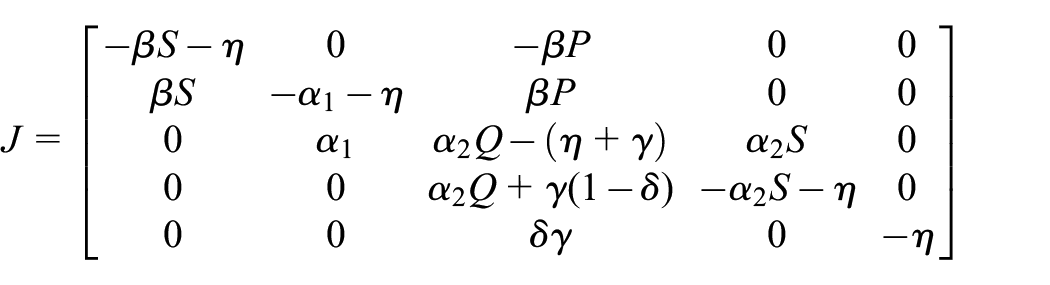
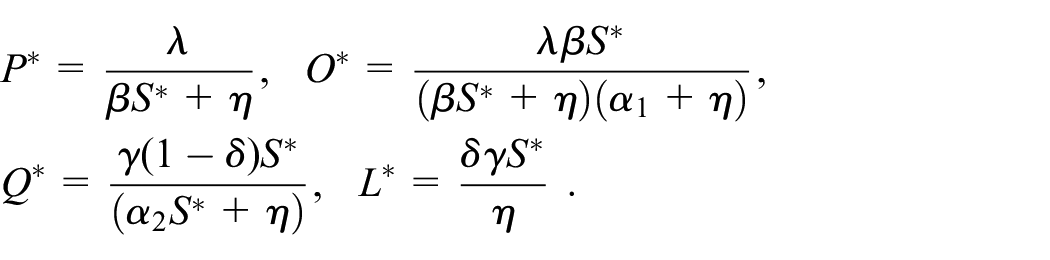
The equilibrium points are given as

Now by substituting the values of parameters represented in Table 1 into

Parameters values defined in equation (1).

The Eigen values corresponding to matrix
Since
In system (1) that at least one of the infected components is non-zero for find the endemic equilibria, we consider (see, for details, previous study 47 )
Fractional differential transform method
The FDTM is semi-numerical and analytical approach, and it is considered as a traditional DTM reform. The differential transformation,

The differential transform (DT) inverse of

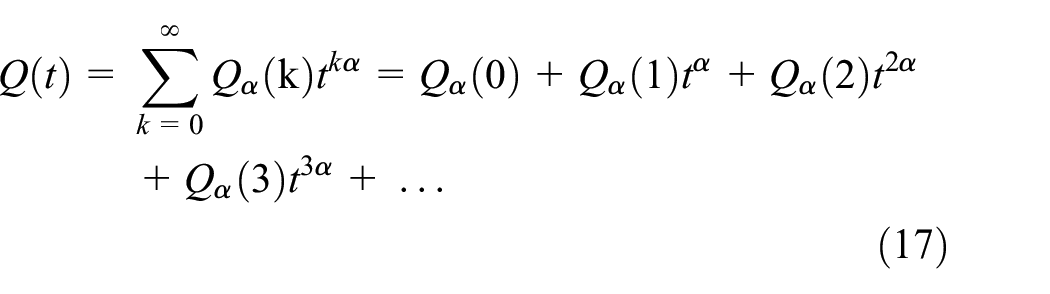
By substituting equation (7) into equation (8), the following is obtained:

Assume that

The above equation (equation (10)) represents the differential transformation resulting from the application of the Taylor series expansion, although the symbolic evaluation of the derivatives is not applicable to this technique. Moreover, comparative derivatives were obtained by applying the iterative procedure. The original function is represented by a lower case letter, while the transformed function is represented by an upper case letter. According to equations (9) and (10), it is obvious that the transformed functions have the basic mathematical values given in Table 2.
The operations for the fractional differential transform method.

In this part, we will show converges of the differential transform method to the exact solution by proof of some theorems. 47

The differential transform method converges to the exact solution.
Now By taking the differential transform of equation (a), we have

We have
By using equation (8), the solution obtained by DTM is as follows:


With initial conditions

The differential transform method converges to the exact solution.

From the initial conditions, we have

By substituting the differential transforms, we have

Substituting the above formulas in equation (b), we get
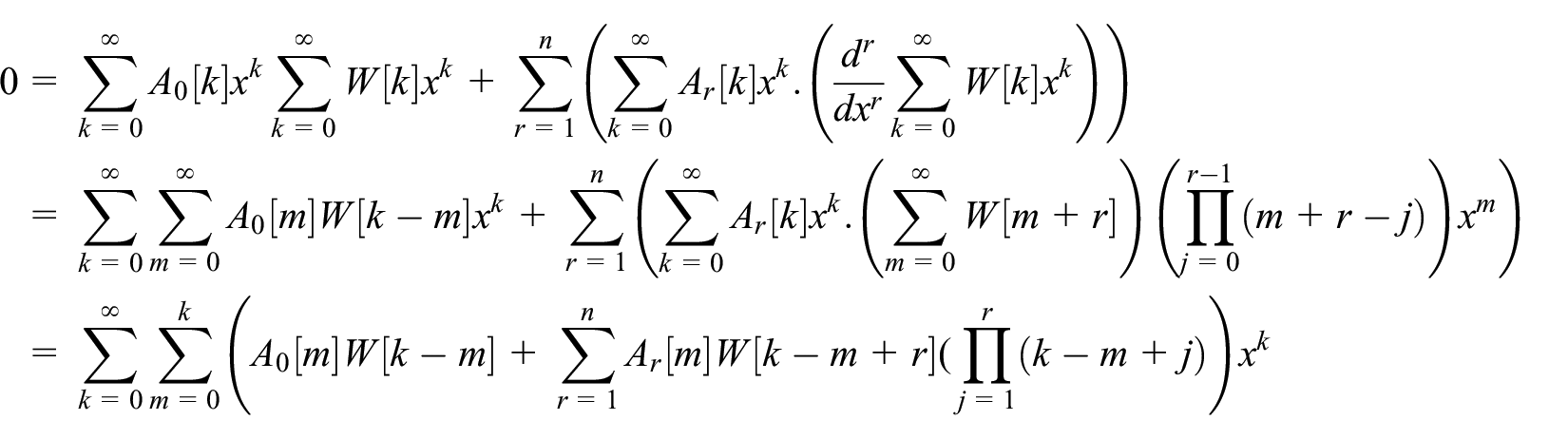
we comparing coefficients and get

Next, we will use the last-mentioned definitions for solving the model described in equation (1) through a numerical example to prove the efficiency of the proposed technique.
Numerical example
In this section, we will examine our method based on the FDTM for the system of fractional order smoking epidemic model represented in equation (1) for various values of the parameters.
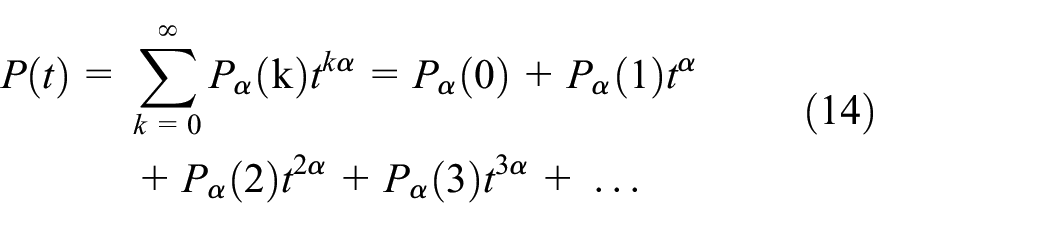
By applying FDTM to the proposed smoking mathematical model, and by using with both Table 1 and the equation (1), a system of equations is obtained as follows:

From the initial condition given by equation (2), we obtain:

Now, by substituting the values of parameters represented in Table 1 into equation (11), we get

where



Numerical simulation of
Approximate solution of

Approximate solution of

Approximate solution of

Approximate solution of

Approximate solution of

Approximate solution of

Approximate solution of

Approximate solution of

Approximate solution of


The solution of

The solution of
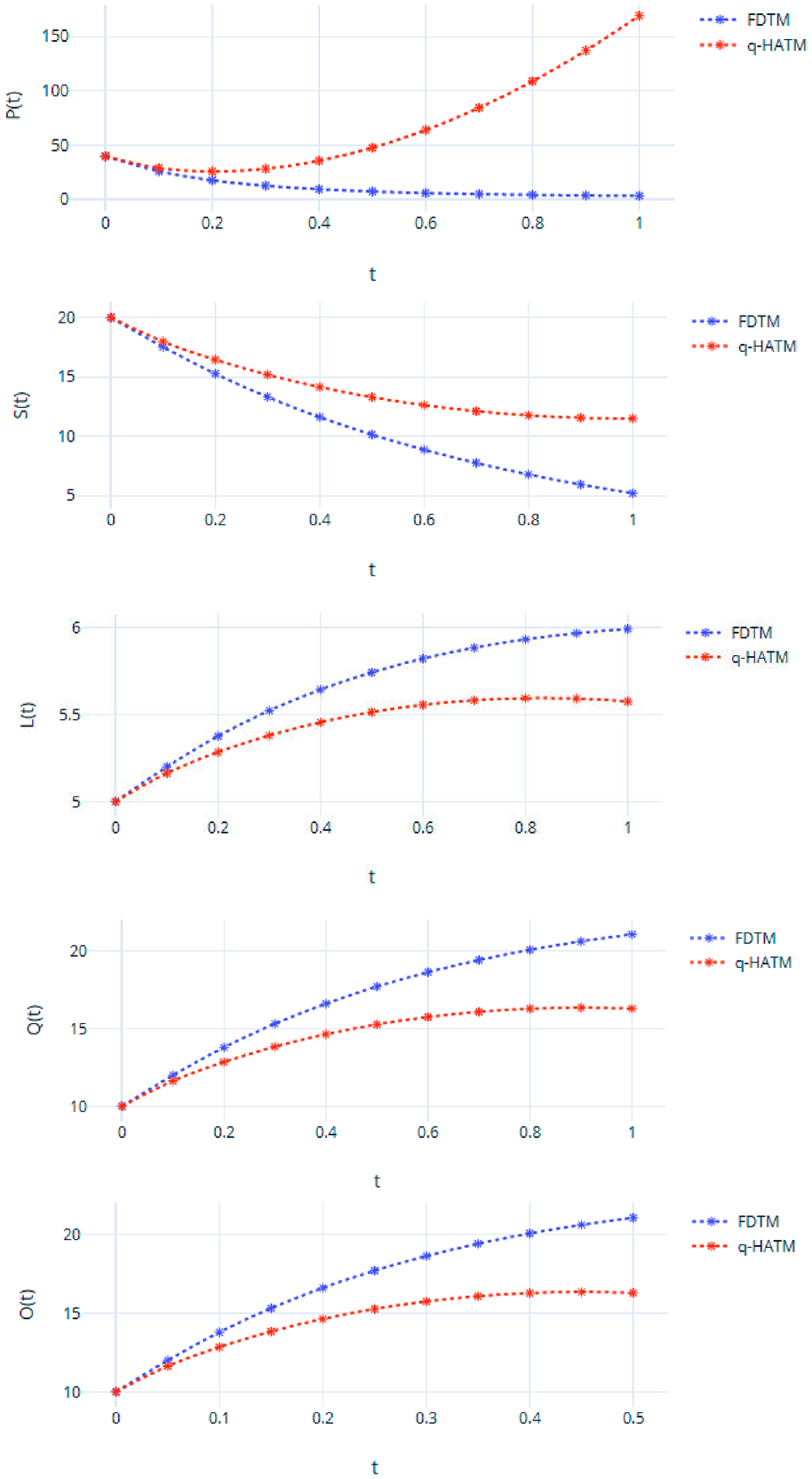
The solution of
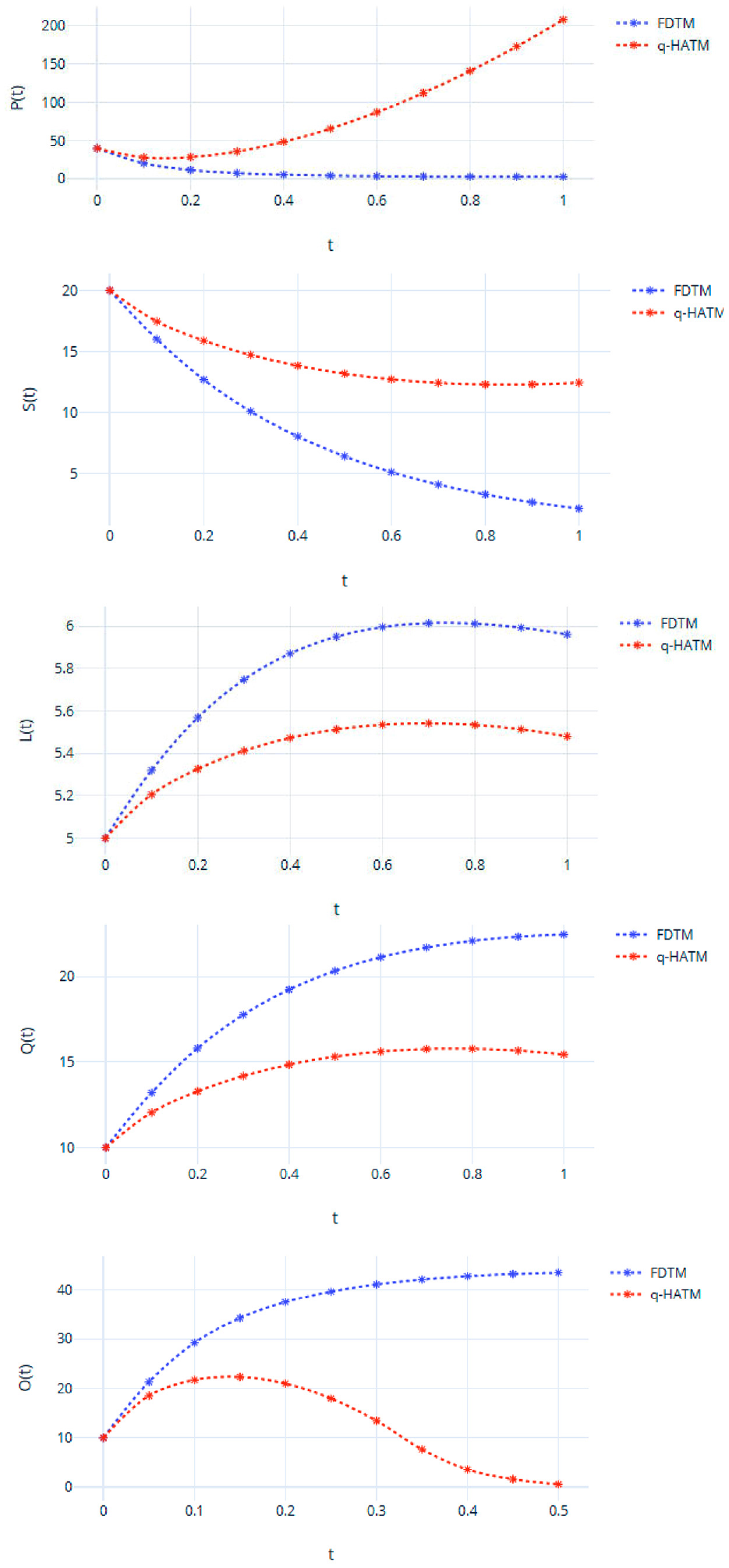
The solution of
It is noticed that the FDTM method is effective in generating approximate solutions for the proposed mathematical model. Numerical simulations of
Figure 1 shows the result of numerical solution of P(t), S(t), L(t), Q(t), O(t) that obtained by Runge-Kutta (4,5). In Figure 2, P(t) shows the number of potential smokers decreases with time. S(t) shows the number of smokers decreases with time, and O(t) shows the number of occasional smokers increases with time. L(t) shows the number of permanently quit smokers increases with time and Q(t) shows the group of temporarily quit smokers increases with time This shows the accuracy of the proposed model. In this figure, we compare the results of the ODE 45, FDTM, and q-homotopy analysis transformation method in the ALpha = 1 case. We can see that Clearly, we can see that the results of FDTM converge with the results of the Runge-Kutta (4,5) (ODE 45). The results data are ensured to be accurate and investigated for different values of the fractional-order α including α = 1 which is the basic model. In addition, the results are compared with some numerical verification tools such as the Matlab code (ODE45) which ensures that these results are accurate and can describe the true dynamics of these models. The behavior of each variable is presented through figures and the method is shown to be a straightforward, efficient, and simple approach and this may help to adapt to several other related models. Our used proposed method is reliable and efficient. Numerical experiments have been performed with the applied methods for different values of α, which have successfully provided good results for the studied problem.
Conclusion
In this research work, the proposed mathematical model of nonlinear fractional smoking associated with a modified version of Caputo’s fractional derivative was successfully solved using the fractional differential transform method. All obtained results were analyzed and compared for different cases. By using ode45 which is based on an explicit Runge-Kutta (4,5) formula, we got the numerical solution of the model, and by using the Fractional differential transform method we got approximate analytical solutions. We compare both results of FDTM and the modified homotopy analysis transformation method (q-HATM) in the ALpha = 1 case. Clearly, the results of FDTM converge to the exact solution as shown in Tables 3 to 6. The results obtained by the FDTM method agree well with the given exact solutions for α = 1. This ensures that our technique is accurate in the results for
Footnotes
Handling Editor: Chenhui Liang
Declaration of conflicting interests
The author(s) declared no potential conflicts of interest with respect to the research, authorship, and/or publication of this article.
Funding
The author(s) received no financial support for the research, authorship, and/or publication of this article.
