




Abstract
Aircraft engine EGT (exhaust gas temperature) is uncertain. In order to reduce the EGT influence to the health of the engine, it is important to carry out the prediction. A novel EGT prediction method based on the combination method is proposed. Firstly, MIV (Mean Impact Value) was used to reduce the dimension of the input numbers. Second, the EGT was predicted by some single models such as BP (back propagation) neural network model, SVR (support vector regression) model, PLS (partial least square) model, GM(1,N) (multi-parameter input gray prediction model), MLR (multiple linear regression) model. Then absolute mean error was used to evaluate the predictive results of single models and the best predictive results of four single methods were selected to establish combination model with PSO (particle swarm optimization). Finally, the combination model was used in predicting the EGT of V2500 aero-engine. Experiment results show that the combination method is more reliable and suitable than the single models for aero-engine EGT prediction.
Introduction
The gas turbine engine is a key propulsion system in heavy transportation equipment and has been widely used in large trucks, aircraft and large warships. The wide range of gas turbine engine, small room but Great power, and high energy conversion efficiency are the most significant advantages of gas turbine engine, gas turbine engine generally run in bad working environment, which makes them suffer from a variety of faults and damages causing many unsatisfactory results such as stop working, economic losses and even human death. 1 Therefore, monitoring the performance parameters of gas turbine engine is important to run a safe and efficient of the heavy transportation equipment.
Aircraft engine EGT, as one of the main performance parameters and monitored by aero-engine health condition monitoring,2–4 whose trend of change can be an objective response to the performance deterioration and the service life of aero-engine during the flight of the aircraft, 5 Therefore, predicting the trend of the EGT can be help to make the maintenance plan, 6 predict the remaining life of the aero-engine7–9 and reduce the maintenance costs and the aircraft engine’ faults.10,11
The field of aero-engine EGT prediction has been studied over 10 years, and plenty of related studies have been reported. PLS regression method was proposed by Shi et al. 12 to build short time prediction methods of aero-engine performance parameter under the condition of small samples. In order to improve the prediction accuracy of aeroengine performance parameters, Li et al. 13 decomposed the original sequence by using wavelet transform and predicted the sub-sequences of different frequency bands by ARMA (auto regressive moving average) or ARIMA (auto regressive integrated moving average). Zhong and Da 14 adopted the process neural networks to predict aero-engine performance parameters. Cui et al. 15 used autoregressive discrete convolution sum process neural network to predict aero-engine performance parameters. Zhong et al. 16 adopted fractional aggregation process neural network to predict aero-engine performance parameters. Zhang and Wang 17 build monitoring models of main aero-engine performance parameters based on SVM regression to monitor an aero-engine health and condition. Fu and Zhong 18 proposed PSVM (process support vector machine) to predict the change tendency of aero-engine performance parameters. Ilbas and Turkmen 19 dealt with the estimation of EGT of a CFM56-7B turbofan engine using ANN (artificial neural network) at two different power settings, maximum continuous and take of. In order to improving the flight safety of aircraft, Huang et al., 20 focused on the prediction method of health management and proposed a prediction method of nonlinear time series analysis using C-C method and BP-adaboost algorithm. Cay et al. 21 adopted artificial neural network (ANN) modeling to predict the brake specific fuel consumption, effective power and average effective pressure and exhaust gas temperature of the methanol engine. Yukitomo and Syrmos 22 proposed a hybrid algorithm called SVM experts and GA (genetic algorithm) to forecast a statistic of EGT, these statistic of parameters and their future values would help maintainers to more effectively plan their maintenance schedules. Zhao et al. 23 proposed a GM(1,1) markov chain-based approach to forecast exhaust gas temperature, and the historical monitoring data of exhaust gas temperature from CFM56 aero-engine of China southern is used to verify the forecast performance of the GM(1,1) by taking the advantage of GM(1,1) markov chain model.
From the literature described above, the PLS regression methods, the ANN methods, the SVM regression methods, the MLR methods and the GM (1,N) methods are the five main methods to predict the EGT. PLS as a multivariable regression method for multi variable and in solving the small sample problem between variables regression multicollinearity is widely used in prediction and control. In the aspect of using the regression equation obtained, which is mainly based on the regression equation to determine in a variable. The goodness of fit is not high and the number is small, so PLS regression is not applicable. ANN has been widely used in aero-engine fault diagnosis and EGT prediction since the simple three layer neural network was proved to be able to approach any precision, however, the traditional neural networks are all established around the ERM (empirical risk minimization) principle, which limits their prediction accuracy. SVM is a machine learning methods that follow SRM (structural risk minimization) principle based on VC (vapnik-chervonenkis) dimension theory, which ensures the SVM has a good generalization capability, but because the kernel functions and other factor are difficult to determine, which can also influence their generalization capability. The strict linear characteristics of MLR is not suited to the complex non-linear system of aircraft engine, therefore, the accuracy of prediction results is not good. GM(1,N) prediction method, proposed by Deng, 24 has been widely and successfully applied in various fields, however, GM(1,N) needs to determine the main factor in the prediction process and the factor variables should be predicted before the ending result predict which can influence the prediction results of GM(1,N).
The combination prediction method, proposed by Bates and Granger, 25 has been successfully used in aero-engine fault diagnosis 26 and the remaining life prediction of aero-engine. 27 The combined prediction method can take into account the prediction effect of different forecasting methods and consider the problem more systematic, more comprehensive and theoretically more scientific compared with each single prediction model. The combination prediction method, considering the single prediction method’s prediction results, can assign a reasonable weight and combine with other single prediction methods to improve the prediction accuracy.
Aiming to solve the problems of the conventional prediction methods, this paper proposes the combination prediction method based on ADQPSO (adaptive disturbance quantum-behaved particle swarm optimization) and applies it to predict the aero-engine EGT from V2500 aero-engine of Airbus 319 craft. Different from conventional combinational prediction methods, the proposed method is able to select the important impact factors from lots of factors and effectively solve the problems that the information is incomplete, the training sample is not sufficient and the data contains noise in the EGT prediction process.
The rest of this paper is organized as follows. In section 2, the problems are proposed in the prediction process of aero-engine EGT and the MIV calculation principle is introduced. Section 3 briefly describes the combination method based on ADQPSO. In section 4, the aero-engine exhaust gas temperature prediction method and the experiments results are drawn in details. Finally, the conclusions are presented in Section 5.
The problems of the aero-engine EGT prediction
In recent years, the prediction of aero-engine EGT is an important problem for aero-engine health management. Therefore, we will introduce the main problems in the prediction process of aero-engine exhaust gas temperature and how to build an EGT prediction model based on the engine structure in this section, the schematic diagram of V2500 engine is shown as Figure 1.

Schematic diagram of V2500 engine.
Establishment the prediction model of aero-engine EGT based on multi-factor
The EGT is gas temperature of the low pressure turbine output, the gas is divided into two major parts that include the air from the outside atmosphere and the gas from fuel burning in combustor, Therefore, factors affecting the temperature of the gas is also divided into two categories that include the external environmental factors of the engine such as atmospheric pressure, atmospheric temperature, the speed of aircraft flight, and so on and internal factors of the engine such as high pressure rotor speed, Low pressure rotor speed, fuel flow, and so on. Therefore, the EGT prediction model is established and can be expressed as

Where f(*) represents an uncertain function, x1,x2,…,xn are the above factors. However, there will be two main problems that require us to solve, firstly, there are many factors that affect the aero-engine exhaust gas temperature and each factor have the different influence for aero-engine EGT, Which parameters should be selected? What is the basis for selection? Secondly, there are many methods to solve the EGT prediction model, what kind of mathematical method do we choose to solve the model? Where we will give the method (MIV) to solve the first problem in this section, the second will be solved in next section.
Mean impact value (MIV)
MIV is the indicator that evaluate the importance of each independent variable on the dependent variable, it is also used as a indicator that evaluate impact of the prediction method input on the output, which positive and negative represent its direction, the size of absolute value is the size of influence level from independent variable on the dependent variable, the specific calculation process can be expressed as follow:
Step 1 when the individual prediction model training is stopped, considering the prediction model of the input test samples is x = [x1, x2,…, xn]T, The simulation result is y = [y1, y2,…, ym]T.
Step 2 selecting a parameter in x is incremented by 10% or Reduced by 10% (This paper is unified by an increase of 10%), then applying the trained prediction model to simulate and the simulation results is Y = [Y1, Y2,…, Ym]. Therefore, the MIV can be expressed as

According to the above steps, the MIV value corresponding to each input factor will be calculated, and the input factor are sorted according to the MIV value from largest to smallest. In this paper, if the MIV value of the input factor is greater than or equal to 1, it will be used as the input factor of model. Otherwise, it will be discarded.
The combination prediction methods based on adaptive disturbance quantum-behaved particle swarm optimization
Recently some methods have been applied to aircraft engine EGT prediction, Among them, multiple linear regression (MLR), Artificial Neural Network (ANN), Multi-Variables Grey (GM(1,N)), Partial Least Square(PLS), and Support Vector Regression (SVR) are five mostly methods and the five common methods are used as candidate for combination. In this section, we mainly introduce the five methods of prediction principle.
The combination prediction methods
The theory of combination forecasting, proposed by Bates and Granger in the 1969s,
25
has attracted great interest from international scholars and made a series of research results. The key technique of combination forecasting is how to combine multiple models, which is usually expressed as an optimization problem. Considering a variable is predicted at time t (t = 1, 2, …, L), there are D models involved in the combination. Where fit is the prediction value of the i-th model at time t, yt is the actual value at time t, the predicted value of the combination forecast is

Where

The detailed procedure of the aircraft engine EGT prediction based on combined theory and method can be shown as in Figure 2.
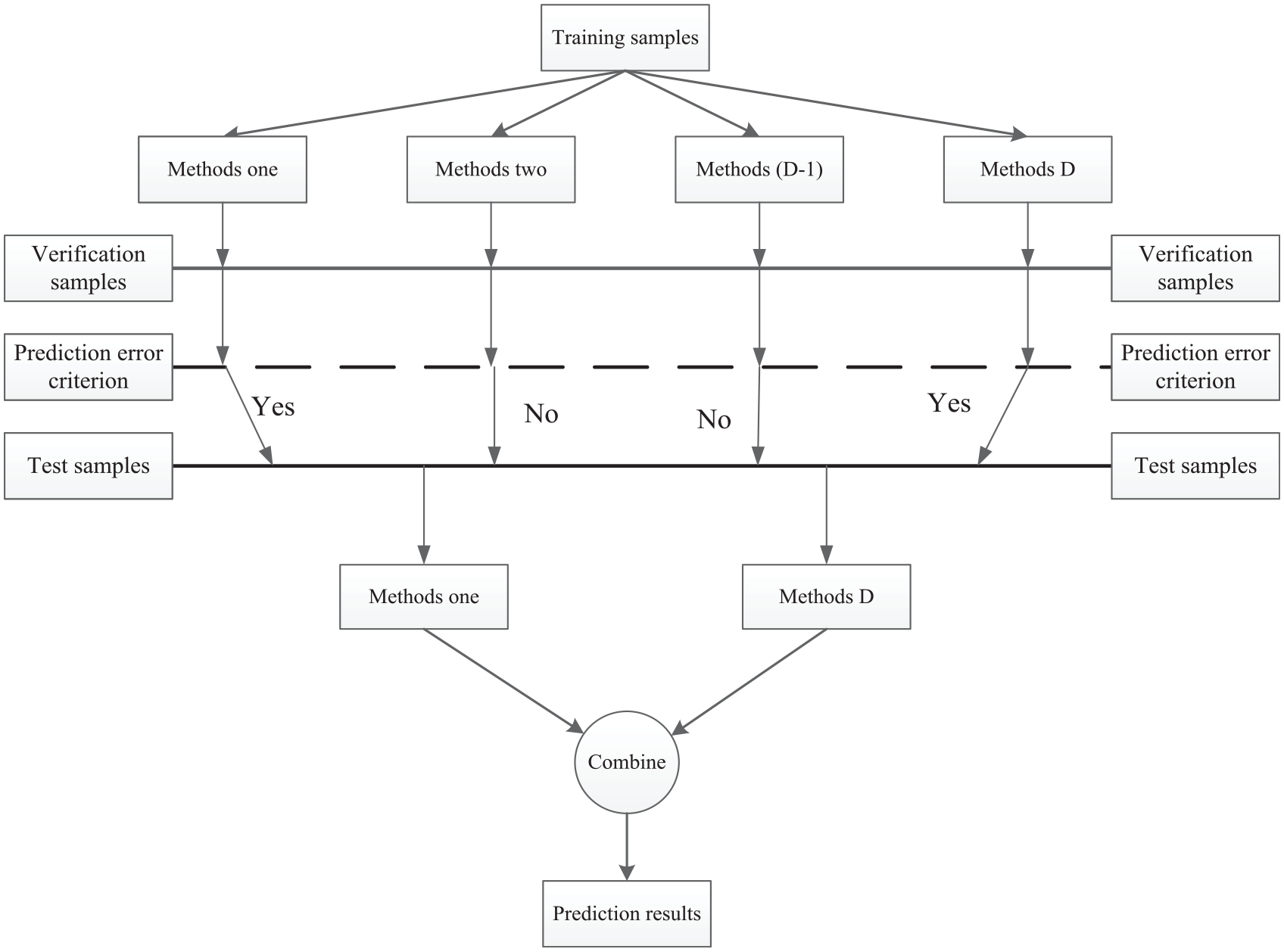
Flowchart of EGT prediction based on combination model.
The suitable combination method is the key step in this process. There are some methods such as mathematical programming method, genetic algorithm, Bayesian method, neural network method, particle swarm optimization and so on, where the particle swarm optimization has the coding simple, Convergence speed fast and versatile compared with other methods. At the same time, in order to overcome the shortcoming that the standard particle swarm optimization28,29 is easy lose local optimum and has convergence slow, therefore, a new methods named ADQPSO is proposed based on QPSO (Quantum-behaved Particle Swarm Optimization). 30
Review of quantum-behaved particle swarm optimization
Quantum-Behaved Particle Swarm Optimization was proposed by Han et al.
31
to solve the problem such as the imperfect global search ability and the slow convergence speed. In quantum mechanics, the velocity is meaningless and the position of the particle can be calculated from probability density function
In the N-dimensional search space, the population size of the particles is N, The position of the i-th particle in the j-th dimensional space can be expressed as follow after t-time update

Where φij(t) is the random number evenly distributed on [0,1], Pi is individual optimal, Pg is the global optimal. Then, The Monte Carlo method was used to calculate the position of the i-th particle in the j-th dimension space after the iteration k + 1 times. The position can be expressed as
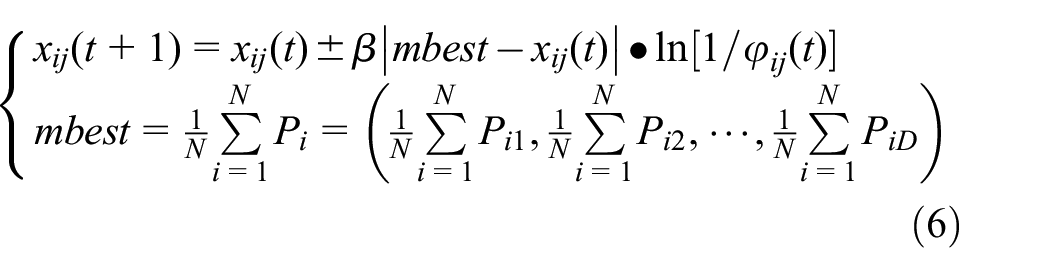
Where β is Compression expansion factor distributed on [0.4, 0.8], the update equation of particle global optimal position and individual optimal is as follows

Where f(*) is the fitness function.
The ADQPSO
As the same with conventional particle swarm algorithm, there is also a convergence problem in QPSO. The diversity of the particles will be reduced when the number of iterations reaches a certain value, so the local search ability will be worse. Therefore, the particle clustering judgment, dynamic parameters and dynamic compression – expansion coefficient operation are necessary for QPSO.
Adaptive operation
For the premature convergence of particles, the mean value of variance in the probability statistics is introduced, and the premature convergence of the particles is determined. Since the number of iterations reaches the later period, the fitness value tends to the global optimal value. Therefore, the variance of the particle fitness is calculated to determine whether the particles reach premature convergence

Where fi is the fitness value of the i-th particle, favg is the average fitness value of the particle, and N is the population size.
Evolution factor operation
With the increase of the number of iterations, the fitness value of the particle is getting closer and closer, the variance of the particle fitness value will be smaller and smaller. When the fitness value of the particle is less than a certain value, it is considered that the iteration enters the later premature convergence stage. In order to avoid this stage, the evolutionary factor is introduced into the average position of the particle. The expression is as follows:

Where ηt is the evolutionary factor of the optimal mean of the particles, Ct (0,1) is a random number produced by the Cauchy distribution at [0,1], Nt (0,1) is the random number produced by the Gaussian distribution at [0, 1], c1, c2 are the disturbance factor, the dynamic operation is as follows

Where: c1max, c1min are the maximum and minimum of c1, c2max, c2min are the maximum and minimum of c2, tmax is the maximum number of updates. After adding the evolution factor, the average optimal position of the particle is mbest’.

Disturbance operation of dynamic compression – expansion coefficient
The compression – expansion coefficient has a common effect on the inertia weight in the standard particle swarm. It plays an important role in the calculation of the particle. In this paper, the dynamic weighting is also used to adjust the compression – expansion coefficient. The operation is as follows:

Where, βmax and βmin are the maximum and minimum values of β. When the number of iterations is small, the size of β is close to that of βmax, which ensures the global retrieval capability of the algorithm. With the increase of the number of iterations, β decreases with non-linearity, which ensures the local search ability. Thus it adjusts dynamic balance of the local search and global search capabilities.
Combination prediction method based on ADQPSO
The main idea of the combination forecasting method is to allocate the optimal weight for each participating model by the ADQPSO, the mathematical expression of the process of combination is express as follows:
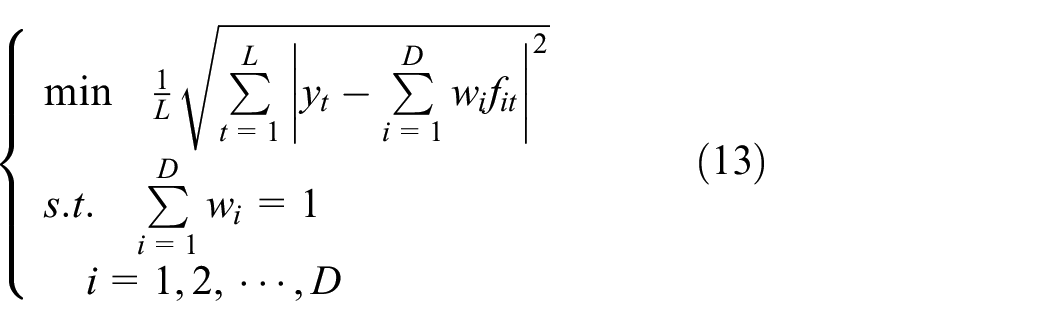
Where: D is the expected type of model; L is the number of expected samples; yt is the actual value; fit is the t-th expected value of the i-th model; wi is the weight of i-th model;

The flow chart of the combination forecasting process based on the ADQPSO.
Experimental study
In this section, In order to verify the validity of ADQPSO combination method in aero-engine EGT prediction, the SVR, BP neural network, MLR, GM(1,N), and PLS are introduced in this paper and will be applied to EGT prediction of V2500 aero-engine to compare with ADQPSO combination method from four aspects (the prediction ability, anti-noise ability, adaptive ability, and different training sample numbers). All of the methods except GM(1,N) were used in aero-engine EGT prediction by programming in MATLAB R2012a environment running on a PC with 3.2 GHz CPU with 4.0 GB RAM and GM(1,N) was used to predict in Gray system theory modeling software (GTMS3.0) provided by Nanjing University of Aeronautics and Astronautics. The absolute mean error (AME) and absolute mean percentage error (AMPE) are used to examine the prediction accuracy of prediction models in this paper and the AME and AMPE are calculated using the function as follow


Where yi is the prediction value, yt is the original value.
Sample data
For this study, a flight cycle data including 80 samples from V2500 aero-engine of the aircraft A320, a part of which have been shown in Table 1, where the first 60 samples data are used training samples and the remaining samples data are used as testing samples. In order to present the prediction performance of the combination prediction methods under part information and discrete small sample data, meanwhile, we randomly select 20, 30, 40, and 50 samples from the 60 training samples test samples remain unchanged.
Original samples.

Parameter selection
In order to select the appropriate dependent variable parameters for the model, The common BP neural network is used to calculate the value of MIV according to the MIV calculation principle based on The monitored parameters by Status monitoring that include Fuel flow (FF), Low pressure rotor speed (N1), High pressure rotor speed (N2), High pressure compressor outlet temperature (T2), Low pressure compressor outlet temperature (T15), Flight height of the aircraft (H), and High pressure compressor outlet pressure (P2), The MIV value for each parameter is shown in Figure 4. From Figure 4, it is clear that the MIV value of H and T25 are smaller than the other parameters, according to the MIV selecting principle, the engine EGT prediction model can be expressed as


The MIV value for each parameter.
Prediction results of five methods
In section 4.3, after the generation of samples and parameter selection, the five methods are used to prediction the results from the generated samples. Specific methods steps have been presented in section 3. We train the five methods using the five input parameters and the prediction results of EGT and original data of EGT are shown in Table 2, what’s more, the AME of the five methods is calculated and its AME is plotted in Figure 5. We can see that the prediction results of PLS and MLR, BP and SVR are closely approximate to the original values. Therefore, the PLS, MLR, BP, and SVR are the participants of the combination model.
The prediction results of five methods.

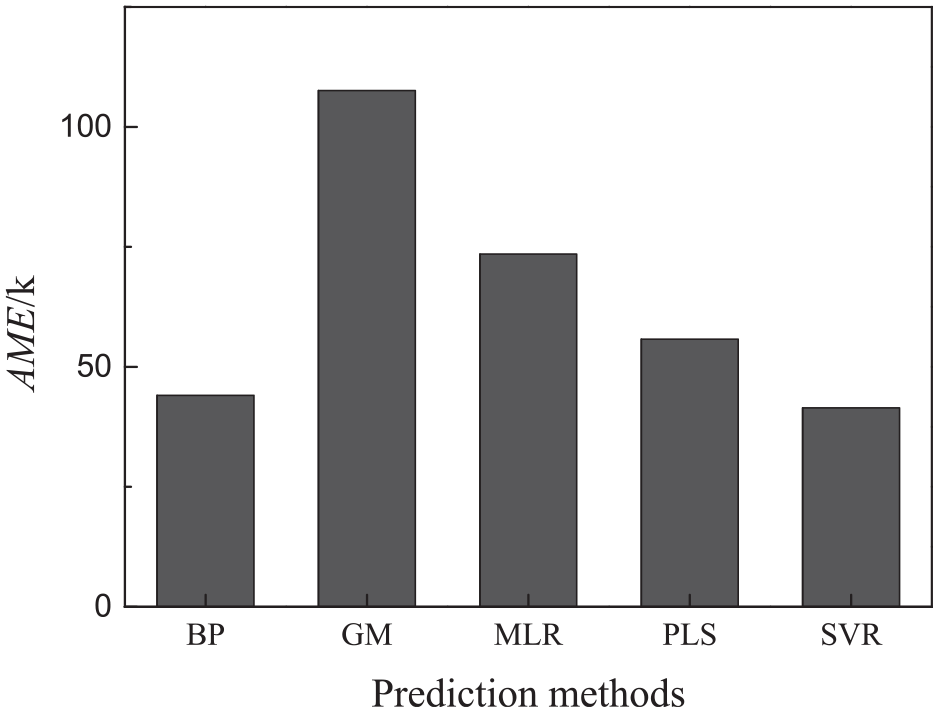
The AME of five methods.
Prediction results of combination model
The proposed EGT prediction methods based on ADQPSO to predict the EGT and compared with AQPSO, DQPSO, QPSO, PSO, and Genetic Algorithm (GA).
Parameters setting
The parameters of each method are set as show Table 3. All of the six optimization algorithms’ evolution times are run 200 times. There is no concept of speed in quantum particle swarm optimization, so the speed parameter of quantum particle swarm optimization defaults to 0 in the Table 3. Besides, the parameters of Genetic Algorithm (GA) have the same value in some special parameters such as population number (M) and iteration times and the others are set with the conventional values.
Parameters in the particle swarm optimization algorithm.

Comparisons of the six methods
Following the flowcharts shown in Figures 2 and 3 in section 3, the combination methods with five single prediction methods, six combination optimization algorithm and different training samples are tested in the experiment. The prediction results of the six methods were compared in 60 training samples and described in Figure 6. Table 4 and Figure 7 present the absolute mean percentage error (AMPE) of the six methods on different training samples.
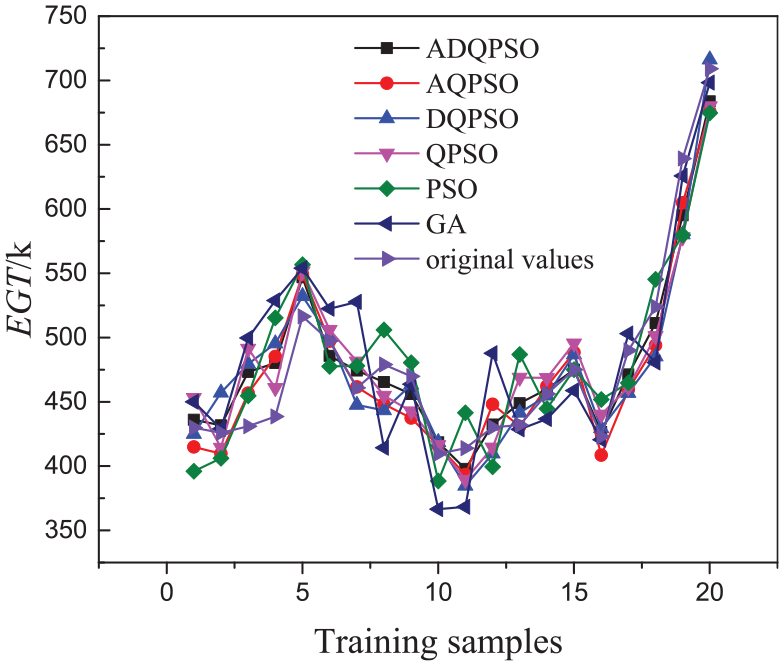
Prediction results of six methods in 60 training samples.
Absolute mean percentage error of four methods in different numbers of training samples.


AMPE on different training samples of six methods.
The experimental results show that the combination method can predict the EGT of the aero-engine effectively and the combination method has the smaller absolute mean percentage error than single methods in the experiment, it is able to be seen from Figure 7 and Table 4 that the ADQPSO combination method achieves the smallest AMPE 3.3934% among all the comparative methods. We think that the prediction results are significantly correlated with the adaptive and disturbance operation of the ADQPSO model of the combination method. The dual operation of adaptive and disturbance allows the quantum particle swarm to find weights for each single prediction model faster and more accurately. Besides, As the number of training samples decreased from 60 to 20, the AMPE increments of the combined methods are approximately 1.7%, which the AMPE of ADQPSO combination methods only increased by 1.3%. Therefore, ADQPSO combination forecasting method is more applicable when some engine data is difficult to obtain.
Comparisons with different Noise intensity
In the above section we train the single methods and combination methods without considering noise disturbance. However, in real applications, the error of data often cannot be ignored in the acquisition process. Besides, in order to verify the anti-noise ability of combination methods in aero-engine EGT prediction, the magnitude of adding noise disturbance is 1%–5% referencing to international sensor measurement error and the actual data transmission. The method of adding noise disturbance is as follows

Where a is the engine performance parameter data, M is the added noise disturbance percentage and σ is the sample standard deviation. Six combination prediction methods are used to predict the EGT of aero-engine after adding different noise disturbance amplitudes. The prediction AMPE of each combination method is shown in Figure 8(a), at the same time, the prediction AMPE of the single methods is show in Figure 8(b).

AMPE on different noise disturbance percentage of combination methods and single methods: (a) The prediction AMPE of each combination method and (b) The prediction AMPE of the single method.
From Figure 8, it is clear that the AMPE of combination prediction methods are less than single prediction methods in any noise disturbance percentage and all the prediction methods show a little rising trend as the noise disturbance percentage increases, especially, the AMPE are approximately of combination prediction methods are approximately 0.5%. However, the AMPE of single prediction methods are approximately 1%. Therefore, we can think the combination prediction methods have a better anti-noise ability.
Compared of training time
During the experiment, we also have a statistics for the training time of each method, which is listed in the Table 5. The experimental statistics show that the mean training time of the combination methods are much more than the single methods and the mean training time of ADQPSO combination method spends the most training time in all of prediction methods. Much of training time of the combination methods is mainly spent on iterative process of optimization algorithm. This shows that reducing the prediction error requires paying more training time. However, training time is also related to the performance of the computer. If the training process is running on a supercomputer, the training time of the combination prediction methods will be the same as the single methods.
Mean training time on training data.

Conclusions and future work
This paper presents a combination prediction method based on particle swarm optimization and some improved PSO to predict the EGT of aero-engine. The processes of predicting of single methods, selecting of single methods, construction of combination method and EGT prediction are all fused into the combination prediction method. Following above processes, the performance of the combination prediction method is evaluated throng the experiment of the aero-engine EGT test. As comparisons, absolute mean percentage error of different training samples, training time, noise disturbance, and other five combination methods are also tested in the experiment. The comparative results of the experiment verify the effectiveness of the combination prediction methods. Especially, the combination prediction method based on ADQPSO achieves the lowest AMPE and has the best anti-noise ability among all the comparative methods in the experiment.
Our future work will pay attention to find a better method to combine the single methods instead of simply assign weights to every single method. What’s more, the single methods of the election in this paper are not the improved methods with high prediction accuracy. Therefore, it is important for combination method to select the single model with high accuracy.
Footnotes
Handling Editor: Chenhui Liang
Declaration of conflicting interests
The author(s) declared no potential conflicts of interest with respect to the research, authorship, and/or publication of this article.
Funding
The author(s) disclosed receipt of the following financial support for the research, authorship, and/or publication of this article: This research was supported by the Open Fund of Key Laboratory of Flight Techniques and Flight Safety, CAAC (No. FZ2021KF09).

Data availability
The data supporting the findings in this paper is not available because these data are collected from airlines and are not publicly available.