



Abstract
The fatigue life of specimen consists of crack initiation and crack propagation life. As the fracture toughness of high strength steel is low, the specimen will fail soon once crack appears. Therefore, the crack initiation life of high strength steel is considered to be its whole life. Based on the evolution of material fatigue damage and the critical plane method commonly used in multiaxial fatigue strength theory, a crack initiation life prediction method for multiaxial specimens is proposed in this paper. Firstly, a uniaxial nonlinear fatigue damage evolution equation is proposed based on the principles of thermodynamics and continuous damage mechanics. Then, a theoretical calculation method for determining the critical plane under multiaxial load is proposed, and the specific calculation process is given. After the critical plane is determined, the multiaxial fatigue damage parameter is constructed from the normal strain amplitude and shear strain amplitude on the critical plane, and a multiaxial nonlinear fatigue damage evolution equation is proposed by replacing the uniaxial damage parameter using the multiaxial damage parameter. Finally, the crack initiation life of fatigue specimens is predicted by using the proposed multiaxial nonlinear fatigue damage evolution equation, and the multiaxial fatigue tests of Q690D steel under different bending-torsion ratios and different amplitudes are validated. The comparison results show that the prediction error of the proposed method is within the two-fold dispersion band and better than that of Manson-Coffin method.
Introduction
With the gradual development of mechanical components toward large-scale, lightweight and high bearing capacity, high-strength steel materials with yield strength of 460–1100 MPa have been widely used.1–3 The superiority of high strength steel has been paid more and more attention in engineering application. High strength steel can not only reduce machine weight, but also can save costs effectively. 4 Compared with ordinary steel, high strength steel has higher yield strength and tensile strength,5,6 and its weldability and toughness have been greatly improved. 7 These excellent material properties meet the requirements of high strength steel economy, high efficiency and low carbon environmental protection, in line with the development trend of steel in the future. On the premise that the static strength meets the requirement, the study of fatigue performance should be paid more attention to, especially the fatigue performance under multiaxial loading. 8
Most of the actual mechanical parts work under multiaxial cyclic loads and many scholars have studied the multiaxial fatigue problem for many years. 8 However, due to the complex geometry of mechanical parts and the diversity of loading modes, the fatigue damage mechanism of multiaxial loads is still not clear. 9 In addition, failure criteria and constitutive relations under multiaxial stress are different from those under uniaxial loading, especially under non-proportional multiaxial loading. 10 Researchers have constructed a variety of different multiaxial fatigue life prediction models using different theoretical methods, but there is no universally accepted method at present. The actual mechanical behavior of mechanical components is very complex5,11 and there are many influencing factors, among which the most important is the load history, especially multiaxial proportional or non-proportional loading. Therefore, multiaxial fatigue research is the key to solve practical engineering problems and the critical plane method is the main method to study multiaxial fatigue. The critical plane method is proposed based on the physical interpretation of fatigue crack initiation and propagation. 12 Brown and Miller 13 thought that the shear and normal strain on the critical plane have a great impact on the multiaxial fatigue life. So, both of them should be taken into account when damage parameter is defined. At the same time, they think that the first stage of fatigue crack nucleation produces mainly along the plane which has maximum shear strain, and the second stage extends along the direction which is perpendicular to the maximum tensile strain. So the model, proposed by Brown and Miller, 14 can well explain the formation and propagation of cracks in the microscopic mechanism. The process to determine the control parameter is generally divided into two steps: the first step is to determine the stress and strain history of the critical plane by the mean of theoretical method or finite element method; then the stress and strain history are transformed into cumulative fatigue damage of the critical plane.
With the increase of service time of components, fatigue damage will inevitably accumulate, resulting in the changes of density, stiffness, strength, and yield limit of components. 15 In order to describe the actual fatigue damage evolution process more accurately, a theoretical framework of continuum damage mechanics was proposed based on classical continuum mechanics. Kachanov 16 believed that in the process of bearing load, the component would experience a process of continuous damage, which is often manifested in the formation and expansion of microcracks accompanied by a large number of plastic deformation. Damage mechanics introduces the damage variable to describe the damage from the point of view of mathematics, and applies it to the structural analysis. With the concept of effective stress, the prediction model of fatigue life can be established and simulated well. When the damage theory is used to analyze the mechanical state of materials, appropriate damage variables should be selected to describe the damage state. The reduction of effective bearing area caused by defects is the main reason for material deterioration. 17 In addition, the macroscopic and microscopic properties of materials also have a great impact on their life. It has been shown that the microstructure and properties of materials affect the initiation and propagation direction of cracks. 18 Liu et al. 19 proposed a macroscale description method for grain orientation effects in α-phase additively manufactured titanium alloy within peridynamic framework, and peridynamic simulations of grain orientation effects on crack-tip fields were performed. Meanwhile, according to the statistical distribution of microcracks with respect to their size and spatial location, Qian and Lei 20 established a weakest-link probabilistic model for fatigue failure to incorporate the combined effect of load range, number of load cycles and specimen size. Of course, many other factors, such as average stress, stress concentration and temperature, also affect the fatigue life of specimens. 21
In this paper, a new multiaxial nonlinear fatigue damage accumulation model is proposed based on damage mechanics and critical plane method, which combines the advantages of the above two methods to predict the multiaxial fatigue life more effectively. The core of the model is to define the plane where the maximum shear strain is located as the critical plane. Then, the influence of normal strain on crack propagation is considered in terms of the physical mechanism by taking the critical plane as the basis for fatigue damage accumulation evaluation.
Damage variable
The damage variable is introduced into damage mechanics with mathematical description, and this method is used in structural analysis. Based on the continuum damage mechanics theory, irreversible thermodynamics theory, effective stress and strain equivalent hypothesis, the constitutive equation of damaged materials is proposed.
Selecting appropriate damage variables to describe the damage state is the premise of using damage theory to analyze the mechanical properties of materials. Kachanov 16 put forward the concept of continuous damage mechanics in the study of creep of metals and believed that material degradation is mainly due to the reduction of effective bearing area. Then the concept of continuity degree was proposed to describe the damage of materials. Its significance is that a representative hexahedron element is selected and the total cross-sectional area perpendicular to n is assumed to be A (Figure 1).

Damaged element.
However, the actual effective cross-section area, decreases with the existence of microcracks, that is, the load-carrying capacity decreases. Consequently, continuity degrees φ is defined as follows:

where A the actual area, A′ is the actual effective cross-section area.
As A′ ranges from 0 to A,

It can be seen that material damage can be described very clearly by the degree of damage. In the condition of no damage A′ = 1, D = 0.When the structure is failure (A′ = 0), D = 1.
Based on equations (1) and (2), the following formulation is obtained:

Effective stress

Equation (4) is a widely accepted classical formula for expressing damage variables. The basic principle of equivalent strain is that under the action of effective force, the strain of the damaged material is equal to that of the same material when it is not damaged. Based on the principle of equivalent strain and the constitutive relation of nondestructive materials, the constitutive equation of arbitrary damaged materials can be derived. In the case of one-dimensional elasticity, the constitutive relation is as follows:

Damage evolution model
The uniaxial fatigue damage model
According to the fatigue damage theory, the damage degree is usually expressed by the function of the number of cycles. The damage evolution equation can be established by the following methods based on the thermodynamic principle under uniaxial loading:

where
Loading parameters and damage variables are inseparable to reflect the influence of damage accumulation nonlinearity and loading sequence. Lemaitre et al. 23 thought that damage evolution is an irreversible thermodynamic process and described the fatigue damage evolution equation as follows:

where
It is easily obtained that when


where
In this paper, the fatigue damage under symmetric constant amplitude load is studied and equation (8) can be rewrote as follows:

Equation (10) shows that the stress amplitude is the main parameter for predicting fatigue life. Existing experiments show that the fatigue performance under proportional load is consistent with that under uniaxial load. 24 Therefore, the equivalent stress amplitude can be used to replace the stress amplitude when the specimen is subjected to multiaxial proportional load. Meanwhile, the strain hardening law is expressed as:

where K is strengthening coefficient and n is hardening index.
So equation (10) can be rewritten as follow:

where the parameters
Critical plane method and multiaxial fatigue damage model
The existing experimental results show that the local plastic deformation of dislocation slip is the main cause of fatigue crack formation and the direction of the maximum shear strain is close to that of these continuous slip bands. 10 So the fatigue cracks appear on the maximum shear strain plane under different loading conditions. In other words, the initial stage of fatigue is mainly controlled by the maximum shear strain.
Thin-walled tubular specimens are generally selected to analyze the state of stress and strain under multiaxial loading. It has been proved experimentally that the material plane, which has most severe fatigue damage, is vertical to the free surface. 13 So, the stress and strain state under tension-torsion multiaxial fatigue loading can be expressed as follow:

In this paper, the sinusoidal waveform is applied in the multiaxial fatigue tests:


The shear strain and normal strain of the selected plane (Figure 2), which sits at a



Selected plane.
where
So, equations (16) and (17) can be represented as follow:


Due to the phase difference of the structure under multiaxial proportional load, the following equations can be obtained by combining equations (14), (15) and (18), (19):
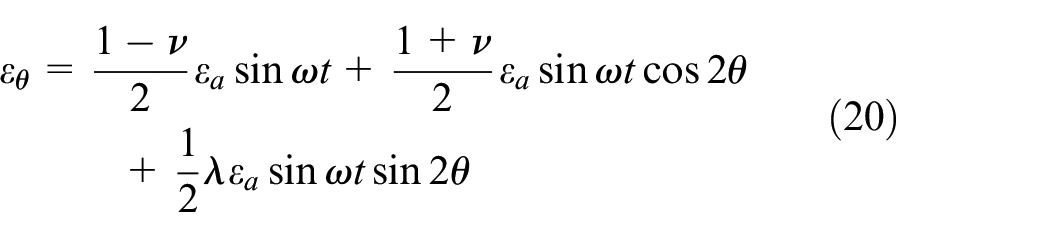

The material plane with the maximum shear strain is defined as the critical plane, so the following equation can be obtained:

So, the value of

When


According to von Mises rule, the equivalent strain on the critical plane can be represented as follow:

Then, equations (12) and (26) are combined to obtain the number of cycles during fatigue failure under given conditions:

where
Experimental program and discussion
The materials investigated are Q690D steel, which are widely used in aviation industry. The chemical composition and property of the material are listed in Table 1.
Chemical composition and properties of Q690D steel.

An Instron Servo hydraulic frame was used for the fatigue tests. The multiaxis loading is programed using self-designed special fixture (Figure 3). The bottom surface of the special fixture is fixed with the test machine workbench by bolts. The stand column (A) is connected to the actuator of the test machine to provide alternating load. The position of the apecimen in the fixture can be changed to provide different bending-torsion moment ratio
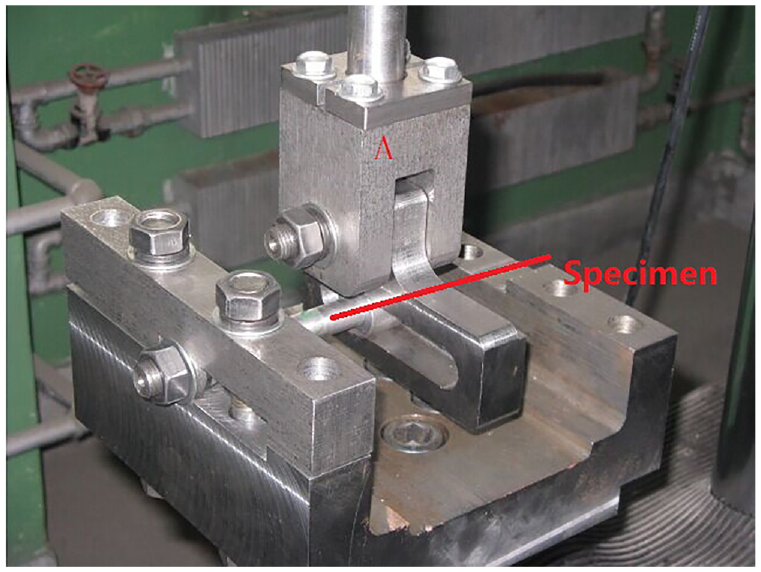
Special fixture.

Fatigue specimen.

Stress-strain curve of Q690D steel.
The experimental data of uniaxial conditions are listed in Table 2.
Fatigue life of uniaxial experiment.

According to the test results, the parameters of Eq. (27) can be fitted as follows:
Also

Then, the shear strain and normal strain on the critical plane can be obtained by substituting the value of
At present, the equation of Manson-Coffin has been widely applied to the prediction of the lifetime for constant amplitude fatigue tests concerning various materials, such as structural materials, welding joint, new materials, etc.
The relationship between total strain amplitude and the low cycle fatigue life can be expressed as follow:

The Manson-Coffin law has been tested in a wide range of situations of uniaxial and even multiaxial fatigue, thus already having information on the parameters of the materials and do not require further tests to obtain new experimental parameters. When Manson-Coffin law is used to estimate multiaxial fatigue life, the equivalent strain can be used to replace the uniaxial parameters.

Comparing the experimental results with the predicted results of the multiaxial nonlinear fatigue cumulative damage model and Manson-Coffin law when

Comparison between predicted and experimental results.
From Figure 6, both the proposed method in this paper and Manson-Coffin law have good prediction effects, but Manson-Coffin law has large dispersion of data, and part of the data is outside the two-fold dispersion band. Therefore, the method proposed in this paper is superior to Manson-Coffin law under proportional bending-torsional loading. The parameters of the proposed model, such as the material constants and uniaxial fatigue data, can be easily obtained through theoretical analysis and the existing experimental data. On the basis of these parameters, the crack initiation life can be well predicted. Thus, the proposed model can avoid conducting the multiaxial test which is time-consuming, money-consuming and troublesome. Meanwhile it is easy to apply in engineering.
Conclusion
In this paper, a multiaxial fatigue life prediction method based on damage mechanics and critical plane method is proposed. The essence of this method is to replace the uniaxial damage parameters with equivalent strain composed of maximum shear strain amplitude and normal strain amplitude of critical plane. According to the results of this study, the following conclusions can be drawn:
Based on the law of thermodynamics and continuum damage mechanics, a new nonlinear fatigue damage evolution equation is advanced to predict the fatigue life. The model can predict the fatigue life from the viewpoint of nonlinear accumulation of fatigue damage and can reflect the actual evolution process of material fatigue damage.
The equivalent strain composed of maximum shear strain and normal strain on the critical plane can be used as fatigue damage parameter to reflect the physical mechanism of crack initiation and propagation under multiaxial loading.
The multiaxial fatigue test data of Q690D material are used to verify the correctness and reliability of the proposed model and the results show that the estimated error is in the two-fold error dispersion zone, which can be used in practical engineering applications.
Footnotes
Handling Editor: Chenhui Liang
Author contributions
Ganggang GAO: Conceptualization, Methodology, Funding acquisition, Project administration, Writing-original draft. Jianhui LIU: Conceptualization, Visualization. Xuebin LU: Fatigue model, Crack initiation mechanism. Rong ZHANG: Experimental design.
Declaration of conflicting interests
The author(s) declared no potential conflicts of interest with respect to the research, authorship, and/or publication of this article.
Funding
The author(s) disclosed receipt of the following financial support for the research, authorship, and/or publication of this article: This research is funded by [Natural Science Foundation of Gansu province] grant number [17JR5RA1220], [National Natural Science Foundation of China] grant number [51605212] and Lanzhou Talents Innovation and entrepreneurship Project [2021-RC-23].
