




Abstract
The established linear fatigue life prediction model based on the Miner rule has been widely applied to fatigue life prediction under constant amplitude uniaxial and multiaxial loading. Considering the physical significance of crack formation and propagation, a multiaxial equivalent linear fatigue life prediction model is put forward based on Miner rule and critical plane method under constant amplitude loading. The essence of this approach is that the equivalent strain, which consists of the shear strain and normal strain on the critical plane, replaces the relevant parameter of uniaxial nonlinear fatigue damage model. The principal axes of stress/strain rotate under non-proportional loading. Meanwhile, the microstructure of material and slip systems change, which lead to additional hardening effect. The ratio of cyclic yield stress to static yield stress is used to represent the cyclic hardening capacity of material, and the influence of phase difference and loading condition on the non-proportional hardening effect is considered. The multiaxial fatigue life is predicted using equivalent stain approach, maximum shear stain amplitude model, CXH model, and equivalent multiaxial liner model under proportional and/or non-proportional loading. The smooth and notched fatigue specimens of four kinds of materials (Q235B steel, titanium alloy TC4, Haynes 188, and Mod.9Cr-1Mo steel) are used in the multiaxial fatigue experiments to verify the proposed model. The predicted results of these materials are compared with the test results, and the results show that these four models can achieve good effect under proportional loading, but the proposed model performs better than the other three models under non-proportional loading. Meanwhile, it also verifies that the proposed enhancement factor can reflect the influence of phase difference and material properties on additional hardening.
Keywords
Introduction
Most of the components in engineering work under alternating loading, and the loading form may be uniaxial or multiaxial. The primary failure model is fatigue fracture that is always resulted by the crack initiation and propagation.1–3 For some axle parts in actual service components, such as aircraft landing gear pillar, wind turbine spindle, automobile half-axle, and transmission shaft and crankshaft in some components, most of them work under bending–torsion coupling alternating load conditions. The fatigue damage accumulates gradually, component performance decreases gradually, and fatigue failure occurs after long-term operation, resulting in loss of personnel and property. Due to the existence of two independent stress/strain components that vary periodically with time under multiaxial loading, it is difficult to determine the damage accurately.4,5 Thus, it is of great significance to study the fatigue damage accumulation law of components under multiaxial loading. At present, some achievements have been made in the study of the cumulative damage theory of multiaxial fatigue, but the geometric structure and loading conditions of actual components are complicated and uncertain. So, the fatigue damage accumulation theories still need further theoretical and experimental studies.
Miner rule has been proved by a lot of experiments and engineering practice under constant amplitude loading. 6 Though it has some drawbacks, it is still widely used in engineering practice. 7 Miner rule or relative Miner rule is used to calculate the fatigue damage of components under constant amplitude loading, which has certain engineering application value. 8 Critical plane method considers that fatigue failure occurs in a particular plane, and fatigue life prediction and damage analysis are studied on that particular plane. 9 Because critical plane method is based on fracture model and crack initiation mechanism, it has certain physical significance. Meanwhile, Brown and Miller 10 believed that cyclic shear strain on the maximum shear plane contributes to crack nucleation, while normal strain contributes to crack propagation.
At present, most multiaxial fatigue life prediction models can accurately predict the fatigue life under proportional loading conditions.2,10–12 But the principal axes of strain rotate continuously under non-proportional loading, and the microstructure and slip system of material change, which leads to additional hardening effect.13,14 It has an important influence on the fatigue life of components. At the same time, the additional hardening effect of different materials is different, which is closely related to the stacking fault energy of materials. The non-proportional additional hardening effect is not only related to the microstructure and slip of materials, but also to the loading history and path. Usually, the additional hardening effect is the most significant when the phase difference is 90°. Non-proportional additional hardening effect complicates the cyclic constitutive relationship of materials and makes it difficult to estimate fatigue life or check strength under multiaxial non-proportional loading.15,16
Cumulative fatigue damage analysis and life prediction of engineering structures/components is vital for ensuring the structural integrity and operational reliability. 17 At present, on account of the mechanism of fatigue damage is very complex, the theory of fatigue cumulative damage is not perfect, which needs more study. Miner rule has good verifiability, adaptability, and feasibility. So, it is still widely used in engineering. Miner rule has made some progress in multiaxial fatigue damage and residual life prediction under constant amplitude loading. 18 In this method, the stress and strain under multiaxial loading are simply equivalent, and then the equivalent parameters are used to replace the relevant parameters under uniaxial loading. The main shortcoming of the method is that the specific location and direction of crack initiation and propagation are not considered. A multiaxial equivalent linear fatigue damage accumulation model by combining Miner rule with the critical plane method is proposed under constant amplitude loading in this article. The proposed model makes use of the engineering simplicity of Miner rule and thinks over the physical significance of the critical plane. It explains the physical mechanism of crack initiation and propagation, rather than simple equivalent. In addition, the influences of phase differences and material properties on the additional hardening effect are considered. The non-proportional additional hardening factor related to material constants and phase differences is defined, which can improve the applicability of the model to different loading modes and materials. It also thinks that different materials have different influence on additional hardening effect. The proposed model is applied to the symmetric and asymmetric loading. The multiaxial fatigue tests of smooth and notched specimens of four kinds of materials are analyzed. The results show that the model is feasible for multiaxial fatigue life prediction, especially under non-proportional loading. By the help of the uniaxial fatigue data of material, the remaining life of the component can be estimated, and the costly multiaxial fatigue test can be avoided.
The critical plane method
Under uniaxial loading, the dangerous position has the maximum principal stress/strain which is selected as fatigue parameters for evaluating fatigue strength generally. Meanwhile, the method is applied to solve the problem of the multiaxial fatigue, but the results are not good. On the basis of studying the mechanism of crack initiation and propagation, Brown and Miller 10 proposed the critical plane method, which assumed that the crack was initiated and propagated on a specific plane. It has certain physical significance and is widely used in the study of multiaxial fatigue. 19 The stress/strain parameters on the critical plane promoted the crack initiation and propagation, which explained the process of fatigue damage accumulation from the physical mechanism. The critical plane method is used to predict the fatigue life on the premise of how to determine the location of the critical plane. So, the position of critical plane should be determined before the fatigue life is predicted. Based on existing research,20–22 the maximum shear strain plane is used as the critical plane. Meanwhile, the maximum shear strain and the normal strain on the maximum shear plane are used as the two basic parameters when the damage parameter is structured. The processes how to determine the position of the critical plane have been described in detail.12,22 So, the process is not repeated in this article. The procedure of determining the position of critical plane is shown in Figures 1 and 2.

The procedure of smooth specimens.

The procedure of notched specimens.
Multiaxial equivalent linear fatigue life prediction model
The multiaxial fatigue damage parameter
Shear strain and normal strain on the maximum damage plane are two important elements for crack formation and expansion which are the most basic parameters for constructing multiaxial damage parameters. Based on the von Mises criterion, the equivalent strain on the critical plane is expressed as follows

where
In Shang et al., 23 it is considered that the applied axial strain and shear strain cannot be directly combined into an equivalent strain by von Mises criterion under non-proportional loading. The concept of the normal strain path is introduced and defined as strain between the adjacent maximum shear strain reentry points on the critical plane

So, the new multiaxial fatigue damage parameter is given as follows

Considering additional enhanced multiaxial damage parameters
Under cyclic loading, the material will undergo cyclic hardening/softening. Its hardening effect is closely related to loading conditions and material properties. For the static characteristics of materials, yield stress is usually used to characterize the resistance to deformation. This article uses the analogy method to introduce the concept of cyclic yield stress

where K′ is cyclic strain enhancement factor; n′ is cyclic strain enhancement index; and
At the same time, the static and cyclic yield strength of material will affect the stress–strain response level of material, and then affect the cyclic deformation and hardening ability of material. This article uses the ratio ρ of the cyclic yield stress to the static yield stress to reflect the cyclic deformation and hardening ability

The larger the value of ρ, the greater the ability of material to strengthen the cycle, or the opposite.
Thus, the phase difference and material cycle fatigue characteristics all affect the non-proportional additional hardening effect, which should be considered when defining the enhancement factor. It is known that additional hardening is a unique phenomenon of multiaxial fatigue and the fatigue life model cannot accurately predict the fatigue life when only strain is selected as the damage parameter. Therefore, the normal stress amplitude on the critical surface is also used as the fatigue damage parameter to reflect the effect of additional hardening on the fatigue life of multiaxial fatigue. Meanwhile, when the load amplitude is the same, the fatigue life generally decreases with the increase in phase difference φ, which shows that the phase difference φ can reflect the degree of additional hardening. The effect of phase difference φ on multiaxial fatigue life should be considered when the damage parameter is structured. In conclusion, the additional enhancement factor is defined as follows

where
It can be seen from equation (6): when the phase difference

Experimental verification
In order to verify the correctness and accuracy of the multiaxial equivalent linear fatigue life prediction model, the experimental results of four materials in the literature were compared and analyzed. The materials used in the experiment were Q235B steel, titanium alloy TC4, Haynes 188, and Mod.9Cr-1Mo steel. Material performance parameters are shown in Table 1.
Material property parameters.

Meanwhile, the equivalent strain method, the maximum shear strain amplitude model, and CXH model, which are widely used in multiaxial fatigue life prediction, are used to predict the life of smooth and notched specimens. The predicted results of multiaxial fatigue life are compared with the experimental results, and the range of 2 times error factor is given.
The equivalent strain method is expressed as follows

where
The maximum shear strain amplitude model is expressed as follows

where
Chen et al. 24 suggested that the damage parameters should consider two typical failure modes. Accordingly, they proposed a critical plane-energy model for tensile-type failure, in which the damage parameter consists in the summation of normal and shear strain energy calculated either on the critical maximum tensile strain plane or on the critical maximum shear strain plane according to, respectively, the tensile or shear type of multiaxial fatigue failure. So, the life prediction model for the tensile-type failure is obtained by
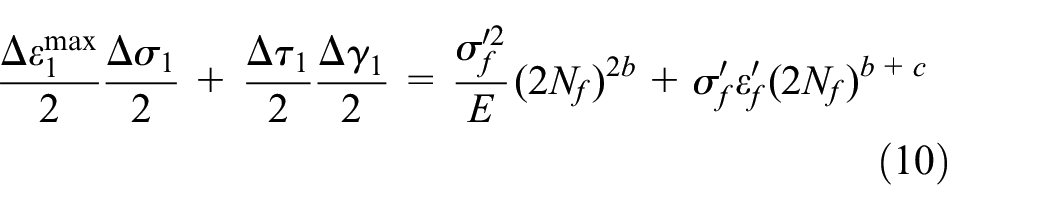
where
Meanwhile, the maximum shear strain plane was defined as the critical plane for the shear-type failure. Therefore, the life prediction model is given as follows

where
Q235B steel
The loading conditions and experiment results are obtained from Zhang. 25 The fatigue specimens are thin-walled tube specimens. The results are shown in Figure 3.
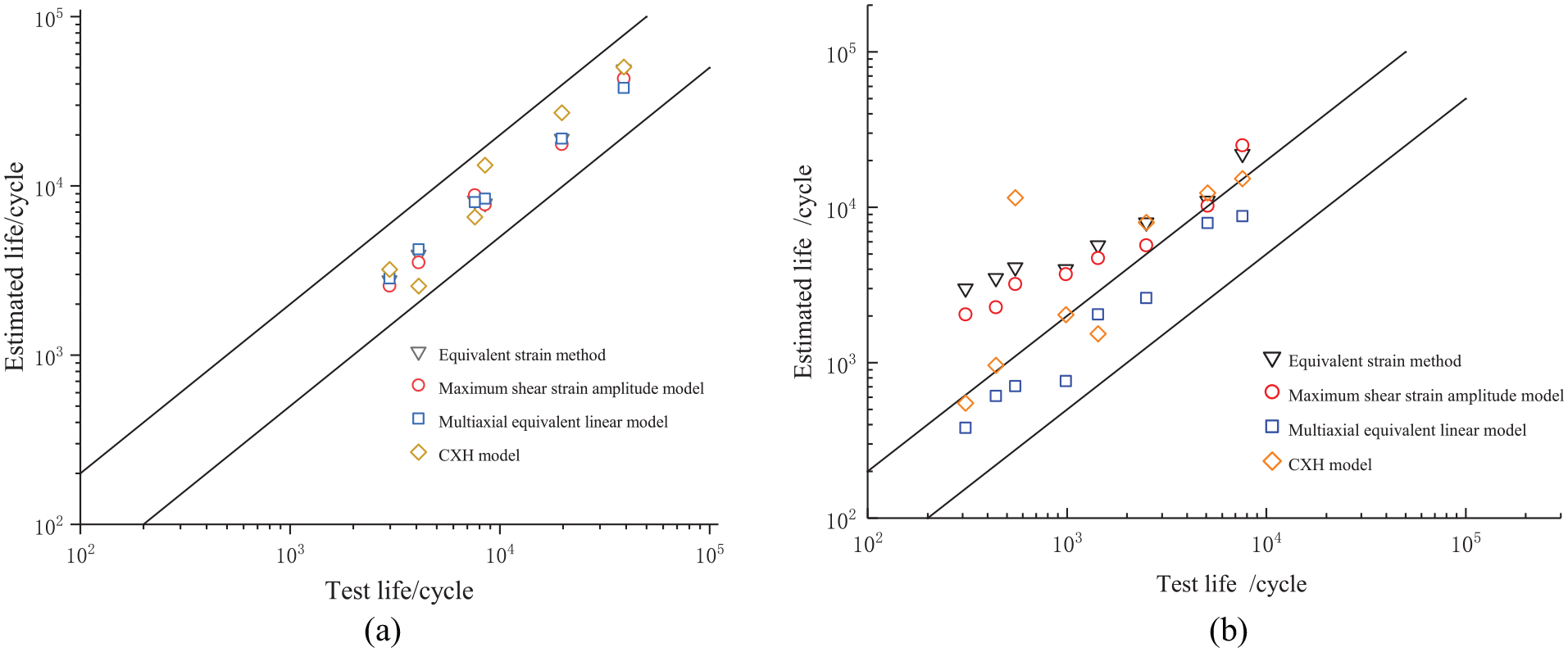
The comparison of the test life with the estimated life of Q235B steel: (a) multiaxial proportional loading and (b) multiaxial non-proportional loading.
It can be seen from Figure 3 that the predictive ability of the four models are not much different in the case of proportional loading. The predicted results are in good agreement with the experimental results, and the error is within the range of 2 times factor. The predictive ability of the equivalent strain method, the maximum shear strain amplitude model, and CXH model under non-proportional loading are not so well. The main reason is that the additional hardening effect is not considered.
Haynes 188
The loading conditions and results are obtained from Li et al. 26 The fatigue specimens are thin-walled tube specimens. The results are shown in Figure 4.
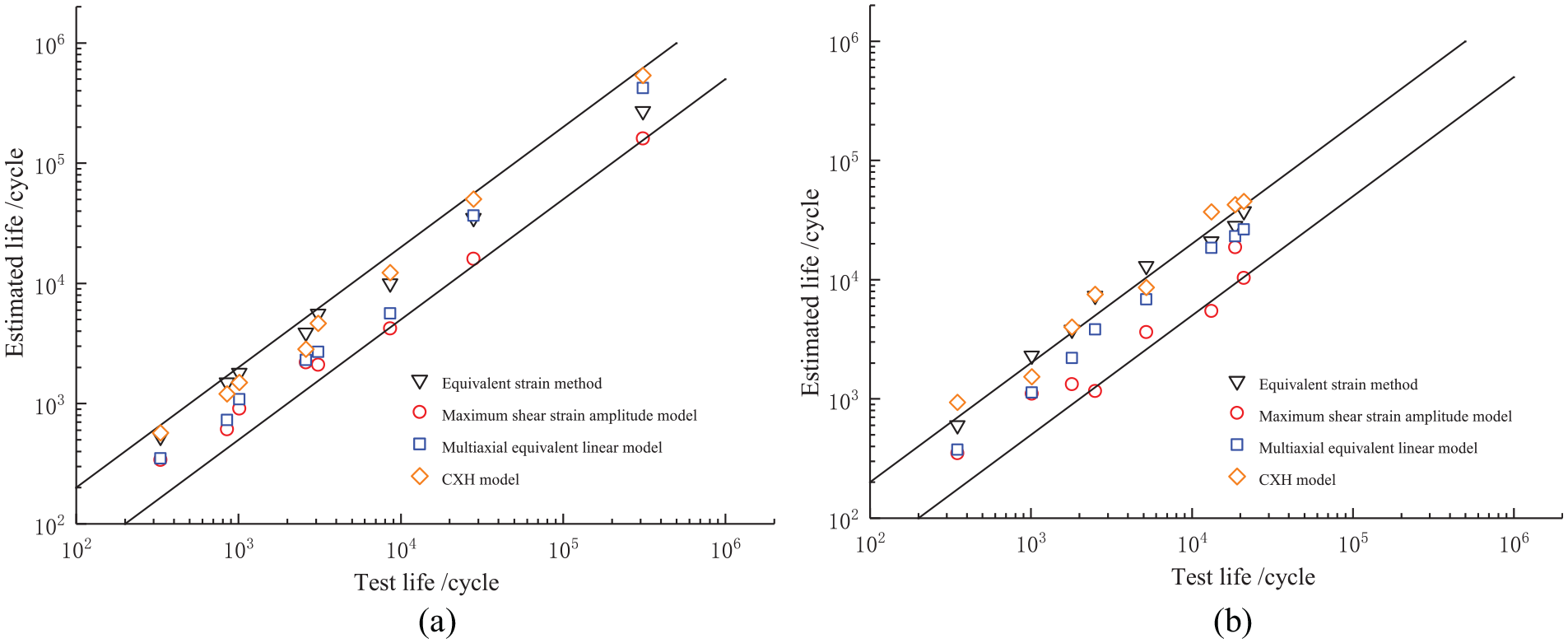
The comparison of the test life with the estimated life of Haynes 188: (a) multiaxial proportional loading and (b) multiaxial non-proportional loading.
It can be seen from Figure 4 that the prediction results of the four models are similar in the case of proportional loading. However, the predictive ability of multiaxial equivalent linear model is better than other model under non-proportional loading.
Titanium alloy TC4
The loading conditions and results are obtained from Wu et al. 27 The results are shown in Figure 5.

The comparison of the test life with the estimated life of TC4: (a) multiaxial proportional loading and (b) multiaxial non-proportional loading.
It can be seen from Figure 5 that the predictive ability of multiaxial equivalent linear model is better than other model under non-proportional loading.
Mod.9Cr-1Mo steel
The loading conditions and results are obtained from Jin et al. 28 The V-notched specimens and proportional loading are selected during the experiment, and the radius of notch tip ρ = 0.6 mm, ρ = 0.2 mm, and ρ = 0.09 mm. The results are shown in Figure 6.
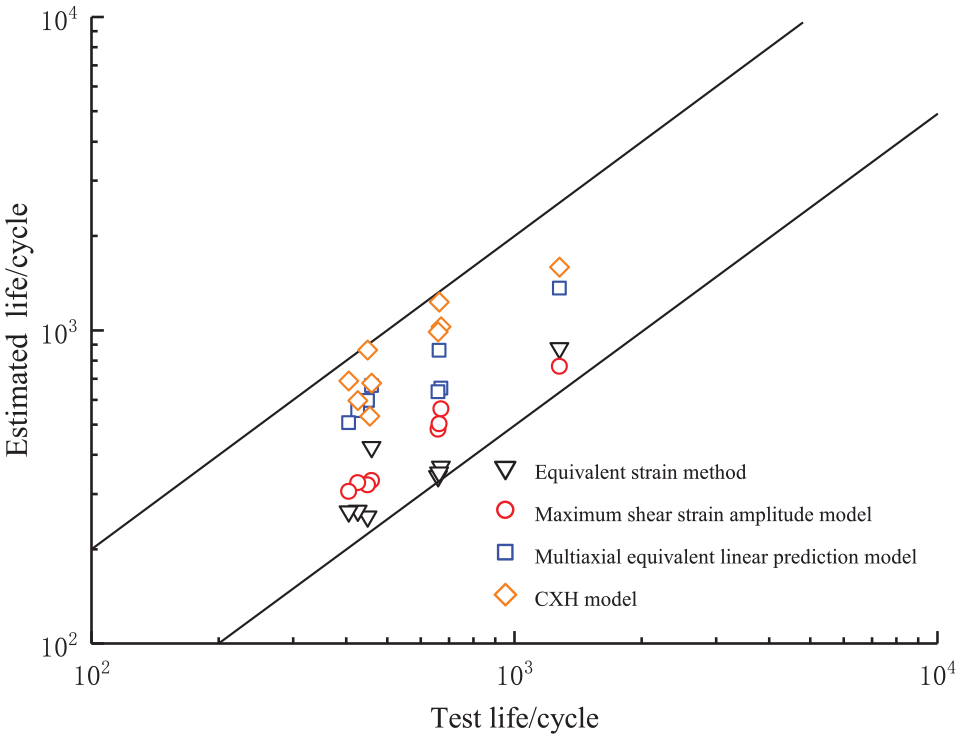
The comparison of the test life with the estimated life of Mod.9Cr-1Mo steel.
It can be seen from Figure 6 that the predicted error of the equivalent strain method is within the range of 2 times factor, but the results are risky. However, the predicted results of CXH model are conservative. Because there is no additional hardening effect under proportional loading, the predicted results of the maximum shear strain amplitude model and the multiaxial equivalent linear prediction model agree well with the experimental results.
Analysis and discussion
In the multiaxial fatigue life prediction model, the equivalent strain method, the maximum shear strain amplitude model, and CXH model can better predict the fatigue life of most metal materials, and it is also convenient for engineering application. It has been widely used in fatigue life prediction. Under the condition of non-proportional loading, the principal axis of stress/strain keeps rotating, resulting in additional hardening effect. Since the equivalent strain method, the maximum shear strain amplitude model and CXH model ignore the additional hardening effect under non-proportional loading, the predictive ability is not good for non-proportional loading (Figures 3–5). At the same time, different materials have different additional hardening effects. It can be seen from Figures 3(b), 4(b), and 5(b) that the non-proportional additional effect of Q235B steel is the largest, while Haynes 188 is the smallest. This also reflects the influence of material properties on the non-proportional additional hardening effect, and verifies the correctness of the proposed additional hardening factor.
Fatigue failure of metallic materials includes fatigue crack initiation and expansion. The critical plane method is based on the micronucleation crack nucleation mechanism of metal materials. At the same time, the critical plane method can well reflect the orientation of crack initiation at the dangerous point. The damage parameters are defined by the concept of material fatigue failure critical plane and the macroscopic mechanical parameters on the critical plane. For the notched specimen, the local stress and strain state is complicated in multiaxial loading, and it is difficult to accurately calculate the stress–strain state by the theoretical method, and the finite element method can solve this problem.
Conclusion
The cyclic hardening ability of material is expressed by the ratio of the cyclic yield stress to the static yield stress, and the influence of the phase difference and the loading condition on the non-proportional additional hardening effect is considered, and an additional hardening factor is defined. The multiaxial damage parameters corrected by this factor can well reflect the influence of additional hardening effect on multiaxial fatigue life.
Considering physical meaning of crack initiation and propagation, an equivalent Miner damage cumulative model applied to constant amplitude multiaxial proportional/non-proportional loading is put forward, which integrated Miner rule and the critical plane method. Compared with the calculation results and the test results of the equivalent strain method and the maximum shear strain amplitude model, the results show that the multiaxial equivalent linear fatigue life prediction model is superior to the other methods under non-proportional loading.
Footnotes
Handling Editor: James Baldwin
Declaration of conflicting interests
The author(s) declared no potential conflicts of interest with respect to the research, authorship, and/or publication of this article.
Funding
The author(s) disclosed receipt of the following financial support for the research, authorship, and/or publication of this article: This research is funded by National Natural Science Foundation of China (grant number: 51605212), Natural Science Foundation of Gansu Province (grant number: 17JR5RA1220), Hongliu Youth Fund of Lanzhou Uinversity of Technology, and the Project of Hongliu First-class Disciplines Development Program of Lanzhou University of Technology and Universities and Colleges Innovation Ability Improvement Project of Gansu (No. 2019A-225).
