



Abstract
Gasoline compression ignition (GCI) is an effective way to achieve both high thermal efficiency and low emission. The combustion and emission performances of GCI and DCI (diesel compression ignition) were compared on a 2.0 L diesel engine equipped with Three-way catalyst-Lean NOx trap/Passive selective catalytic reduction (TWC-LNT/PSCR) aftertreatment system. In order to further clarify the advantages and disadvantages of GCI, this paper first studies the combustion and emission at 1500 rpm and braking average effective pressure (BMEP) of 4–9 bar. Secondly, six small map points of worldwide harmonized light vehicles test cycle (WLTC) are studied. The results show that the braking thermal efficiency (BTE) of GCI is lower than that of DCI at low load. When BMEP is greater than 5 bar, the BTE of GCI is significantly improved. GCI achieves a maximum BTE of 43%, which is 3% higher than DCI. Compared with DCI, the NOx emission of GCI is slightly lower, the smoke emission of filter smoke number (FSN) is significantly improved, and the CO and HC emissions are significantly increased. GCI engine equipped with TWC-LNT/PSCR system with high aftertreatment efficiency has the potential to meet China’s VI B emission regulations.
Keywords
Introduction
Concerns about the consumption of conventional fossil fuels, environmental degradation, and increasingly stringent emissions regulations, automobile manufacturers and research institutions are eager to developing new engine combustion modes to achieve high thermal efficiency and low emissions at the same time. Because the low-temperature combustion model has high thermal efficiency and low emissions, a lot of research has been done in recent years. The HCCI (Homogeneous Charge Compression Ignition) is a typical low-temperature combustion mode.1–3 HCCI can achieve multi-point ignition, and enhance combustion process, which significantly improves thermal efficiency, and reduces emissions.4,5 However, the combustion process of the HCCI is controlled by chemical kinetics, and the combustion phase is difficult to control. Besides, it may misfire at low load, and has high knocking tendency at high load. Therefore, the operating load of HCCI is seriously limited.6–8
The heat release can be controlled by the mixture stratification in the cylinder. In order to improve the shortcomings of HCCI, the GCI (Gasoline Compression Ignition) combustion mode with mixture stratification in the cylinder was developed.9–12
The gasoline is injected into the cylinder near the top dead center to achieve mixture stratification and control the gasoline compression ignition. 10 Gasoline has good volatility and long ignition delay, which helps to form a better fuel-air mixture. The GCI can achieve low emissions and high thermal efficiency. Compared with the HCCI, the GCI has a wide operating load, and easy-to-control combustion phase.13–15
The research from Li et al. 16 show that the GCI fueled with low-RON gasoline has lower fuel consumption as well as lower THC and CO emissions, but higher NOX emissions. At low load, ignition of GCI is difficulty. But at high load, maximum pressure rise rate is easy to exceed the limit. Zhong et al. 17 examined the GCI engine using hydrogenated catalytic biodiesel blended gasoline as fuel to solve this problem. Putrasari and Lim 18 found that the small and high amount of biodiesel in gasoline have similar character and value of IMEP. The lower the biodiesel content in gasoline, the lower the thermal efficiency of GCI engine. Besides, the increase of biodiesel content in gasoline leads to the decrease of THC and CO, but the high oxygen content of biodiesel will lead to the increase of NOX emissions. Wei et al. 19 studied the knocking of GCI, the results show that SI (Spark Ignition) engine knock is a random phenomenon caused by spontaneous combustion of exhaust gas. In contrast, the knock of the GCI engine is attributed to the local rapid combustion rate, which does not happen randomly.
Han et al. 20 fund that when diesel is replaced by a mixture of diesel and gasoline, it can reduce NOX and soot emissions, and without significantly reducing the local combustion temperature as usual in traditional low-temperature combustion. As the proportion of gasoline increases, soot emissions becomes insensitive to the change of intake oxygen concentration and remains at a low level with the gradual reduction of NOX emissions. A kind of second-generation hydrogenated catalytic biodiesel (HCB) with high reactivity was added to gasoline by Zhang et al., 21 the results show that with the increase of the HCB ratio, the GCI ignition performance and combustion stability at low is significantly improved. Kim and Bae 22 studied the effect of injection strategy on GCI. As compared to a single injection, maximum pressure rise rate of double injection decreased from 1.3 to 0.2–0.3 MPa/°. Besides, due to the lower combustion temperature, NOX emissions is reduced by half. However, the combustion stability of the double-injection is decreased. Pan et al. 23 used exhaust gas recirculation (EGR) to improve the GCI operating range. The excessive EGR will hinder combustion, but will improve the ignition stability of GCI. When the EGR rate is between 10% and 60% and the excess air ratio is between 1.5 and 3.0, the combustion efficiency can obtain data greater than 90%. The research by Roberts et al. 24 shows that adding a small amount of diesel to gasoline can improve the combustion stability of GCI, but the NOX emissions increase.
In order to further clarify the advantages and disadvantages of GCI, and provide a theoretical basis for the mass production of GCI. A comparative study of the combustion and emissions of GCI and DCI was carried out at part load on a 2.0 L diesel engine. Besides, there are few reports on the research of GCI aftertreatment. Moreover, traditional diesel engine aftertreatment program is expensive, developing a cheap GCI engine aftertreatment system is necessary. Low-cost aftertreatment system (TWC + LNT/PSCR, Three Way Catalyst, Lean NOX Trap and Passive Selective Catalytic Reduction) based on the gasoline engine aftertreatment was studied in this paper, and experiments were performed on 6 minimap points of WLTC (Worldwide Harmonized Light Vehicles Test Cycle) to evaluate the TWC + LNT/PSCR performance.
Experimental apparatus and data processing
Experimental apparatus
The test engine was a 2.0 L diesel engine with a compression ratio of 17. A 2000 bar high-pressure fuel in-cylinder direct injection system was used for both GCI and GCI. The turbocharger system was an electronically controlled VGT (Variable Geometry Turbine) equipped with water-cooled intercooler. High pressure (HP) and low pressure (LP) EGR were equipped at the same time. More details regarding the experimental engine are provided in Table 1.
Engine specifications.

The schematic layout of the engine bench test system is shown in Figure 1. The dynamometer was AVL PUMA 2.0. The fuel mass consumption was measured by an AVL733S fuel consumption meter. The main chamber pressure signals were measured by a Kistler 6054BR. An AVL indicom combustion analyzer was used to collect the cylinder pressure and calculate the combustion data. The test bench was equipped with a HORIBA MEXA-7100 exhaust gas analyzer to measure the key exhaust components concentration such as CO, NOX, and HC, with the method of Non Dispersive Infrared (NDIR), Chemiluminescence (CLD) and Flame Ionization Detector (FID), respectively. FSN (Filter Smoke Number) smoke was measured by AVL 415S.

Layout of the engine bench test system.
The traditional diesel engine aftertreatment system is expensive. This paper studies low-cost aftertreatment system based on the gasoline engine aftertreatment, and TWC + LNT/PSCR was used in this study.
In rich burn operation, NH3 is generated by the reaction of NO with H2 and CO in TWC. H2 is produced by a water gas shift reaction or a reforming reaction. Studies have shown that the higher the ratio of H2:NO in the original engine emissions, the greater the generation of NH3. The LNT tested in this study was a Pt/Pd/Rh/Al2O3 catalyst. The NOx in the exhaust gas of lean burn is adsorbed by the alkali metal or alkaline earth metal compound (such as Ba, etc.) coated on the LNT carrier to form nitrate or nitrite. he PSCR tested in this study was a Cu-SSZ-13 type catalyst. According to the Eley-Rideal mechanism, NH3 is adsorbed on the active sites of the catalyst during the chemical reaction of PSCR under rich burn. In lean burn, NOx reacts with NH3 produced by PSCR desorption to generate N2.
The installation sequence of the aftertreatment system was TWC, LNT, SCR, as shown in Figure 1. The volume was 2.54, 1.63 , 2.54 L, and the hole density was 116, 62, 62/cm−2, respectively. More details regarding the experimental aftertreatment system are provided in Table 2.
Aftertreatment system specifications.

Test conditions and data processing
The coolant and oil temperature were 85 ± 2°C. AVL indicom records the cylinder pressure data of 200 cycles at each operation point, and the sampling resolution is 0.25°CA. The fuels of GCI and DCI are commercial 92# gasoline and 0# diesel, respectively, the physicochemical properties of diesel and gasoline are shown in Table 3.
Physicochemical properties of diesel and gasoline.

The combustion beginning time (CA10) is defined as the crank angle from 10% heat release. The combustion phase (CA50) is defined as the crank angle from 50% heat release. Combustion end time (CA90) is defined as the crank angle from 90% heat release. The ignition delay is defined as the crank angle from injection timing to CA10. The combustion duration (CA10-90) is defined as the crank angle from CA10 to CA90.
The combustion parameters were averaged over 200 cycles, and emissions and fuel consumption were averaged over 15s in steady state. The maximum pressure rise rate was maintained within 8 bar/°CA, and the CA50 was controlled at about 10°CA ATDC by adjusting the injection timing. The NOX emissions was kept within 5 g/kW h by adjusting EGR rate. The FSN was kept within 1. Under the above restrictions, the injection time, injection quality and air-fuel ratio are optimized to obtain the minimum effective fuel consumption. The injection strategy was two injections, the first injection was pilot injection, which is injected in the compression stroke, 20° before the top dead center, and the injection amount was 4–6 mg; the second injection is the main injection, which determines the peak pressure and emissions performance.
Because the actual operating speed of diesel engine is low, and in the test conditions of diesel engine emission regulations, 1500 rpm is a typical working condition. Therefore, this paper first studies part-load combustion and emissions, the speed was kept at 1500 rpm and BMEP (Brake Mean Effective Pressure) was 4–9 bar. The study of clustering operating points can roughly evaluate the performance of the engine and effectively reduce the test workload. Accurate and rapid evaluation of WLTC cycle fuel consumption and emissions is a significant segment of vehicle performance development and matching, and the determination of representative operating point is an important method to predict the economic performance and emission performance. The K-means clustering algorithm is used to process the engine operating condition data of the WLTC cycle to find representative operating point. K-means clustering uses distance as the similarity index, and by finding the representative point with the closest distance to the surrounding scatter points, the cluster center of each cluster point can be obtained. The detailed K-means algorithm is shown in Hu et al.25,26 The representative operating points are usually 4–25. After clustering the WLTC cycle operating points into 6 points, the estimated fuel consumption and emission values of the typical operating points are within 5% of the actual values, therefore the 6 operating points (6 minimap points) are selected as the test conditions. The 6 minimap points of the WLTC were studied to evaluate the emissions aftertreatment performance. The 6 minimap points of WLTC are shown in Table 4.
The 6 minimap points of WLTC.

The WLTC emissions prediction formula is calculated as follows:

Results and discussion
Combustion and feed gas emissions
The combustion and feed gas emissions of GCI and DCI at 1500 rpm and BMEP 4–9 bar are studied in this section. Figure 2 is the comparison of cylinder pressure, heat release rate and combustion process between GCI and DCI at 1500 rpm and 6 bar. The CA10 of GCI and DCI are 7.3°CA and 3.5°CA ATDC, respectively. GCI has a later combustion beginning time. Compared with diesel, gasoline has longer ignition delay and better volatility, which helps to fuel-gas mixing. Therefore, GCI has a larger proportion of combustible mixture at combustion beginning time, a higher heat release rate, and a larger peak pressure.

Comparison of cylinder pressure, heat release rate, and combustion process between GCI and DCI at 1500 rpm and 6 bar: (a) cylinder pressure, (b) heat release rate, and (c) the combustion process.
The CA10-90 of GCI and DCI are 14.4°CA and 30.1°CA, respectively, and the CA90 is 21.7°CA and 33.7°CA, respectively. The combustion duration of GCI is greatly shortened, and the combustion end time is significantly earlier as compared to DCI. The longer ignition delay period, faster combustion speed and better volatility of gasoline reduce the combustion duration of GCI. This shows that GCI is beneficial to improve the isovolume and thermal power conversion process.
Figure 3 is the variation of BTE (Brake Thermal Efficiency) and MPRR (Maximum Pressure Rise Rate) with BMEP. As shown in Figure 3, when the load is low (<5 bar), the BTE of GCI is lower than DCI, and decreased by 1.3%. When the BMEP is greater than 5 bar, the BTE of GCI is significantly improved. The GCI achieves the maximum BTE of 43%, which is a 3% improvement over DCI. When the BMEP is 4 bar, the MPRR of GCI is greatly reduced compared with DCI; but when the BMEP is greater than 4 bar, the MPRR of GCI is significantly greater than DCI. The reason is that at low load, the mixture is leaner, gasoline has good volatility and long ignition delay, which leads to long fuel-air mixing time and excessive mixed mixture. On the other hand, the combustion temperature is low at low load. This leads to poor combustion stability, even partial combustion, and low BTE at low load. As the load increases, the mixture becomes richer and the combustion temperature rises, which improves combustion stability. In addition, gasoline’s better volatility and longer ignition delay make the fuel-air mixing better, resulting in a faster combustion speed, and an improved thermal efficiency.
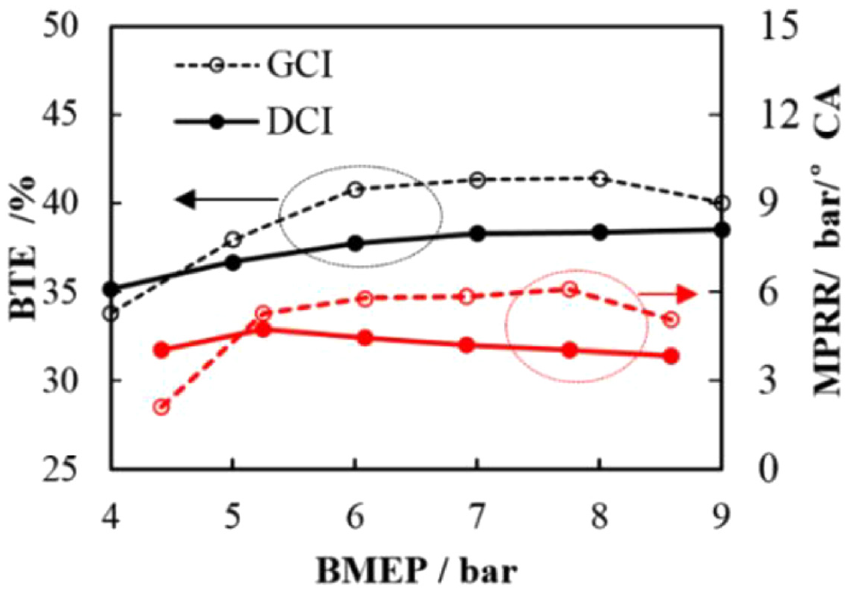
Variation of BTE and MPRR with BMEP.
Figure 4 is the variation of NOX, FSN, CO, and HC in the feed gas with BMEP. As shown in Figure 4(a), with the BMEP increases, NOX emissions decrease slightly and then increase, but there is a small difference in NOX emissions between GCI and DCI. Compared with DCI, GCI has lower NOX emissions at low load. The NOX emissions is mainly affected by temperature. The gasoline has large latent heat of vaporization, the cylinder temperature decreases. Besides, GCI has a lower combustion speed at low load, which makes a slight reduction in NOX emissions. With the increase of BMEP, the premixed combustion ratio of GCI increases, the heat release rate increases and the cylinder temperature increases. Therefore, the NOX emissions difference between GCI and DCI decreases with the increase of BMEP.

Variation of NOX, FSN, CO, and HC with BMEP: (a) NOX and FSN and (b) CO and HC.
Figure 4(a) also shows the variation of FSN smoke. With the increase of BMEP, the FSN smoke of GCI and DCI increases. GCI can significantly improve FSN smoke. This is because the good volatility and long ignition delay of gasoline promote the mixing of fuel and gas, which reduces the over-rich area and the soot generation.
Figure 4(b) show the CO and HC emissions. With the BMEP increases, the CO and HC emissions decrease. GCI has higher HC and CO emissions as compared to DCI, which is mainly due to the better volatility of gasoline, which leads to excessive mixing of fuel and air to produce more HC and CO emissions. At low load, the air-fuel ratio is large, and the area where the mixture is “too lean” in the cylinder is large, which increases the probability of the combustion chain reaction interruption. Besides, the temperature is low at low load, which reduces the oxidation degree of HC and CO. Low load has higher HC and CO emissions. With the load increases, the mixture become rich, the area where the mixture is “too lean” decreases, the combustion temperature also increases, which improves the efficiency of the oxidation of HC and CO. Therefore, as the load increases, HC and CO emissions decrease.
However, with the increase of BMEP, the variation trend of HC and CO emissions is different, and GCI has a greater decline in HC and CO emissions. The main reason is the poor combustion stability of GCI at low loads. As the load increases, the combustion stability increases significantly.
GCI engine aftertreatment
GCI engine operates under lean burn condition, and traditional TWC can’t deal with NOx emissions at lean burn. The traditional diesel engine aftertreatment system is expensive, and it is necessary to develop a low-cost GCI engine aftertreatment system. The aftertreatment combination of LNT (Lean NOx Trap) and PSCR (Passive Selective Catalytic Reduction) can efficiently deal with NOx emissions, besides LNT and PSCR are very cheap. The TWC + LNT/PSCR aftertreatment was used in this study. The 6 minimap points (as shown in Table 3) of the WLTC were studied to evaluate the emissions aftertreatment performance.
LNT can trap NOX in lean burn, and then the reducing gas produced in rich burn can reduce the NOX trapped in the LNT to N2. On the other hand, PSCR can store the ammonia (NH3) produced by the traditional TWC under rich burn, NH3 can be released in lean burn. The highly reducing NH3 released in the lean burn can reduce NOX to N2. In addition, TWC can also promote the rapid reaction of ammonia selective catalytic reduction in PSCR and improve the conversion efficiency of NOX. Therefore, there is a complementary relationship between LNT and PSCR in NOX aftertreatment. The combustion mode of engine can be changed between rich combustion and lean combustion, equipped with the aftertreatment scheme of TWC + LNT / PSCR, which is a low-cost GCI engine aftertreatment scheme. The Aftertreatment system specifications is shown in Table 2.
Figure 5 is the GCI feed gas emissions, aftertreatment gas emissions and aftertreatment efficiency of 6 minimap points. After the feed gas passes through the aftertreatment system, NOX, HC, and CO are all significantly reduced. The aftertreatment efficiency ranges of NOX, HC, and CO are 87.5%–99.9%, 72.6%–99.0%, and 89.6%–99.9%, respectively.

The GCI feed gas emissions, aftertreatment gas emissions and aftertreatment efficiency of 6 minimap points: (a) NOx, (b) HC, and (c) CO.
The emissions of 6 minimap points can evaluate the emissions aftertreatment performance of the GCI, the WLTC emissions prediction formula is shown in formula (1). The predicted NOX, HC, and CO emissions of WLTC are shown in Figure 6. The GCI and DCI have a small difference in NOx and CO emissions. The GCI has significantly higher HC emissions compared to DCI. The predicted NOX, HC, and CO emissions are within the limit of China VI B emission regulation. This means that the GCI engine equipped with the TWC + LNT/PSCR aftertreatment system has the potential in meeting the China VI B emission regulation.

The predicted NOX, HC, and CO emissions of WLTC.
Conclusions
In this study, a comparative study of the combustion and emissions of GCI and DCI was carried out at part load on a 2.0 L diesel engine. Subsequently, the 6 minimap points of WLTC were examined to evaluate the emissions aftertreatment performance of the GCI. The main conclusions are as follows:
The BTE of GCI is lower than DCI at low load due to excessive fuel-air mixing and low cylinder temperature. When the BMEP is greater than 5 bar, the BTE of GCI is significantly improved. The GCI achieves the maximum BTE of 43%, which is a 3% improvement over DCI.
When the BMEP is 4 bar, the MPRR of GCI is greatly reduced compared with DCI; but when the BMEP is greater than 4 bar, the MPRR of GCI is significantly greater than DCI.
Compared with DCI, NOX emissions of GCI are slightly lower, FSN soot emissions are significantly improved. And with the increase of load, the difference between GCI and DCI of CO emission and HC emission decreases. However, the CO and HC emissions of GCI are also significantly increased.
The aftertreatment efficiency ranges of NOx, HC and CO of TWC + LNT/PSCR are 87.5–99.9%, 72.6–99.0%, and 89.6–99.9%, respectively. The GCI engine equipped with the TWC + LNT/PSCR aftertreatment system has the potential in meeting the China VI B emission regulation.
Footnotes
Handling Editor: Chenhui Liang
Declaration of conflicting interests
The author(s) declared no potential conflicts of interest with respect to the research, authorship, and/or publication of this article.
Funding
The author(s) disclosed receipt of the following financial support for the research, authorship, and/or publication of this article: Thanks for the funding of university excellent talent support program (Grant number: gxyqZD2021162) and Key project of Natural Science Research of Anhui Provincial Department of Education (Grant number: KJ2017A581, KJ2020A0837).
