The simulations have been performed for the nonlinear radiative flow of Prandtl nanofluid following the peristaltic pumping in a wavy channel. The applications of entropy generation for the electrokinetic pumping phenomenon are also focused as a novelty. The complex wavy channel induced the flow of Prandtl nanofluid. Moreover, the formulated problem is solved by using the convective thermal and concentration boundary conditions. The Keller Box numerical procedure is adopted as a tool for the simulation task. The results are also verified by implementing the built-in numerical technique bvp4c. The comparison tasked against obtained numerical measurement has been done with already reported results with excellent manner. The physical characteristics based on the flow parameters for velocity, heat transfer phenomenon, concentration field, and entropy generation pattern is visualized graphically. It has been observed that the presence of thermal slip and concentration enhanced the heat transfer rate and concentration profile, respectively. The skin friction coefficient declines with electro-osmotic force and slip parameter. The increasing variation in Nusselt number is observed for electro-osmotic parameter for both linear and non-linear radiative phenomenon.
Peristalsis is a topic of interest for researchers from past three decades because of its applications in physiological and industrial processes. The design of dialysis and heart-lungs machines involves peristaltic mechanism. Peristaltic pumps play an important role in agricultural processes like pushing of chemicals/water from tank/river into the unfertile field. Important industrial applications of peristalsis include the roller and finger pumps to transport fluids. Transporting fluids through this process is helpful in avoiding pollution in industrial expenditures/wastages/consumption. Choudhari et al.1 assumed the peristaltic motion of Bingham material due to the elastic tube with porous walls and distinct flow characteristics. Prasad et al.2 identified the role of slip features for Casson fluid flow due to the peristaltic movement in inclined channel. The peristaltic investigation for non-Newtonian magnetized material in view of electroosmosis aspect was visualized by Tanveer et al.3 Divya et al.4 observed the hemodynamics applications regarding the peristalsis flow of Jeffrey fluid and additional under the consideration of distinct flow properties. Saunier and Yagoubi5 presented the novel contribution on the peristaltic flow with the surface impact and compressive stresses. The Powell-Eyring nanofluid thermal observation based on the peristaltic phenomenon has been focused by Ahmed et al.6 Khazayinejad et al.7 reported a radiative analysis for the biological material subject to the peristaltic pumping and porous space. Parveen et al.8 observed the thermophysical classification of nanofluid with peristaltic activity and slippage features. Abo-Elkhair et al.9 focused on the peristaltic determination of hybrid nano-materials in view of uniform Reynolds number assumptions. Javid et al.10 determined the cilia transport problem for the peristaltic mechanism and electro-kinetic features.
The electroosmotic flow is the flow induced by the application of an electric field across the channel in the presence of electric double layer at channel walls. The electroosmotic flow is most significant in small channels because characteristic length of the channel is much greater than electric double layer (EDL) in small channels and in all heterogeneous fluids based system electric double layers exists. Electroosmotic flow plays a vital role in microfluidic devices such as, micro-reactors, biosensors and DNA analysis, etc. Ramesh and Prakash11 explained the inspiration of electroosmosis phenomenon in microfluidic vessel with inspection of heat transfer. Sharma et al.12 discussed the diffusive convective flow regarding the electroosmosis enrollment due to nanofluid flow. Lodhi and Ramesh13 implemented the Darcy theory for a electroosmosis problem subject to the viscoelastic fluid. Noreen et al.14 observed the electroosmotic activity against the bio-fluid flow via microchannel. The research communicated by Lv et al.15 explored the electroosmosis significances for the viscoelastic material in a metallic cylinder. Noreen and Waheed16 determined the electroosmotic evaluation for the microtube flow with porous activity. Ghosh et al.17 indentified the insight significances of electrophoretic due to electrical layer. Zhou et al.18 prescribed the physiological applications for the electroosmosis pattern along with the joule heating effects. The Prandtl nanofluid determination with electroosmosis assumptions was noticed by Abbasi et al.19
Enhancing heat transfer in a channel is important for designing more compact heat exchangers, which are used in a variety of engineering applications including electronic device cooling, air-conditioning equipment, and ocean thermal energy conversion technologies, among others. For researchers and engineers, the advancement of these technologies is a major concern. However, in engineering and technology departments, poor thermal conductivity is the main impediment to heat transfer of these possible fluids. Choi20 generated the idea of nanofluid and introduced us to its high thermal conductivity compared to other fluids. Saleem et al.21 addressed the hybrid nanofluid thermal performances for the peristaltic flow subject to the curved tube. Narla and Tripathi22 inspected the optimized thermal analysis regarding the peristaltic phenomenon in curved channel. Akram et al.23 determined the heat transfer rate based on the utilization of hybrid nanofluid following the peristaltic pattern and electroosmotic approach. Akhtar et al.24 determined the heat transfer investigation for the peristaltic transport of nanofluid in elliptic duct. Song et al.25 investigated the ciliated motion of nanofluid with double diffusion convection with implementation of Hall features. Ge-JiLe et al.26 observed the nanofluid thermal properties for the creeping flow with claim of biotechnology applications. Mahanthesh27 numerically investigated the flow and heat transport of nanoliquid with aggregation kinematics of nanoparticles. In an other study Mahanthesh28 highlighted the influence of quadratic thermal radiation on the heat transfer characteristics. Mahanthesh et al.29 discussed the impacts of non-linear thermal radiation, Hall current and heat source on the dynamics of dusty nano fluid.
The creation of entropy is linked to the irreversibility of thermodynamic processes; as irreversibility grew, the system’s useful work dropped and its efficiency fell. As a result, researchers aim to come up with a realistic way to reduce the rate of entropy formation in order to improve a system’s performance. For the first time Bejan30 discovered that the rate of entropy generation can be used to calculate irreversibility. A rich research on the optimized flow of various materials has been presented by research.31–39
This research inspired the nonlinear radiative flow of Prandtl Eyring nanofluid presence of entropy generation phenomenon. The peristaltic motion with applications of electroosmotic pumping regarding the Prandtl Eyring nanofluid has been considered in the wavy channel. The mixed convection and chemical reaction consequences are also taken into consideration. Additionally, the problem is further extended by utilizing the electric field and joule heating effects. The whole analysis is performed with implementation of thermal and concentration slip constraints. The solution procedure has been followed by employing implicit finite difference method. After carefully observing the scientific research, it is claimed that such novel thermal investigation for the electroosmotic phenomenon and entropy generation features is not focused by researchers yet. The electroosmotic phenomenon presents applications in capillary electro-chromatography, medicine, microfluidic devices, capillary electrophoresis, microchips, geomechanics, petroleum engineering, etc. Moreover, the motivations for considerations the entropy generation effects are justified due to its significances in the energy storage devices, cooling systems, extrusion processes, solar collectors, exchangers turbo apparatus, combustion, heat, etc.
Mathematical modeling for electro-osmotic pumping of Prandtl Eyring nanofluid
We consider the two-dimensional flow of Prandtl Eyring nanofluid in a symmetric vertical channel by due to peristaltic wave. The applications of electroosmotic phenomenon have been accounted. Moreover, the energy equation is modified in view of joule heating and thermal radiation. For chemical reactive fluid, the chemical reaction features are utilized in the concentration equation. The flow geometry is presented in Figure 1.
Geometry of problem.
Furthermore, the left wall and right wall may be defined as
Where, are non-similar wave amplitudes, is wave length, is time, is half width of the channel, is axial co-ordinate, are parameters related to wave amplitude, and is speed of complex peristaltic wave. For the mathematical formulation of the problem under consideration the basic conservassion laws of mass, momentum, energy, and concentration along with Nernst-Planck and Poisson equations are used which expressed as.
Continuity equation
The equation describes that rate at which the fluid enters the channel is equal to the rate at which liquid leaves the channel and fluid mass in dynamic system remain conserved.
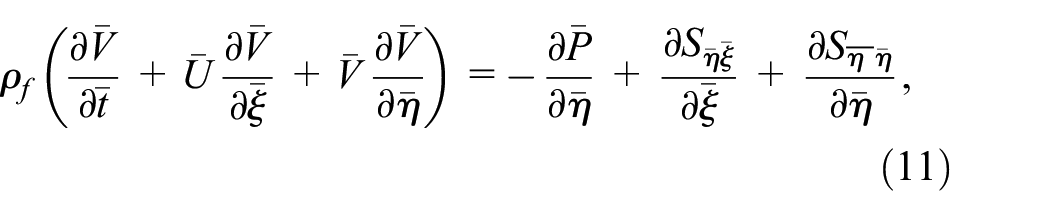
Momentum equations
The momentum equations actually describing the Newton’s second law of motion. The left hand side is describing the inertial forces while the terms on right hand side are describing pressure gradient forces, viscous forces, and body forces.
Energy equation
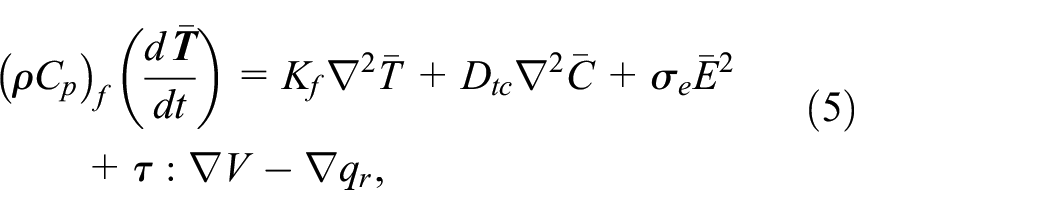
By employing the first law of thermodynamics, the emergy blance equation is
Concentration equation
The concentration equation in presence of chemical reaction in differential form is16:
In above equations, is Dufour diffusivity, is Soret diffusivity, is density of fluid, is heat capacity of nanofluid, is thermal conductivity, is Dufour diffusivity, is material time derivative, is temperature having specific value at both left and right walls, is radiative thermal heat flux, is concentration of mass, and is chemical reaction constant. represents the body forces and is stress tensor and for Prandtl fluid
where
in which , , and denotes the material parameters. The rheological equations of mathematical model under consideration are:
In the presence of electro-static and mixed convection the equation of momentum for the Prandtl Eyring fluid is16,19:
In above equations are velocity components, is pressure, is gravitational acceleration, is thermal expansion coefficient, is concentration expansion coefficient, are components of shear stress for Prandtl fluid. The expressions for energy and concentration equations is19:
The right hand side of above equation is material derivative of heat transfer, the first term on right hand side is due to thermal conductivity, second term is joule heating, third term is due to non-linear Radiative heat flux fourth term is mass convention and last term is viscous dissipation. In view of Roseland approximation heat flux can be written as , in which is the Stefan-Boltzmann constant and is mean absorption coefficient.
Electric field
The electric potential function can be calculated from Poisson equation
with (dielectric constant) (electrolyte electric density) which are presented as:
, , and be charge balance, electric charge magnitude, negative ions and positive ions, respectively. Following Nernst-Planck expression:
with chemical species diffusivity , average electrolyte solution temperature , and Boltzmann constant
Boundary conditions
The flow constraints for model are:
with heat coefficient and mass coefficients , thermal conductivity coefficients and mass diffusivity coefficients .
Linear transformations and dimensionless formulation
Transforming equations from laboratory frame to moving frame we use following linear transformation and dimension less variables for dimension less formulation
In which is Reynolds number, is Helmholtz-Smoluchowski velocity, and be materials constants, be Schmidt number, is Soret parameter, is Dufour number, is thermal Grashof number, is the concentration Grashof number, Prandtl constant, is chemical reaction parameter, is Eckert number, is velocity slip parameter, Joule heating constant, is thermal Biot number, and is concentration Biot number.
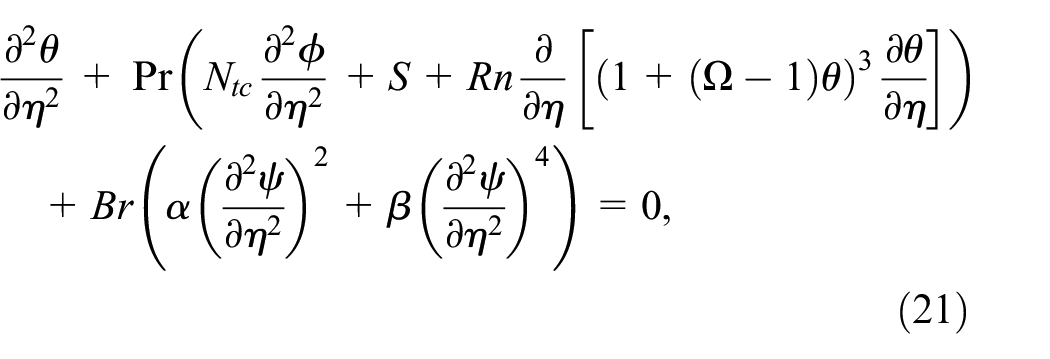
After using the stream function defined by and continuity equation (1) satisfied while flow model retained as:
Incorporating the dimensionless expressions and following constraints of , Poisson equation (14) transformed as:
in which is the electro-osmotic parameter. The dimensionless form of Nernst-Planck equation is:
The solution of the equation (24) subject to the conditions and is obtained in the form
Imposing the boundary condition and . For analytical simulations of equation (23) in view of , one get
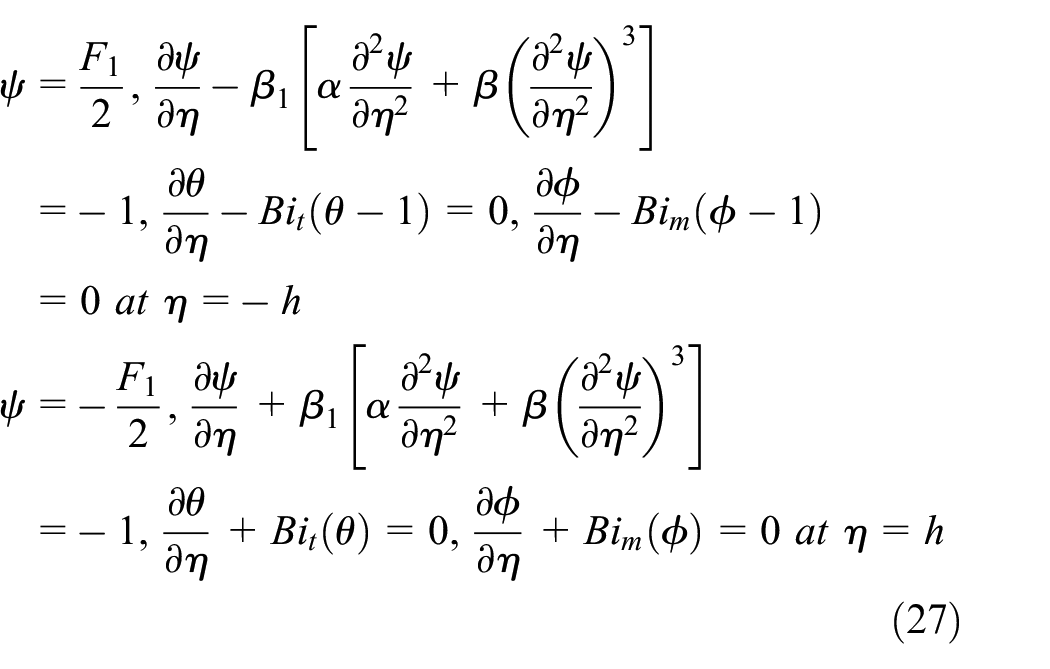
Boundary conditions are:
Where The reporesnetation of skin fraction, Nusselt number and Sherwood number is:
Due to highly complexity, the analytical solution task for problem is almost not possible. Therefore, the finite difference numerical scheme is followed for simulation process.34 Le us inserting new variables like in governing equations:
Subject to boundary conditions
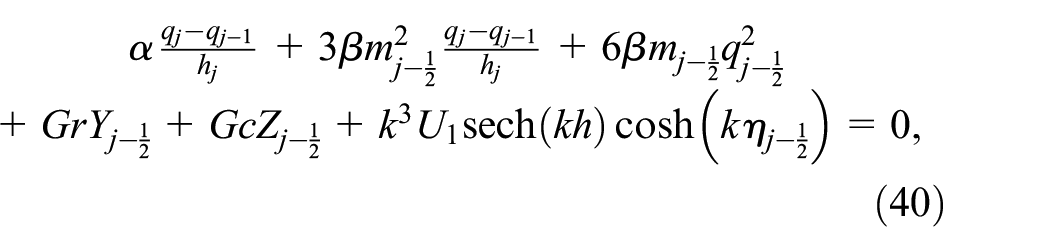
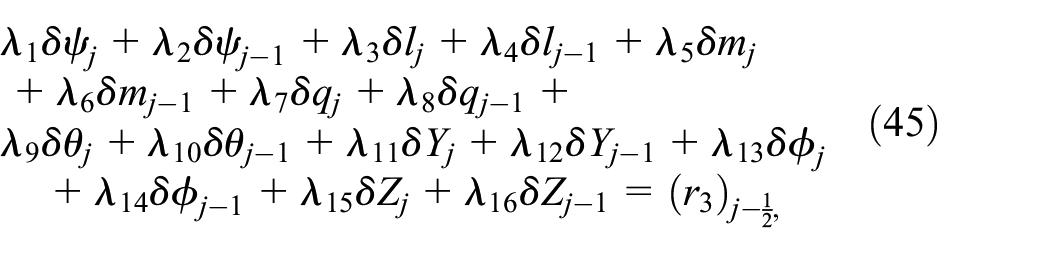
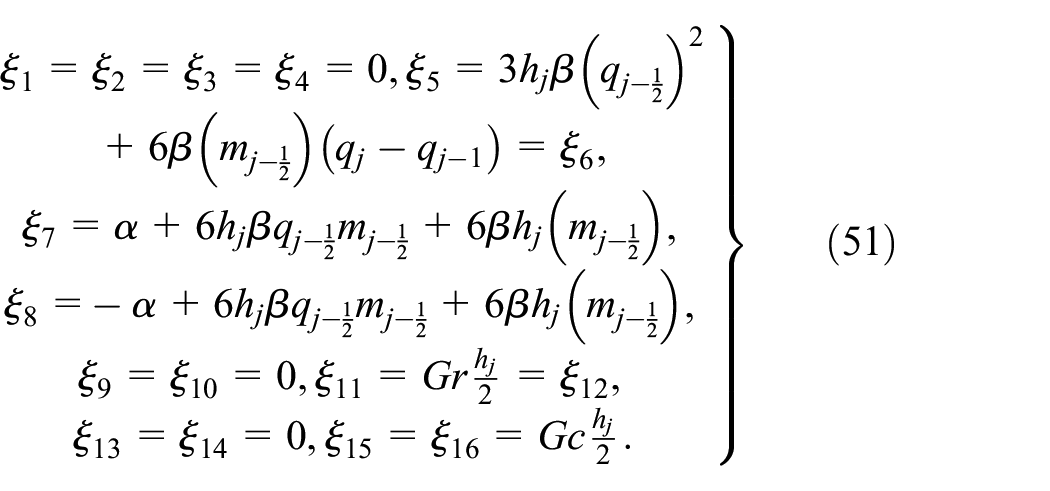
In next step the central difference approximations are used for derivative and average for rest of dependent variables, we have
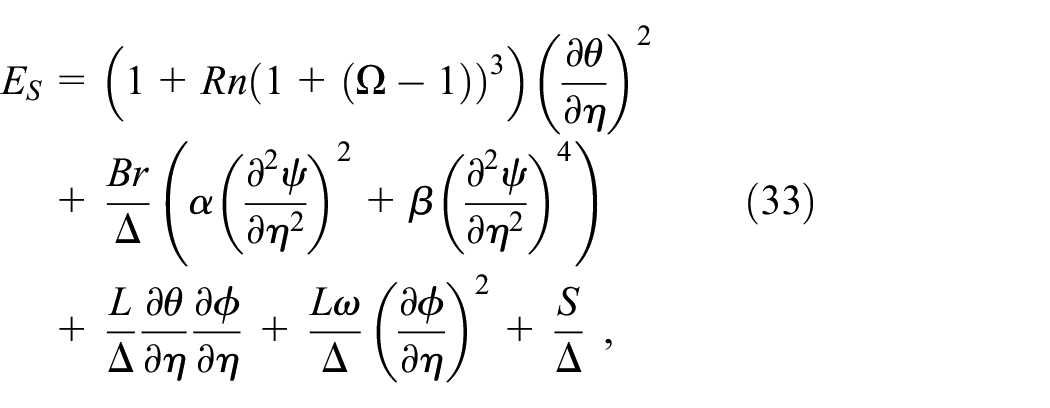
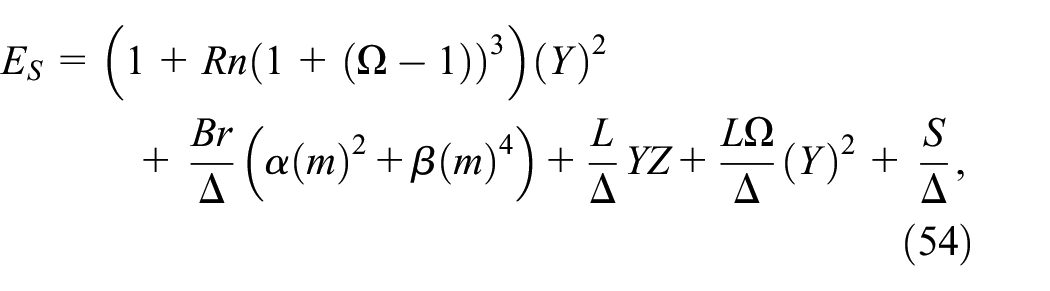
After using the above process the expressions for entropy generation number and Bejan number are
Special cases
Results for simple peristaltic flow can be obtained by
If , the results are in absence of electric field.
Results for no-slip flow case can be obtained by choosing
Results for viscous fluid case can be recovered by neglecting Prandtl Eyring parameters. That is
Results and discussion
The physical interpretations are presented in this section.
Axial velocity
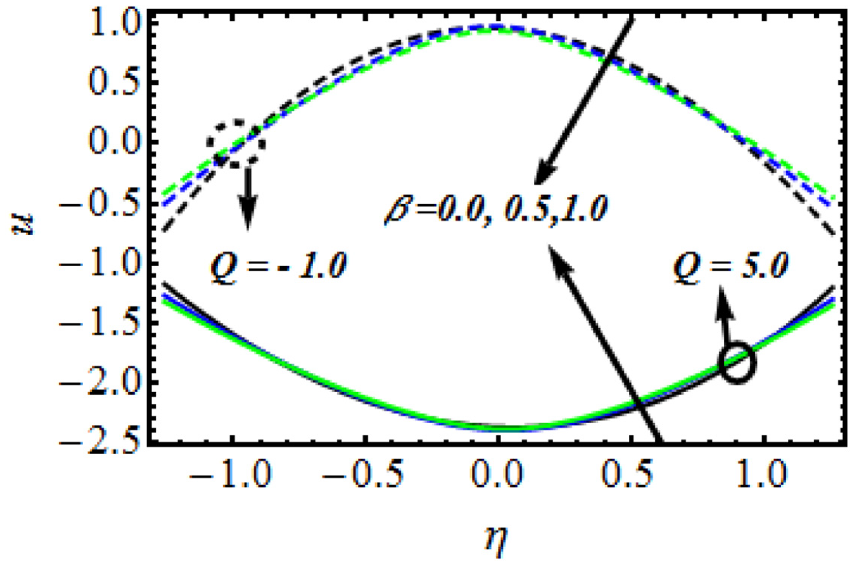
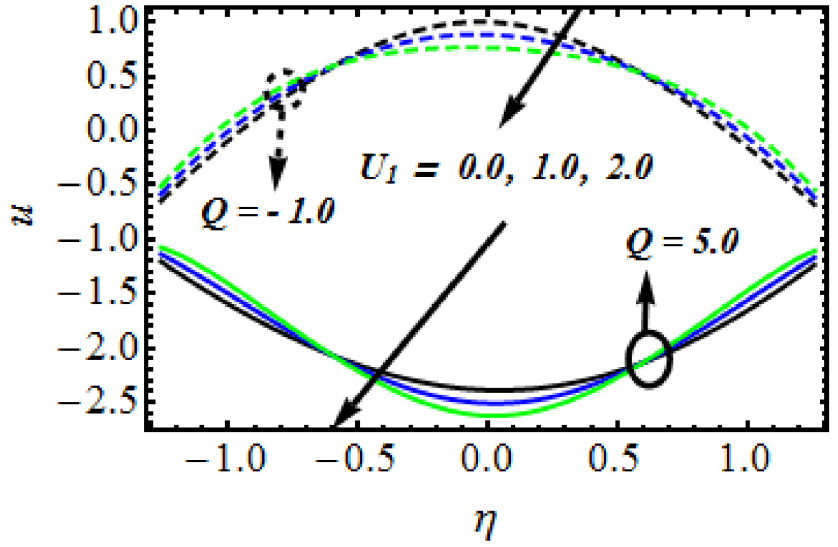
The physical attribution and mechanism of axial velocity has been testified for electro-osmotic constant , rheological fluid constants , electro-osmotic velocity , slip parameter , thermal Grashof number , and concentration Grashof number in Figures 2 to 7 for non-similar values of flow rate. During the variation of other parameters the fixed values of the involved parameters are and
Axial velocity against with .
Axial velocity against with .
Axial velocity against the with .
Axial velocity against the with .
Axial velocity against the with .
Axial velocity against the .
Figure 2 pornounced the axial velocity change for electro-osmotic constant for . A reducing change in core channel surface is noted for electro-osmotic constant. However, arsing observations are predicted in the symmetric surface channel. In view of electric double layer, a reverse relation between electric double layer and electro-osmotic constant is noted. A reducing electric double layer with higher electro-osmotic constant is noted near the surface. With iterative values of for velocity rate in heart of surface and near the surface is opposite. The determinitation in axial velocity with role of slip factor in observed in Figures 3 and 4. The low velocity observations in core surface channel is observed against iterative non-Newtonian numerical values (Figure 5). The arising attribution of velocity for Prandtl fluid is noticed as compared to visocus material. The decline in axial velocity is due to rheological behavior of the fluid which restrict the motion in the core region of flow as a result fall in velocity is noticed near the central line. The decline in velocity is noticed at the heart of the channel and the effects of slip are dominant near both walls for dissimilar values of . It is observed that the increase in slip dominants its impact on velocity near walls and the effects of slip parameter vanishes as the fluid moves toward origin. Figure 6 obsevred the silent features of electro-osmotic velocity parameter for longitudinal velocity The retarded observations in due to are noticed. In core regime of surface, the velocity declined with electro-osmotic constant. However, the vicinity regime surface of boundary, the increasing aspect of velocity is noted. The appearance of electro-osmotic force is attributing the role of resistive force. Moreover, a reverse velocity change with is resulted for Figures 7 and 8 focused the influence of thermal Grashof constant and mass concentration Grashof number . The leading change in velocity rate in left channel surface is resulted while velocity reduces in all remaining zone with Grash of number. Here, the absence of buoyancy forces is denoted for . The trend of velocity change for enhancing mass concentration Grashof number is shown contrary behavior as compared to
Axial velocity against the .
Temperature distribution
Figures 9 to 13 illustrates the interest of petameters like , and on t temperature profile in view of temperature ratio parameter . During the analysis the numerical values of fixed parameters are and Figure 9 reports the nature of temperature profile for Biot number . The observations are visualized for linear and non-linear radiation impact. The improving change in Biot number result decrement in . Owing to temperature jumps, the lower heat transfer is obtained. Figure 10 reports the dynamic of for Dufour constant . The increasing attention in temperature due to has been observed. By definition, the Dufour constants explores the ratio between temperature and concertation differences. Figure 11 claimed the change in for Eckert number The declining temperature rate in left half and right half is observed, respectively. Physically, the increment claimed in Eckert number improves the internal kinetic energy due to dissipation factor and subsequently temperature raise. Figure 12 conveyed the contribution of radiation parameter , the temperature profile decreases by strengthen the radiation process continuously and the fall in temperature occur due to the Radiative process the fall in internal kinetic energy of the fluid and as a result fall in temperature is noticed. The observations for and are defined in Figure 13. When increases, lower heat transfer rate is noted. The association of electric force in flow regime present reduced temperature change due to Grashof number. For that is for non-linear radiation the fall in temperature has maximum magnitude.
Variation of temperature for .
Variation of temperature for .
Variation of temperature for .
Variation of temperature for with .
Variation of temperature for .
Concentration profile
The graphical predictions for , and on profile when other involved parameters are fixed with and The concentration profile observations Joule heating constant is explored via Figure 14. The declining concentration change due to is noted for The profile of concentration due chemical reaction parameter is noted in Figure 15. The lower concentration rate due to is resulted. The physical influence of and on concentration field in discussed in Figures 16 and 17, respectively. With change in and , concentration profile rises.
Variation of concentration for .
Variation of concentration for .
Variation of concentration for .
Variation of concentration for .
Nusselt number and Sherwood number
In this section the Figures 18 to 22 are plotted to show the variation of Nusselt number and Sherwood number for various parameters of interest for both linear and non-linear radiation parameter. The geometrical parametesrs are taken with same values as discussed in above sections. Other involved parameters are and Figure 18 reported the signified impact of and on Nusselt number. When electro-osmotic parameter allocate maximum numerical values, the change in Nusselt number is increased. This trend is same for linear and nonlinear radiative phenomenon. The increasing framework of Nusselt number is predicted for nonlinear and linear radiative case. The physical reason behind such fact is presence of kinetic energy. However, with increasing , Nusselt number rises up to remarkable range. The features explored in Figure 19 illustrates the association of Dufour number on Nusselt and Sherwood number. The boosting profile of and due to is observed. However, no significant change is noted due to joule heating constant. Figure 20(a) predicted the influence of Nusselt against When the Nusselt number get peak trend. With Brinkman number heat transfer rate grows up. In Figure 20(b) the response of Nusselt number against thermal radiation parameter for both and is reported. It is observed that increase in thermal radiation parameter decreases the for both linear and non-linear Radiative flows.
(a) Nusselt number for with . (b) Nusselt number for with .
(a) Nusselt number for . (b) Sherwood number for .
(a) Nusselt number for . (b) Nusselt number for .
(a) Nusselt number for . (b) Sherwood number for .
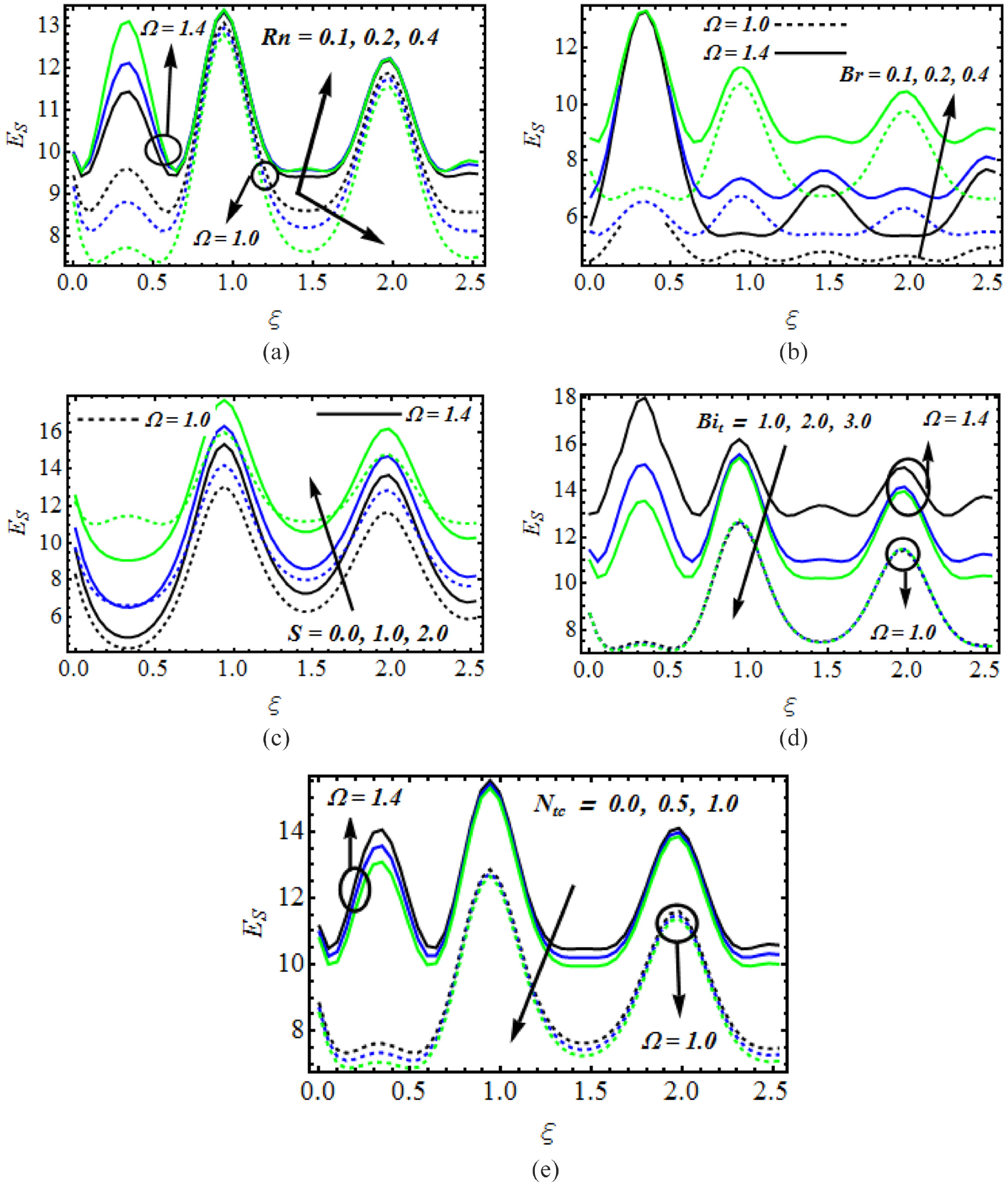
(a) Entropy generation number for . (b) Entropy generation number for Br. (c) Entropy generation number for . (d) Entropy generation number for . (e) Entropy generation number for .
A larger numerical variation in Nusselt number with enhancing joule heating constant is resulted (Figure 21(a). The boosted impact of joule heating parameter for linear radiative and nonlinear radiative phenomenon is obtained. The results focused in Figure 21(b) show the impact of on Sherwood number. The rising behavior of Sherwood number with larger is founded.
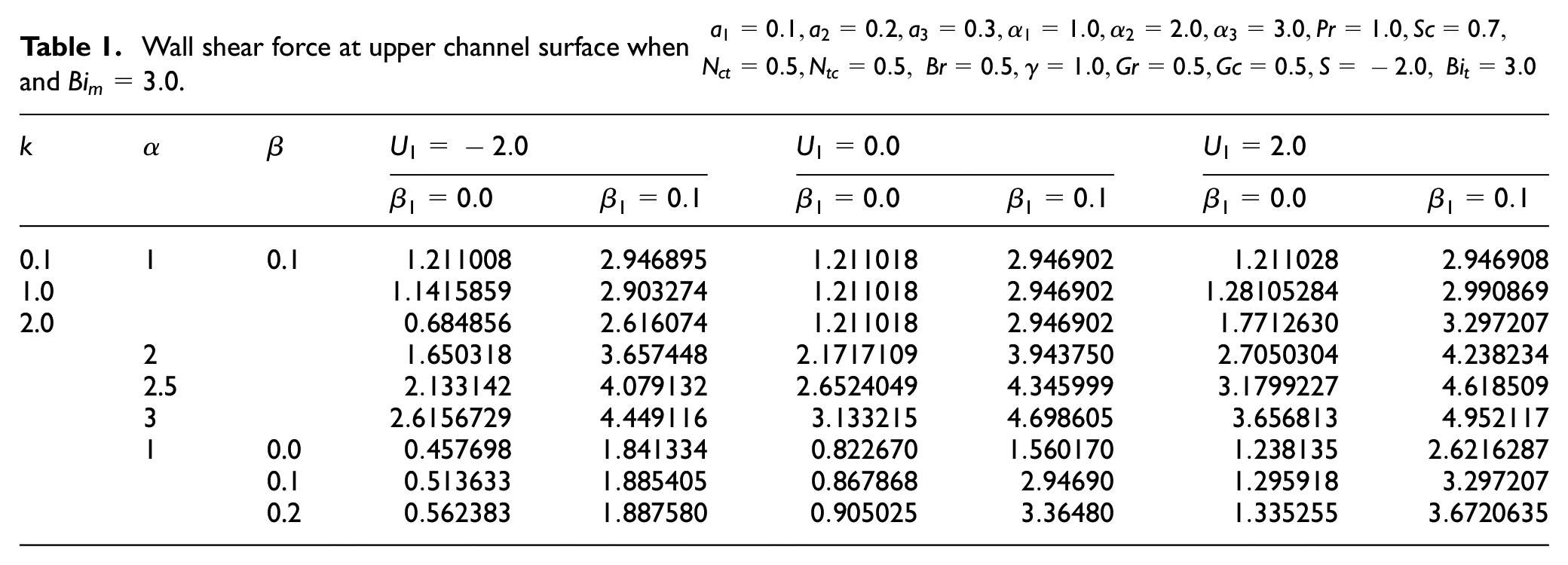
Wall shear force
The impact of wall shear force defined via relations (24) is visualized for electro-osmotic velocity in Table 1. For assisting flow case (), the wall shear force fluctuated when electro-osmotic constant gets vary. The deacceleration in wall shear force due to electro-osmotic force has been noted. Here, for , the role of electro-osmotic constant dismiss which is due to electric double layer. The higher wall shear force magnitude for slip appearance and electro-osmotic is noted. The lower wall shear force is noted for assisting flow opposing flow and without electric force For no-slip appearance, the wall shear force declined.
Wall shear force at upper channel surface when and .
0.1
1
0.1
1.0
2.0
2
2.5
3
1
0.0
0.1
0.2
Entropy generation
Figure 22 is plotted to analyzed the response of axial pressure for involved values of radiation parameter for both linear and non-linear radiative flows. The flow parameters and geometrical parameters are fixed as in above sections. The involved parameters are and .
The rise in thermal radiation declines the entropy generation number along the cross-section with large magnitude for but opposite results are noted for . In Figure 22(b) the entropy generation number rises for the increasing values of Brinkman number . For non-linear radiation case the magnitude of entropy generation number is large due to large heat transfer into the fluid. From Figure 22(c) it is clear that increase in joule heating parameter cause a remarkable increase in entropy generation number for and . Furthermore, the magnitude of entropy generation number is large for It is also clear in Figure 22(d) and (e), the rise in thermal Biot number and also cause a fall in entropy generation number.
Bejan number
The irreversibility in the present study is defined by Bejan number in the present study is plotted for various values of Radiation parameter . The analysis is carried out for both linear radiation phenomenon and non-linear radiation process In Figure 23(a) the effects of of Bejan number is plotted. The Bejan number declines for thermal radiation parameter for linear Radiative flow while rises for non-linear Radiative flow. The rise in non-linear Radiative case is due to rise in temperature ratio which cases the irreversibility. The Bejan number for enhancing viscous dissipation is plotted in Figure 23(b) for several values of . A decline in Bejan number is intended for In Figure 23(c) the rise in joule heating parameter cause a large increase in . The rise in thermal Biot number and Doufor number reduces irreversibility which is interpreted in Figure 23(d) and (e).
(a) Bejan number for . (b) Bejan number for Br. (c) Bejan number for . (d)Bejan number for . (e)Bejan number for .
Verification of results
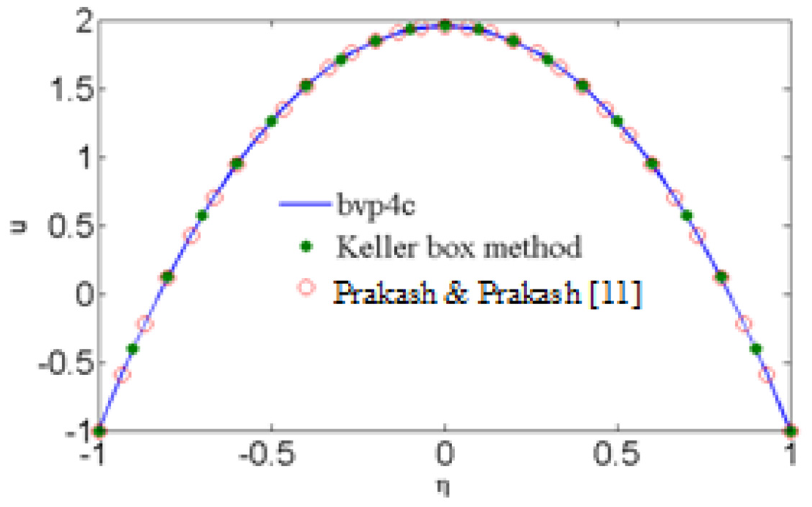
The verification and confirmation of simulation for obtained data is checked first by making comparison of present results with the work of and Ramesh and Prakash.11Figure 24 is plotted to show the accuracy of technique for viscous fluid and in absence of body forces. Moreover, Figure 25 is plotted to show the velocity profile for Prandtl Eyring nanofluid. The velocity profile shows a good agreement by Keller box scheme and bvp4c solver for flow parameters.
Comparison of velocity profile.
Comparison of velocity profile.
The value of involved parameters in Figure 25 is and
Concluding Remarks
The entropy generation flow of Prandtl nanofluid with applications of electro-osmotic is numerically investigated. The considered flow is induced due to wavy channel. The simplification in the governing model has been done by following the Debye-Huckel linearization approach. The finite difference numerical analysis is reported. The major outcomes are:
The axial velocity change in core channel surface decline with electro-osmotic constant.
The increasing change in velocity rate in left channel surface has been obtained for Grashof number.
The temperature rate enahcned with Dufour constant however, the impact of Eckret number is reverse.
When chemical reaction parameter increases, the lower concetration rate is noted.
The entropy generation number rises for the increasing values of Brinkman number.
The magnitude of entropy generation is larger for nonlinear radiative phenomeon as compared to linear radiative framework.
The Bejan number enhanced with joule heating parameter.
With enhancing Dufour number, the local Nusselt number also inreases.
Footnotes
Appendix
Handling Editor: Chenhui Liang
Declaration of conflicting interests
The author(s) declared no potential conflicts of interest with respect to the research, authorship, and/or publication of this article.
Funding
The author(s) disclosed receipt of the following financial support for the research, authorship, and/or publication of this article: The authors extend their appreciation to the Deanship of Scientific Research at King Khalid University, Abha 61413, Saudi Arabia for funding this work through research groups program under grant number R.G.P–1-303-42.
ORCID iD
Shahid Farooq
References
1.
ChoudhariRGudekoteMVaidyaH, et al. Rheological effects on peristaltic transport of Bingham fluid through an elastic tube with variable fluid properties and porous walls. Heat Transfer2020; 49: 3391–3408.
2.
PrasadKVVaidyaHRajashekharC, et al. Slip flow of MHD Casson fluid in an inclined channel with variable transport properties. Commun Theor Phys2020; 72: 095004.
3.
TanveerAMahmoodSHayatT, et al. On electroosmosis in peristaltic activity of MHD non-Newtonian fluid. Alex Eng J2021; 60: 3369–3377.
4.
DivyaBBManjunathaGRajashekharC, et al. The hemodynamics of variable liquid properties on the MHD peristaltic mechanism of Jeffrey fluid with heat and mass transfer. Alex Eng J2020; 59: 693–706.
5.
SaunierJYagoubiN. Investigating the static or dynamic flexural and compressive stresses on flexible tubing: comparison of clamp and peristaltic pump impact on surface damages and particles leaching during infusion acts. J Mech Behav Biomed Mater2021; 123: 104737.
6.
AhmedBHayatTAbbasiFM, et al. Mixed convection and thermal radiation effect on MHD peristaltic motion of Powell-Eyring nanofluid. Int Commun Heat Mass Transf2021; 126: 105320.
7.
KhazayinejadMHafeziMDabirB. Peristaltic transport of biological graphene-blood nanofluid considering inclined magnetic field and thermal radiation in a porous media. Powder Technol2021; 384: 452–465.
8.
ParveenNAwaisMAwanSE, et al. Thermophysical properties of chemotactic microorganisms in bio-convective peristaltic rheology of nano-liquid with slippage, joule heating and viscous dissipation. Case Stud Therm Eng2021; 27: 101285.
9.
Abo-ElkhairREBhattiMMMekheimerKS. Magnetic force effects on peristaltic transport of hybrid bio-nanofluid (Au-Cu nanoparticles) with moderate Reynolds number: an expanding horizon. Int Commun Heat Mass Transf2021; 123: 105228.
10.
JavidKRiazMChuY-M, et al. Peristaltic activity for electro-kinetic complex driven cilia transportation through a non-uniform channel. Comput Methods Programs Biomed2021; 200: 105926.
11.
RameshKPrakashJ. Thermal analysis for heat transfer enhancement in electroosmosis-modulated peristaltic transport of Sutterby nanofluids in a microfluidic vessel. J Therm Anal Calorim2019; 138: 1311–1326.
12.
SharmaATripathiDSharmaRK, et al. Analysis of double diffusive convection in electroosmosis regulated peristaltic transport of nanofluids. Physica A2019; 535: 122148.
13.
LodhiRKRameshK. Comparative study on electroosmosis modulated flow of MHD viscoelastic fluid in the presence of modified darcy’s law. Chin J Phys2020; 68: 106–120.
14.
NoreenSWaheedSLuD, et al. Heat stream in electroosmotic bio-fluid flow in straight microchannel via peristalsis. Int Commun Heat Mass Transf2021; 123: 105180.
15.
LvZZhangLWuH, et al. Induced charge electroosmosis characteristics of viscoelastic fluid around a metal cylinder. Colloids Surf A Physicochem Eng Asp2021; 623: 126727.
16.
NoreenSWaheedS. Study of heat characteristics of electroosmotic mediator and peristaltic mechanism via porous microtube. BioNanoScience2021; 11: 476–488.
17.
GhoshUMukherjeeSChakrabortyS. Electrophoretic motion of a non-uniformly charged particle in a viscoelastic medium in thin electrical double layer limit. J Fluid Mech2021; 924: A41.
18.
ZhouSSAbbasiAFarooqW, et al. Peristaltic transport of nano-fluid through a bio-fluidic channel with Joule heating features: applications of physiological systems. Eur Phys J Spec Top2021; 230: 3731–3741.
19.
AbbasiAMaboodFFarooqW, et al. Radiation and joule heating effects on electroosmosis-modulated peristaltic flow of Prandtl nanofluid via tapered channel. Int Commun Heat Mass Transf2021; 123: 105183.
20.
ChoiSUS. Enhancing thermal conductivity of fluids with nanoparticles. ASME Publ Fed1995; 231: 99–106.
21.
SaleemAAkhtarSAlharbiFM, et al. Physical aspects of peristaltic flow of hybrid nano fluid inside a curved tube having ciliated wall. Results Phys2020; 19: 103431.
22.
NarlaVKTripathiD. Entropy and exergy analysis on peristaltic pumping in a curved narrow channel. Heat Transfer2020; 49: 3357–3373.
23.
AkramJAkbarNSTripathiD. Thermal analysis on MHD flow of ethylene glycol-based BNNTs nanofluids via peristaltically induced electroosmotic pumping in a curved microchannel. Arab J Sci Eng2021; 47: 7487–7503.
24.
AkhtarSMcCashLBNadeemS, et al. Convective heat transfer for peristaltic flow of SWCNT inside a sinusoidal elliptic duct. Sci Prog2021; 104: 1–17.
25.
SongY-QJavidKKhanSU, et al. Hall device impacts on ciliated pump-assisted blood flow of double-diffusion convection of nanofluid in a porous divergent channel. Eur Phys J Plus2021; 136: 667.
26.
Ge-JiLeHQayyumSShahF, et al. Slip flow of Jeffrey nanofluid with activation energy and entropy generation applications. Adv Mech Eng2021; 13: 1–9.
27.
MahantheshB. Flow and heat transport of nanomaterial with quadratic radiative heat flux and aggregation kinematics of nanoparticles. Int Commun Heat Mass Transf2021; 127: 105521.
28.
MahantheshB(ed.). Quadratic radiation and quadratic Boussinesq approximation on hybrid nanoliquid flow. In: Mathematical fluid mechanics. Berlin: De Gruyter, 2021, 13–54.
29.
MahantheshBShashikumarNSGireeshaBJ, et al. Effectiveness of hall current and exponential heat source on unsteady heat transport of dusty TiO2-EO nanoliquid with nonlinear radiative heat. J Comput Des Eng2019; 6: 551–561.
30.
BejanA. Entropy generation minimization: the new thermodynamics of finite-size devices and finite-time processes. J Appl Phys1996; 79: 1191–1218.
31.
RiazAGulAKhanI, et al. Mathematical analysis of entropy generation in the flow of viscoelastic nanofluid through an annular region of two asymmetric annuli having flexible surfaces. Coatings2020; 10: 213.
32.
McCashLBAkhtarSNadeemS, et al. Entropy analysis of the peristaltic flow of hybrid nanofluid inside an elliptic duct with sinusoidally advancing boundaries. Entropy2021; 23: 732.
33.
LiY-MKhanMIKhanSA, et al. An assessment of the mathematical model for estimating of entropy optimized viscous fluid flow towards a rotating cone surface. Sci Rep2021; 11: 10259.
34.
LiY-XKhanMIGowdaRJP, et al. Dynamics of aluminum oxide and copper hybrid nanofluid in nonlinear mixed Marangoni convective flow with entropy generation: applications to renewable energy. Chin J Phys2021; 73: 275–287.
35.
ChuY-MNazirUSohailM, et al. Enhancement in thermal energy and solute particles using hybrid nanoparticles by engaging activation energy and chemical reaction over a parabolic surface via finite element approach. Fractal Fract2021; 5: 119.
36.
ZhaoTKhanMIChuY. Artificial neural networking (ANN) analysis for heat and entropy generation in flow of non-Newtonian fluid between two rotating disks. Math Methods Appl Sci Epub ahead of print 7April2021. DOI: 10.1002/mma.7310
37.
NazeerMHussainFKhanMI, et al. Theoretical study of MHD electro-osmotically flow of third-grade fluid in micro channel. Appl Math Comput2022; 420: 126868.
38.
ZhaoT-HCastilloOJahanshahiH, et al. A fuzzy-based strategy to suppress the novel coronavirus (2019-NCOV) massive outbreak. Appl Math Comput2021; 20: 160–176.
39.
ChuYMShankaralingappaBMGireeshaBJ, et al. Combined impact of Cattaneo-Christov double diffusion and radiative heat flux on bio-convective flow of Maxwell liquid configured by a stretched nano-material surface. Appl Math Comput2022; 419: 126883.