




Abstract
The convective heat and mass propagation inside dies are used to determine the characteristics of coated wire products. As a result, comprehending the properties of polymerization mobility, heat mass transport, and wall stress concentration is crucial. The wire coating procedure necessitates an increase in thermal performance. As a result, this research aims to find out how floating nanoparticles affect the mass and heat transport mechanisms of third-grade fluid in the posttreatment for cable coating processes in presence of a magnetic field with time-dependent viscosity. For nanofluids, the Buongiorno model is used. The model equations are developed using continuity, momentum, and energy in the presence of nanoparticle and time-dependent variable viscosity. We propose a few nondimensional transformations that are relevant. The numerical technique Runge-Kutta fourth method is used to generate numerical solutions for nonlinear systems. Pictorial depictions are used to examine the effects of various factors in the nondimensional flow. Furthermore, the numerical results are also verified analytically using Homotopy Analysis Method (HAM). The analytical findings of this investigation reveal that within the Reynolds modeling, the stress on the whole wire surface combined shear forces at the surface predominate the Vogel model. The contribution of nanomaterials on force on the entire surface of wire and shear forces at the surface appears positive. A non-Newtonian feature can increase the capping substance’s velocity. This research could aid in the advancement of wire coating technologies. For the very first instance, the significance of nanotechnology during wire coating evaluation is explored utilizing time-dependent variable viscosity regarding the magnetic field. For time-dependent viscosity, two alternative models are useful. The Lorentzian strength (a resistive form of force) increases in magnetic strength increases. As a result of the increased magnetic field, the motion of the polymerization in a die decreases. It is clear that increasing the intensity of Nb increases the heat transfer. The innovative fragment of the present study is to scrutinize the magnetized third-grade nanofluid for wire coating with variable viscosity inside the pressurized coating die, which still not has been elaborated in the available works to date. Consequently, in the restrictive sense, the existing work is associated with available work and originated in exceptional agreement.
Introduction
The polyethylene coating is frequently functionalized to cables or pipes for corrosion prevention, voltage differential, mechanical characteristics, and environmental legislation. The metal coating technique, in particular, is important in a variety of commercial applications. Coaxial extrusion, immersion, and electromagnetic application are examples of wire surface treatments. During the first two ways, the connection between the spectrum and polymerization is not as strong. As a result, although the electromagnetic deposition technique is quite sluggish, many researchers prefer and recommend it. Figure 1 shows an example of a wire-coated unit. The heat and mass transportation in the interior of molds determine the quality of wire products. Missoula is particularly interested in polymerization’s momentum features, thermal mass transport, and wall shear forces. Akhter and Hashmi, 1 Ayaz et al., 2 and others have published important mathematical studies on wire-coated assessments in viscous liquids. Khan et al. 3 employed a cylindrical component in the procedure of wire sealant by polymeric flow, which is impacted by numerous factors, including viscosity and unit form. The analytical results for wire sealant extrusion using compression form die in the circulation for third-grade fluid were disclosed by Buongiorno. 4 The appropriate solution for wire covering by extraction from an Oldroyd 8-constant tubular reactor was presented by Choi. 5 They hypothesized that the liquid was subjected to magnetic interaction. The Ellis solvent was used by Denn 6 to analyze wire treatment. Using the binomial series method, researchers were able to achieve closed-form results. They also calculated the coating wire thicknesses. Ellahi et al. 7 described the wire coating evaluation using a Sisko fluid and documented the effect of factors on the velocity and the energy required to draw the cable. By using an Oldroyd 8-constant fluid, Ellahi et al. 8 investigated the source of differential pressure affecting wire coating. Ellahi et al. 9 studied the influence of heat transmission on the viscoelastic fluid transformation into wire coatings postintervention. They also took into account a linear variation of heat on the coating ring’s surface. Eventually, Gireesha et al. 10 expanded on Hayat et al. 11 analysis with including third-grade liquid. Wire coating complications with non-Newtonian fluid have been investigated Hayat et al. 12 and Hussain et al. 13 The impact of changing viscosity on the wire was recently examined by Khan et al. 14 They presented viscous fluid and variable thermal conductivity scenarios using Reynolds and Vogel’s framework. Surprisingly, very few wire wrapping studies have considered sensible solutions of well-dispersed nanofluids. As a consequence, we concentrated our efforts in the present study to close this gap.

Polymer melt flow geometry.
Precincts are common in conventional heat transmission materials. Thermal efficiency is crucial in those areas. Kuznetore and Nield 15 developed a new era the heat transfer fluids called nanofluids to address this problem. However, he stated that with a small volume proportion of nanomaterials (5%), the thermal efficiency of the base fluid could be increased by 10%–50%. Mahamthesh et al. 16 investigated convective movement in nano liquid to determine the cause of an upsurge in heat capacity. He emphasized the significance of mechanisms including Brownian movement and thermal radiation. Numerous researchers have since used this framework exhaustively, such as Mahamthesh et al.17–19; Middleman 20 ; Mitsoulis 21 ; Muhammad et al. 22 ; Nayak et al.23,24; Rashidi et al. 25 ; Sajid et al..26,27; Shafieenejad et al. 28 ; Shah et al.29–31; Shehzad et al. 32 ; Shiekholeslami et al.33,34; Milani Shirvan et al.35–38; Khan et al.39,40; Siddiqui et al. 41 ; Turkyilmazoglu42,43; Khan et al.44,45 to examine the various aspect of nanofluids flow.
Similarly, Mahanthesh 46 investigated the heat flux with quadratic radiative of nanoparticles flow regarding the aggregation of kinematic of nanomaterials. Magnetized nan-third grade fluid with thermophoresis influence has been studied by Mahanthesh and Joseph. 47 Wire coating analysis with variable viscosity of third-grade fluid including nanoparticles has been carried out by Mahanthesh et al. 48
This investigation aims to examine the influence of nanomaterials on magnetohydrodynamic Third-grade fluid in a pressurized die during wire surface covering using Brownian motion and heat conduction. Reynolds, as well as Vogel’s models, compensate for variable viscosity as well. Such an endeavor has still not been constructed to contribute. Before being analytically attempted, the relevant resulting equations are made dimensionless by suitable transformation factors. The effect of various parameters accessing the problem is investigated in two situations: (1) the Reynolds model and (2) Vogel’s model. The innovative fragment of the present study is to scrutinize the magnetized third-grade nanofluid for wire coating with variable viscosity inside the pressurized coating die, which still not has been elaborated in the available works to date. Consequently, in the restrictive sense, the existing work is associated with available work and originated in exceptional agreement. The model equations are converted to ordinary differential equations using suitable transformations and then solved numerically by the RK-4 method. For confirmation of the code, the analytical solution is also obtained by HAM. Additionally, for validation of the results, the present work is compared with available literature and excellent agreement is found.
Modeling of the problem
It is postulated that a third-grade fluid filled with nanoscale material flows within a fixed compression type die with length L. The uncoated wire is dragged inside the die with velocity Uw and radius Rw in the pressurized type coating die with radius Rd and temperature θd. The concentration field is also considered in this analysis. The cylindrical coordinates system is chosen with longitudinal axis z aligned with fluid movement and peripheral direction r aligned with it (see Figure 1). It is also assumed that the flow is laminar, axisymmetric, continuous, and homogeneous. Due to the obvious, immutable pressure disparity and radially magnetized, natural movement is formed. The location of the continuum is believed to be concentrically situated. (Rw, θw, ϕw) and (Rd, θd, ϕd) are the radius, temperature, and volume fraction of the rope and dying, respectively.
Uw is also the speed of this wire as it is inserted along the central path of the machine. Nayak 23 and Nayak et al. 24 evaluated the velocity, additional stress tensor, heating rate, and volume fraction of nanomaterials:

Subject to constraints23,24,27

Regarding third-grade liquid, the stress tensor S is described as23,24,27

The governing equations (continuity, momentum, energy, concentration) that apply are as follows23, 24, 27



The parameters involved in the above equations are defined in the nomenclature given at the end of the article.
The electrical field is presented in a positive radially normal direction toward the wire, and the resultant magnetic force is believed to be insignificant. As a result, effective body force is determined by:

The dissipation factor with tensor components is as follows:



In light of the foregoing relationships, equation of motion (5) yields:
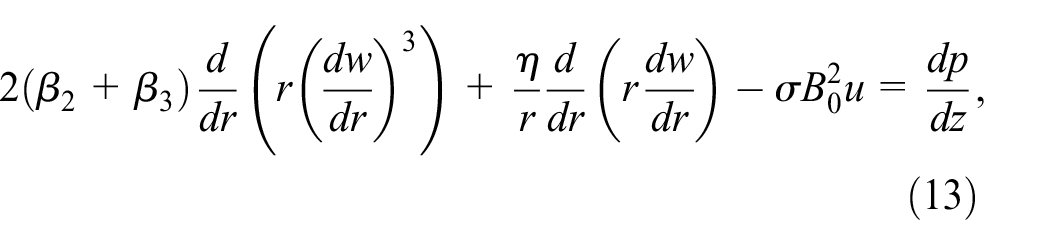

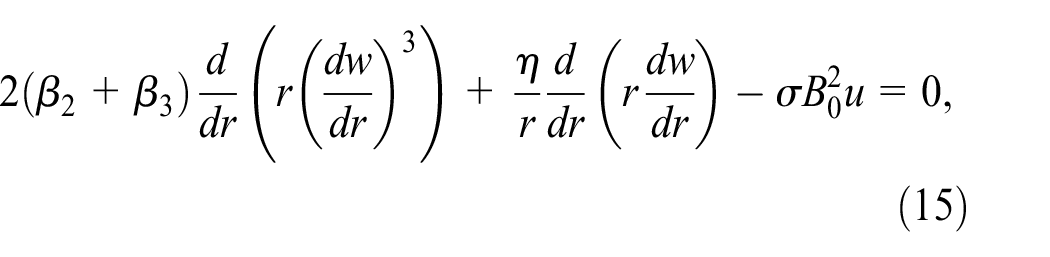
The flow is caused by the pressure difference, as shown by expression (13). Because there is just pull of a wire after it leaves the die, the pressure difference axially is insignificant. As a result, expression (13) can be reduced to:
In view of equation (10), the energy equation (7) becomes


The shear force at the wire’s surface is calculated as follows:

The force acting on the die’s total wire exterior is as described in the following:

Furthermore, the Nusselt number Nwr has the following definition:

Where
Case 1: Reynolds model
Nondimensional viscosity is incorporated in the study as follows Nayak 23 :

Where Ω is Reynolds model parameter.
In light of (21) and (22), the expressions (15)–(20) should be read as follows (without the asterisks):

Nondimensional momentum and energy equations with boundary conditions omitting asterisks are


where
Case 2: Vogel’s model
In this case, the temperature dependent viscosity is taken as

After using the expansion we have

where
Therefore, the nondimensional momentum and energy equations with boundary conditions omitting, asterisks are

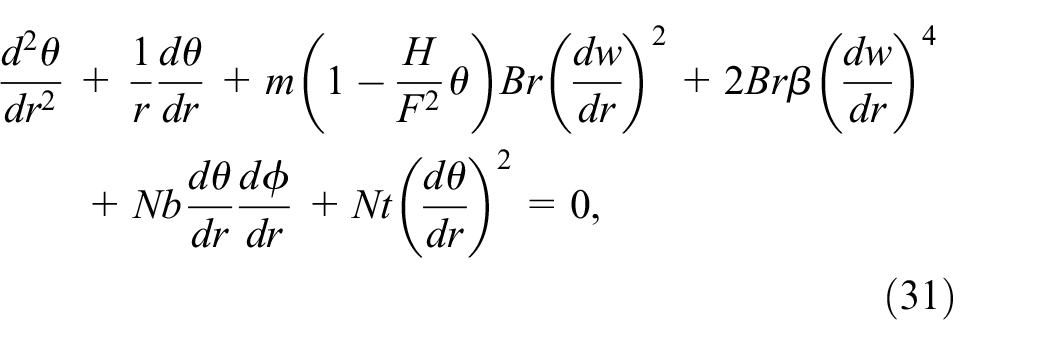

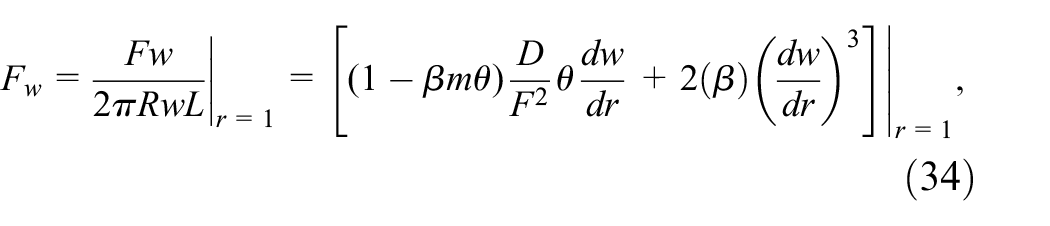
Additionally, equations (26) and (27) become

And
Numerical solution
The Runge-Kutta-Fehlberg strategy is applied to solve the multi degree differential equations system specified in equations (23)–(27). For this purpose following transformations are applied:

As a result, we get the following.

Transferred boundary conditions are:

The best guess estimates for the uncertainities
Validation of the results
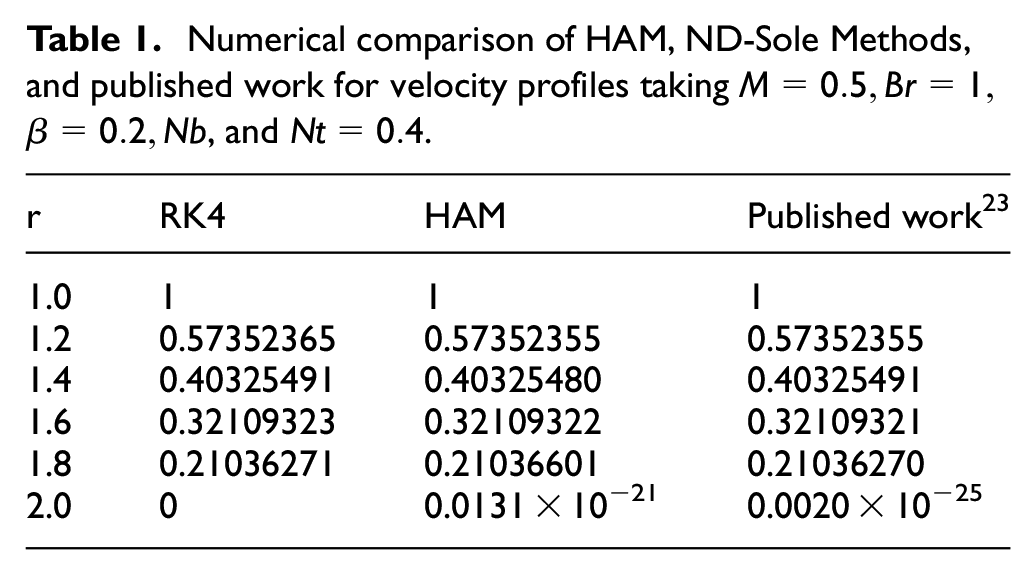
The technique’s consolidation is also required for testing the methodology’s trustworthiness. Figure 2(a) and (b) depict the convergence of such generated numerical results. The conclusions, as mentioned earlier, are also assessed using an analytical method known as HAM, and the two measurements show a remarkable correlation, as shown in Figure 2(a) and (b). In addition, Table 1 provides a comparative analysis of numerical and analytic solutions. The current study is compared to previous data 23 for greater precision, and there is a clear consensus, as indicated in Table 1.
Numerical comparison of HAM, ND-Sole Methods, and published work for velocity profiles taking

(a) Comparison of RK4 and HAM Methods velocity profiles taking
Results and discussion
For two scenarios, RM and VM, the effect of essential factors on velocity flow, temperature, and nanoparticle concentration profiles is explored in the presence and absence of a magnetic field. The shear stress on the surface of the total wire, and the size of the Nusselt number on the surface, are estimated for both Reynolds and Vogel’s model situations. The shear stress on the surface of the total wire is proportional to w′(r), as shown by equations (26), (27), (33), and (34). As a result, the shear stress on a total wire surface has the same characteristic as w′(1).
Figures 3 to 5, show the effect of m (viscosity factor of the RM) on the w(r), θ(r), and ϕ(r) distributions, respectively by keeping fixed M = 0.5, Br = 1, Nb = 0.1, and Nt = 0.4. Higher values of m indicate an increase in w(r) but a decrease in θ(r) and ϕ(r) profiles. Both the existence and absence of magnetism produce the same descriptive trend. Figure 3 further shows that for a larger M and fixed m = 0.5, Br = 1, Nb = 0.1, and Nt = 0.4, the w(r) profile is reduced. The Lorentzian strength (a resistive form of force) increases in magnetic strength increases. As a result of the increased magnetic field, the motion of the polymerization in a die decreases. Furthermore, under the magnetic interaction θ(r) and ϕ(r) simultaneously demonstrate the dual pattern inside the flow zone. Thus, in the region 1 ≤ r < 1.4, both θ(r) and ϕ(r) are stronger, whereas in the region 1.4 ≤ r ≤ 2, the tendency is the opposite (see Figures 4 and 5). It is worth noting that the results of the current study’s flow and thermal measurements match those of Nayak’s 23 study on the effect of the friction factor.

Effect of m on w(r) for RM case.

Effect of m on θ(r) in RM case.

Effect of m on ϕ(r) in RM case.
Figures 6 to 8 show a graphical representation of the variances in the w(r), θ(r), and ϕ(r) profiles form. Figure 6 shows that the fluid velocity grows in the region 1 ≤ r < 1.5, but this behavior is reversed in the remainder of the continent for greater values of Reynold viscosity parameter and fixing M = 0.5, Br = 1, Nb = 0.1, and Nt = 0.4. Figures 7 and 8 show that increasing m causes the polymer’s fields θ(r) to be enhanced while decreasing the ϕ(r) fields. Furthermore, the effect of magnetism is consistent with our prior findings (see Figures 3–5). Furthermore, while comparing the influence of the Reynolds model case and Vogel’s model case on the velocity field, we discovered that the velocity profile across the die is enhanced for the Reynolds model, but is constrained somewhat for Vogel’s model, especially near the die’s boundary.
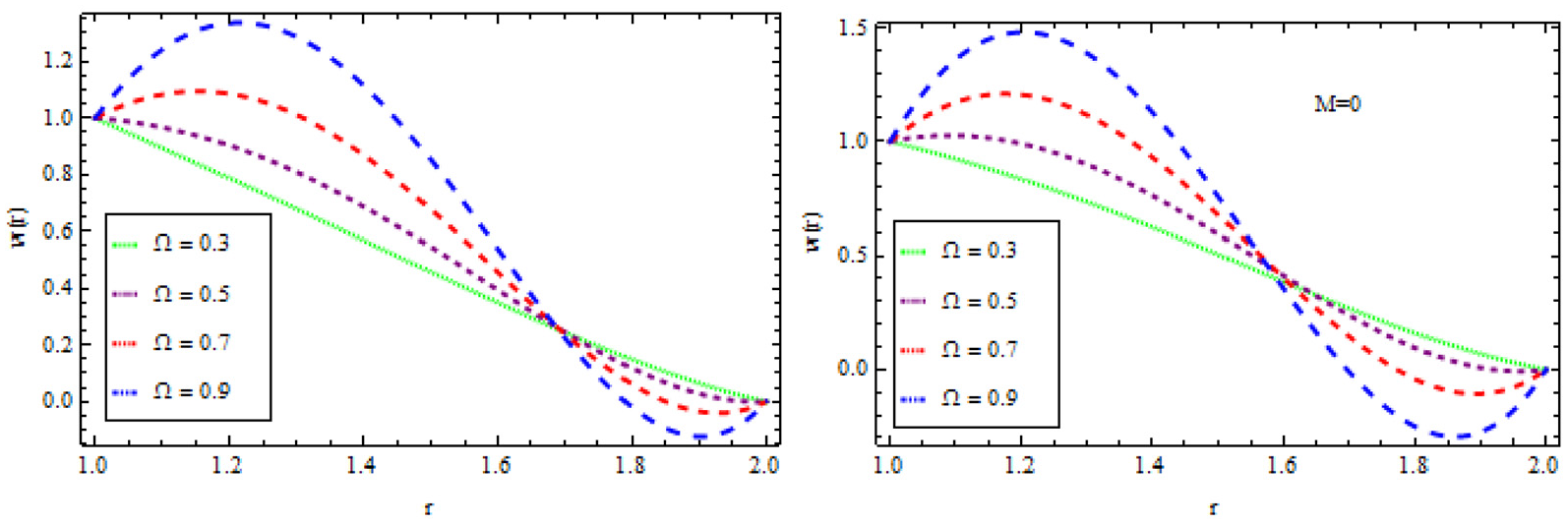
Impact of Ω on w(r) in VM case.

Impact of Ω on θ(r) in VM case.
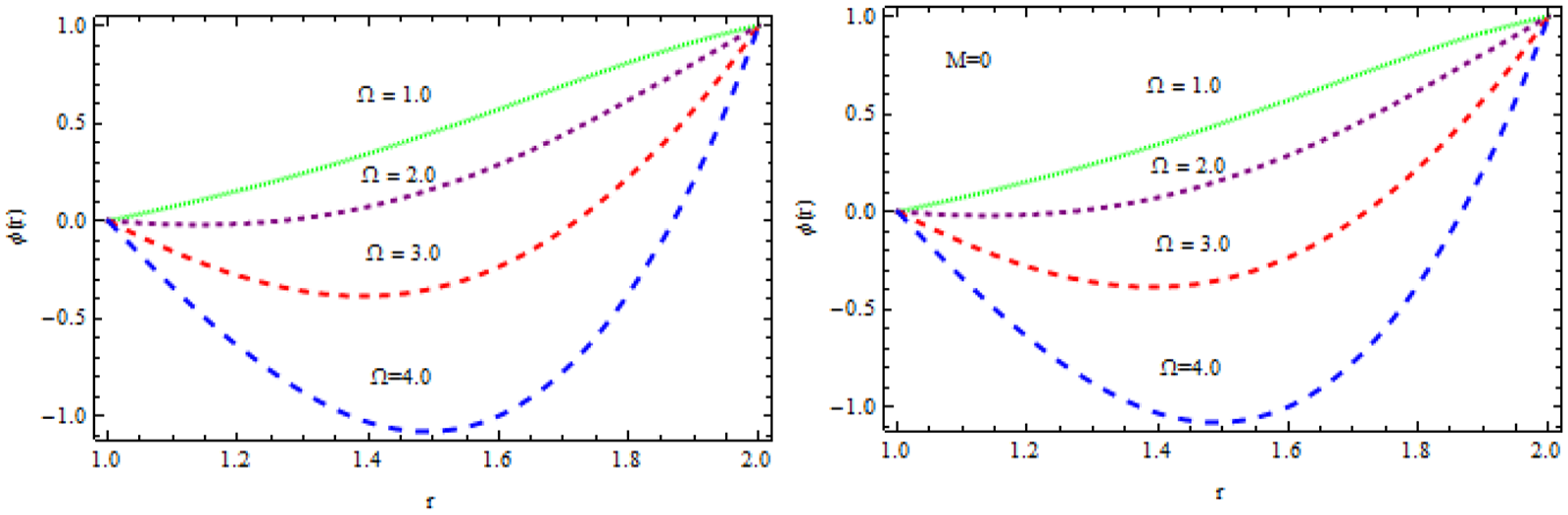
Impact of Ω on ϕ(r) in VM case.
Keeping M = 0.5, Br = 1, m = 0.1, and Nt = 0.4 fixed, Figures 9 and 10 show the modification of θ(r) due to the impact of Nb inside the Reynolds and Vogel situations, respectively. It is clear that increasing the intensity of Nb increases the heat transfer in the range 1 ≤ r < 1.4 for Reynolds and Vogel’s situations, however, the behavior in the rest of the state is the total opposite. Furthermore, in the RM situation, the temperature field, θ(r), prevails over Vogel’s case. With increasing Nb, the stochastic collision among nanoparticles and liquid molecules increases, causing a flow to become heated and the nanoparticle concentration field to decrease (see Figures 11 and 12). Furthermore, the magnetism has no discernible effect on the ϕ(r) field at any location on the die.

Impact of Nb on θ(r) in RMccase.
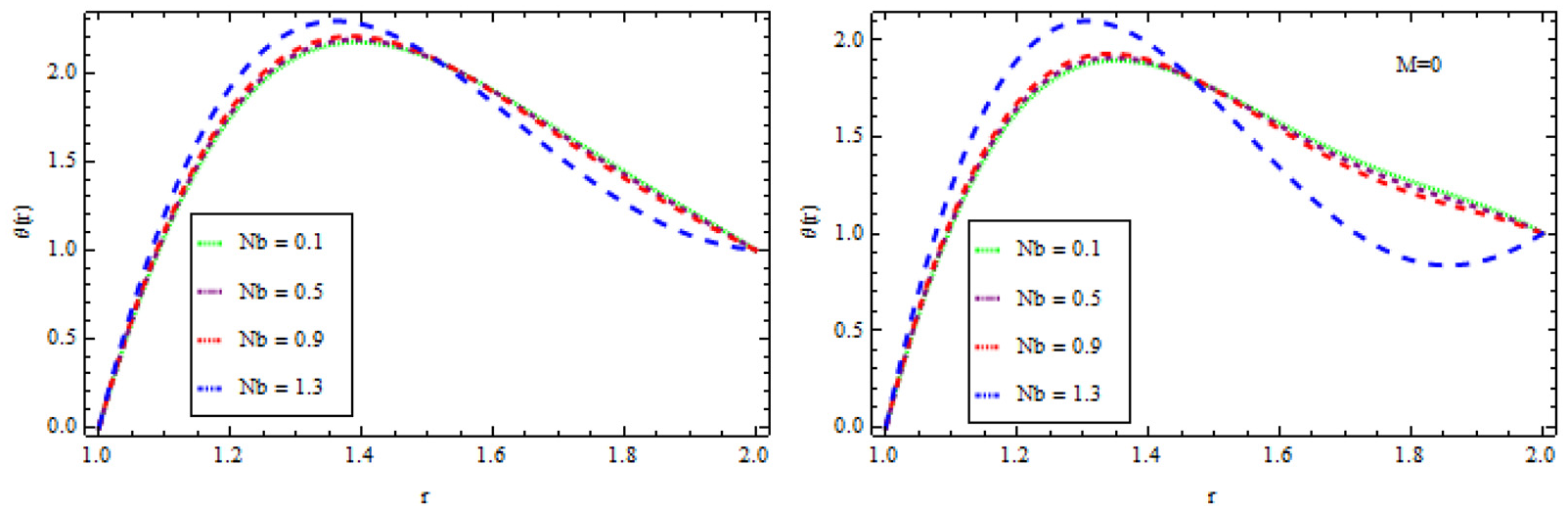
Impact of Nb on θ(r) in VM case.

Impact of Nb on ϕ(r) in RM case.

Impact of Nb on ϕ(r) in VM case.
As shown in Figures 13 and 14, the significance of Nt on θ(r) is analogous to that of Nb on θ(r). The convective heat transfer force is a force that causes nanomaterials to spread into the surrounding fluid as a conclusion of a temperature difference. The enhancement of thermophoretic force causes nanoparticles to migrate deeper into the polymer. As a result, the temperature field increases in nearly half of a domain. Figures 15 and 16 show that with greater values of Nt, ϕ(r) decreases. This is the case in both circumstances.

Impact of Nt on θ(r) in RM case.

Impact of Nt on θ(r) in VM case.

Impact of Nt on ϕ(r) in RM case.

Impact of Nt on ϕ(r) in VM case.
Figures 17 and 18 show the effect of β on w(r) for Reynold and Vogel’s model situations, respectively while keeping other physical parameters M = 0.5, Br = 1, Nb = 0.1, and Nt = 0.4 fixed. The non-Newtonian parameter denominator contains rheological properties. As a result, the fluidity of the polymers decreases as we increase β. As a result of increasing the non-Newtonian liquid factor, the melting polymer mobility increases. This pattern is qualitatively comparable in both situations; however, the effect of β on w(r) is more noticeable in the Reynolds model than in Vogel’s case. The non-Newtonian feature implies that the coating structure’s movement can be increased.
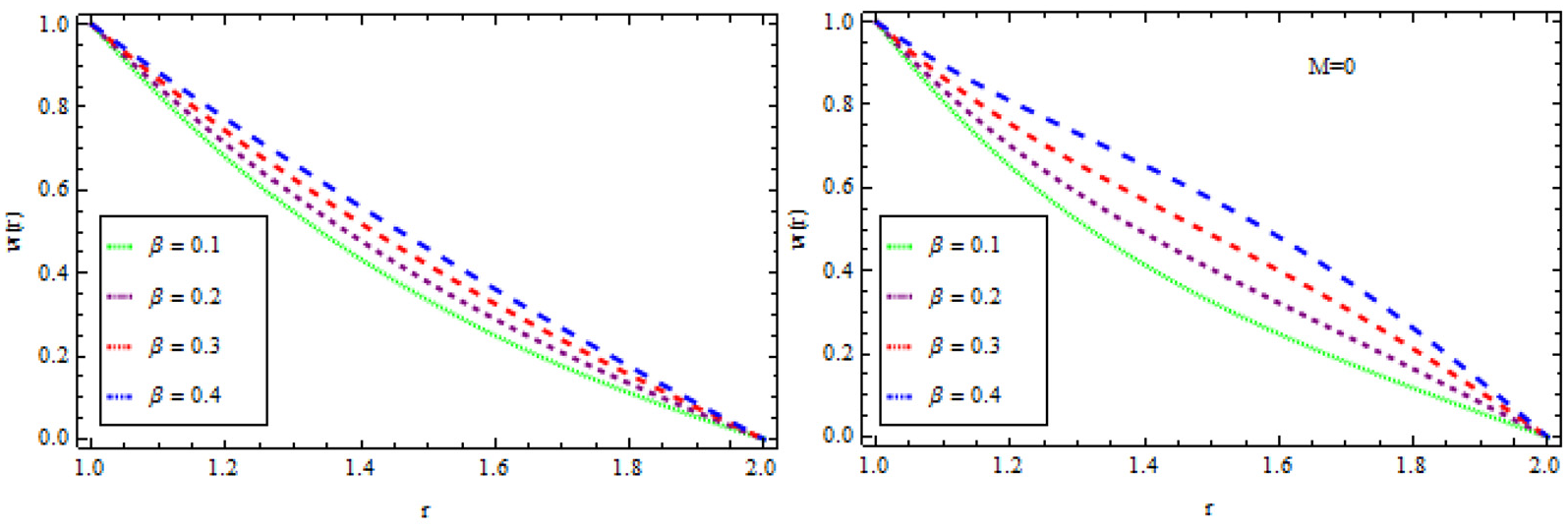
Impact of Nt on w(r) in RM case.

Impact of β on w(r) in VM case.
The influence of Br on θ(r) viscosity is seen in Figures 19 and 20 for the Reynolds and Vogel model models, respectively. A larger amount of Br enhances the θ(r) profile. Br denotes the relative value of viscous heating by conduction of heat. Furthermore, in Vogel’s case, the thermal profile varies substantially more for Br than for the RM case. This is validated with the results of studies published by Nayak. 23

Impact of Br on θ(r) in RMccase.

Impact of Br on θ(r) in VM case.
Figures 21 to 23 show the effect of β, M, Br, Nb, and Nt on θ′(1) for both RM and VM case. Figure 21 shows that θ′(1) is larger with greater values of β and decreases with increasing M in the VM case. Figures 22 and 23 indicate the effect of Br, Nb, and Nt on θ′(1) for VM and RM. θ′(1) decreases for Br, Nb, and Nt. This is true in both RM and VM scenarios. Additionally, in the RM situation, the force at the surface of the total wire plus shear force at the surface are greater than VM.

Impact of β and M on −θ′(1) in VM case respectively.

Impact of Br and Nb on −θ′(1) in RM case.

Impact of Nt on θ′(1) in RM case.
Concluded remarks
Regarding Reynolds and Vogel’s situations, the significance of temperature-dependent viscosity in hydromagnetic heat and mass molecular diffusion of Third-grade fluid with particle concentration is investigated. Variable viscosity has a significant impact on all fluid flows. Viscosity factors can efficiently control the heat transport of resin in a die. The Lorentzian strength (a resistive form of force) increases in magnetic strength increases. As a result of the increased magnetic field, the motion of the polymerization in a die decreases. The fluid velocity grows in the region 1 ≤ r < 1.5, but this behavior is reversed in the remainder of the continent for greater values of Reynold model parameter. With increasing Nb, the stochastic collision among nanoparticles and liquid molecules increases, causing a flow to become heated and the nanoparticle concentration field to decrease.
For larger values of random motion and thermal radiation, the temperature gradient is enhanced in the first quarter of the section, but detrimental behavior occurs in the second half. Furthermore, the Brownian motion factor increases the concentration profile, but the thermophoresis factor shows a decrease. In Vogel’s model, the thermoelectric field varies more strongly than in the Reynolds model case. In the RM case, the force on the whole surface of the wire and shear forces at the surface are greater than those in the VM case. When RM prevails over VM, the influence of nanomaterials is positive for force on the whole wires and shear forces at the surface.
Footnotes
Handling Editor: Chenhui Liang
Declaration of conflicting interests
The author(s) declared no potential conflicts of interest with respect to the research, authorship, and/or publication of this article.
Funding
The author(s) received no financial support for the research, authorship, and/or publication of this article.

Data availibility statement
All relevant data are included in the manuscript. There is no data to support the present work.