



Abstract
This work examines the second law analysis of an electrically conducting reactive third-grade fluid flow embedded with the porous medium in a microchannel with the influence of variable thermal conductivity, activation energy, viscous dissipation, joule heating, and radiative heat flux. A suitable non-dimensional variable is included into the governing equations to transform them into an ensemble of equations that are devoid of dimensions. The acquired equations are then tackled using the Runge Kutta Felhberg 4th and 5th order (RKF-45) approach in conjunction with the shooting methodology. Through comparison with the current results, the numerical results are verified, which provides a good agreement. From the present outcomes, it is established that the entropy generation is supreme for the viscous heating constraint, variable thermal conductivity, Frank Kameneski, heat source ratio parameter and third-grade fluid material constraint. The Bejan number boosts up with larger values of activation energy, and Frank Kameneski constraint and the decreasing nature is noticed for increasing third-grade material parameter, viscous heating parameter. With magnetism, the fluid’s velocity slows down because of a resistive force. A similar impact in the channel on velocity is noticed for larger third-grade fluid, activation energy parameter, and Frank-Kameniski parameters and increasing behavior is noticed for variable thermal conductivity, and permeability parameter. Further, it is cleared that the variable thermal conductivity assumption in the channel plate leads to a significant under prediction of the irreversibility rate.
Introduction
Entropy is taken into account in thermodynamic optimization while analyzing engineering systems. It deals with the problem of entropy production in particular. In a thermal system, the loss of availability or energy is directly correlated with the production of entropy. Contemporary thermal design techniques are now focused on minimizing energy destruction as a way to maximize thermodynamic performance. Whether constrained or unconstrained, the objective function in a thermodynamic optimization is entropy production or entropy production rate. This modern discipline is known as entropy generation minimization (EGM). By using EGM, it is possible to evaluate the combined impact of pressure drop and thermal resistance at the same time while the heat exchanger interacts with the surrounding flow field. Previous research has demonstrated that, the design of a microchannel is influenced by its pressure drop and thermal resistance. But according to EGM, a novel optimization theory stated, optimization of the entropy generation rate should also necessary. The goal of efficient energy utilization of thermal devices can be attained by minimizing their entropy in the processes. This can be achieved by the basic tool called the second law of thermodynamics. The viscous dissipation, convective heat transfer, and joule heating are the three factors that cause Entropy to arise. Entropy generation finds wide-ranging applications in the industry and engineering fields, such as modern electronics cooling systems, systems of geothermal energy, refrigerators, and solar power collectors etc. Within this context, Mahesh et al. 1 have investigated the optimization of entropy production in an unstable hybrid nanofluid flow between two spinning disks. Shoaib et al. 2 have inspected the entropy generation and effect of Ohmic heating for Ree-Eyring fluid. Xiong et al. 3 have studied the impact of hybrid nanofluids on the flow of entropy generation. Yusuf et al. 4 considered the entropy generation on thermal transfer and flow of a Sisko fluid with a permeable medium due to inclined walls. Pakdemirli and Yilbas 5 have elaborated non-Newtonian fluid flow with entropy generation in a pipe.
The Couple stress in flow analysis primarily focuses on the impact of fluid particle sizes, specifically those of thick polymer oils, liquid crystals, synthetic fluid, and animal blood. This is significant due to the application of these fluids in industries and the augmented carrying flow via thin films. Through graphs, they have addressed the effects of effective temperature, rarefaction, and FWTP on temperature, fluid velocity, irreversibility, and the irreversibility ratio. In their study, Cyriac et al. 6 investigated the operation of a roughness secant slider bearing coated with several stress liquids and subjected to a magnetic field. The pair stress circulation among Newtonian fluids owing to a channel was investigated by Devakar et al. 7 Umavathi et al. 8 investigated a couple-stress fluid’s heat transfer and velocity characteristics as it traverses viscous fluid layers. Zeeshan et al. 9 studied the convective heat transfer and flow of two stress fluids using a paraboloid of revolution. Abd Elmaboud et al. 10 studied the pair stress fluid movement with peristalsis in a revolving channel.
Understanding and accurately quantifying radiative heat transfer in the movement of fluids via conduits is critical to optimizing thermal management systems, constructing effective heat exchangers, and forecasting temperature distributions in a range of industrial processes. Jamshed et al. 11 studied the flow characteristics of a second-grade nanofluid that incorporates radiative heat exchange and is implanted inside a perforated flat surface. Madhu et al. 12 carried out research concerning the flow of a nanofluid across a rotating cone and an extended disk. They found out the impact of the solid-liquid interaction layer. Naveen Kumar et al. 13 explored the effect of magnetic dipoles on radiative tiny liquids flowing across a stretched sheet. Varun Kumar et al. 14 conducted research involving the flow of a ternary nanofluid across a slow-rotating disk under uniform-suction. Bhattacharyya et al. 15 did research on the effects of heat radiation on the flow of micropolar fluids by permeable diminishing material.
Much scientific literature has approached non-reactive flow. The recognition of convection has been critically exposed in porous media by Vellanki et al. 16 Furthermore, it is well-established that exothermic chemical reactions control thermal buoyancy-driven flow to a large extent, which is crucial for the development of the temperature field. 17 These types of occurrences are observed in diverse practical situations, including the process of burning oil in subterranean reservoirs to enhance oil extraction, the utilization of catalytic permeable beds to mitigate the potential hazards associated with ignition byproducts, and the implementation of ceramic radiant permeable heaters by enterprises for efficiently transferring thermal energy. 18 To determine how thermal buoyancy affects non-Newtonian fluid transient circulation across a porous medium, Chinyoka and Makinde 19 have conducted a numerical investigation. Moreover, Rundora and Makinde 20 have theoretically investigated the impact of Navier-slip on the disordered circulation of a reactive variable-viscosity TGF via a saturated permeable media, especially when asymmetric convective boundary conditions are present.
Recently, non-Newtonian fluids have seen significant advancements in study because to their vast uses in industrial and technical domains. Examples include ketchup, blood, custard, toothpaste, paint, shampoo, and more. Because it’s used in cooling system designs, hydrology, and MHD generators, it offers valuable experimental, numerical, and mathematical research. Because it can simulate the fluid’s shear thickening and thinning characteristics, the third-grade fluid is a crucial model of non-Newtonian fluids. Furthermore, it finds uses in confectionery, pharmaceutical, lubricant, and petrochemical engineering. Alzahrani et al. 21 investigated mass and thermal distribution in third-grade liquid flow with activation energy. Madhu et al. 22 considered the influence of a magnetic dipole on the motion of a circulating non-Newtonian liquid. Sarada et al. 23 examined the magnetohydrodynamic effect on non-Newtonian fluid flow through a stretching sheet. The electro-osmotic third-grade fluid flow through a channel with stretchable walls was considered by Parida and Padhy. 24 Adesanya et al. 25 analyzed the heat transfer and flow of a third-grade liquid with convective wall cooling. Recently, myriads of authors have worked in various perspectives concerning the third-grade liquid flow through a microchannel. These include Khan et al., 26 Felcita et al., 27 Khan et al., 28 and Adesanya et al. 29
Liquid flowing in vertical microchannels exhibits unique properties due to the small size that enhances heat transfer abilities and control of the fluid stream. Therefore, understanding the diverse relation of the fluid dynamic with the heat transfer phenomena is fundamental to topical-side and diverse engineering devices that rely on microchannel development and improvement. Viscous forces in microchannels are the most influential factors due to small channels causing viscous forces to outweigh inertial forces. Therefore, engineers develop laminar flow in microchannels characterized by an orderly and neat pattern of flow. Sharma et al. 30 investigated the thermophoretic velocity effect of ternary hybrid nanofluid flowing through microchannel embedded with permeable flat plates. Sindhu et al. 31 have studied the multi-walled carbon nanotube suspended in nanoliquid with a heat source via a vertical microchannel. Belahmadi and Bessaih 32 have investigated the transfer of heat and flow of Cu-water nanofluid through a vertical channel. Fersadou et al. 33 analyzed the MHD nanofluid flow with mixed convection via a vertical permeable channel. Kahalerras et al. 34 have probed the entropy generation analysis and thermal transfer of nanofluid with non-uniform heating in a vertical channel.
The study cited above assumed that the liquid’s viscosity and heat conductivity remained unchanged. The liquids have the ability to undergo significant alterations in their physical properties if exposed to varying temperatures. The consequence of internal friction and subsequent temperature increase on the viscosity and thermal conductivity of liquids is of great importance in the field of lubricated theory. The viscosity and thermal conductivity are most significantly influenced by variations in temperature. The rise in temperature results in a localized augmentation of the transportation phenomenon via the reduction of viscosity across the momentum boundary layer. Consequently, the constant values of fluid viscosity and thermal conductivity are no longer regarded as such. The flow instances involving a highly reactive fluid with Arrhenius kinetics in an upward channel are expected to be more intricate in respect to heat transportation and dispersion. Consequently, the linearized Boussinesq approximation may not accurately determine the thermal framework. In this regard, this study extends to the study in Adesanya et al., 25 that is, the reactive third-grade liquid circulation in an upward microchannel with couple stress, magnetism, variable thermal conductivity, heat source/sink, radiative heat flux, joule heating, and viscous dissipation. After an extensive review survey, it is confirmed that the outcome of this work is utilized in various oil recovery, geological, and petrochemical engineering applications. The main objective of the investigation is to address the answers to the following research questions:
How does the porous permeability parameter impact velocity and thermal profiles?
What behavioral changes are observed in entropy generation by changing the values of the Biot number?
How is the Bejan number affected by escalated Magnetic parameter values?
Mathematical background of the flow problem
The physical interpretation of the problem is noticed in Figure 1. The space inside the channel is filled with a uniform porous medium. The walls of the microchannel is kept at constant temperature
vertical microchannel flow;
incompressible flow;
third grade fluid (“differential fluid”) produces viscoelastic effects;
couple stress condition;
electrically conducting fluid;
Arrhenius kinetics is followed to simulate the exothermic chemical reactions;
flow through porous media; and
variable thermal conductivity.
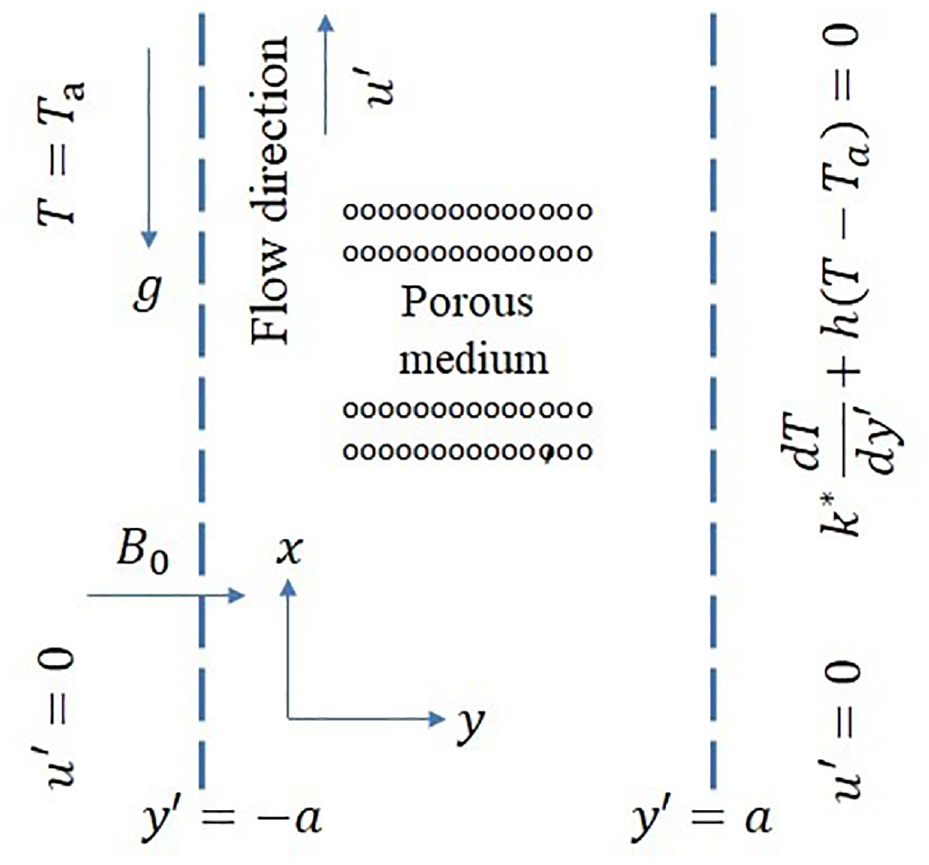
Viscoelastic reactive channel flow geometry.
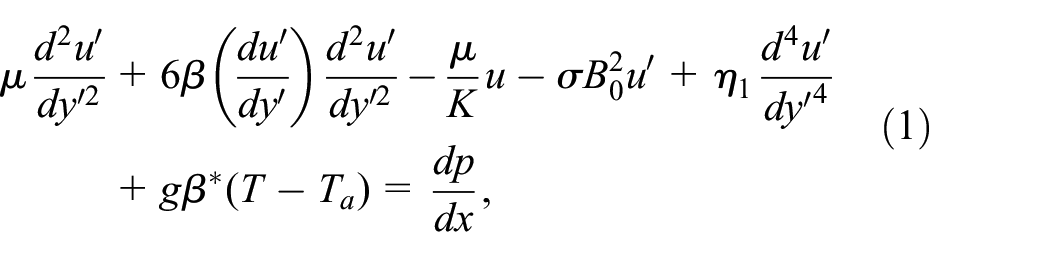
The governing equations of momentum, temperature, and irreversibility can be expressed as follows under the aforementioned assumptions 25


Respective boundary conditions as per the flow problem formulation are, as follows

where,
Assuming a linear temperature variation, the variable thermal conductivity

The thermal radiation via Roseland diffusion approximation can be defined as follows

Introduce the following suitable dimensionless variables

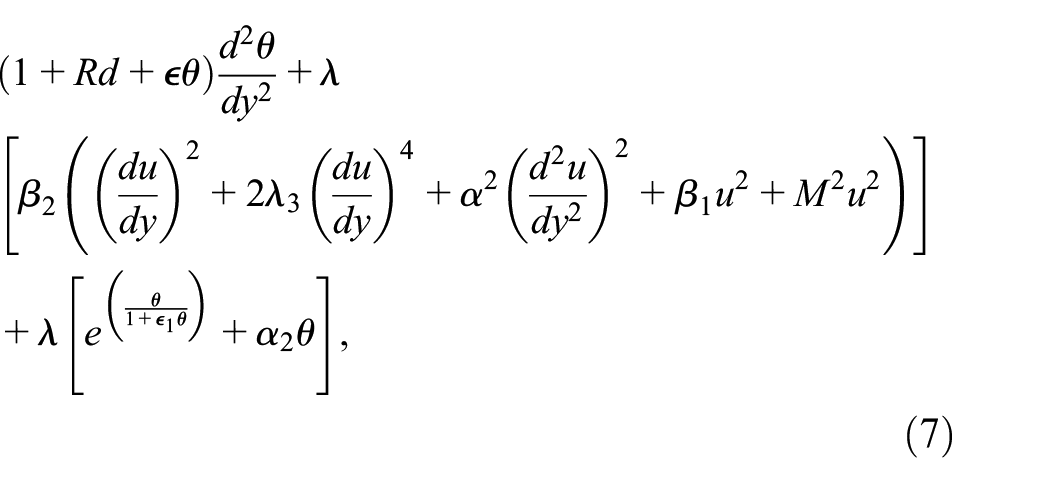
Apply the above mentioned non-dimensional variables (see equation (5)) to the equations (1)–(4), we obtain the following reduced system



The reduced boundary conditions can be written as follows,

where,
In equation (8), the right-hand side of the first term indicates the irreversibility due to heat transfer and the second term denotes the irreversibility due to systems irreversibility, fourth and sixth terms are the irreversibility of magnetism and couple stress parameter respectively.
Solution procedure
The diminished dimensionless system of boundary value problems (from equations (6) to (10)) was convert into a system of initial value problem by using shooting technique. Then these problems are computed with the aid of RKF-45 method.37–43 In the current numerical analysis, the proper step size
With the help of following formulas we can visualize the technique
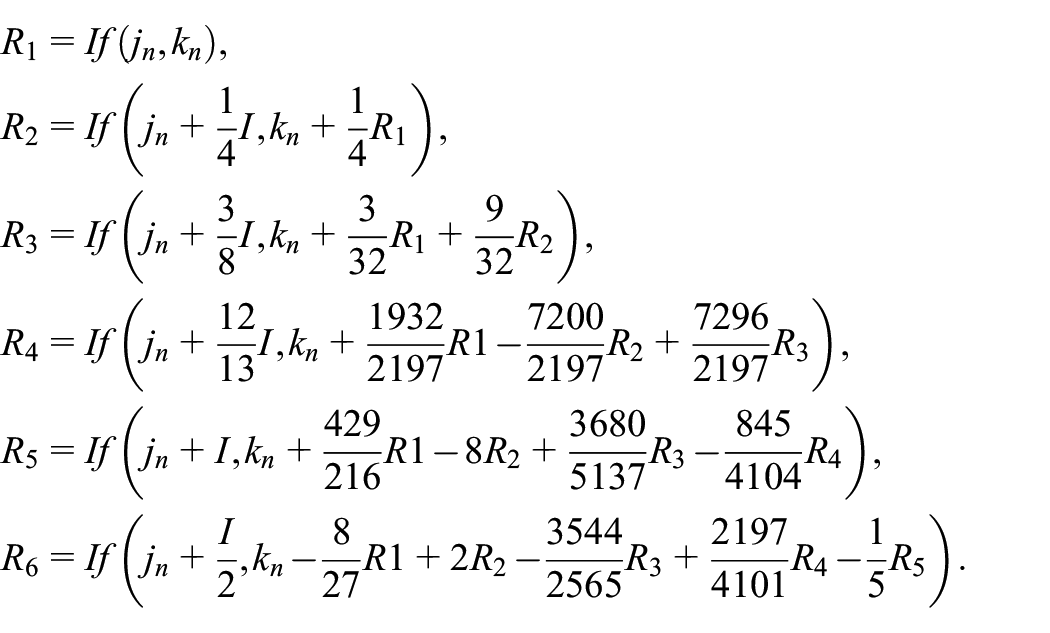
The numeric approximate result was obtained by implementing the Runge-Kutta fourth-ordered scheme.

The Runge-Kutta fifth-order technique was used to obtain refined solutions.

Two previously attained results are subtracted to compute the error term. If the larger error term materializes, the procedure is redesigned by diminishing the step size to achieve the required accuracy and meet the convergence standards
Comparison between present results and exact results in presence of

Results and discussion
This section explores impact of different flow parameters on velocity, temperature, Entropy production and Bejan number through graphical illustration. In diverse scenarios, the computational examination of many flow characteristics included in the issue with consistent estimates of
The occurrence of P-P which inclines the flow resistances, then it results in less friction happening during fluid flow. Consequently, the

Impact of porous permeability parameter on velocity, temperature, entropy generation and Bejan number: (a) Impact of porous permeability parameter on velocity profile, (b) Impact of porous permeability parameter on temperature profile, (c) Impact of porous permeability parameter on entropy generation profile, and (d) Impact of porous permeability parameter on Bejan number.
The Biot number may be defined as the quotient obtained by dividing the interior temperature barrier of a solid border by the BL (boundary-layer) opposition to heat. In the case

Impact of Biot number on temperature, entropy generation and Bejan number: (a) Impact of Biot number on temperature profile, (b) Impact of Biot number on entropy generation profile, and (c) Impact of Biot number on Bejan number.
The decreasing behavior of the velocity for increasing estimations of the couple stress constraint is displayed in the Figure 4(a). Increase in couple stress means, enhancement in solid proportions to the fluids and enhancement in the dynamic viscosity of the liquid. As a results, increment in couple stress as predictable to decrease the flow. Further observed that, in case of couple stress inverse, the fluid velocity is eventually decreasing by increasing the dynamic viscosity liquid. The same nature on thermal filed is observed for accelerating estimations of
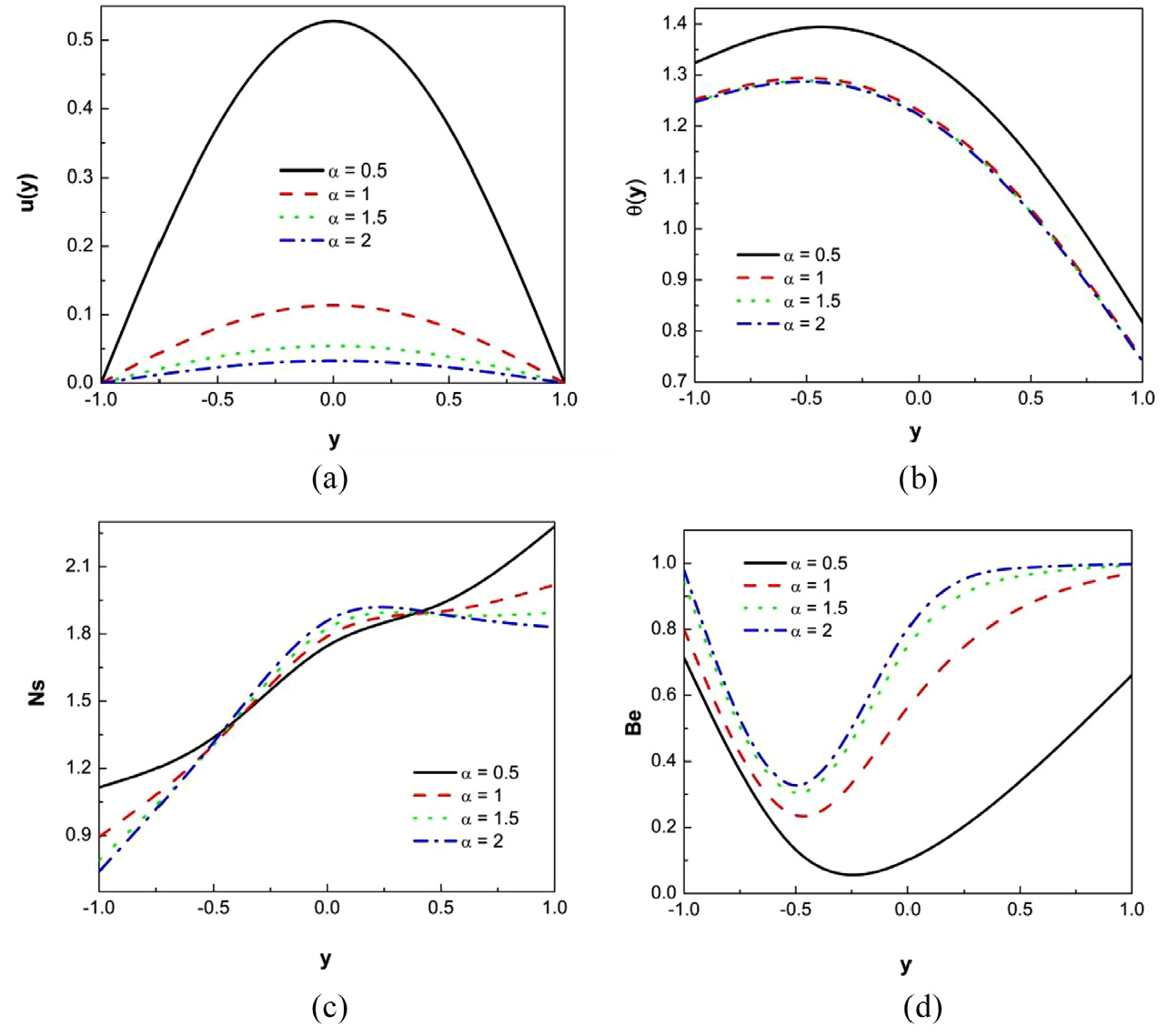
Impact of couple stress parameter on velocity, temperature, entropy generation and Bejan number: (a) Impact of couple stress parameter on velocity profile, (b) Impact of couple stress parameter on temperature profile, (c) Impact of couple stress parameter on entropy generation profile, and (d) Impact of couple stress parameter on Bejan number.
Figure 5 illustrates a graphical representation of the impact of magnetic parameters on distinct profiles. It has been observed that the liquid velocity exhibits a decreasing trend when the M-P is enhanced. Physically, when the M-P enhances then, a resistive type of force is exist in the flow and it reduces the fluid velocity. Hence, decreasing behavior observed for exaggerated values of M-P as illustrated in Figure 5(a). The fluid friction irreversibility is accelerated for escalating estimations of magnetic parameter is shown in Figure 5(b). Increase in magnetism leads to more thermal transmission irreversibility’s in the channel, as a consequence, entropy improves. The opposite behavior on Bejan number is reported in Figure 5(c). This result seen form the physical significance that the dominance of the fluid friction irreversibility over heat transfer irreversibility for higher valuations of M-P.

Impact of magnetic parameter on velocity, entropy generation and Bejan number: (a) Impact of magnetic parameter on velocity profile, (b) Impact of magnetic parameter on entropy generation profile, and (c) Impact of magnetic parameter on Bejan number.
The thermal profile is slowing down with exaggerated estimations of Rd-P is displayed in Figure 6(a). The E-G in the middle area of the parallel plates exhibits an upward trend, but the impact shifts in the vicinity of both slabs of the channel (refer to Figure 6(b)). Due to more heat transfer irreversibility and more heat generates by inter particle collision, the entropy enhances in the plates central region, and to the walls the heat is less compared to central part as a result entropy decreases with increase in Rd-P. It is seen that the effect of E-G due to liquid friction dominates over the thermal distribution irreversibility is seen in Figure 6(c), that is, the irreversibility ratio profile shows accelerating trend in the channel central portion and the reverse behavior is noticed near both the plates of the channel is shown in Figure 6(c).

Impact of radiation parameter on temperature, entropy generation and Bejan number: (a) Impact of radiation parameter on temperature profile, (b) Impact of radiation parameter on entropy generation profile, and (c) Impact of radiation parameter on Bejan number.
It is cleared that for increasing estimations of TGM constraint yields the decelerating nature of the velocity, and escalating trend of the temperature are seen in Figure 7(a) and (b). Increase in non-Newtonian material parameter leads to enhance the liquid viscosity, as a result the velocity reduces. Temperature generated by inter particle collision, the thermal field amplifies is as depicted in Figure 7(c). Increase in

Impact of TGM parameter on velocity, temperature, entropy generation and Bejan number: (a) Impact of TGM parameter on velocity profile, (b) Impact of TGM parameter on temperature profile, (c) Impact of TGM parameter on entropy generation profile, and (d) Impact of TGM parameter on Bejan number.
The fluid velocity decreases due to fluid is thickening with escalating estimations of VH-P as depicted in Figure 8(a). Figure 8(b) reported that the accelerating nature of the temperature for escalating estimations of the VH-P. This is because, the kinetic energy enhances by enhancement in VH-P or in other words the exothermic reaction continues to release energy in the form of heat. Large amount of temperature is generated from particle interaction or in other words heat energy is generated by kinetic energy due to heat source. As a result E-G increases for cumulative estimations of viscous heating parameter due to frictional interaction in the fluid layers (see Figure 8(c)). VH-P is a major influence in irreversibility analysis, therefore, as observed in Figure 8(d), that is, HTI plays a leading impact over generated from viscous dissipation at both walls of microchannel. Further, VH-P enhances FFI begins to notice impacts of the thermal irreversibility ratio.

Impact of viscous heating parameter on velocity, temperature, entropy generation and Bejan number: (a) Impact of viscous heating parameter on velocity profile, (b) Impact of viscous heating parameter on temperature profile, (c) Impact of viscous heating parameter on entropy generation profile, and (d) Impact of viscous heating parameter on Bejan number.
One important parameter in combustion is the Frank-Kameneskii (FK) constraint, which is derived from the Arrhenius kinetics of the exothermic pair stress liquid. The velocity decelerates due to enhancement in the internal fluid particle collision with increasing FK constraint is as shown in Figure 9(a). The opposite effect on temperature with escalating estimations of

Impact of Frank-Kameneski parameter on velocity, temperature, entropy generation and Bejan number: (a) Impact of Frank-Kameneski parameter on velocity profile, (b) Impact of Frank-Kameneski parameter on temperature profile, (c) Impact of Frank-Kameneski parameter on entropy generation profile, and (d) Impact of Frank-Kameneski parameter on Bejan number.
Figure 10 displayed that the HSR-P impact on the thermal field, irreversibility and irreversibility ratio. The thermal field enhances with increment estimations of HSR-P is seen in Figure 10(a). This is because of the thermal absorption nature of HSR-P. The entropy production for increasing estimations of the heat source parameter is displayed in Figure 10(b). Increment in the thermal field leads to dominate the thermal transfer irreversibility. It is cleared that the irreversibility enhances towards both the channel walls and significant in the central region. The significant impact of HTI over FFI leads to enhancement of irreversibility ratio with increasing heat source ratio parameter (see Figure 10(c)).
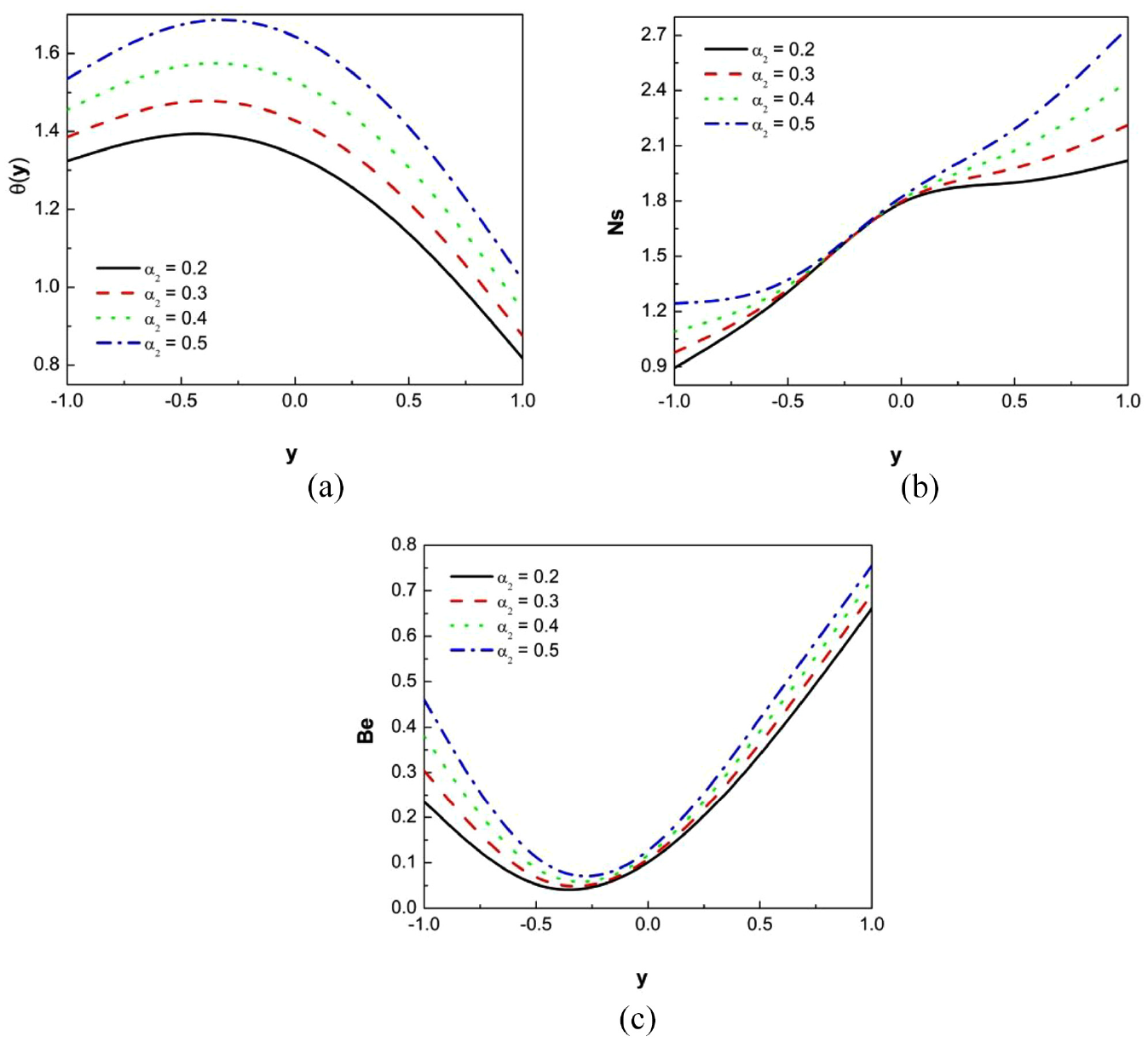
Impact of heat source ratio parameter on temperature, entropy generation and Bejan number: (a) Impact of heat source ratio parameter on temperature profile, (b) Impact of heat source ratio parameter on entropy generation profile, and (c) Impact of heat source ratio parameter on Bejan number.
Figure 11 depicts the impact of variation in the fluid flow of Grashof number (Gr) on the buoyancy induced flow and it is cleared that both velocity, and temperature enhances. Increase in Gr leads to induce more flow which results enhancement in the flow is noticed in Figure 11(a).

Effect of Grashof number on velocity, temperature, entropy generation and Bejan number: (a) Effect of Grashof number on velocity profile, (b) Effect of Grashof number on temperature profile, (c) Effect of Grashof number on entropy generation profile, and (d) Effect of Grashof number on Bejan number.
The influence of variable thermal conductivity on velocity, temperature, entropy generation and irreversibility ratio is represented in Figure 12. The fluid velocity enhances and temperature reduces with increasing variable thermal conductivity as depicted in Figure 12(a) and (b) respectively. This may happens when increase
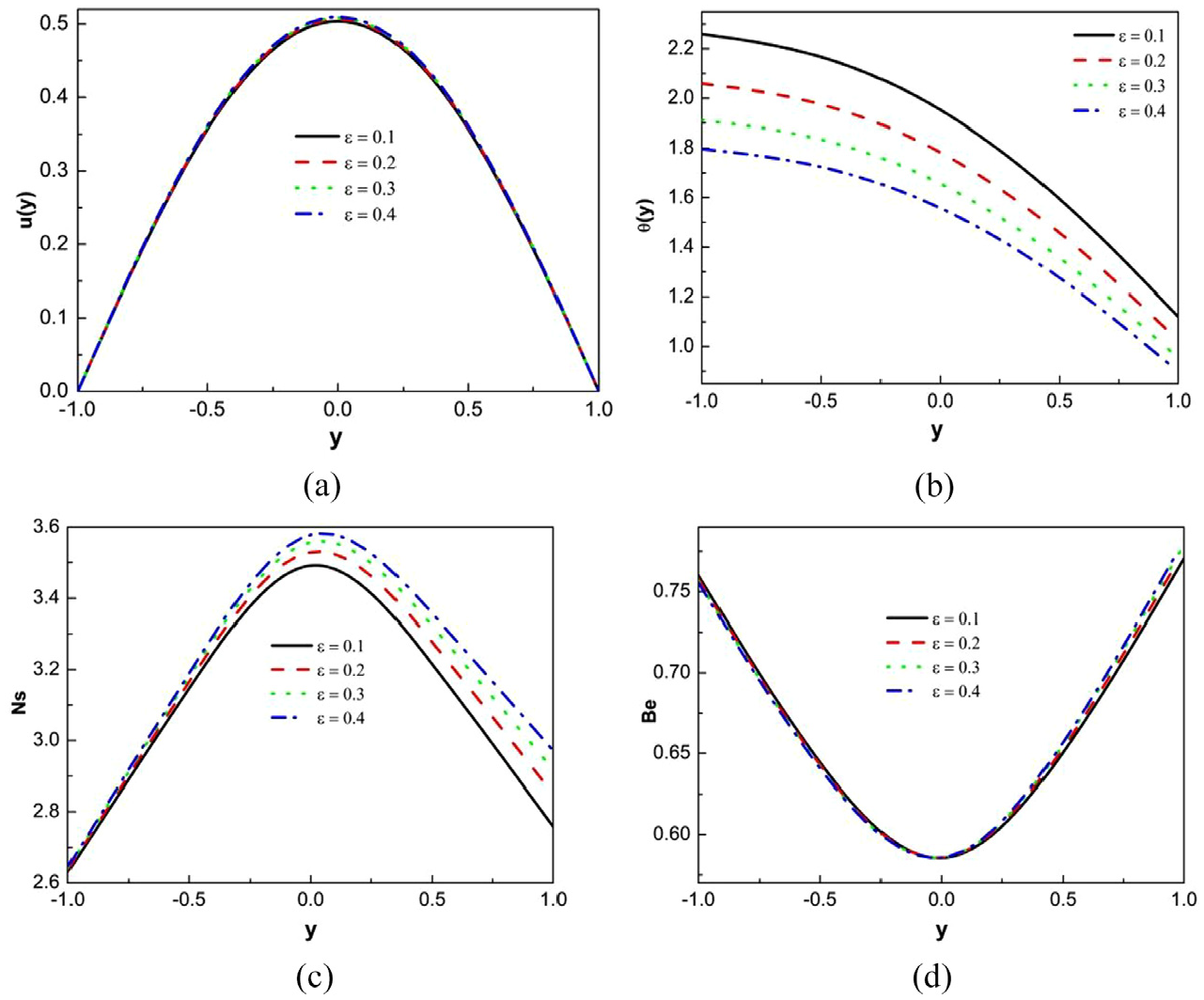
Effect of variable thermal conductivity on velocity, temperature, entropy generation and Bejan number: (a) Effect of variable thermal conductivity on velocity profile, (b) Effect of variable thermal conductivity on temperature profile, (c) Effect of variable thermal conductivity on entropy generation profile, and (d) Effect of variable thermal conductivity on Bejan number.
The fluctuation of the activation energy parameter is seen in Figure 13. As seen in Figure 13(a) and (b), an increase in estimates of activation energy results in a reduction in both velocity and temperature. The lowest irreversibility rate of production is achieved due to the decrease in the AE of the reactive fluid. Consequently, entropy creation reduces, as seen in Figure 13(c). The irreversibility of heat transmission outweighs the irreversibility of friction in fluids, leading to an increase in the Bejan number, as seen in Figure 13(d).

Effect of activation energy on velocity, temperature, entropy generation and Bejan number: (a) Effect of activation energy on velocity profile, (b) Effect of activation energy on temperature profile, (c) Effect of activation energy on entropy generation profile, and (d) Effect of activation energy on Bejan number.
Conclusions
This correspondence investigates the irreversibility of a stress-reactive fluid flow in a vertical microchannel, specifically focusing on a third-grade pair. The answers are obtained by combining the RKF-45 method with the shooting technique. The calculation of irreversibility and irreversibility ratio involves the use of solutions derived from different flow characteristics. The primary outcomes of the current analysis are outlined below:
The velocity of the fluid retards with magnetism due to a resistive type of the force exist in the fluid. Similar impact in the channel on velocity is noticed for larger values of couple stress parameter, activation energy, third grade fluid parameter, viscous heating parameter, Frank-Kameniski and increasing behavior is noticed for porous permeability parameter and variable thermal conductivity.
The thermal field is enhanced with escalating values of porous parameter, third grade material parameter, Frank-Kameniski and slow down impact on thermal field in the channel is noted for increment values of activation energy, variable thermal conductivity and couple stress parameter.
The entropy generation is maximum for increasing estimations of magnetism, third grade material parameter, variable thermal conductivity, porous permeability parameter, Frank-Kameniski parameter, viscous heating parameter and the minimum entropy generation is noticed for activation energy.
Increasing estimations of couple stress parameter, Frank Kameniski, activation energy, and heat source ratio parameter are enhances the irreversibility ratio and the dual impact is noticed for variable thermal conductivity, radiation parameter, and Biot number. The significant impact of Bejan number in the channel’s central region is noticed for increasing radiation parameter.
The fluid creates a minimum velocity when the fluid flow contains couple stress. Further, cleared that as compared to a Newtonian fluid, the velocity in the couple stress is low.
Towards the channel plates, the effect is significant because of the dominant irreversibility effect due to fluid friction and the impact is more in the channel central portion due to thermal transmission irreversibility.
The present work is limited to examine the irreversibility of a third-grade couple stress-reactive fluid flow in a vertical microchannel. The current work can be extended to examine various types of Newtonian/non-Newtonian liquids in combination of various nanoparticles, time dependent impacts and other physical as well as boundary constraints. The outcome of this work is utilized in various geological and petrochemical engineering and oil recovery application. Further, this investigation is used to do further studies on energy conservation, thin film flow, coal water mixture and polymer solution applications.
Footnotes
Appendix
Acknowledgements
The authors extend their appreciation to the Researchers Supporting Project number (RSPD2024R999), King Saud University, Riyadh, Saudi Arabia.
Handling Editor: Sharmili Pandian
Authors’ contributions
A.R; S.P: Conceptualization, Methodology, Software, Formal analysis, Validation; Writing – original draft. J.R: Writing – original draft, Data curation, Investigation, Visualization, Validation. U.K: Conceptualization, Writing – original draft, Writing – review and editing, Supervision, Resources. A.V: Validation, Investigation, Writing – review and editing, Formal analysis; Project administration; Funding acquisition. A.I: Writing – review and editing, software; Data curation, Validation, Resources. Md.I.H.S: Validation; Writing – review and editing; software; and provided significant feedback and assisted in the revised version of the manuscript. Further, he also supported in revising the manuscript critically for important intellectual content.
Declaration of conflicting interests
The author(s) declared no potential conflicts of interest with respect to the research, authorship, and/or publication of this article.
Funding
The author(s) disclosed receipt of the following financial support for the research, authorship, and/or publication of this article: This work has been funded by the Universiti Kebangsaan Malaysia project number “DIP-2023-005.”

Data availability statement
The datasets used and/or analyzed during the current study available from the corresponding author on reasonable request.