



Abstract
This study explored the Darcy Forchheimer flow of Casson hybrid nanofluid (NF) via a persistently stretching curved surface. The Darcy-Forchheimer contribution articulates viscous fluid flow in permeable media. Hybrid nanofluids are made from carbon nanotubes (CNTs) having a cylindrical shape and iron ferrite nanoparticulate. The main equations are reorganized into non-dimensional ODEs via similarity replacement. To accomplish the analytic simulation of modeled equations, the “Homotopy analysis approach” is performed. The effects of flow factors on velocity and energy profiles have been tabulated and discussed. It has been noticed that the integration of iron ferrite and CNT nanoparticulate in the base fluid to control the coolant level in industrial apparatus is quite useful. The energy field ascension effect is helpful for industrial uses since the energy fields exhibit favorable behavior against rising values of both type of nanomaterials. The Casson constraint’s rising values decline the hybrid NF motion.
Keywords
Introduction
The fluid flow across a stretching texture has established an outstanding status due to its momentous character in several segments of industry and manufacturing, such as turning of fiber compression process, casting of fiber, paper production and plastic sheets extraction, etc. The flow across an enlarging surface was initially studied by Crane. 1 Sajid et al. 2 goes on to describe the fluid flow and determining that the curvature factor causes the boundary layer thickness to shrink. Gul et al. 3 inspected the fluid flow of over a strained surface. The fluid flow with the implications of the magnetic flux across an extended curved surface was established by Imtiaz et al. 4 The energy contour has been shown to be improved by the impact of the curvature constraint. Rosca and Pop 5 assessed the fluid flow generated by expanding and contracting sheets. Saeed et al. 6 conducted a thorough research of the Darcy hybrid NF flow via a continuously growing curved texture. The findings show that the hybrid NF improves heat allocation rate by employing MWCNTs, SWCNTs, and Fe3O4 nanocrystals. The hydrological importance of hybrid NF wave transmission over a heated stretched curved substrate with the impacts of a magnetic field was examined by Ali et al. 7 Carbon nanotubes contained in a magnetite NF reduce local heat flow while increasing surface drag. The impact of radiation on the Casson fluid across an exponentially curved sheet was examined by Kumar et al. 8 Reddy and Sreedevi 9 addressed the effects of energy slips on the heat and mass transport properties of a Maxwell hybrid NF across a stretching and shrinking surface. As the number of the thermal relaxation content raise, the temperature scatterings of hybrid NFs decrease. Hussain et al. 10 published the results of hybrid NF flow along a curved sheet. For high frequencies of the curving index, the energy conveyance performance in hybrid nanomaterials is more than that in nanofluids, according to the outcomes. Qian et al. 11 evaluated the conducting flow of NF across an indefinitely curved stretched surface influenced heat transfer and radiation. Their findings were found to be in good agreement with those of prior research.
In current history, heat transfer in carbon nanofluids has piqued the interest of researchers from a range of sectors. Carbon nanotubes (CNTs) are cylinder shape carbon nanotubes having a basic chemical property and a carboxyl group production. CNTs are ideal for use as an aggregate in a base fluid because of their thermophysical, superior chemical, and mechanical features. Because of their small size, structure, layout, dimension, and toughness, they have several benefits over other nanocrystals. Haq et al. 12 looked at the numerical simulations for conductive fluid employing carbon nanoscale across a broad area. Ahmadian et al. 13 explored the 3D model of an inconsistent hybrid NF flow with solvent and momentum transfer produced by surface acceleration. The usage of hybrid nanocomposites is considered to have significantly improved the thermal characteristics of the carrier fluid. CNTs are more effective in the carrier fluid than other nanomaterials because of the C–C connection. Through non-covalent and covalent modification, CNTs NF may be further derivatized to obtain the desired outcome, which can then be employed in a variety of functions. 14 Employing fluid flow across a curved surface, Saeed et al. 6 investigated the hybrid NF using CNTs and iron oxide nanoparticles. Inside a square cavity, Sreedevi and Sudarsana Reddy 15 and Sreedevi and Reddy 16 performed a statistical analysis of energy transfer, flow, and entropy generating aspects of a hybrid NF. The passage of hybrid NF via a blood artery for medicine was observed by Alghamdi et al. 17 Li et al. 18 developed a fractional model for hybrid nanoliquid over a permeable whirling surface. Reddy et al. 19 addressed the thermal slip factor effect on the temperature distribution of CNTs water-based NF across a spinning disk. The results show that when the nanoparticles concentration factor increases, the heat of the fluid rises. Furthermore, when nanomaterial of 0.05 volume fraction is suspended in the base solvent, thermal efficiency increases from 4.8% to 14.6%. The effect of a magnetic flux on the CNT NFs flow via a stirring absorbent medium was described by Akbar et al. 20 Gul et al. 21 evaluated and contrasted the properties of simple and hybrid nanomaterials moving on a spreading sheet. The turbulence of fluid flow may also be synchronized using a magnetic effect corresponding to their conclusions. Bilal et al. 22 measured the Darcy Forchheimer hybrid NF flow using an inclined expandable cylinder. Carbon nanotubes (CNTs) and iron oxide Fe3O4 were studied separately as nanomaterials. The results show that hybrid NFs are the most effectual way to upsurge energy transmission and can also be used for cooling. Ahmed 23 used nanofluids to depict temperature dispersion in a wavy-wall impermeable container. It was determined that raising the sheet’s waviness increases both the heat communication rate and the mass conduction rate. Reddy and Sreedevi 24 and Sreedevi and Sudarsana Reddy 25 compared the unstable and persistent MHD using Williamson and Tiwari-Das model. They presented NF flow through a wedge inhabited by CNTs of multiwalled kerosene oil. In both the unstable and steady scenarios, the rates of surface warming as the values of the nanoparticle volume fraction factor climb.
The inertia effect is accounted for by adding a squared element to the momentum equation, which is referred to as Forchheimer’s term.
26
This novel notion was dubbed the “Forchheimer factor” by Muskat.
27
To accurately portray real-world issues, non-Darcy effects must be included in convective transport analyses. The present mathematical model analyzed and modified the concept of Saba et al.
28
and Xue
29
to study the hybrid NF flow across an extending surface with heat and mass transmission. The CNTs and
Formulation
We considered the steady two-dimensional Darcy hybrid NF flow across an intensifying curved surface. The fluid flow is supposed to be a crossed an expanding surface having radius




Physical sketch.
The basic flow conditions are:

Here,
The mathematical expression for the above experimental terms of hybrid NF are:

Here,
The transformation variables are 31 :

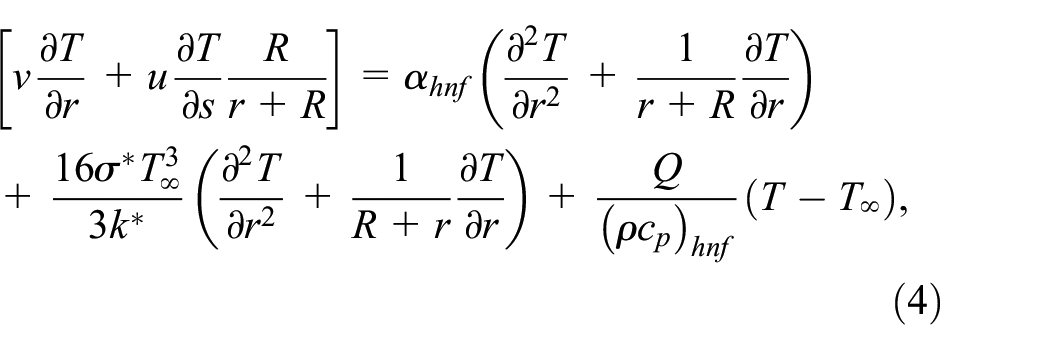
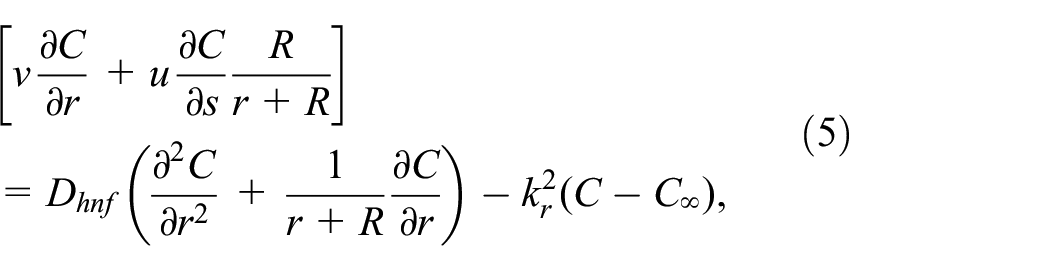
by using equation (7), equations (2)–(6) yield

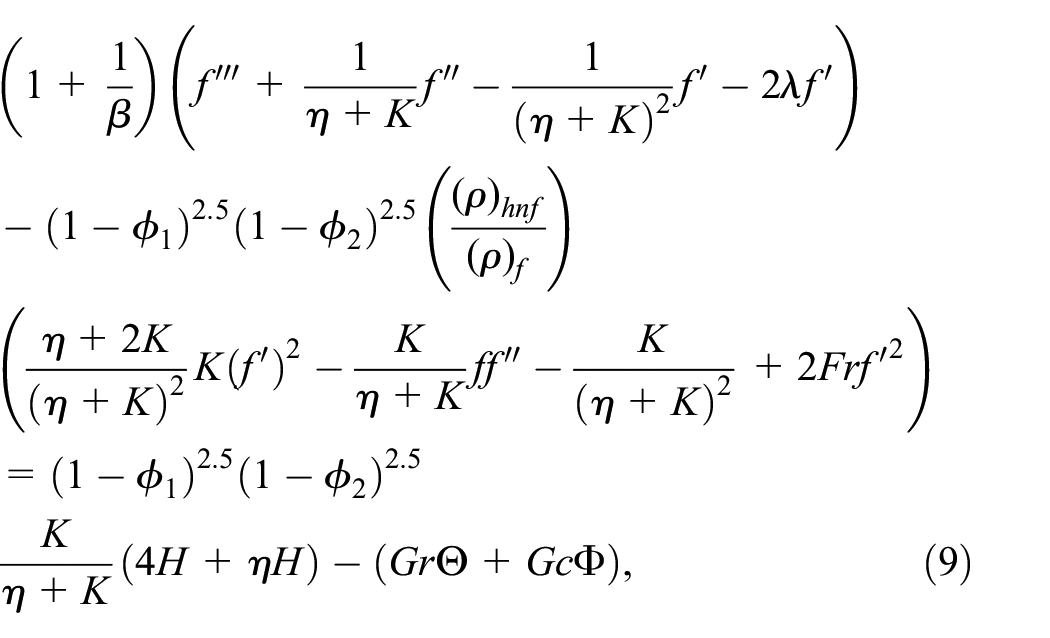


By abolishing
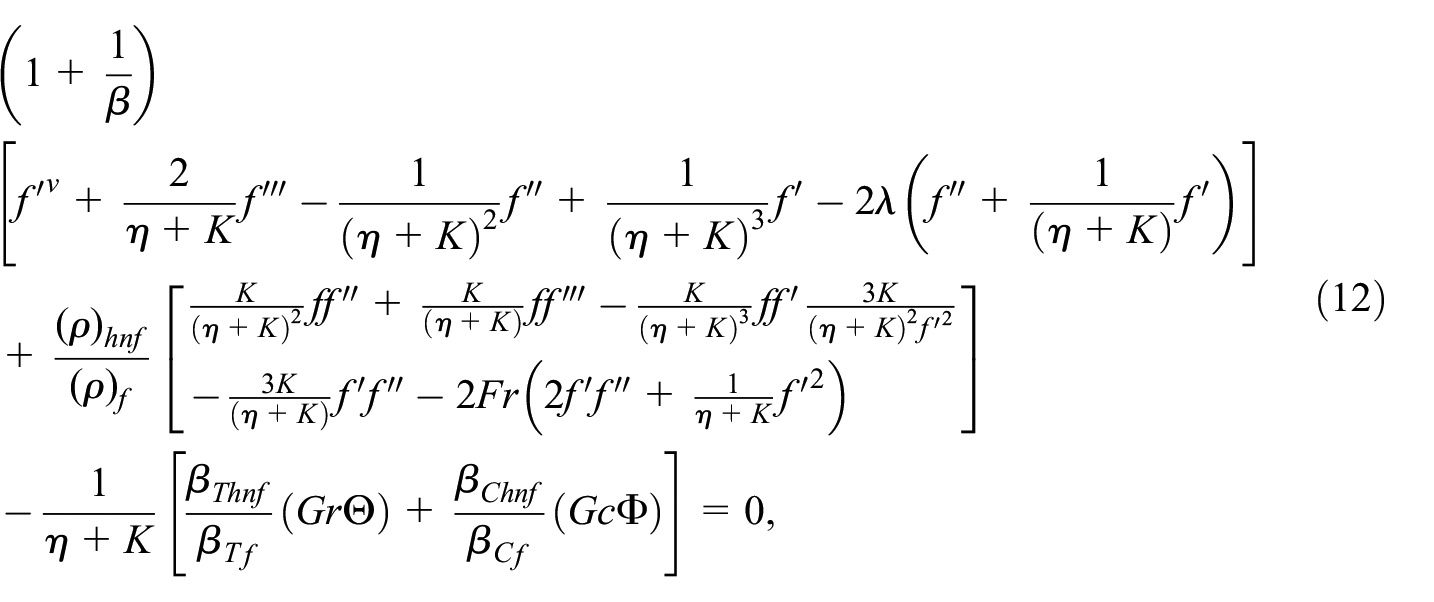
The transform conditions are:

Where,

The physical interest quantities as:

Where local Reynolds number is

Problem solution
The HAM methodology has been employed to obtained set of ODEs as.32–33 The initial guesses are:

The linear terms are

The expanded form of

OHAM convergence
The convergence of OHAM technique is achieved as34,35.



The sum of residual error is
The thermophysical characteristics of solid material and fundamental fluids are displayed in Table 1. The consolidation of the OHAM approach has been determined up to the 30th repetition and is shown in Table 2. Table 3 compares and contrasts the current investigation with the available literature.
The experimental values of base fluid and nanoparticulate. 22

The residual errors.

The statistical outputs, when

Results and discussion:
The purpose of this segment is to look forward to observe how the energy and velocity trajectories behave when the projected components are taken into account. Figure 1 depicts the flow arrangement. Figure 2 depicts the progress and error analysis of the OHAM approach.

Error analysis of the HAM solution.
Figure 3(a)–(f) highlighted the performance of velocity profile

The behavior of velocity profile
Figure 4(a)–(d) elaborated the trend of energy profile

The behavior of energy profile
Figure 5(a)–(d) displays the behavior of energy profile

The behavior of energy profile
Figure 6(a)–(d) reported the behavior of mass profile

The behavior of mass profile
Figure 7(a) and (b) illustrate the numerical outcomes for the Nusselt number
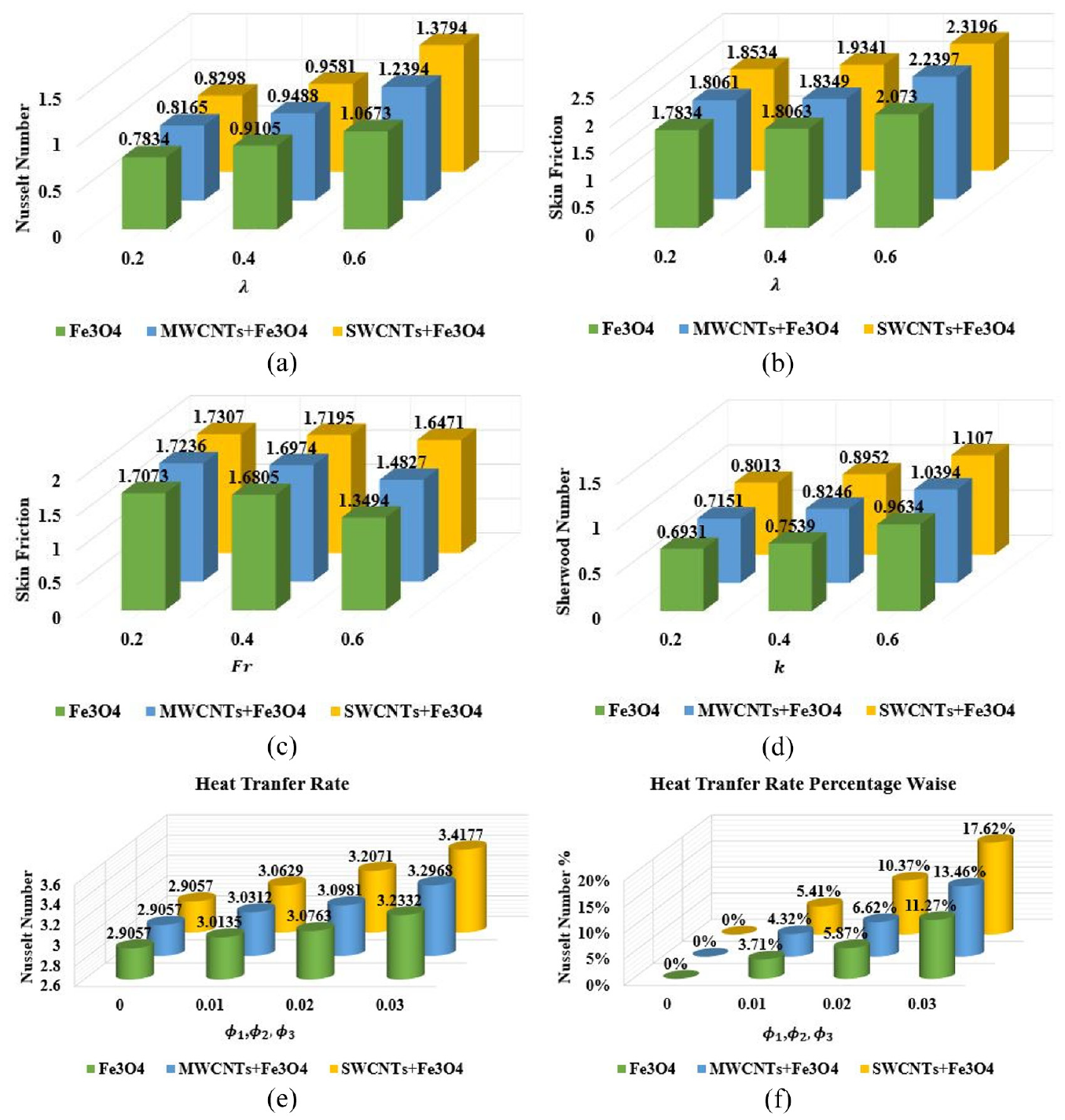
(a) Nusselt number
The statistical data are presented through bar charts 7 for skin fraction, Nusselt number, and Sherwood number. Also, the percent wise enhancement is sketched. Bar chart 7(a, b) shows that
Conclusion
In this problem, we analyzed the Darcy flow of Casson hybrid NF caused by an extending curved surface. The set of differential equations are analytically resolved by employing the “HAM” approach. The supremacy of NF in energy and mass communication in modern era are highlighted in the current mathematical model. The key results are as follows:
This energy field ascension effect is helpful for industrial uses since the energy fields exhibit favorable behavior against rising values of both type of nanomaterials.
The Casson constraint’s rising values decline the hybrid NF motion.
The integration of
The temperature profile displays a decreasing trend as the energy exponent coefficient A escalate.
Fluid velocity is intensified by enhancing the credit of curvature term k.
When the Forchheimer coefficient is elevated, the velocity and energy profiles show the reverse trend.
In comparison to ordinary fluids, hybrid NF is rapid agent for thermal energy transition.
Footnotes
Handling Editor: Chenhui Liang
Declaration of conflicting interests
The author(s) declared no potential conflicts of interest with respect to the research, authorship, and/or publication of this article.
Funding
The author(s) received no financial support for the research, authorship, and/or publication of this article.
