



Abstract
Though miniscrews are widely used as a temporary anchorage device, research focusing on the primary stability of miniscrew loading torque force is limited. This study is aimed to design a novel torque-resistant miniscrew used as orthodontic anchorage (TRO-screws) and to compare the difference of primary stability between TRO-screws and commercial miniscrew anchorage (COM-screws) using torque tests and resonance frequency analysis (RFA). Fresh swine ribs were cut into pieces of 20 mm × 13 mm × 11 mm, and each piece was implanted with one screw after a 1.5 mm-deep hole with a diameter of 1.0 mm was pre-drilled. There were 20 TRO-screws and 20 COM-screws. Maximum insertion torque (MIT) and maximum removal torque (MRT) were measured. The implant stability quotient (ISQ) was recorded parallel to and perpendicular to the long axis of teeth respectively. The measurement was repeated three times for each direction, and the ISQ values were averaged and recorded as the ISQpar, ISQper, and ISQm. The mean values of MIT for TRO-screws and COM-screws were 11.86±1.58 N cm and 10.36±1.42 N cm. The mean values of MRT for TRO-screws and COM-screws were 8.45±2.24 N cm and 6.76±1.78 N cm. The mean values of ISQ for TRO-screws and COM-screws were 61.80±2.9 and 58.15±2.98. These indicated that TRO-screws were more stable than COM-screws. We found that the primary stability of the TRO-screw was better than that of the COM-screw.
Keywords
Introduction
Anchorage control has always been the focus of orthodontic treatments. As a temporary anchorage device, miniscrews are gaining increased use in different scenarios.1–3 Compared to dental implants, primary stability is more important for miniscrew anchorage because they are usually loaded immediately after implantation. 4 Stability is influenced by multiple factors, such as miniscrew design, cortical bone thickness, marrow bone density, and operator technique.5–10 There are many methods used to detect the primary stability of miniscrews, including measurements of insertion and removal torque values, resonance frequency analysis (RFA), and periotest value.11–15 Usually, orthodontic miniscrews bear horizontal force to close the gap. Additionally, in clinical orthodontic treatment, the torque control of the tooth is essential. Or else the bone fracture and periodontal problem will appear. So, torque force is an important form of force loading during orthodontic treatment. And recently, more and more studies have reported that miniscrews could move teeth in three dimensions by bearing composite torque forces.16,17 However, research which focuses on the primary stability of miniscrew loading torque force is limited.
The purpose of this study was to design a new type of torque-resistant orthodontic miniscrew which was specially used to bear the torque force in orthodontic treatment. Also, the study was to evaluate the difference of primary stability between the torque-resistant miniscrews (TRO-screws) and commercial miniscrews (COM-screws) by torque and resonance frequency analysis.
Materials and methods
Miniscrews
Twenty TRO-screws were designed by the Orthodontics Department of Sun Yat-sen Memorial Hospital and produced by Guangzhou Ruitong Biotechnology Corporation (Guangzhou, China). The characteristics were as follows: cylindrical miniscrew; the miniscrew’s total length is 10.0 mm and the miniscrew’s thread part length is 7.0 mm; reverse buttress thread shape; 2.0 mm diameter in the neck part; 1.6 mm diameter in the body part.
As the control, 20 COM-screws were purchased from Cibei Medical Equipment Corporation (Ningbo, China). The characteristics were as follows: cylindrical miniscrew; the miniscrew’s total length is 9 mm and the miniscrew’s thread part length is 5.3 mm; V thread shape; 2.0 mm diameter for all the miniscrew (data were provided by the corporation).
The TRO-miniscrew and COM-miniscrew were drawn as the figure shown (Figure 1). Both the TRO-miniscrew and COM-miniscrew were made of Ti-6Al-4V titanium alloy. Studies have shown that Ti-6Al-4V titanium alloy has significant mechanical properties, good corrosion resistance, and no change in mechanical properties after long-term use.18,19

Miniscrews: (a) torque-resistant miniscrew line drawing, (b) torque-resistant miniscrew entity graph, and (c) commercial miniscrew entity graph.
Bone
The soft tissue and periosteum were removed from fresh pig ribs of the same breed with similar size and weight, and were then cut into pieces of 20 mm × 13 mm × 11 mm. Vernier calipers were used to measure the thickness of bone cortex at both ends of the cross section of the bone model. The sensibility of the caliper was 0.02 mm.
To ensure the stability of the experimental process, bone cortex with a thickness of 1.2–1.5 mm were selected and fixed in EVA hot-melt adhesives (Hejiu Plastic Products Corporation, Dongguan, China). Then, the bone model was immersed in normal saline solution and preserved at a low temperature of 2°C.
Measurements
The steel sand lathe needles which were perpendicular to the bone model surface were used to prepare pilot implant holes with a diameter of 1.0 mm and length of 1.5 mm. The bone tissue was cooled with running water to prevent damage caused by high temperatures. The miniscrews were implanted in a clockwise manner in a direction of 90° (vertically) to the bone. After all the threads of the miniscrews were inside the bone and only the cervical part could be seen, maximum insertion torque (MIT) values were recorded with a modified digital torsiometer (DID-4, Sugisaki Meter, Japan) (Figure 2). After the implantation, Osstell ISQ Device (Osstell, Sweden) was immediately used to measure the implant stability quotient (ISQ) parallel to and perpendicular to the bone respectively(Figure 3). The measurement was repeated three times in each direction, and the ISQ values were averaged and recorded as the ISQpar (the implant stability quotient parallel to the bone), ISQper (the implant stability quotient perpendicular to the bone), and ISQm (the average value of ISQpar and ISQper). The miniscrews were unscrewed in the opposite direction until all the threads were removed from the bone. The torque was measured every second during implantation and removal by the digital torsiometer (DID-4, Sugisaki Meter, Japan), and the maximum insertion torque (MIT) and maximum removal torque (MRT) were recorded. The experiment was performed by an operator.

Torque measurement: (a) the miniscrew is inserted with a digital torsiometer until the last thread of the neck enters the bone tissue and (b) digital torsiometer (DID-4).

Resonance frequency analysis, measurement of miniscrew stability by resonance frequency analyzer.
Statistical analysis
All data were tested for normal distribution and variance homogeneity by SPSS 13.0 (Statistical Package for the Social Sciences, New York, NY, USA). Single analysis of variance was used to compare the difference of MIT and MRT between different miniscrews. The Wilcoxon test was used to compare the differences of ISQ in different directions. Statistical significance was set at p < 0.05. If p < 0.05, the differences of ISQpar and ISQper between different miniscrews were compared. If p > 0.05, the differences of ISQm between different miniscrews were compared.
Results and discussions
Results
Primary stability has been proven to be related to a myriad of factors. The miniscrews which were implanted into bone models displayed good stability with no bending deformation. All the data are normal distribution and homogeneity of variance. The results were represented in Table 1. There was no significant difference between ISQpar and ISQper between the different miniscrews. Subsequently, the ISQm were compared between different miniscrews. As the results indicated, the MIT, MRT, and ISQ values of the TRO-screws were significantly greater than those of the COM-screws (p < 0.01). The correlation analysis revealed that the values of MIT, MRT, and ISQm had positive correlation, which could be seen in Figure 4.
Results of torque and resonance frequency of TRO-screw and COM-screw.
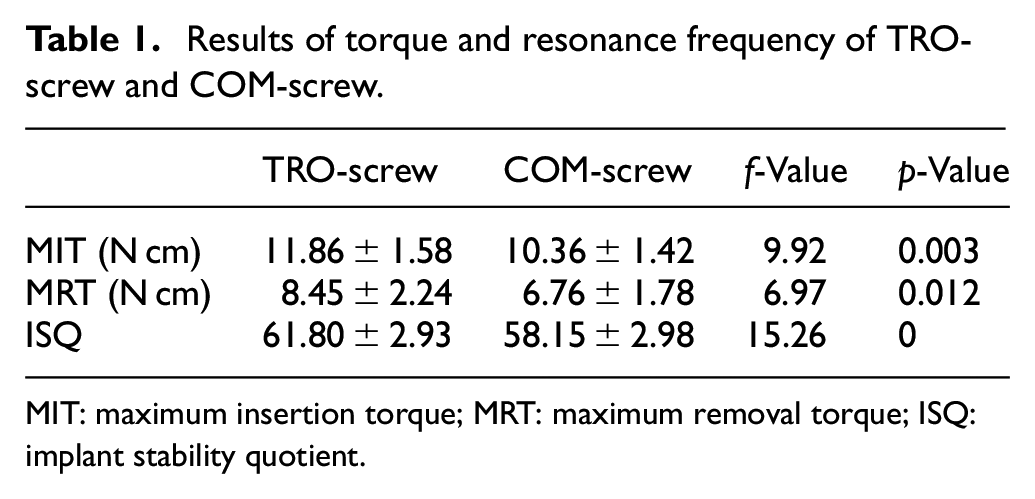
MIT: maximum insertion torque; MRT: maximum removal torque; ISQ: implant stability quotient.

Correlation analysis: (a) the correlation analysis of MIT and MRT, (b) the correlation analysis of MIT and ISQ, and (c) the correlation analysis of MRT and ISQ.
Discussion
Bone tissue model selection
The primary stability of miniscrews is related to multiple factors. Many studies have shown that the quality and quantity of bone, such as cortical thickness and bone density, played an important role in this process. 20 Pig ribs were selected as the bone model in our study since they display similar characteristics to the human maxilla and mandible in several anatomical structures.21–23 In addition, pig ribs exhibited great homogeneity in cortical bone thickness, and are often selected as the bone tissue model in similar studies.7,24
Primary stability under force loading
Miniscrews were usually loaded with horizontal force in clinical applications and the rate of failure can be as high as 25%.25,26 However, torque movement of teeth is common during orthodontic treatment. More and more experiments have proven that miniscrews could provide composite torque force to move teeth in three dimensions.27,28 The stability of miniscrews is adversely affected by composite torque force and the miniscrews tend to rotate. Therefore, it is necessary for orthodontists to develop a new type of miniscrew anchorage which could accommodate the placement of a square wire and have good stability after bearing rotation torque forces.
Key points in the design of torque-resistant miniscrew
Recently, more and more studies have proven that the thickness of bone cortex plays an important role in the primary stability of miniscrews. The greater the contact degree between the miniscrew and bone cortex, the greater the primary stability.29,30 The contact area between the miniscrew and bone cortex increases as the miniscrew diameter increases, with subsequent increase in the resistance to force.31,32 However, the diameter of the miniscrew is limited by the distance between adjacent teeth. Bone support could be insufficient due to the contact since the force on teeth will be transmitted to the miniscrews, which leads to the miniscrew loosening and falling off easily. 33 The diameter of all the COM-screw is 2.0 mm whereas the TRO-screw, with a body part diameter as 2.0 mm, has an increased neck diameter of up to 2.0 mm to strengthen the contact with the cortical bone. Therefore, the risk of root contact of TRO-screws was much lower than that of COM-screws. Besides, this study has proven that primary stability of TRO-screws was slightly improved compared with COM-screws.
The mini-screws will bear force after implantation, which would be concentrated on the interface between the bone and miniscrew especially at the neck.34,35 Previous study indicated the stress distribution was significantly affected by different thread shapes (buttress, reverse buttress, square, and V-shape) at supporting bone structure. 36 A study of our screw used three-dimensional finite element analysis and proved that when the miniscrew received a rotation torque load, the miniscrews with different thread shapes had different maximum stress values in cortical bone (V-shape > buttress > reverse buttress > square). 10 Another previous study showed that thread shape could also influence the axial pullout strength of miniscrews and compared with the other shapes (buttress, 75° joint profile, rounded, and trapezoidal), the buttress reverse thread shape provided the greatest pullout strength. 37 However, there were no studies on the torque or resonance frequency analysis of miniscrews with different thread shapes at present. In our study, the MRT value of TRO-screws which was designed with a reverse buttress thread shape was greater than that of COM-screws with a blade-thread shape. As an animal study showed, MRT value had a greater correlation with friction resistance compared with MIT value. 38 Thus, our study proved that, compared with COM-screws, the ability of TRO-screws to resist reverse rotation and loosening was much higher under the loading of force.
The analysis of implant torque and resonance frequency is most commonly used to evaluate the primary stability of miniscrew anchorage. Insertion torque (IT) is the amount of torque to overcome the frictional force between the screw and the bone when the miniscrew is inserted into the bone. 39 Increased IT induces overcompression of the bone tissue whereas an insufficient IT will prevent ideal drilling of mini-implant into the bone. 40 Increased IT and insufficient IT can lead to inadequate primary stability and miniscrew loosening. Insertion torque (IT) is widely used to estimate the primary stability of miniscrew because it is noninvasive, easy-to-use, and closely correlated with miniscrew primary stability. 41
A certain level of maximum insertion torque is necessary to achieve the primary stability. 42 However, the implant torque is not a linear measurement of primary stability. On the contrary, plenty of studies pointed out that the MIT should be an optimal interval to evaluate primary stability. 43 Excessive torque during implantation can lead to necrosis and ischemia of the surrounding tissues. 44 In the clinical trials of 1.6 mm diameter mini-screws, an insertion torque in the range from 5 to 10 N cm was recommended to resist tooth movement. 45 In the next experiment, Motoyoshi et al. proved that the success rate was much higher in the group with an insertion torque of 8–10 N cm compared with the other groups. 46 When the insertion torque ranged from 3.28 to 14.65 N cm, there was no miniscrew damage or peripheral bone fracture. 47
However, when the magnitude of implant torque was significant to resist the movement of the miniscrew anchor, the larger the implant torque, the stronger the resistance. 12 In this study, the implant torque of all the miniscrews was roughly consistent with the above range, and in this range, the MIT value of the TRO-screws was greater than that of the COM-screws, which indicated that the new miniscrew achieved better stability in a safe range.
The value of ISQ is affected by many factors, such as the direction of the sensor, distance of the sensor to the bone surface, as well as the strength of the interface between the sensor and implant or the bone and implant. The height beyond bone surface of the COM-screws was slightly higher than that of the TRO-screws. A previous study reported that for every 1 mm increase in implant exposure length, the resonance frequency value would be reduced by 413 Hz. 48 Resonance frequency analysis was similar to a class I lever in this respect. When the miniscrew was implanted, the part inside the bone was equivalent to the resistance arm, and the exposed part was equivalent to the power arm. When the resistance arm remains unchanged, the longer the power arm, the lesser the force. The internal length of COM-screws is 5.3 mm, which was almost equal to the exposed length of 4.7 mm. On the contrary, the internal length of TRO-screws is 7 mm, which was far longer than the exposed length of 3 mm. In other words, the power arm was much less than the resistance arm, which requires more moving force and higher stability. However, there is no standard SmartPeg sensor which was matched with the miniscrews. Thus, there is no comparability between the ISQ values measured by various modified methods in different studies.
Conclusion
In conclusion, the TRO-screws increased the neck area contacting with the bone cortex, and the reverse buttress thread enhanced the ability to resist reverse rotation. Its stability is better than that of COM-screws, and the design is reasonable. In this study, only pig ribs were used as the bone tissue model. Later studies will include animal experiments and clinical trials after torque application to further evaluate if the new miniscrew can be used in tooth torque control as ancharage.
Footnotes
Handling Editor: Chenhui Liang
Authors contributions
Yushan Ye contributed to conception and design as well as drafted the manuscript. Jianna Zhang contributed to acquisition, interpretation analysis of data. Yunru Hao contributed to draft the manuscript. Yingjuan Lu contributed to critically revise the manuscript for important intellectual content. Shaohai Chang agreed to be accountable for all aspects of the work in ensuring that questions relating to the accuracy or integrity of any part of the work are appropriately investigated and resolved.
Declaration of conflicting interests
The author(s) declared no potential conflicts of interest with respect to the research, authorship, and/or publication of this article.
Funding
The author(s) disclosed receipt of the following financial support for the research, authorship, and/or publication of this article: This research was supported by the Science and Technology Planning Project of Guangdong Province, China (Grant No. A002014004 to SHC).
