




Abstract
The Flower of Transformation is a community-based tool originating from grassroots alternative organizing in India. This article discusses the potential of the Flower as an innovative co-creative research method, reflecting on its emancipatory potential on the ground as well as its decolonial, reflexive possibilities for researchers. Drawing on literature on participatory, co-creative, and decolonial research methods and the original goals of the format, we critically reflect upon our usage of the Flower as a method during fieldwork in three alternative communities in India and Denmark. This includes an analysis of power dynamics, multi-directional learning, positionality, and meaningful participation. In pointing out both the potential and pitfalls of our engagement, we argue for a more honest dialogue on contradictory logics, uneasiness, and vulnerability in the journey towards emancipatory and decolonial research production.
Introduction
Across the world, communities, collectives and individuals are responding to the multiple crises we face, through both resistance and construction of alternative ways of meeting human needs and aspirations that seek to be ecologically regenerative and socio-economically just and equitable (Kothari, Salleh, et al., 2019). Recently, such alternative ways of embodying and prefiguring the future have been placed at the center of research agendas across disciplines, ranging from scholarship on post-development and degrowth (Escobar, 2015; Kaul et al., 2022; Lockyer, 2017; Ziai, 2016) to management and organization studies, calling for a clearer definition of what “alternative organizing” actually means (Dahlman et al., 2024; Phillips & Jeanes, 2018). This paper aims to contribute to such calls by discussing a new methodological tool called the “Flower of Transformation,” which has emerged from grassroots processes pursuing alternative futures in India. Envisioned primarily as a community-based self-appraisal tool that could lead to further transformations by and within such processes, the Flower is designed to allow for a more grounded self-definition of “alternatives” to emerge, including internal contradictions and synergies. The Flower has also been used as a co-creative research tool, with potential for a more emancipatory and decolonial engagement between the researcher and the community.
One of our aims in this paper is to reflect on our experiences applying the tool in fieldwork within alternative communities across the North/South divide. We do this by following the main objectives of the Flower and applying them back to our own research practice, as well as to the community participant groups. We reflect on two different dimensions of the transformatory potential of the Flower: its emancipatory potential on the ground (participatory dimension), and its capacity as a tool for self-reflection (decolonial dimension). We also highlight the Flower’s co-creative aspect which links these two dimensions together. Importantly, they are also in line with the objectives of the Flower itself. In that sense, while the communities we study pursue alternative transformation in their local initiatives, we as researchers seek to enact transformation within our own research practice. We aim to show how the Flower can help in both these processes. While being aware that we fall short of the participatory and decolonial critique unfolded in the literature review, we believe this is the direction we should be striving towards as researchers. This is why we did not choose other bodies of literature to appear more in line with our endeavor but rather decided to discuss our experience against these critical scholarships. By doing so, we aim to instigate learning even when expectations are not met, and when our research practice does not correspond to an ideal paradigm. We feel this is particularly important in an academic climate that tends to focus on success rather than insecurities and doubts.
Each of the authors of this paper engaged differently with the Flower in their particular field. The third author is a member and active participant of the Vikalp Sangam (Alternatives Confluence) process that devised and drafted the Flower. He has applied it in a few research and action projects in India (Kothari, Venkataswamy, et al., 2019). The first author experimented with the Flower as a research method during her doctoral fieldwork within two alternative Indian communities. The second author replicated this application of the Flower in the Danish context as part of her own fieldwork. By coming together, the authors collectively reflect on the potential of the Flower as a transformative research method (in the double sense outlined above) in conversation with each other and based on these engagements across various contexts. These have been enriched by discussions held with members of the Vikalp Sangam process 1 who continue their work and experimentation on the Flower as a continuously evolving format.
In this paper, we will first present the institutional memory tied to the bottom-up, collective creation of the Flower and its current applications across the world. We then briefly outline selected discussions within the scholarship on participatory, co-creative, and decolonial research methodologies to highlight some of the problematic issues related to mainstream research practice, which we will employ to discuss our application of the Flower tool. We include a short discussion of our methods, both in terms of how the Flower was applied in fieldwork as well as the analytical framework that guides the analysis. Then, we examine the transformative potential of the Flower across different dimensions (participatory, decolonial, and co-creative), and reflect on how it may challenge some of the issues related to mainstream research practice. We conclude with a short discussion on conceptualizing the research process as a transformative journey that embraces the contradictory logics, vulnerability, and uneasiness that comes with our attempts towards a more emancipatory and decolonial knowledge creation.
The Origins and Previous Applications of the Flower
In 2014, an ongoing process called Vikalp Sangam brought together around 90 movements and organizations across India to share and document experiences, collaborate on joint activities, advocate for policy shifts, and take on other activities focused on radical alternatives (Kothari, 2024). One key focus was on evolving a collective vision of what kind of society we wanted. What would be its ethics and values, its design and contours? How would it build on traditional knowledges and practices while adding elements of modern epistemologies and ontologies? How would it center and enhance the agency of communities and collectives on the ground, especially those most dependent on nature, and historically marginalized by gender, caste, class, and other relations of inequity? The result of this exploration was a draft document, “The Search for Alternatives: Key Aspects and Principles” (Vikalp Sangam, 2024), containing the basic values and dimensions of transformation, and the strategies and challenges of implementing them. This document has continued to evolve over the last decade and is now in its seventh avatar.
As part of this process, participants were asking themselves: what makes something an “alternative” approach? Are activities that bring in reforms but maintain or even strengthen the status quo to be considered as alternatives? For example, recycling programs or electric cars might be thought of as “eco” alternatives but, given they may also perpetuate inequities of corporate profitmaking, can we consider them as truly alternative? In these and other examples, often the fundamental structures of unsustainability and injustice—state domination, capitalism, patriarchy, racism, anthropocentrism—may not be challenged, and may even be strengthened.
One other way of responding to the question of what makes an initiative “alternative” is to think about whether it manages to deal with—or at least consider—multiple crises in a holistic way. It can be challenging for organizations or initiatives that wish to make positive change to think about areas other than their particular focus. For instance, they may be doing beneficial work on transforming gender relationships—but is it helping them to become more ecologically regenerative, or strengthening economic livelihoods? How can they be sure that they are not actually making some other aspects worse? In forest protection, for example, the community might be doing positive environmental work, but if patriarchal and/or caste aspects of traditional decision-making remain strong, women and landless people who are gaining their predominant livelihood from the forest may not be part of the decision-making.
As a response to this issue, the Vikalp Sangam process discussed and included in its evolving framework note a visual summary they named the “Flower of Transformation” to represent the intersectional spheres of possible change. At the center of the Flower are the values shared by a self-defined community of people. The Flower then has five petals representing political, social, ecological, economic, and cultural transformation (Figure 1). While most initiatives may not actively work with all five spheres, we agreed that they can be considered as “alternative” when they address explicitly at least two of the five petals. Even if they are not directly addressing the other spheres, they ideally remain open to them and never violate them. The Flower has the purpose of enabling collective visioning and self-assessment on the holistic character of an initiative, while respecting local contexts and avoiding any moralistic judgments (Kalpavriksh & ACKnowl-EJ, 2017; Vikalp Sangam, 2024). Visual representation of the Flower of Transformation: Spheres of radical alternatives (Vikalp Sangam, 2024)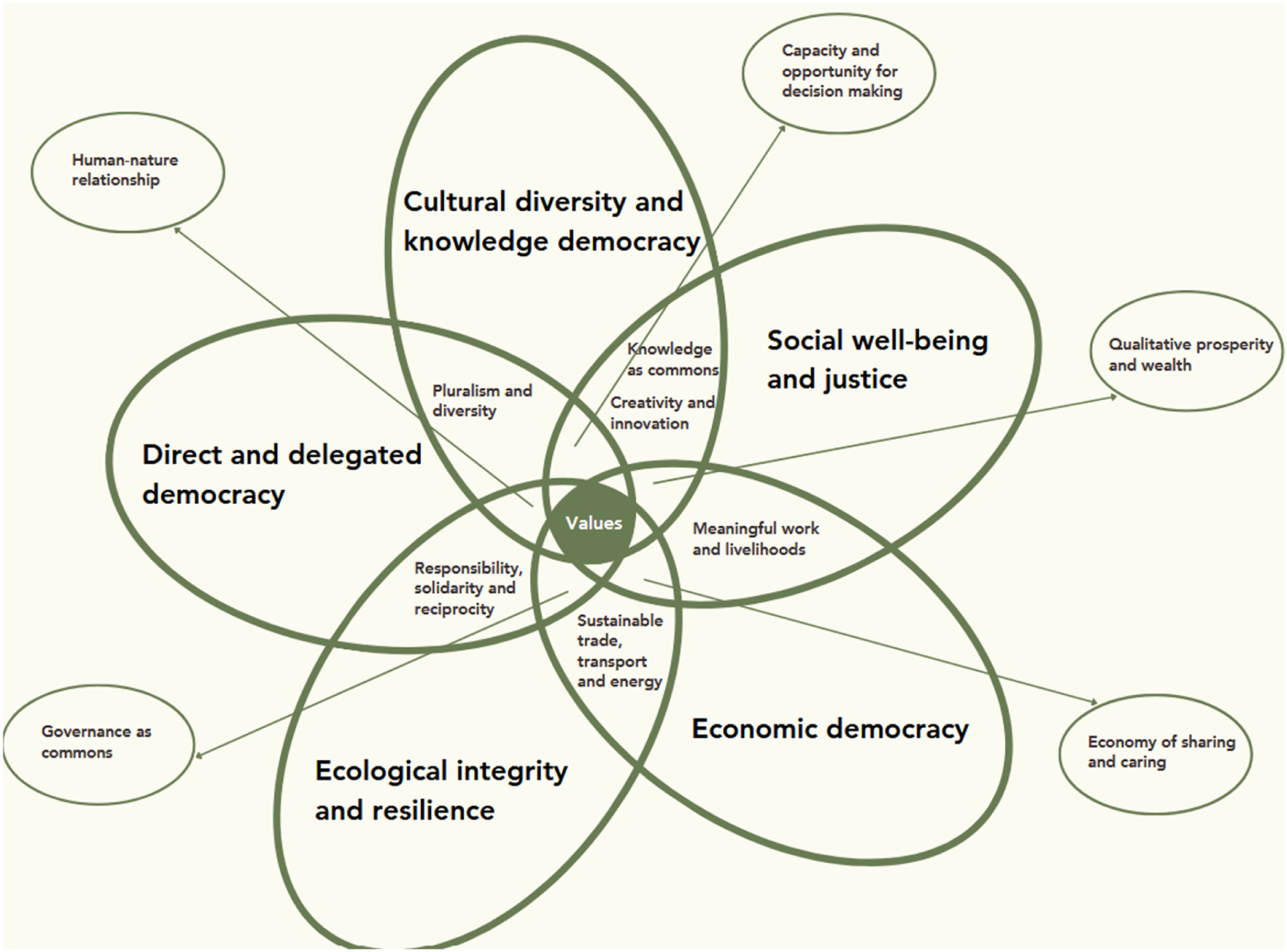
The group at Vikalp Sangam realized that to apply this Flower to actual initiatives on the ground, we needed some kind of tool. This was more for communities and collectives to self-assess, or for researchers from outside to carry out such assessments with the central participation of the actors in the initiative. This tool helps initiatives to assess changes intersectionally, and based on this understanding, take steps for further and more comprehensive transformation. As part of a global research project, the Academic-Activist Co-generation of Knowledge on Environmental Justice (ACKnowl-EJ), the nonprofit environmental organization Kalpavriksh developed an Alternatives Transformation Format (ATF), a more detailed and expanded version of the Flower. The aims were to: (a) distinguish between the transformative initiatives and reformist initiatives as well as false solutions, i.e., those that claim to be transformative but are only strengthening the status quo by being predominantly market-based or technology-based; (b) gain in-depth understanding of the process of transformation; (c) help understand if there are internally contradictory trends in transformation; and (d) through all this, enable the actors in the initiative to take steps towards a more comprehensive transformation (Kalpavriksh & ACKnowl-EJ, 2017).
The ATF was first used in a detailed study of transformations in the handloom weaving community based in Kachchh, in western India (Kothari, Venkataswamy, et al., 2019). It was also used to frame or understand a number of the other case studies in the ACKnowl-EJ project (e.g., Kothari et al., 2024; Lulla et al., 2024; Pathak Broome et al., 2023; Rodríguez et al., 2023). Subsequently, various forms of the ATF, including very simple iterations of the Flower of Transformation, have been used in many community and institutional contexts, including the ones described in this paper. These have been enabled by translations of relevant sections into local languages, or oral transmission where appropriate. These include its use during Sangams (physical confluences organized in the Vikalp Sangam process) in which movements or organizations reflected on how well they are doing in various spheres and opened themselves up to questions from other participants. Undergraduate students at Azim Premji University in Bangalore used the Flower to assess how their own campus fared on parameters such as ecological sustainability, social diversity, and democratic decision-making. In a similar exercise spread over a day, the organization Kalpavriksh reflected on its own internal practices in relation to ecological standards, invisible hierarchies, and structural barriers to diversity. In Ladakh, India’s northern-most region, the ATF has been modified for use as a “Well-being Index,” to understand whether villagers have alternatives to mainstream “development” indicators.
While the Flower has been incorporated into these few research projects, this is the first time that an academic paper proposes it as a research method with participatory, co-creative, and decolonial potential. With this paper, we aim to initiate this conversation, showing preliminary takeaways and lessons on such application of the Flower. In the next section, we offer an overview of the three scholarships that inspired our analysis of the Flower for its potential as a reflexive method and an emancipatory tool on the ground.
Participatory, Co-Creative, and Decolonial Research Methods
Participatory research (PR) is a broader conceptual umbrella that includes a variety of methodologies, such as action research (Brydon-Miller et al., 2003), cooperative inquiry (Heron & Reason, 2008), or participatory rural appraisal (Cornwall & Pratt, 2011), as well as specific methods or tools, for example, photovoice (Sutton-Brown, 2014), storytelling (Burns et al., 2015), or rivers of life (Moussa, 2009). Reason and Bradbury describe PR as “a participatory process concerned with developing practical knowing in the pursuit of worthwhile human purposes” that “seeks to bring together action and reflection, theory and practice, in participation with others, in the pursuit of practical solutions to issues of pressing concern to people, and more generally the flourishing of individual persons and their communities” (2013, p. 4). Influenced in its early days by the Latin American political tradition of participation and emancipatory education (i.e., Freire, 2014), PR seeks to challenge inequalities in knowledge production and empower the most marginalized groups to tackle social problems based on their own learning (Greenberg, 2025). As such, the key difference between conventional and participatory methodologies can be found in the location of power in the research process (Cornwall & Jewkes, 1995). In an ideal participatory paradigm, participants would be involved in every step of the research inquiry, including identifying research questions, collecting data, and analysis (Ospina et al., 2021). However, PR scholars recognize that, in practice, the degree of participation may vary substantially, and some warn against the danger of creating new forms of oppression (Cooke & Kothari, 2007), as opposed to “meaningful” participation (Cornwall & Jewkes, 1995; Ospina et al., 2021).
Knowledge co-creation is a term encompassing a variety of meanings depending on the context and actors involved (Knight, 2025). It can refer to theoretical and methodological frameworks, as well as research processes and outcomes, and is broadly defined as “processes that iteratively unite ways of knowing and acting—including ideas, norms, practices and discourses—leading to mutual reinforcement and reciprocal transformation of societal outcomes” (Wyborn et al., 2019, p. 3.2). Zurba et al. (2022) underscore its reflexive nature and potential to shift power relations, bridge cultural and epistemological differences, positionality, and confront histories of colonization, among others. Co-production most commonly refers to weaving Western scientific knowledge and Indigenous/traditional/local knowledge systems together (Datta & Starlight, 2024). Scholars have identified elements crucial to knowledge co-production like respect, vulnerability, trust, and embodied exchange (Ciavattone, 2023), and guiding concepts like interculturality, plurality, and co-creativity, referring to creative collaborations (Franklin, 2022, p. 2). Franklin (2022) explores how co-creative research practice can best support the emergence of alternative—potentially even transformative—ways of being in the world. In this process, deeper forms of enquiry like activist, community-based, and scientific epistemologies complement as well as collide with each other in processes of joint knowledge production (Rodríguez et al., 2023).
Decolonial research methods seek to incorporate decolonization into research practice through “naming the politics of coloniality” (Bautista, 2019), or unmasking how scientific disciplines and methodologies were born out of processes of othering or invisibilizing colonized people (Hereniko, 2000; Ndlovu-Gatsheni, 2019; Udah, 2024), or reducing them to research objects to be looked at through the “imperial gaze” (Tuhiwai Smith, 1999). While it is true that coloniality also exists in the geographical South, the Western, Euro-centric, and positivist conceptions of science and the pursuit of the “objective truth” result in epistemological violence or epistemicide (de Sousa Santos, 2016) of other forms of knowing which are not useful to the colonial project, and which exclude Indigenous, marginalized, and oppressed groups from knowledge production. To some extent, this process is still upheld in today’s academia through practices such as politics of citation, domination of colonial languages (especially English), economic inequalities, and capitalist relationships in research funding, or the appropriation of native cosmologies and knowledge systems by Western scholars (Stephens, 2024; Todd, 2016).
Decolonial and Indigenous scholars advocate to reveal the politics, embedded power dynamics, underlying assumptions, motivations, and values that inform our research practice (Tuhiwai Smith, 1999). They urge scholars to adopt an intersectional perspective on how individualism, religion, heteropatriarchy, racism, colonialism, and capitalism link together in the practice of knowledge creation (Bautista, 2019). Many decolonial thinkers contend that we need to go beyond merely naming the politics of coloniality and metaphorical uses of decolonization, advocating instead for a systematic and structural transformation in academia and beyond (Mbembe, 2015; Narayanaswamy, 2024; Tuck & Yang, 2012). Others advocate for liberatory and anti-capitalist research methods for non-hierarchical knowledge creation that aims at the construction of non-capitalist social power (Araujo, 2023). In this spirit, research processes can take a more democratic form of mutual learning and relationship building (TallBear, 2014).
In sum, participatory, co-creative, and decolonial research methods share their concern for questioning the processes of knowledge production from different angles, with many overlapping and complementary aspects. Participatory research focuses on inclusion and democratization of knowledge production; co-creation emphasizes iterative exchange between different epistemological traditions, and decolonial research reveals the overarching politics of power. In addition to these, we also take inspiration from feminist scholars that have turned their attention to the importance of embodied, sensory, vulnerable, and affective research practice (Davis, 1997; Le Bourdon, 2022; van den Berg & Rezvani, 2022; Weatherill, 2025). In the spirit of this work, we do not shy away from uncomfortable feelings and emotions that are part of the research process. On the contrary, we believe that “staying with the trouble” (Haraway, 2016) is necessary to advance our journey towards transformative futures, both in alternative organizing that we study as scholars, as in our own academic practice.
Analytical Strategy
Based on the aims of the Flower framework and the concerns and aspirations raised by participatory, co-creative, and decolonial scholarships, in this paper we carry out a dual but also interrelated analysis. First, we analyze the emancipatory potential of the Flower on the ground, based on its employment in three different communities. Our aim is not to do a comparative analysis, but rather to illustrate the diversity of applications of the Flower across the South/North contexts, putting the two sides into conversation. We ask the following questions: to what extent was the participation of the communities perceived as meaningful? Does it further the ability of participants to initiate the changes they would like to address based on their own learning, including any contradictory or complementary trends in their own work? To what extent were the internal power dynamics between members of the initiative challenged or upheld?
Secondly, we analyze the potential of the Flower as a reflexive tool in the decolonial spirit. We operationalize a decolonial critique at a theoretical and meta level by turning the focus inwards to examine the extent to which we, as researchers, were in line with the aims of the Flower. We ask: to what degree were local ways of knowing respected and encouraged, while facilitating a non-hierarchical research process? What kind of structural and systemic power dynamics were at play? How did the Flower exercise allow us to challenge some of the issues inherent to conventional research methods, such as power inequalities, epistemological violence, or uni-directional learning? Which, in turn, did we fail to address and why?
Our analytical frame can be visualized in the form of the three interconnected circles: (1) emancipatory potential, which includes elements of critique from scholarship on participatory research methods, (2) decolonial potential, concerned with themes presented by the decolonial methods scholarship, and (3) knowledge co-creation as a linking dimension between the two (Figure 2). Through this framework, we propose that both critiques raised by participatory and decolonial research methods can be carried forward in processes of co-creation between the communities, activists, and researchers based on continuous co-evolution and dialogical iterative processes. The Flower of Transformation presented in this paper is one tool that can serve such purpose. Analytical framework: Emancipatory and decolonial dimensions of research production through co-creation
Applications of the Flower Exercise
We applied the Flower exercise to three different communities and organizations in India and Denmark. Deccan Development Society (DDS) is a local grassroot organization founded in 1983, working with 1,500 smallholder Dalit women farmers in Telangana, India. Dharani Farming and Marketing Mutually Aided Co-operative Society Ltd (Dharani) is a producer-owned and managed cooperative business enterprise of 2,716 smallholder farmers established in 2008 and promoted by the Timbaktu Collective, a local grassroot nonprofit organization in Andhra Pradesh, India. Karise Permatopia (Permatopia) is a Danish eco-village, a living and intentional community promoting sustainability and populated since 2018 by around 220 people.
Application of the Flower in Dharani and DDS
In both Dharani and DDS, the exercise was organized in the form of a participatory workshop ranging from two (Dharani) to three and a half hours (DDS). In the first case, it involved a group of six farmer members (three men and three women) participating in the program on organic agriculture, and two team members (NGO staff) who also helped to identify the participants. The participant selection criteria ensured gender balance and representation from various roles in cooperative governance, 2 including both members and leaders (Lewartowska, 2024). The DDS case was with eleven team members of the promoting NGO (nine women and two men, where the vast majority of staff is female), performing different roles within the organization. They were invited directly by the researcher. In both cases, the exercise was conducted at the end of a two-month long fieldwork, during which informed consent was obtained and reiterated during all stages of the research process and mutual trust was established. In this specific case, participants were informed of the purpose and nature of the exercise and oral consent was obtained. 3 To allow full linguistic expression of the participants, the workshops were held in the local language (Telugu) with the assistance of an interpreter who was extensively trained on the purpose of the exercise and had previously worked with the researcher during fieldwork at the communities. The interpreter was following a script prepared by the researcher and provided translation whenever possible to avoid lengthy processes of live translation. To mitigate some of the challenges related to translation such as loss of vernacular expressions or involuntary change of meaning, and to enhance the reliability and richness of the data, the exercise was recorded and later transcribed and translated into English.
In both cases, at the beginning of the exercise the Flower framework was introduced and different spheres of transformation explained, using examples of the opposition between mainstream and alternative practices. Each of the spheres was then discussed in more depth by the participants. Using a big sheet of paper or a white board and colorful markers, participants took notes on the community’s efforts in each of the spheres inside the petals, while outside of the petals they included the future ambitions for their initiative (Figure 3). The arrows between the spheres indicate overlaps and synergies. Flower of Transformation chart created during participatory workshop at Dharani
In Dharani, where the workshop was of shorter duration (two hours) the discussion revolved around concrete examples of everyday practices and activities within the different spheres. In DDS, the discussions took a more ideological and value-based turn, where staff members spoke about broader principles that guide the organization (Figure 4). In Dharani, there was more mediation of the discussion from the moderator-outsider, while in DDS the intervention from the researcher was minimal and moderation internal to the group. To some extent, in both cases the exercise allowed for the identification of new avenues of work that the community wished to take on, but the exploration of the interconnections and trade-offs between spheres was limited due to time constraints. At the end of the workshop, both participant groups provided feedback on the format, content, and usefulness of the activity. Flower of Transformation chart created during participatory workshop at DDS (by Santhoshi Srilaya Routhu)
Application of the Flower in Permatopia
In Permatopia, the exercise was organized as a two-hour reflection workshop. The group consisted of seven community members who had responded to an open invitation. The group included a mix of genders but in general was most representative of what could be called “core” Permatopes, i.e., those belonging to the most active and older third of the community. First, the researcher introduced the framework and explained the different spheres of transformation. Using big sheets of paper—each representing a different petal—each of the spheres was discussed in more depth. The researcher facilitated the whole discussion and took notes on the placards. The community described their current practices in each of the spheres, which were noted by the researcher inside the petals, and then the future ambitions for the initiative were listed outside the petals. The intention was to subsequently focus on interlinkages, but this was not possible due to time constraints. Still, quite a number of interlinkages, trade-offs, and synergies emerged though the discussions of the individual petals (in Figure 5, examples of interlinkages are indicated via arrows; Figure 6 shows trade-offs, synergies, and internal contradictions). The exercise was carried out after one year of fieldwork engagement and hence by that time the researcher was quite familiar with the community. The exercise was moderated by the researcher who probed into explanations given, linkages to other spheres, and at times also related discussions to findings emerging from interviews and participant observations. The exercise was carried out in Danish, recorded, and subsequently transcribed. Flower of Transformation chart drawn during participatory workshop at Permatopia Flower from Permatopia: Synergies, trade-offs, and internal contradictions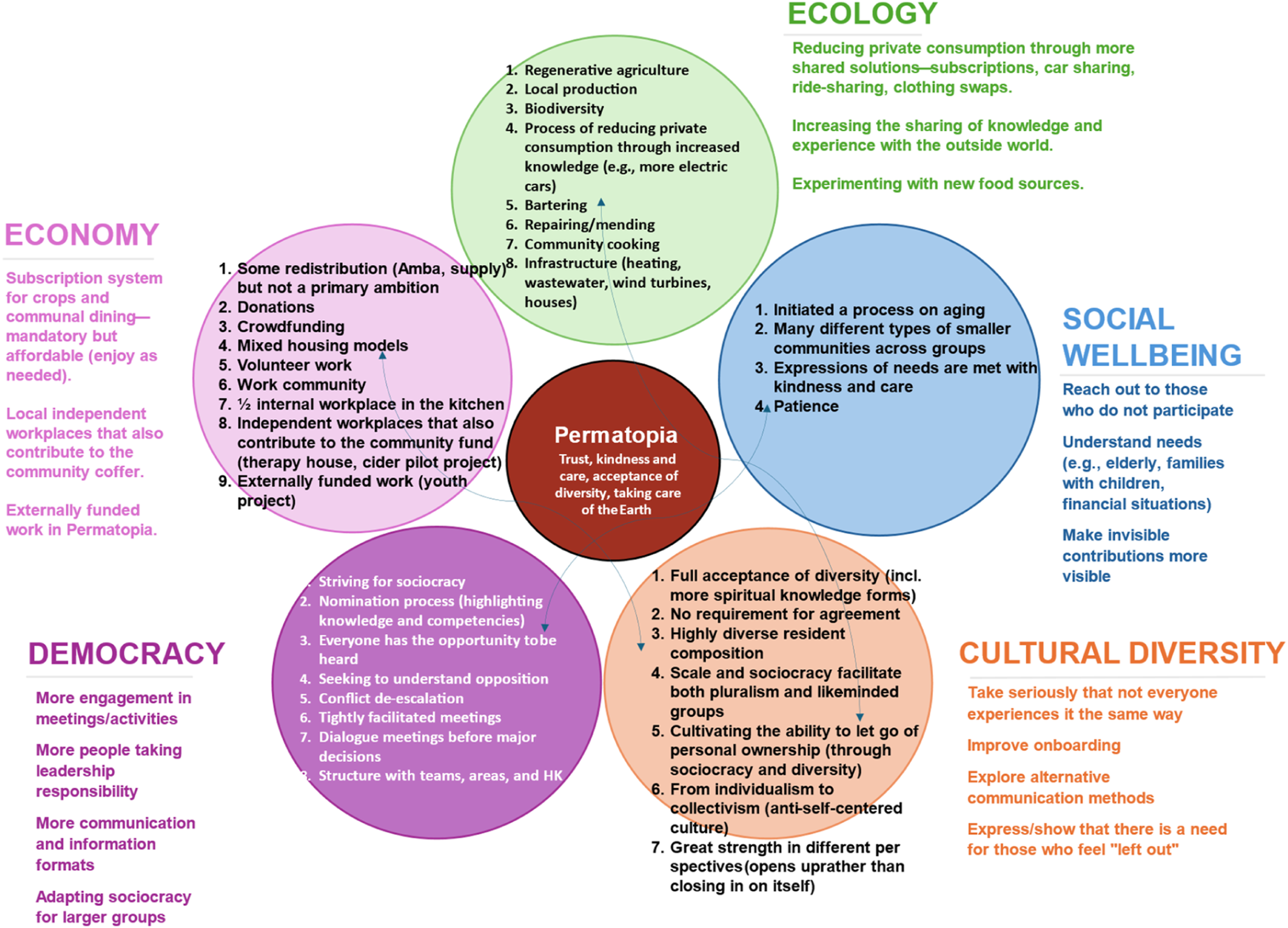

Emancipatory Potential of the Flower on the Ground
We believe the best way to assess the emancipatory potential of the Flower is to reflect on feedback from participants in the exercise. In Dharani, the participants mentioned that they gained a new perspective on their community using an innovative format, with one noting: “We didn’t distinguish these points in different spheres before … From today, we can speak about new aspects. We learnt new things. We got some good ideas from this exercise.” In DDS, the participants highlighted the sense of pride in visualizing all the good work done throughout the years, concentrated into the Flower. One DDS participant commented: “So many experiences, sacrifices and conflicts—all of them culminated into this.” In Permatopia, the members clearly recognized their role in the green transition towards livable and ecologically sustainable futures, highlighting their specific contributions. As one participant explained: We don’t believe we have all the answers or solutions to anything. [pause] But in a way, we do. We are part of the solution. The environmental debate is framed as if doing good requires sacrifice, and that it’s enjoyable to be wasteful. [pause] But actually, it is wonderful to live this way … We have resolved that contradiction.
In all three communities, participants were able to identify avenues for future work in each of the spheres, highlighting the potential of the Flower exercise for the positive conceptualization of goals. In India, examples of such visioning included a greater focus on equality of wages, a move towards self-sufficiency in the economic sphere (without overreliance on external funding), enhanced gender empowerment, and possible new areas for production. In Permatopia, participants discussed future ambitions which arose after uncovering existing challenges through the exercise. For example, it was noticed that some members of the ecovillage do not participate much in community activities. This led to the future goal of understanding better the needs of different groups (the elderly, families with children, etc.) and the factors that potentially limit their participation, as well as making the “invisible contributions” visible. Through the reflection on avenues of future work in each of the spheres, the participants from Permatopia were also able to identify tensions or underlying causes for particular problems.
In addition to the discussion on current work and future ambitions, the exercise also permitted a collective reflection on principles and values that might bring the community together. In fact, it was the centrality of values that clearly marked the truly alternative character of the initiatives. In the Indian communities, these included honesty, recognition and respect, equality, sovereignty and self-governance, and broader principles like ecological resilience guiding economic activities. Participants agreed that people and nature come first and expressed a strongly felt human-nature interdependence. An example of this worldview is a long-term perspective on “growth,” which one participant described during the DDS exercise: In [name] village, a sangham member
4
once found a small infant near a tree. She was quite old and brought him to sangham meeting. She said she did not have milk or much means to support the child, but she would like to take care of him. First, there was an idea that everybody can contribute some money. But how long can we support? So, they made a decision instead to support her to get a cow so that the kid has milk and she also has a livelihood. In other meetings, they would probably dust off their hands by just giving money. But members thought about what to do for long-term. Because of this, the kid grew up well, there was manure too, an animal was also taken care of.
In Permatopia, foundational values of trust, kindness, acceptance of diversity, and care for the Earth and each other emerged. One participant noted: “[These are] values that have brought us together or made us move here.” Another highlighted that shared principles are crucial for creating and nurturing a sense of community, as well as inspiring others: We have built a community where the cognitive dissonance around “What should I do to do something about the climate crisis? What actions can I even take?” finds fertile ground here. … And a model for how to approach it differently. Also for others. Something to replicate.
The ambition of acting as an example was also reiterated in Dharani, where participants expressed the desire to inspire others to do a similar kind of work.
In allowing for the centrality of values to emerge, the Flower exercise gave the participants an opportunity to pause their daily work, reflect on, and reconfirm those principles that are foundational to the community’s struggle. In that sense, the Flower has the potential of nourishing the co-creativity around alternative and transformative ways of being in the world (Franklin, 2022), enabling the emergence of new ideas and reaffirming common purpose and goals through careful reflection (Moriggi et al., 2020). It may help the community to develop practical knowledge and solutions based on their own learning (Greenberg, 2025; Reason & Bradbury, 2013). The exercise produces a grounded self-definition of alternative organizing as perceived by the community members themselves, shedding light on the characteristics, non-negotiable principles, and values that inform the alternative nature of the initiatives (Dahlman et al., 2024; Phillips & Jeanes, 2018). In Permatopia, engagement in these kinds of meta-level reflections is not common during communal meetings as they are tightly facilitated to ensure that discussions stay close to the practical issues at hand. Hence, the Flower opens up a space for “big picture” reflections and facilitates “futuring,” including visioning and reflection on future ambitions.
Due to time constraints, discussions on the contradictory trends between the spheres of transformation were more limited. In Dharani, rather than explicit tensions, a few disagreements emerged relating to the issue of categorization. For example, there was contention over whether the topic of party politics should go in the political/democracy petal. There was also disagreement over what elements should be placed in which sphere of transformation, so substantial overlaps were captured through the use of arrows between petals (Figure 3). In DDS, participants spoke about how changes in the wider society require the community to adapt, even if this sometimes results in compromises that not all members of the community wish to make. One member said: “In the present fast-paced world, it seems that people do not have time to think like this anymore. We must stop trying to convert people to our thinking but rather understand how to talk to them.”
In Permatopia, contradictory trends emerged in discussions, but these were often within petals, rather than between petals. For example, under the social dimension, the importance of inclusion was noted, but this resulted in tension when it emerged that around a third of the community members did not engage much in communal meetings. Participants also discussed hierarchies, for instance between different tasks and competencies in relation to how much credit these are awarded within the community, or the lack of redistribution between the amount of voluntary work and one’s economic standing. Under the democracy petal, a contradiction emerged related to how community members desire flat hierarchies and influence but most often do not want to lead initiatives themselves. To some extent, therefore, the exercise in Permatopia allowed for a collective reflection on invisible hierarchies and more hidden structural barriers, challenging some of the internal power dynamics within the community.
While participation was found overall to be meaningful based on the feedback from community members (Cornwall & Jewkes, 1995), the short and limited format was a significant constraint. Based on the availability of the participants and in order to avoid excessive burdening (Cooke & Kothari, 2007), it was decided to keep the duration of the workshop to a few hours. In Permatopia, where participants are quite used to engaging in self-reflecting discussions, two hours was most likely not enough to serve the purpose of emancipatory learning. For a few, however, the exercise was experienced as novel and inspiring. All participants agreed that there was great potential in discussing inter-linkages more systematically, and some expressed disappointment that time did not allow for this element. After the discussion, the researcher further developed two customized versions of the Flower for Permatopia: one explicating the content of the petals including future ambitions (Figure 5) and another focusing more on the interactions between petals that emerged in the conversation (synergies and contradictions) as well as internal tensions (Figure 6). The hope is that such an output—which will also form part of our dissemination to the community—sows seeds that might germinate in one form or another and help further the ability to initiate changes based on self-learning.
In all three cases, the experience was far from an ideal participatory paradigm (Ospina et al., 2021). Participants were not involved at all stages of the research process, and the format of the exercise was decided beforehand. In that sense, inequalities in the research process and dichotomies between the researcher and participants were reproduced. We also recognize that the imposition of a fixed framework can possibly constrain the exploratory potential of discussions around alternative organizing. In this regard, participants from Permatopia revealed that they had expected a deeper meaning between the location of the particular petals in relation to each other, i.e., where some petals had more overlap with each other compared to other combinations. They reflected that in the sociocracy governance model adopted in the community, there is a reason why you ask questions in a particular way and order—and they wondered if that was similar for the Flower tool. They all expressed a desire and interest in exploring the overlaps, potential synergies, and trade-offs between the petals in more depth.
In addition to these reflections, the feedback from the communities provided important points for improvement around the exercise. In Dharani, for example, participants found it frustrating to summarize the discussions in just “a few words” to be written inside the petals. DDS members further reiterated the problematic nature of the written format in which the exercise was held, pointing out its exclusionary character to those without formal literacy skills. They suggested instead to employ visual representation and more accessible methods, for example Participatory Rural Appraisal (Cornwall & Pratt, 2011)—a technique frequently used in the community’s own work. Hence, the Flower exercise allowed to some extent for a cross-fertilization between epistemologies, revealing certain assumptions that guide our research practice and often remain unnoticed by the researcher (Tuhiwai Smith, 1999). As such, it made us question the way in which we do research, broadening our methodological horizons and gaining new insights from the participants’ point of view (Thambinathan & Kinsella, 2021).
Finally, while in the discussed cases the usage of the Flower was limited to a one-time workshop, it is possible to employ the Flower in a long-term engagement and throughout the different stages of the research process, as it was done in other studies (Kothari, Venkataswamy, et al., 2019). Such engagement enables a more in-depth exploration as well as a more collaborative relationship between the researcher and the community. The Flower could also potentially be incorporated into some more conventional research methods like interviews or focus groups. It goes without saying that careful consideration must be given to how much we as researchers can ask of our participants and how to make the experience meaningful for them (Arieli et al., 2009; Cooke & Kothari, 2007). At the same time, we also recognize the agency of the participants in deciding the degree of their engagement and interest in the research process. In any case, the visual representations of the Flower with information filled into the petals were left with the communities, with the intention of further elaborating on the exercise outcomes when other research results will be presented in each community for feedback, learning, and validation.
Flower as a Tool for Reflexive Research Practice
For Permatopia, the exercise was somewhat effective in challenging uni-directional learning as it was carried out as a more relational exercise focusing on reflecting together (Kral, 2014). Here the researcher—who functioned as moderator—took an active role in asking, prompting, and suggesting. As an example, participants spoke about the importance of accommodating a broad variety of inhabitants and their perspectives. While they framed it as healthy, the researcher invited participants to reflect further: “Doesn’t that also come at a cost in terms of, let’s say, the speed of the transition or the degree of sustainability?” The researcher noticed that the economic, social, cultural, and political practices of the community are conducive to an inclusive environment, where everyone can take part in the transition towards a more ecologically sustainable future, but that change in behavior is limited because many decisions regarding consumption and accumulation are left to the individual. In this regard, members highlighted the preference for a broader path rather than radical and more compulsory change. One participant noted: It can become so avant-garde that one loses touch with society and the power of inspiration disappears. Then there is no path for anyone to walk on. They can only see that there are people over on an island, but they cannot make use of it.
In this sense, the Flower exercise in Permatopia offered an opportunity for community-based and academic knowledge to come together in a co-creative process (Rodríguez et al., 2023) taking a form of mutual learning rather than extraction (Knight, 2025; TallBear, 2014), while using a tool which builds on a different epistemological tradition. Such engagement was enabled by the researcher’s relatively uncomplicated positionality (being quite similar to and familiar with the participants) as well as the previous knowledge obtained through prolonged fieldwork. Undoubtedly, even when conducting research in one’s own context and language, researchers can take on different positionalities. In this case, the exercise enabled a more participatory and engaging approach to the community. In addition, the Flower template goes more explicitly into subtle power dynamics and knowledge inequalities, facilitating explicit discussions about such issues which otherwise might not have emerged as vividly.
In the Indian cases, the workshop prompted a discussion in a group setting using an innovative framework that teased out new perspectives. For example, participants noted the value of the Flower in terms of intergenerational exchange. As one Dharani member noted: “All these aspects are valuable (…) It can be passed on to the next generation (…) It’s connecting different generations, past, present, future”. The exercise helped fostering a multi-directional learning within the community, rather than between the community and the researcher as in the Danish case. The positionality of the researcher—a white, Global North-based woman—was a present factor in terms of power differentials, privilege, complex colonial histories, and cultural and language barriers, among others (Le Bourdon, 2022). These structural issues became even more evident in the Flower exercise because the obstacles to the materialization of an ideal participatory paradigm became more salient (Ospina et al., 2021): in other words, it is much easier to overlook embedded power dynamics when we are not trying to challenge them.
In Dharani, the researcher felt there was a certain “authority” in setting up the workshop, where participants might have felt obliged to participate (Cooke & Kothari, 2007). In addition, there might have been a tendency for participants to highlight the positive aspects of the cooperative’s work and focus less on tensions, potentially due to the researcher’s presence as an external actor—even though the researcher’s access to the field in both communities was facilitated through their trusted, long-term collaborators. At the same time, the agency of the community members in terms of their participation in research activities should not be underestimated—in fact, both the circumstances and the duration of the exercise were tailored to their availability. While trying to interfere as little as possible, the researcher still maintained a certain control over the workshop in terms of moderation (through the interpreter), and therefore the dualism between the researcher and the participants was not dismantled. Some internal power dynamics within the group also emerged: women generally participated less than men, but members discussed the community’s long-term effort to increase gender equality. When speaking about the broader society, one participant noticed that “Only some people think women have to be given their freedom. Only if we keep doing [our work] things will change”. In that sense, the Flower, conceived as a self-appraisal tool and not meant for external evaluation, can potentially help reveal power dynamics and prompt the participants to engage in a meaningful discussion around them.
While the Flower exercise did not erase structural issues of knowledge production, such as the deeply embedded power structures in research funding, nor confronted histories of colonization, it did to an extent shift the location of power in the research process (Cornwall & Jewkes, 1995), as participants took on a much more active and autonomous role. In DDS, for example, the community members took almost complete ownership over the exercise, with one of them acting as moderator. The resulting diagram from the exercise was conserved for future use and the format of the Flower might be used in other contexts by the community (Figure 4). In that way, the Flower allowed for a less extractive, but more mutually beneficial research engagement. Participants had much greater knowledge and experience about the local conditions than the researcher, and therefore a greater power in filling out the Flower; in that sense, the researcher was less capable of challenging the participants than a local moderator would have been, as illustrated in the Danish case. Given that the Flower itself emerged in a participatory process from Indian grassroots movements, its use in the Indian setting highlights the value of methodologies that are culturally grounded and locally resonant. Participants also noted, however, the need for expanding the conversation on alternatives beyond the site of the Flower exercise. As one DDS member noted, “We have written this. But it should also go to some high-level people, and they should find out about us”. This point reiterates the limitation of the one-time exercise and highlights the need for a broader and more systemic approach to transformation at different levels and scales.
The way the exercise was carried out in all three communities, at the end of a longer research period and in an interactive manner, turned out to be a valuable contribution to the qualitative research analysis (Greenberg, 2025). The employment of the Flower allowed for data validation, clarification of doubts, and the emergence of new insights, deepening the researchers’ understanding of the initiatives and their transformative processes. It also fostered enhanced reflexivity for the researchers in questioning their own assumptions around research practices. At the same time, however, the setup fell short of fully challenging the embedded inequalities in academic knowledge production. To begin with, the exercise was carried out within a larger research process in which the proposal was originally elaborated by the researchers without participation from the communities. While research questions, methods, and community-oriented research outputs were subsequently discussed with the representatives from the initiatives, their participation and agency were limited in the broader research process. For example, the initiatives were not funded by the project (although other ways of decentralizing economic power were sought), and only a few community representatives participated in writing and authoring publications. Hence, while some steps were taken to address positionalities and power inequalities, in an attempt to avoid invisibilizing non-Western ways of knowing (Hereniko, 2000; Ndlovu-Gatsheni, 2019), other problematic issues within the knowledge production remained unchallenged, such as the economic inequality or the dichotomy between the researcher and the participants. In hindsight, we also recognize that the analysis of the reflexive potential of the Flower was conducted primarily by the authors of this paper and, to some extent, in conversation with the activists who created the tool, but not with the participating communities. A more explicitly decolonial approach would have required raising these reflexive dimensions with community members, for instance during the feedback session at the end of the exercise - this would allow for greater nuance, validation and shared interpretation. Overall, we aim to be honest about the limitations of our endeavor and recognize that for real decolonization to happen, a systematic transformation of academia, and the world more broadly, is needed (Narayanaswamy, 2024; Tuck & Yang, 2012).
A final interesting learning relates to the use of a Southern reflection method in a Danish context. The petals of the Flower draw on post-development critique among others, in their focus on justice, equity, and pluriversality (Kothari, 2014). These are elements that would not normally figure prominently (or even at all) in a conventional Northern sustainability reflection tool (see, for example, Global Ecovillage Network, n.d.; Økosamfund, 2024; United Nations, n.d.). What emerged during the exercise in Permatopia was that markers of difference relating to class, gender, or age were discussed explicitly (ethnicity did not come up directly, as Permatopia consists mainly of ethnic Danes). The Flower prompted discussions about different ways of knowing and being in the world, and these turned out to be the parts of the workshop where the community participants were most engaged and excited.
Overall, the usage of a Southern framework emerging from grassroots experimentation allowed for a more decolonial engagement, challenging the authority of the mainstream, Northern tools which are normally adopted in the research process. In particular, using a Southern tool in a Northern context reverses the often-unrecognized assumption that knowledge flows only in the opposite direction. The researchers tried to be mindful of the danger of cherry-picking and appropriating Indigenous knowledge (Todd, 2016). The Flower, however, was deliberately created as a co-creative tool to be used and adapted in the spirit of pluriversality (Kalpavriksh & ACKnowl-EJ, 2017; Vikalp Sangam, 2024). Hence, the experimentation with the format was encouraged, and the experience of its employment was fed back and discussed with the initiators in a lively online feedback session. There, community representatives, scholars, and activists reflected together on the benefits and limitations of the Flower, exchanging knowledge on its different uses across cases and contexts. They also discussed the potential to further develop the tool using feedback from participants and researchers. In this way, activist, community-based, and academic epistemologies were exchanged in an iterative process of joint knowledge production (Knight, 2025; Rodríguez et al., 2023). For example, it was discussed how the Flower can be employed for a broader reflection versus a more in-depth engagement in each of the spheres; the implications of doing the exercise at the end versus at the beginning or half way through the fieldwork; different possibilities of output representation including artwork; strategies for teasing out intersections and contradictions; and the importance of tailoring research methods to the community’s own tools and methodologies already adopted in their work.
Conclusions: Flower as a Tool for Iterative Process of Knowledge Co-Creation
In this paper, we analyzed the potential of the Flower of Transformation in emancipatory terms on the ground as well as in relation to its reflexive and decolonial possibilities as a research method. To do this, we took inspiration from participatory, co-creative, and decolonial research methods and the original aims of the Flower. We want to conclude by proposing the Flower as a method in continuous co-evolution and iterative dialogue between different actors in the knowledge co-creation processes. As highlighted by members of Vikalp Sangam (2024), the Flower is meant to be a flexible and malleable tool. Alternative communities may have their starting point in different spheres of transformation, and so none of the spheres is more important than others. The Flower, with its overlapping petals, represents the intersectionality of the spheres, and each community is invited to further define its areas of transformation and struggle, as well as identify synergies and contradictions or trade-offs. The employment of the Flower is meant to ultimately serve their journey of transformation, which can be supported in a mutual engagement between community members, activists, and researchers in a variety of constellations and across different contexts. This iterative process based on mutual learning allows for cross-fertilization between different ways of knowing and can produce a more nuanced understanding of alternative transformation processes. At the same time, such an approach may facilitate change in the hegemonic ways of doing science, while building continuity between community-based actors, activists, and academics.
We do remain cognizant that some important inequalities in research and academia remained unchallenged in the way the Flower was applied—disparities in funding and research design, among others. In that sense, there is a danger of us researchers taking refuge in the comfortable awareness of having explored some decolonial aspects, while in practice not really challenging structural issues. We do, however, think that we need to start somewhere, and if the success criteria of “doing it right” are inaccessible, there is a real danger of scholars not engaging at all in these important debates. For us, embracing vulnerable research also means acknowledging where we are in our journey, even if this means we will most likely (indeed, hopefully) feel awkward going back to this paper when we are more advanced in our transformation as researchers. We would like to challenge the pervasive tendency to rightfulness through performative individual practices in the academic tradition and instead advocate for a more vulnerable engagement and collective learning from our mistakes and insecurities.
In sum, while following the justly pointed direction that scholarship on radical research methodologies offers, we believe that it is part of our intellectual and epistemological honesty to nurture a dialogue on challenges, uneasiness, and contradictory logics that emerge in the pursuit of a more decolonial, emancipatory, feminist, and anti-capitalist research practice—one that is more embedded in epistemologies and methods from the Global South than the Global North, and is developed in conversation with colleagues, community members, and activists. Instead of shying away from such efforts due to fear of not living up to the theoretically outlined expectations, we encourage fellow researchers to dive into an open-ended and honest engagement, contributing to joint reflections which can help advance the alternative agenda as both an individual and a collective endeavor.
Footnotes
Acknowledgments
We extend our gratitude to all the research participants for their valuable contribution to this study. We are also thankful to the “Green Futures” research team for insightful comments on a draft version of this article during our joint workshop in Denmark in June 2025.

Ethical Considerations
The study was approved by the Graduate School of Roskilde University.
Consent to Participate
All participants provided written or verbal (when appropriate) informed consent prior to participating.
Funding
The authors disclosed receipt of the following financial support for the research, authorship, and/or publication of this article: This research is funded by the DFF (Independent Research Fund Denmark), project no: 1127-00212B. “Producing alternative green futures: Exploring interconnections between green transitions and socioeconomic and political organization”. The funder was not involved in the design, writing, or decision to submit this article.
Declaration of Conflicting Interests
The authors declared no potential conflicts of interest with respect to the research, authorship, and/or publication of this article.
Data Availability Statement
The data that has been used is confidential.