




Abstract
Through participatory evaluation research, this study examines the experiences and perspectives of children and young people engaged in a democratic innovation—a citizens’ assembly on biodiversity loss—and a subsequent initiative to co-create educational resources. The research explores how participation and co-creation can empower children as active agents of change in environmental action and assesses the value of participatory evaluation for understanding these processes. This research is timely because children and young people across the world are increasingly voicing their concerns about climate change, environmental degradation and biodiversity loss, and advocating for urgent action. Yet despite extensive research on youth environmental action, their perspectives, experiences and evaluation of participatory processes and the impact of their involvement remain underexplored, highlighting the value of youth participatory evaluation in informing practice, enhancing engagement and supporting action. This paper addresses this gap in the growing body of literature on youth participation in democratic processes, co-creation and research, drawing on participatory evaluation research to enhance our understanding of the processes and outcomes. Recognizing the prominent role of youth in the environmental justice movement, the study investigates innovative methods that empower children and enhance their individual and collective efficacy. The research indicates that children value the opportunity to participate and co-create as they feel best placed to say what their peers want and need, and they report a strong sense of agency gained from participation in such processes. These findings offer methodological insights for researchers and practitioners regarding youth participation in environmental initiatives and in broader research and governance processes. This paper also highlights the potential of engaged research and participatory evaluation approaches to bridge theory and practice as a dynamic, two-way process, capable of producing insights that advance academic understanding and have actionable value for those involved.
Keywords
Introduction
The threat that the triple planetary crisis (climate change, pollution and biodiversity loss) poses to current and future generations requires urgent, collective action to mitigate, and already adapt to, its impacts globally. The knowledge that environmental transformation requires greater public participation in policy, research and practice has led to a surge in deliberative democratic processes, engaged research approaches, and other forms of collaboration in sustainability transitions research and practice. Knowledge creation through participatory processes which draw on diverse perspectives to inform problem framing and the identification of potential responses typically produce more feasible and legitimate solutions, and the engagement process itself can empower the participants enabling them to act for and envision sustainability (Huttunen et al., 2022). Research also indicates that public participation in governance can be a potent means to achieve key democratic values such as legitimacy, justice and effectiveness (Fung, 2015). There have been growing efforts to ensure public participatory processes are representative of diverse groups, and particularly those from marginalised and vulnerable communities who are often most at risk of the impacts of the climate crisis and environmental harm, including children and young people. 1
Despite chronic exclusion from democratic processes, children across the world, defined as those under the age of 18 as outlined in the United Nations Convention on the Rights of the Child (UNCRC, 1989), have highlighted the impact of climate change, environmental degradation and biodiversity loss on their lives, and their concerns and fears about the world they, and future generations, will inherit in later life if urgent action is not taken (Bowman, 2020; Daly, 2022; Daly et al., 2024). The change they demand is systemic and requires re-evaluation of the way decisions and actions are made in society (Barraclough et al., 2021; Kelly et al., 2022). Considering this, children’s right to a healthy, clean and sustainable environment was recognised and outlined by the United Nations Committee on the Rights of the Child in 2023 in its General Comment No. 26, authoritative guidance to all 198 signatories of the CRC on their children’s rights obligations in relation to the environment and climate change (UNCRC, 2023). It highlights that children and young people are not only victims of the crises, but agents of change and that realising children and young people’s rights to education, information and participation in decisions about the environment and climate crisis are essential to this. Indeed, the European Commission (2021, p. 5) calls out the role of children as “agents of change in the implementation of the Climate Pact and the European Green Deal”. Such statements are reinforced within educational research which has shown that empowering and mobilising children and young people is vital to environmental action in practice (UNESCO ESD Roadmap, 2020; Whitehouse, 2021). As informed agents of change, children and young people play a key role within their families and communities, with children, young people and adults influencing one another through intergenerational learning (Trott, 2020). Whilst there is a wealth of research into the myriad ways children and young people are engaged in environmental action, their perceptions of participatory processes and the diverse impact of their participation – though significant – remain less explored. There is much to be learned from participatory evaluation with children and young people regarding their engagement in participatory democratic processes and participatory research projects. A deeper understanding of these processes can inform engagement approaches, enhance participation, and provide insights into the impact of their involvement.
Participatory evaluation with children and young people can offer more diverse, legitimate and instructive findings which can contribute to a better and more holistic understanding of both process and social impact (Sabo, 2001). Aside from the ethical imperative, engaging young people in research and governance promotes democratic practices and social justice. Young people offer unique perspectives informed by their lived experiences, which adults may overlook or misunderstand, and their input on issues directly affecting them enhances the relevance of research and the validity of evaluating participatory processes (Percy-Smith & Thomas, 2009). Participatory evaluation research can help organisations reflect on practice and learn from participants to inform approach, enabling them to build greater guidance and accountability into their processes. This paper draws on a qualitative case study employing participatory evaluation research on the experiences, perspectives and impacts of participation in a democratic innovation—a children and young persons’ citizens’ assembly on biodiversity loss—and a subsequent initiative to co-create educational resources resulting from one of its calls to action. It sets out the practice methods used in the intergenerational co-creation process, describes the participatory evaluation research methods employed to draw out participants’ perceptions of the process and impacts of participation, and concludes with a discussion on insights regarding research and practice in this space. The paper aims to make a contribution to the literature on participatory processes with children and young people, addressing a gap with regards to youth participatory evaluation of deliberative democratic processes and co-creation.
The paper is structured into six sections; section 1 covers the introduction and context, while section 2 draws from the literature on engaged research approaches, participatory processes and participatory evaluation. Section 3 provides an overview of the case study explored in this research with reference to the practice methods employed. Section 4 describes the research methods and section 5 discusses the findings. Section 6 presents the conclusion, drawing out insights, learnings and recommendations for research and practice in this space based on the insights of this work.
Literature Review
Engaged Research
To address complex ‘wicked’ problems such as the triple planetary crisis, new research and knowledge co-production models are emerging which seek to move beyond more siloed approaches and respond to accelerated changes at societal and environmental levels. Engaged Research describes a wide range of research approaches and methodologies that share a common interest in collaborative engagement with the community (Campus Engage, 2016). It is advanced with community partners rather than for or about them, where ‘community’ refers to a range of public research stakeholders, including public or professional service and product users, policy makers, members of the public, civil and civic society organisations (CSOs) and other actors. A European Declaration of Engaged Research describes it as “An overarching term that describes a wide range of comprehensive research approaches and methodologies that share a common interest in collaborative engagement ‘with’ and ‘within’ society” (UNIC, 2022). The Declaration asserts that engaged research nurtures democratic competencies through participation in research – from defining the research need, to the co-creation of knowledge and equitable and reciprocal knowledge translation. It also notes that it is inherently transdisciplinary, respects different forms of knowledge and explicitly builds awareness of the interconnectedness of our social-ecological systems. It has a transformative social justice orientation, consistently pursuing intersectional understanding towards greater social solidarity, diversity, inclusion and equity. The umbrella term includes research practices such as participatory action research, co-creation and co-production, emancipatory research, and public patient involvement. Participatory research emphasises empowerment and epistemic justice through the inclusion of marginalised voices and knowledge. It has the potential to produce social change, as well as personal development and learning for those involved, who can gain agency to affect and transform their own reality (Asenbaum et al., 2025; Bussu et al., 2021). Co-creation aligns with participatory research, engaging stakeholders in co-design or co-production approaches and enables those stakeholders to construct a shared agenda that facilitates collective action, creating useful solutions (Vargas et al., 2022). Co-creation refers to the collaborative approach of creative problem solving between diverse stakeholders at all project stages while co-design describes active collaboration between stakeholders in designing solutions to a prespecified problem (ibid).
Citizen Participation and the Inclusion of Marginalised Voices
As highlighted by Huttunen et al. (2022) in relation to sustainability transitions research, knowledge creation through participatory processes can generate a more accurate diagnosis of the problem, as well as more feasible and legitimate solutions, as diverse perspectives are accounted for in the knowledge-making process. Participation in the production of sustainability knowledge itself can contribute to behaviour change, increasing awareness and the adoption of more sustainable solutions by the participants (ibid). Fung (2015) also notes that citizens can make important contributions to solving wicked problems through participatory multisectoral problem solving. They can help frame the particular problem in more accurate and viable ways, may be best placed to adjudicate important ethical or material trade-offs, and as they are often most affected by efforts to address public problems, they are well placed to provide information relevant to devising solutions and evaluating implementation. The growth of participatory democracy and democratic innovations aims to strengthen lay citizens’ role in governance and advance social justice, especially when they include participation for groups whose voice is marginalised (Asenbaum et al., 2025). Fung (2015) acknowledged that if young people continue to demand greater engagement with the institutions that affect them we could expect both the demand for avenues of co-production and the potential of its contributions to increase, which has been the case. Civically engaged young people have proven to be a powerful force for change. The 1.8 billion young people in the world today are a crucial resource for innovative social change towards a more equal and sustainable world (UNICEF, 2021). Over the last three decades, there has been a surge in efforts to engage children and young people in research and policy making – this has been amplified by the creation of the United Nations Convention on the Rights of the Child (CRC) in 1989 which formalised children’s participation rights, and which has since become the most widely ratified international treaty. A series of typologies and models have been developed to provide greater understanding of what constitutes meaningful children’s participation (see, for example, Hart, 1992, 2008; Lansdown, 2010; Shier, 2001; Treseder, 1997), many of which have sought to challenge tokenistic efforts and adult-centric initiatives by providing frameworks of best practice. One of the most significant and renowned models to have emerged is the Lundy model of child participation which, since its conception in 2007, has been adopted by national and international organisations, agencies and governments to inform their understanding of children’s participation, generating a sea-change in global understanding of child rights-based participation for both policy and practice. Lundy’s model sets out to conceptualise children’s right to be heard as defined in Article 12 of the CRC, through four key elements of a child participation process: Space, Voice, Audience and Influence. Lundy (2007) argues that in order to have their right to express opinions in matters affecting them, children should be provided with a space in which they are encouraged to express their views, should have their perspectives and ideas facilitated accordingly, should be provided with an appropriate audience to listen and respond to them, and should have the opportunity to influence the issue or outcome. Furthermore, children and young people should be told what decision was made, how their views were regarded and the reasons why action has proceeded in a certain way.
Participatory Evaluation
Governments, academics, practitioners, research funders and other stakeholders are increasingly seeking to better understand and evaluate projects and impacts to improve accountability, enable shared learnings on process, demonstrate progress, and to evidence that efforts to inform policy and practice are an effective use of time and resources, and actually contribute to their respective goals (Reed et al., 2018).
Rossi et al. (2004, p. 6) define program evaluation as: “The application of social research methods to systematically investigate the effectiveness of social intervention programs in ways that are adapted to their political and organizational environments and are designed to inform social action to improve social conditions.” In participatory processes and engaged research, evaluation should draw on those involved. Participatory evaluation can be defined as an approach that actively involves stakeholders in the evaluation process (Cousins & Whitmore, 1998) aiming to jointly “assess and monitor the success of a project or program intended to bring about positive changes in a community” (Park & Williams, 1999). Evaluation can focus on processes, outcomes or impact, depending on the context. Process evaluation explores the processes and implementation of an initiative, and is particularly important in participatory decision making and democratic processes as well as participatory research processes. Outcome evaluation focuses on short-term changes, while impact evaluation focuses on the wider, longer-term effects of an initiative. One often overlooked value of process evaluation is the opportunity to improve the understanding of the collaborative process and to feedback to participants and affected communities on the process itself and the outcomes resulting from participation, aside from the wider impact of the initiative or intervention. In their paper on evaluation of transdisciplinary collaborations, van Drooge and Spaapen (2017) suggest that evaluation must be a joint effort whereby it is aimed in the first place at improving the collaborative understanding of the joint process and secondly at the progress towards the common societal goal. As Whitmore (1991) put it: “It’s the process that counts”. What matters most in participatory evaluation practice is the process and experience of stakeholder participation and its enablement of empowerment (Greene, 2006).
While stakeholder participation in evaluation is now a widely accepted practise, the principle of participation does not always extend to young people. Youth participatory evaluation positions evaluation away from being framed as something done to young people to evaluation with or by young people, where the purpose is to acknowledge young people’s legitimate and unique perspectives by meaningfully engaging and empowering them in the evaluation of programmes that serve them (Montrosse-Moorhead et al., 2024). Including youth in the evaluation process can enhance the quality and validity of the inquiry and be empowering for the participants, but it is not without challenges, including ethical and practical dilemmas (Walker, 2007).
Given that engaged research approaches have the potential to reposition the relationship between theory and practice as a two-way process, this paper explores the perceptions and experiences of the children and young people involved in a citizens’ assembly and an intergenerational co-creation process, reflecting on the processes and the outcomes of participation through participatory evaluation research.
Case Study – Context
The Irish government declared both a climate and biodiversity crisis in 2019 in response to large-scale environmental degradation, and a Citizen’s Assembly on Biodiversity Loss was established in 2022 charged with ‘examining how the State can improve its response to the issue of biodiversity loss’. Ireland’s Children and Young People’s Assembly on Biodiversity Loss (CYPABL) was commissioned by the Department of Housing, Local Government and Heritage to be designed and delivered in parallel to the national citizens’ assembly. The Assembly was designed and facilitated by a consortium of practitioners and researchers across the fields of deliberative democracy, children’s rights and participation, environmental education, and public engagement led by Dublin City University (DCU) and University College Cork (UCC). To ensure the Assembly was designed in a way that worked for children, it was created and facilitated with a Young Advisory Team comprising nine children from across Ireland, aged 8–16. The Young Advisory Team was recruited through an initial process calling for Expressions of Interest, launched in May 2022. It received 43 responses from which the nine members were selected following consideration of diversity in terms of age and geography as well as their motivations and prior experience. The wider call for assembly members was issued via schools, relevant groups and media in September 2022 and 35 members aged 7 – 17 were selected from over 500 applications using a modified stratified random sample based on demographics using data from the 2016 Census, including gender, ethnicity, age, geography, urban-rural and disability (see CYPABL report, 2023). Over two weekends in October 2022, the Assembly members learned about and deliberated on the drivers of biodiversity loss, before forming 58 ‘calls to action’.
2
These calls to action were presented to the government Minister responsible for biodiversity, the adult Citizens’ Assembly on Biodiversity Loss, and the Oireachtas (Parliament) Joint Committee on Environment and Climate Action. In the calls to action presented, the children highlighted the need ‘To provide education for children, young people and adults that raises awareness and helps them to understand biodiversity loss, the consequences of our actions, and the things we can do to address this issue’. Following the Assembly, the children involved were invited to join a follow-on intervention addressing this call to action, entitled ‘Teaching Resources for Youth-Informed Biodiversity Education (TRYBE)’, led by researchers at UCC and DCU involved in the Assembly process (Figure 1). Participation in both the CYPABL and the TRYBE project were modelled on the Lundy model of child participation (Lundy, 2007). Graphic Depicting the Case Study Context
In the TYRBE initiative, the children who opted to get involved worked with adult facilitators to co-design educational resources including a Biodiversity Activity Book. Part of the rationale for producing an activity book was that the children involved wanted to produce something that would encourage people to reconnect with nature. This rationale is supported by recent research which demonstrates that people’s nature connection is a stronger predictor of their environmental behaviour than their environmental knowledge and that people who are more connected to nature show greater engagement in pro-environmental behaviours which is also observed in young people (Kelly et al., 2022).
Practice Methods
Both the CYPABL and TRYBE were participatory processes which utilised co-creation and co-design as key methods, engaging the children and young people involved as collaborators. In the CYPABL, a Young Advisory Team comprising of nine children and young people aged 8-16 worked with adult researchers and practitioners to design and facilitate the assembly for children and young people who were randomly selected to participate as assembly members. As outlined in its final report (CYPABL report, 2023, pp. 18–30), the assembly supported children and young people to learn about the issue of biodiversity through creative, participatory, and nature-based methods such as mural-making, nature walks, scavenger hunts, role play, and deliberative games – activities that had been co-created together with the Young Advisors during fortnightly online sessions in the months leading up to the assembly, and a full weekend residential that took place one month prior to the assembly. The Assembly itself took place over two weekends when members learned about biodiversity loss and deliberated, before developing 58 ‘Calls to Action’ including 6 relating to education and awareness raising. Building on the co-created nature of the assembly, the TRYBE co-design team was formed of 14 self-selecting assembly members and young advisors (six boys and eight girls aged between 8 and 17), and adult practitioners and researchers from UCC and DCU, a child participation specialist, a graphic design professional, and environmental educators.
Between March and December 2023, the TRYBE team worked together during seven online co-creation workshops, using the Zoom video conferencing platform. The decision to host these workshops online was largely due to the widespread geographic location of the participants’ homes across Ireland – some of which were rural and inaccessible by public transport – but also due to the fact many of the participants had school and extra-curricular commitments each week. The online workshops were a space for the children, young people and adults to co-create a series of educational resources about biodiversity. Collaborative virtual tools (Jamboard, Padlet, and Canva) were used to collect and discuss ideas for the resources and activities, upload images and artwork, and gather feedback on the progress of the resource development. The TRYBE team met in person in October 2023 at a gathering which also served as an opportunity for a one-year-on reunion of the Assembly. The children were presented with a printed draft of their Biodiversity Activity Book/Leabhar Gníomhaíochta ar an mBithéagsúlacht 3 and supported in reviewing it, testing the activities, and providing feedback. The TRYBE team also co-produced a video storyboard and script with the support of a graphic facilitator and film crew, to publicise the resource during its launch in November 2023. 4 A final TRYBE session was held online in December 2023 as a space for the team to reflect on the initiative after the launch of the resources. After the initiative finished the children were sent a thank you card and a gift of nature books (no monetary compensation was offered though all travel expenses for the in-person meeting were covered).
Research Methods and Data Analysis
On completion of the TRYBE project, the children involved were invited to participate in focus groups in April 2024 to explore their experiences of the TRYBE co-creation process and the impacts of participation. Their parents/guardians were invited to participate in a separate focus group, not to ‘validate’ or ‘verify’ their children’s own views shared, but rather to provide additional perspectives on the process and participation impacts. Focus groups are considered to be effective and suitable for collecting data on the perceptions and opinions of children, youths, and parents, and group interactions can stimulate debate and encourage participants to explore and clarify their views (Adler et al., 2019).
Two focus groups were held in April 2024, one with the available children who participated in TRYBE and one with their parents. All participants provided verbal and written assent, with written consent for the children’s participation provided by their parents. Ethical approval for this research was granted by UCC’s Social Research Ethics Committee (Ref: 2023-314). A total of 8 children participated in the first focus group, coded as Children & Young People (CYP), and 5 parents participated in the second focus group coded as Parents (P). Focus groups were video and audio recorded on MS Teams, then transcribed and coded using NVivo qualitative software. The focus groups employed a semi-structured group interview approach to address the following research questions: - What can we learn from children and young people’s perceptions of participatory processes which aim to support environmental action? - How can participatory evaluation processes enhance engaged research and inform approach in just sustainability transitions?
Focus groups were video and audio recorded, then transcribed, coded and analysed through a process of reflexive thematic analysis (Braun & Clarke, 2022). This flexible yet systematic approach to analysis recognises the relationship between the researchers and the children as participants. It recognises and values researcher subjectivity as the primary way to discern meaning from data. This is important as the researchers involved had been working alongside these children and young people as facilitators over an extended period and thus the relationships and power dynamics at play were a key consideration. The reflexive thematic analysis approach stresses deep interaction with the data and recognizes the researcher’s direct influence on the study. The framing of questions in the focus groups centred on the participation process and outcomes and impacts of participation from the perspective of the children and young people, and that of their parents.
In addition, digital participatory tools were used to elicit other reflections and ideas in both the online TRYBE co-design sessions and focus groups with the children and young people: • A photo elicitation ‘check in’ was introduced to the children at the start of the focus group – a series of abstract photographs from which they were asked to select one that best represented how they were feeling or how they left about their experience of participation. This was a tool used at the start of every TRYBE online workshop as it supported the children and adults to engage with each other and each share how they were feeling. • During the TRYBE project, a digital whiteboard (Jamboard) was used to capture children and young people’s feedback on the progression of the project (as a form of process evaluation). In one of the workshops the children and young people had been asked to add virtual sticky-notes with their responses to three prompts accompanying different parts of an illustrated rose: (rose = what’s going well, bud = possible opportunities or new learning, thorn = things not going well or suggestions for improvement). In the focus group, the ‘Rose, Bud, Thorn’ Jamboard was shared with the children to remind them of feedback they had given during the TRYBE project. • During co-design sessions, the team was encouraged to express views and use emojis in the chat box as well as inputting verbally. An ‘emoji waterfall’ was used at the end of the session where everyone was invited to select an emoji (or multiple) which represented how they were feeling at the end of the workshop, and to paste in the chat function but without pressing send. When everyone was ready, one member shouted ‘waterfall’ at which point, everyone pressed send and the flow of different emojis popped up in the chat.
Some methodological considerations worth noting here include the longevity of participation in this case study and the relationships developed as a result. Throughout the participation journey from involvement in the inception of the Assembly and through to the TRYBE initiative and post-project focus groups (2-year period), the children involved developed strong relationships with each other and with the facilitators involved. Three of the adults had developed good relationships with the children and young people, having also worked on the CYPABL, which hugely benefited the TRYBE project. The TRYBE team already had good working relationships with each other, and this also gave the children and young people involved a much higher level of familiarity with each other. It was therefore important that the research analysis employed recognised the relationship between the researchers and the children and young people as participants.
We should also note that whilst this paper focuses exclusively on data gathered during the TRYBE project (2023) and post-project focus groups (April 2024), significantly, the findings reveal that the children and young people involved did not separate their experiences of participation in the TRYBE project from that of the Assembly, and explicitly recognised their experience as one which had built on from their foundational experience as either assembly members, or young advisors in that process. In essence, although the evaluation sought to focus on the children’s experiences of the TRYBE co-creation process, it proved to be not possible to detach this from the original participatory democratic process (the assembly) which had led onto the TRYBE co-creation project. The data indicated that valuable insights could be drawn on the wider participation processes, and that impacts emerged both from the participation process itself and the outcomes of the CYPABL and TRYBE initiatives. This richness is explored further in the findings and discussion section of this paper.
Findings & Discussion
The emerging themes from the analysis presented an opportunity to draw insights and learnings on the two participatory processes and explore impact evaluation through the lens of efficacy as outlined below (Figure 2). The journey of participation for the children and young people involved started with a citizens’ assembly during which they co-created a set of calls to action including one on education and awareness raising. Participation in the TYRBE project followed where they co-designed and co-created educational resources on biodiversity. The themes emerging from the focus groups centred on perceptions, sentiments and emotions relating to these processes, and the impacts of participation at the individual level and beyond.
Although the data points to some of the cumulative impacts of the participation journey on environmental self and collective efficacy, consideration of wider impact of the Assembly falls outside of the scope of this paper, and so our focus is on the insights which can be drawn from the participants’ experiences and perceptions of their participation in the co-creation process and the impacts participation had on them. Data Analysis: Thematic Map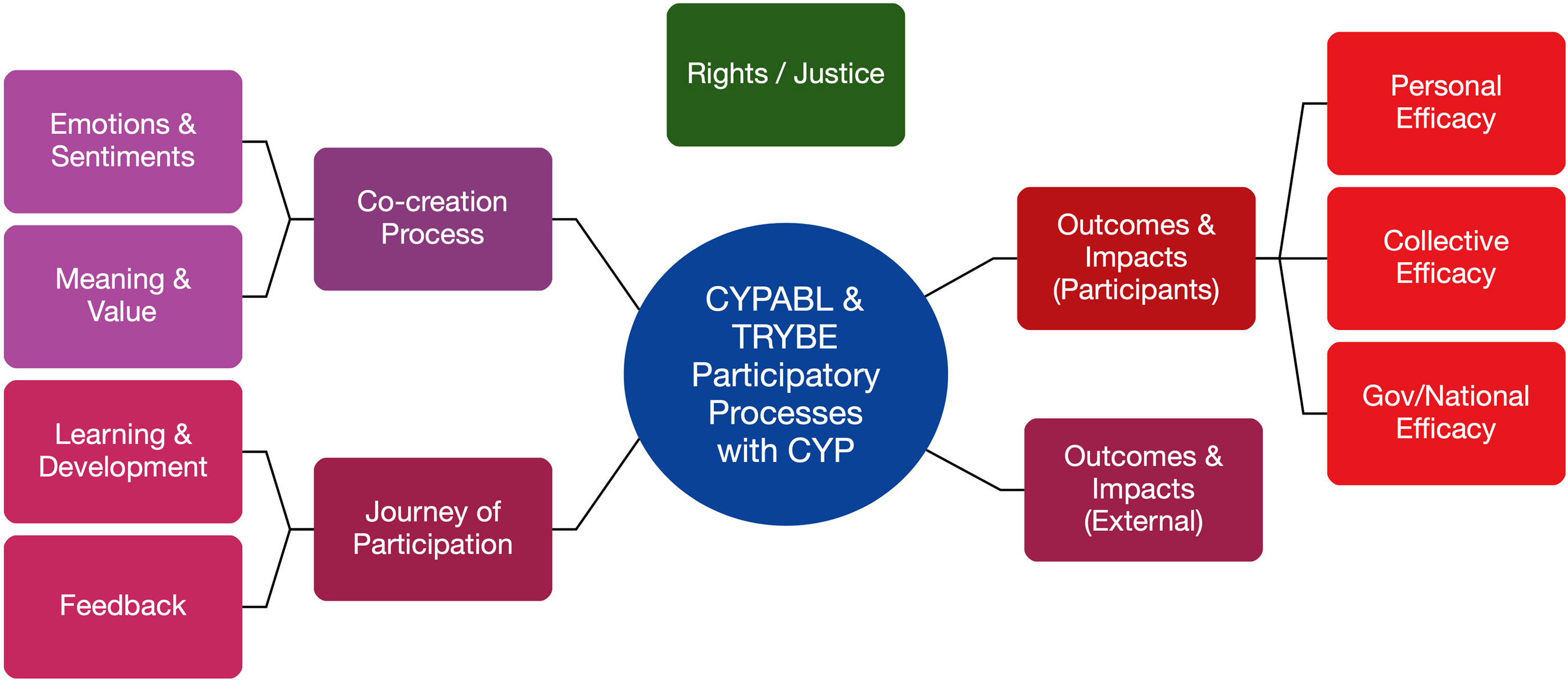
Perceptions of Participatory Processes
The children and young people involved described the processes of co-design and co-creation in a very positive way. When asked to explain these processes in their own words one young person gave the following description; “A group of people coming together to put all their ideas forward, to make one big project that suits everyone's needs and wants and any requirements that people have for the project.” (CYP 7)
Others commented on how they felt better placed to know what children would need and want; “I kind of knew what other children will like.” (CYP 1) “...children know what children need.” (CYP 6) “...we need to actually know what we’re talking about and be included in those kind of processes rather than just kind of having a job done and it can be very hard to relate to when that happens, when it’s adults designing these things and adults telling us.” (CYP 6)
Kelly et al. (2022) highlights the value of creating opportunities for young people to co-create actions toward achieving a sustainable future, and giving them a seat at the table to make decisions about their own input and contributions.
Parents views on the collaborative nature of the approaches employed tallied with that of the children involved; “So children coming up with what children want to engage with is right. Whereas we can think, well, “children would like this”, but we’re not children. We don't know what they want. We don’t know what they like, what visual things are stimulating to them, what is boring to them. So obviously if they want other children to engage in this, they’re the right people to come up with what’s going to be interesting to children, not us. Well, I think that’s a really good idea, like “who’s the audience?” and get the similar people, their peers to come up with how best to engage with them.” (P 4)
There was also recognition from participants of the role of adults as facilitators in these processes; “It was great because the adults were facilitating and guiding us all, but it wasn't over…it wasn’t dominated completely by adults and so everyone was just able to have their inputs and it was all designed, mainly designed, by the children with the adults driving us, so the adults were a key part of the project, but they made sure that the children all had, all of us, had their say.” (CYP 7) “It takes the right type of adult to do this as well, and it’s really important that when adults are going into these types of processes, they’re not telling children how it should be, they should be listening to how the children think that it should be.” (CYP 6)
Regarding the acknowledgement of the role of adults as facilitators, this aligns with other research that shows how children identity this type of adult support as crucial and provide many examples of how their adult facilitators helped them to present their views in a clear and compelling way directly to decision-makers (Lundy, 2018).
There were multiple references to ‘fun’ in the data which Wright et al. (2001) suggests is in fact evidence of relationships in the making, and the strengthening of groups’ social cohesion. Children often highlight the fun and enjoyment they get out of being involved in participatory processes, as well as the skills and knowledge they acquire (including knowledge of their rights), growth in confidence, pride in their achievements, and new or strengthened friendships with other children and/or adults (Lundy, 2018; Wright et al., 2001). This can include pride in their own skills and confidence in the differences they are making and are able to make in engaging with issues that matter to them on a collective level. Participants in TRYBE made references to feeling proud of what they had done, and how they felt they were doing something important. “I felt like pretty proud that this is something we all came together and made…” (CYP 5) “I think pride is definitely one of the first things that I would have felt as well…” (CYP6)
This highlights the importance of the often hidden effort behind creating opportunities and time for fun and other emotions to emerge in participatory processes. As Wright et al. (2001, p. 6) put it “Paying attention to emotions can bring our attention to the often elusive transformations happening in participatory research…and draws our attention to what the is emerging including and perhaps especially what was not planned”.
Participants almost universally commented on feeling listened to and heard, being taken seriously and feeling valued, which speaks to the Lundy model of child participation (2007) with regards to views being listened to and being taken seriously. “I felt very listened to...” (CYP 3) “I’d say our ideas we’re taken very seriously because everyone has a chance throughout the whole duration of the workshop to add their views and to change whatever we want...” (CYP 7) “[She] felt really valued and that her ideas and art etc was of use.” (P 1) “...it was really, really strong how much that her opinion and the opinion of the other kids was valued and listened to, so I think that part was really, really successful.” (P 4)
These statements demonstrate the value of enacting the Lundy model, particularly in relation to the first two quadrants relating to Space and Voice. The other quadrants, Audience and Influence, speak to the significance of offering meaningful engagements with audiences perceived as having influence, and to the importance of follow up and feedback.
Lundy (2018) notes that the feedback given by adults to children at the end of a process is a pivotal point in the dialogue, as from a children’s rights perspective, this is when duty-bearers and decision-makers get an opportunity to demonstrate to the rights-holders how they have put the ‘due’ in the ‘due weight’. It opens up a space for further informed interaction and the possibility of continuing the dialogue. Lundy (2018) suggests that feedback to children should comply with the 4 “F’s”: Full, Friendly (child), Fast, and Followed-up. This is a point in the participatory process that demonstrates transparency and an opportunity for further participation, thereby enabling social accountability (ibid).
Both participants and their parents commented on the importance of providing feedback following participation in both the Assembly and TRYBE, and the children noted that they were happy with the opportunity to meet and ask questions of Government officials after the process; “It was great to be able to...ask [the Minister] questions about like everything that happened because it just lets us know the impact of our assembly and of the book on the, on Ireland really, as a nation, and especially on like primary and secondary school students, just it gives us feedback and it’s just encouraging and really just to hear the answers.” (CYP 7) “...it was great to be able to meet [the Minister] again, and he’s able to tell us like, what he’s been doing since we met the first time. And like, what’s going be changed and everything and how he’s taken what we said into consideration, and everything.” (CYP 5) “I just wanted to commend [the facilitators] generally on that follow through all the time. I felt like that they were always…there was always follow through on everything. They’ve always been updated on the next steps and I think that’s really wonderful because they have a real sense then that it wasn’t just a project for the sake of a project that like....that they got to see that it isn’t just something they did and put away and it’s done now, you know that they have that follow through.” (P 5)
Cebrián et al. (2024) note that creating joint collaborative and participatory initiatives and spaces between different stakeholders can contribute to learning for sustainability, the belief in the ability to have a positive influence (self-efficacy) and the capacity to influence individuals’ actions and external sustainability actions (sense of agency).
Impacts of Participation: Efficacy, Response Efficacy and Motivation to Act
In the face of major environmental crises, the individual actions required to have an impact may be seen as inadequate to the scale of the issue, leading to the questioning of the effectiveness of individual agency and so the logic of the model of individual behaviour change is based on the expectation that one person’s actions will add to others to have a cumulative effect (Gallagher & Cattelino, 2020). Vital in instigating and maintaining environmental behaviour change is what people believe they are capable of doing (i.e., efficacy beliefs) and achieving (response efficacy beliefs) (Bandura, 1977, cited in Meijers et al., 2023). Both participants and their parents made statements indicating increased self-efficacy and personal response efficacy as a result of participation; “Well, we got an electric car and we eat less meat. And we mow the grass less. Just small little things, but small things can make a difference.” (CYP 1) “...my class are doing an assembly on Earth Day and like I’m giving a couple of lines on the assembly [CYPABL]...” (CYP 2) “It was very....a very life changing experience for them. And very empowering experience. And they felt so special.” (P 3)
This draws on the Social Cognitive Model (Bandura, 1977) in relation to pro-environmental behaviour, where personal or self-efficacy is referred to as the perceived capability to engage in pro-environmental action while personal response efficacy refers to the belief that their pro-environmental actions can make a difference and provide a solution to the problem.
Research with children about their experiences of participation processes reveal that the individual benefits for children are often more positive than the collective benefits (Lansdown, 2006) and thus should not be overlooked. Lundy (2018) notes that children routinely report a range of ancillary benefits from their experiences of participation, including gaining skills and confidence, and this personal learning can be described as both an outcome and a component of the participatory process itself.
Parents also spoke about the personal development through participation, identity shaping, confidence development, and empowerment; “I think probably that apart from the sense of empowerment that that came from it definitely, and the confidence - I think that there’s a little bit of identity shaping in him around, you know, activism and being a... what’s the word, like Eco warrior or something similar? You know that that’s how he sees his role, that he’s an activist already.” (P 5) “It’s continued to shape her, her kind of sense of identity around nature and environment and the importance of that and it's certainly something she very much brings into part of herself.” (P 3) “...as an individual, she’s grown and developed and got more confident just generally across the board as a result of participating...” (P 4) “... there’s just been so much development for her in all of this...” (P 3)
The enhanced power of collective efficacy also emerges from the data. Meijers et al. (2023) define collective efficacy as ‘The belief that most people are capable of engaging in pro-environmental actions’ and collective response efficacy as ‘The belief that people’s actions collectively are effective in realising a pro-environmental outcome’ (p.3). The authors also note the concept of participative (or participatory) efficacy, which is defined as the incremental difference an individual can make to the group, such that the group as a whole can make a difference. Participative efficacy is sometimes referred to as a bridge concept between personal and collective response efficacy, but has also been successfully discerned from both (Van Zomeren et al., 2013). Young people gain confidence from each other and act on a resilient sense of collective efficacy, developing a belief that they have the power to affect significant change both as individuals and as a collective community (Bandura & Cherry, 2020). “It only takes a group of people like us to inspire thousands...I think we’ve inspired young people all around the country” (CYP 6) “Ever since I’ve shown some of the teachers, the activity book and they’ve brought down to the student council. So now we have, we’ve got more recycling bins and all imposed within the school.” (CYP 7) “...especially for fostering collective action rather than just individual action and making children feel empowered.” (CYP 6)
Motivation to act is affected by a sense of self-efficacy and collective efficacy. Baldwin et al. (2022) found that there is a strong relationship between both collective and individual efficacy, and engagement in group action, similar to the concept of participative efficacy. As James Clear put it in his book “Atomic Habits” (2018: p. 104), “Nothing sustains motivation better than belonging to the tribe...It transforms a personal quest into a shared one... It’s friendship and community that embed a new identity and help behaviors last over the long run.”
Parents in particular commented on the journey of participation in both the Assembly and TRYBE, and how participation contributed to a sense of community and collective efficacy; “She loved the continuation – the fact that there was more, you know, I suppose she'd started on the journey with the Children’s Assembly and then the fact that there was an opportunity to …kind of keep going with her tribe... There’s a sense of a group and a connection and a friendship and that the chance to keep meeting and to keep engaging was really important, I think for her as well. So that kind of community sense of, of belonging to a group...” (P 3) “....getting together with people who are kind of like her or thought the same as her…or finding that kind of commonality because they all were doing the same thing, has been huge like that has been, I hope I’m not being too, I actually think it’s life changing for her, like I think it’ll be a pivotal moment in her life that that whole thing she’ll look back, like there was the before that and then there was the after that.” (P4)
A related term, sense of agency, is also used to describe the experience of being in control of both one’s own actions and, through them, of events in the external world (Haggard & Tsakiris, 2009, cited in Baldwin et al., 2022). One parent commented; “It’s given [him] a wonderful sense of his own agency in the world,….and his expectation to be listened to with the same level of respect as every other adult in the room, which is something that just came directly from this...or at least has been amplified by this, by his involvement in both the Assembly and the TRYBE project.” (P 5)
Young people’s visions of the future reflect their perceptions of society’s ability to address current problems and of their own power to effect the changes they wish to see, while wider studies of political efficacy show that people feel that their actions can affect the political process to varying degrees depending on personal effectiveness and system responsiveness (Gallagher & Cattelino, 2020). These concepts of change at a higher level (government, national, international) came from some older participants (15 years and older). “...it kind of feels like the start of systemic change. Like things are about to start changing, and our children and young people are going to be taken more seriously across the board everywhere, not just here, and not just in these ways, but on every social issue.” (CYP 6)
Some of these older participants also expressed their views with regards to their rights, particularly in relation to their right to have a say in decisions that affect them; “Because the simple fact is, it is our future and we have the right to have a say on anything that’s going to affect us. And this proves that bringing, children, young people into the equation and giving them a seat at the table, they’ll just flourish and it will be so much easier to find those solutions...” (CYP 6)
These concepts of rights, justice and systemic change reflect the youth climate justice movement, and the re-evaluation required in relation to research, policy and practice in this space. This tallies with research which notes that participatory processes involving children are typically underpinned by an overarching vision to simultaneously transform the lives of the individual participating children and children collectively through systemic change (Hart, 2008).
Conclusion
Environmental transformation requires greater public participation in policy, research and practice, and these processes need to be representative of those from marginalised communities who are often most at risk of the impacts of the environmental crisis such as children and young people. Empowering young people to become actors for change within their communities and in governance processes requires new and more integrative approaches to public participation (Kelly et al., 2022). There is much to learn from participatory evaluation research on such processes which draws on the voices of children and young people involved, to inform future endeavours, and understand the outcomes and impacts from both the act of participation and the interventions themselves.
The findings, based on participatory evaluation research, indicate that the participation framework (Lundy model, 2007) and methodology (co-creation) employed resulted in a positive experience for the children and young people involved with participants expressing greater personal, participative and collective efficacy. This correlates with research which indicates that successful action builds a resilient self-efficacy for new challenges (Bandura & Cherry, 2020) and links with the concept of critical acts of citizenship and spheres of influence emerging from related research on the CYPABL which has identified multiple examples of horizontal (citizen-citizen) and vertical (citizen-state) citizenship action (Deane et al., in press; Mallon et al., 2025). Children and young people value the opportunity to participate and co-create as they feel best placed to say what they and their peers want and need, and they report a strong sense of agency gained from participation in such processes. Our participants indicated that young people want more opportunities to be involved in decision making, and that they want a say in decisions on issues that affect them.
The findings demonstrate the value of enacting the Lundy model of child participation, ensuring adequate consideration is given to Space, Voice, Audience and Influence. In this regard, the role of the child participation specialist in our project was crucial to the planning and execution. Related to this, research indicates that the role of adult facilitators helping children and young people to present their views to decision-makers is considerable (Lundy, 2018) and thus ensuring all facilitators are adequately trained and briefed is important. It is worth noting that a certain amount of ‘letting go’ of control is required in participatory processes (particularly co-creation) with children and young people, which calls for faith, flexibility and responsiveness. In addition, we recommend that adequate time, space and effort are allocated to creating opportunities for play, fun, reflection and emotional responses as they can facilitate participation and draw attention to what is emerging through and from the process. Practitioners are strongly recommended not to underestimate the increased time and resources required for co-creation, where the participants are involved in every step of the process including evaluation. Ideally these processes should also adopt participant perspectives on impact pathways, particularly in participatory democracy where those involved should have a say in what the intended impacts might be and how they might be achieved and tracked. A narrow focus on short-term outcomes risks overlooking both the broader transformative potential of these processes in fostering longer-term citizen participation and the emergence of instrumental impacts on systems, policies and practices. Our initiative was also informed by Laura Lundy’s research on feedback (2018), complying with the 4 “F’s”: Full, Friendly (child), Fast, and Followed-up, which our participants and their parents seemed to value. This requires a commitment to follow up after the initiative and/or research have finished even though the team may then also be working on new endeavours. This also has relevance for how funders administer grants for such initiatives and how research organisations operate, in that there is, in practice, an ethical onus on researchers and engagement professionals to continue this work long after the allocated funding has typically expired.
These findings and insights could support wider participation of children and young people in democratic processes and participatory research relating to environmental action, including highlighting their role in participatory evaluation in both engaged research and environmental governance. This paper highlights the valuable role of participatory evaluation in further understanding participation in democratic innovations supporting sustainable transitions and suggests potential avenues for further engaged research in this space. The findings also offer some useful insights for both practitioners and researchers engaging children and young people in participatory processes. It speaks to the role of engaged research and participatory evaluation approaches to reposition the relationship between theory and practice as a two-way process capable of producing insights that both advance academic understanding and have actionable value for practitioners and communities.
Footnotes
Acknowledgements
We thank the children and young people who participated in the TRYBE initiative, and their parents, for their contributions in the focus groups and their involvement throughout the initiative.

Ethical Approval
Ethical approval for this research was granted by University College Cork’s Social Research Ethics Committee (Ref: 2023-314) on March 06th 2024.
Consent to Participate
All focus group participants provided verbal and written assent, with written consent for the children and young people’s participation provided by their parents. Consent/assent forms are stored in accordance to UCC’s data management policy.
Consent for Publication
Consent for publication of anonymised data was also obtained.
Author Contribution Statement / CRediT (Contribution Roles Taxonomy)
Aoife Deane: Conceptualization (lead), Data curation, Data analysis, Methodology, Writing – original draft and coordination, Writing – review & editing, Funding acquisition.
Katie Reid: Methodology, Writing – original draft, Writing – review & editing.
Diarmuid Torney: Writing – review & editing, Funding acquisition.
Catriona Iulia Reid: Data curation, Data analysis, Writing – review & editing.
Brian Ó Gallachóir: Writing – review & editing, Supervision, Funding acquisition.
Clodagh Harris: Writing – original draft, Writing – review & editing, Supervision, Resources.
Funding
The authors disclosed receipt of the following financial support for the research, authorship, and/or publication of this article: This research was part-funded by Taighde Éireann – Research Ireland through the MaREI Research Centre for Energy, Climate, and Marine at University College Cork (Grant No: 12/RC/2302_P2). The TRYBE initiative was funded by Research Ireland through the Discover Programme (Grant No: 22/DP/10487). The Children and Young People’s Assembly on Biodiversity Loss was commissioned and funded by the Government of Ireland, Department of Housing, Local Government and Heritage.
Declaration of conflicting interests
The authors declared no potential conflicts of interest with respect to the research, authorship, and/or publication of this article. Aoife Deane, Katie Reid, Diarmuid Torney and Clodagh Harris were members of the independent research consortium that co-designed and implemented the CYPABL.
Data Availability Statement
Anonymised data available from the authors upon request.