




Abstract
Tourism research has increasingly embraced methodological diversity, yet often separates qualitative and quantitative traditions. Revisiting King, Keohane, and Verba’s Designing Social Inquiry, this research highlights their claim that social science is guided by a unified logic of inference, comprising descriptive and causal inference. While these logics underpin much of tourism scholarship, from mapping destination images to modeling the tourism-growth nexus, the distinctive nature of tourism as lived experience invites a more explicit articulation of how KKV’s unified logic can be applied to tourism’s humanistic domains. Drawing on inferential reasoning, this study proposes a three-tier logic of inference specific to tourism: experiential inference, which captures how tourists live and feel the world; transformative inference, which explains how experiences catalyze personal, communal, and environmental change; and existential inference, which addresses ultimate meanings and being through tourism. To operationalize this perspective, the paper develops an integrated inferential framework that links research questions, measurement strategies, and analytic procedures to these inferential targets. The framework is illustrated through an empirical vignette of dark tourism at Con Dao Island, demonstrating how experiential encounters, processes of transformation, and existential interpretations can be systematically inferred from empirical materials. In addition, the study advances a meaning-oriented analytical orientation that encourages scholars to attend not only to observable outcomes but also to processes of human meaning-making within tourism contexts. Collectively, these contributions provide methodological clarity while acknowledging tourism’s existential dimensions, offering a coherent framework for applying KKV’s inferential standards to tourism’s experience-, change-, and meaning-oriented inquiries.
Keywords
1. Introduction
Over the past three decades, tourism research has developed rapidly, with a diversity of topics and methods (Huang et al., 2025; Marti & Puertas, 2025). Qualitative works often exploit participant observation, in-depth interviews, or ethnography to explain tourist experiences, while quantitative research relies on large-scale surveys, structural equation modeling, or more recently, big data analytics and machine learning tools (Azizi et al., 2024; Huang et al., 2025). However, this diversity also poses a challenge: many scholars continue to maintain a qualitative-quantitative dichotomy, viewing them as two distinct, even opposing, paradigms. As a result, qualitative research sometimes stops at detailed description without generalization, while quantitative research tends to lean towards statistical techniques but lacks connection to causal mechanisms and deeper meanings of phenomena (Khoo-Lattimore et al., 2019; Kim et al., 2018).
In this context, King, Keohane, and Verba’s Designing Social Inquiry (1994/2021; commonly known as KKV) put forward a fundamental argument: regardless of the method, social science is based on a unified logic of inference (King et al., 2021). According to KKV, there are two basic forms of inference: descriptive inference, i.e., generalization from limited data to a larger whole, and causal inference, i.e., establishing cause-effect relationships based on empirical evidence (King et al., 2021). This argument reshaped how methods are understood and provided an important conceptual foundation for raising scientific standards in applied research fields. However, tourism is a distinctive field. Unlike many other social sciences, the central object of tourism is experience, which is both personal and community-based, both tangible and spiritual, and both reflecting the present and opening up existential changes (Cohen, 1979; Urry & Larsen, 2011). This nature motivates tourism studies to go one step further: applying descriptive and causal logic to generalize and organize its application into a three-layered inference process that reflects the unique nature of the field.
Specifically, this article proposes three specific forms of inference: experiential inference, which focuses on generalizing how tourists live and perceive the world through tourism; transformative inference, which explains the mechanism through which experience leads to personal, community, and environmental change; and existential inference, which focuses on the profound meanings, existential values and existential openness that tourism creates. When integrated with the descriptive and causal logic of KKV, this three-layered process forms a methodological framework that both strengthens scientific rigor and reflects the unique nature of tourism.
With that orientation, this study has three objectives: (i) to present the core thesis of KKV, (ii) to analyze evidence from tourism studies on descriptive and causal inference, and (iii) to propose a three-tiered inference process specific to tourism. Through this, the article not only connects tourism studies with international social science standards, but also highlights tourism’s potential contribution to interdisciplinary, meaning-oriented inquiry.
2. The Core Thesis of KKV
Designing Social Inquiry by Gary King, Robert O. Keohane, and Sidney Verba (1994/2021) is one of the important methodological milestones of modern social science. The central thesis of the book can be summarized in one assertion: all social science research, regardless of qualitative or quantitative, is based on a unified logic of inference (King et al., 2021). In other words, the methods may be different, but the principles of inference to draw scientific knowledge are the same.
According to KKV, there are two basic forms of inference: descriptive inference and causal inference.
First, descriptive inference is the process of going from limited data to a broader generalization about a whole. A typical example is when a researcher interviews 20 tourists at a destination and draws conclusions about the general behavioral trends of international visitors. The focus here is not on finding causes, but on generalizing features, describing patterns, and identifying distributions. KKV emphasizes that descriptive inference is only valid when data are accurately measured, representative, and when the level of uncertainty is clearly defined.
Second, causal inference focuses on the question: “Does X cause Y?” This is the process of establishing a cause-and-effect relationship based on evidence. According to KKV, a good causal study must address two challenges: (i) omitted variable bias - omitting confounding variables that can distort causal relationships, and (ii) selection bias - sampling bias that makes the results not reflect the true relationship. In addition, KKV emphasizes the need to explain mechanisms: not only demonstrate that X and Y are related, but also show how X affects Y. On this basis, KKV proposes a series of standards for scientific research, including posing clear and testable research questions, measuring abstract concepts through observable and reliable indicators, identifying and transparently reporting the degree of uncertainty in inference, controlling bias and limiting sources of error, and designing structured comparative studies to enhance generalizability.
For tourism studies, KKV’s thesis provides an important and robust foundation. Building on this foundation, tourism research highlights empirical domains in which the unified logic of descriptive and causal inference must be applied with particular care and explicitness. Tourism is distinctive in that lived experience, processes of transformation, and questions of existential meaning are central objects of inquiry (Heidegger, 2010; Merleau-Ponty, 2013). Accordingly, tourism studies do not merely aim to describe behavior or establish causal relationships but also seek to understand how tourism experiences are associated with changes in individuals and communities and how such processes give rise to meanings that tourists attribute to their being and life trajectories. Applying KKV’s logic to these domains therefore requires a more deliberate articulation of inferential targets and analytic procedures, rather than a departure from the logic itself.
3. Toward a Framework of Inference in Tourism Research
3.1. Descriptive Inference in Tourism
According to King, Keohane, and Verba (1994/2021), descriptive inference is the process of moving from limited observational data to broader generalizations about the whole (King et al., 2021). This is the foundational step for social science to not only record individual phenomena but also provide a general picture of behavior and social characteristics. In tourism studies, descriptive inference is particularly popular, as many studies are interested in identifying tourist behavior, preferences, and experiences, rather than establishing causal relationships. The following examples show the diversity of descriptive inference methods in this field.
First, research on destination image and service quality has applied the Mamdani fuzzy inference system to quantify how tourists evaluate service dimensions such as reliability, responsiveness, empathy, and assurance (Wullur & Sutapa, 2019). This is not a causal analysis, but an attempt to generalize from the perception of a group of customers to a general picture of the destination image. Next, the development of machine learning opens up new approaches to descriptive inference. Félix et al. (2025) use text feedback from TripAdvisor combined with contextual data to train trip profile classification models (Félix et al., 2025). Models such as the Light Gradient Boosting Machine (LGBM) with TF-IDF features have demonstrated the ability to accurately classify vacation, business, and other purposes. The focus here is not on explaining causes, but on building a recognition map to generalize trip types from limited observational data.
In the context of ecotourism, Dagustani et al. (2021) applied structural equation modeling (SEM) to analyze travel motivation, experience impressions, and destination image, describing how these factors relate to revisit intention, mediated by word of mouth (WOM) (Dagustani et al., 2021). Although using SEM, which is often associated with causal research, this study is primarily intended to describe the statistical relationship structure, rather than to establish a strict causal mechanism. The environmental aspect also provides evidence of descriptive inference. Research in shopping districts has shown that tourists infer service quality from the landscape and appearance, which in turn influences their purchasing decisions (Yüksel, 2013). This is a form of cognitive behavioral generalization: tourists form service evaluations from external cues. In online tourism, Chen and Ding (2023) analyzed booking behavior in peer-to-peer accommodation (Chen & Ding, 2023). They showed that travelers use reviews and ratings as cues to make decisions when information is incomplete. Here, the descriptive conclusions emphasize how travelers process uncertainty through cues, rather than going into causal mechanisms.
The above evidence shows that descriptive inference in tourism can be conducted through a wide range of methods, from fuzzy logic, machine learning, SEM, to data visualization. The common point is that they all aim to generalize from limited data to describe tourists’ behavior, perception, and experience. However, if stopped at this level, tourism research is at risk of falling into the state of describing a lot but explaining little.
Therefore, the concept of experiential inference was proposed.
This is a process in which descriptive inference goes beyond identifying behavior to generalizing how tourists live and experience the world through travel. Experiential inference helps clarify that travel data not only reflect behavioral patterns but also carry with them life experiences, emotions, and spiritual values (Cohen, 1979, 2021). This will be the first level of the inference process specific to tourism studies, laying the foundation for approaching higher levels: transformative inference and existential inference.
3.2. Causal Inference in Tourism
While descriptive inference helps social science generalize phenomena from limited data, causal inference asks the central question: Does X really cause Y, and through what mechanism? According to King, Keohane, and Verba (1994/2021), any good causal study needs to address three issues: identifying meaningful relationships, eliminating or controlling for confounding variables, and explaining the mechanisms of action (King et al., 2021). In tourism studies, causal logic has been applied at many levels - from the macro-level relationship between tourism and economic growth, to micro-level processes such as satisfaction, loyalty, or green behavior.
An important avenue of causal inference is the relationship between tourism and economic growth. Hu and Wang (2025) explored the causal impacts of 115 armed conflicts on tourism demand in 16 countries using the synthetic control method, showing that negative effects ensued under the condition of a sufficient number of attraction sites (Hu & Wang, 2025). Meanwhile, other studies find more diverse causal patterns: Sokhanvar et al. (2018) show a unidirectional relationship from tourism to economic growth in Mexico (Sokhanvar et al., 2018), while Kyara et al. (2021) identify the opposite direction in Tanzania. These results show that the same phenomenon but the causal relationship may differ depending on the context, emphasizing the importance of research design and variable control (Kyara et al., 2021).
In addition to economics, the environment is also an area analyzed using causal logic. Kongbuamai et al. (2020) used Granger causality tests to demonstrate that tourism in ASEAN is negatively causal to ecological footprint, i.e., tourism growth can be accompanied by improvements in environmental quality (Kongbuamai et al., 2020). In contrast, Tunçel et al. (2025) found a bidirectional relationship between tourism demand and environmental sustainability indicators in the world’s top ten destinations (Tunçel et al., 2025). These studies demonstrate that causality is not only linked to economic development, but also explains the interaction mechanism between tourism and ecosystems.
At the micro level, research on tourist behavior exploits attribution theory to explain psychological causal mechanisms. Choi and Cai (2016) show that pre-trip loyalty influences satisfaction, but this effect is mediated by two attribution dimensions: stability and globality (Choi & Cai, 2016). This is a typical causal analysis: X (loyalty) influences Y (satisfaction) through M (attribution). Similarly, Saleh (2023) demonstrates that destination social responsibility (DSR) influences how tourists attribute positive experiences, thereby strengthening loyalty and promoting positive word of mouth (Saleh, 2023). Here, the study goes beyond describing attachment, to identifying specific causal mechanisms. The above evidence shows that causal inference in tourism operates at two main levels, with the macro level focusing on identifying causal relationships between tourism, the economy, and the environment, often using time series and panel data, while the micro level explains individual behavior and experiences through underlying social-psychological mechanisms.
The common thread across these studies is their consistent reliance on KKV’s unified logic of inference, including the formulation of causal hypotheses, the design of research strategies to address potential sources of bias, and the use of empirical evidence to assess causal claims. When this logic is applied to tourism research, however, it becomes particularly salient that causal inference is frequently oriented toward tracing processes of change rather than identifying isolated cause-effect relationships.
Many studies on transformative tourism have shown that tourism experiences not only change immediate perceptions but also create new life values, open up spiritual depth, and even lead to transcendent experiences (Amaro et al., 2025; Zhang, 2025). From analyzing well-being behavior, spiritual experiences, to studies on meaningful tourism and transcendent tourism, evidence shows that causality in tourism often occurs in a chain of transformation, beginning with lived experiences that shape personal values, which in turn influence behavioral change and may ultimately lead to deeper forms of existential restructuring. This is not just linear causality, but a multidimensional transformation process, where tourism acts as a catalyst for transformation at both the individual and community levels.
It is from this observation that the concept of transformative inference was proposed as the second level of the inference process in tourism studies.
Transformative inference emphasizes that tourism research does not only aim to prove that X causes Y, but also to explain the mechanisms of change - where the tourism experience becomes a catalyst for personal, community and environmental change (Pung et al., 2020; Zhang, 2025). This illustrates how KKV’s causal inference, especially mechanism-focused explanation and process tracing, can be applied to transformation processes that are salient in tourism.
3.3. Integrating Descriptive and Causal Inference in Tourism
As discussed, descriptive and causal inference play a fundamental role in social sciences in general and tourism studies in particular. However, rather than viewing them as two separate paths, combining these two forms of inference opens up the possibility of a more comprehensive approach, allowing both to generalize the phenomenon and explain the mechanisms of impact. In the spirit of King, Keohane, and Verba (1994/2021), all methods - from qualitative interviews, field observations, to quantitative surveys, SEM models, or machine learning - can refer to the same unified inference logic. The key issue is how these two forms of inference can be integrated into a coherent analytic process.
An integrated process can be envisioned in three steps.
First, descriptive inference provides the basis for identifying and generalizing the phenomenon. Studies have shown that from limited data - such as TripAdvisor feedback, sentiment analysis of online reviews, or GPS data - it is possible to generalize a broad picture of tourist behavior and experience (Dang, 2023; Polus & Carr, 2023). This is an indispensable step, because without precise description, establishing causal relationships is difficult.
Second, causal inference goes into explaining why phenomena occur as they do. From the described behavioral map, causal research identifies cause-effect relationships, such as tourism impacts economic growth, or destination social responsibility influences tourist loyalty through attribution mechanisms (Mthombeni et al., 2024; Saleh, 2023). Causal inference helps move from the “what is happening” picture to the “why is it happening” question.
Third, the integration of description and causality allows for the formation of an evolutionary research chain: describing the phenomenon → testing causal relationships → returning to extend the description in a new context. This sequence helps tourism research remain closely grounded in empirical data, while enhancing the power of generalization and explanation.
The important point is that when applying KKV logic to tourism, this integration also opens up a new direction: from description and cause and effect, tourism research can move towards existential inference. This is a distinct inferential focus, where data and analysis are not only used to generalize or determine causes, but also to approach the existential meaning and life values that tourism creates.
Thus, while descriptive inference answers the question “what is happening”, causal inference answers “why is it happening”, existential inference asks a deeper question: “what is the ultimate meaning of this phenomenon for human existence?”. Applying KKV’s descriptive inference to existential meaning does not lose the scientific standard, but adds existential depth, which is characteristic of tourism as an interdisciplinary science.
In short, integrating descriptive and causal inference not only helps to improve the reliability and application value of tourism research, but also opens up the possibility of accessing a deeper level - existential inference. This is an important theoretical contribution: from the foundation of KKV, tourism studies develops three inferential targets (experience - transformation - existential), reflecting the unique nature of this field.
3.4. Toward Existential Inference in Tourism
If descriptive inference helps to generalize behavior, and causal inference explains the mechanism of change, then the highest level of the inference process in tourism studies is existential inference. This level goes beyond answering the question “what is happening” and “why is it happening”, to move towards a deeper question: “what is the ultimate meaning of this phenomenon for human existence?”.
In many studies, especially on spiritual tourism, pilgrimage or inner tourism, tourism is seen not only as a consumer activity or a recreational experience, but as a process of existential opening (Brown, 2013; Jiang et al., 2024). In certain destinations, the tourism experience can become a mechanism for people to face impermanence, seek spiritual liberation, or restructure their identity in relation to the community and the universe (Assiouras & Bayer, 2024; Wang et al., 2023). This suggests that tourism data do not only reflect behavior and causal processes, but may also reveal an existential dimension.
Existential inference is particularly relevant in the modern context, where travel is increasingly associated with goals of well-being, mindfulness, and the search for meaning in life (Jiang et al., 2024; Matteucci, 2022). Studies on transformative tourism have shown that travel experiences can lead to changes in personal identity, the formation of new values, or even the creation of transcendental experiences (Amaro et al., 2025; Zhang, 2025). However, simply stopping at the level of causal analysis - for example, experience X leads to a change in value Y - is not enough. What needs to be approached more deeply is the existential meaning of that change: what it says about human existence, about the relationship between the individual and the world, about the possibility of achieving a richer existential state.
In tourism studies, existential inference can be deployed through three directions.
First, analyzing signs and symbols, such as rituals, sacred landscapes, or historical narratives, to infer the deeper meanings that tourists attach to the experience (Brown, 2013; Nigatu et al., 2025; Wu et al., 2023). Second, exploiting the method of autoethnography, where the researcher’s personal experiences become a source of data to access the existential dimension (Rostami et al., 2024). Third, integrating existential and Eastern philosophies (such as Buddhism, Taoism) into tourism analysis, thereby extending inference from empirical data to existentially revealing meaning (Christopher & Ngoc An, 2023; Zheng et al., 2024).
The key point is that existential inference does not negate scientific standards, but adds to them existential depth. If description and causality create an ‘objective’ picture of tourism, then existential inference brings tourism science closer to what tourists are really looking for: connection, meaning, and enlightenment.
In short, the existential inference layer completes the three-layer process that this article proposes: from experiential inference (generalizing emotional and behavioral data), through transformational inference (explaining the mechanism of change), to existential inference. This is not only an explicit articulation of KKV but also a distinctive methodological mark of tourism studies, affirming the position of the field as a science that is both empirical and existential.
3.5. An Integrated Inferential Framework Illustrated Through Dark Tourism at Con Dao Island
An Integrated Inferential Framework for Tourism Research

Source: Author’s own work.
3.5.1. Step 1. Question: Structuring Multi-Layered Research Questions
In line with KKV, rigorous tourism research begins with clearly formulated questions. However, in contexts such as dark tourism, a single-layer question is often insufficient to capture the complexity of the phenomenon. Instead, a layered set of guiding questions is required. For example, rather than asking “How do tourists perceive dark tourism at Con Dao Island?”, the inquiry can be structured as: How do visitors experientially encounter spaces of death and suffering at Hang Duong? (experiential); How do these encounters contribute to changes in values, emotions, or life orientations over time? (transformative); and What existential meanings, related to impermanence, sacrifice, or being, do tourists articulate through these experiences? (existential). These questions are analytically distinct but logically connected, guiding the inferential process from experience to transformation and meaning.
3.5.2. Step 2. Measurement: Capturing Experience, Change, and Meaning
Measurements in such studies must extend beyond behavioral indicators. In the Con Dao case, experiential data may include embodied sensations, emotional responses, and moments of silence or reverence recorded through autoethnographic notes and reflective diaries. Transformative dimensions can be captured through follow-up narratives documenting shifts in attitudes toward death, suffering, or everyday life practices. Existential meanings emerge through symbolic language, metaphors, and philosophical reflections expressed by visitors. Combining qualitative materials with established quantitative indicators of wellbeing, values, or spiritual orientation enables measurement that is both methodologically credible and sensitive to existential depth.
3.5.3. Step 3. Inference: Moving Across Experiential, Transformative, and Existential Layers
At the experiential level, inference generalizes patterned features of lived encounter from limited observations, such as temporal slowing or heightened emotional awareness in cemetery spaces. At the transformative level, causal inference is employed to trace how repeated exposure to sites of death, mediated by reflection or ritual practice, contributes to changes in values or ethical sensitivity. At the existential level, inference focuses on meaning-making, interpreting how tourists frame death not merely as historical memory, but as an encounter with impermanence that reshapes their understanding of being. These inferential moves are complementary, forming a progression rather than separate logics.
3.5.4. Step 4. Validity and Bias Awareness
Finally, rigor is ensured by explicitly addressing potential sources of bias. In the Con Dao case, contextual bias is particularly salient, as findings are deeply embedded in a specific historical and spiritual setting. Rather than eliminating such bias, the framework requires clarifying scope conditions, practicing reflexivity, and triangulating data sources. This approach aligns with KKV’s emphasis on transparency while recognizing that existential meaning requires criteria of credibility and coherence rather than strict positivist bias control.
Collectively, this framework demonstrates how tourism research can meet international social science standards while engaging with experience, transformation, and existential meaning as core concerns. It affirms tourism not only as a field of behavioral analysis, but as a domain in which empirical inquiry can illuminate how travel becomes a practice of change and being.
4. Discussion & Implications
4.1. Discussion
This research advances tourism methodology by repositioning experiential, transformative, and existential inquiry not as loosely defined thematic interests, but as a coherent inferential progression grounded in empirical inference. Existing tourism studies have long demonstrated the field’s capacity for rigorous descriptive and causal inference. Research on destination image, service quality, and tourist perception has refined descriptive inference through advanced techniques such as fuzzy inference systems, sentiment analysis, and probabilistic modeling. Similarly, studies examining revisit intention, booking decisions under uncertainty, and tourism-led economic or environmental outcomes have employed causal inference to identify relationships, mechanisms, and feedback loops. These contributions collectively confirm that tourism research already operates within KKV’s unified logic of inference.
The contribution of this paper lies not in challenging that logic, but in demonstrating how it can be extended analytically to address domains that are central yet under-theorized in methodological terms. Experiential inference foregrounds how tourism is lived and embodied, complementing existing descriptive studies that often prioritize observable perceptions or attitudes. Transformative inference builds on causal inference by emphasizing processes of change rather than isolated effects, resonating with research on transformative tourism, wellbeing, and sustainability that traces shifts in values, behaviors, and life orientations over time. Existential inference, in turn, articulates how tourism research can make empirically grounded inferences about meaning, being, and impermanence without departing from methodological rigor.
By integrating these inferential moves into a single analytic progression, the paper offers a way to bridge technologically driven tourism analytics with existential and phenomenological inquiry. Rather than fragmenting tourism research into qualitative versus quantitative or positivist versus interpretive camps, this framework clarifies how diverse methods can be aligned with distinct inferential targets. In doing so, the paper contributes to ongoing methodological debates in tourism by showing that rigor and depth are not competing ideals, but mutually reinforcing dimensions of a mature and reflexive tourism science.
4.2. Implications
First, the study advances tourism methodology by reconceptualizing inference as an inferential progression rather than a binary choice between descriptive and causal analysis.
Building on KKV’s unified logic of inference, the paper demonstrates that tourism research can be organized around a sequential movement from experiential inference to transformative and existential inference. This reconceptualization shifts methodological debates away from rigid distinctions between qualitative and quantitative approaches, toward a more nuanced understanding of how different inferential targets, experience, change, and meaning, can be systematically addressed within a single empirical framework.
Second, the paper provides a methodological grounding for experiential inquiry by formalizing experiential inference as a legitimate inferential focus.
While experiential aspects of tourism have been widely studied, they are often treated as illustrative or exploratory. This study clarifies how experiential data, embodied sensations, emotions, and lived encounters, can support rigorous inferential claims, thereby strengthening the epistemological status of experience-centered research within tourism studies and qualitative social science more broadly.
Third, the study reframes transformative tourism through an inferential lens, positioning transformation as a causal process rather than a descriptive outcome.
By aligning transformative inference with causal inference and mechanism-based explanation, the paper responds to critiques that transformation is conceptually vague or methodologically under-specified. It demonstrates how transformation can be empirically examined through process tracing and longitudinal interpretation, contributing to more robust theorization of change in tourism, wellbeing, and sustainability research.
Fourth, the paper opens a new methodological space for existential inquiry in tourism without abandoning scientific rigor.
By treating existential meaning as an inferential target rather than a separate epistemological domain, the study shows how tourism research can engage with questions of being, impermanence, and meaning while remaining compatible with established standards of transparency and validity. This contribution supports the growing existential turn in tourism studies, positioning tourism not merely as a site of consumption or behavior, but as an empirical arena for examining how individuals and communities make sense of existence through travel.
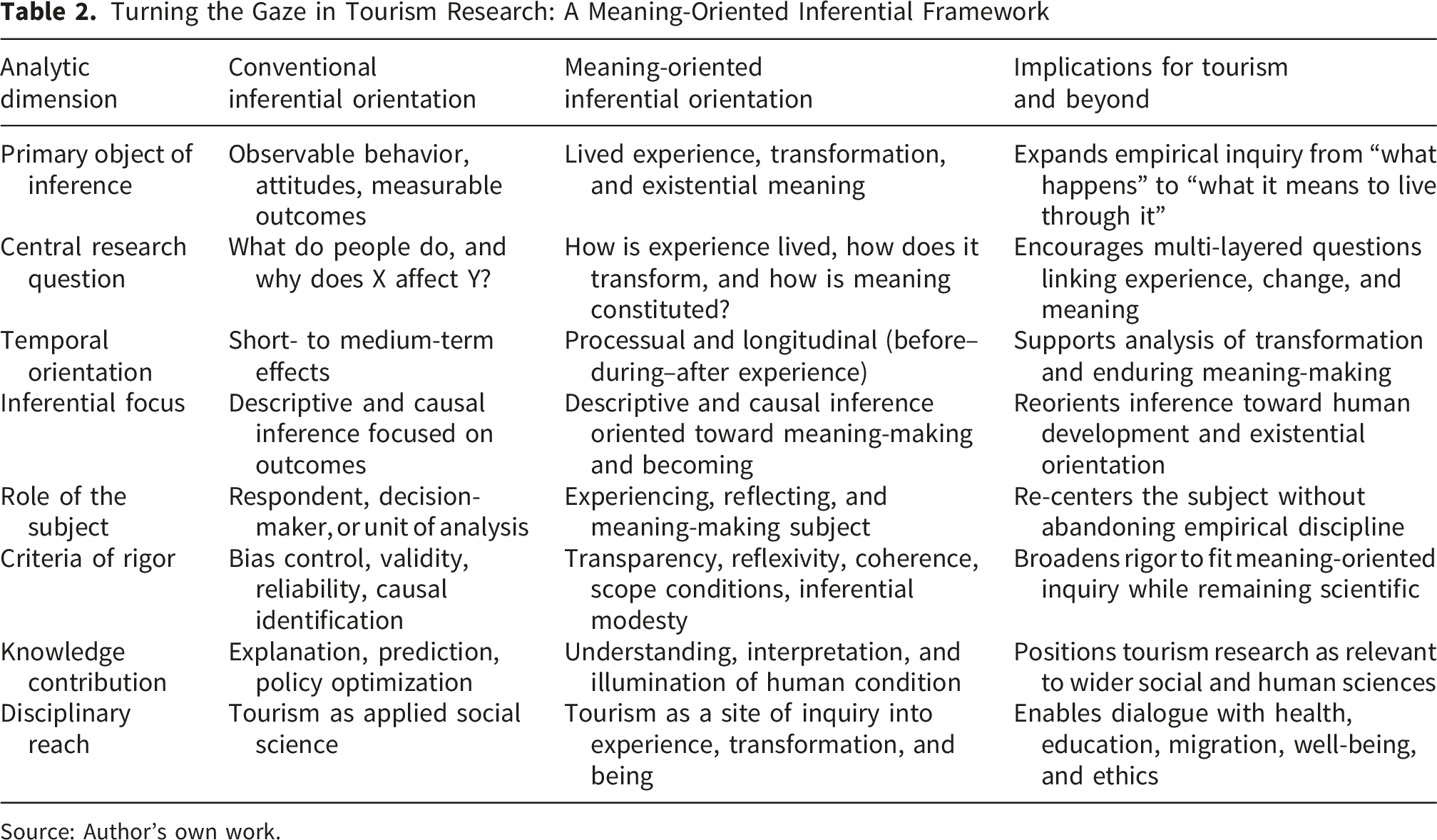
4.3. Turning the Gaze: Toward Meaning-Oriented Inference in Tourism and Beyond
Turning the Gaze in Tourism Research: A Meaning-Oriented Inferential Framework
Source: Author’s own work.
The inferential progression articulated in this study encourages researchers to look not only at what happens and why it happens, but also at what it means for those who live through it. This shift does not abandon rigor or empirical discipline. Rather, it calls for a recalibration of analytic attention, recognizing meaning-making as a legitimate and empirically accessible object of inference when approached with transparency, reflexivity, and clearly specified scope conditions.
Such a turning of the gaze has relevance beyond tourism. Fields concerned with health, education, environmental change, migration, and spirituality increasingly confront phenomena where transformation and existential orientation are central. By demonstrating how descriptive and causal inference can be systematically mobilized toward these domains, this paper contributes to a wider methodological conversation: one in which social inquiry remains scientifically grounded while becoming more attentive to the human condition it seeks to understand.
5. Conclusion
This paper proceeds from the central thesis of Designing Social Inquiry (King, Keohane & Verba, 1994/2021): social science, regardless of its qualitative or quantitative methods, is based on a unified logic of inference. The analysis shows that this logic is already clearly present in tourism research through two basic forms of inference: descriptive and causal. Evidence from fuzzy logic, machine learning, SEM to Granger causality shows that tourism studies have long operated on the foundation of KKV, although sometimes not directly named.
However, drawing on the specificity of tourism as a field centrally concerned with experience, transformation, and existential meaning, this paper focuses on these domains as core objects of inquiry. It argues for a more explicit theoretical articulation of how KKV’s unified logic of inference can be systematically applied to them. A three-tiered inferential process specific to tourism studies is proposed, comprising experiential inference, which generalizes from behavioral and emotional data to understand how tourists live and perceive the world; transformative inference, which explains the mechanisms through which experiences lead to changes in values, behaviors, and communities; and existential inference, which approaches existential meaning by revealing the modes of being and life values that tourism makes possible.
By integrating this inferential progression into the four-step framework of question formulation, measurement, inference, and bias awareness, tourism research can maintain the scientific standards articulated by KKV while making explicit the inferential targets that are particularly salient in the study of travel and mobility. Rather than positioning tourism as an exception to social science methodology, this approach demonstrates how tourism functions as an interdisciplinary empirical domain in which experience, transformation, and meaning can be systematically examined without departing from established inferential principles.
In conclusion, KKV’s unified logic of descriptive and causal inference proves not only applicable to tourism research, but also capable of accommodating a turning of the analytic gaze toward meaning-oriented inquiry. Through tourism practice, the inferential movement from description to causality, and from lived experience to existential interpretation, becomes especially visible and empirically tractable. This paper clarifies how tourism research can contribute to contemporary social science by aligning rigor with reflexivity, explanation with interpretation, and generalizability with sensitivity to existential concerns: “Tourism research, at its deepest, reveals not only how we travel, but how we become through experience, transformation, and meaning.”
