




Abstract
Qualitative design is a research approach to explore a central phenomenon by reporting how people see the world. Meanwhile, design science research (DSR) is a problem-solving design paradigm that seeks to enhance human knowledge via developing innovative artefacts. Qualitative design has mostly been used as an approach to finding and analysing the cause and effect of a phenomena. However, with the increasing importance of digital technology in the current digital age, research that encompasses qualitative design and developmental methods such as DSR is becoming more important. This study presents how qualitative design methods can be merged with DSR. This study will discuss how DSR research can be designed using the DSR framework and DSR process. The DSR consideration that needs to be considered when conducting DSR research will also be presented. The results show that by constructing the DSR framework and DSR process mindfully, DSR research can comply with the DSR considerations. The intersection of qualitative design and DSR approach is also presented which shows how using these two approaches can align more with the current digital age. We have then constructed a DSR framework and process that incorporates qualitative design methods. We hope that the results and presentation of this study will be able to help researchers who are interested in doing DSR research that merges qualitative design methods to know how to comply with DSR considerations and how to incorporate them into DSR research.
Introduction
Qualitative design has been stated as a research approach that explores a central phenomenon (Creswell and Báez, 2021). Qualitative design consists of collecting data from people by reporting how people talk about things, how they describe things, and ultimately how they see the world (Creswell and Báez, 2021). The research methods used in qualitative design research such as the semi-structured interview with open-ended and close-ended questions, encourage respondents to provide insight into unique phenomena Soto Setzke et al. (2021) which allows the researcher to understand deeply about how their respondents view the world regarding a certain phenomenon.
Meanwhile, Design Science Research (DSR) has been stated to be a problem-solving design paradigm that seeks to enhance human knowledge via the development of innovative artefacts (Vom Brocke et al., 2020). Besides that, it has been stated that the goal of DSR is to extend the frontier of human and organizational capabilities by designing innovative artefacts by developing constructs, models, methods, and instantiations (Hevner et al., 2004).
DSR Guidelines
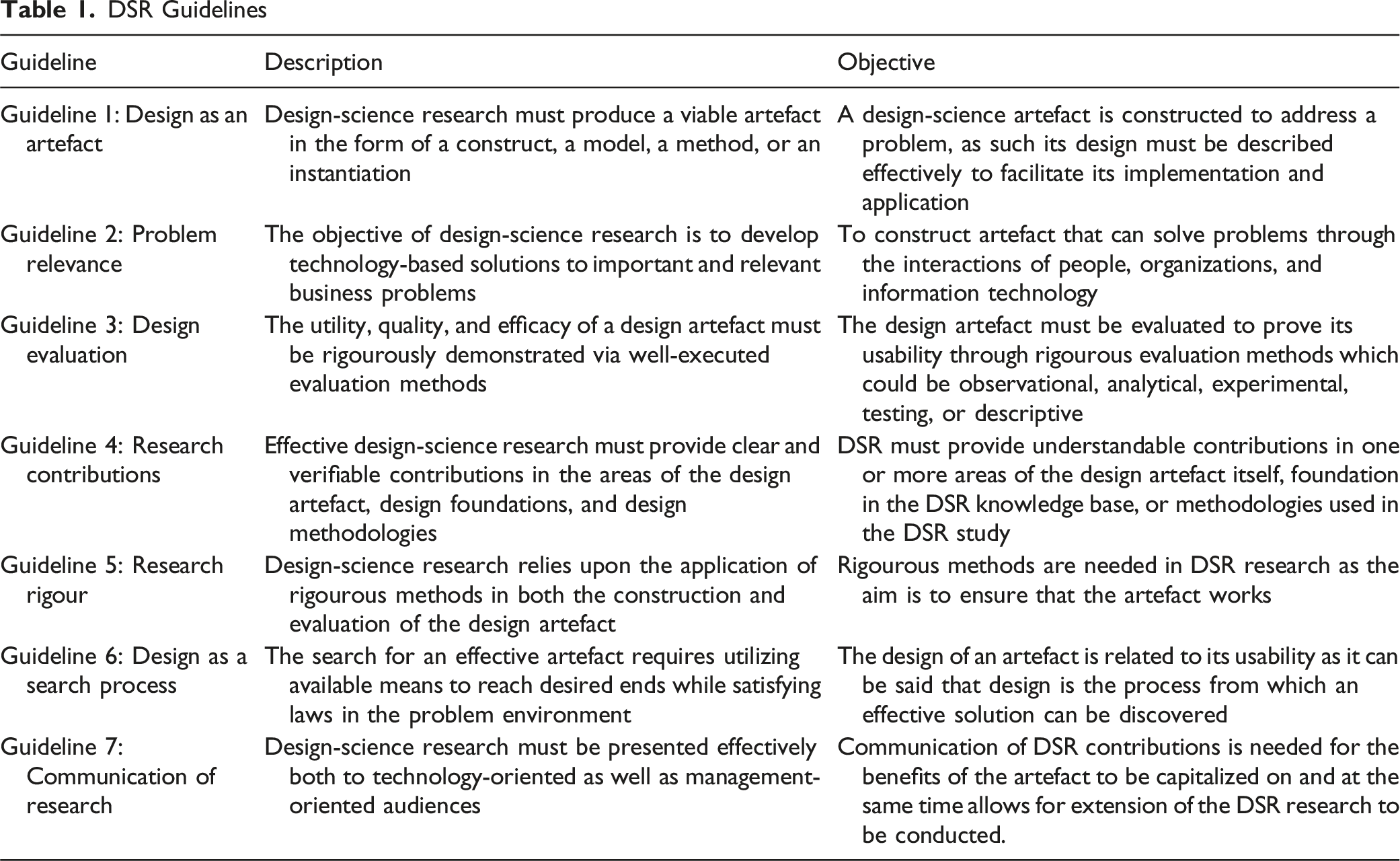
1. DSR research must be grounded in addressing a problem (Guidelines 1 & 2).
2. DSR artefacts must be rigorous in their design, construction, and evaluations to ensure their suitability to be used as a method in addressing the problem (Guideline 1, 3, 5, 6).
3. DSR research contributions must be understandable and communicated effectively to recipients for their benefits to be capitalized on and extended (Guidelines 4 & 7).
DSR has also been stated to be divided into two subtypes which are 1) quantitative design research and 2) qualitative design research as its main objective is to develop artefacts that enable satisfactory solutions to practical problems (Ebneyamini, 2022). Developing artefacts and constructs has not usually been the goal of social science research, as most social science research such as in technology management studies has leaned towards more behavioural studies to only analyse cause and effect such as the unified theory of acceptance and use of technology (UTAUT2) model Paraskevi et al. (2023) which leads to limited studies regarding the merging of DSR and social science (Carter et al., 2022; Castro et al., 2025; Hevner et al., 2004)
However, with the importance of digital technology nowadays, research that encompasses both social science studies and technology development is important. Furthermore, it had been stated by Hevner et al. (2004); and Castro (2025) that merging DSR and social science such as qualitative methods can create a positive synergistic effect which can lead to a more comprehensive as well as effective approach in addressing a particular problem. As such, merging both social science methods (ex. qualitative methods) and development methods (ex. DSR) in research are becoming more important.
The goal of this study is to show how social science research (qualitative) can be merged with developmental methods (DSR), by merging qualitative design methods and DSR for developing an artefact. Moving forward, Qualitative and DSR approaches will be discussed. Then, the intersection of qualitative design and DSR will be presented. Followed by a discussion on how qualitative design methods can be merged with DSR. Lastly, the conclusion of this study is presented.
Qualitative Approaches
Qualitative Designs
Qualitative research provides several designs from which studies can strategize their processes and methods (Creswell and Báez, 2021). Though there are many designs for qualitative research it had been stated by Creswell and Báez (2021) that the most prevalent are: • Narrative research focuses on an interesting story or experience of an individual. • Phenomenological research focuses on the experience of several individuals regarding a certain phenomenon or event (Creswell and Báez, 2021). • Grounded theory focuses on a study researcher’s intent to generate a theory that could explain a process, an action, or an interaction (Creswell and Báez, 2021). • Ethnographic research focuses on how a pattern of action, talking, and behaviour of a specific cultural group is developed through their interaction over time (Creswell and Báez, 2021). • Case study research focuses on an in-depth analysis of a singular or several cases to describe how it illustrates a problem (Creswell and Báez, 2021).
However, besides these five qualitative designs, there is another one emerging as a prevalent design for qualitative studies which is action research (AR) (Wieland et al., 2024). AR focuses on a researcher actively involving themselves in an object of study to formulate or test theories in practice which can then contribute to situational improvements (Wieland et al., 2024). Besides that, AR and case study design have also been combined which have shown positive synergistic contribution (Castro et al., 2025).
Qualitative Methods
In qualitative research, there are also several methods for researchers to collect their data. Creswell and Creswell (2022) stated that there are four prevalent types of data collection which are: • Observation is where researcher observe their participants to discover their behaviour or responses. Options for observation include 1) complete participant; 2) observer as participant; 3) participant as observer; or 4) complete observer (Creswell & Creswell, 2022). • Interviews where the researcher communicates with their participants to elicit responses. Options for interviews include 1) face-to-face; 2) telephone; 3) focus group; or 4) online (Creswell & Creswell, 2022). Besides that, the method of questioning can be 1) structured; 2) semi-structured; or 3) unstructured (Creswell and Báez, 2021). • Documents where the researcher obtains, analyses and synthesizes languages along with the words of their participants that are contained in these documents. Documents that can be obtained can either be public or private (Creswell & Creswell, 2022). • Audio-visual materials such as photographs, videotapes, art objects, computer messages, sounds, or films of research participants may allow them to share their reality with the study researchers (Creswell & Creswell, 2022).
Besides these qualitative methods, there are many other methods for qualitative studies such as the Delphi method (Fathullah et al., 2023b). The Delphi method allows researchers to forecast issues through reaching a consensus among experts using anonymous feedback among themselves in repeated rounds (Fathullah et al., 2023). The Delphi method also allows for rigour in a qualitative study as it allows a researcher to elicit collective judgement of their participants through multiple rounds and iterations.
Reliability and Validity in Qualitative Methods
Creswell and Báez (2021) stated that inherently qualitative research is interpretive as a researcher makes a personal interpretation of the data they have gathered. Due to this researcher of qualitative studies need to present the reliability and validity of their studies.
Creswell and Báez (2021) also stated that there are nine common strategies that qualitative researchers could use which are 1) “Triangulation”, 2) “Disconfirming Evidence”, 3) “Researcher Reflexivity”, 4) “Member Checking”, 5) “Prolonged Engagement in the Field”, 6) “Collaboration with Participants”, 7) “External Audit”, 8) “Thick, Rich Description”, and 9) “Peer Debriefing”. These nine validity strategies though varied in their approach aim to ensure that the overall accuracy of a qualitative study is acceptable.
Meanwhile, the reliability of qualitative research is to ensure the consistency between two or more qualitative researchers (Creswell and Báez, 2021). One of the most common methods to measure the reliability of a study is intercoder agreement where a percentage of agreement between qualitative researchers is measured through measurements such as Cohen’s Kappa coefficient (Creswell and Báez, 2021).
Validity and reliability ensure that a qualitative study though interpretive is rigourous in its accuracy and consistency.
DSR Approaches
DSR Framework
DSR provides a framework to understand, execute, and evaluate design science research (Hevner et al., 2004). The DSR framework involves three categories which are 1) “Environment” 2) “IS/DS Research” and 3) “Knowledge-Base”. Furthermore, there are sub-categories in all three of them as shown in Figure 1. DSR Framework Categories and Sub-Categories.
Besides that, there are several relationships between the three categories with knowledge-base influencing IS/DS research through “applicable knowledge” and environment influencing IS/DS research through “business needs”. Meanwhile IS/DS research results contribute to the environment through “application to the environment” and knowledge base through “addition to the knowledge base”.
DSR Process
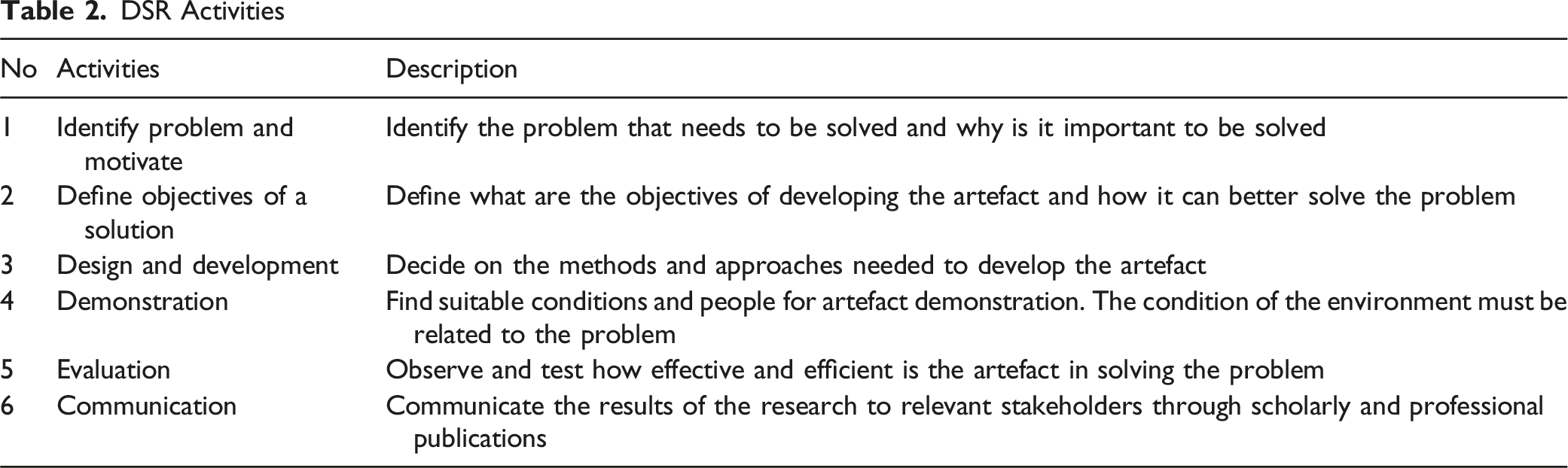
DSR Activities
DSR Considerations
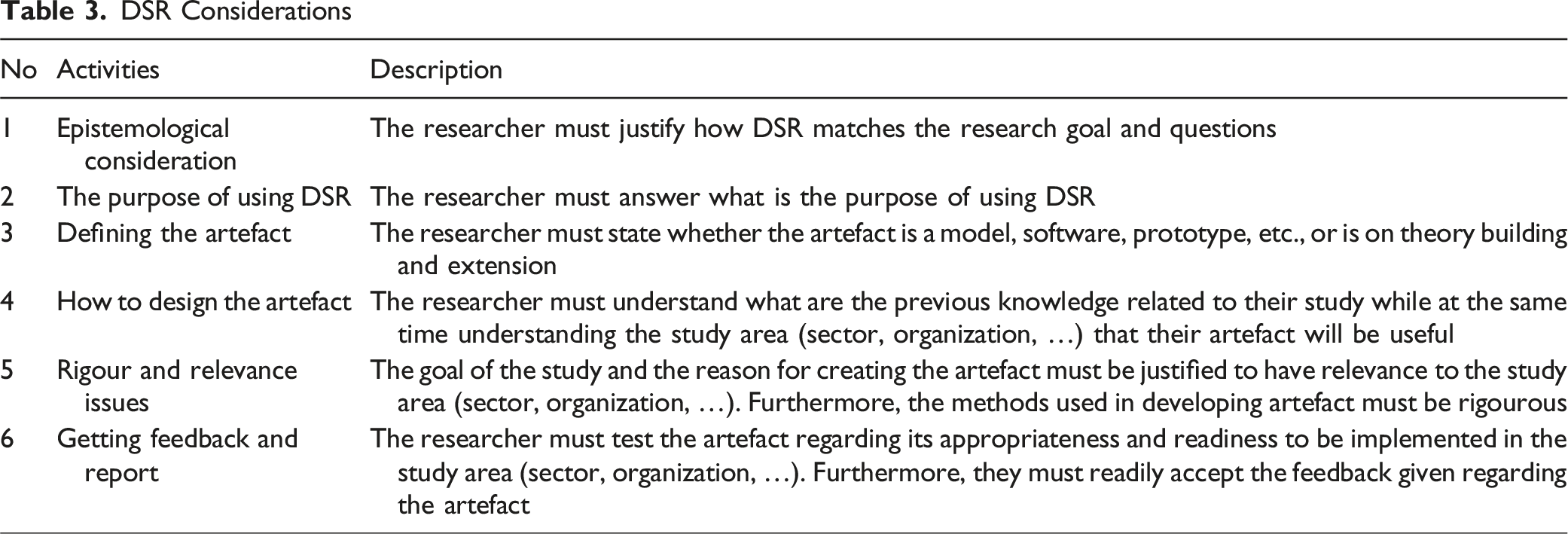
DSR Considerations
DSR and Qualitative Methods Combination Cases
DSR and Qualitative Methods Studies

Qualitative Methods Usage in DSR Studies

As presented in Tables 4 and 5, merging DSR with qualitative methods is achievable and can produce contributions which can assist in addressing a problem. However, as can be seen in Table 4, L1 used action research as their qualitative design while L2 combined both action research and case study. Meanwhile, in this study, a combination of DSR and qualitative phenomenology design will be presented.
Results
Complying With DSR Considerations
The researcher first considered whether the categories in the DSR framework Hevner et al. (2004) and processes in the DSR process Peffers et al. (2007); vom Brocke et al. (2020) are sufficient to be used as the foundation of a DSR research. This is due to DSR research having to comply with the six activities in DSR considerations (Ebneyamini, 2022).
After examining the main thought of the activities in the DSR considerations along with the DSR framework categories and DSR process processes, the researcher matched them with each other to facilitate an understanding on how DSR research can comply with the DSR consideration as can be seen in Figure 2. DSR Consideration Compliance.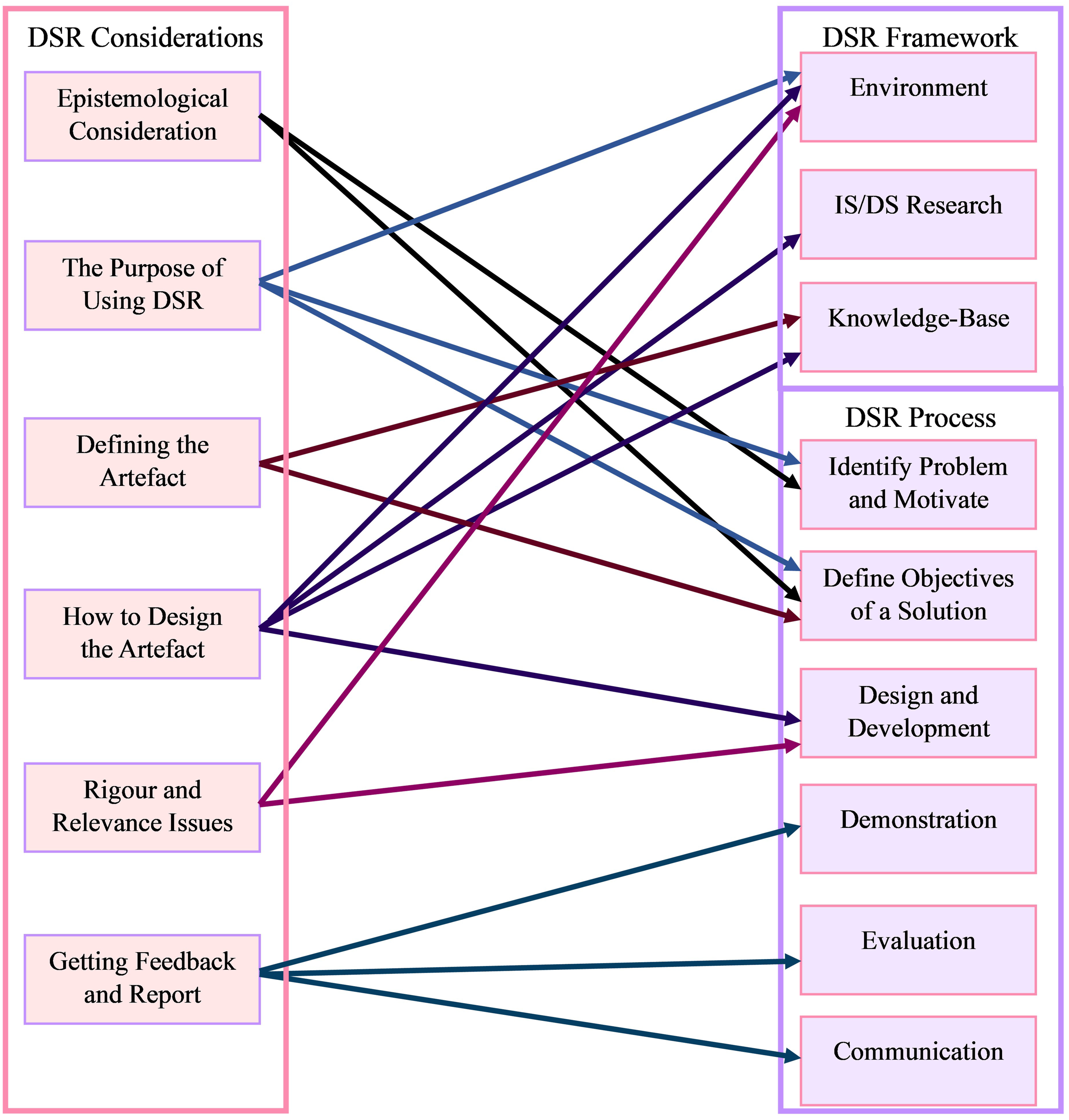
As can be seen in Figure 2, the DSR framework along with the DSR process complied with DSR consideration through their categories and processes respectively. Epistemological consideration can be complied from the DSR processes activity 1) “Identify problem and motivate” and activity 2) “Define objectives of a solution”. This is due to the main thought of epistemological consideration is the justification of how DSR matches the research goal and questions. As such, by identifying the problem that needs the DSR solution including the researcher’s motivation for using DSR to solve the problem and defining what is the objective of the DSR solution, the study can comply with the epistemological consideration.
The second activity of DSR consideration is the purpose of using DSR which main thought is to justify why the research needs to use DSR. The purpose of using DSR can be complied through the environment category of the DSR framework which allows the researcher to understand the context of the people, organization, and technology related to the study which allows for an understanding of the business needs in the study environment. The consideration was also complied through Activity 1 and Activity 2 of the DSR process as it identified the problem and motivation of the research along with defining the study objective. The purpose of using DSR is justified as the researcher understands the problem currently in the environment and why it is important to use DSR to solve it.
The third activity of DSR consideration is defining the artefact whose main thought is on what is the type of artefact that must be developed. Defining the artefact can be completed through the knowledge-base category of the DSR framework by understanding existing research and theories related to a study.
Furthermore, activity 2 of the DSR process defines the objective of a solution. By defining what is the objective of developing the solution, researchers can decide on what kind of artefact is needed to reach their objective.
The fourth activity of DSR consideration is how to design the artefact which main thought is that for a DSR study, a researcher must understand the existing knowledge related to their study and to who the results of their study will benefit. How to design the artefact can be complied through the three categories of the DSR framework which are: 1. Environment that allows the researcher to understand the business needs in the current study environment. 2. Knowledge-base which allows the researcher to understand the existing knowledge related to the study. 3. IS/DS research allows the researcher to design the artefact based on the understanding of the current business needs in the environment and prior knowledge related to the study.
Besides that, process three of the DSR process, design and development also allows for the consideration to be complied with as a researcher would need to determine the design and methods that can help to develop their artefact.
The fifth activity of DSR consideration is rigour and relevance which main thought is that DSR research must be relevant to the study area and be rigourous in their methods. Rigour and relevance can be complied with through the environment category of the DSR framework which allows for an understanding of the current business needs and makes an artefact that meets the business need requirement relevant. Furthermore, in activity three of the DSR process, design and development, a researcher should select methods that are rigourous to comply with the fifth consideration.
The sixth activity of DSR consideration is getting feedback and reports which main thought is that for a DSR study, the researcher must test the artefact in their study area to verify its appropriateness and readiness. Getting feedback and reports can be performed through the process four to six of the DSR process which are: 1. A demonstration where a researcher would need to demonstrate how to use the developed artefact and what it does to the people and organization related to the study. 2. Evaluation where a researcher needs to ask participants that are related to their study to evaluate their study and provide feedback on how appropriate is the developed artefact reach the study objective. 3. Communication is where the researcher needs to publicize their results to the relevant stakeholders.
From these results, it can be implied that through understanding and designing the DSR framework along with the DSR process thoroughly, DSR research can comply with the DSR consideration.
Intersection Between Qualitative Methods and DSR
Social science as a philosophy involves finding and investigating the cause and effect of a phenomenon (Benton & Craib, 2023). As such. Qualitative research design which is part of social science research Creswell and Báez (2021) involves the study of discovering the cause and effect of phenomena.
Meanwhile, DSR as mentioned in the introduction section is problem problem-solving design paradigm that focuses on developing an artefact in the forms of constructs, models, methods, and instantiations (Hevner et al., 2004).
There are no common threads between qualitative design and DSR, as one design focuses more on investigating the cause and effect of a phenomenon while the other on developing an artefact to solve a problem. However, as shown in Figure 3 overlapping these two designs can allow for a more comprehensive research design that takes into consideration both the philosophical aspect of cause and effect with the practical problem-solving development which aligns with the digital age nowadays. Furthermore, this also shows that merging these two designs could lead to a positive synergistic effect that can produce a more comprehensive and effective approach to addressing a particular problem compared to them being used individually. Qualitative Phenomenology Design With DSR.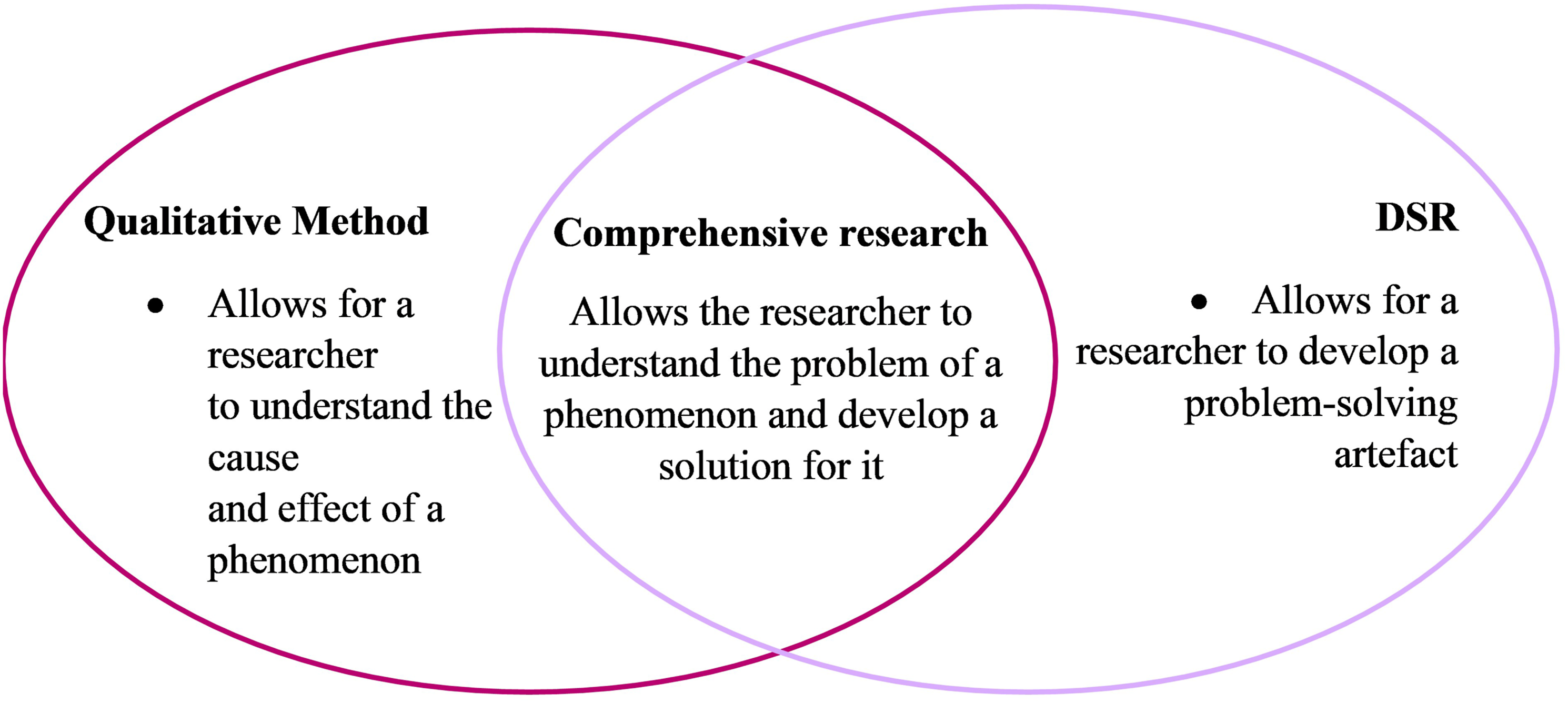
Discussion
How Qualitative Design Methods can be Merged With Developmental Methods (DSR)?
The results show that the DSR framework and DSR process can be used to comply with the DRS considerations. Along with, the results on how qualitative design can intersect with DSR research. The researcher has constructed a DSR framework and DSR process that merge qualitative design methods for a study titled “Risk Management of Cloud Computing Projects in Healthcare” to present how this merge can be achieved.
DSR Framework
The study was conducted due to there being relatively low options for cloud computing projects’ risk management guidelines in the healthcare sector. The goal of the study was to develop a risk management artefact in the form of a software prototype for cloud computing projects in healthcare to effectively handle risks in their cloud computing projects.
The study first adapted the DSR framework as shown in Figure 4. The qualitative methods have been added to the knowledge-base category of the DSR framework through the foundations including the phenomenology research design while the methodologies include systematic literature review Fathullah, Subbarao, and Muthaiyah (2023); Fathullah et al. (2024), semi-structured interviews and the Delphi method (Fathullah et al., 2023b). Qualitative Method Merge With DSR Framework.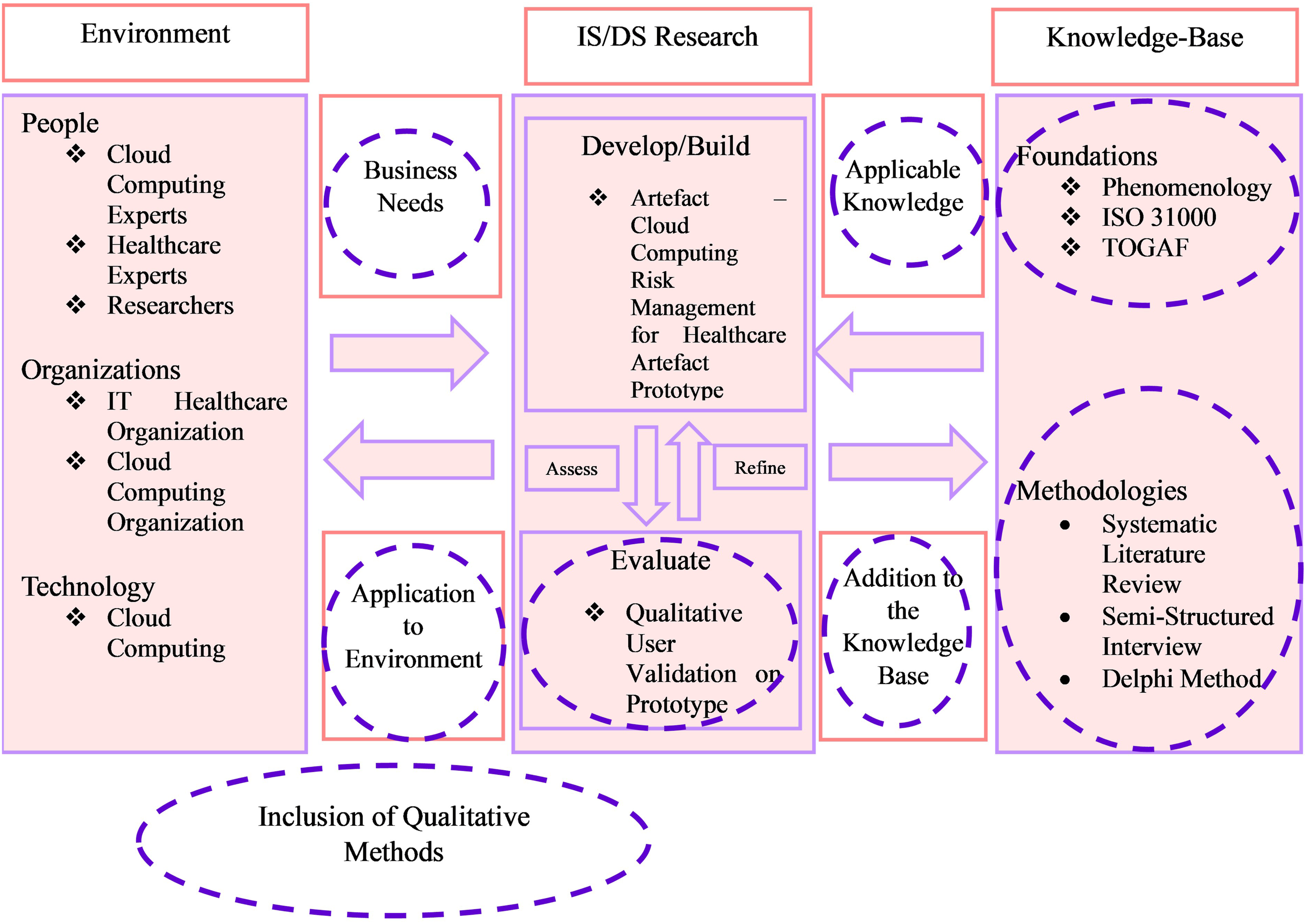
The environment category does not have an inclusion of qualitative methods as its subcategories relate to people, organizations, and technology. However, the people and organizations that are stated in the constructed framework would be the sampling criteria for the research while the technology is technological focus of the study. As such, the participants for the qualitative method which is the semi-structured interview and Delphi method in the study must match these criteria.
The applicable knowledge from the knowledge base influences the IS/DS research category by using these qualitative methods to evaluate and assess the developed artefact. From there, the developed artefact will be refined based on the analysis of the comments collected for the qualitative methods. Furthermore, as the qualitative data has been collected from the people and organizations in the environment category, the business needs that influence the IS/DS research also include qualitative methods.
Then, the results from the IS/DS research will add an addition to the knowledge base through the methodology and theoretical knowledge discovered. Besides that, the IS/DS research goal is to solve a problem. As such, by providing the people, organization, and technology a solution to their problem, the results will also provide an application to the environment. Therefore, this shows that the merging of qualitative methods from a phenomenology design perspective in the environment, IS/DS research, and knowledge-base category of the DSR framework is not only achievable but also could produce a positive synergistic effect.
DSR Process
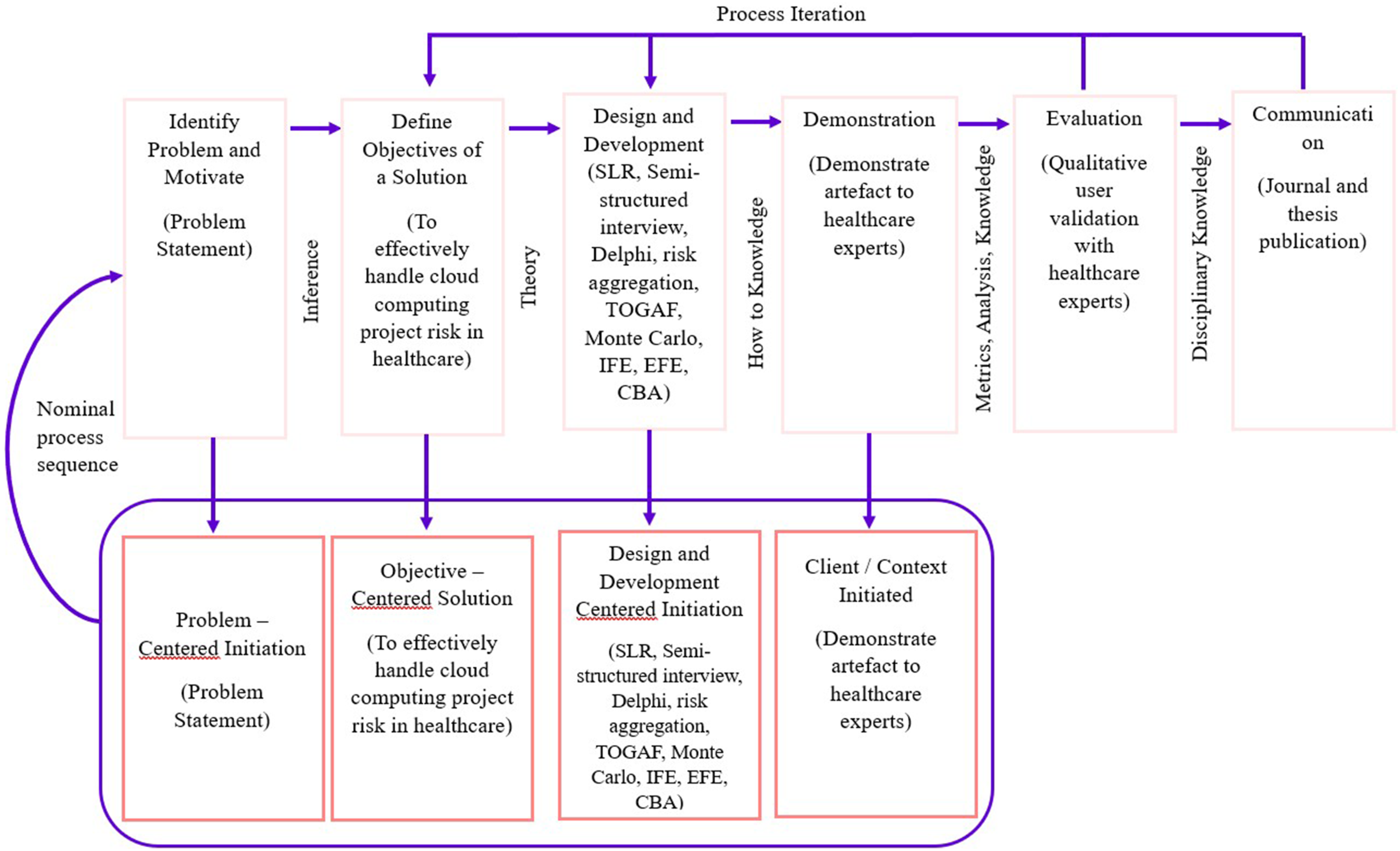
The study also adapted the DSR process to organize the processes for developing the artefact as shown in Figure 5. All six of the DSR processes were used in the construction of the adapted DSR process which are: • Activity 1. Problem identification and motivation. The problem identification for this study is due to “Low options for cloud computing projects risk management guideline in the healthcare sector”. • Activity 2. Define the objectives for a solution. The objective for the DSR activities is “To develop a risk management artefact in the form of a software prototype for cloud computing projects in healthcare to effectively handle risks in their cloud computing projects.” • Activity 3. Design and development. The artefact is developed through the data found through SLR, and qualitative methods which are semi-structured interviews and the Delphi method. Purposeful sampling specifically expert sampling was used for these qualitative methods as it has been stated by Creswell & Plano (2018) that “purposeful sampling is a sampling method where the sample is chosen based on whether they have experienced either the central phenomenon or key concept related to the study’s objective” which aligns with the objective of this study as both cloud computing and healthcare are expert field along with the design of this study is phenomenology. In addition, thematic analysis was used to analyse the data gained from the semi-structured interview and construct indicators (Braun & Clarke, 2021). Thematic analysis was chosen as it allows the researcher a lot of flexibility in interpreting the data and to approach data sets more easily by sorting them into broad themes (Braun & Clarke, 2021). Meanwhile, the median and coefficient of variation (CV) were used to measure the consensus of the indicators (Fathullah et al., 2023). Besides that, Cohen’s Kappa was used to test the reliability of the indicators Creswell and Báez (2021) while triangulation, member checking, and audit trail were used to increase the validity of the qualitative results Creswell and Báez (2021). These methods were used to show the rigourousness of the qualitative data in this study which is aligned with DSR consideration of “rigour and relevance”. The artefact was then developed using risk aggregation through risk matrix Cai et al. (2022), TOGAF architectures Alwadain (2019), Monte Carlo Simulation Anderson (1976), Internal Factor Analysis (IFA) Fitriani (2022), External Factor Analysis (EFA) Fitriani (2022), and Cost-Benefit Analysis (CBA) (Mishan & Quah, 2021). • Activity 4. Demonstration. The artefact was demonstrated by the researcher to healthcare experts on its functionality to solve the problem as the first part of the artefact testing. • Activity 5. Evaluation. Qualitative user validation (semi-structured interview) with healthcare experts was used to evaluate how well the artefact solved the problem as stated in this study by comparing the objectives of the solution with how the artefact was used as the second part of the artefact testing. The evaluation of the artefact was also analysed using thematic analysis (Braun & Clarke, 2021). In this study, the researcher did not reiterate back to activity three but will instead leave further improvement to subsequent projects. • Activity 6. Communication. The researcher published several results of this study in journals along with conferences to communicate and present it to relevant stakeholders. DSR Process With Inclusion of Qualitative Methods.
Conclusion
To conclude the goal of this study was to show how qualitative design methods can be merged with developmental methods (DSR). This goal was achieved as the researcher has shown how using the DSR framework along with the DSR process can comply with the requirement of DSR consideration. The researcher also showed how qualitative study (phenomenology) can intersect with DSR to provide a more comprehensive study by merging philosophical qualitative study and problem-solving DSR study. From this, the researcher constructed a DSR framework along with a DSR process that merged qualitative design aspects. The activities of the DSR process have also shown how both DSR and qualitative methods have inherent rigour in them which are synergistic in addressing a problem. However, we must acknowledge that this study looked at the merging of qualitative methods and DSR from phenomenology a perspective as such future research could also look at merging them through different qualitative design perspectives. We hope that the results and presentation of this study will be able to help researchers who are interested in doing a DSR study that merges qualitative design methods to know how to comply with DSR considerations and how to merge them into a study.
Moving forward, we will be conducting our study using the adapted DSR framework and DSR process in our study. Through the usage of this framework and process, we hope to develop an artefact that reaches our objective and proves relevant to relevant stakeholders related to our study.
Footnotes
Acknowledgements
We are grateful to Multimedia University, Faculty of Management, family members, and other individuals for their kind support and encouragement.

Funding
The authors received no financial support for the research, authorship, and/or publication of this article.
Declaration of Conflicting Interests
The authors declared no potential conflicts of interest with respect to the research, authorship, and/or publication of this article.