




Abstract
In this paper, we explore Northern Ghanaian weaving traditions using Visual Participatory Storytelling (VPS) as a collaborative methodology to address critical gaps in knowledge production and craft documentation. We demonstrate this by showing how key weaving practices, traditions and histories – from material sourcing to finished textiles – and textile wearing codes function as living repositories embodying both human and non-human entanglements, cultural semiotics, spiritual beliefs, and community knowledge systems. Through co-creation with communities in the documentation process, we contribute to design anthropological and decolonial scholarship as well as participatory research by proposing a six-stage VPS framework that positions communities as primary knowledge holders.
Keywords
Introduction
“The way we wear our hats tells our story... when you see a chief, his hat sits high, showing he answers only to the divine. But for his herald, the hat tilts forward - he leads the way, protected by spiritual powers…….” – master weaver, Loho, 2023.
The above description from Northern Ghana illustrates how deeply cultural meanings are woven into textile traditions and everyday weaving practices. Such narratives reveal not just technical processes but complex social hierarchies and knowledge systems that are often hidden from conventional documentation methods (Bentkowska-Kafel & MacDonald, 2018). Across Africa, textile traditions have long served as repositories of cultural knowledge and social memory (Kriger, 2006; Lemi, 2024), yet as these practices face mounting pressures from industrialisation, modernisation and changing social patterns, capturing and preserving these multifaceted knowledge systems has become increasingly urgent. Traditional craft knowledge, particularly in textile production, represents complex systems of intergenerational learning and cultural transmission (Clifford Collard, 2020; Spring, 2012). In Ghana specifically, a rich body of scholarship has emerged examining these traditions and their cultural significance (Adom, 2024; Afriyie et al., 2023; Boateng, 2002; Nunoo, 2022). For instance, Nunoo’s (2022) work on Kente weaving aesthetics demonstrates how traditional textile practices encode complex social and corporate identities and heritage.
Despite this increasing scholarship, there remains a notable methodological gap in how these practices are documented and analysed. Most of the existing methods such as text-based documentation or text-based ethnography, despite their usefulness, have been argued to be characterised by “thick description” that sometimes makes access difficult for non-traditional academic audiences (Gans, 2010; Graizbord & McPike, 2020; Vannini & Mosher, 2013). It has also been argued that other existing approaches often pay limited attention to the multisensory and hybrid embodied knowledge essential to indigenous practices and broader publics (Nakamura, 2013; Vannini & Mosher, 2013). These limitations have prompted growing interest in visual documentation methods such as photovoice, comics, digital storytelling, participatory videos or photography (Brown et al., 2020; Davey & Benjaminsen, 2021; Pink, 2022; Quilty et al., 2024; Sou & Hall, 2023). However, while substantial literature discusses visual approaches in cultural research, important challenges persist in how meaning is made across different sites of production, circulation, and audiencing (Allen, 2020; Evagorou et al., 2015). Also, emphasis has mainly been on conceptual understanding and reportage, and less on treating visual representations as epistemic objects that actively generate knowledge and engage in world making (Evagorou et al., 2015; Hawkins, 2020; Lankow et al., 2012; Rieger et al., 2023; Traue et al., 2019).
Building on calls to engage in and produce more public-facing research and adopt creative methodological innovations, we draw on a digital art-based sensory ethnographic approach that combines traditional ethnographic methods with visual documentation through digital illustration. Through a one-month artist residency at the Nubuke Foundation Centre for Clay and Textiles Loho (June – July 2023) by the first author, this study engaged with weavers’ practices and histories to explore how socio-cultural meanings and traditions are embedded in weaving processes and products. Following this, we developed what we term ‘visual participatory storytelling’ (VPS) – a methodology that enables practitioners and communities to actively shape how their knowledge is documented and represented.
In doing so, we also aim to make two key contributions to existing scholarship. First, we add to the growing visual design anthropological thinking (Bresciani, 2019; Palmieri et al., 2021) and creative geographies to demonstrate how digital art-based methods can reveal and preserve the hidden stories and meanings embedded in traditional craft practices. Second, we offer a methodological framework for documenting embodied (human and non-human) cultural knowledge through participatory visual storytelling, which contributes to the growing body of work on decolonial approaches to cultural documentation and research. This allows communities to be actively represented as knowledge holders (or owners) in how their traditions are represented and preserved.
The remainder of the paper is structured as follows. The next section provides a brief review and the analytical lens of storytelling, and its link to creative methods. This is followed by a brief description of the study context and research methods. We then describe the VPS framework and its processes as used in our study. In the penultimate section, we present the case findings that describe the weaving storylines and narratives looking at the different art-based knowledge systems. The last section provides the concluding discussions.
Place-Based Stories and Storytelling as Ways of Knowing
Following the narrative turn in social sciences, scholars have increasingly focused attention on stories, narratives, and storylines as analytical frames for understanding how meaning is constructed and transmitted through different forms of ‘telling’ or knowledge systems and modes of expressing non-representational, (post)phenomenological geographies (Cameron, 2012; Moezzi, 2004; Moezzi et al., 2017). Particularly within sub-disciplines such as cognitive psychology, human geography and Science and Technology Studies (STS), this methodological shift recognises that human knowledge is fundamentally organised through stories and storytelling – how people make sense of experiences, transmit cultural understanding, and navigate everyday life through narrative structures (Moezzi, 2004; Cameron, 2012; Bietti et al., 2018; Bruner, 1991; Czarniawska, 2004). Similarly, as part of this, there has been the emergence of new materialism, which attempts to address the perceived limitations of social constructionist (narrative) theories and methodologies about the non-human worlds, with some scholars suggesting new ways of storytelling and storying (Jordan, 2019; Smith & Monforte, 2020).
Within the wider literature, stories (and repeated narratives) function as more than simple communication tools but as constitutive elements of social reality or facts (MacKinnon, 1996). As Czarniawska (2004) argues, ordinary knowledge is circulated in stories, making narratives constitutive of social reality itself. Indeed, stories always take place in a space and storytelling helps us to build up the understanding of a place (Bassano et al., 2019). Such place-based storytelling approaches demonstrate how narratives explore hidden experiential dimensions of environments, operating as exploratory processes that engage with the dynamics of place, emotion, and cultural meaning-making (Heck & Tsai, 2022). This also involves understanding different modes of knowledge representation of places or spaces, which has been increasingly evaluated using community-based research and visual methods (Davey & Benjaminsen, 2021). As Literat (2013) explains, visual and textual approaches offer distinct affordances for capturing embodied knowledge that might otherwise remain invisible in conventional documentation. In its attempt to rethink conventional documentation approaches and ways of ‘telling,’ and the new ways of doing, place-based storytelling has increasingly drawn on (new) arts-based methodologies and the digital to engage defiant imagination and challenge the status quo through collaborative practice that creates unique visualisations embedded in the everyday (Davey & Benjaminsen, 2021; De Jager et al., 2017; Ferrando, 2016).
This digital placed-based storytelling is particularly a significant co-creative media practice that facilitates critical participatory and collective sense-making, attachments and community-engaged scholarship (Heck & Tsai, 2022; Mitchell et al., 2017). For instance, the openness of these methods and ways of ‘telling’ – as opposed to research that seeks definitive answers – enable participants and researchers to attend to the nuances of lived experiences of the world, and to produce knowledge beyond epistemological boundaries (Foster, 2016; Mitchell et al., 2017). For this paper, we draw on and extend this scholarly terrain by positioning Visual Participatory Storytelling as a methodological response to documenting place-based traditional knowledge systems and ways of knowing.
Methods
Research Context
The study was conducted in Wa, the regional capital of the Upper West Region of Ghana, with particular focus on the Loho community. Wa Municipality, with a population of 200,672 as of 2021 (Ghana Statistical Service, 2021), represents one of Ghana’s significant cultural centres in the north, with a long-established history of textile production and craft traditions that predates colonial contact. In recent decades, Wa has experienced rapid urbanisation, with an urban population growth rate of 4% (higher than the national rate of 3.4%) (GSS, 2021). The selection of Wa and specifically the Loho community was guided by their historical significance in Northern Ghana’s weaving traditions. The area has long served as an important centre for artisanal practices in clay pottery and weaving (Tevie, 2019), where knowledge has been preserved and transmitted across generations through established apprenticeship systems and family lineages. This study was conducted during an artist residency programme with the Nubuke Foundation, a non-profit visual arts and cultural institution founded in 2006 with a mission to record, preserve and promote Ghanaian culture through community-centred programming (Tevie, 2019). The Foundation operates with varied funding sources including international partnerships and cultural grants. It also operates multiple centres, including the Centre for Clay and Textiles in Loho, which focuses on strengthening design thinking and innovation within artisanal practices by working with craftspeople, women associations and young adults in weaving and pottery communities (Tevie, 2019). Through over a decade of engagement, the Foundation has established relationships and permissions to work with traditional craft communities across Ghana.
Research Positionality and Knowledge Co-production
The research positionality significantly shaped our approach to documenting weaving traditions in Northern Ghana. The first author, who conducted the primary fieldwork through a one-month artist residency programme at the Nubuke Foundation Centre for Clay and Textiles Loho (https://wa.nubukefoundation.com/Residency-1), brought both insider knowledge and creative expertise to the research. Born and raised in the Wa municipality, he combines a background in publishing studies with professional experience as a digital illustrator, designer and arts-based researcher, which provided unique tools for documenting traditions and storytelling. This combination of local knowledge and creative skills proved particularly valuable in translating complex cultural practices into accessible visual narratives. A key methodological decision that reflected this positionality was the relocation of the first author’s studio directly within the Loho community. This strategic choice transformed a physical space into a nexus for collaborative research and artistic creation, dissolving traditional boundaries between researcher and participants. The studio setup involved integrating digital illustration equipment into existing workshop spaces with traditional looms and pottery exhibitions within Nubuke, which created a hybrid environment where different forms of knowledge production could coexist. By establishing a presence within the community fabric and through Nubuke Foundation’s work in the community, rather than entering as an outside observer, the research process became more accessible to community members who could engage on their own terms and in familiar settings.
The first author’s position as a male researcher in a craft tradition practiced by both men and women required careful consideration. His understanding of local (gender) dynamics helped ensure balanced representation in the documentation process. Also, his local roots and cultural understanding facilitated trust-building with weavers and community members, enabling deeper access to both technical processes and cultural meanings.
While the first author conducted all fieldwork and created the digital illustrations, the second author, a researcher, also contributed to the methodological conceptualisation and design, analytical framing and further data analysis. He has extensive experience with participatory methodologies and familiarity with the region’s sociocultural dynamics which helped frame the findings within broader academic and cultural contexts. His understanding of the local language and cultural nuances aided in the interpretation and analysis of the collected data. We acknowledge that this division of research roles shaped how knowledge was collected, interpreted and represented. However, this collaborative approach allowed us to combine deep, on-the-ground engagement with broader theoretical perspectives.
Storying as Both Data and Methodological Approach
Drawing on arts-based ethnographic approaches, the first author conducted intensive fieldwork in the Wa municipality of North-Western Ghana from June to July 2023. The approach also employed multiple qualitative co-produced methods, termed VPS, to document weaving traditions, combining conventional ethnographic approaches with creative digital storytelling techniques. Central to this methodology was the use of stories as both data sources (storied data) and methodological tools, enabling us to capture not just technical processes but the rich cultural meanings embedded within weaving practices.
In order to capture the depth and richness of weaving traditions, we conducted life history interviews with 7 weavers from the Loho community. The life histories were conducted in Dagaare and Waale (the local dialects in the area) and subsequently translated into English to preserve community voices and cultural nuances. Each interview lasted between 1 hr to 2.5 hr and was audio-recorded with participants’ consent. These recordings were transcribed verbatim before translation to English. These interviews focused on weaving histories, personal journeys, technical knowledge, and the cultural significance of weaving practices. Life histories proved particularly valuable for this research as they revealed not just how weaving is done, but how knowledge is acquired, adapted and transmitted across generations. Through these extended conversations, we collected stories of learning, practice, and innovation. The weavers shared narratives of their apprenticeships, described changes in techniques over time, and explained the significance of different patterns and designs through cultural stories that situated technical knowledge within broader social contexts.
Also, through participant and field observations, the first author immersed himself in the daily rhythms of weaving workshops and community spaces. This immersion proved particularly valuable in understanding the nuances of different weaving techniques (see Figure 1). These observations yielded in-situ stories, narratives that emerged spontaneously during practice rather than through formal interviews and were captured through initial co-created field sketches and photographs.
To engage the broader community, the first author also facilitated three weekend workshops with local children and community members, focusing on creative storytelling and traditional folklore. These workshops were followed by periodic studio visits and a six-day Open Studio period that attracted over 500 visitors. These engagements created opportunities for dialogue between weavers, community members and local schools, providing additional context for understanding weaving’s social significance. During these sessions, stories emerged as a primary means through which community members explained and interpreted weaving traditions.
Drawing on his expertise as a digital artist and illustrator, the first author (co)created five detailed digital artworks based on storied data and key themes from the fieldwork and the VPS process (see the next main Section for the process). We also conducted 14 follow-up interviews and informal discussions with some community elders, smock sellers and members and other key personnel, particularly around their experiences and knowledge on weaving, meanings and cultural significance and symbolisms, gendered practices, and other discussions around smock and hat fashions and traditions. We ensured ethical considerations throughout the research process. Research was conducted through the Nubuke Foundation’s established community relationships and permissions, developed over more than a decade of engagement with weaving communities in the region. Before any data collection began, informed consent was obtained from all participants, and all data and consent forms were securely stored in accordance with institutional ethics policies. Participants were informed of their right to withdraw at any time Figure 1. Participatory approaches were used to engage community and weavers (source: author fieldwork with Nubuke Foundation)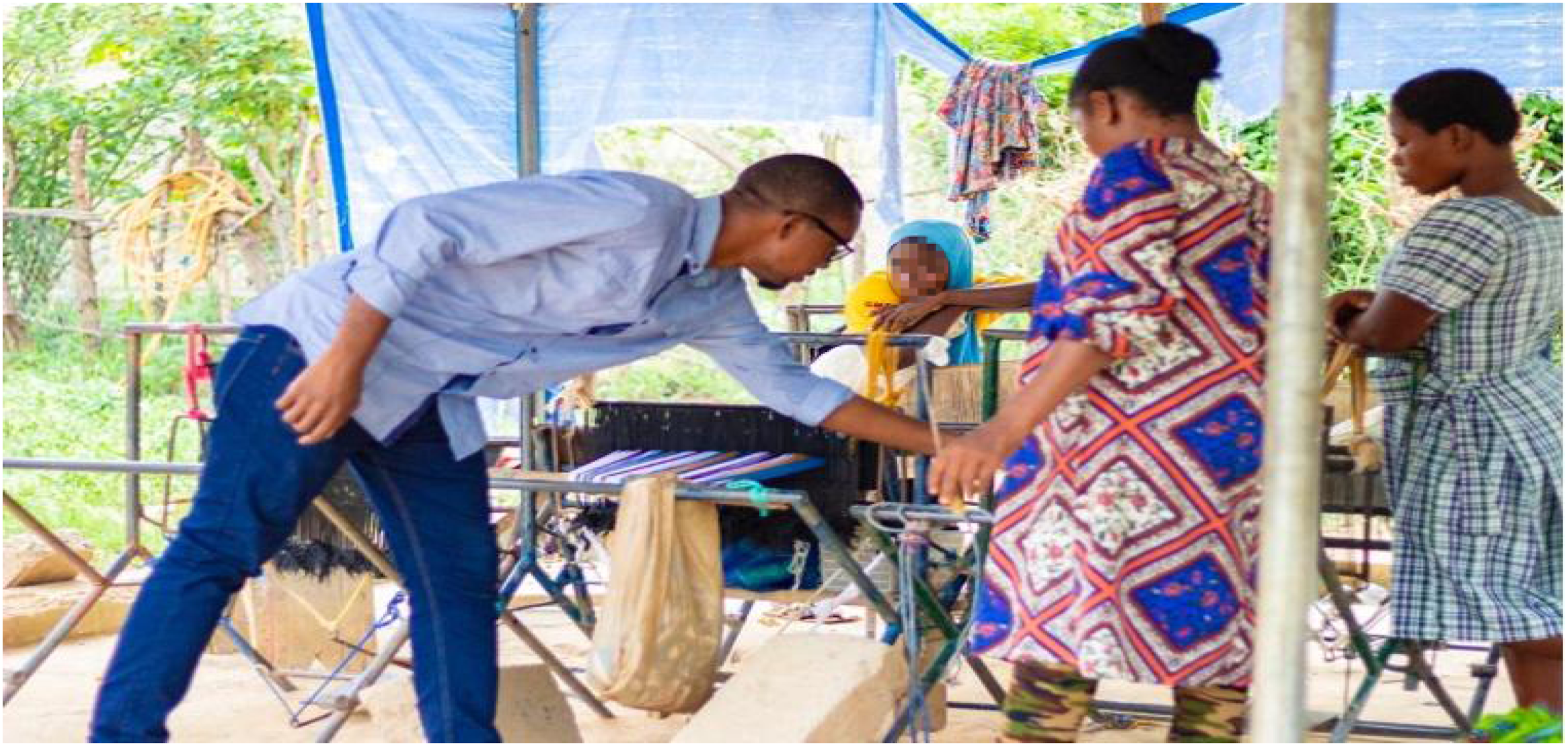
Data analysis followed a thematic narrative approach (Frank, 2010; Smith & Monforte, 2020), allowing the authors to identify recurring themes whilst preserving the storytelling context essential to understanding weaving traditions. The multiple data sources, interview transcripts, field notes, workshop observations and community feedback were triangulated and except for the life histories responses, in reporting findings, we have used pseudonyms to protect participants’ identities. These multiple methods were organised and implemented through the six-stage Visual Participatory Storytelling (VPS) framework, which we detail in Section 4 below.
The Visual Participatory Storytelling (VPS) Process and Its Application
Building on established visual design anthropological thinking and participatory visual methodologies (Bresciani, 2019; Dahlgren et al., 2022; Hawkins, 2020; Mitchell et al., 2017; Pink, 2022), we propose and use Visual Participatory Storytelling (VPS) (see Figure 2) as a methodological framework that fundamentally reimagines the process of documenting traditional knowledge systems, designers’ positions and participatory research. While (visual) participatory methods have been widely used in various contexts including heritage documentation (Davey & Benjaminsen, 2021; Nikolakopoulou & Koutsabasis, 2025), a persistent challenge remains in transferring true interpretive authority and ownership to community members throughout the entire process. VPS helps address this challenge by redistributing control over representation and documentation, moving beyond consultation to position communities as primary knowledge authorities with genuine ownership of how their cultural practices are documented, curated and data gathered. Proposed VPS framework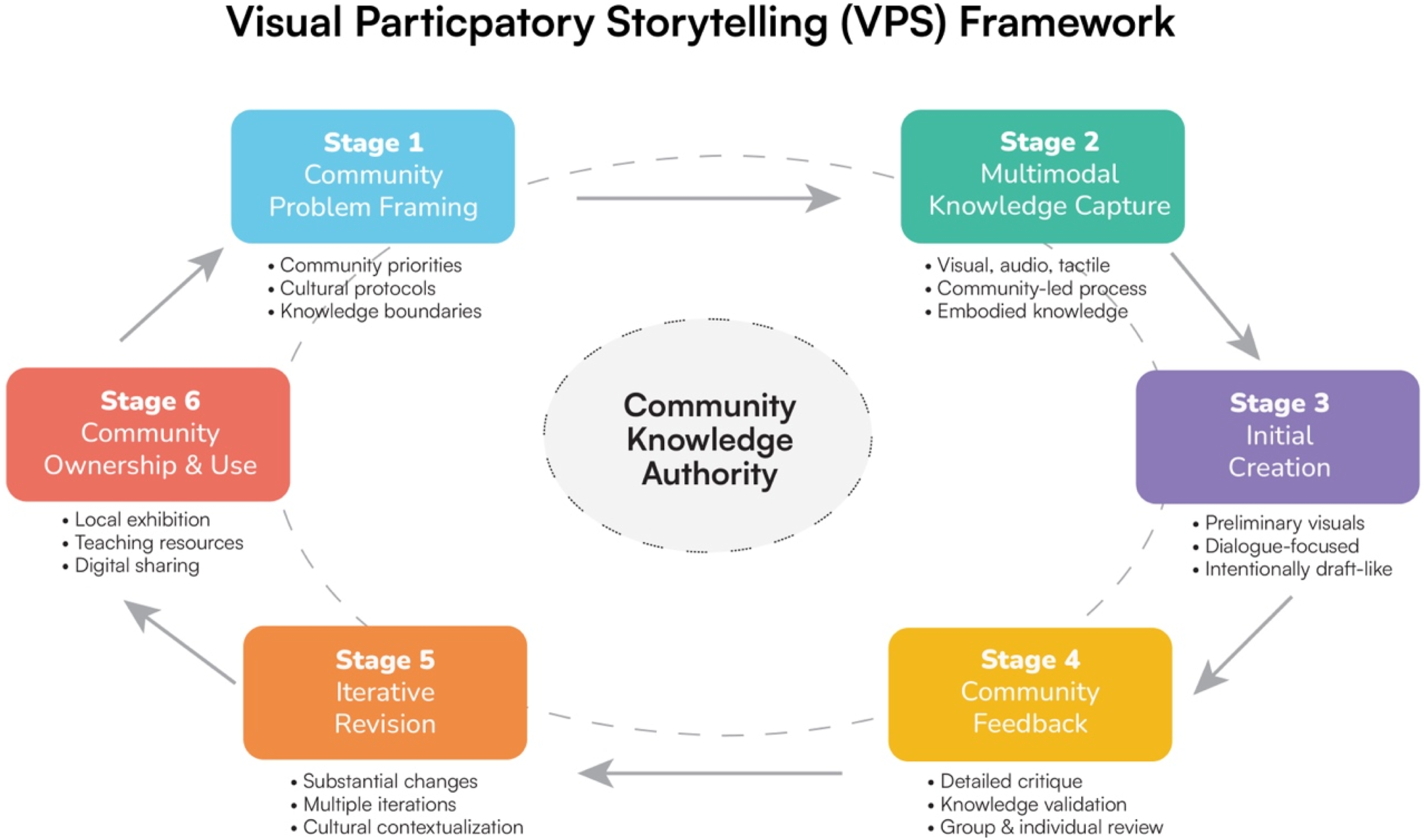
We present VPS as a framework that offers a structured yet adaptable approach, implemented through a six-stage iterative process (see Figure 2), drawing on our research with weaving communities in Northern Ghana. Our development and application of VPS emerged through intensive engagement with weaving communities in Northern Ghana, where the process evolved organically in response to community needs and the specificities of textile traditions and community engagements. Through this, we documented and co-created key visual digital illustrations, with each stage following guided procedures while remaining flexible to community input and creative collaboration in knowledge construction.
Stage 1 – Community Problem Framing
VPS begins by deliberately inverting conventional research dynamics where external researchers define documentation priorities. Instead, we must ‘meet people where they are,’ through long-term partnerships such as the continuous engagement of the Nubuke Foundation with communities, where communities themselves identify what aspects of their knowledge require documentation, preservation, or wider sharing. Building on Nubuke’s engagement with the communities, in our study area, this stage emerged organically through conversations with weavers who expressed specific concerns about key issues and knowledge loss. Rather than imposing predetermined research questions, 1 we facilitated mapping sessions and engagements where weavers individually and collectively identified documentation priorities and established cultural protocols governing knowledge sharing.
The first author conducted initial framing discussions with selected (weaver) groups, drawing on these established connections to identify key knowledge holders. From these engagements, we identified and selected groups and master weavers who helped co-develop the documentation priorities based on three criteria: mastery of traditional techniques, role as community knowledge transmitters, and willingness to share cultural knowledge for preservation. These preliminary conversations helped map key issues requiring documentation such as unique weaving processes, traditional knowledge systems, and cultural meanings embedded in textile practices. This process also resulted in the strategic decision to establish a studio within the Nubuke Foundation centre, transforming it into a nexus for collaborative research and artistic creation, which also helped create an environment where different forms of creative documentation could unfold organically.
Stage 2 – Multimodal Knowledge Capture
Traditional documentation approaches often privilege text and static images, missing crucial dimensions of embodied knowledge. Stage 2 of VPS employs multiple documentation techniques that respect the multisensory nature of craft knowledge or general knowledge production, with community members actively directing what is captured and how. Drawing on multiple data sources including expert (knowledge holders) observations, life histories, visual documentation, and community engagements, this stage captured the depth and richness of weaving traditions. The studio’s positioning within the community workspace, for instance, allowed for continuous immersion in daily weaving practices, facilitating real-time documentation of both technical processes and cultural narratives. Central to this stage were the life history interviews with 7 master weavers and the observations (see Methods Section) This also involved intensive participant observations through immersion in the daily rhythms of weaving workshops and community spaces, capturing everyday practices. These observations yielded in-situ stories - narratives that emerged spontaneously during practice.
In some instances, the first author co-sketched some of the shared stories in the presence of community members or ‘tellers’ as they were being narrated, with weavers providing direction, corrections, and highlighting key issues that might have been missed. This real-time visual sketching served as visual field notes to interpret verbally shared stories with illustrations and also created immediate feedback loops where preliminary representations could be adjusted based on community guidance and was sometimes completed by field photographs. Also, three weekend studio workshops with local children and community members, focusing on creative storytelling and traditional folklore, created additional opportunities for intergenerational knowledge sharing. These sessions revealed how stories emerged as the primary means through which community members explained and interpreted weaving traditions, providing crucial context for understanding the social significance of textile practices. Additional expert (knowledge holder) visits facilitated deeper engagement with specific aspects of weaving knowledge, allowing for focused documentation of particular techniques or cultural meanings identified as priorities during Stage 1.
Stage 3 – Initial (Co)Creation
Drawing on community-directed documentation, researchers develop preliminary visual representations that integrate multiple knowledge dimensions. These initial creations serve not as finished products but as tangible starting points for deeper dialogue.
To create initial illustrations in our study, the first author drew on varied data sources, and using his expertise as a digital artist and illustrator, he worked in the studio to transform these analysed narratives and documented practices into preliminary visual representations focusing on the complete weaving process. The creation process involved translating the co-created data from earlier stages into visual form using digital illustration software. Working systematically through the documented stories and technical processes, the first author developed sketches that captured both the sequential flow of weaving activities and the cultural meanings embedded within them. For example, the “To Weave a Story” illustration (Figure 7) was earlier done as separate arts but later conceptually arranged reminiscent of Egyptian pictorial hieroglyphics to tell the weaving process as a visual narrative, from harvesting cotton through dyeing, sorting threads, weaving on wooden looms, sewing, to the final product being worn. Each illustration integrated multiple data sources, combining technical accuracy from observations with cultural significance gleaned from life histories.
In all, nine main detailed digital artworks emerged from this initial process, each focusing on different aspects identified as priorities by community members during earlier stages. The initial versions deliberately remained as a ‘draft’ or ‘unfinished’ to create space for community intervention and feedback.
Stage 4 – Community Feedback
Initial creations then undergo rigorous community review through both group and individual consultations. Rather than superficial member-checking, this stage involves detailed examination of representations with knowledge holders actively repositioning elements, suggesting alternatives, and/or identifying omissions. In our work, the feedback process primarily involved targeted follow-ups with the 7 key master weavers who were involved in the life history interviews, to ensure continuity between data collection and validation. These focused sessions allowed for detailed examination of each illustration with the specific knowledge holders whose stories and expertise had informed the visual representations. Each weaver was consulted individually about the illustrations relevant to their particular areas of expertise and the stories they had shared. During these follow-up sessions, weavers scrutinised details with the expertise that comes from lifelong practice, identifying subtle inaccuracies and other seemingly minor details, such as the angle of hat placement or weaving process that have been missed or needed adjustment. For instance, there was feedback on merging some of the earlier arts into one to mirror the Egyptian pictorial hieroglyphics (reducing the number to 5 total artworks as earlier envisioned by the first author), with further feedback to adjust some of the illustrations in the process. For instance, in Figure 3 vs the finalised version in Figure 7, the loom weaving scene with the woman (second from right on Figure 3) was amended based on feedback to stick to historical practices, as her depiction was deemed more modern and the process was also incomplete. One of the earlier iterations of the weaving process
This participatory approach allowed for illustrations to generate not only feedback but also inspire practical adoption. One significant moment occurred when a weaver (Charlotte) was inspired by one of the initial sketches to create a woven fabric for a client (see Figures 4 and 5). Initial sketch of some aspects of the weaving stories One of the adopted sketches by a weaver, used to make a design for a client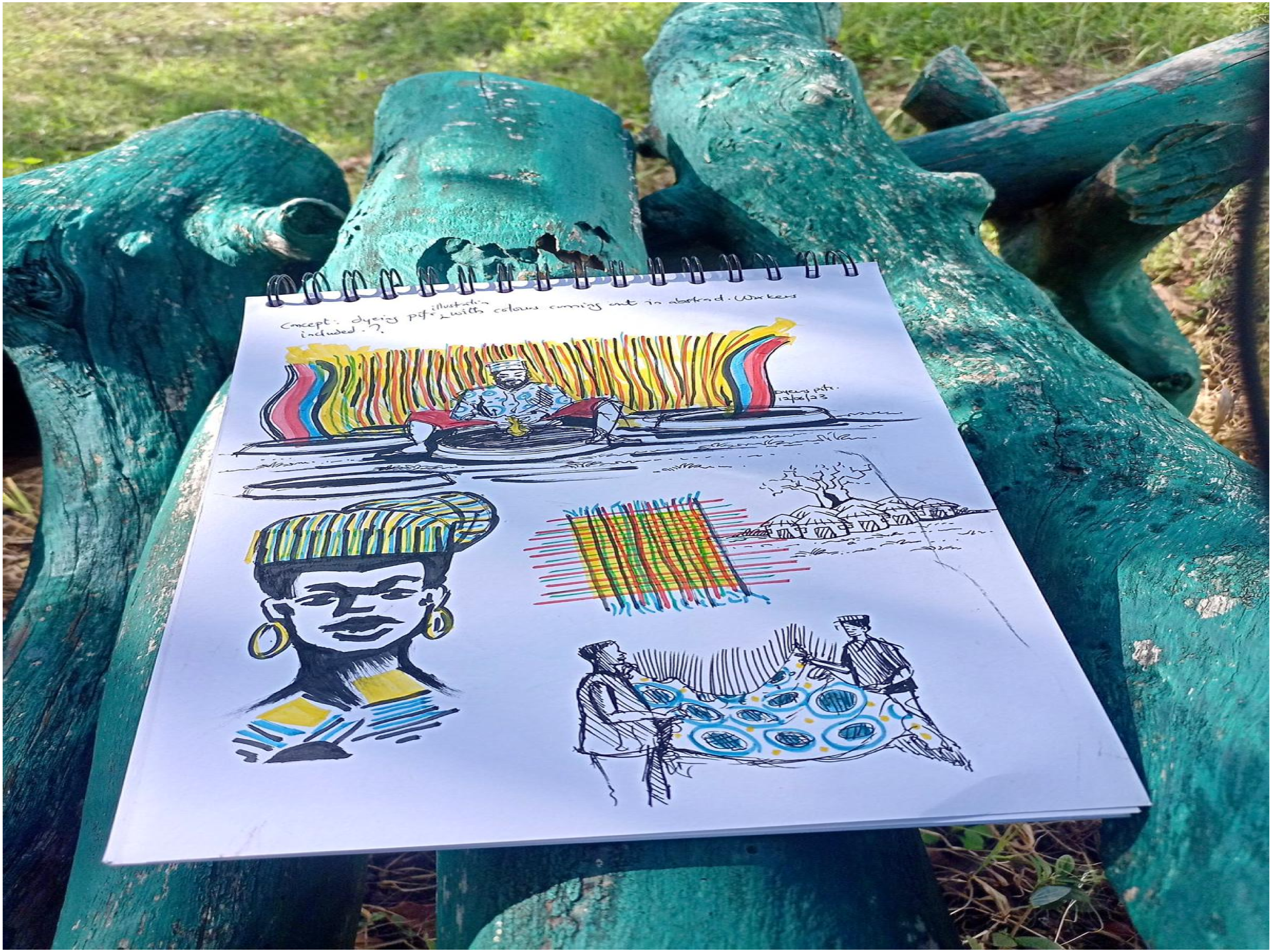

Stage 5 – Iterative Revision
Based on community feedback, visual designs undergo (substantial) revision, not just superficial adjustments but often complete reconceptualization if need be. This iterative process may repeat multiple times until community members confirm that representations accurately reflect their knowledge. In our case, we undertook iterative revision based on feedback, involving an iterative process of co-illustration through further community engagement with knowledge holders. The initial visual designs/illustrations underwent revisions until community members confirmed that representations accurately reflected the true meanings and cultural values. For instance, the ‘Hats’ illustration evolved from a simple depiction of headwear styles to a complex representation of social hierarchies embodied in hat positioning and the different cultural structures showing levels of authority. Also, the periodic studio visits and discussions provided some opportunities for real-time collaborative revision and any additional details that needed to be considered. This engagement created opportunities for dialogue between weavers, community members and local schools, providing additional context for understanding weaving’s social significance. Following this, five final illustrations were created depicting the complete weaving process from cotton sourcing and dyeing to the finished textiles being worn, each capturing both technical processes and their cultural significance within Northern Ghanaian weaving traditions.
Stage 6 – Community Ownership and Use
The final stage ensures that completed visualisations serve community needs rather than merely academic interests. This involves not just final approval from knowledge holders but collaborative development of strategies for using the documentation within and beyond the community. In the Loho community, the completed artworks now reside at the Nubuke Foundation Centre for Clay and Textiles, where they serve multiple functions simultaneously (see Figure 6). The artworks were also showcased in open studio sessions, which attracted over 500 visitors and as part of 2023 Woori Festival, which featured a range of activities, including educational workshops and art exhibition. This provided a platform for community members to share their knowledge with broader audiences. As observed during follow-up visits, these visual narratives function as reference materials for practicing weavers, artists, visitors, students and cultural heritage for the community. For instance, community members gathered around the artworks, using them as focal points for (intergenerational) discussions about weaving traditions and their cultural significance. Some of the artworks displayed at the Nubuke Foundation centre for visitors to see and use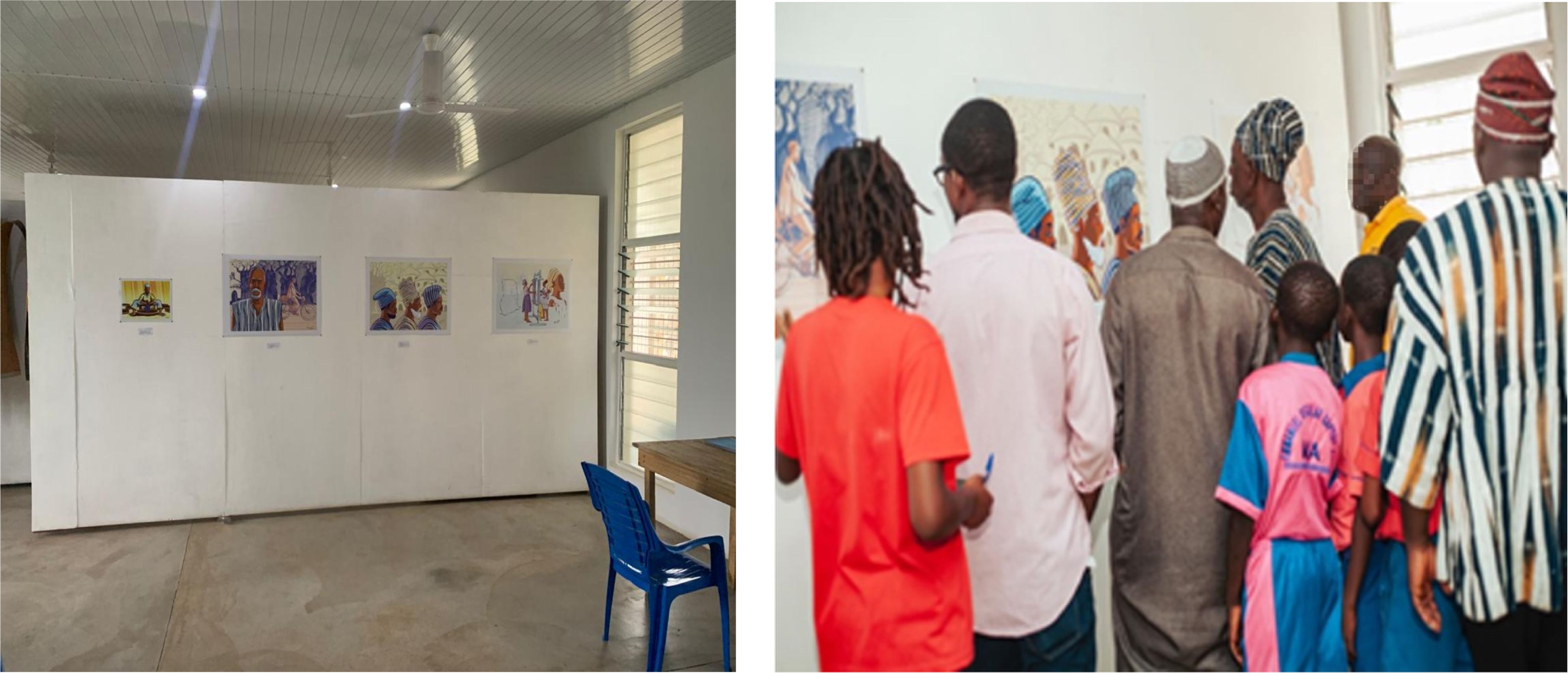
Weaving Narratives and Storylines – Case Study
To Weave a Story, Weaving Traditions: The Case of Woori
In this section, we convey the history and co-created stories of weaving traditions through the lived experiences and life histories of weavers and community members. We retain the texture of storytelling and engagement to create an understanding of how personal weaving stories and the practices in which they are enacted are shaped by wider cultural and social changes. As will be shown through each stage in Figure 7 and all the illustrations, from cotton collection to the wearing of finished textiles, we discuss how Northern Ghanaian weaving traditions reveal complex knowledge systems, that connect to cultural identity, beliefs, technical practices, and social bonds across generations. To weave a story: The story of weaving from harvesting cotton, dyeing, sorting out threads, weaving on the wooden loom, sewing and then the end product which is the smock being worn. This is a more traditional approach to weaving. The concept was to arrange the artwork in a way reminiscent of Egyptian pictorial hieroglyphics to tell the process of weaving as a story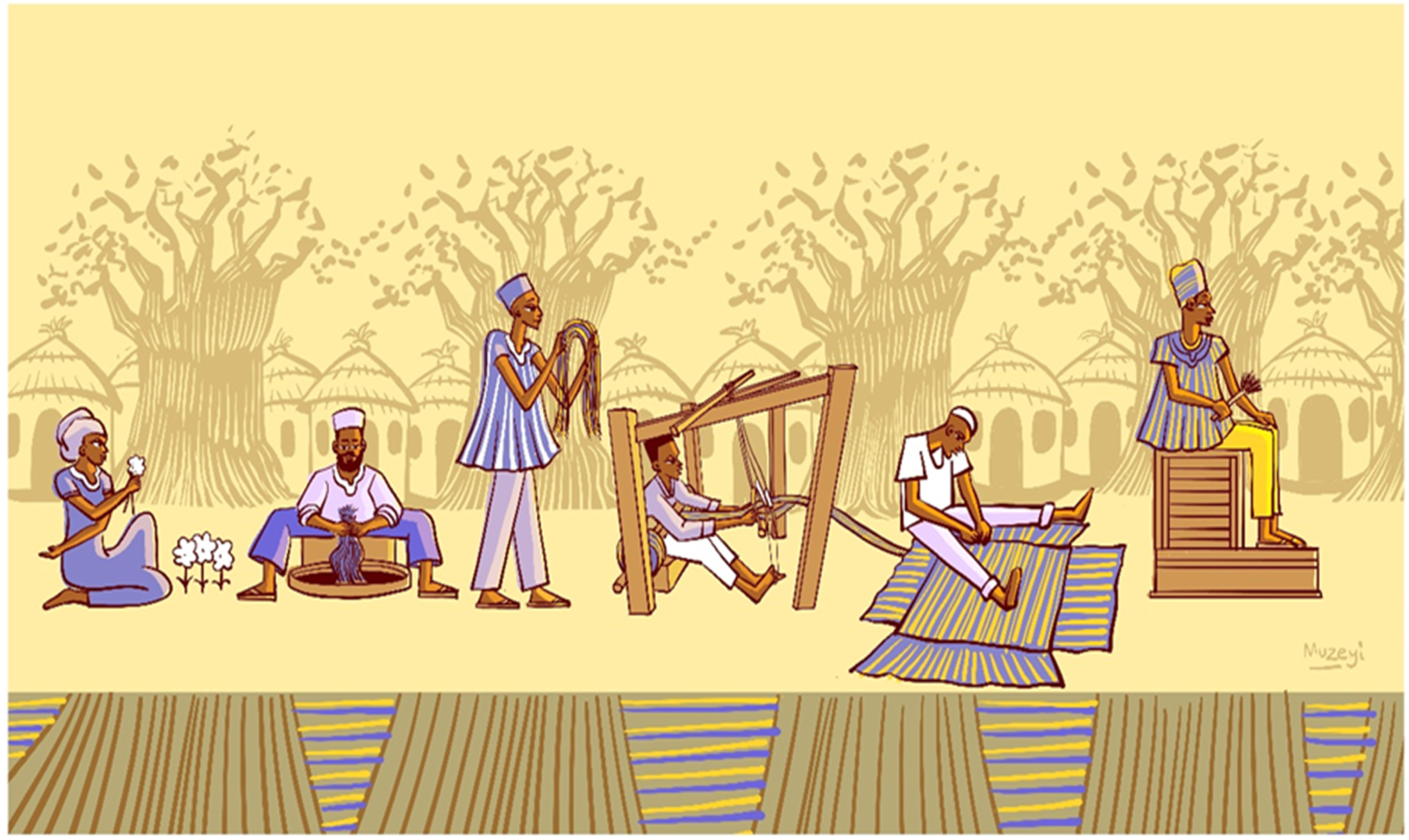
Histories of Cotton Sourcing and Weaving Journeys
The journey of cotton through Northern Ghanaian weaving traditions begins far from the loom. In the Loho community, the procurement of quality materials represents both a physical activity and a cultural journey embedded in generations of practice. This was discussed or narrated in two main ways.
First, weavers described how physical journeys and social relationships sustained their (cotton) material sourcing practices. When asked about the source of cotton, Mr. Karim Mahama, a master weaver (see Figure 8) explained with evident pride: “I used to set out to Wechaiu early morning. I remember once going to Wechaiu with a man to buy white threads who couldn’t ride a bicycle well. When we got to Dorimon [on our way back] I put him and his bicycle in a bus [lorry] and rode to Wa.” In discussing this, it was explained that each journey was not simply about acquiring materials, rather it was also about maintaining relationships with spinners who understood exactly how the threads were and prepared for our traditional designs. In their narrations, weavers consistently emphasised how these arduous journeys were never merely practical necessities but represented the continuity of cultural knowledge and the maintenance of social bonds that have sustained weaving traditions for generations, and most importantly ways of getting quality cotton. A portrait of K. M., known as “Daboya Man” donning his smock that was made with traditionally spun cotton threads. He is also represented on a bike as a nod to his days riding his bicycle all the way from Wa to Wechau to source cotton which he then gave to local cotton spinners before he sent the threads to Daboya to be dyed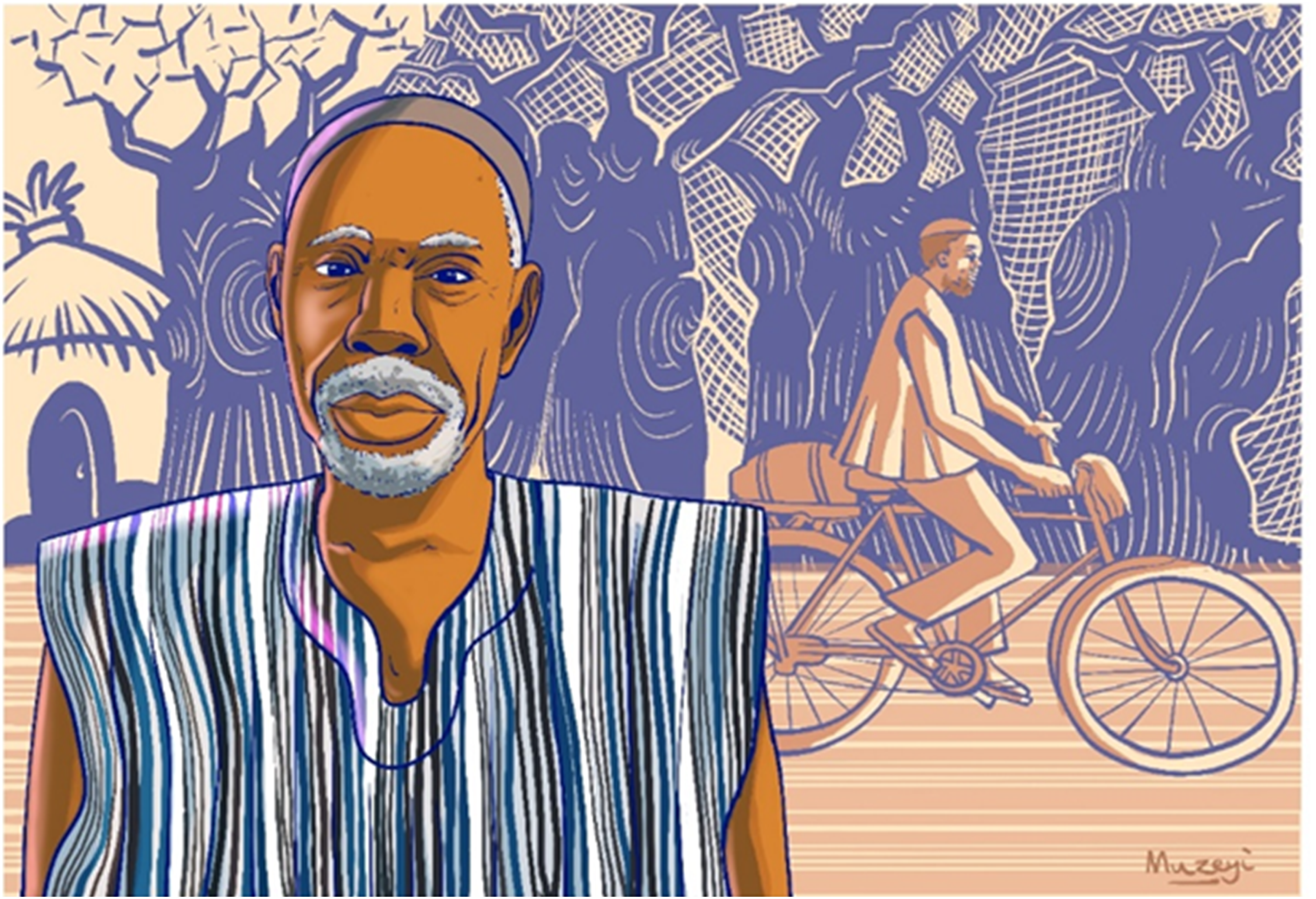
Second, weavers also noted how their embodied knowledge guided their assessment of material quality and selection processes, both in the past and in current practices. For instance, in the discussions with Mr Mahama, he revealed that weavers in Wa had intimate knowledge of different cotton varieties. This material literacy extends throughout the weaving community of Northern Ghana, with weavers offering particularly insightful observations on material quality. For instance, in terms of (yarn) thread characteristics, he emphasised the tactile difference of quality based on the material weight and sometimes texture: “The locally spun thread (Waala thread) is heavy, but the factory-made ones aren’t that heavy.” This simple distinction encapsulates generations of embodied knowledge, which also reflects forms of deep cultural values tied to material authenticity. His clear preference was evident in his statement: “Back in the day, we didn’t like the factory-made yarns, there were not even there…….” Also, relatedly, the account of maintaining relationships with specific suppliers reveals how material sourcing was embedded in social networks that sustained traditional craft practices: “I had a lady at Dondoli who I bought the threads from every 2 weeks.” These relationships were central for maintaining quality, as craftspeople recognised that different materials carried different properties that would ultimately affect the final textile.
In all of these, the physical journeys described by weavers also reveal changing patterns of mobility and trade. Where once weavers would travel for days to source materials, new transportation networks have altered and improved these traditional patterns. Yet, as several knowledge holders/experts noted during narrations, the relationships built through these journeys continue to influence how materials are sourced and valued and from where. In one of the discussions, one of the chief weavers described how modern roads now trace the paths they once cycled and how they can now order these materials to be delivered via vehicles, though some still choose to make the journey (via vehicles) in person when possible.
Dyeing Processes
The transformation of raw cotton into vibrant threads is traditionally associated with the famous dyeing wells of Daboya (Asinyo et al., 2021). While weavers in the Loho community (and Wa municipality) rarely travel to Daboya to dye their threads (or dye at all), many maintain strong attachments to the dyeing techniques and cultural significance associated with these wells. As observed during fieldwork, some practitioners in Wa have adapted and refined these methods for local use while still referencing the Daboya tradition as a cultural touchstone.
Some weavers also explained the regional significance of the Daboya dyeing tradition. They noted the fact that knowledge of Daboya dyeing is respected throughout the region. Even when people dye locally, it was argued they followed the same or similar principles that were used at the Daboya wells, or others used the half-buried ground pots for dyeing. This mostly involves deep pits (5–12 feet) where cotton yarns are immersed in a prepared solution of indigo leaves (which is pounded into paste and allowed to ferment), wood ash, and other catalysts that are left for several days, creating the distinctive blue-black colours (see illustration in Figure 9). According to interviewees, the process (in the past) remained highly ritualistic, with practitioners often reciting prayers or traditional sayings at crucial moments in the dyeing cycle and each dye well belonged to a specific family or group. The deep indigo-blue tones from these traditional methods are particularly valued for their cultural significance and durability. Dyeing wells of Daboya: A depiction of the age-old tradition of dyeing local wool threads in similar to those done in Daboya
In recounting the process, for instance, the careful preparation of dye baths involves knowledge passed down through generations and attachments to these practices, with subtle variations in temperature, timing, and ingredients creating distinct colours. During our engagement, several weavers spoke of the Daboya wells with reverence despite never having visited them in person. The regional significance of Daboya dyeing for instance was further confirmed by Mr. Karim Mahama, known locally as the ‘Daboya Man’ due to his connections with the area. As he explained, “When it came to the three northern regions it was us [Daboya] who did that. When you go to Adgozume they weave there but they don’t do local dyeing.” This geographical specialisation created and still maintains a distinctive hierarchy in dyeing practices, with Daboya being particularly renowned for its Indigo-dyed threads, as he emphasised, “if the threads were dyed black, it was done in Daboya.” The superior quality of these dyes manifested in weavers’ willingness to undertake significant journeys to access them in the past: “We couldn’t dye it here in Wa because the dye here wore off after a while.” Such accounts from the 1990s reveal how the Daboya dyeing tradition maintained its cultural authority even as practitioners developed localized adaptations. However, it was also noted that the cultural continuity of dyeing in general faces significant challenges with most of these practices fading due to reduced interest and modernisations, as many people are now turning to factory dyeing and synthetic powders.
Sorting out Threads and Warp Preparation
After dyeing comes the crucial stage of thread preparation – a process demanding both technical precision and aesthetic judgment (see third image from your left on Figure 7). 2 In their narratives, weavers and some community members recalled how this activity in the past was communal in nature, where groups of weavers would gather under shade trees to assess, sort, and prepare threads before they reached the loom. In their detailed explanations of the process, weavers frequently described this stage as what one elder spinner termed “a conversation between our hands and the cotton.” 3 Throughout the Wa municipality for instance, weavers demonstrated specialised knowledge about thread tension, thickness, and compatibility, understanding which threads would work harmoniously together in the final textile.
During documentation sessions with two weavers, we observed that spinners would constantly test threads between their fingers, assessing strength and elasticity with subtle movements refined over decades of practice. This is because, per our analyses and as found in our field discussions, thread sorting in Northern Ghanaian communities carries its own cultural significance, as patterns and colour combinations often reflect family traditions or regional identities. As one weaver explained: “the way they arrange yarns before weaving tells you where we come from, who taught them.” These initial arrangements prefigure the patterns that will eventually emerge on the loom which to some, carried cultural codes recognisable to knowledgeable observers, weavers or community elders. These ‘technical’ aspects of thread preparation are also inseparable from their cultural meanings, this is because the way threads are grouped becomes a statement about community identity, while the quality standards maintained reflect deeper values regarding craftsmanship and respect for materials. However, similar to what is also reported in other regions (Afriyie et al., 2023; Seidu et al., 2017), it was found that the use of traditionally spun cotton in weaving and hand-spun yarns is not common nowadays (and disappearing) because the process is laborious and weavers prefer just buying factory-manufactured threads. As Daboya Man lamented: “As we sit here it’s only two women who can do this. If there are others I don’t know them. It will come a time where it’ll be hard to find these threads because no one is learning and the technique is disappearing.”
Weaving on the Wooden Loom or Not
The weaving process itself represents the culmination of all previous stages, bringing together materials, knowledge, and cultural expression on the loom to make the fabric. Across the discussions, we found that weavers’ design patterns, even for looming techniques, drew from multiple sources such as client specifications, environmental observations, unexpected creative encounters, and knowledge exchange with other practitioners. In terms of looming, we documented two distinct weaving traditions that coexist in the Loho community, namely the traditional horizontal loom used by most weavers and the standing loom used or introduced by Charlotte Aweh from Benin, which was the focus of this paper due to its uniqueness and cultural significance.
Throughout, traditional horizontal looms (see fourth image from your left on Figure 7 4 ) were observed as one of the commonly used looms. These methods, deeply embedded in Northern Ghanaian weaving culture (Afriyie et al., 2023; Asinyo et al., 2021), allow for specific tension patterns and rhythmic weaving movements that have developed over centuries. Here, observations of weavers at their work revealed the full-body engagement required by the craft, and the use of different related accessories. In traditional loom settings, due to different styles and accessories, weavers also develop specific (bodily and) physical rhythms that synchronise with the loom’s operation. These embodied techniques represent what one master weaver described as a skill and knowledge that lives in “their hands and feet, not just their minds.” Indeed, the practices (i.e. the social choreography) around the looms also carries cultural significance and meanings. For instance, at different training shops or spaces observed and as recountered throughout Wa, it was noted that apprentices learn by watching and doing, and are most times positioned at specific distances from master weavers.
Another interesting and unique case, as illustrated in Figure 10 was the standing loom used by Charlotte Aweh, who moved from Benin to Ghana. In her narrations of the ‘Charlotte process’ and as noted in the illustrations (see Figure 10), she explained how her technique differed from local methods and even how her patterns were adapted by incorporating local threading methods with her Benin weaving style, creating a distinctive technical syncretism that enhanced traditional Northern Ghanaian designs. The technique involves standing while weaving, which allows for different body positioning and loom control compared to the traditional sitting position. As she explained: “In Benin, I grew up watching weavers work on standing looms. When I came to Wa, I saw only the traditional sitting looms.” However, she noted that, for certain patterns and techniques, the standing loom offers advantages. Her workspace functions as a space where different technical traditions encounter and transform each other. “Every weaving community has its secrets…” Charlotte reflected during a late afternoon discussion and explained that the art is not in keeping these secrets, but in learning how to share them, how to let them grow. Charlotte’s process: Portrait of Charlotte Aweh a local weaver in Wa and her work process using the standing loom. She’s possibly the only weaver using this weaving method in the Wa-Loho community and its environs, a weaving method she saw growing up in Benin
While maintaining the standing loom style, our discussions and observations pointed to fascinating insights, such as how she incorporated some of the locally established threading methods and tension techniques with her new looming style, so as to highlight the weaving/technical syncretism in Northern Ghanaian patterns. Indeed, these adaptations also emphasise the non-static nature of traditional craft practices and instead reveal how skilled practitioners or craftspeople actively negotiate and synthesise different knowledge systems to expand their creativity (Asinyo et al., 2021; Fetzer, 2025).
Sewing and Final Products: The Cultural Life of Smocks
The final stages of production transform woven strips into functional garments, most notably the iconic smocks that feature prominently in Northern Ghanaian cultural life. The assembly of smocks requires specialised knowledge similar to the weaving itself, and can be grouped as hand-sewn, machine-sewn or hand and machine-sewn smocks. In multiple instances, strips were observed being matched and sewn with precise tension to create garments. One of the weavers recollected how in the past, older community members or practitioners would often offer critique, ensuring that garments maintained traditional proportions and construction techniques even as designs evolved.
Across the narratives, it was found that the hand-sewn ones are seen as more authentic, heavy and have much more cultural significance than machine-sewn ones: “handmade ones carried the spirit of smock more than the machine” (Interview, Wa; Also see Second image from the right on Figure 7). This preference for traditional methods is exemplified by Mr. Karim Mahama, as shown in Figure 8, who is shown donning his smock made with traditionally spun cotton threads. These garments tend to be of higher quality, evident in their heavy weight, though this also makes them more costly as they are laboriously handmade through such processes. Indeed, consistent with findings across northern Ghana, it was noted that the value of the smock is not always considered in terms of physical qualities alone, such as the colours used in weaving, but rather its aesthetic significance (Acquaah et al., 2017), meanings and authenticity (Afriyie et al., 2023). When discussing completed garments, many consistently emphasised their communicative function. Examples included the patterns of the lining, the heaviness of the garment as noted earlier, and how smocks or hats were worn (also discussed in the next section).
In community and follow-up discussions, these sartorial codes created a visual language immediately legible to community members. The positioning of a hat, the pattern choices in a smock, or the colour combinations selected all communicated information about the wearer’s status, role, and even personal characteristics. Mr Mahama and other members explained during detailed discussions, noting how finished textiles also carry deep cultural heritage through their patterns, with certain motifs referencing historical events, proverbs, totems or spiritual concepts. For instance, the smock known as the ‘suntaala’ was traditionally worn for war or by those going to war.
Beyond their practical functions, these textiles hold profound cultural significance. Community members revealed how specific textiles were required to properly mark occasions, with each design element carrying its own cultural meanings. Some community elders described how certain garments are preserved for generations, passing from elders to younger family members along with the stories embedded in their patterns and construction. For instance, whilst there may be some flexibility in usage, ‘black and white’ smocks are generally reserved for the elderly, whilst colourful ones are more commonly worn by the young (Interview, Wa). Additionally, smocks decorated with cowries and pebbles are specifically reserved for traditional leaders or respected people, such as chiefs or spiritual leaders or who they termed as ‘neber3.’ Overall, these traditions ensure that each completed garment carries forward the stories and values embedded throughout the weaving process, in ways that transform raw materials into cultural artefacts that embody the full complexity of Northern Ghanaian heritage. In addition to their cultural functions however, weaving also serves commercial purposes across the community, with weavers serving both local clients within Loho and the immediate and external customers from Wa and surrounding areas. Some also participate in regional trading networks that extend to areas like Tamale and Bolgatanga. Indeed, Nubuke Foundation, through their work, has also continuously offered opportunities for weavers and has facilitated connections with clients and customers, and has created pathways for greater recognition and reach of these smocks to other areas such as Accra and beyond, including the diaspora.
The Way of the Hat: Status, Power and Social Hierarchy
The hat is part of the smock that is usually worn to complement the outfit. Woven hats and how they are worn serve as powerful symbols of social position and hierarchy. Throughout the discussions and engagement, these accessories function as markers within a visual language of social relations, instantly recognisable to those who understand local cultural codes. These insights informed the ‘Hats’ illustration, which emerged through dialogue with weavers and community elders about authentic representation of these social hierarchies.
The ‘Hats’ illustration (Figure 11) captures this complex social choreography through a triptych design showing three key positions: the chief’s elevated angle, the herald’s forward tilt, and the princely/royalty positioning. In their narrations, elders emphasised the cultural significance of hat positioning as a form of non-verbal communication: “The angle must be exactly right,” insisted one elder whilst demonstrating with his own hat: “If the hat is too high or too low, it changes the whole meaning.” Each position carries precise social significance that community members learn to read and respect from childhood. From the left (in Figure 11), we have a character wearing his hat tilted to the back, representing a follower of a chief and a ‘Nabie’ (Prince) – one with royal blood who perhaps has the opportunity of becoming a chief one day. He naturally protects his chief. In the middle of Figure 11 is the chief, whose elevated hat position symbolises a unique relationship with higher powers and responsibilities. The chief’s hat sits high on the head, angled slightly backward – a physical manifestation of looking upward to divine guidance whilst remaining grounded in earthly duties. This positioning is reserved exclusively for those with recognised chieftaincy status, with improper adoption considered a serious breach of protocol and known ways of doing. The colours are purple and gold/yellow, which are also royal colours. The character on the right has his hat pointed forward because he leads the way for the chief. Such individuals represent the herald and protector of the chief and lead the way wherever the chief goes. It shields his eyes as he looks ahead for danger and marks him as someone with the spiritual protection needed to go first. This positioning, therefore, connects with specific ritual responsibilities typically earned through demonstrated practical skills and spiritual knowledge. Hats: This is a representation of the hierarchy of royals and their subjects through the way they wear their woven traditional hats as per the tradition of the Northern tribes of Ghana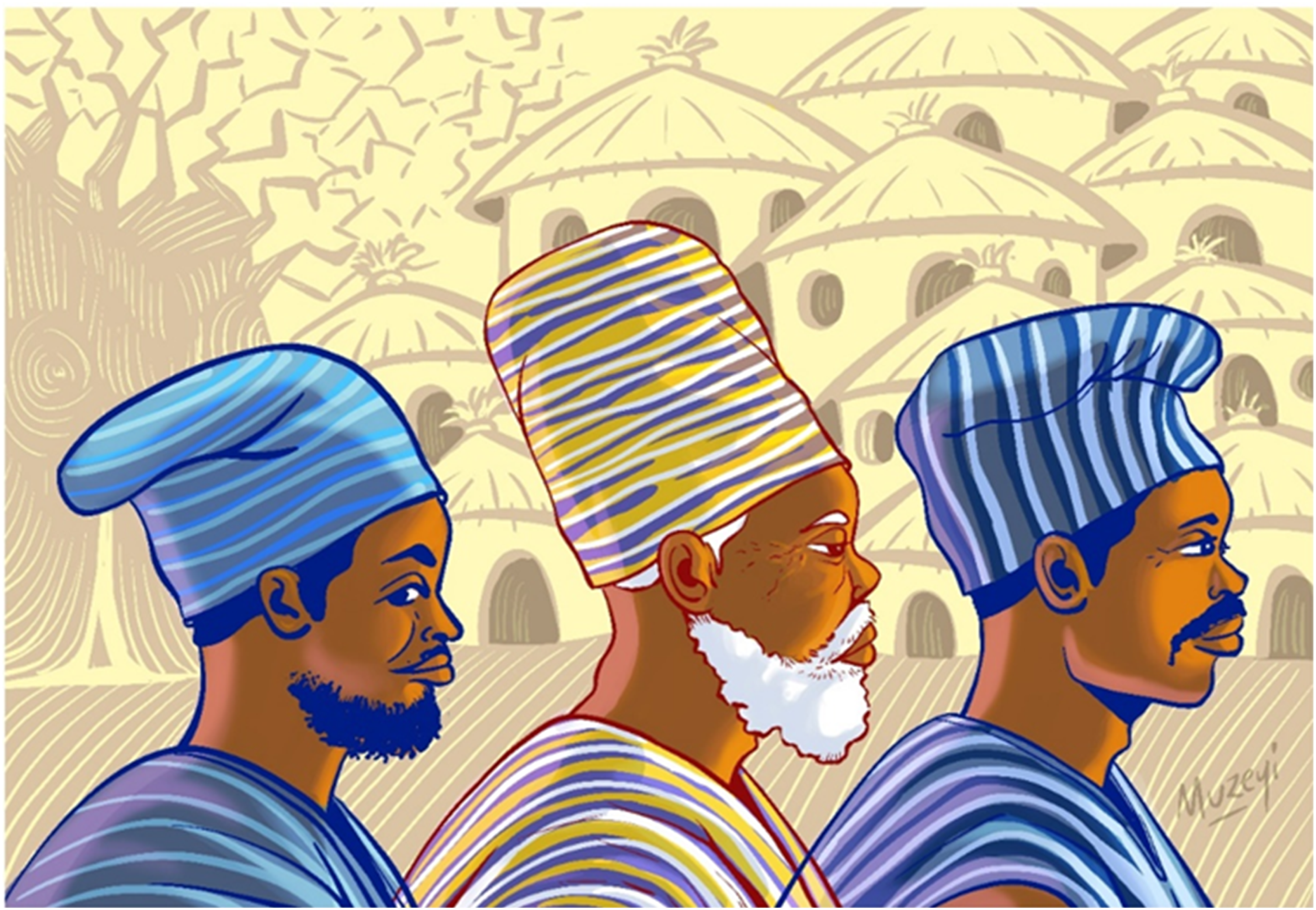
Beyond these cultural nobility (royalty) and hierarchical contexts, hat positions also create a visible matrix of social relationships that structures everyday community interactions through subtle signals of authority, responsibility, and deference. In events and gatherings, momentary hat adjustments serve as micro-signals of recognition when individuals of different social standing encounter one another, and as ways of maintaining community hierarchies through embodied practice rather than verbal assertion. When tilted to the left, for instance, the hat signifies friendliness and that one ‘belongs to everybody,’ showing openness to people of all ages. Also, when hats are pulled to the side or flattened, it refers to what locals’ term ‘respect positioning.’ In everyday practices, younger men and those without ceremonial roles consistently adjust their hats this way when in the presence of chiefs or elders. One young man clarified during an informal exchange: “When we push our hats down or to the side, we show we know our place. It’s not about being less important - it’s about showing respect for the order that keeps our community strong.”
Despite modern influences in various contexts, these hat-wearing traditions remain key and prevalent in most traditional and culturally ‘sensitive’ settings, demonstrating their continued relevance in contemporary social life. As one young weaver noted during a follow-up conversation about changing fashion, even when everything else changes, the way hats are worn keeps community members connected to who they truly are and most importantly, how people know their traditions. Through careful positioning of a single garment element, community members navigate complex social terrains, in ways that communicate respect, authority, and belonging without speaking a word.
Weaving Tensions and Preserving Knowledges
Throughout our engagement across the project and as also noted in some aspects above, one key theme we observed was the tensions between traditional and industrial textile production methods due to the increasing availability of factory-made materials and synthetic alternatives. These tensions manifested in various ways, for instance in weavers’ clear preferences for locally spun threads over factory-made alternatives, concerns about traditional dyeing techniques disappearing in favour of synthetic powders, and the shift towards machine-sewn garments despite their perceived lack of ‘spirit’ compared to handmade ones. For instance, Mr. Mahama’s distinction that the locally spun thread is heavy, but the factory-made ones are not, exemplifies how some weavers acknowledge the practical pressures from the seeming industrial homogenisation of these processes. In discussing these tensions and issues, some community members noted how recent curatorial works such as those by Nubuke Foundation, and most importantly, our current co-creating and storying approach (the VPS), were useful for documenting and preserving traditional knowledge that they feared might otherwise be lost to industrial alternatives and changing practices. It was explained that these illustrations told the weaving story well and reminded communities of key historical practices (Open studio session_July 2023).
Conclusion
In this study, we used stories as both method and data, drawing on Visual Participatory Storytelling (VPS) to document the rich weaving traditions of Northern Ghana. In the Wa municipality and Loho community, moving beyond artefact collection and what would involve visiting museums or pressure for material preservation, we demonstrated how visual documentation combined with community authority can capture the multidimensional nature of traditional knowledge.
In adopting this approach, this paper contributes methodologically to both creative research and (visual) design anthropology by proposing a structured yet flexible six-stage co-production framework that redistributes interpretive authority to communities throughout the research process. By positioning community members as knowledge holders and owners rather than mere informants, VPS reconceptualises the relationship between researchers, designers, artists and communities, and helps create space for more ‘authentic’ and decolonial knowledge exchange and representation. The VPS framework represents more than just another toolkit for researchers, scholars and designers or artists, but also acts as key methodological reference whose structure deliberately disrupts conventional research hierarchies that have historically positioned communities as data sources rather than knowledge authorities. For instance, it was our aim to prevent the instances where researchers go to communities, take pictures, write things down, then leave, without communities ever seeing what is written about them, as reported in some jurisdictions in exploitative research (Schroeder et al., 2019). VPS responds to such critiques by creating multiple points of community intervention and ensuring that documentation serves community priorities. The deliberate cyclical structure of VPS, ending with community use that may identify new documentation needs, transforms research from a linear extraction process into an ongoing relationship. This structure acknowledges that traditional knowledge systems are living entities that continue to evolve, requiring documentation approaches that can grow alongside them. As seen in our case example, VPS also repositions the designer or artist or researcher as a (technical) facilitator whose expertise serves community representation goals, particularly through the creation of multiple feedback loops, from framing to ownership.
Additionally, our work contributes to cultural geography and heritage studies by highlighting how traditional craft practices like weaving represent complex systems of tacit knowledge exchange where technical processes and cultural meanings are inseparably interwoven. For instance, the co-created visual artworks now serve multiple functions simultaneously, such as reference materials for practising weavers and artists, educational resources for local schools and community members, and publicly accessible documentation through online platforms (e.g., Instagram) and the 2023 Woori Festival exhibition. Through our focus on five key thematic dimensions of weaving traditions, we also demonstrate how craft knowledge embodies not just technical expertise but cultural narratives, social hierarchies, and community identity. This understanding challenges conventional artefact-focused documentation and research that often separates objects from their cultural contexts and production processes, instead recognising communities as the true custodians of both their material and intangible heritage.
Despite the effectiveness and value of our approach, we do acknowledge that power dynamics between researchers and communities persist under current (conventional) neo-colonial research epistomologies, and requires continuous reflexive attention to positionality, relationship and ethics of care. Hence, future research should explore adaptations of VPS for diverse craft traditions and community research and also investigate how digital or visual outputs can be more systematically integrated into knowledge transmission practices within communities. Overall, VPS offers a promising framework for more ethical, inclusive, and holistic documentation of traditional knowledge systems that places communities as primary authorities in representing their cultural heritage and knowledges.
Footnotes
Acknowledgements
The authors thank the Nubuke Foundation for supporting and hosting the residency of the first author at the Nubuke Center for Textiles and Clay in Loho. Also, thanks to funding from the European Union, the support of the OACPS Secretariat – Organization of African, Caribbean, and Pacific States and Programme AWA that made the residency training of the first author possible. However, the views and opinions expressed are those of the author(s) only and do not necessarily reflect those of the granting authority. We are particularly thankful to the management and staff at the Nubuke Foundation and Edina Galaa for all their support. We also thank Berthy Kpiebaya for all her insights, suggestions, and support, as well as her informal conversations, which further enhanced this paper. Finally, we express our deep appreciation to Mr Karim Mahama, Charlotte Aweh, Talata Tutigah and all the other weavers, community members, smock sellers and students for their time and support during this project.

Funding
The authors disclosed receipt of the following financial support for the research, authorship, and/or publication of this article: This work was supported by the European Union, the OACPS Secretariat – Organization of African, Caribbean, and Pacific States and Programme AWA, through funding for the Artist's Residency at the Nubuke Foundation, Wa.
Declaration of Conflicting Interests
The authors declared no potential conflicts of interest with respect to the research, authorship, and/or publication of this article.