




Abstract
The benefit of survivor participation in human trafficking research is becoming increasingly recognised. Ethical and equitable relationships between qualitative researchers and lived experience experts rely on developing trust within the research team, yet literature on building trusting partnerships with survivor researchers is scarce. For survivors of labour exploitation and human trafficking, employment and workplace practices may reactivate traumatic memories, making it difficult to trust colleagues and supervisors. We conducted thematic analysis of reflexive journals, evaluations and group discussion recordings of our team’s lived experienced researchers. This was compared and thematically synthesised with a review of the literature which identified methods of control used by abusive employers. Aspects of professional behaviour that co-researchers identified as building trust were inversive to the coercive behaviours used to subjugate trafficked people. The data were drawn from the Modern Slavery Core Outcome Set (MSCOS) Project; a participatory study that identified and implemented into practice a set of core recovery outcomes for survivors of human trafficking. We provide best-practice recommendations for researchers working in partnership with lived experience experts, based on six trust-building domains designed to resist evoking memories of exploitation: holistic, strengths-based practice; non-hierarchical, reciprocal relationships; fair pay; transparency and dialogue; anti-oppressive practice; and recognising trauma and cultivating consistency. Our recommendations may also be pertinent to work with trafficking survivors in alternative settings.
Keywords
Introduction
There is growing recognition of the need for survivor leadership and involvement in anti-trafficking service delivery and research (Bush-Armendariz et al., 2018; Dang and Layden, 2021; Poo & Tracy, 2021). However, there is a dearth of literature detailing recommendations for building relationships with survivors of human trafficking as co-researchers. Having endured extreme forms of labour exploitation and violence, and with many navigating complex immigration procedures, trafficking survivors possess distinct vulnerabilities, strengths, and expertise (Dang and Layden, 2021; Lockyer & Koenig, 2022; Schwarz & Williams-Woods, 2022). These needs and qualities require careful consideration when building productive and trusting professional relationships.
While guidelines exist for effective support of survivors who access government systems or direct services (e.g., Human Trafficking Foundation, 2018; Jannesari et al., 2024; ODIHR, 2022; US Dept of Health and Human Services, 2020), these relationships are different in quality and purpose to those of professional research collaborations. Academic colleagues must be attuned to the risk of reactivating trauma in survivor co-researchers, particularly when prior trauma occurred in work environments. For trafficking survivors, employment relationships may have been violent, coercive, and disempowering. This interpersonal trauma may lead to mistrust in subsequent workplace relationships (Potter, 2020). The abuse experienced by trafficking survivors often involves extreme forms of control, with traffickers exerting pervasive and coercive influence over those they exploit (Preble, 2019). These power dynamics may shape survivors’ vigilance when engaging with individuals in positions of relative authority.
Research relationships can either foster healing or deepen harm, especially around survivors’ ability to trust (Godoy et al., 2025; Yea, 2016). Mistrust can limit participation and openness in participatory research (George et al., 2014; Owen-Smith et al., 2016). When experiences feel exclusionary, misrepresentative, or tokenistic, they may retraumatise participants and erode confidence in research processes (Godoy et al., 2025).
Trust is foundational in fostering reciprocity, collaboration and equity between peer researchers and the research team (Maiter et al., 2008). Despite its importance, trust-building in human trafficking research remains underexplored. Yea (2016) identifies respect, responsibility, reflexivity, and reciprocity as key principles, while Martin et al. (2022) highlight integrity, transparency, competence, vulnerability, and shared purpose in transdisciplinary survivor collaborations. Although participatory approaches are not always examined in terms of trust-building, benefits such as increased agency, narrative ownership, and survivor empowerment are well evidenced (Capous-Desyllas & Forro, 2014; Godoy et al., 2025; Keighley et al., 2023).
Survivors’ broader experiences of trust and distrust are well-documented. Survivors describe trust as a vulnerability that can be exploited, and highlight challenges in trusting others following exploitation (Rajaram & Tidball, 2018). Being trauma-informed, survivor-centred, consistent, non-judgmental, and having lived experience, were among professional characteristics described as enhancing trust (Contreras et al., 2016; Hemmings et al., 2016; Rajaram & Tidball, 2018). Across populations, trust is commonly associated with communication, shared power, reciprocity, transparency, integrity, and expertise (Dave et al., 2018; Evans & Krueger, 2011; Hamzeh et al., 2019; Mayer et al., 1995; Ozawa & Sripad, 2013).
This paper builds on intersecting evidence from survivor narratives and participatory research to examine the cultivation of trust within research relationships. Informed by the research team’s reflexive recordings, we recommend fostering workplace relationships that intentionally counteract exploitative past experiences that survivors’ distrust may be rooted in. We begin by deconstructing mechanisms of control known to be used by exploitative individuals and structures in situations defined as human trafficking or modern slavery. In response to divergent interpretations between survivors and academics regarding the drivers of human trafficking, this paper foregrounds both the individual actions of traffickers and the structural role of state policies and practices that enable or facilitate labour exploitation. State complicity in creating conditions conducive to exploitation can contribute to deep-seated mistrust toward institutions and authorities (Alfano & Huijts, 2020; Magugliani et al., 2024).
We examine how the Modern Slavery Core Outcome Set (MSCOS) project fostered relationships grounded in values that deliberately resisted actions typically associated with exploitative individuals and systems. The analysis also acknowledges challenges in preventing the replication of exploitative dynamics and identifies areas where the project was less successful in doing so.
A Summary of the MSCOS
The Modern Slavery Core Outcome Set (MSCOS) aimed to determine what recovery outcomes were desired for survivors post-trafficking, by consulting experts in the field (Jannesari et al., 2024). The research team consisted of academic researchers, co-researchers with lived experience, and direct service practitioners.
The MSCOS project used E-Delphi methods to identify recovery outcomes. A list of seven were selected by identifying outcomes in existing literature, interviewing survivors, holding exploratory workshops with survivors and stakeholders, then narrowing down the list via three rounds of voting (Jannesari et al., 2024). The project design drew from the principles of participatory health research. It was informed by the Survivors Voices Charter, which advises creation of “intentional space for dialogue… with survivors’ voices as a key input, allowing them to be the ‘experts by experience’” (Survivors Voices, 2018). We were also guided by trauma-informed care principles (SAMHSA, 2014).
Survivor voices were prioritised throughout the project by assigning greater weight to their perspectives in the E-Delphi exercise, exploratory workshops, and supplementary interviews. Nine co-researchers collaborated with the research team—two in embedded roles within the academic team, and six as members of a lived-experience Research Advisory Board. Survivors also comprised over one-third of participants in the exploratory workshops. The MSCOS project and this paper were supported by the AHRC (AH/V012932/1).
Methods
The data informing this paper were drawn from multiple sources: the lead author’s reflexive research journal, video recordings and minutes from Survivors’ Research Advisory Board (SRAB) meetings, team reflexivity notes, and evaluative feedback—both video-recorded and written—from lived experience and academic researchers. Discussions and meetings involved up to eight MSCOS SRAB members, the post-doctoral researcher, and the principal investigator. Co-researchers responded to structured prompts regarding project improvement, including whether it fulfilled its survivor-focused aims, how retraumatisation might be avoided, and whether participants felt meaningfully included. Unstructured dialogue was also encouraged.
Data were reviewed and selected for analysis using defined inclusion and exclusion criteria. Content was included if it evaluated or advised on relationship-building or workplace practices that influenced trust—either positively or negatively. These data were analysed using reflexive thematic analysis and subsequently grouped into domains. Reflexive analysis was employed to mitigate limitations, particularly the potential for researcher bias due to the analyser’s dual role as data contributor and lived experience researcher.
During analysis, it was noticed that the SRAB members’ descriptions of their desired treatment often stood in stark contrast to their accounts of exploitation. In recognition of the ethical imperative to avoid retraumatising co-researchers, we chose not to pursue detail about the behaviours of their abusive employers. Instead, we explored this dynamic through a narrative review, focusing on documented coercive strategies leveraged against trafficked individuals.
Literature was identified between April and July 2024 through searches in PubMed, Scopus, PsychInfo, and Google Scholar, using a combination of broad terms including human trafficking, coercion, control, and manipulation. Reference lists of key studies and NGO reports identified in the search were also reviewed.
The inclusion criteria were. 1. 2.
Given the narrative design, this review is intentionally selective rather than exhaustive, offering an interpretive synthesis of the available literature. A narrative approach was chosen for its capacity to integrate diverse empirical sources and its suitability for identifying a range of coercive control strategies, rather than quantifying their prevalence.
The literature on methods used to control and coerce trafficking victims remains limited, underscoring the need for further empirical research and subsequent systematic review. Notably, certain forms of exploitation—such as organ trafficking, the recruitment of child soldiers, and forced marriage—were underrepresented, while accounts from sex trafficking survivors and exploited domestic workers were disproportionately prevalent.
A Note on Language
The terminology used in this paper reflects a commitment to valuing expertise gained through academia, lived experience, and direct service equally. We intentionally use the terms academic researcher and co-researcher to acknowledge lived-experience experts as researchers in their own right. Their contributions, skills, insights, and leadership were as indispensable to the project as those of academics. These terms, however, are not without their drawbacks; some co-researchers may also wish to have been viewed as academics, and differentiating between researchers in this way infers a hierarchy of roles.
This paper adopts a ‘spectrum of exploitation’ perspective on human trafficking (O’Connell Davidson, 2010). It is difficult to draw a definitional boundary between trafficking and other types of abuse and exploitation, given the overlapping and context-dependent nature of these experiences. We use the term ‘human trafficking’ with full awareness of its contested and problematic nature—recognising its widespread use in legal and policy discourse, yet its limitations in capturing lived realities. For many survivors, the decision to enter into what is legally defined as trafficking may reflect constrained choices within complex postcolonial, gendered, and class-based contexts.
While trafficking is often traumatic and life-altering, for some, it may represent a less harmful alternative to the conditions they are fleeing (O’Connell Davidson, 2015). Similarly, traffickers are not a monolithic group: some engage in exploitation as a means of survival in precarious circumstances, or perceive themselves as offering better options to those in desperate need. Others act with deliberate cruelty and interpersonal violence. Many occupy ambiguous positions along this continuum (Broad & Gadd, 2022).
Methods of Control Used in Human Trafficking and Labour Exploitation
Although human trafficking is difficult to distinguish from other types of exploitation and abuse, it is possible to identify methods of control used by exploitative employers in situations identified as human trafficking in the literature. This section synthesises the results of a narrative review which researched the behaviours of abusive employers in situations defined as human trafficking. We also considered related structural traumas that may impact on survivors’ relationships with work.
Dehumanisation
Humiliation was used by traffickers to weaken the resolve of victims by lowering their self-worth. This included the use of physical violence, verbal degradation or manipulation of sociocultural constructs of shame and dishonour. Victims were often forced into humiliating sexual acts or subjected to name-calling and demeaning language (Baldwin et al., 2015; Ioannou & Oostinga, 2015; Verhoeven et al., 2015). Survivors’ human agency was systematically undermined through denial of knowledge about their rights—such as entitlement to minimum wage or protection from workplace hazards—that could have supported informed decisions about escape. Rather than being recognised as individuals with ideas and beliefs, their value was reduced to utility and profitability (Ioannou & Oostinga, 2015). Basic human needs were also denied, including access to medical care, adequate food, hygiene, and sleep (Baldwin et al., 2015; Doychak & Raghavan, 2020; Yoder et al., 2024). These dehumanising tactics not only induced psychological powerlessness but also contributed to physical deterioration (Preble, 2019).
Authoritarian, Intimidating and Controlling Behaviour
Traffickers were described as using multiple authoritarian tactics to restrict choice and freedom of movement. Workers were subjected to high levels of surveillance, such as being constantly observed by abusive pimps, domestic employers or supervisors, and strict micro-regulation (Baldwin et al., 2015; Doychak & Raghavan, 2020; Ioannou & Oostinga, 2015). Little freedom was afforded to victims in deciding when, how, where or in what manner they would work. Violence, threats, and psychological manipulation were used to instil fear and ensure compliance (Chisholm et al., 2024; Ioannou & Oostinga, 2015; Preble, 2019; Verhoeven et al., 2015). Control of movement was common either through confinement in locked premises, or through violence and psychological abuse (Reid, 2016; Verhoeven et al., 2015).
Financial Control
Traffickers controlled workers’ finances through taking the majority or entirety of their earnings. They attempted to justify this by claiming unreasonable and increasing levels of debt incurred through travel and/or living expenses, or by claiming control of money as a relationship right or compensation for protection (Ioannou & Oostinga, 2015; Verhoeven et al., 2015; Yoder et al., 2024). Spending was monitored and restricted, and victims were forced to work excessive hours (Verhoeven et al., 2015; Yoder et al., 2024).
Silencing and Deceit
Workers were deceived through false promises. They were misled about the type of work, conditions, rate of pay, or the nature of their relationship to the trafficker. Control of access to outside information resulted in ‘monopolisation of perception’: some knew little of the world beyond the confines of their workplace, so rarely encountered information that contradicted the viewpoints imposed by their traffickers (Biderman, 1957, in Baldwin et al., 2015).
Traffickers sometimes ensured victims’ silence through the deceptive use of rituals and oaths. Spiritual and religious practices, for some, were manipulated to convince workers that consequences would occur should they disobey or speak out against their abusive employer (Chisholm et al., 2024). Other methods of silencing included preventing workers from learning the language of the country of residence, and being ordered not to speak about their work (Verhoeven et al., 2015; Yoder et al., 2024).
Targeting Existing Oppressions
Victims were frequently targeted when in precarious situations, or because of belonging to a minoritised and/or persecuted group (Preble, 2019; Reid, 2016; Yoder et al., 2024). Undocumented migrants and refugees were said to be easier to exploit because of their irregular immigration status or lack of right to work (Yoder et al., 2024). People who were in economic difficulty reported accepting poor pay and conditions because of a lack of alternatives (Preble, 2019; Reid, 2016). Men were said to exploit female sex workers by taking their wage on the basis that they were providing ‘protection’ from a heightened risk of gender-based violence, but would withhold all earnings and act violently towards the worker themselves. A lack of alternative options made people experiencing homelessness, drug dependencies, and/or mental health problems easier to control (Reid, 2016).
Trauma-Coerced Attachment
Similarly to domestic violence, trauma-coerced attachment was used as a means of psychological control (Doychak & Raghavan, 2020; Reid, 2016; Verhoeven et al., 2015; Yoder et al., 2024). Workers described being drawn into a false sense of security through traffickers deceptively presenting as trustworthy; with some ‘love bombing’ victims by giving excessive gifts and compliments in the early stages of a relationship, before using violence and psychological manipulation. Traffickers then created continued dependency through isolating workers and cycling between affection and kindness, and punishment and brutality (Baldwin Fehrenbacher & Eisenman, 2015; Reid, 2016; Verhoeven et al., 2015; Yoder et al., 2024). Access to children and family was also limited, creating greater reliance on abusive employers (Yoder et al., 2024).
“Re-Centring the State”
Critical research has highlighted the similarity between coercive and controlling behaviours adopted by traffickers and actions of states towards migrants, colonised peoples, and other marginalised groups. Scholars argue that it is impossible to draw definitional boundaries which separate trafficking from other types of exploitation, such as worker exploitation under capitalism, the unpaid domestic labour of women, and postcolonial conditions which leave people with no choice but to accept low pay and dangerous working conditions (Brace and O’Connell Davidson, 2018; O’Connell Davidson, 2015). Most co-researchers in the MSCOS project identified states and the effects of colonialism as playing at least as much of a role in their exploitation as individual traffickers.
State structures may imitate the coercive methods of traffickers through migrant surveillance and control, and visa or work restrictions. For example, UK domestic worker immigration regulations now bind a person to their employer, who must continue as their sponsor in order for them to remain in the country legally (Home Office, n.d.). Survivors in the asylum system may be denied work or be restricted to certain types of employment (Home Office, 2024). Those classed as ‘vulnerable’ to trafficking are often made vulnerable by the dehumanising actions of states: through being criminalised as migrants or sex workers; being treated as if their contributions to society are less valuable as women; or being put at risk by insufficiency of services that support young people in poverty or local authority care. Akin to individual traffickers’ cycling between kindness and cruelty, governments may provide refuge and safety while placing restrictions on freedom and causing migrants to live in fear of rejection from the sheltering state.
Global economic systems additionally create an environment which favours ‘wage theft’ by corporations to maximise profits, often at the expense of worker safety and wellbeing (Harkins, 2020). The extraction of resources and the exploitation of workers in the Global South by global north countries maintain hierarchies of power and wealth. As such, critical theorists consider trafficking to be part of a broader phenomenon of neo-/postcolonial capitalist exploitation (Brace and O’Connell Davidson, 2018; O’Connell Davidson, 2015).
For this reason, we suggest that for workers aiming to avoid retraumatisation in their survivor peers, seeking an understanding of colonial control and capitalist exploitation complements awareness of methods of coercion used by traffickers.
Countering Exploitative Employment
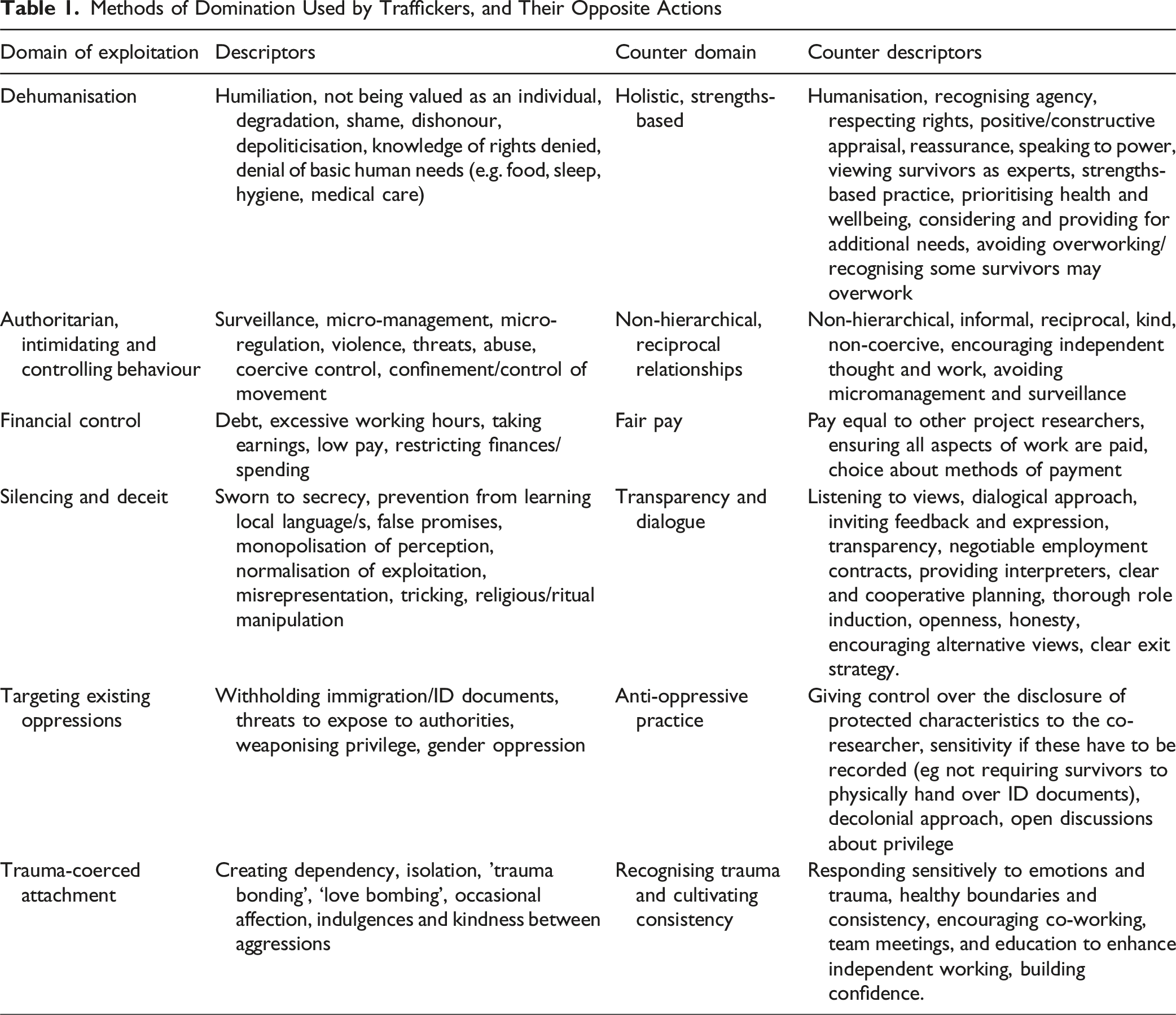
Methods of Domination Used by Traffickers, and Their Opposite Actions
Trust-Building Domains
Having discussed the tactics of abusive employers and the role of exploitative structures in perpetuating human trafficking, we now compare them with the effective workplace trust-building behaviours described by MSCOS co-researchers.
Holistic and Strengths-Based Practice
Holistic Working Relationships
The dehumanising tactics of traffickers had the effect of stripping down the multidimensional aspects of people’s personalities by undervaluing them as individuals, and suppressing their political and personal agency. Trafficking response services have also been criticised for their tendency to adopt a paternalistic and depersonalised view of survivors, which acknowledges victimhood while discounting acts of human agency, strength, and resistance (Brace and O’Connell Davidson, 2018; Chisolm-Straker & Chon, 2021). A holistic, strengths-based approach alternatively encourages survivors to bring their ‘whole self’ to the project, valuing them as people with a multitude of skills, values, needs and beliefs.
Developing mutual trust involved recognising survivors’ multifaceted identities as lived experience experts, practitioners in the community, political subjects, workers, and individuals with academic experience. The ability to bring these aspects of their identities ‘to the table’ – as opposed to solely their victimhood – altered both personal survivor narratives and the integrity of the research. Focusing on survivors as agents of change instead of disordered victims impressed upon co-researchers that other aspects of their identities were equally valued.
Rather than positioning survivors solely as contributors of labour, academics sought to normalise conversations that acknowledged the broader dimensions of life and wellbeing. Introductory phases of meetings were often dedicated to informal dialogue and ‘check-ins’, creating space for relational connection. This required a careful balance—expressing genuine interest in survivors as whole people without being intrusive. Although such practices could be perceived as diverting time from project tasks, they ultimately fostered greater openness, enabling survivors to share ideas and perspectives more freely.
A humanising approach required recognition of basic survival needs alongside social, psychological, and educational dimensions. Rather than overlooking these needs, the team aimed to respond to them wherever reasonably possible. Informal, broader conversations—often considered ‘off-topic’—frequently surfaced unmet needs such as childcare and data costs, which were then addressed. Wellbeing breaks were encouraged, and a hardship fund was established to support financial emergencies and equipment access. It was common for survivors to overwork, either due to perceived expectations or as a self-identified coping strategy. Regular check-ins helped ensure co-researchers adhered to paid hours and did not feel overloaded.
Centring Strengths
Discussion of survivors’ advocacy interests enabled co-researchers and academics to deepen understanding of diverse issues that affect different groups of trafficking survivors. These experiences shaped survivors’ contributions and informed the project’s direction. Both survivors and academics demonstrated investment in broader systemic change, including campaigns to reinstate domestic workers’ rights.
One survivor, for instance, declined to participate in dissemination meetings with the Home Office as a form of protest, citing the contradiction between her advocacy for domestic workers’ visa rights and the asylum-based framework imposed on survivors. Others contributed valuable insights into disability rights and their relevance to trafficking experiences. Participation in the project also fostered confidence and momentum for change-making. Several co-researchers initiated meetings with Home Office representatives to advocate for improved outcomes, while another convened her own stakeholder workshop.
It was clear that above being merely subjects or providing cursory advice, co-researchers sought to use the process to leave a legacy that had lasting impact within and beyond the research field. In creating a legacy, survivors regain control of making meaning out of their experiences: while the past cannot be changed, they retain the power to alter the present and future (Dang and Hawkins Layden, 2021). The harnessing of traumatic experiences to promote individual and societal improvements through the use of survivors’ strengths, values and skill sets has been shown to encourage positive wellbeing; it enables survivors to regain a sense of control over their experiences (Berntsen et al., 2003; Janoff-Bulman, 1979 in Schuettler & Boals, 2011).
Participatory involvement, when effective, enables survivors to harness and politicise their experiences to improve outcomes for others. This, in turn, has a positive effect on their identities as agents of change. Balancing sensitivity around trauma with the appreciation of the agency, skills and interests of peer researchers created trust that researchers are interested in survivors as fully human, rather than depersonalised as victims. This was echoed in the comments of one peer researcher, who described being “treated first as human, and second as experts”.
Non-Hierarchical, Reciprocal Relationships
Challenging Hierarchies
As a team, we were acutely aware of the impact of former authoritarian and controlling behaviour on survivors’ reactions to new workplace settings. Co-researchers seemed anxious about making mistakes and fearful of the reactions of academics, and, at times, were defensive or reluctant to voice their views. To establish an environment in which survivors felt confident to contribute, as well as free to withdraw from the project, we aimed to minimise feelings of intimidation, demand, or inferiority. We did this by attempting to form horizontal learning relationships, emphasising that the lived experience knowledge that survivors contribute to projects is equally as valuable as any experience or skills that academics bring.
We were less successful in ensuring co-researchers felt easily able to exit the project. In one feedback meeting, a co-researcher raised the importance of an ‘exit strategy’ being laid out and for survivors to be regularly reminded of this option throughout the course of their employment. This ‘exit strategy’, she suggested, would remind survivors that “no door is locked”, that they are there through choice, and are free to leave or take a break. Such a strategy should set out the process for leaving or taking time off, such as any notice period and effect on pay if not providing one, and how to notify the project. An exit strategy would have supported equal relationships by reducing feelings that co-researchers were duty-bound to stay until the project’s completion.
Another challenge included perceptions of status attached to job roles and titles. Co-researchers felt it was important that academics and medical professionals did not share their titles. One co-author commented: “We’re all here for the same goal...titles create barriers. If you’re talking to someone who makes you feel like they’re above you, it overwhelms you”. We had interesting discussions around the label ‘peer researchers’, and the possibility of this being a demeaning term. People did not seem to be particularly put off by this label, but generally preferred the term ‘co-researcher’. This term was felt to be more inclusive of survivors as part of the research team.
Despite the shared ‘co-researcher’ title, some co-researchers’ confidence was affected by feelings that they were not as experienced, knowledgeable, or worthy of input as other team members. Co-researchers found it helpful to be able to disclose their concerns, and to hear that ‘imposter syndrome’ and fear of error was a shared experience among academic staff. Academics being open about their own mistakes, worries, and learning enabled co-researchers to be open and less fearful about their own. Survivors were reassured that mistakes are fixable and human, and that there was no expectation of perfection.
To avoid creating an authoritarian working culture, the team aimed to offer choice about the division of tasks. Co-researchers appreciated being asked which parts of the project they wanted to be involved with, rather than being directed. Consequently, survivors’ contributions were matched with their unique skill sets and interests, leading to more meaningful engagement. Asking for survivors’ ideas about how to proceed with different stages of the research, such as helping to structure the workshops or design interview schedules, gave a sense of control and direction. It also provided valuable, survivor-informed perspectives on methods.
Reciprocity
Valuing survivors’ expertise meant framing interactions as co-production rather than extraction. Learning was reciprocal: knowledge was intended not to be, in Freirean terms, ‘deposited’ by academics, nor nor unilaterally drawn from lived experience (Freire, 2017). Production of knowledge was not one-way: it involved upskilling survivors in areas they identified, while academics also learned from survivors’ contributions as consultants. Nevertheless, traditional top-down training was used during induction, covering data protection; qualitative methods; ethics; and interviewing. Although useful, these were described as less engaging than the informal, relational exchanges that occurred during supervisions and meetings.
Co-researchers identified an increase in assertiveness and ability to share ideas, improved teamwork, and greater understanding and respect of others’ opinions. Some disclosed that it helped in getting jobs and setting goals by giving them confidence to apply for work and study opportunities. Overall, most survivors viewed their engagement as transformative.
Supporting survivors to access the learning tools and supervision needed to participate meaningfully was more time-consuming than anticipated, but was integral to the participatory nature of the project. Some of the challenges included factoring in enough time to build relationships through regular supervision and team meetings, alongside time for training and co-researcher contributions.
The academic experience of co-researchers varied widely, meaning that training needed catering to each individual. Engagement was limited by the number of working hours assigned to each co-researcher. This resulted in reduced involvement and an imbalance of participation between academic and lived-experience researchers. This may have unintentionally reinforced existing knowledge hierarchies which favour academic expertise, and lessened the sense of worth of survivors’ contributions (Kovach, 2021).
Maintaining a mindset of reciprocal inquiry meant enabling survivors to feel comfortable in educating academics about survivors’ perspectives. Continued reflexive discussions about needs in terms of training, inclusion, respect and support enabled co-researchers to trust that they could give feedback without repercussions. This included being honest about challenges and able to admit, reflect, and learn when things go wrong.
As survivors learnt about research methods, academics learnt about working with survivors: co-researchers educated academics on survivors’ needs, the anti-trafficking field, and ethics from a lived-experience standpoint. Different perspectives were held by co-researchers when contextualising their experiences: some located causes and solutions in crime and justice, some prioritised the reinstatement of immigrant worker’s rights, and others were interested in preventative decolonial solutions. These perspectives influenced their views on health outcomes and recovery.
In offering their expertise, survivor co-researchers are taking a considerable risk, given that their expertise is bound with traumatic and personal experiences. Trust is formed upon the evaluation of risk, and if survivors’ risks in sharing their expertise are not reciprocated, the potential for trust is damaged (Torche & Valenzuela, 2011). Contributing their lived-experience expertise involves drawing on past experiences of distress and betrayal. It is important for academics to ensure that this is met with a balance of respectful curiosity and willingness to respond with openness about sharing knowledge in return.
Fair Pay
Dialogue with co-researchers revealed dissatisfaction with payment rates. In deciding payment rates, the project was guided by recommendations outlined by the NIHR (2021). Although the project followed NIHR (2021) guidance, some lived experience researchers felt compensation should match that of academic staff, reflecting the equal value of their expertise. As one RAB member stated, “there is no research project without us [survivors]”.
These concerns align with broader debates on balancing fair remuneration with avoiding coercion in research participation (Duong, 2015; MacKinnon et al., 2021; Różyńska, 2022). For trafficking survivors, who have experienced exploitative labour practices, compensation is especially sensitive. While safeguarding informed consent is essential, so too is respecting survivors’ autonomy and recognising their capacity to assess the value of their contributions (Dang and Layden, 2021).
In response to concerns about payment, the project team shared information about the funding structure and the guidance that shaped remuneration decisions. While survivors appreciated this transparency, several expressed that the budget should have been accessible from the outset. Its delayed disclosure was perceived as a form of deceptive omission by some survivors. Upon reviewing the budget and discovering that lived experience researchers were paid less than academic staff, some felt devalued and regarded as unequal members of the research team.
As the budget had already been determined, we were unable to adjust co-researcher payment rates. Full inclusion of survivor researchers would have required their involvement in shaping the funding and ethics applications—an approach complicated by the inability to offer compensation prior to securing funding. However, lessons were learned: in subsequent projects, survivor payments were aligned with academic or expert consultancy rates, reflecting a commitment to valuing lived experience expertise on equal terms.
Non-hierarchical relationships are difficult to establish within economic hierarchies and existing institutional power structures (Mackinnon et al., 2021; Walker & Boni, 2020). Income and power differences exist between academic staff; paying survivors the same rate as the post-doctoral researcher would entail them earning a lower hourly rate than the Principal Investigator. Management and funding demands place further limitations upon the research team’s autonomy. Barriers to the co-production of research paradigms and methodologies exist on a broader scale than within individual research teams. Large applications demand established academics as lead and co-applicants, and rarely provide seed funding for collaborative application writing.
While reforming these institutional barriers is too large a task for a time-constrained research project, appraising how these contexts impacted the research team supported the building of confidence, openness and trust. Regular reflexive team discussion helped us learn what actions felt and/or were exploitative of co-researchers, whether occurring in the immediate team or the broader structural context.
Transparency and Dialogue
Transparent Motivations
Survivors may understandably be worried about being deceived regarding the nature of employment and the motivations of their employers. Their past experiences may have involved being lied to about work and then silenced when trying to challenge this. It was therefore important that academics cultivated a culture of openness, honesty and receptiveness to feedback.
Early discussions about how to balance power in the team drew out concerns about researchers’ motivations. Explanations of academics’ interests in and aims for the project removed some ambiguity and reassured survivors that their motives were not exploitative. This included transparency about academics’ reasons for interest in the research topic. Candidness about employment, economic and career motivations was valued by co-researchers. Questioning academics’ motivations helped survivors to test the honesty and integrity of the researchers, and to ensure that the project was consistent with the co-researchers’ values.
Problem-Posing
Respect and listening helped co-researchers feel their knowledge was appreciated. Academics used problem-posing techniques to introduce issues for discussion, encouraging critical inquiry surrounding research decisions rather than an instructive approach. Co-researchers were invited to ask questions and make decisions for themselves (Freire, 2017 [1970]). This encouraged inquisitive and reflexive attitudes among co-researchers, which helped draw out themes regarding areas for improvement. The effects of this dialogical approach were reflected in a co-researcher’s comment that “at the end of the day, we’re all human”.
Co-researchers’ educational guidance, underpinned by lived experience, sometimes involved volunteering experiences that were personal and difficult. This required careful handling by academic researchers. It was, at times, challenging to balance survivors’ need to be heard against the risk of retraumatisation. Discussions and guidance from co-researchers assisted with this, but such concerns may have been better addressed by agreeing boundaries and trauma response plans during the induction process.
Anti-Oppressive Practice
For survivors of human trafficking, trauma is rarely confined to past experiences of exploitation. Engaging meaningfully with survivors requires attention to ongoing sources of trauma—including the stress of navigating immigration and legal systems, pre-trafficking adversities such as poverty and familial abuse, and the enduring impacts of discrimination and intergenerational trauma (Busch-Armendariz et al., 2018).
A trauma-informed framework demands sensitivity to power dynamics within working relationships, which may inadvertently echo past experiences of control or harm. To avoid re-traumatisation, it is essential to acknowledge the cumulative effects of racialised, gendered, and economic oppression. In response, the team adopted an anti-oppressive approach that actively recognised and created space to discuss barriers rooted in both historical and present-day marginalisation.
Institutional and economic inequalities posed early barriers to meaningful participation. Higher education has historically excluded marginalised groups (Dorling & Tomlinson, 2016), and many survivors—both migrant and British-born—remain shut out due to funding restrictions, trauma, poverty, and criminalisation (Lambrechts, 2020). These structural inequities inevitably shaped team dynamics.
While the project embraced participatory principles to challenge knowledge hierarchies, efforts to build non-hierarchical relationships revealed deep-seated feelings of powerlessness among some survivor researchers. Academic spaces and unfamiliar tasks often reinforced assumptions that professionals ‘knew best’. Early on, co-researchers were hesitant to comment on reports, and team meetings were dominated by academic voices. The most reticent contributor was a Black female survivor, highlighting how intersecting marginalisations continued to influence participation.
Naming and exploring perceptions of inferiority allowed survivors and academic staff to reflect on the origins of these perceptions and begin to challenge them. However, these reflections did not significantly shift the balance of contributions. Survivors’ feelings of inadequacy were rooted in intersecting experiences of trauma and systemic inequality—economic, racialised, gendered, health-related, and educational. Although academics aimed to share power, they were working against deeply internalised effects of lifelong marginalisation (Kovach, 2021). Disrupting hierarchical dynamics required co-researchers to question assumptions that they do not deserve equal working relationships. It also relied upon academic researchers’ continual evaluations of the risk of unconscious bias and the effect of privilege on relationships with co-researchers.
Recognising Trauma and Cultivating Consistency
Trauma-Informed Working
Survivors’ intergenerational, past, and present traumatic experiences meant the research team had to consider and adapt to the needs of co-researchers. Trauma could be reactivated through materials encountered during literature reviews, workshop discussions, and participant interviews.
Trauma-informed approaches prioritise physical and psychological safety (Wilson et al., 2013). For survivors, anonymity can be essential to prevent re-targeting, while disclosure of trafficking experiences may risk stigmatisation (Fukushima et al., 2020). To support safety in meetings, we offered flexibility around camera and audio use, and the use of pseudonyms. Workshops began with a review of a survivor-informed agreement, including principles such as non-disclosure, non-judgment, and taking breaks when needed. These were especially vital when non-survivors were present, to uphold respectful boundaries. Safeguarding and trafficking support specialists were consulted when safety or wellbeing concerns arose.
Survivors entered their MSCOS working relationships with a justifiable belief that trust was to be earnt; they were vigilant about exploitation, and openness took time to develop. This speaks to survivors’ determination to avoid risks of re-exploitation, and this extended to being protective over each other and the research participants. Academics’ openness about feelings and concerns encouraged a reflexive environment in which co-researchers felt able to express their own vulnerabilities. It was helpful to frame openness about vulnerabilities as a strength: it enabled researchers to relate to one another and to disentangle problems collectively.
Consistent Relationships
A level of consistency was aimed for in our interactions - our regular meetings followed a similar format, and the approach followed was centred around consistent trauma-informed and participatory principles. Outside influences sometimes intervened, such as external responsibilities and illness. However, we aimed to maintain consistent central values— always returning to group reflexivity, shared problem solving, and asking how collaboration could be improved. Employment relationships for survivors in the past may have been unpredictable, relying upon drastic shifts in portrayed values and behaviour, and leaving survivors disoriented and not knowing what to expect. It was important, by contrast, that academics established a consistent set of values while remaining open to revisiting them.
Conclusion
Positive teamwork approaches identified by survivor co-researchers were described as diametrically opposed to the control tactics used by abusive employers. A literature review and our reflexive recordings supported this. Traffickers employed authoritarian, dehumanising, financially restrictive, deceptive, oppressive, and coercive methods. Conversely, researchers with lived experience found that holistic, non-hierarchical, fairly paid, transparent, anti-oppressive, trauma-informed, and consistent practices built collective trust.
Building trusting professional relationships with survivors requires an understanding of exploitative dynamics and societal conditions that shape their mistrust. Tactics used by abusers and enabling state actions are adaptive, responding to shifting societal precarities and priorities. Staying informed through current research and literature on the conditions faced by those most vulnerable to exploitation is essential to understanding methods of control and coercion.
Asking survivor colleagues to explain methods of coercion and control that have been used against them is unethical and may be re-traumatising. Instead, it is advisable to ask individuals what they need to participate and feel safe, and to review this regularly. Each person’s experience of exploitation is unique. While survivors may share a tendency to avoid relationships that echo trauma, individual differences must be acknowledged and addressed.
Recommended practices for researchers and survivors aim to counteract trauma and foster relationships that directly oppose coercive control and exploitation. Such approaches can enhance research quality, deepen participant openness, strengthen working relationships, and begin to restore faith in human trust.
1. Holistic, Strengths-Based Practice • Researchers should set aside time to bring their whole selves to the team, including space for interests, values, and wellbeing • Survivors must be recognised for more than their victimhood—emphasising strengths, abilities, and legacy-building over trauma. • Attend to the physical, emotional, and financial needs of all researchers. • Be open about insecurities and fears, and reassure team members that mistakes are understandable, expected, and often fixable. 2. Non-Hierarchical, Reciprocal Relationships • Researchers should aim to foster an equitable, non-hierarchical work culture wherever practicable—avoiding declaring titles unless necessary, and negotiating preferred job titles collectively. • Clearly outline and regularly communicate exit routes from employment throughout the project. • Align tasks with researchers’ skills and interests, offering as much choice as possible. • Facilitate exchange of knowledge and skills between those with and without lived experience. 3. Fair Pay • To reflect the equal value of lived experience, co-researcher payment rates should match at least those of the project’s post-doctoral researcher. • Ensure transparency in project spending by granting all researchers access to the budget. 4. Transparency and Dialogue • Begin with an honest discussion about motivations for joining the project. • Share team decisions wherever possible, and embed group reflexivity into funded roles. • Early on, negotiate strategies to avoid reactivating trauma and to respond to distress. 5. Anti-Oppressive Practice • Be attuned to marginalisation, and encourage dialogue on countering oppression. 6. Recognising Trauma and Cultivating Consistency • Uphold consistent values of reflexivity and responsiveness to feedback. • Embed a trauma-informed approach. • Prioritise survivor safety at every stage. • Aim for consistency in the structure, timing, and quality of team interactions.Recommendations
Footnotes
Acknowledgements
Special thanks to our survivor research advisory board for their contributions to the reflexive work that this paper drew from. They are Jeanet Joseph, Ruth Aguele, Keith Lewis, Wendy Caballero, Mimi Jalmasco, and Emily Vaughn.

Ethical Considerations
This project received ethical approval from the King’s College London Health Faculties Research Ethics Committee (HR/DP-21/22-26450 and HR/DP-21/22-26029).
Consent to Participate
Written informed consent was obtained from participants.
Funding
The authors disclosed receipt of the following financial support for the research, authorship, and/or publication of this article: This research was part of a broader project (MSCOS) that received financial support from the Strategic Priorities Fund via the Modern Slavery Policy and Evidence Centre, on behalf of the Arts and Humanities Research Council (AHRC). The AHRC is a UK Research and Innovation Council (No. AH/V012932/1).
Declaration of conflicting interests
The authors declared no potential conflicts of interest with respect to the research, authorship, and/or publication of this article.