




Abstract
While gathering young children’s insights and perspectives in any area of research is complex, there is increasing recognition of the need to elevate children’s voices to build shared understandings about what matters, and in the case of this paper their literate practices. Commonly used methodologies often follow traditional research models where young children participate in research as defined by the adult researcher. However, this approach can potentially limit young children’s ability to contribute their perspectives to genuinely inform and contribute to the research. This paper reports findings from a child-led inquiry nested within a broader project where children aged 4–8 years old were invited to participate as research partners alongside adult researchers. In this nested inquiry, children conducted explorative and reflective research on their own and others’ digital text production practices. In doing so, the children worked with adults to provide insights into their experiences through research practices, offering deeper understandings as to how children can act as research partners during the inquiry process. This study offers insights into how adult planning and facilitation can create the conditions for meaningful, child-led inquiry and highlights the value of recognising children’s agency within participatory methodologies.
Keywords
Introduction
The ways children participate in research vary widely, from offering insights through focus groups and interviews to actively collaborating across all stages of the research process. Participatory research methodologies frequently activate children as researchers of their actions, processes, and products (Bradbury-Jones & Taylor, 2015; Shamrova & Cummings, 2017). In doing so, young children can offer insights into their experiences and perspectives within and beyond adult interpretations and understandings.
This paper reports on a research project that engaged children as research partners to explore the literate practices children use when producing digital texts. Participatory research is described as an “action-oriented research activity” (Park, 2006, p. 83) that invites participants to take a central role in understanding and addressing problems that impact their own lives. The concept of research partnership extends this role, drawing from traditions of community participation and outreach in research where researchers and others “work alongside each other in the construction of further knowledge” (Harcourt & Conroy, 2011, p. 64). In such partnerships, research partners contribute “expertise, knowledge and skills” (Hoekstra et al., 2020, p. 245) that enable the co-production of knowledge for shared understandings.
Åkerström and Brunnberg (2013) explain that when children are included as partners in research, they bring diverse knowledge and lived experience through active participation in data collection and analysis (Kervin et al., 2023; Willison & O’Regan, 2007). Accordingly, we define a research partner as an individual who works alongside researchers, but is not an academic themselves, who contributes to the development of knowledge through co-conducted research processes.
Leveraging existing models of children’s participation, such as Hart’s (1992) Ladder of Participation and Shier’s et al. (2019) analytical matrix for children’s engagement in research, this paper reflects on how children acted as research partners alongside adult researchers in a research project. Children were invited to one of three Digital Design Workshops to explore the digital, online, media and critical literacy skills they used as they produced digital texts (Kilgariff et al., 2025 [forthcoming]). Within these workshops, the children also assumed roles as research partners as they conducted child-led explorative and reflective data collection on one another’s text production practices. This formed an embedded layer of inquiry that emerged alongside the broader adult-led research process.
Building on these reflections, this paper considers the implications for designing and implementing methodologies that foster children’s agency as research partners. In doing so, it addresses the central research question: In what ways can children be empowered to engage as research partners alongside adults?
Literature Review
Theoretical Approaches to Children’s Participation in Research
The body of literature surrounding research on, with and by children is significant and ever-growing (Bradbury-Jones & Taylor, 2015; Fraser, 2004; Shier et al., 2019; Tisdall et al., 2008). It is well established that children, alongside all other members of society, have the right to be ‘properly’ researched (Beazley et al., 2009). Children’s involvement in research that impacts them is widely recognised as a fundamental human right (United Nations, 2009). However, what this involvement looks like, including the level of children’s participation, the degree of agency they hold, and the roles children assume, varies considerably. This variation reflects the specific needs and contexts of differing research activities.
As one of the first models of children’s participation, Hart’s (1992) Ladder of Youth Participation focuses on children’s formal participation in their communities, describing their involvement primarily in relation to adults and adult activities. Informed by Arnstein’s (1969) Ladder of Citizen Participation, Hart (1992) described children’s power as active citizens as occurring on a scale ranging from non-participation to participation. Illustrated as a ladder, the model has eight rungs. The bottom three – manipulation, decoration, and tokenism – describe children’s non-participation where adults don’t provide opportunities for authentic agentic participation in research or political activities. At worst, an adult’s engagement with children at these lower rungs may be harmful to children (Shier, 2001). Ascending the rungs of the Ladder, participation is described as increasingly child-centred, then child-informed, and then child-initiated.
At the highest level of the ladder, rung eight, decision-making is initiated by children but carried out in collaboration with adults (Hart, 1992). The implication that the top of the ladder is somehow a goal to be achieved has raised critique (see Cahill & Dadvand, 2018; Malone & Hartung, 2009) as children’s involvement in research on a ‘lower’ rung should not be interpreted as of lesser value. Instead, critique emphasises the importance of children’s engagement and participation across different rungs to reflect the needs of the wider research context, including the needs of the children.
Responding to the sense of linearity in Hart’s ladder, Treseder (1997) proposed that rungs 4 to 8 are ‘Degrees of Participation’ and repositioned them into a circle to demonstrate that they are different but equally ‘good’ forms of participation. Recognising this reframing, Freeman and Mathison (2009) describe children’s participation in research as occurring along a continuum of possibilities as there is frequently movement between and among different degrees of participation. Participation is dynamic as children and adults interact in different ways depending on the needs of a particular activity or community. This reframing also acknowledges that participation can shift toward partnership, where children and adults collaborate more equitably, at different stages of research activity. By viewing partnership as fluid rather than fixed, this approach moves beyond static categories and allows for more nuanced interactions in participatory research with children and adults.
Hart’s ladder (1992) extends this conceptual shift through description of an emerging Continuum of Participation and Partnership (Figure 1), offering researchers a tool to guide their development of opportunities for children’s active participation in research. In a research setting, in addition to enabling children’s formal participation in research activities, adults can scaffold children’s informal participation (Gauvain, 2005) by providing opportunities for play, learning, exploration, and sharing (Wood et al., 1976). Rather than a rigid hierarchy, the ladder can be understood as a flexible framework where children and adults engage across different rungs of activity to achieve shared goals (Hart, 2008). Continuum of Participation Adapted From: Hart (1992). Children’s Participation: From Tokenism to Citizenship. Florence: UNICEF International Child Development Centre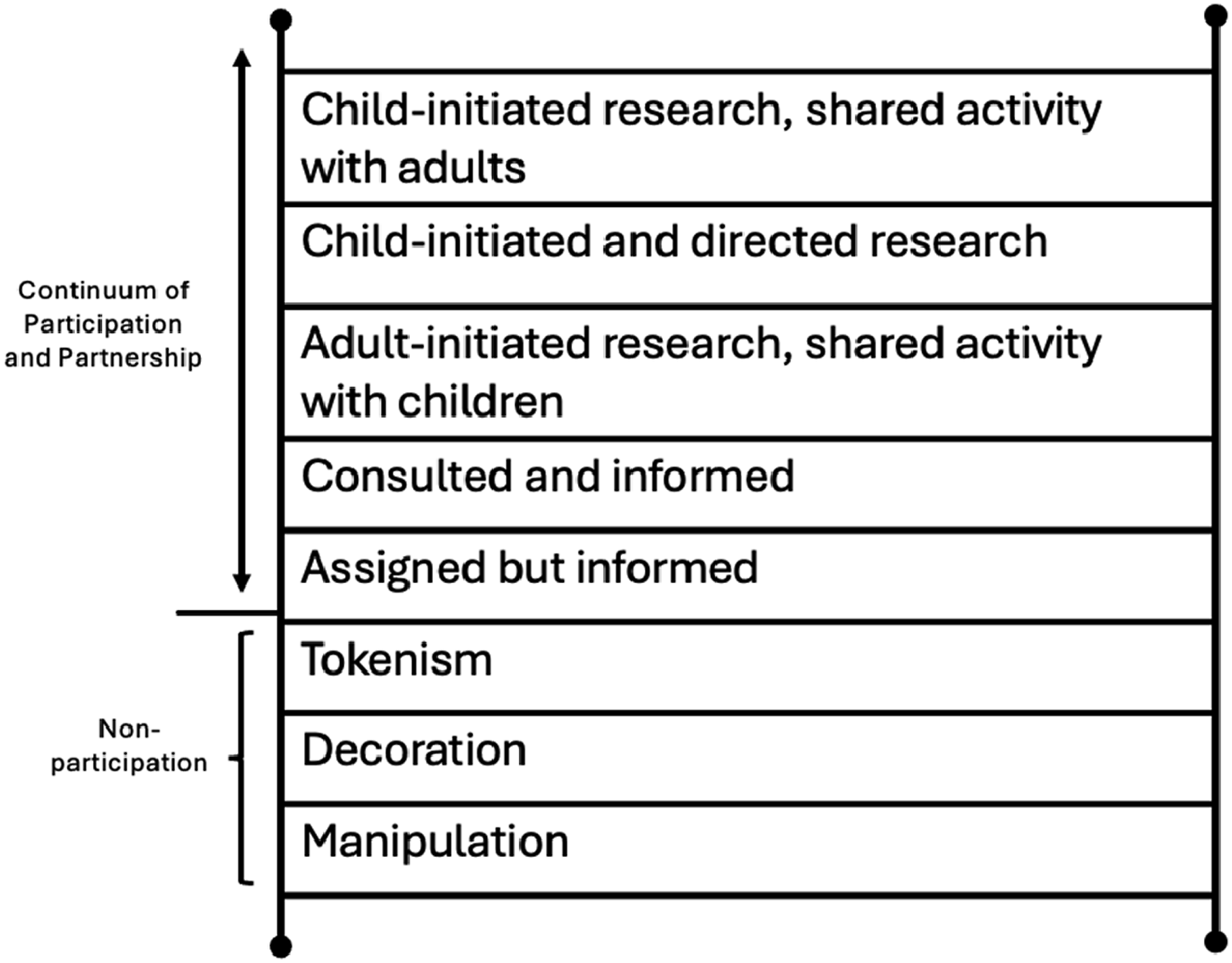
Adult-driven research projects and goals frequently position research involving children within a particular framework, agenda, or set of adult-directed priorities (Bradbury-Jones & Taylor, 2015; Kellett, 2005). In these projects, adults draw upon the methodological expertise as they identify a problem, plan a research study, and create the research infrastructure within which children then engage (Shamrova & Cummings, 2017). These activities are likely best described as primarily happening midway on the Continuum, where children are consulted by or assigned work by adults (Hart, 1992). However, within these adult-driven research projects, there may also be the opportunity for increasingly child-initiated action.
In later work, Hart (2008) reflected on and extended earlier descriptions of the Continuum of Participation. While the initial framework describes children’s formal and structured participation, Hart (2008) acknowledges that children also participate in their communities informally with adults, peers and individually. This broader view positions informal participation, often taking the form of play or social learning, not as passive or lesser to more formalised practices but as an active and meaningful form of engagement and shared knowledge building. Informal modes can enable emergent, authentic partnerships, where children’s everyday ways of knowing and interacting are recognised as valuable contributions to shared inquiry through research.
Recognising the Value of Children’s Contributions in Research
In child-centred methodologies, gathering children’s perspectives provides depth to adult understanding and interpretations (Harcourt & Einarsdottir, 2011) by centring the children and their experiences (Clark, 2010). Involving children as active contributors to the development of understanding through participatory research is crucial (Creswell, 2021); their lived experiences and perspectives on these shape a study’s process and findings. This highlights the importance of distinguishing between research on children, research with children, and research by children (Bodén, 2021), as each approach reflects different levels of agency and participation.
The centring of children in research requires consideration of what research practices look like to children. Aligned with broader conceptualisations of a qualitative paradigm, research is defined in this study as any activity that involves the generation and analysis of data (Kervin et al., 2023; Willison & O’Regan, 2007). Children’s data may include interviews or discussions, observations, physical or digital documents and images or other visual or audio recordings. How and what an adult chooses to collect data about and how and what a child chooses to collect data about are often different (Hunleth, 2011). Acknowledging these differences while retaining the foundation of established research practices opens new possibilities for capturing young children’s perspectives more authentically (Einarsdóttir, 2007; Kellett, 2005; Water, 2024).
Lohmeyer (2020) recommends accepting that children’s research will always take place within an adult framework. Rather than seeing these as two distinct activities, researchers can reconceptualise participatory research with young children as occurring parallel and complementary to that of adults. Within the study described in this paper, children engaged as research partners in the production and collection of data rather than in the development and implementation of the research design. The decision to engage children in these later parts of the process reduces the need for extensive research training (Bradbury-Jones & Taylor, 2015) by leveraging children’s existing skills, such as observation (Harlen, 1985; Johnston, 2009), curiosity (Engel, 2011; Jirout & Evans, 2023; Suardi et al., 2021) and inquisitiveness (Engel, 2011; Kreitler et al., 1975). By recognising these abilities, children’s participation challenges the perceived “competence barrier” (Kellett et al., 2004, p. 330), positioning them as knowledgeable research partners and contributors who offer unique perspectives on their own lives to enrich adult-framed inquiry.
Operationalising Children as Participants in Research
As identified by Grace et al. (2019) the majority of Australian child participatory research engaged children only as participants who provided data to adults, primarily through interviews and focus groups. They observe that, “a stark commonality was the observation that there were very few published projects across all sectors that engaged with children and young people in the different phases of the research beyond data collection” (Grace, et al., 2019, p. 185). This is likely a result of external factors such as the current process of securing research funding or ethics approval, both of which often require delivery of research questions and project design before research can begin (Grace, et al., 2019). Children’s level of agential involvement can vary significantly based on the adult positioning of the child’s role, and much of this work is done before the child is involved with any research activities.
Informed by Hart's (1992, 2008) continued influence on participatory research, this paper proposes an approach that positions children as research partners by acknowledging such limitations and intentionality creating opportunities for young children to engage meaningfully in research activities. Shier et al. (2019) offers an analytical matrix that enables adult researchers not only to describe research with children, but also to plan, implement, and develop meaningful partnerships with young people and children (see Figure 2). Based on many years of work with underserved communities, this matrix describes the phases of the research activity on the vertical axis (derived from Kumar 1997/2018) and positions children’s levels of decision-making power or control along the horizontal axis. In theory, participatory research is a collaborative process where both researchers and participants engage in systematic enquiry (O’Brien & Moules, 2007). Shier’s et al. (2019) matrix allows the consideration of what that collaboration may look like across different phases of research activity and acknowledges that this may change in response to the needs of a particular moment or activity. Shier’s Participation Matrix (Shier et al., 2019) Methodological Frame: Adapted Design-Based Research Framework (Reeves, 2006)

Shier et al. (2019) explicitly states that the matrix is not a model of perfection or something to aim towards, but a simplified practical instrument to support researcher planning, implementation, and reflection. Shier et al. (2019) encourages thoughtful practice that considers children’s engagement in context, ensuring their participation aligns with their age, abilities, interests, and the aims of the project. Shier deliberately does not identify any approach as right or wrong but prompts adult researchers to reflect on the dimensions of decision-making power and shared responsibility in research on and with children. In doing so, the matrix can facilitate more intentional engagement with the concept of partnership, moving beyond tokenistic involvement to more equitable and collaborative research relationships. In this context, both Hart (1992, 2008); Shier et al. (2019) provide not only frameworks for planning and implementing research activities with children but also guidance for analysis and discussion.
Ethics in Research with Children
Evaluating children’s roles through a shared model of understanding (e.g., Shier’s et al., 2019 Participation Matrix), enables researchers to critically examine the extent to which children’s participation is meaningful and equitable. The ethical implications of researching with young children are well documented (e.g., Dockett et al., 2009; Montreuil et al., 2021), and ethically responsible adult researchers must incorporate ongoing, conscious reflexivity in all stages of the research (Kiili et al., 2023) to reduce the risk of bias and adult influence on children’s research practices and contributions. Moore, et al. (2016) advocate for moments of co-reflexivity with children in research, encouraging shared reflection on methods, data and shared research practice. These moments not only validate the ways children conduct research but also provide the opportunity for their experiences and perspectives to inform the research design.
While children have historically been described as vulnerable (Morrow & Richards, 1996), vulnerability does not mean incompetence (Carter, 2009). Indeed, within adult-designed research activities, there are opportunities to leverage their existing competence for empowerment. Kellett (2005) describes this as power-sharing, acknowledging that in different moments of a research process individuals are empowered, or potentially disempowered, as agential actors. Here, it is acknowledged that “power relations between children and adults are not reducible to the binary of powerless and the powerful” (Holt, 2004, p. 13) but are fluid and context-dependent, varying across different stages of research activity and participation (e.g., Hart’s 1992 Continuum of Participation (Figure 1)). Acknowledging this fluidity supports a dynamic view of partnership with children; throughout the research process, the adult researcher can recognise both the contributions and constraints experienced by children and adults.
Method
Reported here are children’s research practices observed in a project using participatory research methodology. Within the qualitative paradigm of this study, the experiences of the child participants remain central.
Significant consideration was given to possible ethical concerns and the impact of adult-child power relationships (Alderson, 1999; Broström, 2012; Chavez & Andrea, 2020; Harcourt & Einarsdottir, 2011). Throughout this paper, we describe children as research partners rather than co-researchers (Montreuil et al., 2021) to reflect both their meaningful contributions and the structural constraints that prevent full parity in decision-making. As such, we recognise the children’s contributions to co-constructed understanding (Bellinger et al., 2014; Reusser & Pauli, 2015) through their active data collection and acknowledge both their expertise and the limitations that adult-designed research places on comprehensive end-to-end child-led research.
With consideration of children’s agency (Pole et al., 1999; Skånfors, 2009), the negotiation of power (Holt, 2004) and the collaborative nature of research (Dockett et al., 2009; Nowland et al., 2022) the study draws upon Hart’s (1992) Ladder of Participation and Shire’s et al. (2019) analytical matrix for children’s engagement in research. These models are used to guide both reflection and analysis of the children’s data collection practices. The study was designed to support the children’s agency as research partners by intentionally leaving space for the children to choose both how to participate in and document the experiences and opportunities. Within the framework of the broader adult-designed research study, time was intentionally created for child-led nested research activity, where children could act as research partners by following their interests, lead with their expertise, and share their authentic perspectives (Ayles et al., 2023).
Research Context
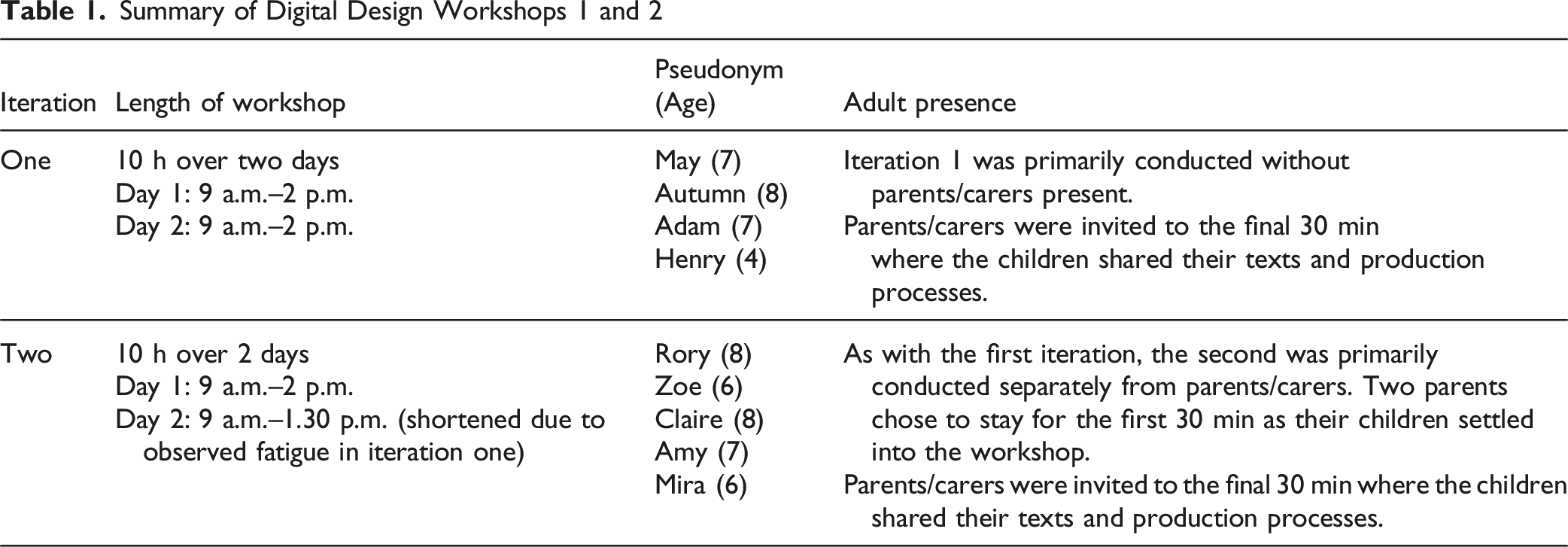
The methodological design and implementation described are drawn from a broader study exploring children’s digital text production practices. In the broader study, children aged 4–8 were invited to one of three Digital Design Workshops to produce digital text. The data collection phase (Phase III) of the research occurred across three iterations of the workshop, as shown in Figure 3.
The analysis and discussion here centre on data from Iterations One and Two which offer comparable data about the children’s research practices due to similarities in participant age range, parental involvement, and duration. Iteration three represented a departure in form from the first two to target younger participants (4–5 years old). Rather than a more structured two-day workshop, as in Iterations One and Two, Iteration Three consisted of two highly fluid sessions of 2 h each with different participants attending each session along with their parent or carer. Given these differences, the following discussion utilises data from Iterations One and Two only.
The iterations took place in the University of Wollongong’s (UOW) Children’s Technology Play Space (CTPS). The CTPS is a child-centred space adjacent to UOW’s Early Start Discovery Space. The Discovery Space is located on the University’s campus and is a play-based children’s museum for children in their first decade of life. It is a research translation space connecting academic research and the community by offering research-informed play-based experiences for children and their adults.
Recruitment
During recruitment, parents were provided with a Participant Information Sheet that invited children to take part in workshops focused on digital text production and research. Because the task was broadly framed, participants who were familiar with the use of digital tablets and the tools available for creating multimodal texts were sought. Specifically, the participants needed skills including the ability to take a video or audio recording, to take a photo, and to use drawing apps or tools to create an image. Parents were encouraged to make their own judgment on whether this was an appropriate and potentially enjoyable activity for their children. As such, each participant was familiar with tablets and other forms of digital technology prior to the workshop; however, their levels of experience, skill, and understanding differed. Following interest from parents, children were also provided with information about the project.
Consent and Research Ethics
This study was approved by the Human Research Ethics Committee of the University of Wollongong (Reference, 2022/173). Obtaining consent from all participants, including the children, was essential (Einarsdóttir, 2007; Tisdall, 2015). After receiving information, parents gave consent on behalf of their child.
Children’s consent and assent were actively sought throughout the workshops. Dockett et al. (2009) define assent as a “relational process whereby children’s actions and adult responses, taken together, reflect children’s participation decisions” (p. 231). Informed assent requires children to be informed about the overall purpose of the research as well as the current research activity. In both iterations, children were explicitly introduced to the overall aims of the workshop and their role within the research at the start. While consent is formalised, usually through writing or drawing, and gathered from parent and child, assent is reflective and reflexive. In this research assent was considered an active choice to participate, as demonstrated through the children’s actions, rather than passive disengagement. In addition, non-verbal cues, such as body language, facial expressions, or other behaviours indicating discomfort or reluctance, were interpreted as a withdrawal of consent, even without explicit verbalisation. Children provided written consent through a written form with four statements accompanied by face emojis (see Appendix 1). In Iteration One, written consent was also reaffirmed after each break. In Iteration Two, this process was simplified to verbal reaffirmation only, reflecting the children’s preference for fewer adult interruptions during their activities. Although all participants gave consent at the start of the workshop, if at any time a child wished to withdraw or not participate, either verbally or non-verbally (Arnott et al., 2020; Palaiologou, 2019), they were able to do so. If the consent or assent was withdrawn, children remained within the space until they were able to leave with a parent or guardian.
Adult Research Design
Both Iteration One and Two of the Digital Design Workshop were anchored by the same task - using an iPad to ‘tell a story or teach something’. In offering this open-ended prompt, the participants could interpret and approach the text production task as they chose rather than conforming to a prescriptive understanding of what a ‘text’ might be or look like. In addition to a shared central activity, each iteration was run by the same lead researcher and held in the same physical location.
Summary of Digital Design Workshops 1 and 2
The methodology was designed to activate the child participants in two roles: as digital text producers who were responding to an adult-designed activity, and as research partners completing child-led research activities such as generating questions, gathering data, and reflecting, interpreting, and drawing conclusions about that data.
Adult-Led Activity: Engaging Children as Digital Text Producers
Across Iterations One and Two, each workshop was divided into four focused blocks of time. The activity in each block was shaped by the stages of the CTPS pedagogical framework of Plan and Talk, Play and Make, and Share and Reflect (Kervin et al., 2024). It was anticipated that the children may naturally shift in and out of each stage throughout each block as they responded to the task. Prior to starting any text production, an overview of the session, including aims and tasks, were shared along with a discussion of consent. In taking this time to orient the workshop, the children were informed by a shared and co-constructed understanding of the activity (David et al., 2001). At the beginning of each iteration, the Plan and Talk stage began with a read-aloud of Here We Are (Jeffers, 2017), a story about a father introducing his young child to the world and some of the people and things that inhabit Earth. The story was offered as a stimulus for the participants’ text production as they considered what they would like to share with someone new to the world, such as a story or a piece of knowledge, and how they would like to deliver that message.
Following the read aloud the children were invited to produce their text through a series of scaffolded sessions modelled on the text production cycle (planning, drafting, reflecting, and revision). Throughout Iterations One and Two, the children’s text production was facilitated by the adult-designed spaces and processes as they made choices about their texts as agentic producers in a safe and unpressured space (Christensen & James, 2017). The children’s text production activities included making decisions about the style and focus of the text, the content, how they would share their product, and the design and mode/s of production. The text production prompt and pedagogic structure of the workshop remained unchanged between these first two iterations, however, Iteration Two was shortened to accommodate the children’s observed fatigue in the final hour of Iteration One.
Nested Child-Led Activity: Engaging Children as Research Partners
To position the children intentionally as research partners throughout Iterations One and Two, the concept of “research” was introduced in a way that mirrored the structure of the text production activities. In Iteration One, children were introduced to the ideas of research and ethical research in the first block of day one. This included an opening discussion of what ‘research’ meant to them. When asked ‘What does a researcher do’, one participant summarised a researcher as “someone who wants to learn stuff” with the example of “a researcher can research about new animals”. In her response, the participant identified that a researcher is someone who works to source information to answer a question or meet a specific need.
The adult researcher offered opportunities that supported the children’s predicted research practices, for example, the suggestion of observational techniques and ways to document their observation such as research journaling, taking photos or making notes or recordings (Lundy et al., 2011). It was anticipated that the children might be asking questions, recording data with voice and videos, taking pictures (Jorgenson & Sullivan, 2010), or documenting their research through writing or drawings (Baroutsis et al., 2019).
Research time was not specifically planned for within the text production cycle however, children were encouraged to use the regular ‘reflecting’ stages of the text production cycle for collaborative peer review. In this way, ‘research’ was an opportunity for the children to learn about the actions, texts, and processes enacted by their peers. The children chose if they wanted to do this and if they did, when and how they captured and shared their data.
Data Analysis
Throughout Iterations One and Two, the adult researchers collected data through observations, field notes, audio and video recordings, and conversations with the children. These data collection procedures were chosen to capture direct interaction with the adult researcher as well as peer-to-peer interactions and other activities where the adult was not present, offering insights into the children’s activity as research partners in a variety of situations.
In parallel, the children captured their own evidence by documenting their immediate and in-situ decision-making (such as their inclusion or discarding of specific ideas or practices). While the children did not produce a formal dataset in the conventional sense, their contributions were recorded by the adult researcher and later analysed in relation to how they observed, interpreted, and responded to one another’s text production practices. This approach aligns with the view of children as active, responsive research partners whose participation is embedded in the flow of shared activity rather than formal data capturing processes.
Coded Sub-Themes, Descriptions, and Examples (Informed by Shier et al., 2019)

Video and audio recordings were analysed to identify patterns of child action and interaction under two primary themes: text production and research. Research included children’s independent research activity and research in partnership with adults. The children’s actions were categorised and grouped into coded sub-themes. The use of reflective and inductive coding allowed for a highly flexible and iterative development of the themes, as the children’s practices did not always remain consistent or confined to the adult-described research skills described in Shier’s et al. (2019) matrix. Literature around children as researchers and research partners supported the introduction of targeted themes; however, these themes changed significantly over the course of analysis. For example, observation (Johnston, 2009) evolved into ‘reflection’ before becoming the more specific theme of ‘reflection and interpretation’. Here, the active practice of questioning and comparison that often accompanied a child’s observation of another’s research practice was acknowledged. For the purposes of this paper those themes that responded to the children as research partners are examined (see Table 2).
The workshop’s design positioned child-led activity as being nested within the broader adult-led structure. Shier et al. (2019) describes the dimensions of decision-making power as occurring on a spectrum, as in the revised Ladder of Participation (Hart, 1992). This movement between adult-led and child-led activity was seen throughout the analysis and patterns became more evident as activities were coded into text production or research themes. This validated the nested design of the children’s research practices within the adult research project.
Findings - Considering the Children’s Practices as Research Partner Activity
Analysis of the data revealed three distinct ways children acted as research partners. First, through the observation and documentation of the practices of others. Second, by analysing self- or peer-collected data to inform critical and conscious decision-making. Third, through active meaning-making through sharing and reflection. These findings are explicated with examples drawn from Iterations One and Two.
Finding 1: Data Collection & Data Recording when Exploring Others’ Practices
Observation of the environment and the actions of others within that environment is a widely acknowledged practice of data generation and collection (Yurumezoglu & Oztas Cin, 2019). Given documentation is the process of collecting and recording the generated data (Willison & O’Regan, 2012), the children did this through writing, drawing, taking photos, videos, or audio recordings. Further, informal documentation through verbal or non-verbal interactions with peers added to the data.
The study found that young children first initiate the research process by generating a question or aim based on experience and interest. Through this generation, they begin the process of gathering self-identified information from self-determined sources (Willison & O’Regan, 2007). The question, and indeed the data collection method, may not be expressed externally or formally documented. Instead, the children’s research practice may be identified through peer questioning or non-verbal indications such as facial expressions, prolonged observation, or changes in their body position towards the action of interest.
While producing digital texts, as researcher partners, the children were also looking to understand how others produced texts in turn. In Iteration One, May (7) and Autumn (8) attended the workshop together. As friends from school, they chose to work alongside each other, although they focused on separate text productions on separate iPads. May had chosen the topic of ‘octopuses’ for her text and conducted a Google search on the iPad, navigating through a list of YouTube videos to select one she deemed potentially relevant. During this process, her friend, Autumn, became interested and moved towards May’s iPad. The interactions between the children highlight May’s text production practices as she sorted, evaluated and synthesised information that met her self-defined goal.
Transcript 1: May: Ooh, I want to watch this. [Referring to a YouTube video that she has selected and opened] Autumn: (Looking over at May’s iPad) Does it have octopuses in it?
Both children wait and watch the video.
May: Octopus! (Sits up and moves closer to the screen) Autumn: It’s so small and cute. Autumn: You might want to record that. May: What? [Not knowing what Autumn is referring to] Autumn: That (Gestures to the video) May: No. Autumn: You could say octopuses live there?
May does not respond. The video continues with Autumn looking over at May’s iPad screen intermittently while working on her digital text.
May: Ooh, he’s trying to catch a crab. Autumn: Leans over to watch.
The video continues focusing on crabs, May chooses to pause and returns to her text.
When considering this example, the interconnected nature of the children’s role as text producers and as research partners is apparent. Here, May is conducting research for her text production, while Autumn is conducting research on May’s text production practices, while working alongside May on her own text. By supporting May in her text production process, Autumn was collecting data about May’s process.
Autumn and May expressed differing opinions on what they considered important in the task. May chose not to take Autumn’s suggestion and did not include any of the video or the information from the video in her production. Later, when the adult researcher asked if there was anything May was looking for when watching the video, she replied, “Not really, just watching to see”. As May chose not to take Autumn’s suggestion, Autumn was building an understanding of May’s text production aim and her strategies towards meeting that aim. Autumn’s data collection was not distinct or defined but appeared to be intuitive, reflexive, and informal. Autumn used data collection strategies that worked alongside their creative production processes.
Finding 2: Deeping Understanding through Iterative and Ongoing Data Analysis
The process of critically analysing data, including assessing its relevance and reliability (Burke & Williams, 2008), enables researchers to make informed decisions about their actions. The children demonstrated that this data analysis may happen independently or in collaboration with others. Peer discussion offered insight into the often hidden analytical research practices conducted by the children, including how they make critical decisions about their work.
In Iteration Two, one participant, Rory (8), was excited to share a text production tool she had learned of at school, Book Creator. She asked if she could provide a demonstration of the tool using the projector and delivered a confident introduction to the app.
Transcript 2: Rory: (Standing at the front of the room, in front of the projected mirrored iPad display) It’s called Book Creator, and I really like using it to make your own book, and also, it’s very fast at making books. So maybe now I might teach them how to use it? (Looks toward adult) Adult: (nods) Rory: Ok, well, you see the orange plus thing (gestures towards the top right of the projected image), you press that (presses the icon on her iPad screen) Rory: If you use the pen, you can draw a picture of the background. (selects pen to bring up the drawing tool bar) and if you choose text, you can write down what you want to say (selects text to bring up a text box and keyboard).
Rory continues, demonstrating several other features of the app while answering questions from the other participants as they evaluate the app’s limitations and affordances. Together, the children consider how a text could be constructed with the new tool, reflecting on what features, such as page layout, might be effective in conveying meaning.
Several participants chose to try the unfamiliar app for their productions. While the participants were all familiar with how to use an iPad to complete simple text production tasks such as typing in a text box, adding images from a photo gallery and changing the positioning and size of those images, doing so in a new context brought some new challenges. Amy (7) and Claire (8), also friends from school, attended Iteration Two of the workshop together. Working separately, they shared their emergent skills in using Book Creator, a tool new to them, as they completed the first draft of their texts.
Transcript 3: Amy: (Looking over at Claire’s iPad) What are you doing? [Referring to Claire’s tapping on the app screen] Claire: I don’t know. How do you get it to save? Amy: Hm. (Interacts with screen). Do that, and then…. Is that done? [Referring to Claire’s page of text] Claire: Yes (Nods and follows Amy’s gesture to save the page) Amy: (Pauses and looks at the saved page) Nice page.
Amy continues to look over at Claire’s screen to observe her production while opening a page to work on her own text. Claire deletes text and adds new content several times before saving the page. Amy observes this before starting her production.
Amy appears to watch Claire’s actions to understand the process of production using an unfamiliar tool to inform her own text production. In taking the time to observe Claire’s practice before starting her own, Amy is actively learning about Claire’s text production practice – she now understands what skills Claire needs to complete a task, and the iterative nature of the production process. Her findings are documented through her own text production process, which appears to be more confident than the initial interaction, as there are no further complications with saving. Again, the intertwined nature of the two tasks, production and research, is apparent.
Finding 3: Meaning Making through Shared Reflection and Interpretation
Sharing and reflecting is a collaborative strategy for knowledge building through informal or formal discussion (Engel, 2011). Through these discussions, individuals share ideas, insights, or experiences, reflect on them together, and develop a multi-dimensional shared understanding.
When interacting with little or no adult involvement, the children frequently shared their perspectives and ideas. This included taking feedback and suggestions from others. For example, in Iteration One, a participant was conducting a Google search to find images to include in her text and found one she suspected was “fake”. After asking her peers if they agreed, a discussion followed on the characteristics of the image, such as the proportions and colours of the animal and an overall conclusion was made of “fake”.
In Iteration Two, two children, Mira (6) and Zoe (6), chose to work together on a shared video text production about blowing bubbles. After identifying their topic, the adult researcher asked them how they could find out more about their topic before filming their video. Zoe suggested YouTube and shared that she watches YouTube videos at home. The girls sat with a shared iPad and Zoe, holding the iPad in her lap, navigated to the YouTube app and searched for ‘bubbles’. Together, they looked at the search results, with Zoe scrolling through the list and Mira commenting on the results. Mira indicated that a particular video looked as though it was appropriate. When asked ‘why?’ by the other participant, she described the colours, the ‘sciencey font’, and the imagery of scientific beakers on the cover image of the video as looking more ‘real’ than that of the other videos. Zoe agreed, and together they watched the video. Later in the session, as they were producing the text, both Zoe and Mira included information directly sourced from that video.
In each of these examples, the interactions between the children provided an opportunity for shared reflection on how a peer chose to approach the text production task. Zoe appeared to accept Mira’s answer as a valid and reliable evaluation of the selected source, as demonstrated by including the content of the video in their shared production. In doing so, she reflected on Mira’s text production practice to deepen her own understanding. In the first example, when evaluating whether an image was ‘fake’, the other participants contributed to shared knowledge building (Engel, 2011), which in turn provided insights into the evaluation and information gathering phases of digital text production.
Discussion
Children were empowered to take the lead in the interactions as they assumed the role of research partner (Lundy et al., 2011; Shamrova & Cummings, 2017). The children acted as research partners by: collecting and recording data by observing, exploring and documenting the practices of others (Harlen, 1985; Johnston, 2009), deepening their understanding through data analysis to inform critical decision-making (Burke & Williams, 2008), and building understanding through shared reflection, interpretation and meaning-making (Engel, 2011).
How the children acted as research partners differed from anticipated patterns expected by the adult researcher. Instead of separating themselves from the text production practice and stepping back to conduct ‘research’, the children integrated explorative and informal research practices throughout the creative production of their texts. Often, the lines of inquiry and learning about others’ text production practices tightly mirrored the children’s production. As the children learned about others’ text production through their research activity, they often responded through their own text production, drawing on peers’ strategies that resonated with their current focus or challenge.
The children’s process as research partners was reflective and iterative (O’Brien & Moules, 2007). Informal and explorative knowledge building, such as observation and discussion, is frequently “embedded in meaningful activity” (Rogoff et al., 2016, p. 356) and often occurs in the conversations and interactions that surround a targeted task. When working as research partners, the children in this study appeared to move through a series of explorative and flexible steps. For example, when May chose to explore, observe, and then discard the new information she had sourced, she was making a considered and critical decision about the content of her text. In observing May’s actions as a researcher, Autumn learned about the fluidity and intentionality of her production practice.
Child-centred and child-led research necessitates child-centred methodologies (Barker & Weller, 2003). This was evident in the ways the children used a variety of strategies to evaluate, reflect, and respond to others’ research and text production practices. The children’s informal conversations also worked to complement more formal data gathering (Swain & King, 2022). Their research practices were fluid and iterative, and this fluidity became increasingly apparent during peer discussions (Engel, 2011). Consequently, data about text production practices were primarily collected through peer sharing and activities such as asking their chosen project partner questions and requesting design input. These data were not formally collected but were captured in the ways in which they responded to the feedback.
Intentionally creating space for child-led research practices allows for insights that may not have otherwise been possible. When working alongside children as research partners, there were moments where the adult drove the interaction, as both adult and child moved along the continuum of possible interactions (Freeman and Mathison, 2009) and the continuum of Participation and Partnership (Hart, 1999) as described in Figure 1. Acknowledging this fluidity is essential (Lohmeyer, 2020), as is deliberately creating opportunities for children to also lead interactions, even within an adult research design (Grace, et al., 2019). It is through these intentional opportunities that children’s perspectives, experiences, and actions can meaningfully contribute to shared understanding.
Being intentional in planning for children’s research activity is particularly important when considering research practices and knowledge-building. Research often comments on the playful practices of young children (e.g., Ilgaz et al., 2018) and emphasises that unstructured time for exploration and play provides an opportunity for children to build new understanding (Arnone et al., 2011; Chiu & Chi, 2014). Baker, et al. (2023) states that it is through recognising children’s natural tendencies towards exploration and play that adults can support children’s agency. Children can be supported as research partners by deliberately planning and making space for child-led activity, while recognising the sometimes hidden alignment between children’s research practices and adults’ research practices (Shier et al., 2019). This recognition extends to consciously valuing the tasks children choose to engage in during the research process, such as shared reflection and interpretation of data. By fostering children’s independence over time, in a safe space where adults and children are positioned working together, children can be empowered to act with both confidence and agency as research partners alongside adults.
Conclusion
This study aimed to support children’s active participation and agency as research partners through participatory research designed to amplify children’s perspectives and foster emerging insights into their research practices. The qualitative paradigm of this study afforded exploration of participants’ experiences and perspectives within a unique sociocultural context (Denzin & Lincoln, 2011), emphasising their expertise in understanding their own lives (Boylorn, 2008). The study intentionally positioned children as research partners during data collection, recognising the children’s agency and expertise.
The interpretation and application of the children’s role within research directly impact the ways in which their contribution is valued (Lundy et al., 2011). That is, if research positions young children as competent and active participants, then their voices, views, experiences, and perspectives become valuable and fundamental to understanding issues that affect them. Children are capable of more than adults know (Alderson, 2001).
By carefully considering the role children play in research, as well as their expertise, adult researchers can engage young children as research partners in their own right. Empowering children to engage as research partners involves creating space for them to explore, learn, and develop their capacity for documentation and expression, enabling them to contribute confidently and meaningfully alongside adults (Lundy et al., 2011).
Supplemental Material
Supplemental Material - Exploring Young Children’s Research Practices as They Engage as Research Partners
Supplemental Material for Exploring Young Children’s Research Practices as They Engage as Research Partners by Lisa Kilgariff, L. Kervin, and J. Mantei in International Journal of Qualitative Methods
Footnotes

Funding
The authors disclosed receipt of the following financial support for the research, authorship, and/or publication of this article: This research has been conducted with the support of the Australian Government Research Training Program Scholarship. This research was also enabled through the use of a living lab supported by the Australian Research Council Centre of Excellence for the Digital Child through project number CE200100022.
Declaration of Conflicting Interests
The authors declared no potential conflicts of interest with respect to the research, authorship, and/or publication of this article.
Supplemental Material
Supplemental material for this article is available online.
References
Supplementary Material
Please find the following supplemental material available below.
For Open Access articles published under a Creative Commons License, all supplemental material carries the same license as the article it is associated with.
For non-Open Access articles published, all supplemental material carries a non-exclusive license, and permission requests for re-use of supplemental material or any part of supplemental material shall be sent directly to the copyright owner as specified in the copyright notice associated with the article.
