




Abstract
In the 21st century, post-qualitative inquiry has emerged as a novel approach that promotes non-linear, non-hierarchical, and unpredictable perspectives, drawing on postmodernism, poststructuralism, and posthumanism and moving beyond the boundaries of traditional qualitative research methodologies. In this article, we combine bibliometric analysis- with a thematic synthesis approach to recognise the distinct features and prevailing trends and patterns of post-qualitative inquiry. Our research identifies the most cited publications, journals, and word co-occurrences. During our analysis, we collected over 300 papers from the WoS (Web of Science) database. The data analysis involved two procedures. Using bibliometric analysis, six clusters were distinguished based on authors’ keywords. We then selected the articles for the thematic synthesis based on authors’ keyword occurrences and the citation levels within each cluster. Descriptive and analytical themes were identified by coding the articles using MAXQDA software. The bibliometric analysis helped to map the intellectual landscape of post-qualitative inquiry by highlighting its connections to contemporary philosophical ideas of posthumanism and new materialism. The thematic synthesis identified key analytical themes that resonate with new materialism, feminist new materialism, posthumanism, pedagogy, and methodological debates.
Keywords
Introduction
The postmodern paradigm, which emerged in the second half of the 20th century, is characterised by a lack of trust in established principles and objective truth. As Lyotard (1993) noted, during this process, minor narratives began to replace grand narratives in science, providing a theoretical basis for paradigm shifts in research methodologies. In the 21st century, St. Pierre (2011) introduced the concept of post-qualitative inquiry, which is based on postmodern theories and ideas and represents a new, emerging, and freer approach to quantitative, qualitative, and mixed methods. Post-qualitative inquiry has been promoted by the works of prominent scholars, such as St. Pierre (2011), Lather (2013), MacLure (2022), and Jackson and Mazzei (2012). Post-qualitative inquiry was inspired by the works of Deleuze and Guattari, Karen Barad, Rosi Braidotti, and Donna Haraway, among others. Applying these philosophical ideas to empirical research has sparked a broad academic discourse that encompasses distinct ontological, epistemological, and methodological considerations. This has led to the emergence of a newly recognised field of knowledge and activity that requires in-depth investigation. There is a need to reveal the main theoretical influences and to show how authors’ philosophies and ideas from intellectual movements, such as poststructuralism, posthumanism, feminism, and new materialism, are transformed into the practical realm of social research.
The Main Features of Post-Qualitative Inquiry
Post-qualitative inquiry (PQI) has emerged as a novel approach aimed at moving beyond the boundaries of traditional qualitative methodologies by adopting a more fluid, non-linear, and flexible approach. Poststructuralist philosophers (Deleuze & Guattari, 2004; Lyotard, 1993, etc.) called for a reconsideration of conventional ways of thinking based on binary oppositions, questioned the existence of a single truth, and challenged hierarchical structures and the domination of imposed power from above. Post-qualitative inquiry draws on poststructuralist thought, which envisions a multidimensional, multidirectional, and non-hierarchical way of thinking that considers multiple relationships and diversity.
It incorporates Deleuze and Guattari’s (2004) concepts, such as the rhizome, nomads, becoming, and de-, re-, and territorialisation. The rhizome is a plant root with no beginning or end that spreads freely in multiple directions of lines of flight within a smooth plane. It mirrors the process of nomadism, whereby the limits and boundaries of the rigid, striated plane controlled by the State apparatus are broken through. Based on these ideas, PQI inquiry proposes a new, provocative, and unconventional way of understanding and interpreting data, applying research methods that go beyond traditional norms and rules.
Alongside the rhizome, other concepts express open-endedness, unexpectedness, and becomingness. Events occur through assemblages and entanglements when diverse and heterogeneous elements come together in surprising and unpredictable ways. Emphasising the non-predefined and unexpected nature of this type of inquiry and the ongoing process of becoming, Lather and St. Pierre (2013) suggested thinking of post-qualitative research as involving a ‘methodology-to-come’, rather than a simple methodological tool to be learnt or explained in textbooks. PQI is also grounded in new materialism, a perspective influenced by critiques of social constructionist postmodernism, feminist theory, and science and technology studies. ‘Vitalist new materialism’ reconsiders matter and agency, emphasising that matter is inherently ‘active’, ‘alive’, ‘lively’, ‘vibrant’, ‘dynamic’, and ‘agentive’ (Gamble et al., 2019). It challenges the Western mechanistic understanding of matter as passive and devoid of meaning. Notably, post-qualitative inquiry is primarily influenced by vital and performative new materialisms. Vitalist new materialism, arising from Gilles Deleuze’s interpretation of Spinoza and Leibniz, is represented by the philosopher Jane Bennett and political theorists Diana Coole and Samantha Frost. Performative and relational new materialism, championed by thinkers such as Karen Barad and Vicki Kirby, offers an ‘onto-epistemological’ view of reality, ‘agential realism’, whereby reality is constructed through ‘intra-actions’ with things, and agencies are interconnected and evolve through actions, encounters, and entanglements with other things.
Barad (2007) posited that matter is active in the process of meaning-making, suggesting that knowledge and materiality are intertwined and that material events and objects actively shape a reality that is not composed of distinct, pre-existing entities that interact with one another.
Deleuze and Guattari’s (2004) concept of changing assemblages that combine heterogeneous elements challenges the division between human and non-human components, as human agency and bodies are entangled with a variety of material objects, artefacts, animals, and machines. Building on their insights, St. Pierre et al. (2016) encouraged researchers to engage in a ‘new material inquiry’ to explore the ontological and epistemological assumptions of a new materialism that perceives reality as fluid and in flux and in which subjectivity and materiality are seen as interconnected. Critical theorist Buchanan (2021) pointed out that an assemblage is not merely a collection of different things but a dynamic configuration of interconnected, heterogeneous elements – people, objects, ideas, and desires – that actively create affects and new realities.
In addition, the concept of nomadism is enacted in post-qualitative inquiry. According to rhizoanalysis (Masny, 2015), nomads’ movement from one place to another creates new trajectories of escape through lines of flight, inducing transformations into something different and new, thus becoming self-other. The concept of nomadism as a state of not having or leaving territory and experiencing constant transformations of self-other – becoming – plays an essential role in post-qualitative inquiry. The concept of ‘nomadic subjectivity’ (Braidotti, 2013), as opposed to essentialist notions of identity (such as those associated with race, gender, nation, or class) as a fixed set of characteristics, suggests that identity is more the result of relationships, contexts, movements, and transformations. Braidotti’s (2013) post-anthropocentric notions of the posthuman admit the blurred boundaries between the human and others (non-humans and more-than-humans). Haraway's (2006) concept of a cyborg as a hybrid of organism and machine, a more-than-human, transcends traditional boundaries and dualisms that divide in a binary way human and machine, male and female, etc. The open-ended, undefined, and unexpected nature of post-qualitative research is related to the notions of becoming and event. In a rhizomatic way, events form becomings. Furthermore, post-qualitative inquiry draws on feminist new materialism (e.g., Donna Haraway, Karen Barad, Jane Bennet, and Rosi Braidotti), which offers a new perspective on the body and materiality. According to Braidotti (2016), feminist new materialism is an interdisciplinary approach that focuses on feminist theory from a new materialist perspective, highlighting the importance of materiality in understanding power dynamics and social relationships. Bennett (2010) suggested rethinking agency in alignment with feminist efforts to decentralise the rational, autonomous (often male) subject. Instead, it emphasises relationality, interdependence, and the interconnectedness of bodies, objects, and the environment.
In post-qualitative inquiry, concepts derived from new materialism, such as agential realism and the interaction between humans and non-humans, are explored. Intra-action is examined as the process through which intertwined entities become co-constitutively entangled, manifesting as assemblages of researchers, their agency and bodies, data, research participants, places and environments, and texts alongside other human and non-human bodies. MacLure (2022) suggested the use of ‘ambulant methods’ in post-qualitative inquiry that are practical and contextual and emphasised preparation for unpredictable engagement with the subject matter and the spontaneity of data. Charteris et al. (2020) suggested applying Deleuze and Guattari’s (2004) view of ‘haecceity’ in PQI as a lived experience, which is a mode of individuation that does not refer to a person, a subject, or an object but instead to relationships, movement, intensity, and the merging collapse of time and space into a pure event. Haecceity can be understood as a form of ‘data amalgam’ (subjectivity added or not) and is related to the idea of ‘floating time’, which is not linear or fixed but instead constantly changing and flowing. In post-qualitative research, the ‘researcher’s body’ is considered both a resource and a research output, aligning with Haraway’s (1988) concept of situated knowledge. This emphasises communities rather than isolated individuals and fosters active discussion in this area alongside feminist bodies and ideals.
Post-qualitative inquiry faces several challenges (Aagaard, 2021). It has been criticised for becoming theory-centric and post-empirical. While it gives theory a more prominent role in research, PQI devalues traditional fieldwork data collection methods, such as interviews and observations. This can result in a disconnection from empirical reality and a tendency towards solipsism. As Phaf (2024) puts it, this is akin to ‘flushing out the empirical baby with the positivist bathwater’ (p. 8). Another challenge arises in understanding the role of researchers when their contribution is diminished by a posthumanism approach that decentres the humanist subject and embraces the concept of new materialism, whereby data has agency and ‘finds’ or ‘announces’ itself to researchers. A further challenge relates to writing in post-qualitative research, in which experimenting with language and creating ‘porous writing’, as described by Guttorm (2012), as well as messy texts, as mentioned by Charteris et al. (2020), deconstructs traditional academic research practices. Writing in PQI celebrates and fetishises textual complexity (Aagaard, 2021), which can result in self-styled esotericism and the use of hermetic language. As Bochner (2018) pointed out, the opaque texts of post-qualitative inquiry create an abstract and intellectually esoteric discourse that alienates and excludes people from outside its inner circle. Camiré (2025) observed that post perspectives can appear too abstract, impractical, and elitist. In addition, PQI is criticised for lacking structure, reliability, and validity. In contrast, conventional qualitative research remains a major player in contemporary research (Camiré, 2025).
This knowledge gap can be addressed by conducting bibliometric research on post-qualitative inquiry, which can help in understanding how the field of PQI has evolved, reveal the prevailing ideas and themes, and identify the main trends and patterns. It is noteworthy that bibliometric research has already been conducted on qualitative research in specific areas of study, such as nursing, public administration, and education (Ospina et al., 2018; Sánchez et al., 2022; Wolf et al., 2020), as well as on specific topics.
The aspects allow us to formulate research questions and problems, describe the authors’ positions, and explain how research strategies and methods are used. In this study, we apply bibliometric analysis, a quantitative research approach that examines sources using mathematical and statistical methods, allowing us to represent the state of the intellectual structure and emerging trends of our chosen research topic or field (Donthu et al., 2021). In addition, we employ a qualitative approach, thematic synthesis, which allows us to structure large amounts of qualitative data by identifying common themes (Dixon-Woods et al., 2005) and generating new interpretive constructs beyond individual research findings (Thomas & Harden, 2008). We believe that the combination of bibliometric analysis and thematic synthesis will contribute to a deeper understanding of the terrain of PQI, revealing its theoretical conceptualisation, epistemological stances, and varieties of methodology. Thus, we set the aim to disclose the features of PQI by analysing scientific publications and combining the quantitative bibliometric analysis method with the qualitative method of thematic synthesis.
Research Methodology
This article utilises a mixed-methods approach, combining quantitative bibliometric analysis and the qualitative method of thematic synthesis. The authors have discussed how to combine bibliometrics with qualitative content analysis (Zhang et al., 2021), how to conduct a systematic literature review (Wang et al., 2023), and how to perform mixed-methods systematic review studies using bibliometrics (Ding et al., 2021). Bibliometric analysis allows researchers to analyse the details of a particular discipline’s progress while highlighting new developments in that field from other authors’ works (Donthu et al., 2021). Passas (2024) claimed that bibliometric analysis, a method for analysing and evaluating massive amounts of scientific data, is being utilised more often in research. It offers a set of trustworthy, detailed guidelines for conducting bibliometric analysis with assurance (Passas, 2024). In addition, thematic synthesis allows us to dig deeper into descriptive and analytical themes (See Figure 1). Mixed-Methods Approach (Bibliometric Analysis and Thematic Synthesis)
According to Donthu et al. (2021), bibliometric analysis consists of two fundamental parts: performative analysis and science mapping. We applied some elements of performative analysis suitable for our research, such as identifying the most relevant authors and their productivity (publications) and impact (citations), as well as the most popular journals. Science mapping was applied through the analysis of the co-occurrence of authors’ keywords.
To gain a deeper understanding of the data, we applied the qualitative research method of thematic synthesis outlined by Thomas and Harden (2008). This involved coding the text ‘line-by-line’, organising these codes into ‘descriptive themes’, and generating ‘analytical themes’ by applying a higher-level theoretical framework. As Seers (2015) pointed out, this uncovers new understandings, helps to illuminate the ‘why’, and contributes to theory building. For the interpretation of our findings, we obtained results from both the bibliometric analysis and thematic synthesis.
Selection of Articles for Bibliometric Analysis
We logged in through the institution and gained access to search sources from the Web of Science (WoS) Core Collection. The search interface has limitations on export functions (no more than 1,000 records in RIS format at a time), and on the total number of results (often excluding regional, non-English, or less prestigious ones, which can lead to disciplinary or language bias). The WoS database provides scientific publications across various interdisciplinary fields. These articles were selected between 01/01/2013 and 31/12/2024, a period marked by the growth and development of PQI. Although St. Pierre first mentioned PQI in 2011, we could not find any scientific articles on this topic in the database from 2011 to 2012. Therefore, it can be assumed that this type of research had not yet been developed at that time. Christ and Varga (2024) pointed out that the choice of words relies on philosophical understanding, as well as on individual preferences. Thus, researchers use terms differently. For example, the term ‘post qualitative’ is used by St. Pierre (2011), whereas ‘postqualitative inquiry’ is presented by Mazzei (2020). Gerrard et al. (2017) use the term ‘post-qualitative inquiry’, while Østern et al. (2021) prefer ‘post-qualitative approach’. In this article, we use Gerrard et al.’s (2017) term ‘post-qualitative inquiry’; however, in exact citations, we use terms that the authors have identified in their works. We used the following search string: (Topic search) TS = (‘postqualitative’ OR ‘post-qualitative’ OR ‘(post)qualitative’ OR ‘post qualitative’) AND Topic search TS = (‘inquiry’ OR ‘research’ OR ‘methodology’ OR ‘approach’).
In addition, we established specific inclusion and exclusion criteria for our study. We included only scientific articles published in English, excluding early access articles, during the period from 01/01/2013 to 31/12/2024. The exclusion criteria consisted of non-scientific material, such as editorial material, review articles, meeting abstracts, books, book reviews, book chapters, and proceedings papers. In addition, as exclusion criteria, we added scientific articles published outside the set period and written in languages other than English.
In total, we identified 325 articles with no duplicates, all of which were suitable for bibliometric analysis.
The bibliometric analysis was done using the R programming language for statistical computing and the VOSviewer software tool for constructing and visualising bibliometric networks. The bibliometric analysis was performed in R (version 4.5.1) using the bibliometrix package. This allowed us to identify the most popular journals with the most significant number of publications (n) and Journal Impact Factor (JIF), the most cited publications, the most relevant authors’ production, and the co-occurrence of authors’ keywords. VOSviewer’s parameters included a minimum keyword co-occurrence frequency, keyword co-occurrence, minimum cluster size, and clustering for the co-occurrence of keywords. The visualisation was created using the VOSviewer functions.
To select full-text articles for thematic synthesis, we used a seven-step procedure: 1. We conducted a bibliometric analysis and constructed six clusters of articles (325 articles in total). 2. In every cluster, we looked for the keywords that appeared most often. 3. We searched these keywords and grouped articles that had the same keywords. 4. For every keyword group, we sorted the articles by the number of citations. 5. In each cluster, we calculated how often each keyword appeared. We did this by dividing how many times one keyword appeared by the total number of all keywords mentioned in that cluster. For further analysis, we used only keywords that had a minimum of five mentions. 6. Using keyword frequency, we calculated how many articles to select from every cluster. This was done proportionally, as the clusters were not equal. From the first cluster, we selected 15 publications; from the second, 8; from the third, 9; from the fourth, 5; from the fifth, 5; and from the sixth, 5. 7. We finally obtained 34 unique articles for thematic synthesis (see Table 1).
Selected Publications for Thematic Synthesis

Qualitative Method of Thematic Synthesis
To gain a deeper understanding of the data, we applied the qualitative research method of thematic synthesis, following Thomas and Harden (2008). We used MAXQDA software, employing line-by-line coding and an inductive approach to derive free codes from the data. These codes were then grouped into broader units of descriptive themes, which were subsequently merged and organised into analytical themes. During the line-by-line process, we added codes that represented the meaning of the analysed context. From the free codes, we constructed descriptive themes and grouped them into analytical themes, which allowed us to identify the main topics of post-qualitative inquiry. In addition, throughout the writing process, we followed the procedures of qualitative methodology of thematic synthesis (Thomas & Harden, 2008), explaining in depth how we carried out the coding and theme generation.
As Seers (2015) pointed out, this method uncovers new understandings, helps to illuminate the ‘why’, and can contribute to theory building. For the interpretation of the findings, we obtained results from both the bibliometric analysis and thematic synthesis.
Combining Different Methodological Approaches and Paradigms
Our study involved post-qualitative inquiry as a philosophical investigation, offering insights into key ideas, concepts, and theories, and linking them to the empirical research methods employed in the literature on post-qualitative research. PQI fundamentally rejects accuracy and measurement, instead embracing emergence, entanglement, and performativity (Lather & St. Pierre, 2013; Østern et al., 2021; St. Pierre, 2011).
This conceptualisation was essential for describing the subject of the research and interpreting the data from the quantitative bibliometric analysis and the qualitative thematic synthesis research. To analyse PQI as an emerging field of knowledge, we employed both the positivist paradigm (i.e. bibliometric analysis) and the interpretivist paradigm, applying the conventional qualitative method of thematic synthesis. Bibliometric analysis allows one to obtain a ‘big picture’ of the evolving landscape of PQI, recognising trends, patterns, and influences by ‘identifying, highlighting, and allowing visualisation of the research front, the scientific collaboration networks, as well as the cognitive networks, the invisible college, and major schools of thought, among others, in a knowledge domain’ (Castanha & Grácio, 2014, p. 173). Bibliometrics as a technique and a form of big data analytics effectively synthesises large quantities of bibliometric data to present an overview of a field’s performance and intellectual structure (Donthu et al., 2021). This method aligns with the main principles of the positivist paradigm: objectivity and reproducibility. It focuses on a specific objective reality: big data (i.e. thousands of scientific publications) from databases. It uses complex bibliometric data, including the characteristics of publications and contributors (e.g., author name and year of publication), as well as content markers, such as citations, keywords, and references. In bibliometric research, statistical methods, algorithms, and quantitative techniques are applied using software with specific parameters. However, beyond the objectivist stance, it necessitates interpretation, in which a proactive, meaningful interpretation of the bibliometric results and engagement in the sense-making process should occur (Lim & Kumar, 2023). Thematic synthesis, representing the interpretivist paradigm, focuses on structuring meanings and identifying common themes (Thomas & Harden, 2008). Unlike the ‘no method’ of the post-qualitative approach, this conventional qualitative method is applied following well-defined coding procedures, which express the logic of the hierarchical subordination of concrete units of analysis to higher, more abstract categories and themes. This method relies on researchers’ subjective interpretations when recognising codes, grouping them into categories and themes and interpreting them in light of relevant theories. Combining quantitative and qualitative methods provided us with intriguing insights into the field, despite the paradigmatic tensions and contradictions. Thematic synthesis enabled us to ‘dig deeper’ into the ‘right place’ of this vast territory (i.e. choosing articles from the central cluster) and to reveal the nuances of the academic discourse on the post-qualitative approach. By adopting a post-qualitative stance, this entanglement of methods and findings can be seen as an ‘intra-action’ and the dynamism of forces (Barad, 2007), whereby ‘the primary ontological units are not ‘things’ but phenomena -dynamic topological reconfigurings/entanglements/relationalities/(re)articulations of the world’ (p. 141).
This occurs when diverse heterogeneous elements (such as the theory of post-qualitative research, methods, data (articles), databases, bibliometric analysis techniques, algorithms, and tools, as well as philosophical and theoretical analysis, thematic synthesis procedures, and researchers’ positionalities) come together in an event to create an assemblage (Deleuze & Guattari, 2004). The resulting paradigmatic tension can be negotiated and seen as contributing to new knowledge and ‘research-in-becoming’.
Post-qualitative inquiry, bibliometrics, and thematic synthesis operate from different ontological and epistemological foundations, which raises tensions and requires critical reflection. Throughout the research process, we reflected on how our fluid positionalities and situated knowledge (Haraway, 1988), encompassing our professional backgrounds and experiences, as well as our theoretical and methodological commitments, influenced our research. Our collaboration became an assemblage (Deleuze & Guattari, 2004) and an intra-action (Barad, 2007) comprising three interdisciplinary researchers who have been professionally socialised and academically trained in philology, philosophy, education, and computer science. We drew on our experiences in conducting research across various fields, including education, sociology, and science and technology studies, applying grounded theory, narrative analysis, action research, bibliometrics, and statistical analysis. Writing the article involved ‘negotiating’ our insider-outsider positions within various paradigms and research communities, including post-qualitative inquiry, philosophical scholarship, conventional qualitative research, and quantitative research based on statistical methods. Our previous research on the ‘working with theory’ approach (Jackson & Mazzei, 2012), which involved applying critical, poststructuralist, and feminist theories to empirical post-qualitative research and using rhizoanalysis in studies on rhizomatic learning, made us aware of the concepts underlying post-qualitative inquiry. Nevertheless, our lack of familiarity with the philosophical concepts and authors of new materialism made us feel like outsiders. However, this feeling prompted us to undertake further studies and embrace our role as learners rather than experts. It also strengthened our commitment to the community of philosophical scholars. Our professional experience within the positivist paradigm helped us meet the demand for rigour in bibliometric research based on statistical occurrences.
As the authors of this article, we collaborated on the recognition and grouping of codes into descriptive and analytical themes. The different professional profiles of the authors, including expertise in qualitative and quantitative methodology, philosophy, gender studies, education, and computer science, created researcher triangulation and allowed us to ensure the validity of this research.
The limitations of this research relate to its narrow scope of analysis – it examines 325 articles from a single database (WoS), publications in the English language, and during a limited period (2013–2024). The qualitative research design, which involves selecting the most cited publications (34) from the main clusters, leaves some articles and ideas of less influence in the shadows.
Results
Bibliometric Analysis
The bibliometric analysis consisted of two stages: performative analysis and science mapping (Donthu et al., 2021).
Bibliometrics: Performative Analysis
The study analysed 325 scientific publications prepared by 604 authors.
The Most Relevant Authors’ Production (2013–2024)
According to our bibliometric analysis, the most productive period for authors is from 2019 to 2021. The most productive authors in this field are St. Pierre, with 9 publications; Benozzo and Koro-Ljungberg, with 7; Kuby and Setchell, with 6; Thiel and Thorpe, with 5; and Crinall, Gherardi, and MacLure, with 4 publications. In 2024, St. Pierre, Thorpe, and MacLure continued to contribute to the field, publishing articles on post-qualitative inquiry.
The Most Cited Publications (2013–2024)
The leading author is St Pierre (2015, 2017, 2018, 2019, 2021a, 2021b), whose citations cover 20.3% of the overall publications in this area. Over 100 total citations (2013–2024) have St. Pierre’s (2019) ‘Post Qualitative Inquiry in an Ontology of Immanence’ (164 total citations), St. Pierre’s (2018) ‘Writing Post Qualitative Inquiry’ (154 total citations), and St. Pierre’s (2019) ‘Post Qualitative Inquiry, the Refusal of Method, and the Risk of the New’ (151 total citations) publications. Over 50 total citations (2013–2024) are from the following publications: St. Pierre’s (2015) ‘Practices for the “New” in the New Empiricisms, the New Materialisms, and Post Qualitative Inquiry’ (77 total citations), St Pierre (2021a) ‘Why Post Qualitative Inquiry?’ (76 total citations), St. Pierre’s (2017) ‘Haecceity: Laying Out a Plane for Post Qualitative Inquiry’ (53 total citations). Among all the publications, 12.8% include works of Gherardi’s (2018) ‘Theorizing Affective Ethnography for Organization Studies’ (106 total citations), Lupton’s (2019) ‘Toward a More-Than-Human Analysis of Digital Health: Inspirations from Feminist New Materialism’ (106 total citations), Gerrard et al.'s (2017) ‘The Politics of Post-Qualitative Inquiry: History and Power’ (59 total citations), Markula’s (2019) ‘What is New About New Materialism for Sport Sociology? Reflections on Body, Movement, and Culture’ (57 total citations), and Murris and Bozalek's (2019) ‘Diffracting Diffractive Readings of Texts as Methodology: Some Propositions’ (55 total citations).
The Most Popular Journals on Post-Qualitative Inquiry
The most popular journal for post-qualitative inquiry is the interdisciplinary journal Qualitative Inquiry, which has published the largest number of publications (n (number) = 87, JIF (Journal Impact Factor) = 1.8). Other notable interdisciplinary journals are Cultural Studies-Critical Methodologies (n = 9, JIF = 1.1), International Journal of Qualitative Methods (n = 8, JIF = 3.8), Qualitative Research (n = 6, JIF = 2.9), and Qualitative Report (n = 6, JIF = 1.6). In addition, dominant journals on education, which represent specific areas of academic research and discipline, have promoted the field of post-qualitative inquiry. These journals are the Australian Journal of Environmental Education (n = 14, JIF = 2.7), International Journal of Qualitative Studies in Education (n = 11, JIF = 1.5), Environmental Education Research (n = 10, JIF = 3.1), and Teaching in Higher Education (n = 5, JIF = 2.4). The journal Qualitative Research in Sport, Exercise and Health (n = 8.0, JIF = 3.2) represents sport and health issues and focuses on new materialism, embodied movements, and a feminist approach. In addition, the Journal Impact Factor (JIF) for 2024 indicates that the most popular journals belong to Q1 and Q2.
Bibliometrics: Science Mapping
From the 325 articles in our study, we conducted a co-occurrence analysis of authors’ keywords.
Co-Occurrence of Authors’ Keywords
We analysed the co-occurrence of the author’s keywords and set the condition that the minimum number of occurrences of a keyword must be five, as this allowed us to identify the main clusters. Forty-six of the 1,034 keywords met the threshold, and with a minimum cluster size of four, they were grouped into six clusters (Figure 2). The clusters identified through the bibliometric analysis were revealed by selecting the articles (the most cited authors within each cluster according to keyword occurrences). The Co-Occurrence of Authors’ Keywords (Network Visualisation From Vosviewer)
The keywords of each cluster are presented according to occurrence, which is the frequency of repetition. The keywords of the first cluster mostly show the topic of new materialism. The most influential keywords are post-qualitative (number of author keywords n = 35) and postqualitative (n = 19), new materialism (n = 23) and new materialisms (n = 10), affect (n = 21), posthuman (n = 10), barad (n = 7), ethnography (n = 7), agential realism (n = 6), environmental education (n = 6), early childhood (n = 5), assemblage (n = 5), and performativity (n = 5). The second cluster mostly encompasses ideas of posthumanism (20). It discloses mostly post-qualitative research (n = 25) and post qualitative research (n = 5) approaches, which cover higher education (n = 7), neoliberalism (n = 5), and representation (n = 5). The third cluster represents post qualitative inquiry (n = 19) and post qualitative (n = 10), which are based on postmodernism (n = 6), poststructuralism (n = 9), the insights of Deleuze (n = 22), disclosing new ethics (n = 5), methodology (n = 10), and ontology (n = 8). The fourth cluster discloses feminist new materialism (n = 6) based on post-qualitative inquiry (n = 23) with affect theory (n = 8), embodiment (n = 6), highlighting collaborative writing (n = 6), and post-humanism (n = 5). The fifth cluster presents insights in pedagogy (n = 7) and post-qualitative inquiry (n = 27), where research-creation (n = 8) leads to becoming (n = 9). In addition, feminist new materialisms (n = 5) dominate in this cluster. The sixth cluster discloses approaches of methodologies (n = 12), qualitative research (n = 19), methodologies (n = 12), and methods of inquiry (n = 11). Special attention was paid to writing as a method of inquiry (n = 6) and arts-based inquiry (n = 9).
Thematic Synthesis
To analyse the full texts of these 34 articles from six clusters, we used the thematic synthesis method (Thomas & Harden, 2008).
Example of Steps of Thematic Synthesis: From Text Excerpts to Codes, Descriptive Themes, and Analytical Themes

The interrelation of analytical themes (e.g., rational ontologies), descriptive themes (e.g., human-non-human intra-actions), and codes (e.g., body assemblage (Brice et al., 2020; Landi, 2019; Setchell et al., 2019), research assemblages (Masny, 2016); forming queer desire assemblage (e.g., Landi, 2019) is illustrated in Figure 3. Overview of Descriptive and Analytical Themes With Supporting Codes
In our research, the themes and subthemes represent a post-qualitative terrain rooted in poststructuralist philosophical concepts, embodying what is considered a ‘gentle’ methodology. On the one hand, it should be noted that most post-qualitative researchers aim to move away from the word ‘methodologies’ and instead use various expressions, such as encounters, intertwining, and relations. On the other hand, they also employ the word ‘method’ and create new methods, such as ‘embodied movement’ (Fullagar et al., 2021).
Relational Ontologies
The first analytical theme, formed of three descriptive themes, presents rational ontologies (see Figure 3) (the number in brackets indicates the frequency of codes). This analytical theme represents assemblages in new materialism, which describes a turn towards ontology and the material world, drawing on Karen Barad’s concepts (2007) of agential realism (human and non-human interaction), cutting together (direct material engagement), and intra-action (intertwined entities).
Assemblages in new materialism are seen as the dynamic action of multiple components (human, non-human, and more-than-human elements) coming together as the result of these interactions (DeLanda, 2016). Drawing on new materialist theory, researchers, such as Landi (2019), Brice et al. (2020), and Setchell et al. (2019), created assemblages of bodies composed of multiple material and non-material parts and entities that interact to produce the body. Describing such bodies as assemblages, Landi (2019) contrasts the ‘athletic and sexy body’, and the ‘white’ and ‘heterosexual’ ‘normal’ bodies often depicted in physical education with the bodies of ‘queer men’, ‘gay gym bodies’, and the ‘cyborg’ bodies that emerge through technologies such as breast augmentation. Another example of such assemblages is provided by Brice et al. (2020), who used a feminist perspective to describe how women’s bodies and their sports bras become ‘entangled’ and ‘intra-acting’ in complex ways that shape movements, affects, and practices. This perspective relates to ‘understandings of identity, power and feminist politics, as well as to broader social notions of women’s empowerment’ (p. 3). Also appearing in this research process are Barad’s (2014) ‘agential cuts’, which determine which knowledge and understandings are included and which are excluded. Kuby (2019) described assemblages of humans, non-humans, and more-than-humans that emerge through togetherness and ‘with-ness’. The author demonstrated these entanglements in a case study on a puppet theatre performance by second-grade girls, in which schoolchildren, plush toys, chairs, and papers ‘socialise together’ and create complex assemblages as social phenomena. Based on Karen Barad’s (2007) ethical onto-epistemology, Masny (2016) emphasised the challenges of making absolute distinctions between binaries and highlighted pluralities that include discursive and material, human and non-human, subject and object.
Setchell et al. (2019) intensively explored the entanglements of human and nonhuman bodies, emotions, objects, and discourses created by a cheerful atmosphere (Cheer*) in a paediatric healthcare practice dealing with Duchenne muscular dystrophy (DMD). ‘Cheer*’ is an affective, intra-active material-discursive practice of cheering and cheerfulness that includes emotional and sensory aspects, such as words, gestures, looks, and smiles. According to Setchell et al. (2019), human and non-human bodies are intertwined in the entanglements of clinical practice when, for example, respiratory assessment machines that generate ‘scores’ are intertwined with patients’ bodily experiences.
Discussing the phenomenon of hyperandrogenism (a higher natural testosterone level) in gender and queer sport studies, Linghede (2018) presented cyborg assemblages as an unexpected and thought-provoking juxtaposition of objects when the ‘glitching bodies’ break, fail, and confuse pre-programmed and binary gender patterns. Taylor et al. (2019) presented entanglements of bags, various objects, materials, and human bodies as examples of assemblages. Authors have referred to Barad’s (2007) notions of ‘intra-action’ and (2013) ‘cutting together apart’. Taylor et al. (2019) experimented with bags as simple objects of everyday life and noted that bags choreograph human and non-human relationships. The bags were used in various situations, such as bags with provocative objects, sewing bags, cutting bags, images of bags, and dialogue ‘inside’ bags. The bags in the choreography improvisation combined fragments to form new units, revealing and creating different and sometimes unexpected objects to form new combinations and relationships.
Mannion (2019), Ruck and Mannion (2019), Clarke and Mcphie (2020), and Weldemariam (2019) thoroughly explored entanglements and assemblages in environmental pedagogy. In a study based on ‘assemblage pedagogy’, which is understood as the development of an expression of place-responsive pedagogy and research and manifests in environmental and sustainability education (ESE), Mannion (2019) presented the concept of reassembling as changes of assemblages, which allows various unpredictable connections with individuals, places, and activities between students and non-human elements, such as plants, grass, water, cattle, fire, and wool. According to Ruck and Mannion (2019), environmental education encompasses not only the environment but also human intentions and the affective agencies of species and multi-species. As the authors note, it is useful to observe education through multi-species ethnography. Meanwhile, Clarke and Mcphie (2020) disclosed the human-environment assemblage, which is constructed as a dynamic connection in which human and environmental elements operate effectively in environmental education. According to the authors, for example, micro and nano plastics can penetrate the human body, creating a new material assemblage called the ‘anthropoglomerate’, which is dangerous to human health. Weldemariam (2019) disclosed an environmental education theatre performance as a ‘child-bee assemblage’, an engaging experience in which children actively immerse themselves in the role of ‘becoming a bee’, collectively representing the essence of bee-ness and children’s empathetic understanding and care for the insects. According to Weldemariam (2019), this theatrical assemblage consists of actors, a bee set and props, children, and an ecological narrative.
Another type of entanglement in PQI is the research assemblage. A prominent author of feminist materialism, Bennett (2010), stated that assemblage emerges when feminist materialism theory comes together with post-qualitative research methods and generates a ‘thing-power’. According to Bennett (2010), this theory offers new ways to analyse and conceptualise human subjectivity and embodiment, agency and power relations, and the intertwining of humans with non-humans in a ‘more-than-human’ world. As Lupton (2019) pointed out, this pertains to the researcher and all the research components (including theories, methods, data, participants, setting, etc.), entities that interact and are connected. Masny (2016) conceptualised rhizoanalysis as a non-methodological approach that facilitates the formation and revelation of research assemblages that emerge through the interconnection of diverse elements, including data, participants, and materials. Sweet et al. (2019) presented research assemblages in arts-based research (ABR), disclosing the position of the researchers between research and creativity, and enabling various elements, such as researchers, bodies, things, and artistic expression, to integrate into ‘research-creation’ assemblages. According to the authors, this approach leads to shadow philosophy, exploring what shadows bring to post-qualitative inquiry and how art processes intersect with the philosophical premises of ABR and research-creation. Guttorm et al. (2016) depicted research-assemblage through the collaborative ‘doing-together and being-together’ embodied practices of female academics who engage in a process that pushes researchers off their habitual paths and trails, resulting in ‘scattered words, scattered papers, scattered thoughts, and movements’ (p. 1). In this way, a research assemblage enables researchers to conceptualise the research process as an ever-changing entanglement of elements in which theory, methods, researchers, and subjects are interrelated.
The Posthuman
The second analytical theme, formed of two descriptive themes, is devoted to posthumanism (see Figure 4). Overview of Descriptive and Analytical Themes With Supporting Codes
Drawing on the work of leading feminist authors, such as Braidotti (2013), posthumanist philosophical thought promotes a critical perspective in post-qualitative inquiry that highlights the connections between human and non-human beings. Posthumanism proponents critique the Anthropocene view by showing the importance of human potential in relation to living and non-living environments.
Drawing on posthumanist thought and feminist new materialist philosophies and referring to Barad’s (2005) notions of material agencies and entangled relationships, as well as the idea of decentring the human, Kuby and Christ (2018) explored the potential for teaching and learning to occur in a ‘more than human’ context. The authors describe university textbooks as ‘lively bodies’ that interact with students and lecturers and produce new understandings in practice. In this context, all bodies – human bodies, plant bodies, animal bodies, non-living bodies, digital bodies, discursive bodies – are a part of the production of theories.
Jukes and Reeves (2019) critiqued anthropocentrism and highlighted posthumanism, which emphasises diverse agencies and entangled relationships and the decentralisation of the human in a more-than-human world. They revealed that posthuman knowledge production considers humans in conjunction with others (bodies, things, actants, and technologies) while challenging the dominant notions of what it means to be human. Benozzo and Gherardi (2019) questioned the traditional humanist and human-centred position of the researcher and delved into the posthuman approach. They advised paying attention to data that are not yet something but something to come. Benozzo et al. (2016) presented the idea of decentring human agents, describing non-centric human character, contrasting it with the traditional author, and delving into the different ways of writing and knowledge production with fluid meanings and various interpretations. The ‘imposters’ (or fake authors) are the authors themselves. In their work, Benozzo et al. (2016) used Pirandello’s play Six Characters in Search of an Author and took on the role of the characters in the play who are in search of their author. ‘The characters impose themselves within the framing play and try to convince a producer to help them (re)live the drama of their authored, but dislocated, lives. In this context, these characters become ‘imposters’ in the framing play, seeking sense, making nonsense in their lives in a script not necessarily accommodating that of their own authored lives’ (Benozzo et al., 2016, p. 1). The ‘imposters’ are still asking questions about authorship in the academic world; for example, why is the order of authorship still debated? They also explore how the traditional power and intentions of the author disappear, leaving the text open to multiple interpretations.
Affect and Embodied Knowledge
The third analytical theme, comprising two descriptive themes, reveals affect and embodied knowledge (see Figure 5). According to Colman (2010), affect manifests changes in experience as separate items of reality. It serves as an experimental force or power source that emerges during interactions between different organic or inanimate bodies, including spiritual, animal, mineral, vegetable, and/or conceptual bodies. Overview of Descriptive and Analytical Themes With Supporting Codes
Robinson and Kutner (2019) discussed Deleuze and Guattari’s (2004) concepts of affect and the body. The authors introduced Spinoza’s (1996) philosophy as the basis for a theory of affect, emphasising the concepts of substance, modes, adequate and inadequate ideas, and notions of action and suffering. Thus, affect operates and manifests differently in its onto-epistemic relations among bodies. In their article, Setchell et al. (2019) discuss affect highlighting ‘cheer*’ (cheerfulness, cheering, cheering up). According to the authors, cheer* ‘does emotion, feelings’ and ‘materialises’ through the body, such as by releasing ‘happy hormones’ and causing a smile (p. 2). In this way, cheer is an affective practice that shapes what comes to matter in the clinical environment; for example, clinicians’ cheer(ing) for ‘normal’ physical function and high-test scores made these things more important, while excluding aspects such as grief, loss, and ‘non-normative’ bodies and lives.
Gherardi (2018) suggested a new concept of affective ethnography, a methodology that recognises the interconnectedness of all components, including texts, actors, materiality, language, and agencies, treating them as dynamic data. This kind of research harnesses an affective power to act, allocates an affective location with a place as flow, and engages with embodied knowledge, emphasising the ability of ‘becoming-with’. ‘I define affective ethnography as a style of performative ethnographic process that relies on the researcher’s capacity to affect and be affected in order to produce interpretations that may transform the things that they interpret’ (Gherardi, 2018, p. 2). Ruck and Mannion (2019) presented a multi-species ethnography, which, according to Pacini-Ketchabaw et al. (2016), challenges the anthropocentric approach and traces how the lives of humans and other animals are intertwined. Ruck and Mannion (2019) highlighted the writing and analysis of ethnographic field notes in the context of environmental education, integrating Clarke’s (2005, 2017) situational analysis (SA), which aims to redress ‘positivist tendencies’ to ‘understand the dense complexity of a particular situation, broadly conceived’ (Clarke, 2017, p. xxiv). The authors’ fieldnotes allow for the exploration of concepts, perceptions, and affects, and the situational map created captures ‘affective capacities’, understanding affect as ‘a force that is present within an assemblage, potentially giving rise to feelings’ (p. 9).
Jukes and Reeves (2019) introduced the ‘echo of affect’, a concept that describes the emotional resonances, perceptions, and manifestations in more-than-human environments. The authors presented a storybook that was created in an unconventional manner that expresses the relationship between human and non-human elements. They state, ‘The re-reading by others is continued performativity and an echo of affects that allows thinking with a more-than-human other’ (Jukes & Reeves, 2019, p. 10). In addition, Weldemariam (2019) defines affect as the emotional reactions of children to performance and the implications that come with this. Thus, children become like bees. Wyer et al. (2017) used video ethnography for affective intelligence and patients’ involvement in infection and control. This improves collaboration, patient understanding, and quality of care. Clarke and Mcphie (2020) presented a feminist new materialism that focuses on how the forces of matter and the processes of organic and inorganic life contribute to or provide elements and ways of resisting the play of power. Using Donna Haraway’s and Clarke Colebrook’s insights, they analysed the effects and affects of bodies.
Embodied interactions appear as another descriptive theme. Brice et al. (2020) described the sports bra as ‘an active force in the production of experience’ (p. 5). As embodiment, they present women’s moving bodies and everyday sporting objects – sports bras. According to the authors, ‘the sports bra is not simply a neutral object nor is it merely a signifier of “fit femininity”; rather, it is an active force in the production of experience’ (p. 5). Landi (2019) introduced the term ‘embodied subjectivities’ instead of ‘identities’, emphasising that students’ bodies and subjectivities are assembled via material practices in physical education. The author analysed how material practices affect what queer bodies can do. Fullagar et al. (2021) asserted that embodied movement is a way ‘to attune to bodies, vulnerabilities, openings, objects, texts, thoughts, surfaces, and senses as a means of (un)learning together’ (p. 2). The authors also use ‘embodied methodologies’, such as moving-writing sport, digital photovoice, movement improvisation, and body mapping somatic movement.
Open-Ended Nature of Research
The fourth analytical theme, composed of two descriptive themes, reveals the open-ended nature of research (see Figure 6). The concept of becoming appears in many publications. Guttorm et al. (2016) described the shift from a state of ‘being’ to a state of ‘becoming’, which is characterised by continuous change. Kumm and Berbary (2018) argued that humans should no longer be viewed as superior to other living or non-living entities, and that researchers are in a constant state of becoming. Sweet et al. (2019) described the concept of ‘becoming research’, which is not static but dynamic, encompassing theories, practices, recorders, computers, people, methods, and research environments. The concept of becoming originates from the work of Deleuze and Guattari (2004), in which becoming is seen as creation and may involve imitation or identification with something. At the same time, it is associated with experimentation and risk. Becoming manifests through various activities. ‘Shadow thinking/writing/playing brings forward affects, thinking-doings, researcher/research becomings, how the processes of doing and interacting with artistically inspired research mark the bodies of researchers. Multiplying and diversifying doings embody bodies’ becomings and their becoming research’ (Sweet et al., 2019, p. 11). In addition, Sweet et al. (2019) disclosed the ‘becoming art’ of when a researcher becomes an artist, and this can be transferred to a collective level. Overview of Descriptive and Analytical Themes With Supporting Codes
Guttorm et al. (2016) employed open-ended, embodied, and ‘becoming’ research methods, presenting learning as a continuous process of becoming through embodied encounters, collaboration, and experimental practices in the intersection of arts, education, and artistic/post-qualitative research. This perspective views learning as a performative, relational, and emergent process, as opposed to the manifestation of predetermined knowledge or skills. Mannion (2019) emphasised spontaneity and unpredictability in the ‘assemblage pedagogy’ as a dynamic and improvisational ‘wild pedagogy’ that allows the ‘will of the learner’ and the more-than-human world to express themselves. The author introduced the concept of ‘becoming a drover’, which describes the transformations of students as they learn about ranching and old droving practices. The students were actively involved in camping in places where droving used to take place. Weldemariam (2019) depicted ‘becoming a bee’ as children participating in a theatre performance and becoming intensely interested and concerned about the lives of bees.
Sweet et al. (2019) described research-creation as a process in which production is intertwined with the creative practice of doing. Weldemariam (2019) emphasised artistic research as a form of research-creation that includes theatrical performance. In addition, Taylor et al. (2019) depicted research-creation improvising with bags in engagement with various elements.
Novel Research Practices
The fifth analytical theme, formed of three descriptive themes, invites the exploration of novel research practices (see Figure 7). Overview of Descriptive and Analytical Themes With Supporting Codes
St Pierre (2021a) noted that new materialism facilitates the generation of novel concepts. As he pointed out, post-qualitative inquiry is experimental, eschewing prescribed methodologies and research practices, and instead encouraging the creation of new concepts and ways of thinking. According to St. Pierre (2022), learning post-qualitative inquiry is possible through the study of poststructuralism, which teaches us how to think.
New concepts emerge from philosophical theories that prioritise experimentation and creation rather than repetition and application, challenge binary oppositions, and encourage thinking rather than representation or organisation of reality. St Pierre (2021a) introduced a new concept, ‘post qualitative inquiry’, that opens the space for freedom and experimentation for researchers. Numerous publications on PQI have endeavoured to introduce new concepts reflecting the ideas of poststructuralism, posthumanism, and new materialism.
Kuby (2019) presented a new concept of ‘social(ing)’, where non-human parts, such as puppets, stools/booths, time, and small spaces, are entangled with humans to produce relations. Setchell et al. (2019) introduced new concepts, such as cheer*, to describe the creation of a cheerful atmosphere in healthcare settings. Similarly, Gherardi (2018) presented affective ethnography as a research practice that enables all elements (texts, actors, materialities, language, and agencies) to be entangled in complex ways. They should be read in their intra-actions, through one another, as data in motion/data that move. Ruck and Mannion (2019) introduced ‘multi-species ethnographies’, including various species, and strove to avoid a human-centric perspective. Brice et al. (2020) described women’s moving bodies in the relationship with sports bras, while Weldemariam (2019) disclosed entanglements in child-bee assemblages in theatre performance.
Sweet et al. (2019) explored the relationship between arts-based research (ABR) and research-creation. Sweet et al. (2019) incorporated Manning’s theory of research-creation, which focuses on the artistic process rather than the final product. They described the interaction between artist and researcher as a connective process of research and creation rather than the usual subject-object relationship. The artistic process becomes a creative way to pursue new knowledge and enables artistic creation, opening new possibilities in social research.
In addition, new concepts appear in reading and writing in research. Benozzo and Gherardi (2019) suggested that in research situations that are uncertain, imprecise, and can be described as in the shadows, researchers should read not yet shadow data. The authors argued that for example, shadow data, the silence in the classroom, should also be read. Wondrous and disorienting data occur when the researcher is surprised and confused by unexpected realities, such as noticing something unusual in the picture. Researchers should be prepared to read hesitant data, particularly when they feel hesitant in interpreting the words of participants who have conflicting feelings. The researcher can deal with reading worn-out data that has lost their original form due to the passage of time. Kuby (2019) presented the notion of repeatable reading, as when the text can be read many times. Smithers (2020) mentioned the extended reading of the television show Cheaters. The author used this popular show as an example of ‘grounded theory’ to reveal, through its analysis, the past and future of the logic of preemption in higher education. Such ‘reading’ discloses the narrative of the show, characters, and plot, which helps in finding parallels with higher education processes. Taylor et al. (2019) disclosed an unusual ‘baggy writing space’, revealing unconventional academic writing practices. Sweet et al. (2019) suggested that writing wildly while walking and writing in the forest can also provide intellectual space and practice. This is part of a larger creative process that incorporates woods, lakes, land, and air.
Guttorm et al. (2016) used various writing styles, such as embodied writing, which is not separated from the body, movement, and experience. They highlighted collective writing, which appears in the writing of four researchers who share ideas, insights, and experiences. There is also a predominance of non-representational writing, which seeks to express the experience itself and create a new reality through the mere act of writing. The collaboration is conceived as a fermentative process in which the researchers meet, talk, walk, and create a shared space in which new ideas emerge.
Benozzo et al. (2019) presented different styles of writing, such as experimental writing, prospective writing, cyborg writing, writing as performance, etc. Positioning an author in ‘writing as performance’ is a way to disrupt normative practice and lead to the generation of unpredictable meanings. The authors presented ‘prospective writing’ that ‘emphasises curiosity, unpredictability, and readiness toward the next possible word’ (p. 2). This aligns with rhizomatic writing, which is a process of free writing without fixed rules and structures. Experimental writing suggests experimentation with the text and opens curiosity and unpredictability, while cyborg writing blurs the boundaries between human and non-human, author, and text. In addition, Benozzo et al. (2016) investigated how imposters (fake authors) try to explore and problematise fixed concepts, such as author, authoring, and authorship, and what happens when the author disappears.
Fullagar et al. (2021) presented embodied movement as a method and revealed moving writing in physical activity: ‘After the physical movement, participants were prompted to write about the experience, focusing on their bodies and their emplacement in the social world. Their written responses emphasised breath, movement, and vulnerability. Yet in their vulnerability, there came a sense of strength and joy’ (Fullagar et al., 2021, p. 5). These new concepts offer a non-hierarchical, non-traditional perspective on the post-qualitative approach. Based on Deleuze’s poststructuralist philosophical ideas, St Pierre (2021a) created a new theory – post-qualitative inquiry, which begins not with a social science research methodology but with a philosophy of immanence. The author emphasised non-linear and non-hierarchical development and rejected the structuralist notion of binary oppositions. Furthermore, St Pierre (2021a) suggested that ‘post’ theories, such as postmodernism, poststructuralism, and posthumanism, can be integrated into education and defined by specific relational ontologies and ethics. In presenting transcendental empiricism, St. Pierre (2019) noted that it represents a radical rethinking of empiricism, with the aim of establishing new perspectives that go beyond human experience. St Pierre (2021a) suggested using Deleuze and Guattari’s philosophical concepts to ‘re-orient thought’ and ‘experiment and create new forms of thought and life’ (pp. 163–165) as a challenge to the use of pre-established methodologies. The author integrated various concepts from Deleuze and Guattari (2004), such as assemblage, haecceity, and the concepts of difference and becoming as opposed to identification and representation. St. Pierre proposed that PQI should seek to ‘think difference itself’ (p. 165).
(Non)Method and Disruption as a Methodological Stance
The sixth analytical theme, formed of three descriptive themes, reveals non(method) and disruption of qualitative methodologies (see Figure 8). St. Pierre (2019) states, ‘Post qualitative inquiry is not a methodology. It does not have a preexisting, formalised, systematic research process that one can follow, thereby guaranteeing validity’ (p. 5). As the author points out, it is aligned with the humanities, philosophy, history, arts, sciences, and literature, rather than the social sciences. St. Pierre (2018) explained that in post-qualitative inquiry, ‘there can be no textbooks with titles like post qualitative methodology, or post qualitative research designs, or post qualitative research practices’ (p. 2). Bodén and Gunnarsson (2021) agree with St. Pierre (2019), arguing that ‘post-qualitative inquiry’ is no-thing (it gives no instructions), any-thing (it can be transformed into anything), and every-thing (it suggests hope). Overview of Descriptive and Analytical Themes With Supporting Codes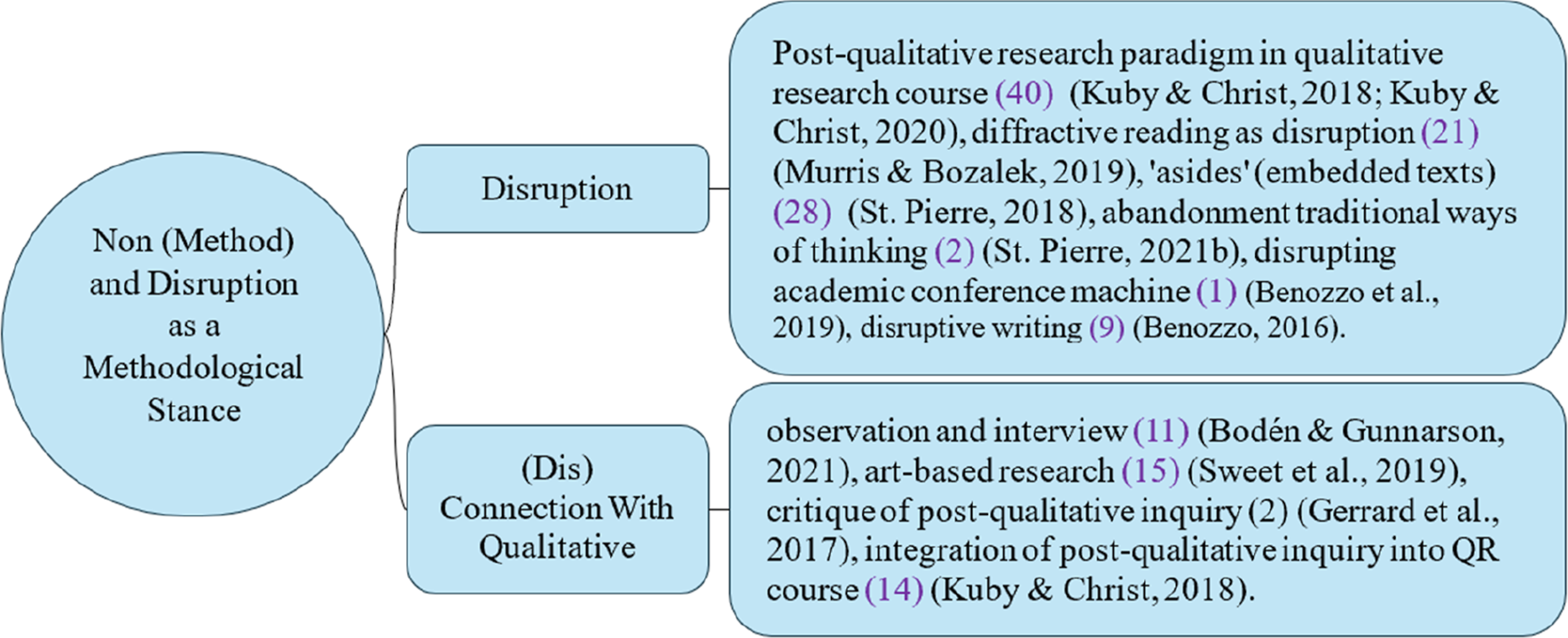
Kuby and Christ (2018) presented disruptive practices in teaching and learning in an introductory qualitative research (QR) course by inviting students to engage with fluid, malleable, and constantly evolving research paradigms. The authors applied the pedagogical approach and methodology of diffractive analysis, drawing on Barad’s (2007) posthumanism theoretical concepts, such as ‘ethico-onto-epistemology’, ‘intra-action’, and ‘spacematerring’, with particular attention to space, time, and materials in research. This allowed one to describe a similar approach to how phenomena emerge through interaction and how ‘cuts’ are made that create differences and allow cognition to occur. Meanwhile, Kuby and Christ (2020) introduced students to more diverse, disruptive, non-traditional, and non-dominant approaches to qualitative research. They teach students by inviting them to read Koro-Ljungberg’s textbook Reconceptualising Qualitative Research: Methodologies Without Methodology instead of Cresswell’s traditional books. This shift aims to deepen students’ critical thinking and to disclose comparisons with qualitative research.
The disruption manifests in reading and writing. Murris and Bozalek (2019) described diffractive readings of texts as methodology: ‘A diffractive reading is unlike a literature review as the latter assumes that you are at a distance from the literature, having a bird’s eye point of view – creating an overview by comparing, contrasting, juxtaposing or looking for similarities and themes. A diffractive reading, on the other hand, does not foreground any texts as foundational, but through reading texts through one another, comes to new insights’. (Murris & Bozalek, 2019, p. 3). St. Pierre (2018), as a disruption, used the deconstruction of poststructuralist ideas of texts and the deconstruction of language in her dissertation. Rather than presenting methodology separately, she engaged widely in reading philosophy, social theories, and the history of science and social science to find concepts that reorient thinking. As St. Pierre (2018) demonstrated, writing as a process of inquiry enables researchers to reveal the process of philosophical thinking.
The concept of ‘unraveling’ in writing as a research method is facilitated by deconstruction and Deleuze and Guattari’s (2004) concept of assemblage. Engaging with philosophy, not merely the methodologies of the social sciences, facilitates a transformation in thinking. St Pierre (2021b) noted that Deleuze’s philosophy encourages researchers to overcome traditional ways of thinking and to seek new perspectives.
As a main tactic, Benozzo et al. (2019) used unusual writing, such as cyborg writing, which provokes, returns, and disturbs the academic conference machine. Using unconventional and disruptive styles, Benozzo et al. (2016) delve deeply into their own practices. For example, the authors try out collective improvised collaborative writing in which researchers use dialogues between ‘imposters’ and characters in an IKEA advertisement, combining conceptual elements from organisational studies, poststructuralism, and LGBTQ theory.
Post-qualitative research draws parallels and establishes differences from qualitative research. Some authors state that in post-qualitative research, similar methods, such as observation and interviews, can be used as they are in qualitative research (Bodén & Gunnarsson, 2021). Sweet et al. (2019) suggested that the integration of PQI and a performative approach into qualitative research supplement each other and provide new insights into post-qualitative inquiry.
Furthermore, Gerrard et al. (2017) critically examined post-qualitative inquiry as a methodological approach due to the lack of ‘new materialism’ and ‘posthumanism’. According to the authors, post-qualitative inquiry can also include a humanistic point of view. Kuby and Christ (2018) integrated post-qualitative research into qualitative research courses, focusing on the creativity process over product and exploring how time is incorporated into the artistic process. This point of view makes connections with qualitative research, as post-qualitative research has been developed from qualitative research and can be successfully integrated into qualitative research methodology courses and qualitative research.
Discussion and Conclusions
This article demonstrates how a mixed-methods approach can be applied by combining bibliometric analysis with qualitative thematic analysis to enhance methodological robustness. The quantitative research method of bibliometric analysis, which is rooted in positivist epistemology, with an emphasis on objectivity, accuracy, and replicability (Donthu et al., 2021) and based on computational and algorithmic logic and statistically calculated occurrences, contributed to mapping the field and provided an understanding of the internal structure and trends within this area of knowledge. By analysing the body of literature comprising 325 articles, the bibliometric analysis allowed us to identify citation patterns, highlight the most frequently cited authors in the field of PQI, and distinguish keyword occurrences and clusters. We identified that the most central themes and strongest clusters of ideas (derived from the author keywords) were ‘new materialism’ and ‘posthumanism’.
The bibliometric analysis indicates that, based on citation frequency, the leading figure in post-qualitative inquiry is its founder, St. Pierre. Her publications form a primary foundation for understanding PQI. Furthermore, the most cited works highlight new methodological post-qualitative approaches, such as affective ethnography (Gherardi, 2018) and diffractive reading (Murris & Bozalek, 2019), and show how feminist new materialism could be employed within the practical contexts of concrete types of scholarship, such as health studies and sport sociology (Lupton, 2019; Markula, 2019), as well as how the politics and power of PQI work (Gerrard et al., 2017). The most frequently cited journals that disclose post-qualitative inquiry are mainly promoted in education, health, and sport studies. This research also illustrates how bibliometric analysis can be helpful for thematic synthesis by selecting articles for qualitative analysis based on statistical criteria, such as keyword frequency and citation levels.
At the same time, the qualitative analysis facilitated a ‘deep dive’ into the most influential publications identified through the bibliometric analysis. This involved subjective interpretation and meaning-making at all stages of coding and organising the themes. The qualitative analysis enabled a rich and detailed exploration of the features and characteristics of the field. The thematic synthesis literature review showed how PQI challenges traditional boundaries and liberates researchers from the constraints of qualitative research, with its prescribed rules and procedures. Articles on post-qualitative inquiry and research are heavily influenced by the work of the poststructura authors Deleuze and Guattari (2004), especially their concepts of assemblages, rhizome, becoming, nomads, etc. The practice of scholarship of post-qualitative inquiry and research is shaped by Haraway’s (1988) notions of situated knowledge and the cyborg, Braidotti’s (2013) concept of nomadic subjectivity, and Barad’s (2007) ideas of agential cuts, intra-action, and entanglement. It should be noted that Deleuze and Guattari’s (2004) concepts, such as de/re/territorialisation, territory, and lines of flight, are either not mentioned in the articles under qualitative study or are mentioned only rarely.
Thematic analysis demonstrates how philosophical ideas and concepts are enacted in empirical research, as well as how researcher-data-environment entanglements and amalgamations emerge. It shows how writing styles are practised and how improvisations and experimentations are applied in empirical research endeavours. The central themes of new materialism and posthumanism are reflected through six analytical themes that distinguish and reflect concepts of assemblages involving human, non-human, and more-than-human agents, the idea of decentring human agents, the creation of new concepts and research-creation practices, and the concepts of affect and becoming.
The first analytical theme, ‘Relational Ontologies’, uncovered the significant poststructuralist idea of assemblage. It highlighted a key concept in new materialism: interactions and assemblages of human, non-human, and more-than-human entities. Ideas from new materialism are reflected by illustrating how different material bodies (such as glitching bodies, physical bodies, queer bodies, etc.) shape various assemblages within empirical research on post-qualitative inquiry. These bodies’ relations, entanglements, and assemblages are examined through the lens of philosophical ideas from Karen Barad, Donna Haraway, and Rosi Braidotti through empirical feminist research (Brice et al., 2020; Linghede, 2018), queer studies (Landi, 2019), sports scholarship, and pedagogical inquiry, with a focus on environmental education (Clarke & Mcphie, 2020; Jukes & Reeves, 2019; Mannion, 2019; Ruck & Mannion, 2019; Weldemariam, 2019). Barad’s concept of the ‘agential cut’ appears in various articles that explore scholars’ and research participants’ interactions and relations with artefacts and non-human agents while cutting and sewing bags (Taylor et al., 2019) and cutting pieces as an experimentation in the physical act of cutting together-apart in physical education (Brice et al., 2020).
The analytical theme ‘The Posthuman’ reflects a critique of the Anthropocene, challenging the anthropocentric perspective, decentring humans and researchers as power-holding agents, highlighting the importance of non-human beings, and addressing environmental issues (Jukes & Reeves, 2019). In addition, the posthuman perspective seeks to disrupt established norms in scholarship and ‘doing science’, which involve strict normative methodological procedures and communication practices, such as traditional conferences (Benozzo et al., 2019), a binary understanding of gender (Benozzo et al., 2016), and a fixed relation between human and non-human elements (Benozzo & Gherardi, 2019). Furthermore, this analytical theme disclosed that the teaching and learning of qualitative research methodologies should incorporate more-than-human approaches and non-human elements, exemplified by research on reading books on post-qualitative inquiry within the university studies context (Kuby & Christ, 2018).
In the third analytical theme, ‘Affect and Embodied Knowledge’, the central position considers emotions, affect, and the body together when the authors discuss embodied movements (Fullagar et al., 2021), affective ethnography (Gherardi, 2018), and affective learning (Weldemariam, 2019), as well the creation of various assemblages, such as the entanglements of patients, researchers, personnel, and equipment in medical environments (Wyer et al., 2017). In this analytical theme, in presenting embodied situated knowledge, special attention is paid to body assemblages, such as woman-sport artefact assemblages (Brice et al., 2020), queer bodies assemblages (Landi, 2019), and embodied movement-writing assemblages in sport education (Fullagar et al., 2021).
The fourth analytical theme, ‘Open-Ended Nature of Research’, demonstrates how scholars, as well as other human and non-human participants and agents, are engaging in various forms of becomings. The evolving and dynamic assemblages in post-qualitative research are described as ‘becoming art’ (Sweet et al., 2019), ‘becoming research’ (Sweet et al., 2019), ‘becoming bee’ (Weldemariam, 2019), and ‘becoming embodied writer’ (Guttorm et al., 2016).
The fifth analytical theme, ‘Novel Research Practices’, uncovered St Pierre (2018, 2021a, 2021b, 2022) insights on post-qualitative inquiry, including that it can be developed without robust methodological prescriptions and rigid methods. This perspective shows how new concepts, such as cheer* (Setchell et al., 2019), affective ethnographies (Gherardi, 2018), and research-creation (Sweet et al., 2019) are developed. In addition, various new concepts emerge in reading and writing, such as ‘diffractive reading’ (Murris & Bozalek, 2019), ‘cyborg writing’, and ‘prospective writing’ (Benozzo et al., 2019).
The sixth analytical theme, ‘(Non)Method and Disruption as a Methodological Stance’, emphasised that PQI involves disruption and discontinuity (Benozzo et al., 2016, 2019) and creates tensions with conventional methodologies (Gerrard et al., 2017). However, Gerrard et al. (2017) argued that an emphasis on ‘novelty’ and the discourse of the ‘new’ can weaken the sense of continuity and connection to the past. PQI, as a ‘new’ ontology and methodological movement rooted in new materialism and posthumanism, overlooks broader ethical and political implications. Gerrard et al. (2017) emphasised that PQI researchers tend to concentrate more on data, fieldwork, and themselves, detaching from other people embedded in political and social worlds, as well as from the broader social and political context. Therefore, PQI researchers should pay more explicit attention to the political and historical relations of social power and address issues of marginalisation and oppression within the context of global inequalities.
This study revealed the ongoing tensions that exist between conventional and post-qualitative inquiry (Monforte & Smith, 2021) and the divergent as well as convergent nature of the interaction between PQI and qualitative research (Gerrard et al., 2017). According to the authors, PQI rethinks the fundamental concepts of qualitative research, such as ‘data’, ‘interview’, and ‘representation’. Although this contradiction persists, we tend to agree with Monforte and Smith (2021) and Camiré (2025) that qualitative research and post-qualitative inquiry can coexist and thrive, complementing each other and entangled in their becomings. As Monforte and Smith (2021) highlighted, this can be achieved by promoting a new paradigm, ‘agonistic pluralism’, which, unlike antagonism, fosters dialogue among representatives of different methodological approaches.
Our research highlights the potential value of PQI for practitioners across diverse professional fields, including teachers, healthcare and medical professionals, policymakers, sustainability workers, and others. Teachers and educational researchers can foster experimental pedagogy and introduce innovative practices, such as cyborg writing, art-based inquiry, theatre-based learning, and physical education. Healthcare workers and researchers can work towards a deeper understanding of the complex entanglements of patients’ emotions, bodies, medical technologies, and social contexts. PQI ideas can assist policymakers in creating spaces for innovation and raising awareness of sustainability issues and inequalities, while considering posthumanism and feminist new materialism approaches.
Our findings reveal the intellectual structure of the terrain of PQI, which thrives on the ideas of creativity, freedom, and nomadic thinking. This approach rejects hierarchical structures in favour of more fluid and open-ended epistemologies, resisting rigid frameworks and embracing uncertainty and multiple perspectives, as well as exploring new ways that enact research as ‘becoming’.
Footnotes

Funding
The authors disclosed receipt of the following financial support for the research, authorship, and/or publication of this article: This study is supported by the Lithuanian Research Council (LRCLT), project: “Rhizomatic Learning of Scientific Research Methodologies Among Education Researchers: Trajectories of Assemblages and Becomings”, funded by the Lithuanian Research Council (LRCLT), Contract No S-PD-24-116.
Declaration of Conflicting Interests
The author declared no potential conflicts of interest with respect to the research, authorship, and/or publication of this article.