




Abstract
Qualitative research often involves the collection of data from multiple sources, inclusive of the embodied and multisensorial. These differing data sources, that are not language based, pose difficulties for researchers. Often this multimodal data is collected alongside interviews, field notes and other language-based data and then translated into language. In the process of this translation, the embodied, relational, and multisensorial aspects of this data is often lost. To address this issue, we created Embodied Mapping/s (EM) as an approach for collecting, analyzing and becoming-with non-language-based data. This doing of embodied mapping/s is not about fixing lines and encounters in order to produce a two-dimensional cartography, plan or model; on the contrary it is about exploring differing embodiments and material relations among people and things to create a new inquiry in embodied and multisensorial research and methodologies. Embodied mapping/s suggests a need for a more holistic exploration of qualitative methodologies beyond language and visual communication. Through centralising embodiment, not only as an analytical method but also as something that informs innovative methodologies and methods, these doings of embodied mapping/s offer something novel to qualitative inquiry and embodied methodologies. To evidence the doing of embodied mapping/s, two multi-sited case studies in Canada will be explored—the Canadian War Museum in Ottawa; and the Canadian Museum for Human Rights in Winnipeg, to advance methodological insights in relation to multimodal and multisensorial research.
Introducing: Relational and Embodied Research
Imagine a thread. What does this thread represent? How do we descibe it? Could this thread be data? As we unravel this thread to analyse it, it begins to open things up and allow the reseracher and the research to become undone. This undoing is presented here through the co-constitution of Embodied Mapping/s (EM) and is a following of materials, not methods, and a becoming-with. This relational process is the anticipation of what might emerge, the openness of an exchange, yet possibility for structure. Qualitative inquiry requires that we be critical of our ways of knowing through methodologies and methods—doing embodied mapping/s allows for an undoing of methods and a questioning of the situatedness of the researcher to the research through a becoming-with. Here, we are speaking to our relationship to the data and the participants (both human and non-human). The researcher in this sense is not leading the research through a prescriptive method or methodology but following the research as it unravels. This is not just an iterative process but a process that has no prescribed path.
In order to not lose the multisensorial data in the world of words in this paper, we have woven the images throughout the text to make the embodied mapping/s process more concrete and to make this paper itself multisensorial and multimodal.
Qualitative research involves data from multiple sources and media (Denzin, 2010; Guttorm et al., 2016; Jackson, 2017; Jackson & Mazzei, 2011; Watson, 2020). These differing data sources, that are not language-based, pose challenges for researchers and difficulties for analysis. When multimodal data is collected (like photos, soundscapes and videos for instance) alongside interviews, field notes and other language-based data, this multimodal and embodied data is most often translated into language. It is in this process of translation where the embodied, relational, and multisensorial aspects of this data are often lost (Figure 1). Human and non-human encounters at the Canadian War Museum (CWM) to co-create Embodied Mapping/s (EM).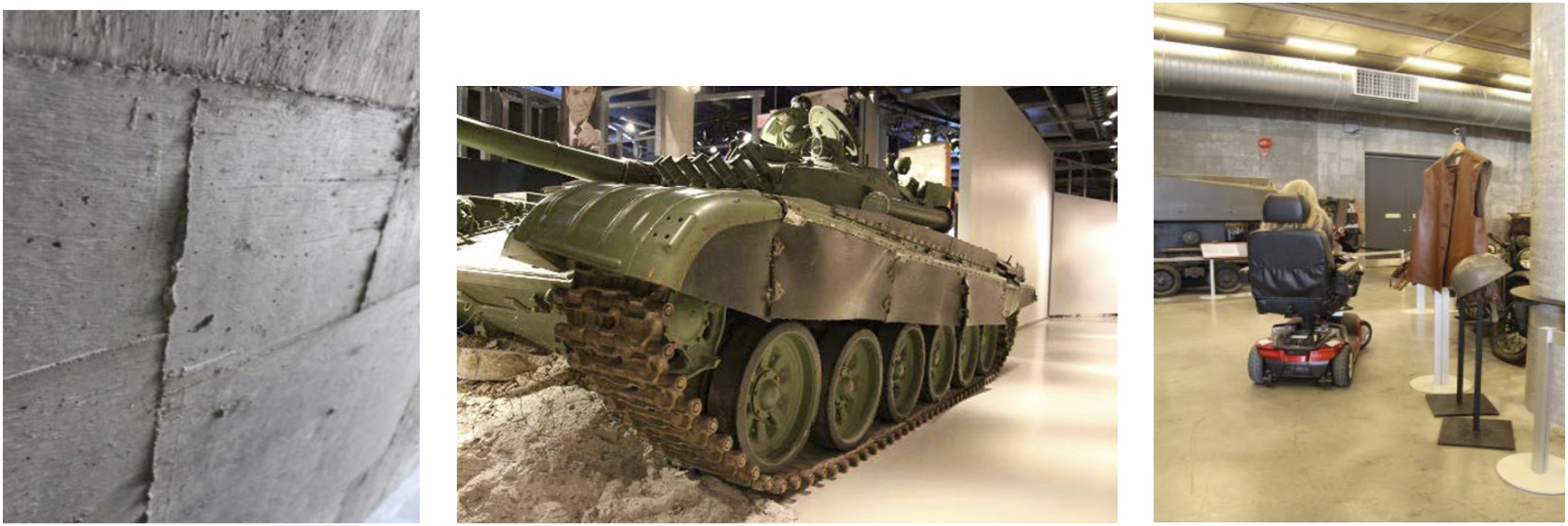
To address this issue, we present a new kind of embodied methodology—a doing of Embodied Mapping/s (EM) for collecting and analyzing multisensorial and embodied data. A mapping of material relations to bring forth a novel methodology for qualitative inquiry. Here, material relations are about the relations between the researchers and the participants and the things that they encounter together (for instance, walking through a museum with a participant who is blind and their dog-see Figure 2). While an immediate thought might be to separate out the data into sensorial categories (sound, smell, taste and sight), into sonic mappings, photographic mappings, smell mappings or taste mappings; this process is about creating more holistic multisensorial embodied mapping/s that reveal information about material relations and a body of research (Rieger, 2016). Images of dialoguing while wandering at the Canadian War Museum with a participant who is blind and their dog.
In this paper we first overview the need for a more nuanced qualitative approach for embodied and relational research beyond what has been offered through other embodied methodologies. Second, we discuss the underlying theories of embodied mapping/s and offer a process outline called MAPPINGS. We then offer an example of embodied mapping/s through our case study research of two museums. In these case studies, we explore differing embodiments of people and things and specifically our encounters with people with disability and their embodied knowledge. Embodied mapping/s as an approach is not specifically about working with people with disability but rather inclusive of differing embodiments of self and others and understanding these relations to non-human actors. These points will be expanded upon through a discussion of the doing of embodied mapping/s in the two museum case study examples. Finally, we offer key insights and examples of embodied mapping/s and how it can be braided with other methodologies, methods and creative outputs to expand on the body of knowledge in embodied methodologies.
Embodied Mapping/s: Novel Ways of Doing Qualitative Research
Embodied mapping/s is a novel methodology that braids together threads of sensorial and multimodal data that goes beyond language and pushes against the well-established methods of data collection and analysis. It moves beyond methods and even theory-as-method as it becomes an entanglement of doing and becoming undone. Reflecting and revisiting, asking and pausing, then being critical of prevailing knowledge, especially our own knowledge, is imperative to doing embodied mapping/s.
Research and its design are often a shaping of knowledge, but this does not mean there has to be a focus only on attaining the knowledge necessary to create a knowing; it means that knowing must be seen as a considered and unconditional openness, and therefore entangled with an unknowingness (Loacker & Muhr, 2009; Rieger et al., 2022). But what about knowledge outside of language - embodied knowledge? How do we shape this knowing? Doing embodied mapping/s relies on an unknowingness and a process that contests the coding of qualitative research. So, the question we kept asking ourselves was: do we have the right tools to analyze this kind of embodied and multisensorial data? As part of our process, we explored software that codes data and also tried other types of coding strategies, but the process of data analysis did not seem to align with our embodied research design. We started to question whether it is possible to code through embodiment and not language alone? Would this coding or pattern recognition then become a different kind of thematic analysis, one done through embodiment? If so, then whose embodiment(s)? Is this embodied coding done through knowing-doing alone or through knowing-doing together? Do these mapping/s elucidate a new kind of multisensorial and embodied semiotics beyond a material semiotics? Are the doing of these dis/ordered mapping/s a Deleuzian enterprise? It was in these questions that we chose to pursue a differing kind of methodology and develop Embodied Mapping/s (EM).
We also looked at how other scholars have explored similar qualitative approaches and specifically embodied methodologies. Embodied methodologies do exist, as in the work of Kriger (2019) and Gillies et al. (2005), but they are often focused on health research and autoethnography. Studies that speak to embodiment or embodied methods are often only looking at the human body and more specifically that of the researcher (Ellingson, 2006; Francombe-Webb et al., 2014; Gale, 2010; Schuster, 2013), and not bodies in motion and the entanglement of bodies with non-human things. Chadwick (2017) argues that despite a decade’s worth of research with ‘embodied methodologies’, we are no closer to solving the problem identified by Frank (1995) 20 years ago that no satisfactory solution has been found to avoid reducing the body to a thing that is described. Our embodied mapping/s offer something new to the development of embodied methodologies, in that it extends sensory approaches to qualitative research analysis, which most embodied methodologies have not (O’Dell & Willim, 2013; Chadwick, 2017). According to Chadwick (2017): The driving impetus and assumption behind most work on bodies/embodied methodologies is to ‘get beyond’ the discursive, talk and text. It seems we are no closer to solutions as to how to go about doing this in qualitative research. However, perhaps the objectives and starting points for developing ‘embodied methodologies’ need more careful questioning. Should a key objective of embodied qualitative methodologies be to find ways of accessing ‘the body’ outside of talk, language and discourse? (p. 58)
Our embodied approach is not about one body (most often the researcher’s embodied reflections) as it can only work as a co-constitution. This is not a limitation of the approach, but a more finely tuned relation between the approach and what it aims to investigate and transform. We point out the idea of embodiment in relation to process and enactments, to emphasize process as something that is open, ongoing and inhabited. We move away from other methods of data analysis that sometimes bracket off embodiment in practice, and instead look at a doing of embodied mapping/s as a dynamic process and open doing. Lastly, research studies that speak to embodied methods, and embodied ways of doing data collection beyond language, more often than not turn that data back in to language, even if poetic language, to then analyse it.
So we tripped and stumbled and decided to follow the threads of this research and how the threads started to create mapping/s and new trajectories for embodied research. As these doings of embodied mapping/s are case and encounter-specific, and specific to the embodying in cases, the mapping/s are not meant to become a model. This was our reluctance to create these mapping/s in the first place, as this research is about pushing against models and prescriptive thinking in general. But if, indeed, we have created something different and dis/ordered than it is important to explore it through other cases, through new spaces and with other things. Embodied mapping/s has the potential for contributing to the growing field of new embodied, creative and innovative qualitative methods.
Embodied mapping/s are also not focused on contributing to the field of creative arts-based approaches to qualitative inquiry, however through the differing explorations with people and things, this approach may indeed contribute more broadly to creative arts-based approaches and work. We did not set out to explore fibre arts, sketching, visual mappings, films or soundscapes in this research, but this is where the encounters pushed us and by following these threads it led us to these embodied and multimodal explorations (Rieger, 2016). Our embodied mapping/s push towards new trajectories for qualitative inquiry within relational ontologies, where: we catalyse agency, all of us, and thus respond to how existing relations and future encounters are made possible. Our being and becoming with is always situated and embodied but also constituted in relating, located in between, and co-shaping new entanglements. This is relational ontology where agency is mutually constituted through relations to other things and people (Light & Akama, 2014, p. 159).
The genealogy of doing embodied mapping/s does not come from cartography, as cartographies often plot lines of entanglement between knowledge and power, discourses of practices, and conjectures of how foldings-together and/or unfoldings might occur and impact surfaces (Rieger, 2016). Doing embodied mapping/s draws from a Deleuze-Guattarian methodology and enables the researcher to be a co-producer of knowledge through an entanglement with human and non-human things (Andersson et al., 2020; Deleuze & Guattari, 1987; Deleuze & Guattari, 1983). This approach to qualitative research is a decisive onto-epistemological shift to enable embodied and multisensorial knowing, in the way that we collect our data, the kinds of data we chose to collect, and how we analyse that data (Lenz Taguchi, 2012; Lenz Taguchi & Palmer, 2014; Rieger, 2016; Rieger et al., 2022; Rieger & Strickfaden, 2018b). Doing embodied mapping/s likens itself to Denzin’s (2010) ‘somewhat more radical position’ of subverting dominant paradigms, pushing progressive politics, and creating a bricolage that points to the complex intersections of epistemology, methodology, and inquiry techniques (Watson, 2020).
Doing embodied mapping/s is to follow the relations of things in order to explore movements, flows, trajectories, and encounters. As researchers we mobilise creative tools and resources, through considering the multimodal data that we need to collect, to map processes in which things and their relations emerge and become ordered and disordered (Moser, 2006; Rieger & Strickfaden, 2016). Doing embodied mapping/s allow for a perceiving of things from multiple viewpoints and a diversity of physical positions (Casey, 2001). The result is a translation of sensorial and multimodal data that goes beyond language, pushing against preconceived models and images of the ‘look’ and ‘should’ of mappings. These embodied mapping/s are created though chance encounters with people and things, and a giving-in to following where these encounters may lead. Doing of embodied mapping/s creates new trajectories for qualitive research with doing-as-method to explore the relations between things, and to follow an embodied approach.
Doing Embodied Mapping/s: Not as a Product but as an Embodied Process
Doing embodied mapping/s follows threads that are shaped through and by embodiment, enabling embodiment to become the continuous line that weaves through all of the data collection and analysis - the doing of this research. Embodiment is not just about the human body in embodied mapping/s; here, all embodiment matters—the human-to-human embodied encounters as well as those with the non-human. It is not a matter of the researcher deciding what embodiment matters, as sometimes non-human things push and press upon the participants and researchers. The multisensorial and multimodal data is collected through a following and not a prescribed research protocol. Participants are invited to encounter a space, things within a space, people and other things, and can chose the path they want to follow. The paths of the data collection are not determined in advance but rather are an unfolding. For instance, while moving through a museum in Canada, a research participant who was in a wheelchair could not access certain parts of the museum and exhibitions because of physical barriers and objects. Here, these non-human actors (like stairs and pillars) and their agency, determined how we encounter the space, and its narratives were determined by access and not by the researchers. The constituents in this research therefore are not determined by the researcher, nor are the ends, but rather come together and push and press their way into the research and its co-construction.
Doing is about a relational process and not about creating a product. The process emerged from the analysis of entangled threads of mapping/s upon mapping/s. It is important here to distinguish between mapping and maps, between cartography and cartographies. This methodology is not about fixing lines and encounters onto a map but is a doing of embodied mapping/s to explore the material relations of qualitative research (Rieger, 2016). These mappings are about the process of doing and not about the process of producing through methods, which differentiates this approach from other methodologies.
Doing embodied mapping/s and the making of mapping/s are very different processes. The 'making of mappings' is more of a process towards making a product while doing mapping/s is more a process of investigating, exploring, and creating multiple and complex mapping/s, not maps. What can be celebrated here is how the idea of doing mapping/s creates flows, movements and trajectories that move beyond the making of hylomorphic models (Ingold, 2010) of form and matter. Making has more 'mental imaging’ and form to it than a doing. In that sense, making has an end goal of a made product but doing is about the process of exploring and becoming undone (Rieger, 2016). In doing embodied mapping/s, lines are articulated, as they show the encounters between things (people and people, sounds and spaces, movement and planes) as the data is being collected, analysed, and explored (see Figures 3–5, 8 and 9 for lines of mapping/s). Sketch mapping/s of lines in the Canadian Museum for Human Rights (CMHR). Details of Fibre Mapping/s of Canadian War Museum and Canadian Museum for Human Rights. Photographing sloping walls at the Canadian War Museum.


Deleuze and Parnet (1987) expand this idea of mapping claiming that: “To extract the concepts which correspond to a multiplicity is to trace the lines of which it is made up, to determine the nature of these lines, to see how they become entangled, connect, bifurcate, avoid or fail to avoid the foci. These lines are true becomings, which are distinct not only from unities, but from the history in which they are developed” (p. viii.). The potential for and possibility of lines as becomings is as the weaving of warps and wefts that connect and become entangled in the process of doing mappings. These encounters with human and non-human things have consequences, and collecting, transcribing, interpreting, and exploring these relations can be understood as an embodied activity—a doing. Recognizing the embodied experience, the knowingness and unknowingness of a researcher, creates the possibility of unveiling hidden fore-meanings, especially the destructive ones that affect the research process (Rieger, 2016).
In doing embodied mapping/s it is necessary to illustrate the lines, flows, and trajectories of embodiment(s) and their interconnected encounters. Doing embodied mapping/s allows for a drawing of the relations and entanglements of the data through movement, which is paramount to understanding embodiment and multisensorial encounters (this is why it demands multimodal and moving data like videos and audio walks). Recognizing the process of mapping in this research stemmed from the struggle to draw movement and to try to move beyond flat two-dimensional diagrams, models, tables, and sketches. When it was decided to create multiple mappings (some of which are three dimensional and tactile) we came to understand the layers of this research in relation to embodiment(s) (Rieger, 2016).
The lines of these mapping/s are not drawn in advance and then traced and retraced as a familiar form. Instead, these lines move in rhizomatic ways, in many different directions and with no set direction. This doing of mapping/s flows like “a rhizome and is not amenable to any structural or generative model” (Deleuze & Parnet, 1987, p. 12). Deleuze and Parnet (1987) state that a rhizome is “a map and not a tracing”, that “the map is open and connectable in all of its dimensions; it is detachable, reversible, susceptible to constant modification. It can be torn, reversed, adapted, to any kind of mounting, reworked by an individual, group, or social formation” (p. 12).
What we propose here, our embodied mapping/s, acknowledges the rhizomatic nature of knowledge production, in Deleuzian fashion. The approach is utterly useful for exploring situations where space, identity, and discourse relate in complex patterns which cannot be explored easily with other language-based research methods, based on tracing discourse or mapping space, or which start from predefined identities. As information provided by the different senses cannot be easily translated back to each other, without a loss which can be essential, one needs to consider different senses at the same time, yet through a process of mapping and materialization of those mappings which can guide the exploration towards different relations between the senses.
Overview of Doing of Mapping/s.
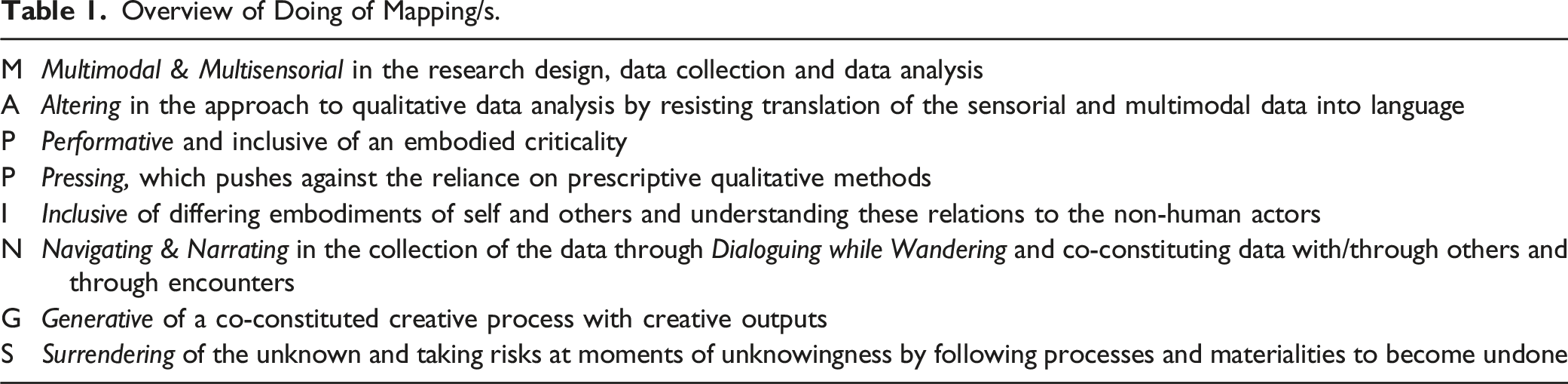
First, like most qualitative research, to employ embodied mapping/s, the researcher must determine the research problem, research question/s, and rationale (see Creswell, 2009). In MAPPINGS, each of these eight aspects needs to be incorporated into the research design, data collection, data analysis, and dissemination, so in this way doing embodied mapping/s is a methodology. Doing embodied mapping/s is inclusive of all eight aspects of MAPPINGS but is not just for case study research. It can be braided with other qualitative methodologies like ethnography, participatory action research (PAR) and even Grounded Theory (GT). In this paper we explore the doing of embodied mapping/s (EM) through two case studies on museums that highlights the eight different aspects of MAPPINGS.
Doing Embodied Mapping/s through Case Study Research
Here we present the threads of doing EM through the Canadian Museum for Human Rights (CMHR) and the Canadian War Museum (CWM), as exemplars of doing EM. Doing EM is about following lines and threads—lines through library stacks and museums, through airports and on buses, through blizzards, on trains, in cars, in wheelchairs and scooters, on bikes, through hands, and from feet on the ground (Rieger, 2016). These lines come together to create mappings made of differing embodiments and wandering movements with human and non-human things. The people and things encountered through these wandering lines became entangled, in this case with this research. Things entangle in ways that move beyond participatory practices and methods, towards a becoming-with.
In the case studies presented here these stories are about disability and ability; remembering, forgetting and silencingand ways of knowing through processes and products that are inclusive of differing lines of embodiments (reading, digging, resting, wheeling, swirling) (Rieger, 2016). These thematic threads came out of the doing of EM and from across all the of multimodal and multisensorial data collected across the CMHR and CWM museums.
This paper presents how, by doing EM in these case studies in Canadian museums, this research pushed into encounters with threads and makers. The doing of EM does not require a 3D fibre mapping, nor inclusion of a fibre artist, as every doing of EM has different creative outputs based on the co-creators/participants and things. The mapping/s described here were more than a following of materiality and threads; they also revealed a relation around doing difficult knowledge. It is through the handing over of the data to be woven and encountered differently, through both human and non-human things, that allowed for a becoming-with. And it is the encounters with boards, nails, mail, threads, hands of the maker, and words through emails that moved the data out of the hands of the researcher. The data could then be played with through other forces, could become entangled with difficult materials which pushed and pulled this research into new encounters between the maker of the mapping/s, the researcher, and the other things, and in so doing created new dialogues and trajectories, unknown to the researcher.
In doing these EM one might ask who and what is included, and who and what are excluded, and who makes this decision? Like all research methods, biases and limitations need to be articulated. In EM we reflected on the biases and limitations of this research through what we call ‘material memoing’ which translated into the creation of bias lines in the mapping/s. Creating threads of bias lines in these mappings and articulating their entanglements with the doing of these mapping/s enables opportunities for reflection and alternate trajectories to unfold. After all, why can’t the limitations and biases in our research be articulated beyond language and through threads?
Embodied mapping/s was created through case studies created with two national museums in Canada. The data analyses initially involved a doing of mapping/s for each case study separately, then moved into a dynamic layering of the mapping/s. Data was organised by embodied explorations and not according to types, or themes, or separated though software. Instead, the data was laid out on the ground and shuffled around. It was this embodied activity, this overlapping of images, stories, handwritten and typed text, that enabled us to see relational encounters (Rieger, 2016). The aim with this doing of EM is not to rely on temporality as the organizational frame, rather an embodied and relational frame that disentangled and entangled as we engage(d) with things. Each case has differing kinds of encounters and so the wanderings and lines of the mapping/s of each case is different.
Using embodied encounters as the weaving line for the data organization and analysis provides a new understanding for qualitive inquiry. One mapping is not greater than another mapping. They are non-hierarchical. The process involved layering embodied lines and showing their entanglement with other things, and then exploring the encounters of all these things. The sketched two-dimensional lines felt too fixed, too rigid for the fluidity and flows of movement, and so we decided to map these encounters through differing embodiment(s) and materials into three-dimensional fibre explorations (see Figures 8 and 9). The lines demanded to be touched, played with, looked over and under in order to draw out exactly how these lines were entangled, and the importance of their encounters. This is not to say that sketched lines do not have flow, pause, and movement. They do. We wanted to explore these lines through another medium, another body, other materials and through multisensory modalities. The process of doing fibre mapping pushed and pressed in ways we could not have imagined. The translation of the line drawing to the doing of fibre mapping/s entangled with difficulties of materials, sizing, communications between both makers, and the difficulties in shipping, formed the data analysis (Rieger, 2016). To unpack this process further we briefly outline the doing of EM in the two case studies for the reader to start to think about how they can use MAPPINGS to inform their embodied methodologies and embodied research.
M: Multimodal & Multisensorial in the Research Design, Data Collection and Data Analysis
Multimodal and Multisensorial Data Collection.

For the CWM and CMHR case studies, interview participants were recruited for each study (for a total of 38 interviews) so that an understanding of the lived and embodied experiences of each participant could be understood and mapped in relation to the case study. These participants included architects and other designers who worked in the museums, curators, engineers, facility managers, historians, tour guides, archivists, librarians and visitors with diverse abilities. During the interviews (often 60 mins in length) audio and video recording data was collected (inclusive of soundscapes) and photographs were taken to map all the multisensorial and relational encounters (see Table 2).
A: Altering in the Approach to Qualitative Data Analysis by Resisting Translation of the Sensorial and Multimodal Data into Language
It is prudent to point out that many studies talk and write about mapping, but when the study is actually articulated it is not about a doing or a making of a mapping at all (Rieger, 2016). By following the lines of embodiment throughout this research and pursuing them even when it seemed they were becoming wild and disorderly, and then resisting turning this data into language, allowed for a braiding together of our data analysis, our methodologies, and our data collection methods in EM (Rieger, 2016). For us and for this research, the doing of EM was about the process of understanding the embodied experiences of people with disabilities and the process of creating with a fibre artist (Rieger, 2016).
P: Performative and inclusive of an embodied criticality
Considerations around an embodied criticality moved into lines of silencing at the CWM which flowed through/from ableist discourse. This ableist discourse is around the design of the museum (its building, site and exhibits) and around the fit able-bodied soldiers and veterans (Rieger, 2016). Ableist discourse also shapes the understanding of the users/visitors so that they are seen as a fixed and ordered object, stakeholder, or code, and does not consider the user/visitor through ongoing and complex embodiment(s) (Rieger, 2016). An architect of the CWM comments: Yeah, texture…and at some point, I’m wondering if the design isn’t going to be an issue to have sloping walls. But what we found and rightfully so is that because it’s leaning, people actually move away further from it and there’s been no issues of any type of scratching or hitting the walls. So I think we’ve tried and used our hunch that people will move away [from the sloping walls] and it’s kind of proven to be true. (Dialoguing while wandering interview with an architect of the CWM April, 2015).
Here the focus on the design of an ableist building as a product with textures and sloping walls does not consider the diverse embodiments that actually play out in this space (Rieger, 2016) (see Figure 5). This “hunch” is contrasted with observations (from another designer visiting the CWM) of the actual diverse embodied experiences of the sloping walls and their effect on users/visitors (Rieger, 2016): [I] start walking up the long ramp to get out of that space and hear two old vets, halfway up, and they’re using wheeled walkers. And they’ve gotten halfway up the ramp and there’s no flat area in that ramp. And they have worn themselves out, so they are halfway up and they decide they’re going to lean against the walls. The walls are angled. And so here’s these two older gentlemen and there was virtually nothing I could do to help them, but they’re trying to lean against the walls to rest. And I said okay, who's the most likely customer? Who is the person that's going to go up these ramps, it's going to be a vet. Why would you have not thought… we need to have a rest station (Face-to-face interview, June, 2015).
Extending upon this line at the CWM through the stories and embodied experiences of soldiers and veterans, the articulation of the disabled soldier and disabled veteran is silenced because it is overtaken by ableist discourse around the fit, young, able-bodied user (Rieger, 2016). Through the layering of the photos, dialoguing while wandering interviews, seated interviews and soundscapes this underlying line of silencing pointing to ableist constructions becomes apparent and begins to become a thread in the CWM EM (Rieger, 2016). This holistic understanding of these issues would not have been understood though interviews and language-based data alone—it was only through this multimodal and multisensorial data that these threads emerged.
P: Pressing, which Pushes Against the Reliance on Prescriptive Qualitative Methods
In collecting multimodal data as lines of inquiry for our EM one of the lines that emerged was around mediated knowing, which became the mediated line in the EM. Here, pressing as a part of MAPPINGS refers to the understanding that we need to push and press beyond prescriptive methods and data collection based on language alone. Here, pressing beyond interviews and their transcriptions for analysis, we also pressed our research into new directions and with other people and things. We encountered the museum with a participant who was blind, and walked and talked with them for hours as we photographed and videotaped our shared encounters with the museum and its exhibitions (Rieger, 2016). We also interacted with non-human objects like tactile maps, technologies, and tactile strips on the floor to follow these mediating lines and explore an understanding of access and inclusion beyond interview data (Rieger, 2016).
The CMHR does not have many tactile exhibits other than through the embodied encounter of touching of a screen, but they do offer tactile maps for their visitors, especially visitors who are blind or have low vision. A museum director at the CMHR responds to how the tactile maps are used in conjunction with the audio tours: “So those worked really well in conjunction with the tactile map because it’s going to describe all the main elements within the gallery, and then you could actually feel what those elements are in situ” (Face-to-Face Interview, June, 2015). Our wanderings, with a participant who is blind, explored a different kind of encounter with these tactile maps at the CMHR. The participant who was blind explained that the raised lines on the tactile map were created from vision and knowledges of/through vision; therefore, they could not be understood through touch or by someone who is blind as they were just raised lines on a page (Rieger, 2016). Following the lines of mediated knowing further we came across technology that was designed for inclusive access through audio features in the exhibitions. To indicate where these universal access pads were located in the exhibition spaces, the museum installed a white tactile strip on the floor for wayfinding (see Figure 6). Our wanderings with a person who is blind at the museum revealed that quite possibly these tactile strips were designed through visual knowledge, as they were not detectable to blind participants (see Figure 6). This kind of embodied knowledge was only possibly through complex weavings of multimodal data and with differing embodiments. Images of dialoguing while wandering in the Canadian Museum for Human Rights to analyse tactile wayfinding. Images of embodied exhibitions from Canadian War Museum and Canadian Museum for Human Rights.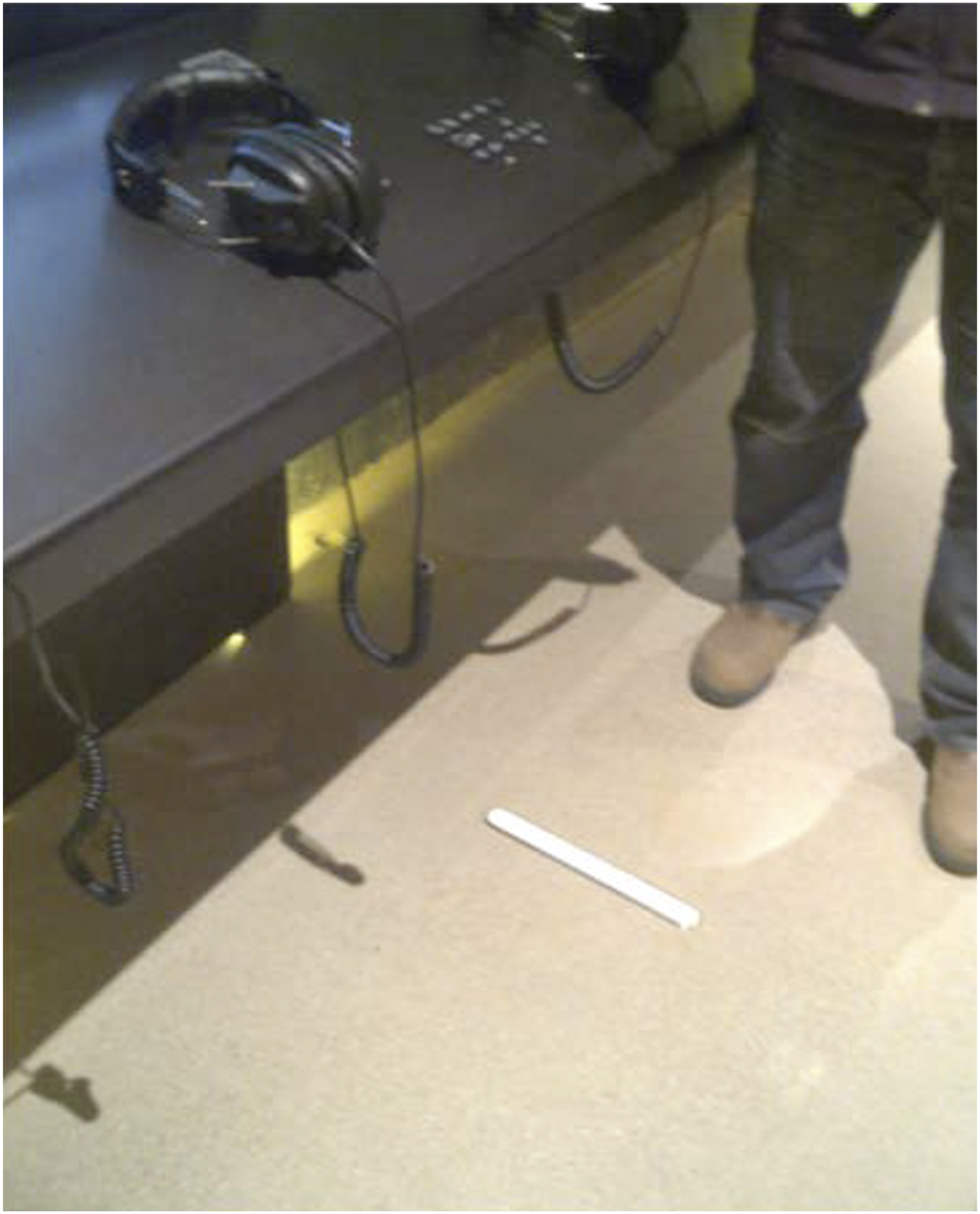

I: Inclusive of Differing Embodiments of Self and Others and Understanding These Relations to the Non-human Actors
Here, we followed lines of remembering and how these lines became entangled mapping/s with human and non-human things. In the museum case studies, we discovered lines relating to knowledge and power, discourses of practices, materialities of seeing, telling, and doing, and mapped these lines in our EM (Rieger, 2016). While lines are something we think of as remembered and tangible, there are also lines that point to things forgotten and absent. As the lines of these two museum case studies were mapped out and layered upon one another, what was intentionally remembered and forgotten became very apparent (Rieger, 2016). These lines can be thought of as sociocultural memories of that which is spoken and that which is silenced. Interestingly, much of the spoken aspects of disability were about empowerment, heroic acts, and creating explicit inclusion, whereas the silenced aspects of disability were historical events, peoples and places that were thought to have messages more valuable than the ones disability could tell (Rieger, 2016). We mapped this through our threads and entangled lines (see Figures 3, 4, 8 and 9). Fibre Mapping/s of the Canadian War Museum (CWM). Fibre Mapping/s of the Canadian Museum for Human Rights (CMHR).

These lines of remembering were only made apparent through the collection and analysis of a multimodal and multisensorial data set in these two museum case studies (see Figure 7). It was also not just collected by the researcher(s), but through a coming together of people with differing embodiments and encountering objects, documents, spaces and services in the museums, and then mapping these lines, these threads and their entanglement through EM (Rieger, 2016).
N: Navigating & Narrating in the Collection of the Data through Dialoguing while Wandering and Co-constituting Data With/Through Others and through Encounters
We created an embodied interviewing method called Dialoguing while wandering to uncover a world perceived from different angles and viewed through diverse vantage points (often with participants who are Deaf, blind, have low vision, use a wheelchair or other mobility aid, and those that identify as neurodiverse). Thus, allowing for a perceiving of things not from a single perspective, but rather from multiple viewpoints and physical positions. By employing this different interview method, dialoguing while wandering strives to embody the experiences of the participants and to map out the encounters with one another, and all relations (Rieger, 2016; Rieger & Stickfaden, 2018a). Dialoguing while wandering explores rich embodied knowledge and experiences because information is prompted by one’s surroundings.
This interview method is valuable in bringing forth phenomena that may often escape awareness in people who inhabit a particular environment (Rieger, 2020a, 2020b; Rieger & Stickfaden, 2018a). By engaging in dialoguing while wandering, it can lead to a deeper emotional connection and therefore listen, watch, experience, understand, and enact each other’s experiences (Rieger & Stickfaden, 2018a). Furthermore, dialoguing while wandering has the ability to excavate personalized knowledge and the lived experience of those with different abilities and uncover systems of exclusion that are often hidden or naturalized, and thus rendered invisible to other interviewing approaches (Rieger & Stickfaden, 2018a). These wanderings foster insights that would not have been made possible through sit-down and online interview techniques. Dialoguing while wandering promotes a co-constitutive knowledge process which seeks to challenge externally generated knowledge and find new ways to create more equitable and collaborative forms of knowledge and research data (Rieger, 2016).
G: Generative of a Co-constituted Creative Process with Creative Outputs
The embodied encounters and wanderings at the CWM and the data collected and analyzed with and through people and things then translated and mapped out as: Sight Lines, Site Lines, Entry Lines, Lines of Silence, Servicing Lines, Exhibiting Lines, Seated Lines, Digging Lines, Constructed but Moving Lines, Observational Lines, Wheeling Lines (one line for the wanderings with the scooter and one for the wanderings with a manual wheelchair), Meandering Lines, and Exiting Lines (see Figure 8). For instance, the lines of silence/silencing unpacked above through the rich data set collected about sloping walls and ableist spaces was then woven together to create this particular thread on the EM that entangled with other threads and encounters (Rieger, 2016).
The EM of the CMHR lines were different as they included different people and things, and quire different encounters in the data collection and analysis. The lines of the CMHR mapping/s included: Sight Lines, Dis/ordinary Lines, Site Lines, Entry Lines, Resting Lines, Servicing Lines, Swirling Vertical Lines, Exhibiting Lines, Seated Lines, Observational Lines, Constructed but Moving Lines, Enshrined Lines, Meandering Lines, Wheeling Lines, Exiting Lines, Traced and Retraced Lines, Mediated Lines, and Bias Lines (see Figure 9). Consideration was given to the proximity of the lines, their shape and length in order to articulate the embodied encounters and things in this case study. The line colours have no meaning, other than to communicate them as entities sperate from the other entities. Colour was used as a method of communication between the fibre artist/maker and the researchers to move the sketched line mapping/s into the fibre mapping/s (see Figure 3). For instance, mediated lines unpacked above through the data collected around tactile maps and tactile wayfinding at the CMHR shows how this rich and multimodal data wove into the creation of this thread in the EM.
S: Surrendering of the Unknown and Taking Risks at Moments of Unknowingness by following Processes and Materialities to Become Undone
Embodied mapping/s here are those shared through emails that highlight the textual elements of MAPPINGS and the co-constitutive and creative knowledge production as a part of the case study research with the two Canadian museums (CMHR & CWM). These exchanges (emails) to many might appear insignificant and alike Chadwick (2017), we argue that these moments of excess, or ‘insignificant exchanges’ are usually pruned out of qualitative analyses. We argue that embodied analysis needs to start with acknowledging these moments of ambiguity as theoretically and analytically important (Chadwick, 2017). Here are examples of these email exchanges when doing EM of the CMHR and CWM, which allow for a conversation with and through the materials and our encounters with threads, nails, and boards:
These exchanges between makers, researchers and things emphasise the difficulty with doing EM and working with multimodal data. The digital dialogue with and through the materials of the mapping/s, brought to the fore the invisibility of embodied knowledge and embodied methods. The dialogue created in EM, and the pulling out of these difficult threads, also highlighted the difficulty of tracing methods and methodologies in embodied and multisensorial research (Rieger, 2016). It is the embracing of an embodied and multisensorial process that makes it possible to imagine doing research beyond language.
We may have started out thinking about what these mappings may look like, what colours the fibres and boards would be in order to create a map, but then later it was through the process of doing and following the materials that we realised we did not want to make a map at all. So these mapping/s are not to be read as maps; the lines are not to be traced. It was from our own doing of the mapping/s that we were able to make sense of the data. These woven threads are entangled in wild and unpredictable ways that are not easily reproduced. In other words, it was through the doing of embodied mapping/s that we were able to explore these complex entanglements. Not to reproduce them or have anyone else reproduce them, but as a process of exploration. Therefore, these embodied mapping/s are context/site/case/text/research specific and are not meant to act as a model or mapping to be traced (Rieger, 2016).
A discussion of the limitations of this approach, and in doing EM, should include a discussion of the hylomorphic model of maps. Making maps is a complex undertaking and maps have traditionally been used as a product and/or device of power and colonization. The doing of these maps was not to represent the architecture or site of the museum. Doing EM is to understand the flows and movements of the participants. Embodied mapping/s are not a final product, to be read or to be consumed, but understood as part of a process of doing, and a way to follow the flows and movements of things, participants and their encounters (Rieger, 2016). This doing outlines recommendations for further research as ongoing encounters and ongoing enactments. As there will be further encounters with different things, followed by enactments of these encounters, new lines and mapping/s will be created and/or entangled with the mapping/s of this research.
Ongoing Enactments and Future Trajectories
Following (and touching and feeling) threads allows for a further exploration of this approach for case studies and other research approaches—how the lines and encounters move, flow, and entangle within other contexts. For instance, the doing of mapping/s could be explored through sporting facilities, health institutions, educational institutions or other government agencies. What these further explorations would reveal is how EM can be used in other cases and how the lines, encounters and mapping/s create different relations and different trajectories. We stress though, that even if the contexts and cases shift, the doing of EM must be inclusive of the eight aspects of MAPPINGS.
Embodied mapping/s has the potential to pursue creative and non-traditional research mobilisations, like films, exhibitions, and artworks, in order to emphasise embodied and multisensorial processes through an unknowingness, an embodied criticality and a co-constitutive knowledge process. Further exploration of EM resulted in the creation of a documentary film Wandering on the Braille Trail, (Rieger & Stickfaden, 2018a; https://vimeo.com/393821853), which furthered the key aspects of MAPPINGS in Navigating & Narrating, in the collection of the data through dialoguing while wandering and through the co-constitution of the data with/through others and through encounters. Understanding film as a part of the research approach and not just a research output is also echoed through the work of Fitzgerald and Lowe (2020) which “highlights the possibilities and challenges inherent in innovating in the qualitative methodology space when considering the use of documentary filmmaking practices.” (p. 1). Doing EM allows for an exploration of differing processes to share new data collection techniques and research methods with qualitative researchers, educators, and designers that emphasises differing embodied know-how.
Concluding
Doing EM by its very nature is an entangling of various things (e.g. building, ramps, historians, signage, exhibits, site, designers, wheelchairs, researchers, and participants) and their stories. The entanglements are the layering of multiple mapping/s, and the embodied stories they create through the data. In doing EM, it is also important to entangle the embodied and multisensorial encounters, so that the hierarchy of some senses (like vision) do not overwhelm the analysis. In other words, it becomes problematic to map out the lines of sound (silence, soundscapes, and audio walks) from the lines of touch (tactility of the walls, tactile exhibits, and the tactile tour with our participant who is blind), as the sensorial encounters were entangled (Rieger, 2016).
Expanding on the use of multisensorial data, we offer key insights and examples of doing EM through the eight-step MAPPINGS approach, and how it can be braided with other methodologies, like case study research. Doing EM is not just for case study research but for qualitative research that includes a multimodal data set and ‘observational’ research. Not observational in the sense that the researcher is either insider or outsider, nor recording visual observations alone, but in the sense that the researcher is observing through a multisensorial and embodied encounter. Doing EM is not just a creative arts-based approach to qualitative research, it is a material co-constitution with human and non-human actors to present a new path for qualitative inquiry and open up differing ways of doing embodied and multisensorial research. Embodied mapping/s addresses the gap wherein qualitative researchers doing embodied methodologies do not have concrete methodological and analytic tools with which to do research about embodied experience (Chadwick, 2017). This work responds to the decades-long need for theoretical-methodological strategies and tools to successfully develop embodied qualitative methods, methodologies, and analysis (Chadwick, 2017; Inckle, 2010).
Embodiment(s) and embodying are used as analytical and methodological approaches and as a theoretical doing in this study. This results in an analysis of entangled lines that become dis/ordered mapping/s upon mapping/s. The doing of embodied mapping/s require a certain amount of abstraction, such that the ‘results’ are not to be investigated and summarized but played with and explored. Simply put, these embodied mapping/s were created to explore embodiment and the relations among people and things beyond language; not as an end product, output, text, theory, or model, but as an ongoing enactment of and following of new threads—offering something novel to qualitative inquiry and embodied methodologies.
Footnotes
Acknowledgement
The authors would like to thank the staff and participants at the Canadian War Museum and the Canadian Museum for Human Rights for their generous support.
Declaration of Conflicting Interests
The author(s) declared no potential conflicts of interest with respect to the research, authorship, and/or publication of this article.
Funding
The author(s) disclosed receipt of the following financial support for the research, authorship, and/or publication of this article: This work was funded by a Social Sciences and Humanities Research Council (SSHRC) Doctoral Fellowship, a Queen Elizabeth II Award, a Support for the Advancement of Scholarship (SAS) Grant from the Faculty of Agricultural, Life and Environmental Sciences at the University of Alberta, and a Canadian Federation of University Women (CFUW) Fellowship, part of the United Nations (ECOSOC), Graduate Women International and UNESCO, Canada.
