




Abstract
Due to increased migration and global aging, transnational caregiving plays an increasingly significant role in supporting work-family integration in Canadian society. Yet, there is limited research exploring racialized transnational carer employees’ (R TCEs’) experiences in Canada. TCEs are immigrants working in paid employment in Canada and providing unpaid care to family and/or friends across nations. This unpaid care can include emotional, physical and/or financial support. The data for this article were drawn from a larger study that examined R TCEs’ experience using arts-based and qualitative inquiry. Seventeen participants (male = 10, female = 7, other = 0) provided an art piece (e.g. poem, artifact, photograph, and drawing) as well as a written or verbal description of their piece’s meaning. This paper applies a semiotic framework and “Systematic Visual-Textual Analysis” to triangulate our analysis of participant art pieces and the meaning they gave to these creative products. Our analysis illustrates the multi-dimensional experience of transnational carer employees in Canada, through the common and overlapping symbolism of transition, care, love, and motivation. The research provides a cross-cultural, nuanced, and wholistic perspective on transnational care by R TCEs in Canada, while taking a novel analytical approach that allows for the systemic application of semiotics to arts-based analysis. Our findings have the potential to inform the implementation and content of caregiving supports in Canadian workplaces, post-secondary institutions, and medical care, as well as the application of semiotics and systematic visual-textual analysis in social science.
Introduction
Transnationalism is the process where immigrants create social networks which connect their country of origin and country of settlement (Schiller et al, 1992). As immigrants’ loved ones in their country-of-origin age and/or require care, immigrants often become Transnational Carer Employees (TCEs). TCEs are immigrants working in paid employment and providing unpaid care to family and/or friends in their country of origin (Sharma, 2014). This unpaid care can include emotional, physical and/or financial support. Due to increased migration to Canada (Statistics Canada, 2022), as well as global aging, transnational caregiving plays an increasingly significant role in supporting work-family integration in Canadian society (Sethi, 2022). Given the continuing trend toward immigration in Canada, reflected in the 1.3 million new immigrants settling permanently in Canada between 2016 and 2021 (Statistics Canada, 2022), transnational caregiving will likely continue to increase.
Over the past 50 years, the number of Canadian immigrants from Europe has declined, and the number of Canadian immigrants born in Asia (including the Middle East) and Africa has increased (Statistics Canada, 2022). As the population of racialized newcomers continues to grow, it is imperative that we further examine racialized TCE’s transnational care experiences to support current and future work-family integration in Canadian society. “Racialized” is a term that refers to individuals who are not Indigenous or White (Ontario Human Rights Commission). There is limited research exploring racialized TCEs’ (R TCEs’) experiences in Canada.
To address the knowledge gap in R TCEs’ experiences in Canada, this paper employs data from a larger five-year study that aimed to understand Indigenous, racialized, and European TCEs' experiences, pre-and during the COVID-19 pandemic in Ontario, Canada. In this study, participants engaged in paid employment or volunteering while providing unpaid care to family members and/or friends abroad. The study collected data through interviews and arts-based methodology (Barone & Eisner, 2012), where participants had the option to submit art pieces that symbolized their transnational caregiving experience. The study interviewed 29 R TCEs, 17 of which also submitted art-pieces. Rottenberg et al. (2023) analyzed the n = 29 R TCE’s interview data. This paper focuses on the n = 17 submitted art pieces. Using an arts-based research approach, this current paper analyzes all 17 submitted art pieces to deepen our understanding of R TCE experiences. Semiotics is applied using Brown and Collins' (2021) Systemic Visuo-Textual Analytic framework.
Barone and Eisner (2012) define arts-based research as an approach that employs the arts to “capture qualities of life that impact what we know and how we live.” (p. 5). Arts-based research is also known to access nuanced aspects of the human experience, not frequently achievable through conventional research approaches alone (Barone & Eisner, 2012; Wang et al., 2017). Integrating arts into health research has been found to help tap into the psychological and emotional characteristics of lived experience not easily expressed through traditional research methods (Fraser & Al Sayah, 2011).
In research with unpaid caregivers, arts-based methods have gained attention due to their ability to provide a deep and nuanced understanding of the caregiving experience; three published reviews explore the use of creative methods with caregivers of patients in a radiation oncology unit, individuals with dementia, and patients with neurological conditions. Lang and Lim (2014) implemented a systematic review exploring the effects of art therapy on caregivers of cancer patients, indicating that this kind of approach effectively reduced stress among caregivers. Bourne et al. (2021) led a systematic review focusing on dyadic arts interventions for individuals with dementia and their caregivers, discovering that participants enjoyed the activities and reported positive effects of participating. Finally, Irons et al. (2020) implemented an integrative systematic review of creative arts interventions for older informal caregivers of individuals with neurological conditions, underscoring the psycho-social benefits of creative arts interventions for caregivers. A scoping review on the application of arts-based methods in caregiving research (Dupuis et al., 2024) further reveals that arts-based methods provide understanding into the emotional, psychological, and social dimensions of caregiving, with findings illustrating the possibility for arts-based methods to promote dialogue, foster selfcare and self-reflection, and enhance caregiver well-being.
Little to no literature has applied arts-based methods to understanding and thus supporting R TCEs or TCEs more broadly. Ilagan et al. (2021) used an adapted photovoice methodology (Wang et al., 2017) to address literature gaps in the experiences of Filipino Canadians. The study collected pictures from eight Filipino Canadian TCEs, with an associated interview about the meaning of their pictures. Arts-based methods have yet to be used to better understand the experiences of R TCEs more broadly. Consequently, this study has the capacity to aid in our understanding of R TCE experiences, through capturing additional emotional, psychological, and social nuances associated with their trans-national care.
Next, we introduce our data collection methods and data analytic methods. We then present the four thematic findings before discussing the implications of the findings and conclusions.
Methods & Materials
This sample’s inclusivity criteria included: 18+ years of age, self-identification as a racialized immigrant, providing care to a friend or family member in a different country, while working or volunteering in Canada, and residency in London, Ontario. The criteria did not include asylum seekers and refugees. However, there were no specifications about immigration status or length of time in Canada. The larger study used purposive and snow-ball sampling to recruit 29 R TCs. The study team collaborated with the home institution’s research advisory committee, and through placing flyers in public spaces (i.e. community vendors, libraries, grocery stores, local community centres, local community organizations that serve immigrants, and places of worship. Interested parties then contacted a research assistant (RA) through email or phone. The RA then met with each interested party to ensure they met the inclusivity criteria and conducted an open-ended interview (Rottenberg et al., 2023). Each participant was also invited to submit an art piece (of any modality) that they felt symbolized their transnational caregiving experience. Seventeen participants (male = 10, female = 7, other = 0) provided an art piece (e.g. poem, artifact, photograph, and drawing) accompanied by a written or verbal description of the meaning of their art piece (n = 17).
This paper provides an in-depth analysis of the submitted art pieces and their associated descriptions to inform our understanding of R TCE experiences. These n = 17 participants were included in our study. The remaining n = 12 participants were excluded from this arts-based data set, given that they did not submit an art piece. Using the qualitative analysis software, our paper applies semiotics to Brown and Collins' (2021) framework for “Systematic Visual-Textual Analysis” to triangulate our analysis of participant art pieces and the corresponding descriptions. Our use of this analytical theory and framework is described in depth below.
Analytical Theory & Framework: Semiotics
Semiotics is the study of signs and symbols, as a system of communication (Chandler, 2021, p. 2; Rose, 2005, p. 79). Although originating in linguistics, contemporary semiotics notes that signs can take multiple forms, “a word, an image, a sound, an odour, a flavour, an action, an object, or whatever” (Chandler, 2021, p. 2) with an associated meaning.
Semiotic theory divides a sign into two parts: (1) the signifier – the literal meaning of the object symbolized, and (2) the signified – how a person experiences the object (Saussure, 2020; Rose, 2005, p. 76). In other words, the signifier is the word/image/sound that we perceive, and the signified is the meaning we associate with the symbol. For example, the Canadian flag (seen in Figure 1) can be broken down into a signifier and a signified. Its signifier, identified literally, is a red maple leaf in between two red rectangles. Its signified is our experience of the meaning of this flag as an indication of the country, “Canada.” Applying Semiotics to Brown and Collins (2021) Systematic Textual-Visual Analysis
Aiello (2020) further outlines that semiotics is both a theory and a methodology. When applied to visual images, semiotics refers to the experience of a sign (and its meaning) from the standpoint of the image’s viewer and/or creator. Thus, the semiotic analysis of visual images attempts to unearth dominant meanings, hidden structures, and cultural codes within the image (Aiello, 2020). Cultural codes refer to implicit rules that dictate how the creators and/or viewers of an image experience their meanings (Aiello, 2020; Sturken & Cartwright, 2009, p. 434).
Given that our study’s analytical objective was to add to our understanding of R TCE experiences, our analysis centers on the creator’s experience of the image through the associated image descriptions. However, we also want to identify the patterns that are potentially unintended or not mentioned within the analysis (unintended similarities). Semiotic analysis typically involves an in-depth analysis of a single image or a small number of images, often seen in marketing research or film studies. Yet, several papers (Turkcan, 2013) have used semiotic analysis in qualitative arts-based research. Our study team chose to apply semiotic theory with Brown and Collins' (2021) framework for “Systematic Visual-Textual Analysis” to ensure systemic semiotic analysis of textual and visual data.
Analytical Framework: Systematic Visuo-Textual Analysis
Brown and Collins' (2021) “Systemic Visuo-Textual Analysis” provides a systemic framework for analyzing textual and visual data, in conjunction with one another. In other words, they provide a systematic framework to connect these two communication modalities and our interpretation/analysis of them. The framework approaches textual and visual data with equal importance, ensuring researchers account for both modalities equally to generate visuo-textual information (Brown & Collins, 2021). The analytic process involves six steps, separated into two levels: Level 1, noticing and describing, and Level 2, conceptualizing. Within each level, there are three steps for analysis, each of which focus on a different element: visual, textual and visuo-textual data. See Figure 1 for a visual representation of this framework.
Level 1 is focused on “noticing and describing,” where researchers focus on noticing descriptive aspects of the data. For example, for the visual data, researchers code “colour, space, perspective, form, tone, light, and composition” (Brown & Collins, 2021, p. 1281). In textual data, researchers take note of “language, words, phrases and structure” (Brown & Collins, 2021, p. 1281). Following analysis of the visual and textual data, researchers then connect these two elements in their “structure, meanings and expressions” to form visuo-textual data (Brown & Collins, 2021, p. 1281). This process is then repeated for each participant, to build relevant visuo-textual data, prior to Level 2.
Level 2 is then focused on ‘conceptualizing,’ where researchers start to make larger connections, identify patterns/commonalities, and craft themes. In the visual data, researchers code for “essential elements that unite artifacts,” and in the textual data, code for “words/phrases that capture patterns and themes” (Brown & Collins, 2021, p. 1281). To form visuo-textual data, they then identify any connections between the common visual elements/artifacts and larger themes. Brown and Collins (2021) also note that researchers will likely revisit the textual, visual, and visuo-textual codes/findings of each participant, prior to and when commencing Level 2. They describe the framework as a weaving and dynamic process, allowing the researcher to revisit, and build on each piece of data in (and prior to) the conceptualization process (Brown & Collins, 2021).
In the final stages of Level 2, clear patterns, themes, and/or overall narratives emerge and are often organized by the researcher (Brown & Collins, 2021). In some cases, Brown and Collins (2021) note that there is a middle stage (1.5) called “describing,” which allows researchers to go through the individual participant data sets (after having completed Level 1), to build descriptive categories/descriptions of data; in so doing, they start to build descriptive categories that are seen throughout the textual, visual, and visuo-textual data.
Data Analysis: Applying Semiotics to Systematic Visuo-Textual Analysis
In the image descriptions, participants were asked to discuss the meaning they associated with their art piece. In other words, the image description contained the ‘signified,’ or participants’ experience of their created art piece. Therefore, to apply a semiotic framework to Systemic Visuo-textual analysis, we understood the ‘art piece’ to be the ‘signifier’ and the associated description as the ‘signified.’ Our analysis of the visual data identified the main ‘signifiers’ and the textual analysis identified the larger ‘signified.’ Through compounding the visual (signifiers) and textual (signified) data to visuo-textual data, we defied the main symbols. See Figure 1 for the application of semiotics to Brown & Collins’ (2021) systematic Textual-Visual Analysis.
Four art pieces (n = 4) did not include a description and were all text-based (n = 1 quotation and n = 3 poems). To analyze these art pieces, we used ‘written imagery’ as the signifiers (i.e. the heart, the hand, etc.), and the associated written context as the ‘signified.’ We then analyzed the remainder of the poem through Brown & Collins’ (2021) ‘textual analysis’ and later applied this data to generate ‘visual-textual data.’
To analyze the data, we first uploaded all the data (art pieces and associated descriptions, where available) to the qualitative analysis software. Corresponding with Brown and Collins' (2021) Level 1, we reviewed participants’ art pieces and associated descriptions individually. For each participant, we created visual codes, then textual codes, and later created visual-textual codes. Throughout the Level 1 process, we often ‘weaved’ through the data, re-visiting and re-coding past work. This allowed us to build and adapt code-groups (i.e. code-categories) to identify and accurately portray the associated patterns in all three data modalities, and thus transition to Level 2. In the Level 2 process, we reviewed our code-groups/codes to identify the significant commonalities across our ‘signifiers’ and ‘signified.’ Later, we paired and organized patterns seen, to create three main symbols/themes. However, one notable ‘signified’ theme was not paired in Level 2, but included in this paper.
Trustworthiness
Semiotics uses the term, “cultural codes” to refer to implicit rules that dictate how creators and viewers of an image experience it (Sturken & Cartwright, 2009, p. 434; Aiello, 2020). Although our analysis aims to better understand the creators’ experiences, we bring our own cultural codes, as researchers, to the analysis. The first author is a second-generation immigrant, cisgender women of colour, who has immediate family members taking part in trans-national care. The second author is a racialized immigrant woman who has provided transnational care to her family in India and the Middle East for over a decade. Throughout data analysis, a reflexivity journal was kept in attempt to unpack the cultural codes brought to the analysis.
In attempt to limit our input and increase reproducibility, our analysis focused on meanings, attributed to the artwork in the image description. We also looked for patterns/shared aspects among the art pieces and image descriptions, which could be verified throughout.
Findings
Demographics
Participant Demographics

Participants were invited to submit any type of art (poetry, etc.) that they felt represented the TCE experience. Seventeen participants submitted art pieces (n = 17). Consequently, our arts-based data is comprised of many different forms of art: poems (n = 3), photographs (n = 8), original visual artwork (n = 3), objects (n = 1), and quotations from others’ work (n = 2). The photographs submitted by participants often captured gifts from loved ones (n = 3), or showcased one, or several pictures of the participants themselves and/or their family members (n = 5). Although we discuss and describe these pictures throughout, we did not include photographs that showcased people to ensure participants’ anonymity.
Art Pieces Submitted (n = 17)

Through analysis, we identified four overarching in the data: (1) Transition to Canada, (2) Caring Without Hands: The Duality of Transnational Care, (3) The Heart: Love, Care & Missing, and (4) Individual Motivational Symbols.
Transition to Canada
Several submissions (n = 7) acknowledge participants (i) travel, (ii) distance from their family, and/or (iii) adjustment to the Canadian environment.
Travel
Three submissions showcase a transport vehicle (n = 3), with the associated image descriptions describing an adventure or journey to Canada. For example, Adil submitted a picture showcasing a bus used in their country of origin to travel from one town to another, including the image description “Pakistan to Canada a Journey” (Figure 2). Unsurprisingly, the symbolism associated with transport vehicles suggests that travel, physical distance (and journeys) are a significant part of trans-national carers’ experiences. Adil’s Submission, Showcasing a Bus Loaded With Bottles, and Vases Reading “Pakistan to Canada a Journey.”
Canadian Imagery & Comparisons
As seen in Figure 2, Adil also included Canadian imagery (Justin Trudeau and Canadian Flag) beside imagery associated with their country of origin (flag and bus). Like Adil, other submissions (n = 5) also include visual or written imagery of Canada (i.e. Canadian flag, CN tower, snow, Niagara Falls) in tandem with images or discussion of their home country. This side-by-side occurrence not only represents an environmental change and adjustment to the Canadian environment, but also their reflections about this change and the different contexts they and their care-recipients experience. For example, Banji made stark comparisons between the Canadian environment and that of his country of origin: “From hot to cold and shades of Fall To patterns of dust and snow From the jungle of trees to steel and glass We prance, finding spaces to perch.”
Experiences of Racism
Banji was also one of two (n = 2) participants to discuss their transition to Canada as a racialized individual. When describing newcomers to Canada, he writes, “I’m here now in a land without the full acceptance of the son you raised…building homes and lives in places where they’re visible and ignored.”
Unsurprisingly, these travel and environmental symbols illustrate trans-nationalism is a key component of R TCE’s experiences. More specifically, these findings indicate that the journey and adjustment to Canada’s geographic/social/racial environment is a significant part of many R TCE experiences.
Caring without Hands: the Duality of Transnational Care
We often use hands to symbolize “the act of caring.” Many non-profit and care-based networks use an image of “holding hands” to illustrate ‘helping’ or ‘caring.’ When describing their transnational care experience, three participants (n = 3 - 1 photo, 2 poems) showcase “hands” in relation to technology, care, and distance. In doing so, all three recognized the critical, yet complex, role technology plays in transnational care, and indicated (a duality) feelings of both connection and disconnection to their care recipients. In contrast to the typical care symbol (two hands holding), Nina submitted a picture of her hand holding a phone with the WhatsApp logo on its screen. In her image description, she describes WhatsApp as her connection to the people she loves. The stark comparison between “two hands holding” and Nina’s hand holding a phone illustrates technology’s facilitatory role in her care and feelings of connection. As the geographic distance does not allow for physical forms of care, technology enables Nina to provide care and maintain a connection from afar.
Two poems further describe an experience of connection – through technology and intimate health-knowledge – and disconnection, due to distance from their loved ones overseas. For example, Banji explicitly named his poem, “Caring without hands.” Anlaije further uses the terms “transatlantic handholds” and “virtual hugs” in their description of transnational care. Telephone calls, texts, emails, FaceTime We’ve done it all… …Transatlantic handholds, virtual hugs And imaginary visits unfold… …Falls, ER, X-Rays, Bloodwork, Pills, Doctors come and go… …Caregivers, parents, sisters, brothers, All together, Alone
Anlaije’s poem description of their loved one’s medical care and family support system further suggests that the act of “caring” fosters connection, because of intimate health-knowledge and family coordination. Their final line, “All together, Alone” further points to trans-national carers' dual experience of both connection and disconnection.
Therefore, Nina’s image may serve as powerful imagery for the duality of transnational care and its relation to technology; transnational carers can feel both connected and disconnected to their care-recipients, in tandem. Technology enables care and feelings of connection, while physical distance feeds into feelings of disconnection and “aloneness.”
The Heart: Love, Care & Missing
The heart is often used to symbolize love (Leonti & Casu, 2018). Unsurprisingly, nine participants (n = 9) included visual or written heart imagery in their submission. The heart was often associated with participants’ country of origin and/or their loved ones, indicating the love they feel for/their family members and country of origin.
Within the larger heart-based imagery, we identified two subthemes: (i) Love and Connection, and (ii) “the Displacement of the Heart.” In the transnational care context, love may serve as a direct and indirect motivator for transnational care. Love directly motivates care and/or ‘causing feelings of missing/disconnection/away,’ then motivating individuals to partake in care.
Love as an Expression of Care
Participants positioned gifts from family members near their chest (n = 1), added hearts to family pictures (n = 2), to visual submissions and to symbols of their country of origin (n = 2). Further, out of the five submissions (n = 5) that showcased a gift from a family member in their country of origin, four included heart-based imagery (n = 4). In each of their image descriptions, participants described the love they feel for their family, and/or the love they have/do received. As seen in Figure 3, Julian submitted a picture of a small toy with a heart placed after the name of the bus ‘COLUMBIA’, a gift from his uncle. In his image description, he talks about the love his uncle has for him and his appreciation of this gift: “I know that when my uncle bought it for me, I know he did it with love and with great effort because he doesn’t have a lot of money, but he wanted to give me a present the last time I visited him. … That’s why I appreciate this piece so much.” Julian’s Submission, Showcasing a Gift From his Uncle: a Small Craft Showcasing an Old-Style Bus Used in Their Country of Origin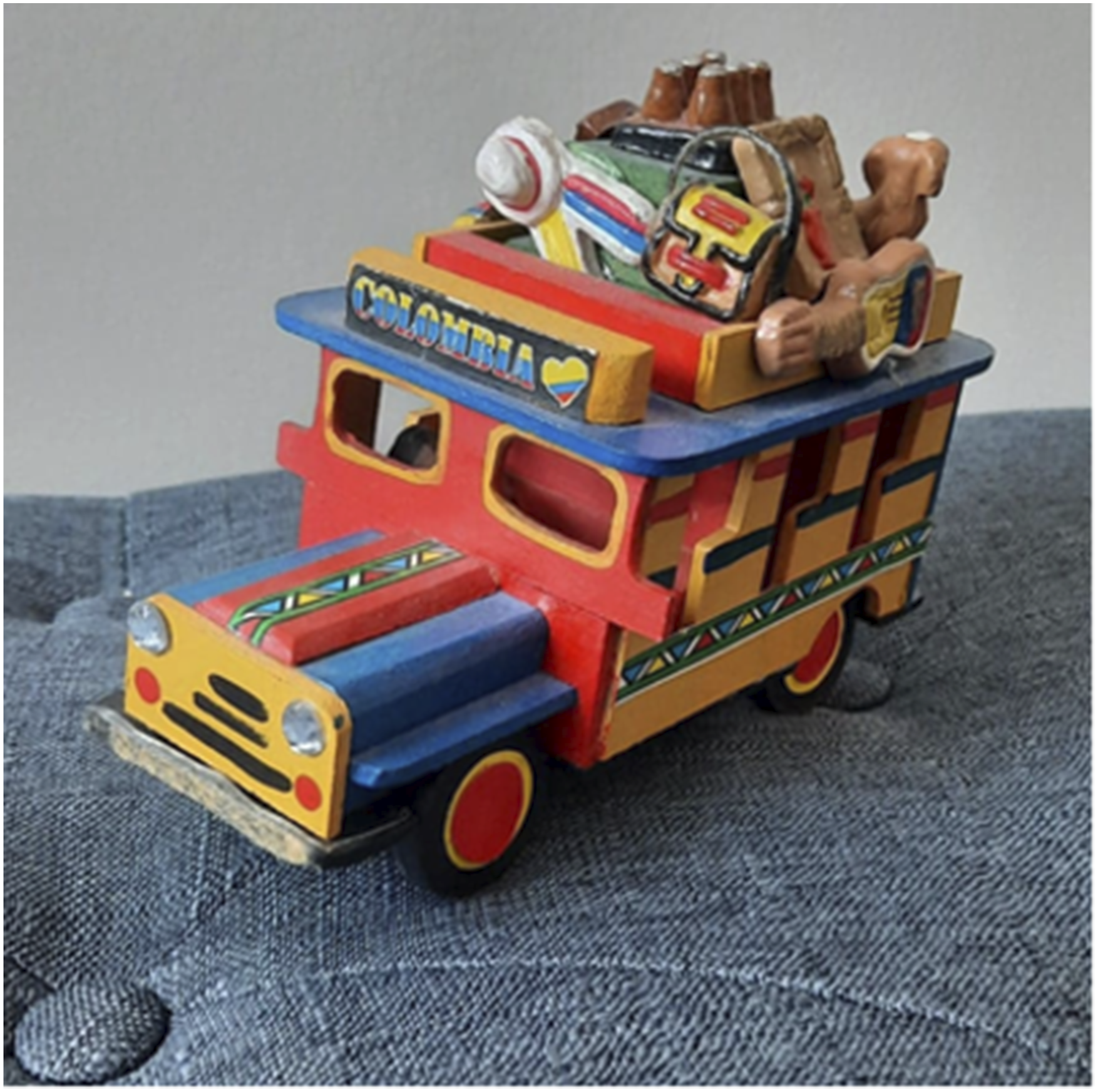
In his poem, Banji expands on the relationship between love and transnational care: “…from here you see only my hand / A minor expression of my heart.” Here he illustrates that care (his hand) is a way to express his love (his heart) towards, or maintain a connection to, his care recipient. Consequently, the love participants feel for/from their care recipients may not only motivate their care, but care may also serve as an expression of their love.
Displacement of the Heart
Four participants (n = 4) also describe/showcase their heart as strained, disconnected or hurting. For example, in the photo shared in () paper, a participant (Carlos) is working in Canada, with their heart located in their country of origin. Abdu further submitted a poem in Arabic providing the following translation: The verses talk about the body being in one place while the soul is in another. It describes the loneliness of the soul in an estranged body. So, if the loved one’s eye sheds tears, they are like arrows delivered to the estranged bodies heart.
Similar to the theme “Caring without hands” Abdu’s translation describes the emotional challenges of caring for loved ones experiencing challenges and living afar. This imagery points to experiences of pain, missing and/or disembodiment. This shared experience of pain and “missing” or disembodiment may further motivate participants to actively engage in caregiving, as it provides feelings of connection. For example, as quoted in the second theme, the “Duality of Care,” Alaige writes, “Caregivers, parents, sisters, brothers / altogether, alone.” This suggests that providing care may act as a way to feel connected, or “altogether” with her family, although she may feel geographically “alone.”
Consequently, participants’ heart-based symbolism is nuanced. Through it we see the love they have for their care-recipients (and/or country of origin), a key factor motivating their care. However, we also see participants’ experiences of pain, through witnessing loved ones’ struggles, loneliness and missing due to the geographic distance between them.
Individual Motivational Symbols: Remembering, Responsibility & Faith
In previous themes, we discussed common “symbols” (i.e. heart, hand and travel-based imagery) identified throughout participant works. Through our analysis, we found that there were many participants’ works that had no clear visual, or “signifier” similarity. Yet, their associated meanings (i.e. the “signified”) revealed common threads of motivation to provide transnational care and live in a different country. Due to different familial experiences, countries of origin, and religious experiences, participants used different “signifiers” to communicate similar “signified.” As a result, this theme focuses on the commonalities seen throughout the “signified.” As a result, we use the term “personalized symbols or individual symbols” in our discussion of these themes. We have identified two subthemes within the larger “motivational theme:” (1) Familial reminders, (2) Responsibility and Faith.
Remembering
Five participants (n = 5) shared pictures of gifts from their family members in their country of origin. Participants described how these objects provided reminders of family (n = 5), their home country (n = 3), and that they will be reunited with their family someday (n = 1). For example, Maria submitted an image of an origami plane, gifted from her nephew (see Figure 4). In her image description, she described its significance: “I always carry it with me and whenever I’m sad, I look at it and it lifts my spirits, and it gives me energy to continue working towards my dreams.” Although only Maria noted she carried her submitted object with her, all other pictured objects were also small enough to carry around (i.e. small toy, rosary, key chain). Further, four participants (n = 4) submitted pictures of their family members, likely also serving as familial reminders that participants can carry with them. Maria’s Submitted Artwork. Prior to Her Departure to Canada, Her Nephew Gave Her This Origami Plane to Symbolize Her “New Adventure.”
Further, four participants (n = 4) submitted pictures of their family members, likely also serving as familial reminders that participants can carry with them. In fact, pictures with multiple people (n = 3), all show physical closeness. In each photo subjects are touching shoulders, holding hands, or have their arms around each other. Like themes associated with heart-based imagery, this physical closeness signifies the emotional closeness participants feel to these loved ones. These feelings of connection may serve as motivation to continue onward and continue transnational caring. For example, when sharing a collage of family pictures, Marcela provided the following image description: “This picture means the support and strength that I need to keep going with my goals. My family is the most important, no matter how far we are we’ll always be together.”
Consequently, these individual symbols, or familial reminders, serve as reminders of their family members, country of origin, and the closeness/love received/have for these members, further serving as motivation to engage in care and continue in a new country.
Responsibility & Faith
Two participants’ artwork (n = 2) described their feelings of cultural and familial responsibility, which motivated their transnational care. For example, Bashir drew a tree to symbolize his parents (care recipients). On this tree, he drew growing fruit, to symbolize himself. He further discussed how he, as fruit, felt a sense of obligation to his parents (or the tree), to “extend the same act of kindness towards them” and others who nurtured his growth (Figure 5). Bashir’s Art Submission Showcases a Drawing of a Green and Blue Tree, With Leaves and Red Flowers. He Also Includes a Description of why He has Chosen a Tree From a Cultural and Moral Perspective
Therefore, cultural and familial responsibility also motivates trans-national carers’ care.
Faith
Several participant’s (n = 3) artwork and/or image descriptions also discuss faith and religion, ranging from images of rosaries to quotes from religious texts. All three participants (n = 3) talked about the protection for themselves, as they navigate Canadian culture, or for their care recipients’ wellbeing. For example, Luis submitted a picture of himself wearing a catholic rosary. In his description, he wrote, “If a man has faith and keeps god in his heart, he will always be fine.” Religion also promised redemption or renumeration for their care, one participant quoting the Quran included the translational quote in their piece, “Whatever good things you spend shall be paid back to you in full.”
Discussion and Study Implications
Methodological Implications
Within a semiotic framework, everything that communicates information can be considered a symbol. As a result, in-depth semiotic analysis is typically applied to one or a few images (Aiello, 2020). Although we found two papers applying semiotics to a larger sample, we found it challenging to identify how to reproduce their methods. Through applying semiotics to Brown and Collins' (2021)framework, we were able to apply semiotics systematically and in a reproducible fashion. As, to our knowledge, these two frameworks have yet to be combined, this application may allow for future systematic semiotic analysis of larger data sets. Further, Systematic Visio-Textual Analysis was intended for visual arts-based data and textual interview data (Brown & Collins, 2021). Our study’s use of Brown & Collins’ (2021) framework illustrates that it can also be applied to visual data and associated descriptions.
Given semiotics’ broad definition of ‘symbols,’ it allowed us to analyze textual and visual data through a semiotic lens, contributing to the literature surrounding multi-modal art-based analysis (Wandera, 2016). However, as four (n = 4) participants did not submit associated art-descriptions with their written text, it was challenging to apply the Systematic Visuo-textual framework. When using this framework for a multi-modal analysis, we recommend that researchers ask for all art pieces and descriptions (verbal or written) to ensure clarity in the analysis of participants’ experiences of their artwork.
Although we applied the theory of semiotics, more generally, there is a branch of semiotics called “visual semiotics,” specifically focusing on the study of visual images (Aiello, 2020). There are a variety of underlying theories and theorists in visual semiotics (i.e. Barthes, 1988). Visual semiotics also discusses the relationship between language and image (Barthes, 1988; Rose, 2020). Given the multi-modal nature of our data (i.e. poems, visual art,pictures), we chose to apply a broader understanding of semiotic theory. Yet, given the shared examination of written and visual information, there is much opportunity to apply visual semiotics, specifically Barthes (1988)’s theory, to Brown and Collins (2021) framework for Systematic Visuo-textual Analysis.
Substantive Implications
Our results illustrate the multi-dimensional experience of transnational carer-employees in Canada, through common and overlapping symbolism of transition, care, love, and motivation. In doing so, our findings validate and expand on Rottenberg et al. (2023)’s findings and the R TCE/TCE literature at large. For example, Rottenberg et al. (2023)’s generalized findings from the R TCE interview data (which includes two art pieces for illustration), employed thematic analysis to identify three themes: (1) nuances of providing transnational care, (2) impact of geographic dislocation on care and wellbeing, and (3) caregiving during COVID-19. These findings highlight the fluidity of transnational caregiving; participants both shape and are impacted by time-space dimensions. Shahbaz et al. (2023) later completed a secondary analysis of the R TCE interview data, diving deeper into the commonalities and differences between R TCEs of Pakistani, Syrian, African and South American origin. Shahbaz et al. (2023) employed thematic analysis and generated three themes: (1) feelings associated with transnational care; (2) employment experiences of TCEs; and (3) coping strategies for well-being. This secondary analysis suggested that these four cohorts experience far more similarities than differences.
Brown (2019) notes that art can express information, that cannot be communicated through language, giving the opportunity for more embodied communication and/or understanding. Similarly, we observed that Rottenberg et al. (2023)’s interview-based findings showcased more practical aspects of the R TCE experience (i.e. employment experiences, finances, time-changes), often not present in our arts-based findings. Whereas our arts-based findings/data centered on R TCE’s emotional experiences, often mentioned or related to/underlying the interview-based findings. For example, Rottenberg et al. (2023) note that many participants felt a strong desire to be with their loved ones permanently, actively trying to help them immigrate to Canada. This was not present in the participant's artwork, however, the underlying emotions (i.e. closeness, missing, heartache), as seen in the heart-based imagery, were present in our analysis. This observation presents a further opportunity for an in-depth comparative paper between the arts-based and interview-based findings, within the n = 17 participant sample.
The engagement with arts-based methods confirms the scoping review results of Dupuis et al. (2024), specific to providing insights into the emotional, psychological, and social dimensions of caregiving. The findings presented here fill the noted gaps identified in Dupuis et al. (2024), with respect to little racial and ethnic diversity.
With respect to how the substantive results reflect the larger literature, the four overarching themes in the data are confirmed in the larger transnational literature. The first theme - Transition to Canada is evident in most transnational literature on health care workers moving from their country of origin to a different country. Given the large presence of travel and transition related art in this project, our findings indicate that the transnational experience is a substantial part of the R TCE experience. Baldassar and Merla (2013) discuss transnational care circulation, highlighting how mobility, travel and transition are central to this experience. The second theme - Caring Without Hands reflects the duality of transnational care. Given the often-expansive geographical gap, R TCEs face unavoidable challenges, such as navigating different time zones to organize communication times (Sethi, 2022). The use of modern technologies, such as messaging platforms, shared calendars, and other virtual platforms mediates some of these difficulties (Sethi, 2022), although technology “can increase feelings of psychological closeness, it does not completely eliminate the effects of geographical distance” [Wilding (2006), as cited in Miyawaki & Hooyman, 2021, p. 13]. The third theme, surrounding The Heart is less evident in the literature as a symbol, but its representation of love, care and missing are often discussed widely by transnational carers, as noted by Coe (2011) in their work on the materiality of care in Ghanaian transnational families. The final theme notes the importance of Individual Motivational Symbols, which are again a common lived experience with transnational carers (Sethi, 2022).
As with any study, several limitations exist. A symbol’s signified can vary between the audience and author (Aiello, 2020; Chandler, 2021; Rose, 2005, 2020). Although we tried to ensure that we captured participant/authors' signified through analyzing image descriptions, there were several limitations in this area. Participant descriptions varied in length; n = 3 participants had a one or less than one sentence in their description. Further, participants often did not always discuss the meaning behind all the signifiers in their work. Consequently, if we identified a pattern involving an art piece with little information in the description, we relied on the pattern’s other pieces to illuminate a signified. Further, n = 4 participants submitted written artwork without including a description. In these cases, we relied on the written context to identify each textual pieces’ signified. Although semiotics’ definition of the symbol has breadth, we adjusted our analysis for these four pieces, using the identified symbol’s context to identify the ‘signified.’ Due to this adjustment in methods, we suggest researchers prepare an interview guide, or a set of reflection prompts, focused on gaining transparency into participants’ signified.
Further, as with much qualitative analysis, we, as researchers, play an active role in identifying, organizing and reporting patterns and commonalities in the data (Braun & Clarke, 2006). Thus, researcher's subjectivity impacted our findings. Notably, both authors have direct or indirect experience with trans-national care in Ontario, Canada. Additionally, our participant sample was cisgender, limiting the gender diversity.
Conclusion
This study revealed wholistic insights into the emotional, social, and cognitive aspects of transnational care, providing a unique cross-cultural perspective on an increasingly common experience: transnational care. The research provides a cross-cultural, nuanced, and wholistic perspective on transnational care by R TCEs in Canada. Art methodology is an innovative way of understanding the experiences of vulnerable and underserved populations, with this work underscoring the need for further exploration and methodological refinement to harness the full potential of creative techniques in better developing a holistic and nuanced understanding of R TCE’s lived experiences. Our findings can also inform the implementation and content of caregiving supports in Canadian workplaces, post-secondary institutions, and medical care, particularly given that TCEs are an integral part of the care economy (Hapsari et al., 2022) that will only increase in importance due to aging demographics and the shortage of healthcare workers which require innovative ways to recruit and retain them (Kralj & Sweetman, 2024).
Footnotes
Acknowledgements
The authors express appreciation to all participants for openly sharing their experiences. This study would not be possible without their contributions.

Ethical Considerations
This study received approval from the [redacted] Research Ethics Board (MREB#: 4881) and [redacted] Research Ethics Review Committee. Informed consent was obtained using Qualtrics. To ensure confidentiality, participants chose their own pseudonyms or were otherwise assigned one by an RA. Participants were given a $50 honorarium for their time and participation.
Funding
The authors disclosed receipt of the following financial support for the research, authorship, and/or publication of this article: This work was supported by the CIHR/SSHRC Healthy Productive Work Partnership Grant “Scaling up the Carer Inclusive Accommodating Organizations Standard” FRN: HWP-146,001 (CIHR); 890-2016-3018 (SSHRC).
Declaration of Conflicting Interests
The authors declare that they have no known personal relationships or competing financial interests that could have appeared to influence the work reported in this paper.
Data Availability Statement
We do not have informed consent to share the primary data publicly. As there were only seventeen participants in this study (n = 17), there is also concern about participant anonymity.