




Abstract
Introduction
The past twenty years of health and social science research has documented a shift towards understanding and applying the perspectives of knowledge users in research (e.g., groups, individuals or organizations who require knowledge for use in decision making such as clinical researchers, administrators, and the lay public; Tan et al., 2022). Within health contexts, this shift has been driven in part by a recognition that knowledge users are well suited to determine priorities associated with their care and wellbeing (Barnieh et al., 2015). Such trends are demonstrated through the expanding body of literature on the direct involvement of patients in care priorities (Burnell et al., 2012; Charles et al., 2017) and the inclusion of end users in health technology designs and evaluative processes, for example (Sönnerfors et al., 2023). While a variety of engagement approaches exist, the inclusion of knowledge-users in research priority setting has garnered particular interest. For example, a key word search of priority setting across subscribed databases at the lead authors institution yielded 139 articles in 1990, 479 articles in 2000, 1011 articles in 2010, and 2425 artilces in 2020, respectively, illustrating proliferation of priority setting research across contexts of application.
There is no universal definition of research priority setting; however, it generally involves processes wherein knowledge users express what matters to them and, depending on the method, agree on specific priority topics or questions (Tong et al., 2019). Prior to the involvement of knowledge-users in priority settings, there were frequent misalignments between the priorities of various user groups (Barnieh et al., 2015; Tong et al., 2019) and while priority setting does not eliminate these differences, it does provide opportunities to better consider, align, or integrate knowledge user priorities into existing and future research and care activities. Thus, priority setting creates opportunities to highlight the voices of those with lived experiences (Barnieh et al., 2015; Boivin et al., 2014; Tong et al., 2019), and create more inclusive research agendas.
While various methods have been used to highlight the voices of those with lived experience and identify research priorities, current approaches to priority setting privilege traditional and often reductive methods of expression. Surveys and questionnaires are common and provide useful opportunities to assess what is important to a range of knowledge users on a large scale but can be criticized for their rigidity in both expression and choice (James Lind Alliance, 2021). For instance, the popular James Lind Alliance (JLA) approach, the Dialogue Model, and the Delphi technique, commence their priority setting with topics from the literature (Barnieh et al., 2015; McPherson et al., 2018; Tong et al., 2019), which may or may not reflect positivist leanings. Limited choice in survey responses and an emphasis on ranking and ordering, particularly when done remotely wherein deliberation of decision making are not captured empirically, provides little room to explore nuances. What is missing is an opportunity to express and explore the profound unconscious and embodied knowledge that motivate and explain human behavior (Gerber et al., 2020). Arts-based approaches to priority setting hold promise in this respect but to date, no literature review has been conducted on this topic. As such, we examined how arts-based approaches have been used in priority setting in order to provide an overview and needed direction in this emerging area.
Common Approaches to Priority Setting
Extant reviews highlight particular approaches to priority setting research as the most common. Common approaches include the JLA framework, Delphi methods, expert consultation, literature reviews, and online surveys (Tan et al., 2022). The dialogue method is also common, and combines approaches such as focus groups, Delphi methods, and online surveys, depending on the context of use (Tan et al., 2022; Tong et al., 2019).
The JLA framework originated in the UK and brings together various knowledge users – often clinicians and patients – to develop the top ten priority questions for funders (Tong et al., 2019). The process begins with a steering committee that guides the priority setting process, and leads into partnerships with organizations who assist with identifying uncertainting and distributing surveys-based on existing literature, clinician perspectives, and practice guidelines (Barnieh et al., 2015). Responses are collated into categories, ranked, scored and combined and consolidated in a final workshop using a nominal group technique/ordering or ranking system (Barnieh et al., 2015).
The popular Delphi method, also referred to as the Delphi technique, was developed in the 1950s and involves expert responses to a series of survey rounds – typically two to three – to reach a consensus on a study issue (Brady, 2015; McPherson et al., 2018). The method commences with an expert panel that develops open-ended questions from the literature (McPherson et al., 2018). Surveys are used to elicit members’ opinions, followed by descriptive analyses, panel responses, and subsequent surveys. In the final stage, participants prioritize and rank each survey item in an effort to reach a consensus (McPherson et al., 2018). The Delphi method, also termed the Delphi technique or study, is most commonly used and associated with quantitative and mixed methods literature, although qualitative orientations and theory building applications in qualitative and community-engaged research are also present (Brady, 2015).
While the JLA approach uses existing literature as the starting point, the Dialogue Model generally begins with knowledge users who broadly identify issues to be included in the subsequent steps of priority setting (Abma, 2019). It is a multidisciplinary agenda-creation process indended to involve patients in research agenda-setting with consideration of power differentials between health care recipients and other knowledge user groups, such as healthcare providers (Abma, 2019). Here, knowledge users name the issues to be included, and independently consult about developing and ranking research topics from their perspectives. Prioritized topics are then integrated and transformed into a research agenda. The Dialogue Model utilizes interviews, questionnaires, focus groups, or the Delphi method in the prioritization phase of the process (Abma, 2019; Tong et al., 2019).
Despite the benefits of many popular approaches to priority setting (e.g., Delphi offers flexibility and ability to revisit responses; Barrett & Heale, 2020), these approaches are often challenged by power imbalances between knowledge user groups, are reductive with the possibility of overlooking unique experiences and priorities not captured in existing literature, and emphasise cognitive recall and expression. This can limit meaningful participation for groups less reliant on or versed in complex verbal communication, such as youth, and possibly newcomers and neurodiverse individuals, whose development and ways of knowing may recognize and benefit from other forms of expression (e.g., visual, arts-based). Idealising consensus, which may not entirely be achievable and is often not defined (Barrett & Heale, 2020), and establishing priorities derived from academic literature may exacerbate or highlight tensions between professional and lay knowledge, as well as power (Barrett & Heale, 2020). Encouraging holistic ways of expressing priorities that supports the voices of diverse groups, including hard-to-reach and underrepresented groups, is critical to move towards health equity and more fullsome representation of a range of voices in patient and public involvement (PPI) research (Tierney et al., 2021).
The Growth of Arts-based Research in the Health Sciences
Arts-based methods are becoming popular amongst health researchers due to their potential to reveal tacit knowledge – knowledge that is unconcious, subliminal, embedded and non discursive (Gerber et al., 2020). The incorporation of arts-based approaches in research spans a continuum of emphasis and integration, ranging from a peppered use of art within a dominant – often qualitative – methodology as occurs with arts informed research, to positioning the arts as the dominant form of systematic inquiry, which is reflective of arts-based research (Archibald et al., 2016). Similarly, arts-based approaches can take myriad artistic forms, such as visual (e.g., bodymapping), performative (e.g., research based theatre), and narrative forms (e.g., Indigenous storywork). Differences are also observed in the extent of participant involvement in the art making process, with the viewing of art and the active engagement in the artistic process activating different mechanisms and resulting in differing outcomes (Archibald, Caine, & Scott, 2014).
Of the arts-based forms and modalities employed, visual methods are among the most common (Archibald et al., 2014, 2016; Boydell et al., 2012). Visual methods often provide ease of access for participants given their every-day familiarity, and use a range of visual materials and approaches to generate data or representations in response to research questions. Some examples include photovoice—where participants, within an anti oppressive framework and methodology, take pictures in response to a critical question in order to reflect personal and contextual meanings. Participatory drawing, where participants are asked to draw the meaning of a phenomenon concerning their experience and research questions (Literat, 2013), and life graphs, where participants are asked to represent important aspects of specific phenomena graphically (Lipstein et al., 2013) are also examples of visual approaches. Visual research methods generate knowledge or evidence that surveys and interviews fail to capture (Rose, 2014). They actively engage participants, bringing to the center and making visible what is usually taken for granted by allowing participants to reflect before creating their visual images and providing time to reflect on the created image (Literat, 2013; Rose, 2014).
Arts-based methods have theoretical utility in priority setting research given their capacity to elicit and unveil alternative ways of knowing (e.g., emotive, embodied; Archibald et al., 2016). The ethos of arts-based methods makes them amendable for use in priority setting research, which has largely been dominated by narrative and numerical data collection means. Furthermore, arts are inherently familiar and inclusive and often demonstrate therapeutic effects; their methods are considered developmentally appropriate when working with youth and children (Percy-Smith, 2007). The propensity of arts-based methods to uphold the voice of groups typically underrepresented in research provides opportunities for more inclusive and accessible research practices (Tierney et al., 2021). Despite their potential, however, the use of arts-based methods in the context of priority setting research has not yet been examined. Here, we report on a scoping review of arts-based methods in priority setting research to provide an overview of this field and possible directions for the future.
Methods
We conducted a methodological scoping review of arts-based methods used in priority setting. We asked: how are the arts used in priority setting research? We used Arksey and O’Malley’s (2005) 5-step framework to guide our review, which includes: identifying the research question, locating pertinent studies, selecting the studies, charting the data, and lastly, summarizing and reporting the findings. To ensure rigor and quality reporting, we adopt Preferred Reporting Items for Systematic Reviews and Meta-Analyses (PRISMA)—a systematic tool that specifies the minimum standard for reporting systematic reviews and meta-analyses (Page et al., 2021).
Locating Pertinent Studies: Search Strategy
We ran a preliminary search to generate a foundational understanding of existing literature and devise an effective search strategy (Arksey & O’Malley, 2005). Using no restrictions, we open searched the online library of the lead author’s institution, and the databases EBSCOhost, CINAHL, PubMed, Medline, PsychInfo, Sage Journals, and Google Scholar. Keywords relevant to arts-based, art, priority setting, and health* were used; only a few articles were retrieved. Promising journals that published articles relevant to this topic were handsearched (i.e., the Nordic Journal of Arts, Culture, and Health and An International Journal of Research, Policy, and Practice). This produced no additional results. We then repeated our searches in the databases indicated, eliminating the term “health” and its variations. This yielded little, which provided confidence in the multipronged and comprehensive search approach being used.
Following this preliminary assessment of the literature, we conducted a systematic search using keyword varieties of art*/approaches/methods AND priority setting in CINAHL, Medline, and Scopus. We limited our search to English-language academic publications, with no date limiters, and without limiting to full text availability. To ensure comprehensiveness, we mined the reference lists of all identified reviews articles (e.g., scoping, rapid, and systematic reviews) for relevant titles, and contacted the corresponding authors of relevant conference and poster abstracts. We also drew from the lead author’s extensive experience in this area to identify two additional articles not retrieved using our search methods.
Selecting the Studies
All records were uploaded into Covidence, an online software designed to support efficient, transparent and rigorous systematic reviews. In accordance with best practices, the authors conducted independent screening over two stages. In stage one primary screening, two authors separately screened the titles and abstracts of all publications and routinely convened to discuss their findings (Polanin et al., 2019). In stage two secondary screening, one of the authors screened all the articles, while a second author screened 10% of articles to determine alignment and agreement. Authors met during and after the title and abstract screening to resolve conflicts. The same procedure was followed for the full-text screening.
All articles incorporating arts-based methods for priority setting, with or without other non-arts based priority setting activities, were included. Arts were defined as expressive or embodied creative modalities of any medium, orientated towards an aspect of human experience. Articles using only graphics or visualizations to communicate data were excluded (e.g., pie chart descriptions and life grids) because they do not leverage the emotive and reflective mechanisms characteristic of arts-based approaches.
Data Extraction & Analysis: Charting, Summarizing and Collating
We extracted data from the included articles into a Microsoft Excel file with pre-established categories to aid the systematic retrieval of data and its subsequent analysis. Prior to extraction, we defined each data extraction category to ensure standardization. Categories included location of the study, focus of the arts-based priority setting, justification for use of arts-based priority setting, whether qualitative or quantitative approaches were used alongside arts-based priority setting, participant groups, and benefits and challenges of arts-based priority setting. Two authors independently extracted data and met to discuss the categories at interim points throughout extraction, and to check for agreements/disagreements arising from this process. Disagreements were discussed with the primary author to achieve resolution.
Following extraction, data were collated and tabulated within Microsoft Excel. Common domains were identified and results were summarized. We produced narrative summaries as well as descriptive statistics (e.g., frequencies) within categories to overview the state of the science of arts-based methods to priority setting research.
Results
Our search yielded 5457 articles. After removing duplicates, 5154 titles and abstracts remained and were screened against the inclusion and exclusion criteria. We reviewed the full texts of 76 articles and mined the reference lists of 11 review articles identified in the search. After mining the references of review papers, we located an additional article of possible relevance to the review. During full text screening, we excluded 70 articles because they did not include arts-based methods, leaving 6 articles for inclusion in the review. We identified an additional 1 article through the reference list mining of included articles and an additional 4 articles by reaching out to authors and through the lead author’s expertise in this area, resulting in a total of 11 included articles (refer to Figure 1). PRISMA flow diagram.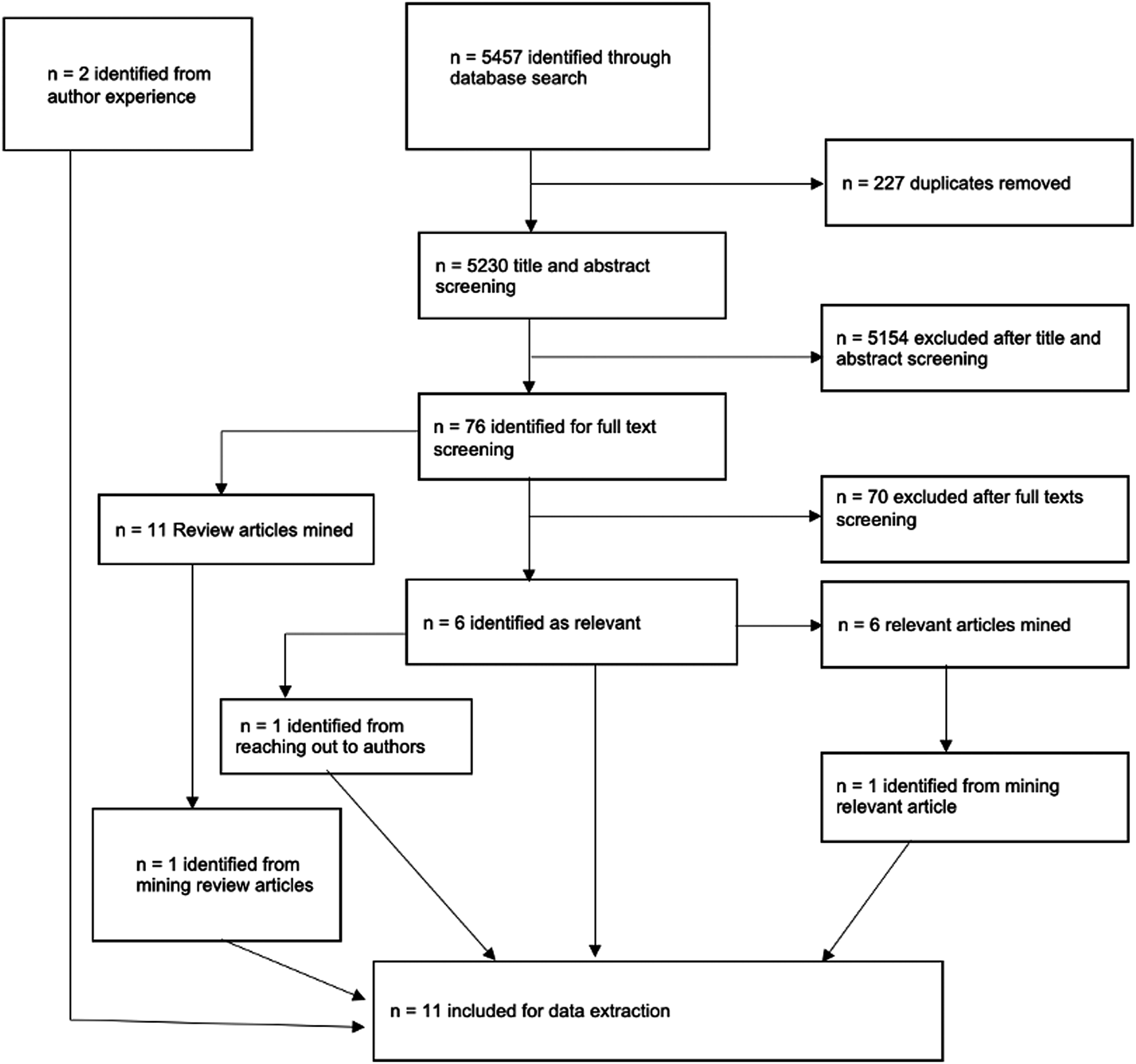
Articles were published between 2010 and 2022, with the majority (n = 9, 82%) published between 2020-2022. Two records (18%) were abstracts and nine (82%) were empirical articles. The majority (n = 8; 73%) took place within the United Kingdom, and the remaining three (27%) were located within North America, with two in the United States and one in Canada, respectively.
Population focus and sample sizes varied between articles. The most common application was across chronic illness contexts, with four articles assuming this focus (n = 2 dementia) (Keogh et al., 2021; Tierney et al., 2021); (n = 1 juvenile idiopathic arthritis) (Albasri et al., 2022); and (n = 1 vitamin B12 deficiency and pernicious anemia) (Tyler et al., 2021). Two articles focused specifically on migrant and/or refugee health (MacFarlane et al., 2022; Phelan et al., 2021) and an additional one article focused on groups described as “hard to reach” (Shields et al., 2010). One article focused on breast cancer survivorship (Yan et al., 2020), one on dental reform (Overs et al., 2022), one on community youth (Sprague Martinez et al., 2020), and one had a highly varied participant focus inclusive of individuals with diabetes, lay community members, clinicians, and people living in poverty, for example (MacFarlane et al., 2017). The vast majority (n = 9; 82%) focused upon adult and older adult populations; only two articles included a youth focus (Albasri et al., 2022; Sprague Martinez et al., 2020). Sample sizes were reported in all but one article and ranged from five to over 800 participants depending on the overall design (e.g., semi-structured arts-based interviews vs. survey design with follow up arts-based components). All articles focused on some component of health; no articles were identified that used arts-based priority setting outside of a health related context or application.
Authors provided various, and often multiple, justifications for using arts-based approaches to priority setting, but only one article explicitly identified the theoretical underpinning of its arts-based approach (i.e., positioning theory; Overs et al., 2022). Regarding justifications, arts-based approaches were commonly seen as useful in facilitating dialogue (n = 5) (Albasri et al., 2022; MacFarlane et al., 2017; Overs et al., 2022; Phelan et al., 2021; Tierney et al., 2021) and were regarded as accessible, engaging and inclusive methods (n = 4) (Keogh et al., 2021; MacFarlane et al., 2022; Shields et al., 2010; Tierney et al., 2021). Arts-based approaches were often explicitly considered by authors to be creative or innovative (n = 7; 63%). Authors of three articles (27%) indicated that use of arts-based approaches helped give voice to participants, or supported participants to use their voice (Keogh et al., 2021; Tyler et al., 2021; Yan et al., 2020).
Arts-based approaches to priority setting were always used alongside other methodological approaches. All articles employed qualitative methods in conjunction with arts-based methods. Qualitative methods and tools varied, with variations of cafés (e.g., world café, café inclusive of interviews) being used in three (27%) of the included articles (Keogh et al., 2021; MacFarlane et al., 2017; Phelan et al., 2021). Authors of five articles (45%) used group discussion, often alongside or following a workshop (Albasri et al., 2022; MacFarlane et al., 2022; Tierney et al., 2021; Tyler et al., 2021; Yan et al., 2020). Interviews were explicitly reported in four (36%) articles, while two (18%) used storytelling in conjunction with other approaches (e.g., interviews, writing, discussion) (Shields et al., 2010; Sprague Martinez et al., 2020). Quantitative techniques were also commonly used, and were reported in seven (64%) of the included studies (Keogh et al., 2021; MacFarlane et al., 2017; Shields et al., 2010; Sprague Martinez et al., 2020; Tierney et al., 2021; Tyler et al., 2021; Yan et al., 2020).
Evidence Table.

Note. General information about the included articles.
Arts-based approaches to research can be executed with or without collaboration with a professional (e.g., practicing artist with a high level of skill, reputation, and or professional commitment and who is often financially motivated or compensated) or an amateur artist (e.g., someone who practices art making as a non-professional). Of note, professional or amateur artist status did not necessarily correlate to receiving compensation for arts involvement or facilitative activities in the included studies. Articles included in the review reported both approaches, at almost equivalent frequencies. Authors of five articles (45%) did not work with an external artist (MacFarlane et al., 2017, 2022; Overs et al., 2022; Shields et al., 2010; Sprague Martinez et al., 2020). Artists included amateur and professional visual artists, art therapists, involvement of a World Academy of Music and Dance, an illustrator, and a storytelling coach.
Facilitation of the arts-based approaches varied extensively; however, the majority utilized a workshop or group facilitation approach (n = 8; 73%). Group activities involved the use of various cafes (e.g., World Café) or workshops. Two articles utilized individual activities exclusively (Overs et al., 2022; Tierney et al., 2021), while one used a mixed approach which emphasized individual activity with encouragement towards community based discussions (Shields et al., 2010).
The benefits of the arts-based components of the studies were often, but not always, identified. Eight articles (73%) reported benefits specific to the arts-based approach. Most often, benefits centered around enhanced communication with participants (n = 4; 36%) (MacFarlane et al., 2017; Overs et al., 2022; Tierney et al., 2021; Tyler et al., 2021); authors of two articles identified improved communication of research as a benefit (Keogh et al., 2021; Tyler et al., 2021). Authors of four articles (36%) identified benefits to the participants, which included enhanced participant enjoyment (Keogh et al., 2021), motivation to create artwork (Tierney et al., 2021), and empowerment, which was reported in two articles, respectively (Overs et al., 2022; Yan et al., 2020). Improved understanding and insight related to arts-based methods was reported in two articles (Overs et al., 2022; Tierney et al., 2021). One article (Tierney et al., 2021) reported the creation of an inclusive, accessible and creative space. Of note, the majority of benefits identified were determined by way of researcher reflection or observation, rather than through explicit empirical evaluation. Notable exceptions included the work of Tyler et al. (2021), who included assessment of the visual arts modality as a secondary study aim. Sprague Martinez et al. (2020) alluded to participant perspectives resulting from a process evaluation, but further insights were not described. Keogh et al. (2021) also sought feedback from participants about the research process, but did not present comprehensive empirical feedback about participant or researcher experiences of benefits and challenges of the arts-based approach.
Challenges of using arts-based approaches were less commonly reported. Of the four articles that reported challenges, resource limitations were the most common (n = 2) and related to time and capacity (Keogh et al., 2021; Sprague Martinez et al., 2020). Only one article (Tierney et al., 2021) identified a challenge related to the artistic practice, specifically, that professional artists had concerns with accurately representing participants experiences when they did not share their same culture. No article reported challenges related to participant experience or engagement, and no operational or notable aesthetic challenges were reported.
Discussion
We reported the results of a scoping review on the use of arts-based approaches within priority setting research. 82% of the articles included in this review were published between 2020-2022 suggesting that there is a growth of interest in these approaches. This aligns well with the expansion of arts-based approaches across disciplines and the proliferation of arts-based methods, applications, and techniques, in associated literature (Archibald, 2022; Archibald & Blines, 2021; Hinsliff-Smith et al., 2022).
Expanding Beyond the Health Sciences
Despite using no search terms or limiters specific to health, all included articles were relevant to health research. This is not entirely surprising, as arts-based approaches to health research have increasingly been adopted as a means to reflect and communicate about lived experience of health and illness; communicate the complexities of health research in alignment with knowledge translation imperatives (Archibald, Scott, & Hartling, 2014); attend to alternative ways of knowing more characteristic of the whole person and their facilities (Archibald, 2012; Barone & Eisner, 2012), and as a means of working with those groups who are “easy to ignore” (Bird, 2022, p. 2). The recognition of arts ability to function as a developmentally and often culturally appropriate approach, coupled with knowledge of its benefits for unveiling new, hidden, or possibly forgotten perspectives and insights, has contributed to this adoption (Archibald, Scott, & Hartling, 2014; Milasan, 2022).
A lack of adoption beyond the health sciences also illuminates future opportunities for application and methodological development in other sectors. Among these, environmental and sustainability research, education, criminal justice, and various domains of technological research and innovation, are sectors where priority setting research is common but not yet inclusive of arts-based modalities. The inclusion of arts-based methods may enable new access points for inclusion of previously underrepresented groups, encourage critical and creative thinking around priorities, provide empathetic insights into the perspectives of system users (e.g., those within the criminal justice system), thereby aiding depth and dimensionality for priority setting research endeavors. Reflective application of these methods across diverse fields may provide insight into the unique utilities, challenges and context-specific modifications required, and is an area that is germane for further inquiry.
Integrating Arts with Qualitative and Quantitative Methods
The arts component within each included article was used in conjunction with qualitative methods. This aligns well with literature supporting qualitative integration to better understand participants meaning and interpretation of art work, as well as the alignment of arts approaches, particularly arts informed approaches, as a component of qualitative methodology. Certainly, articles within this review reflected the range and diversity of art forms and applications characteristic of the larger body of literature on this topic; how art is used by whom, and its centrality to inquiry and representation vary considerably (Greenwood, 2019). Within this review, art applications varied by dose and by extent of artistic integration with other research methods and findings; whether or not collaboration with other artists took place, as well as the artistic forms used, for example.
Quantitative methods were also commonly used (64% of articles), which reflects a historical alignment of priority setting research with numerical and often reductive approaches that seek to achieve consolidation or consensus, the latter of which is infrequently defined a priori (Barrett & Heale, 2020). The application of arts-based modalities in dialogue with research traditions, such as quantitative and mixed methods research, is also growing in popularity as scholars investigate the contributions of ontologically and epistemologically distinct approaches towards integration (Archibald, 2022). As such, arts-based priority setting appears to hold potential as an inherently mixed methods technique that could help advance arts-based mixed methods research, support integrative research activities, whilst providing more holistic and comprehensive understanding of priorities as predicated on authentic, accessible, engaging methods understood as meaningful to facilitative discussion.
Attending to Theory
Regarding the theoretical underpinnings of the arts-based approaches employed, only Overs et al. (2022) identified a specific theory guiding the development of an arts-based priority setting method, thereby signifying a shortfall of attention to the theoretical underpinnings of arts-based modalities. Certainly, there are a number of candidate theories that could hold merit for an arts-based priority setting study, including critical, feminist and intersectional theories. However, what theoretical perspective(s) informs the development of any specific arts-based approach is reliant on the intention, modalities, methods and forms that the priority setting activity undertakes. Explicitly identifying the theoretical underpinnings of the arts-based approach, as opposed to the theoretical orientation of adjacent methods or overarching design, which is more common, is recommended to provide clarity of purpose, enhance methodological quality, provide insights for interdisciplinary consideration, and to encourage overall alignment with the research questions and artistic components of the study.
Assessing Benefits and Challenges
Although the anticipated benefits of arts inclusion in priority setting research are well supported by adjacent literature highlighting the merits (and challenges) of arts-based methods, few articles empirically investigated the benefits and challenges of their novel applications. In fact, only one article (Tyler et al., 2021) included an aim specific to the possible impacts of arts inclusion on research participants. No authors included empirical evaluation inclusive of participant and researcher perspectives. Including an evaluative component that captures both the impressions of participants as well as the impressions of facilitators of the arts-based priority setting activity (e.g., researchers), would provide more fulsome insight and direction to others seeking to employ these modalities. These insights could guide future modifications necessary to optimize the benefit and acceptability of arts-based priority setting, encouraging more robust methodological development in this space.
Equity, defined by the World Health Organization (2023) as the “absence of unfair, unavoidable or remediable difference between groups (para 1), was infrequently identified as a benefit or aim by authors of included articles despite the potential alignment of arts-based approaches to this objective. While Tierney et al. (2021) recognize the influence of methods and research approaches on structural disadvantage impacting participation, with few additional authors (e.g., MacFarlane et al., 2017; Sprague Martinez et al., 2020) also recognizing the merits of youth participation in particular in addressing health inequities, there is potential for further development in this area. Future research could consider the use and adherence to best practices of arts-based priority setting within specific equity facing groups – such as Black, Asian and minority ethnic communities – that are in critical need of quality priority setting research (Iqbal et al., 2021).
Authors highlighted the benefits of arts-based approaches within their priority setting research as largely communication based, and emphasized their creativity and innovation. While arts as a means of investigation and representation may be regarded as novel in the health research context, the concept of aesthetics in knowing (Archibald, 2012; Carper, 1978) and narratives in medicine (Kalitzkus & Matthiessen, 2009), for example, have been part of the inquiry and practice landscape, longstanding. Storytelling, often positioned as novel in myriad research contexts, reflects an ancient and rich practice within Indigenous cultures (Absolon, 2022). As such, while arts-based applications within priority setting research may be a novel integration of ways of knowing and representing, their legitimacy and longstanding contributions in numerous other contexts offer strong foundations of their use and merger.
Limitations
This scoping review commenced with a preliminary search which we used to guide a search strategy of three databases, hand searching of two journals, and reference list mining of relevant articles. While we aimed for a comprehensive search, a broader search strategy may have yielded additional articles. Although we regarded priority setting as a broad term adopted by a range of disciplines, differences in conceptualizations of and terminology related to priority setting research may exist. Inclusion of adjacent terms, such as agenda setting (e.g., public policy), resource management (e.g., environmental science) or curriculum planning (e.g., education) may have yielded a broader dataset and may be a fruitful avenue for a future scoping review.
Conclusion
Both priority setting and arts-based research are part of a larger movement emphasizing patient and public involvement in research. With this has come a desire to improve the accessibility and appropriateness of research approaches across diverse research groups and contexts, with the aim of more fullsome representation of authentic experience and perspectives. Recognizing that knowledge is aesthetic, pragmatic, and dynamic, existing both through the self and in relation to our social experiences, there is benefit and a need to shift towards more embodied knowledge that transcends our current conception and discursive understandings (Archibald et al., 2016; Gerber et al., 2020). Priority setting, while critical to advancing person-centered research agendas, is often challenged by power imbalances and by the privileging of one form of knowledge and associated methodologies. Integration of arts-based approaches within priority setting research is an emerging area with potential to augment such fullsome expression and access to particular participant groups. Further research in this area that incorporates theoretical directives, builds upon the robust literature on arts-based research approaches, and employs a self-reflective lens ideally inclusive of methodological evalaution, would help advance this emerging field.
Footnotes
Author Contributions
All authors actively participated in each component of the manuscript. The lead author conceptualized the study. All authors contributed to various stages of the scoping review, including analysis, as well as manuscript writing.
Declaration of Conflicting Interests
The author(s) declared no potential conflicts of interest with respect to the research, authorship, and/or publication of this article.
Funding
The author(s) received no financial support for the research, authorship, and/or publication of this article.
