




Abstract
Equitable research practices with marginalised populations aim to centre participants voices and address inherent power imbalances. Timelines are one example of a visual method which can be used to support qualitative research, though its potential to enhance the quality of data collection has rarely been fully explored. Women with experiences of multiple exclusion homelessness are often missing from research and policy, and their experiences framed through the lens of services. A selection of narratives from 20 women are presented with critical reflections on using timelines. We describe how timelines were used to create a space where power dynamics were minimised, and researcher and participant jointly “made sense” of hidden and less often heard life stories. Six themes emerged: 1. Challenging stories; 2. Chaotic stories; 3. Untellable stories, 4. Producing acceptable stories; 5. Invisible stories; 6. Unheard stories. Repositioning marginalised women as valid storytellers in their own lives has implications for how services might best offer support. We outline how timelines can be utilised as a dynamic reflective space in real time, supporting elicitation of rich and detailed narratives and shared understanding of complex life stories.
Introduction
Narratives of marginalised populations have historically been less visible in public health research and policy discourse. In the context of the ongoing need for research which is “done with” rather than “done to” marginalised populations (Coyne & Carter, 2024) equitable research practices are not just desirable but essential, increasingly aiming to go beyond the necessary ethics approvals (Shaw et al., 2020) to create genuine collaborations centring participants voices as actors in their own lives (Farzaneh & Turin, 2024; Scott, 2022). Conducting collaborative research requires paying attention to addressing inherent power imbalances which can be reproduced in these settings (Shaw et al., 2020), and which affect how participants tell their stories (Llewellyn-Beardsley et al., 2022). Visual methods are one means of minimising power dynamics, and are becoming increasingly used to support the research process. We discuss using timelines as a means to enhance research collaboration and dialogue with marginalised groups (Lancione, 2019) who are less often heard directly in policy and research.
Timelines, sometimes called “lifelines” or “life maps” (Neale, 2017) are graphic illustrations of life events, mapped and organised to show meaning and importance. Qualitative studies have reported that interviews contextualising the whole life are useful to enhance understanding of complex data (Berends, 2011; Monico et al., 2020; Sexton Topper & Bauermeister, 2021). Timelines have been adapted in different contexts to support qualitative interviews on sensitive and stigmatised topics such as sexuality in immigrant adolescents (Punjani et al., 2023); female genital mutilation (Gutiérrez-García et al., 2021) and understanding the process of recovery from substance dependency (Martinelli et al., 2023). Whilst timelines have not been widely utilised as a qualitative tool in homelessness studies to date, Patterson et al. (2012) reported that timelines added depth and context to their study of health barriers experienced by people who are homeless and more recently, Dass-Brailsford et al. (2024) utilised a life history calendar to assist in gathering data about the traumatic experiences of a specific group of homeless mothers living in an urban environment.
Supporting the idea that combining graphic elicitation methods with verbal interviewing can support participatory spaces (Bagnoli, 2009), Kolar et al. (2015) found that by situating responses within personal and structural contexts “timelines create a visual middle ground between interviewer and participant from which both can draw to iteratively inform interview questions and responses” (2015, p. 28). Previous studies have reported that timelines can be a helpful aide to data collection (Addison et al., 2021; Gray & Dagg, 2022; Kolar et al., 2015), facilitating engagement with difficult topics by enhancing researcher reflexivity (Berends, 2011; Monico et al., 2020; Sheridan et al., 2011) and as well as focusing participants’ attention by acting as both a memory aid and a visual guide highlighting events in each individual’s life story; though other studies found that timelines tended to “flatten” data, losing nuance (Berends & Savic, 2017).
Underlining the importance of hearing all voices is the observation that when people become less visible Pascale (2005, p. 261), they can become subject to discrediting and stigmatising discourses (McGrath, Lhussier, et al., 2023). It is widely reported that women in marginalised situations are likely to face additional barriers to accessing services (Galán-Sanantonio & Botija, 2024; Sharpen, 2018), including “failure to ask” whereby services do not take a full account of individual circumstances (Huey et al., 2014). Women have reported being labelled as not engaging with services when, in fact, the service failed to understand their needs, or appropriately engage with them (Sharpen, 2018). This narrow understanding of women’s lives is compounded by delivery models which exclude women on grounds of being assessed as being “too complex” or “too challenging” (McCarthy et al., 2020) thus serving to perpetuate inequalities and institutional injustice (Asquith & Bartkowiak-Théron, 2021; Marmot, 2013; McCormack & Fedorowicz, 2022; McGrath et al., 2023).
We aim to explore how timelines as a qualitative method enhanced both the data collection process and interpretation of the data in our study. In doing this, we produce a unique contribution to this emerging field, specifically focusing on the exploration of women’s untold stories of homelessness but applicable more widely to research and practice with marginalised groups who have been vulnerablised and silenced (Santinele Martino, 2023).
Methodology
Overview of Study Design
The timelines discussed here were utilised within a wider study focusing of the experiences of women who had experienced multiple exclusion homelessness. Multiple exclusion can be understood as experiencing homelessness, substance use, poor mental health and domestic abuse (Sosenko et al., 2020) and is associated with complex life histories (Bretherton, 2020; McGrath, Crossley, et al., 2023; McGrath, Lhussier, et al., 2023). Qualitative methods were chosen for their capacity to provide rich insights into individual experiences of homelessness, framed by a feminist epistemology which positions participants as experts in their own lives. Semi-structured interviews were conducted between October 2021 and February 2022, in a city in the north of England at two drop-in services for anyone homeless or vulnerably housed. The study was approved by the University of Northumbria Research Ethics Board [32683] and followed all ethical protocols for research involving humans.
Participants
Sociodemographic Characteristics of Participants

Convenience and snowball sampling methods were used to recruit participants. One woman was rough sleeping and was recruited directly from the street after being provided with information about the study. Participants were told that pseudonyms would be used when sharing the findings and that participation was voluntary and could be withdrawn at any time. All participants provided written consent to be interviewed and audio-recorded. Participants were provided with a copy of the interview protocol and an outline of the purpose of the study in advance. Participants self-reported their current housing situation and number of episodes of homelessness. They were also asked if they had any diagnosed or self-reported mental or physical health problems, which were coded as yes or no responses. Finally, demographic questions included age, and services used in the past 12 months.
A £25 shopping voucher was given to each participant in recognition of their time, they were told that this was theirs to keep regardless of whether they completed the full interview. Staff at each location facilitated in-person introductions to the researcher, who briefly introduced the study, and then screened potential participants for inclusion. Participants were interviewed at each location until data saturation was reached.
Process
Minimal practical guidance exists in the current health sciences literature explaining how to conduct timeline qualitative research (though see Adriansen (2012) and Hurtubise and Joslin (2023). The lead researcher in this study had experience of both using timelines as a practitioner in homeless services and as a participant. This helped add authenticity and understanding from the researcher’s perspective and further establish rapport with participants.
Time was taken to ensure that the participant was relaxed and comfortable. The timeline was placed between the participant and researcher with the aim of creating a participatory space. The technique was briefly explained. It was emphasised that timelines did not have to be done in any specific way, and were not pre-structured but were divided into thirds representing different stages of the person’s life.
Participants were invited to “tell me your life story however you want to tell it”. Broadly, two types of story emerged: linear stories, beginning in childhood leading to the present day, or more often, a series of events with disconnected and hard to follow narratives. Whilst appearing disorganised at first, these timelines were generally evocative, focusing on events that were particularly important or relevant to understand the life course. When recalling these more disorderly timelines, women’s recollection of the sequence or timing of life events was generally hazy, but achieving total accuracy is not the point of the timeline. By working together and showing curiosity about when events happened, it is possible to draw interferences about why they happened and jointly make sense of seemingly disparate events. It is not necessary to stick rigidly to the timeline, some people were less engaged with the process and just wanted to tell their story, whilst others became highly engaged and curious, facilitating joint observations to be made and generating rich, insightful data.
Either approach is person centred, and led by the participant. As Hurtubise and Joslin (2023) found, a pragmatic, person-centred approach enables the tool to be adapted flexibly to specific needs and characteristics of the population. Integrating qualitative methods can improve both the participant and researcher experience by making data collection more accessible, with meaningful participant engagement in the research as well as allowing diversified exploration and representation of life experiences (Patterson et al., 2012). Most timelines were sketched by the researcher during the interview with significant input from the participant. By constructing the timeline as the interview progressed, anchor points naturally emerged (where the participant is certain of the date, e.g., children’s birthdays, anniversaries and deaths of loved ones). These dates were used as a reference point, aiding and clarifying understanding and locating events in context. Sometimes the timelines could get quite complex as the interviews progressed, other times there was minimal information depending how the interview unfolded. Some people added their own pictures or words, others did not. Life events relating to episodes of homelessness were the primary, but not the only focus, allowing space for the wider context around each event. Probing questions aimed to elicit an understanding of what happened during various timepoints which were of significance.
Data Synthesis and Graphic Representation of Timelines
Following data elicitation, coding and extraction, all participants were anonymised. Graphic timelines were constructed which visually represented both the rough timeline constructed during the interview [appendix 1 a rough timeline] and incorporated data synthesis which took place afterwards [appendix 2. a completed timeline]. Events were placed on the timeline according to the persons age, and the detail constructed around it as well as narrative drawn from interview data which contextualised events.
These timelines represented significant events in the life story, turning points and the surrounding context. Events, experiences and narrative details, were used to build timelines anchored primarily by what participants felt was important to understand their life stories and homeless trajectories. Extracted data were arranged horizontally along the timeline to order dates and associated narrative text. Timelines were identified by pseudonyms. The visual, graphic timelines were developed into a synthesized version which highlighted important milestones identified by participants, relevant experiences, and brief narrative data to provide context and meaning.
To simplify the timelines whilst retaining meaning, icons were used to represent significant events, mental health and substance use. A key helped convey diverse events in each timeline and their relationship to each other. Conceptual and graphic development of timelines allowed for further analysis. Notable was the observation of the frequency with which substance use became more intense or risky following trauma. Episodes of homelessness tended to occur following a confluence of crisis points. Domestic abuse was also notable as a contributing factor in almost all women’s narratives, which extended periods of homelessness and prevented access to support.
Findings
The following discusses a selection of findings from the data, which are organised into themes. These themes emerged organically from field notes made by the lead researcher during debrief meetings with the second author, which were undertaken after each interview. The emergent themes bore similarities to those identified by Frank (2013) in “The Wounded Storyteller” which describes three specific types of narratives that influence stories that people tell of various stages within, and recovery from, long term or significant illness, which he calls: restitution, chaos and quest. Within the context of the medicalisation of the homelessness industry, explanations of homelessness as a “sickness” (Gowan, 2003), continue to underpin modern policy and practice, influencing public attitudes towards homelessness as a form of deviancy and deepening marginalisation (Bevan, 2022). Inspired by the framework proposed by Frank, themes were adapted and expanded upon here to better fit these women’s stories of becoming homeless, surviving, and recovering from their experiences.
Challenging Stories
The Challenging Stories theme draws together stories which produced opportunities for what Riach (2009) calls “sticky moments” during which participants challenged the researcher. Early on in the interview, one participant, Suzy, asked rather sharply: “So, after everything I’ve just said there can you understand my life?”. The researcher admitted honestly, that no, Suzy was the expert in her own life and what we covered in the interview could only try to partly understand and voice her experiences, thus re-emphasising the power held by the participant. This moment of reflexivity from the researcher seemed to be appreciated by Suzy, who continued the interview voluntarily and with more engagement and visible enthusiasm than before, potentially reflecting that she felt seen and respected as an autonomous person with power.
Suzy
One commonality in each woman’s story was a crisis point, where vulnerabilities conflated to produce an early tipping point into marginalising situations. This is represented in the timeline as a circle with the contributing factors linked to it. Frequently the first crisis point was being forced to leave the family home at a young age, often before the age of 18. This event created a vulnerability to predatory relationships of necessity to find somewhere to live, and these were associated with substance use. Suzy’s story was typical of this set of narratives, in that she first became homeless, after being forced to leave the family home at 15 which precipitated a long chain of events. Noting that Suzy had referred to herself as a lifelong alcoholic the researcher referenced this in a question, a label which Suzy immediately rejected: Suzy: I wouldn’t say I was an alcoholic. Cos I tell you why, I’ll tell you what I was, erm, Amphetamines, I was on Speed. I was on Speed, so the alcohol didn’t really come in till about, I was on Speed from, god, 99, 1999 just after I’d had the bairn [XXXX]. I was on Speed, obviously because I thought I was fat. Interviewer: right for weight loss Suzy: uh huh I was 24. [goes back to timeline] 15 is when I got kicked out.
Another layer was added to Suzy’s initial description of this early critical turning point in her life, when she returned to the timeline we had constructed in response to a follow up question: “how long have you been having trouble sleeping and feeling anxious at night?” Suzy related this directly to her use of Amphetamines several decades prior, indicating the relevant point in time: See when I was on Speed. That sent us cuckoo, that did cos I didn’t sleep, sleep sleep for weeks and weeks and weeks and then I used to see the little mushrooms coming down the street ahhh hey. Erm but when I come off the Speed, that was really bad, I was in a bad way coming off that.
Causal connections were thus made clear between seemingly disparate events in Suzy’s life, and according to her account, the underlying trauma could be traced far back. Whilst she still self-medicates her anxiety and sleeping problems with alcohol; the timeline explains her reasoning why despite her alcohol dependency, she doesn’t view herself as an alcoholic.
Gillian
Gillian’s timeline was well organised and detailed, notable for its explanation of various crisis points which were interrelated with substance use. She explained how she stopped using substances then relapsed after a lengthy period where she felt positive about her life: I’ve turned me life around and I’ve ended up doing a full circle again so it’s shit.
One less well explored aspect of research with marginalised populations is that there is often little time and space made to acknowledge happier times. In the context of her life story, Gillian expanded on a period of stability with evident happiness: I was fine then though. This has all been recently. The ribs and the face and stuff. This has all been recent. When I was with [XXXX] and we were both PT [personal trainers] everything was fine and when I became a PT my life was absolutely the best it was for the past 4 year. Amazing uh huh. I had a job at [XXXX] and I was there for 4 year. Became a PT and now a sports therapy massage course. Done all that. None of that in my life though. No domestic violence or nothing. I was just happy.
Women in marginalised situations don’t often get a chance to talk about successes. This was a pivotal moment in the interview, in which Gillian was able to present herself differently, with a successful career that she enjoyed, and a happy relationship. Discussing this in the context of her whole life allowed some space to reflect on this when we ended the interview: Interviewer: Can I ask you what your hopes are for the future Gillian: Just get back to the gym. Aye get back to the gym get me life back really. Interviewer: That sounds like a really happy period of time in your life. And it sounds like you were really good at that job. Gillian: Mint. Yeah. Shit happens doesn’t it. It’s still happens to the best of us man.
At the conclusion of the interview Gillian effectively reclaimed her voice, feeling strong enough to call her housing officer and challenge her seeming lack of action: “I need to ring me housing officer now I feel a bit better. Ring her up and say here, look, what ya doing”.
Chaotic Stories
These types of stories, described in a non-linear way, are described by Frank (2013) as “chaos narratives” diverging from institutionally preferred stories, which arise when serious threats to the self-arise and there is no clear solution. These stories can be difficult for the listener to make sense of, but as Frank (2013) suggests, lacking the words to express stories does not imply that there is no story to tell, but rather the story might be embodied or communicated in silence.
Kerry
Kerry’s account suggested features of depersonalisation and she found it difficult to account for time elapsed. She explained each episode of homelessness was “a few months” but using the birth of her child as an anchor point, it became clear that there were some inconsistencies in terms of how long she was homeless. In this except, Kerry estimated she’d been homeless for “a few months” but the timeline suggested the actual time elapsed was far longer: Interviewer: How old where you then just to keep me right with the timeline Kerry: I fell pregnant, the first one’s five now Interviewer: So you must have been about 26 Kerry: 26 Interviewer: I wonder if I’ve missed some things then cos that’s a 10 year period.
Here is an illustration of how anchor points (events where participants are certain of the date) were utilised to organise the data and make sense of the story in real time, during the interview in tandem in this case to get a more accurate picture of time elapsed in different places and periods of homelessness. The resulting timeline lacked accuracy, but organised Kerry’s story in a more understandable way and drew attention to the gaps in her account which was revealing in itself.
Untellable Stories
Feminist researchers draw on the work of Woodiwiss (2017) who write about the importance of enabling women to speak and hearing all women’s stories as “the promotion of singular or dominant stories … silences other stories and renders other (women’s) stories invisible, unreal or unauthentic”. Here, we discuss a story which emerged in the course of the narrative interviews which was difficult to discuss, that she had rarely had the opportunity to talk about with anyone.
Sienna
Sienna’s timeline contained a gap representing several years. Explaining this, Sienna explained that she was in work, clarifying: “I was working in the sex industry actually”. She then elaborated on this in some detail, which she described as: “just horrible, things like that but you never really talk about it”.
Several experiences were described vividly, and recalled as traumatic and difficult to process. In response to a comment from the researcher acknowledging the difficulty in talking about that period in her life, she referred back to the timeline and the importance of making sense of her life experiences: “I try and block it out actually, and when I was looking at that, what you were doing from 13 I’ve actually tried to forget about it so I forgot about that part. I was thinking, ‘Shall I mention it?’, and I thought ‘well I’m not going to be the only one am I?’”
Sienna expressed that she felt some emotional release after telling her story in a setting free from judgement. Letting other women know they were not alone in their situation and sharing her experiences was an important part of the therapeutic value that Sienna experienced in telling her story and made her story visible for the benefit of others. This draws attention to so-called “acceptable stories” and which stories are heard or not.
Producing “Acceptable” Stories
Many of the women’s stories were dominated by narratives of domestic abuse and often, losing custody of their children. It has been hypothesised that women’s awareness that they do not conform to feminine ideals in society leads them to routinely silence themselves, with a voice which observed, judged, and “silenced the self” and that this may be attributed to moral strictures (Jack & Dill, 1992). These stories were told in the context of an awareness that society does not always treat these mothers kindly, and were often accompanied by heavy burdens of guilt and personal responsibility.
Michelle
Michelle’s timeline was dominated by narratives of domestic violence and great anguish associated with losing custody of her children. Very few questions were asked by the interviewer, except small points of clarification. Michelle became upset when talking about her children and the grief she felt at their removal by social services. She felt a huge burden of guilt as one of the primary causes was being in an abusive relationship she felt unable to leave. She explained: I did this thing at the council like a circle thing to show you and like it all added up, I was low and vulnerable erm 4 year I put up with that. And then I got out of it, erm I’ve lost the kids cos of the violence, erm basically I ended up in a women's refuge ... it’s all me own fault. Nobody else’s, me own. I made the decisions, so I have to take the consequences of it.
An ethical decision was made at this point in the interview to stop and check that Michelle was OK to continue, acknowledging the depth of her anguish. Referring back to the therapy session she’d mentioned, the interviewer commented: Interviewer: You were in a relationship that you weren’t fully in control of Michelle: Never. I haven’t in any relationship. Interviewer: So you can’t blame yourself
This was a challenging interview which illustrates the enhanced difficulties facing researchers in the field (Ellis, 2023). Researchers may feel ill-equipped to deal with emotive or distressing interviews (Mitchelson, 2017). Michelle’s story was emotionally taxing, and tricky to navigate, being laden with self-judgement and self-blame. Situating her narrative within the timeline offered Michelle a metaphorical safe space to talk about painful topics. Following the interview, she seemed somewhat unburdened suggesting the semi-therapeutic value of research which is participant led.
Tracey
Tracey explicitly discussed how women can sanitise stories which fall outside societal norms. Her timeline was reflective and dominated by two main threads: long term substance use, and the physical, emotional and sexual trauma she experienced. Threads referencing turning points and steps to recovery were interwoven with significant trauma. Prompted by the visual representation of this in the timeline Tracey directly conflated the two, stating: “I created my own vulnerability by being an addict”.
Reflecting on her own story prompted insight into some of the difficult choices Tracey had to make along the way. She found difficult to leave one abusive relationship partly because of her substance use: I just don’t understand my rationale. Telling the story is very difficult because I think, you knew he was going to hurt you. But I didn’t know he was going to hurt me. I just didn’t trust them. I mean his mother always told me, he’s crazy.
The comment “you knew he was going to hurt you” recalls the judgement that women reporting domestic abuse can find from services who sometimes interpret their decision to stay with their abuser as being complicit in the continuation of the abuse. Tracey expands further: Tracey: Yeah, he was a drug dealer. I’m having trouble even saying that now “I went out with a drug dealer”. I just didn’t want to admit it. Interviewer: You can get used to things Tracey: Well if you don’t talk about it, if you don’t say it, it doesn’t exist. Isn’t that sad?
This comment was illuminating in the context of reflecting back on her life, Tracey acknowledged having trouble admitting the severity of her situation to herself at the time. Having initially stated that her former partner was a drug user, implying respectability and thus sanitising her partners status as a consumer of drugs, she admits that he was actually a drug dealer with all the associated violence and criminality.
Invisible Stories
Sally
Sally’s story explained very movingly how significant the act of acknowledgement of her children’s birthdays was to her. The stigma surrounding child removal was so great, she felt unable to acknowledge her identity as a mother, even to her closest friends:
“[XXXX] was born in 2001, and I had twin girls in 2005. And I remember their birthdays cos I light a candle for their birthdays. And that’s only ones, not many people know they were adopted” (Sally).
Poignantly, for Sally, the factual filling in of these details in the context of her whole life afforded her a rare and valuable opportunity to acknowledge the birth of her children. Her identity as a mother separated from her children was not acknowledged by services working with her. In this study, every woman who was a mother chose to highlight the birth of her children as key anchor points in their lives. This is particularly symbolic and poignant for women whose children were removed by the state and in many cases were no longer in contact with them.
Delia
Delia was reflecting on a 20-year period of homelessness and was now permanently housed in local authority accommodation. Her account was dominated by threads of substance use, homelessness and trauma. Her timeline was notable for containing several turning points which led into multiple exclusion homelessness and also several turning points in her recovery and reintegration when housed.
Delia indicated during her narrative that she felt some guilt for not reporting a previous partner for a violent assault which hospitalised her: “all the busys wanted us to do, they said ‘just nod your head’ and I was like no”. She went on to explain: “unfortunately a couple of ladies who he fucking slapped a couple of years back have been murdered in a B&B” which she felt some guilt and responsibility for. Fear of the perpetrator prevented her from accessing any services: “I was ducking and diving all of the time and just hiding out, not wanting to be seen. Cos there’s loads of people I don’t know that he knew. All over [Area X] you know what I mean, I just had to for me own safety basically”. Gradually layering different events and building up the timeline of her life she came to this simple but striking realisation: “I wish I had done him now, aye. Through fear, I didn’t” (Delia).
Her story circled back to this traumatic period, concluding with an observation that she now felt safe enough to seek justice when she needed help: “a couple of weeks ago, a lad got out of jail, I gave him a little session with cocaine and stuff, I wouldn’t go in on a 20 bag of coke so he decided to punch us in the eye. In the temple there, bleeding everywhere. Next morning I woke up, and it popped right out. Aye, so I got him done. Aye I’m going make an example out of you. And eventually he admitted it” (Delia).
This story was important to understand Delia’s story and the process of finding her voice, representing a turning point in her identity as a formerly homeless person settling into permanent accommodation. Delia’s previous reluctance to report abusive behaviour was largely associated with the danger she would put herself in as a result. As a securely housed person, she effectively took on a new identity in which she could seek justice and still feel safe.
Unheard Stories
Sienna
Sienna’s narrative focused on her lack of sense of safety, which connects her experiences from childhood to present day. Her narrative begins: “me mam ended up getting with some bloke and he used to bray us all over all the time … I started dabbling in drugs. I ended up living with me nanna who I was dead close with, erm and that’s when I felt safe when I was living with her”.
The timeline that we constructed during this interview gives some visual ideal of the overwhelming weight of trauma that Sienna was dealing with. A close correlation can be seen between trauma and substance use, with each traumatic event coinciding with an uptake in her substance use. This culminated in a near fatal overdose and lengthy hospital stay: I remember waking up. And they said that I had been like, the police had kicked the door in, looked through the letterbox and seen my foot through the letterbox and kicked the door in... I’d been there apparently for like 3 to 4 days.
Despite being in hospital for almost 3 months, a holistic account of Sienna’s circumstances was never undertaken. On release she was referred to a substance use centre, one could surmise the hospital felt they had fulfilled their duty of care and attempted to “solve the problem”. Crucially, however they failed to ascertain that she was living with an abusive partner, who picked her up from hospital and returned her to the same situation she had left. I think that somebody should have like I dunno not just went “all right she’s went to hospital she’s fine now”. I think that’s what it was like. They should have actually sat and talked to us a bit, or asked us how I was or something, or sat like this even, and spoke about things. And then they maybes would have knew how to help. Do you know what I mean?... It just seems like nobody listens sometimes (Sienna).
Discussion
Our aim was to explore how timelines can support qualitative interviews with women who experience multiple, intersecting inequalities. Timelines were utilised as a neutral, and central space both helping to make sense of and contextualise data whereby rich narrative accounts were elicited in which both interviewer and participant found meaning in the data together. Rather than the timeline being either constructed either by the participants (Bremner, 2020) or the researcher following the interview as an analytic strategy following interview (Patterson et al., 2012), this study demonstrated how the full potential of the timeline was utilised by situating the timeline as an integral reflexive part of the interview. We thereby avoided the problem of overly flattened data found in some studies in which timelines were completed independently of the researcher (Berends & Savic, 2017).
Timelines utilised in this way, can be viewed as a 4-dimensional tool: an anchoring shared space which helped to address power dynamics, a temporal dimension (ordering events, and clarifying their relation to each other), a narrative dimension (being given the chance to tell one’s story) and a dynamic dimension of sense making (as the story is being told). Women described the importance of using their voice, of “speaking up”. The repositioning of women as valid storytellers was apparent in how women told their stories, specifically a number of stories less often heard, and thus falling outside of dominant narratives. These were grouped thematically, as challenging stories, chaotic stories; untellable stories, acceptable stories; invisible stories; and unheard stories.
Life stories could be told by women in ways which might empower (challenging stories); while the emergence of hidden or invisible narratives makes visible the restrictive social settings within which stories and their interpretation can be viewed. This complex interaction of marginalised women’s stories with the wider cultural narratives which exist about them can be summarised within the concept of narrative power (Plummer, 2019). The power to challenge dominant narratives can be beneficial for individuals and others through their stories (Llewellyn-Beardsley et al., 2022; Mancini, 2019). Plummer describes this perspective as engaging in “a language of liberation, and the capacity [of stories] to do things” (2019, p. 31). The extent to which this was achieved was reflected in the challenge that one of the participants offered to the researcher: so after everything I’ve said do you think you can understand my life? Reflexivity in real time (rather than after the fact) is important for researchers; Weick (2002, p. 897) argues that “an observational moment when something unexpected occurs is an ideal time to get a quick glimpse of a presupposition or tendency that may affect observing, interpretation and acting”.
As a means to organise data, timelines aided analysis of the narratives categorised by the researcher as “chaotic stories” containing complex interrelated events which would be difficult to otherwise fully contextualise. Visual timelines enabled the ordering of lengthy and often complex narrative chronologies. These narratives can be difficult to make sense of, thus risking misrepresenting the narrator, and further silencing their narrative and limiting the articulation of their experience (Goldstein, 2012). In response, feminist scholars have called for “listening for, and lingering in, the spaces where language fails” (McKenzie-Mohr & Lafrance, 2011, p. 65).
Previous studies have tended to utilise timelines as an interview aid for the researcher. Here, it was demonstrated how timelines can be integrated within a narrative interview to “make sense” of people’s stories in real time. This elicited genuine moments of clarity and openness in the interview, reflected in the themes: untellable stories, acceptable stories, hidden and invisible stories and unheard stories. Hidden and invisible stories included taboo and less often discussed topics like sex working, domestic violence, and sex for rent as well as unacknowledged but important aspects of identity such as motherhood emerged when participants contributed information to provide context to their timeline. These might have otherwise been too difficult or uncomfortable to discuss, but in this reflective and collaborative space produced rich narrative data, with greater clarity and meaning than is likely had the interview been purely narrative.
The findings in this study point to important potential applications of timelines in practice. The predominance of “acceptable” stories whereby women were heavily influenced by prevailing societal norms and judgment was revealed by the process of engaging with the timelines with ‘a voice that “sits on top” of the original interview data Riach (2009, p. 364). Supporting participant reflexivity produced rich data and insight to how “the stories that we come to tell can liberate, or imprison us” (Tavris, 1993). Women’s narratives of losing custody of their children in the family courts were heavily laden with shame, and isolation compounded by lack of opportunities to share these stories without judgement.
The existence of institutional injustice, whereby people are inadvertently harmed by services which attempt to help them (Farzaneh & Turin, 2024) points to the necessity to support women to tell their stories when they present to services. Increasing financial constraints restricting time that frontline workers can spend listening to clients can impact their ability to fully grasp their circumstances thus further entrenching inequalities. As Woodiwiss observed, by restricting the possibility of telling different stories we restrict the possibility of constructing new identities and living different lives (Woodiwiss, 2017). Timelines can assist workers to take an accurate history which can be built upon, and the ease with which these could be shared between agencies with the clients permission, points to possible future utilisations of the timeline methodology.
Conclusion
Our findings are intended to add to a growing body of evidence demonstrating how timelines can support equitable research and elicit meaningful narrative data. We show how, rather than the timeline being used alongside narrative interviews, or as a separate tool to be completed during analysis, it can sit within the interview itself to aid reflexivity. This type of interview can present challenges to researchers, as it does require the ability of the researcher to take part as an active participant in the interview but conversely can also improve the research process, by supporting the building of rapport with participants. As a useful contextualising and ordering tool, timelines could be usefully employed by a wide range of services to support gathering of data, when a history would be relevant. The participant observation if you don’t say it it doesn’t exist underlines the value of employing equitable research practices, highlighting ongoing need for opportunities for marginalised populations to tell stories which diverge from dominant narratives and contribute to discussions at a wider policy level.
Footnotes
Acknowledgements
Joanne McGrath received a co-funded PhD studentship – NIHR Applied Research Collaboration (ARC) NENC & NIHR School for Public Health Research

Ethics Considerations
Ethical approval was given by Northumbria University ethics board [32683] before any data collection started and all participants in the study provided informed consent.
Funding
The authors disclosed receipt of the following financial support for the research, authorship, and/or publication of this article: Joanne McGrath received a PhD studentship jointly funded by the NIHR Applied Research Collaboration (ARC) NENC and the NIHR School for Public Health Research.
Declaration of Conflicting Interests
The authors declared no potential conflicts of interest with respect to the research, authorship, and/or publication of this article.
Appendix
A Rough Timeline Produced During the Interview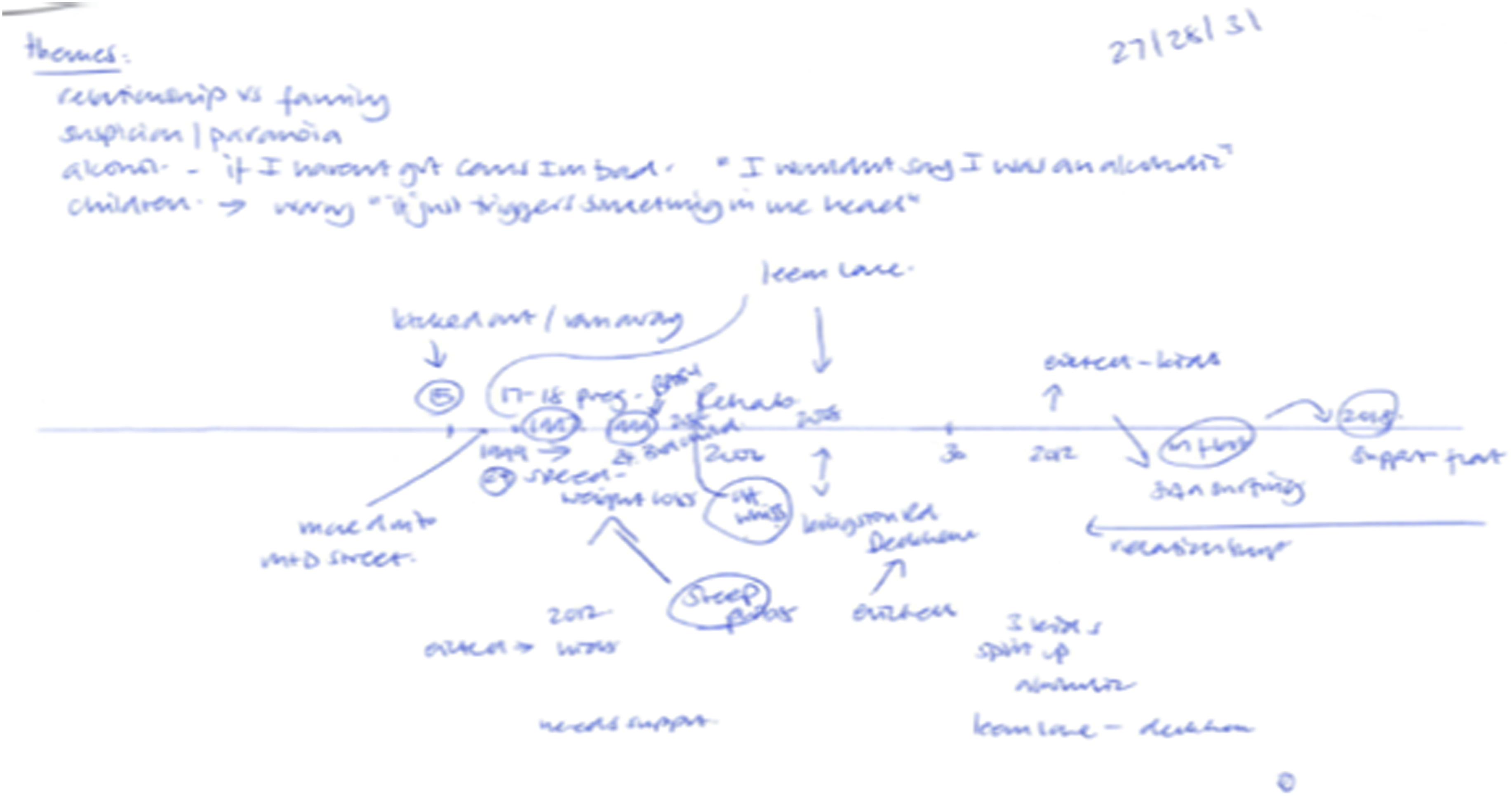
An Example of a Stylised Timeline Produced as Part of the Data Analysis