




Abstract
This article explores the potential of co-design to facilitate an imagining of ontological security when designing safe, long-term and affordable housing with women who have experienced homelessness. Drawing on Blomkamp’s (2018) representation of co-design as process, principles, and practical tools, we critically and reflexively examine the relational, dialogic and practical approach we took to research with women who had experienced homelessness. Through providing a co-design model and reporting on our decision-making and key moments in our interactions with 21 women in two Australian locations, we provide an example of how co-design research enables the imagining of ontological security. This article highlights the central role of values including social justice, cultural responsivity and gender equity in research, and the importance of trauma-informed principles to facilitate safety, choice, collaboration, trustworthiness and empowerment.
Introduction
Co-design is a participatory research methodology involving the engagement and collaboration of those with lived experience to design practical and new solutions to meet their needs related to a specific social issue (Visser et al., 2005). Lived experience participation is an expectation within western health, social service and government contexts as a measure of good practice (Gulliver et al., 2022; Slattery et al., 2020; Victorian Government, 2023). Housing and homelessness services are increasingly promoting co-design as a method to create authentic change, embedding lived experiences into the sector to improve outcomes for those experiencing homelessness or housing insecurity (MCM Group, 2024; Victorian Government, 2024; South Australian Housing Trust, 2023). However, recent research indicates that the meaningful participation and influence of people with lived experience of homelessness is primarily aspirational (Martin et al., 2024).
This article applies a gendered lens to housing co-design with two cohorts of women who have experienced homelessness: older women, and women with children who have experienced family violence. Despite being a relatively small population in Australia, between 2011-2016, the national census found that homelessness among older women notably increased by over 30% accounting for 81.7% of the 6,067 increase of people overall experiencing homelessness (ABS, 2018), a figure that has remained relatively stable (ABS, 2021). Additionally, older women are 10% more likely to access Specialist Homelessness Services (which includes a range of service types such as crisis and transitional accommodation) than older men (Australian Institute of Health and Welfare, 2022). Likewise, women who have experienced family violence are over-represented in the homelessness service system with 42% presenting to specialist housing services, and 40% having children in their care (AIHW, 2022). For many women, opportunities to participate in decision-making and design processes about the types of housing that promote security – both real and imagined – are limited (Martin et al., 2024).
It is unusual for women who report homelessness to have experienced absolute safety at home, whether that be a result of family or other forms of interpersonal violence, insecure tenure or unsafe living environments. Yet, this article provides an example of how a methodological approach created the conditions for women who had experienced homelessness to imagine suitable housing, building design and service responses which promoted an imagined sense of ontological security.
Women’s Homelessness and Ontological Security
In Australia, the cultural definition of homelessness (Chamberlain & MacKenzie, 1992), locates literal homelessness and inadequate housing in socio-historic contexts to identify and enumerate people experiencing homelessness. Single women and women with children in their care are more likely to experience homelessness in hidden and precarious situations such as temporarily staying with friends or family and may only engage with the homelessness sector when these options cease (Baptista et al., 2017; Mayock et al., 2017; Mayock & Sheridan, 2020). For women presenting to generalist homelessness services, disclosing family violence is difficult (EDVOS et al., 2015; Spinney & Zirakbash, 2017), with culturally and linguistically diverse women facing further and unique barriers to divulging family violence (George & Harris, 2014; Spinney, 2014). Moreover, the separation between family violence and homelessness service systems can mean inadequate recording of circumstances and support that does not account for the full range of needs (Baptista et al., 2017).
Housing and homelessness researchers have long argued for definitions and meanings of home to extend beyond the physical structures that people inhabit (Easthope, 2004; Hiscock et al., 2001; Mallett, 2004; Watson, 2018; Zufferey & &Horsell, 2022). While the material aspect is vital, as Mallett (2004) argues, the home is also the receptacle for a range of complex, interconnected, and sometimes contradictory ideas about space, place, relationships and objects. The framing of home through the concept of ontological security acknowledges the embedded material, subjective, and contextual meanings; and for housing and homelessness scholars, this stems from Giddens’ (1984) concept of structuration, whereby individuals and institutions reproduce social structures thus underscoring the relationship between structure and agency. Giddens (1990, p. 92) contends that ontological security exists when people have confidence ‘in the continuity of their self-identity and in the constancy of the surrounding social and material environments of action’. Ontological security is not static; rather, it is an ‘ongoing accomplishment’ (Giddens, 1993, p. 114), yet rests on ideas such as constancy and consistency.
The focus on ontological security and housing initially emerged from work on home ownership (Dupuis & Thorns, 1998; Saunders, 1989, 1990), which is pertinent for advanced capitalist societies such as Australia where it is the dominant and privileged tenure. Dupuis and Thorns (1998, p.30) were instrumental in applying Giddenss framework to the housing sphere by positing that the home connected the material environment with ‘a deeply emotional set of meanings to do with permanence and continuity’. More recently, there has been growing scholarly attention given to ontological security and different types of tenure such as public housing, community housing, affordable housing, and private rental (e.g., Carey, forthcoming; Hiscock et al., 2001; Mee, 2007, 2009; Morris et al., 2017). Research on how ontological security is experienced by those who are homeless or in housing precarity (e.g., Parsell, 2012; Plage et al., 2023; Power, 2023; Stonehouse et al., 2021) has also emerged to progress the field theoretically, although as Power (2023) argues, theorisation and practices of ontological security still remain under-researched in the fields of homelessness and housing precarity.
This article explores ontological security in relation to homelessness for older women and women who have experienced family violence through a process of co-designing safe, long-term and affordable housing. Historically, homelessness research has neglected women’s experiences (Bretherton, 2020), and while there is growing awareness and visibility of certain cohorts of women, gendered representations of ontological security are typically absent.
In Australia, housing policy for older people in general has been neglected, with those who are asset-poor at greatest risk of homelessness including people with substantial mortgage debt post-retirement, low-income renters, and those in social housing but without secure tenure (Colic-Peisker et al., 2015). Homeowners may also experience tenure churn, involving a pattern of moving between home ownership and private rental due to relationship breakdown and re-partnering (Colic-Peisker et al., 2015). The application of a gendered lens reveals the causes and impact of homelessness that can be more specific to older women. Many, for example, have previously had conventional housing histories, and experience homelessness for the first time in their 50s or 60s due to a relationship breakdown (including family violence), health crisis, employment interruption, and/or an unexpected rent increase (Petersen & Parsell, 2015; Watson et al., 2024). Others may have experienced chronic homelessness including all the associated economic, health, social and safety difficulties that are further compounded by ageing (Watson et al., 2024). Relational factors are markedly significant in older women’s experiences of homelessness. Women are more likely than men to have spent time out of the paid workforce due to caring for children and ageing parents, greatly affecting their earning capacity and exposing them to lifetime poverty accumulation and housing precarity later in life, particularly if their intimate relationship ends due to separation or death of a partner (Colic-Peisker et al., 2015; Watson et al., 2024).
Older people develop strategies to manage precarious housing conditions to preserve ontological security (Colic-Peisker et al., 2015; Power, 2023). Power’s (2023) work is particularly useful as it expands Giddens’ (1990) idea of ongoing accomplishment to focus on the strategies and practices that older women employ to secure, maintain and restore ontological security. Power (2023) identified adaptive responses to cope with homelessness including emotion-focused strategies such as reframing their understanding of housing systems and their (insecure) place within them; action-focused strategies such as through engagement with tenancy practices; and establishing a new home quickly and storing items if necessary, which demonstrated an overlap between emotion- and action-focused strategies.
Women experiencing family violence-related homelessness face similar conditions such as unaffordable housing, the gender pay gap, and caring duties. However, while there is a body of work examining the relationship between family violence and homelessness (e.g. Baptista et al., 2017; Bimpson et al., 2022; Mayock et al., 2017), there has been less explicit conceptualisation through the lens of ontological security. A central tenet of ontological security is the predictability that exists when someone is in control of their social and material environment, in which the home ‘provides a secure platform for identity development and self-actualisation’ (Padgett, 2007, p. 1926). Homelessness resulting from family violence is further undermined by violence and abuse within the home. Home is not experienced as safe; nor does it provide comfort or sanctuary and consequently does not offer a foundation for ontological security. Indeed, Wardhaugh (1999, p. 97) argues that women who have experienced family violence are ‘homeless at home’. The experience of ontological security can be further undermined for women with children. A study by Kirkman et al. (2015) reported a deterioration in ontological security for women who had been homeless with children in their care. Practices and policies, including child protection and the lack of affordable and safe housing, lead women to return to violent partners and to face possible child removal (Bimpson et al., 2022). Moreover, women who are separated from their children due to homelessness, either temporarily or for longer periods, are often not recognised as mothers by housing and welfare services and therefore experience this additional hidden loss (Van den Dries et al., 2016). Women’s homelessness, therefore, can only be resolved when women are in control not only of their physical housing, but also have full autonomy within their housing (Bretherton & Mayock, 2024; Mayock & Sheridan, 2020; Watson & Austerberry, 1986).
Our co-design projects with older women and women who had experienced family violence, alongside our theoretical foundation of ontological security were grounded in the tradition of feminist empiricism, which centres women’s experiences in the construction of knowledge (Hundleby, 2012). This is compatible with standpoint theory, which recognises and identifies how social positions are spatially- and temporally-located, and that this situated knowledge not only shapes experience, but also influences and restricts access to knowledge (Lauve-Moon et al., 2020; Sprague & Kobrynowicz, 2006; Wiley, 2003). Taking a feminist standpoint, as researchers, we prioritised women’s lived experiences of homelessness, ageing, and family violence in the construction of knowledge. This form of feminist enquiry gives space to women to develop and express their own expertise and to unearth gendered oppressions that may otherwise remain concealed (Harding, 1987). Researcher reflexivity is a key feature of feminist research, which should seek to ‘make explicit the power relations and the exercise of power in the research process’ (Ramazanoglu & Holland, 2002, p. 118). There is a strong epistemological history in feminist and feminist-inclined homelessness research of raising critical questions about gendered experiences and challenging intersectional power norms. Taking a feminist standpoint, we build on this while also unlocking a new research space for ontological security through our co-design methodology, which as discussed below, opens fresh possibilities for power-sharing and reflexivity.
Co-design and the Role of Imagination
Collaborative design, or co-design, refers to a process of ‘creative cooperation’ (Steen, 2013, p. 6) where actors from different disciplines, experiences or identities share their knowledge and engage in acts of collective creativity to imagine and create new life situations, products, or services (Sanders & Stappers, 2012). Co-design builds upon two design traditions, participatory design and user-centered design, whereby participants inhabit dual roles of ‘users’ and ‘designers’ to investigate, understand, develop, and design the desired objective, which is usually a new or improved service, product, or experience (Antonini, 2020). It can be argued that co-design is a new term for established community engagement practices and participatory methods (Blomkamp, 2018; Mullins et al., 2021) or is adopted without consideration of design history and theory (Antonini, 2020). However, Blomkamp (2018) proposes that definitional inconsistency, and broader confusion can be addressed by conceptualising co-design as a process, a set of principles, and tools or methods.
A co-design process is those dialogic, iterative, and flexible stages of convergent and divergent thinking, focusing on and exploring the unknown through problem identification, which then frames ideation and design development through testing in a real-world context (Blomkamp, 2018; Folkmann, 2010; Sanders & Stappers, 2012; Steen, 2013). A design process fosters participants’ ability to perceive problems by looking into their past, and to then imagine desirable alternatives and ‘picturing’ how these alternatives might be engaged or interacted with (Steen, 2013). This process of looking forward based on past or current experience allows participants to engage with their lived experience for the explicit purpose of creating.
Principles are relational agreements that guide the process. Design principles may be co-developed between participants, specific to the design context. Principles are useful for defining the purpose of a design project or process (Sanders & Stappers, 2012), encouraging a collective mindset of participants (Blomkamp, 2018), and determining the process for decision-making or the scope of acceptable or expected action (Killam et al., 2023). Commonly, interrogating power relations between stakeholders features as a core principle of co-design, requiring dialogue, decision-making processes and engagement activities that explicitly names and addresses unequal power relations and makes transparent those imbalances that may affect design outcomes. Some examples include democratising decision-making, prioritising community-centered outcomes over organisational or academic outcomes and demonstrating flexibility within the research to promote equitable and active participation according to participant’s personal or contextual circumstances (Chauhan et al., 2021; Moll et al., 2020).
Tools and techniques are practical methods used within the design process including photo elicitation, sketching, and role-plays, to generate and visualise tacit and latent information about what people know, feel and dream and trigger associations, emotions and memories specific to the area of design interest (Sanders & Stappers, 2012). That is, co-design tools and techniques facilitate participants’ ability to imagine and generate new ideas that were previously ambiguous or unknown to them or form new connections between previously unconnected ideas, linking abstract conception and concrete views to create novel outcomes (Folkmann, 2010; Sanders & Stappers, 2012). Tools and techniques are a key element of design methodologies, as they are used to co-create a shared language and facilitate collaboration and participation between participants, and for the purposes of that which is being designed.
Co-design research in the social services sector has increased significantly in recent times, particularly in mental health and hospital settings (Donetto et al., 2015; Hawke et al., 2024). While there remains interest in participatory and democratic research within feminist homelessness research (e.g. Norman & Pauly, 2013; Vaccaro, 2023) there is limited literature on co-designing with women in the housing sector (Marshall et al., 2023; Schiffler et al., 2023) and none reporting on the design of both buildings and support services to enable women’s ontological security.
The goal of this co-design research project was to collaborate with two groups of women who had experienced homelessness to: (1) design housing including building requirements (2) design supports and services connected to the housing, and (3) consider elements that promote ontological security. We consider women’s experiential knowledge of homelessness as privileged and central to imagining design elements that promote emotional wellbeing, psychological security, and constancy that is associated with safe, long-term, and affordable housing. The women had varied pathways into homelessness, including violence, forced migration, unemployment and financial insecurity and as such we did not assume their past experiences of ontological security. However, through a series of key moments and interactions with the women throughout the co-design research, their explanations of, and longing for, long-term, affordable, and safe housing indicate their ability and desire to imagine and materialise prototypes representing ontological security. We reflect on our methodological approach and these key moments that facilitated this imagination below.
Overview of the Project
This study, a housing build and service design project, was initiated and funded by Good Shepherd Australia New Zealand (GSANZ), a community services organisation that supports women, girls and families. The project’s aim was to explore the housing-related needs and priorities of women who had experienced homelessness and to extend this exploration to identify key elements of long-term, safe, and affordable housing. Co-design was the chosen methodology to meet these aims with a view to facilitating implementable ideas and solutions.
The project was undertaken in two locations, responding to the place-based needs identified by GSANZ. The first location was an inner-western suburb of Sydney, Australia, and comprised women over the age of 45. The second location was an outer south-eastern suburb of Melbourne, Australia, involving women with children who had experienced family violence. Each location included three co-design workshops. The study took place between August and December 2023 and received ethical approval from RMIT University (26180 and 94810). In reporting on our methodological approach, we draw on Benz et al.’s (2024) stance by describing our relational, dialogic, and practical research methods and decision-making. First, we present an outline of the process decisions as we prepared for the co-design workshops. Then, we identify key moments within the design workshops leading us to observe the women’s ability to share, imagine, and build ontological security in material form.
Commencing the Study
Researcher Positionality
We are social work and human services academics who research housing and homelessness, gender-based violence, health and wellbeing of diverse communities, policy, and co-design in social work research. We are experienced in participatory research methods and working with minoritised communities, and our collective professional values align with enacting social justice, upholding human rights, practicing reflexivity, and trauma-responsiveness. We acknowledge the expertise and knowledge that stems from lived experience and privileged the voices of the co-designers (women participants) in determining recommendations from this research. However, as researchers we acknowledge that the institutional context affords us power in decision-making about the design subject, research process, and method. As such, the intersection and embodiment of our disciplinary and methodological orientation toward collaborative approaches encouraged us to diligently attend to these power imbalances by decentering ourselves as content ‘experts’ and wherever possible, embed the co-designers’ knowledge, experience, and needs into this study. This approach was important for building trust and critical for demonstrating our trust in co-designers as knowers and as knowledge producers. As Sundbäck (2024, p. 1252) notes, “epistemic notions of trust are concerned with how people are viewed as knowers and knowledge producers and whether or not they are trustworthy based on their position as knowers (Medina, 2020)”.
Recruitment
Three methodological choices informed recruitment. The first was to prioritise diverse experiences and voices. Diversity is viewed as a strength in co-design, incorporating varying viewpoints and knowledge reflecting a range of experiences of social and health inequities (Chauhan et al., 2021). The second was to ensure the involvement of women who had experienced homelessness in the last five years but were not currently homeless, creating space for co-designers to reflect on the learnings from their lived experiences of homelessness. The third choice was to attend to power inequalities by ensuring that the women outnumbered the researchers at each site and stage of the co-design, emphasising democratic principles when making key decisions within the research process. Both sites utilised organisational support services to assist with recruitment, and in Sydney, involved a third-party service also known to the women. The services were briefed by the research team, ensuring accurate and ethical explanations of the study to potential co-designers. Recruitment resulted in 13 older women in Sydney, and eight women with children who had experienced family violence-related homelessness in Melbourne.
Pre-workshop Preparations
Practical Resources and Requirements
During recruitment, each co-designer was asked to share access needs and dietary requirements. This initial information gathering provided us with a beginning understanding of the women, for example, the material resources or accommodations that were needed, such as having interpreting services available in the design workshops and culturally respectful catering, to enable meaningful participation.
As each workshop was in person, the research team paid attention to conditions that promoted a respectful and comfortable environment. These seemingly small touches signaled that the research team valued the co-designers’ preferences and promoted trust and relationship. The workshops were held in a neutral location, such as a private meeting space at a public library. Some co-designers had to travel long distances, and the recruitment organisations assisted with this travel. Additionally, three interpreters joined the Sydney workshops and childcare was provided in Melbourne. The workshop spaces were large, light, and disability accessible.
Design Principles
Being mindful of the women’s range of experiences of homelessness, forced migration and violence, we intentionally approached the project with explicit principles and values that sought to co-create a safe enough, respectful and suitable environment for the workshops.
Sharing Power
Sharing power is essential to meaningful collaboration. Collaboration suggests ‘power with’; that is, developing shared and interpersonal understandings related to issues of mutual concern, and promoting opportunities for the pooling of knowledge and resources to work toward a goal (Farr, 2018; Graham and Barter, 1999). One of the challenges faced by academic researchers is a hierarchy of decision-making when designing and undertaking studies related to social injustice. The research team discussed these challenges and opted to communicate decisions that prioritised researcher or funder decision-making (such as the aim of the study) to the co-designers, as well as developing workshop schedules based on the co-designer’s feedback and suggestions for subsequent workshops. Sharing power meant centering the co-designer’s expertise and diverse, knowledge, views, priorities and learnings (for example, knowledge of a support service) with each other. This meant workshop agendas were adapted and adjusted as the co-designers’ priorities were centred.
Seeing the Women as Whole People
In contrast to deficit-centric narratives of women’s experiences of homelessness found in the wider literature, this study was approached from a ‘desire-based’ perspective, which is ‘concerned with understanding complexity, contradiction, and the self-determination of lived lives’ (Tuck, 2009, p. 416). Tuck’s (2009) framework led researchers to engage the co-designers not as the sum of their vulnerabilities, but as whole people with hopes, aspirations, and desires as well as their lived experiences of homelessness. This decision required the team to be mindful of its language and shift away from categories such as ‘at risk’, ‘homeless’, or ‘victims’, and instead invited the women’s contributions, expertise, learnings and reflections they deemed relevant.
Co-Creating Safety and Trauma-Responsiveness
Environments where the co-designers could imagine ontological security necessitated the prioritization of relationship development based on safety, trustworthiness, and choice. When planning the research, the team considered how to demonstrate trustworthiness to the women, for whom trust and safety in services or in researchers could not be assumed. First, the researchers reflected on trauma-informed approaches suggested by the Substance Abuse and Mental Health Services Administration (SAMHSA, 2014) and Dietkus (2022). The researchers understood that safety is a relative concept and sought to demonstrate trustworthiness by being authentic, transparent about the constraints of the research, stimulating opportunities for the women to connect and collaborate with each other, plan for and advocate for the co-designers’ control in the process, facilitate choice wherever possible, and verbally acknowledge the limitations of our own experience and knowledge through practicing cultural and epistemic humility (Tascón & Gatwiri, 2020).
Embodying Ethical Standards
Ethical principles and decision-making frameworks guided the approach with examples including co-designer contributions recognised at industry award standards of $75 retail voucher per hour of participation. To co-create safety, respect and trust, the researchers facilitated dialogue about the importance of and limitations to confidentiality at each workshop, inviting conversations about how the researchers and co-designers might uphold these values, for example, seeking permission to take photographs with the co-designers’ explicit verbal consent. Co-designers were reminded that their participation was voluntary and that they could withdraw at any time without consequence to their existing or potential relationships with SSI, the Sydney recruitment organisation, GSANZ, or the university. Other ethical norms included gathering the co-designers’ written and verbal consent to participate, and to audio-record and transcribe their experiences.
Methodological Observations
Across each of the workshops in both locations, we noticed a series of ‘key moments’, which we describe as methodological learnings or findings, related to our interactions with the co-designers during the design workshops. In this section, we briefly describe the focus of each design workshop, and then we describe three themes encapsulating key moments from across the workshops that facilitated the women’s imagining of ontological security.
Design Workshops
Illustrated in Figure 1, three workshops were held in Sydney and in Melbourne. Both first workshops explained the research, explored the co-designers’ lived experiences, built rapport, offered opportunities for connection and sought to demonstrate the researchers’ trustworthiness. Following the first workshops, an online workshop was held with professional stakeholders from the housing services sector to share their perspectives on the opportunities and challenges within women’s housing services and their ideas on building features. We then developed an analysis protocol using sensitising concepts of ‘build’ and ‘service’ to reflexively thematically analyse (Braun & Clarke, 2019) collective views on key elements that represent safe, affordable, and long-term housing. The findings from the stakeholders’ workshops were disseminated to the co-designers in the second workshops, which had a focus on the ideation stage of developing the build and service prototypes. In Sydney, with the women’s agreement, professional stakeholders were invited to attend to collaborate in the prototyping. This required us to facilitate trust building between the groups. The Melbourne co-designers did not consent to stakeholder attendance, and to embody our commitment to privilege the women’s contributions, the professionals were not invited to attend the second workshop. Facilitating the women’s control over this stage of the process not only enacted choice as a component of ethical research but also demonstrated our trauma-responsiveness by acknowledging that many of the women had previous negative experiences of services. Following workshop two, we analysed artefacts, notes, observations, audio-recording and co-designers’ reflections. We used software to consolidate and visually represent the women’s service prototypes, and we contracted an architect to develop sketches from the build prototypes. Workshop three focused on refining the visual representations of the build and service model prototypes. Structure and Purpose of the Design Workshops
Key Moment One: Sharing Stories of Difficult times
The first workshops enabled the co-designers to share their stories and discuss barriers to sustainable housing with questions such as “What does home mean to you?” “What does safe and affordable housing look like?” and “What does belonging and freedom look like at home?” In our planning, we opted not to focus explicitly on the women’s lived experiences of homelessness, instead planning for co-creation of a safe enough space to explore concepts of safety and belonging. As an introduction, we (the researchers) shared personal and professional information (for example, our favourite season, or a special leisure activity) when introducing ourselves, spoke directly to our inherited power and authority in some aspects of the research, our commitment to dispersing that power where possible and as an example, referenced our intention to learn from the co-designer’s lived expertise. The co-designers also introduced themselves (for many women in Sydney, through interpreters), which promoted a sense of the whole person as well as building shared understanding, common goals, and expression of hopes for the project. Unprompted, they also shared their stories of homelessness, contextual factors leading to their experience, and their experiences of (in)security in their current housing. This unprompted and potentially sensitive information provided a contextual lens for the elements promoting wellbeing, community, safety, connection, and belonging they wanted to include in the building and service response. For example, one older woman shared that she was sleeping on the kitchen floor in her brother’s home because of overcrowding, highlighting the lack of privacy, comfort and control over her sleeping quarters. Similar stories were shared across the prototyping workshops to help refine key elements of the build and service, including the need for security through long-term lease arrangements, outdoor areas and quiet spaces for children to play (Figure 2), lockable doors, and secure access – all indicating an imagined place of safety for the women and their families. Our decision to invite the women to share their stories was also foundational for co-creating trust, a foundational element of trauma-responsiveness and psychological safety. A Visual Representation of an Outdoor Space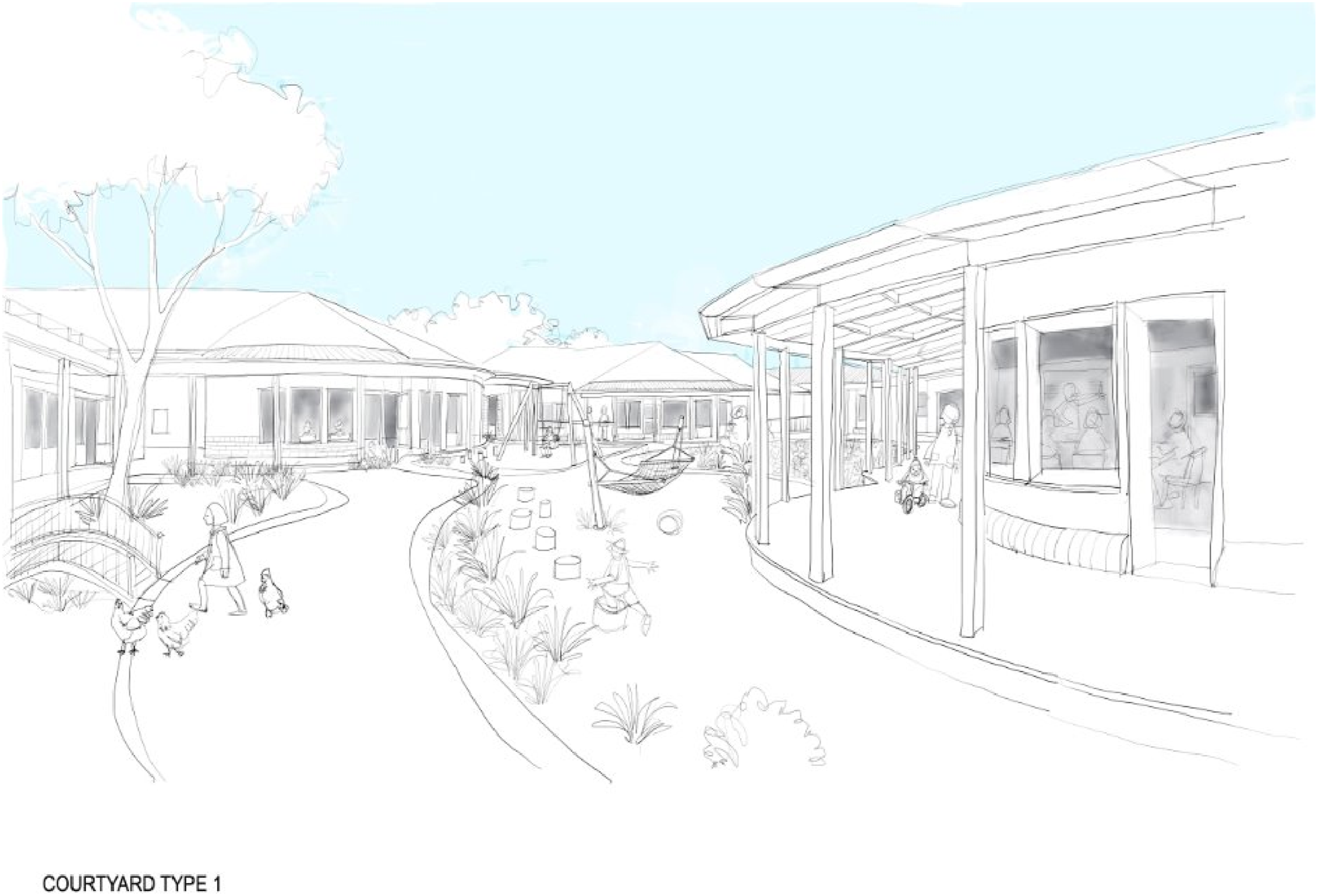
Key Moment Two: Continuous Trust-Building
Trustworthiness is a key element of trauma responsiveness (SAMHSA, 2014), collaboration (Graham & Barter, 1999), and embodying of ethical standards, and we prioritised the development of epistemic trust within the group to co-create a safe enough space to facilitate imagination. For example, after the women shared their stories in the first workshop, we learned that adjacent supports, such as obtaining a driver’s license, or other health-related services such as dentists, were inaccessible to the women. We demonstrated our trustworthiness by facilitating access to others who could provide information. At the request of the research team, GSANZ prepared an information pack and provided a support person who could respond to the women’s questions and requests. Our decision to facilitate this information sharing and support was outside of our role as researchers, but a tangible example of the collaborative process. We continually communicated with the co-designers as ‘whole people’ and did not position them from a deficit-centric perspective. This appeared to produce a sense of ownership over the process by the co-designers. In response to feedback, the Sydney location of workshop three was changed to better suit the women’s preferences. To enact power sharing, we asked the co-designers if they wanted professional stakeholders to join the second workshop to witness their priorities for housing and service design and contribute when invited by the women. The Sydney group involving older women agreed to have three stakeholders join workshop two, but the Melbourne group did not agree, therefore the stakeholders did not attend. Through these actions, we observed a noticeable growth in the co-designers’ confidence in their own leadership over the process.
Key Moment Three: Visual Illustrations of Prototypes
In workshops two and three, we used creative and visual methods to promote dialogic engagement between the co-designers, explore ideas for the build and service model prototypes, and create and refine the prototypes. Visual methods are common in co-design to generate physical representations of an imagined outcome (Sanders & Stappers, 2012) and can promote sharing and co-creation between participants. In workshops two, we asked the co-designers to use art and craft materials (including textas, paper, blocks, plasticine, and pipe cleaners, see Figure 3) to create their building designs, which they then shared with the wider group. Co-Designers Building Prototypes Using Craft Materials
Some of the features they imagined related to the tangible and intangible aspects of (ontological) security, such as preferring physically secure freestanding houses over apartments. The importance of having one’s own room reflects the importance of privacy and agency. Key themes emerging from both groups focused on the primacy of safety, security, privacy, dignity, comfort, and freedom. To ensure that the prototypes emphasised those elements of ontological safety, we asked the women to identify ‘non-negotiables’ and ‘nice-to-haves’, and in summary, asked that we had understood them correctly. This direct line of questioning is an example of facilitating the women’s authority in the design process.
In contrast to crafting their imagined homes individually, the co-designers held conversations about services to collectively envision housing supports that would meet their needs. A large piece of paper was spread out on the tables, and service elements were collectively imagined and documented (Figure 4). We noted the needs and suggestions of the co-designers and privileged their role as knowledge producers, clarifying their contributions by asking “have we understood you correctly?” and “Is this right?”. Co-Designers Documenting Service Elements
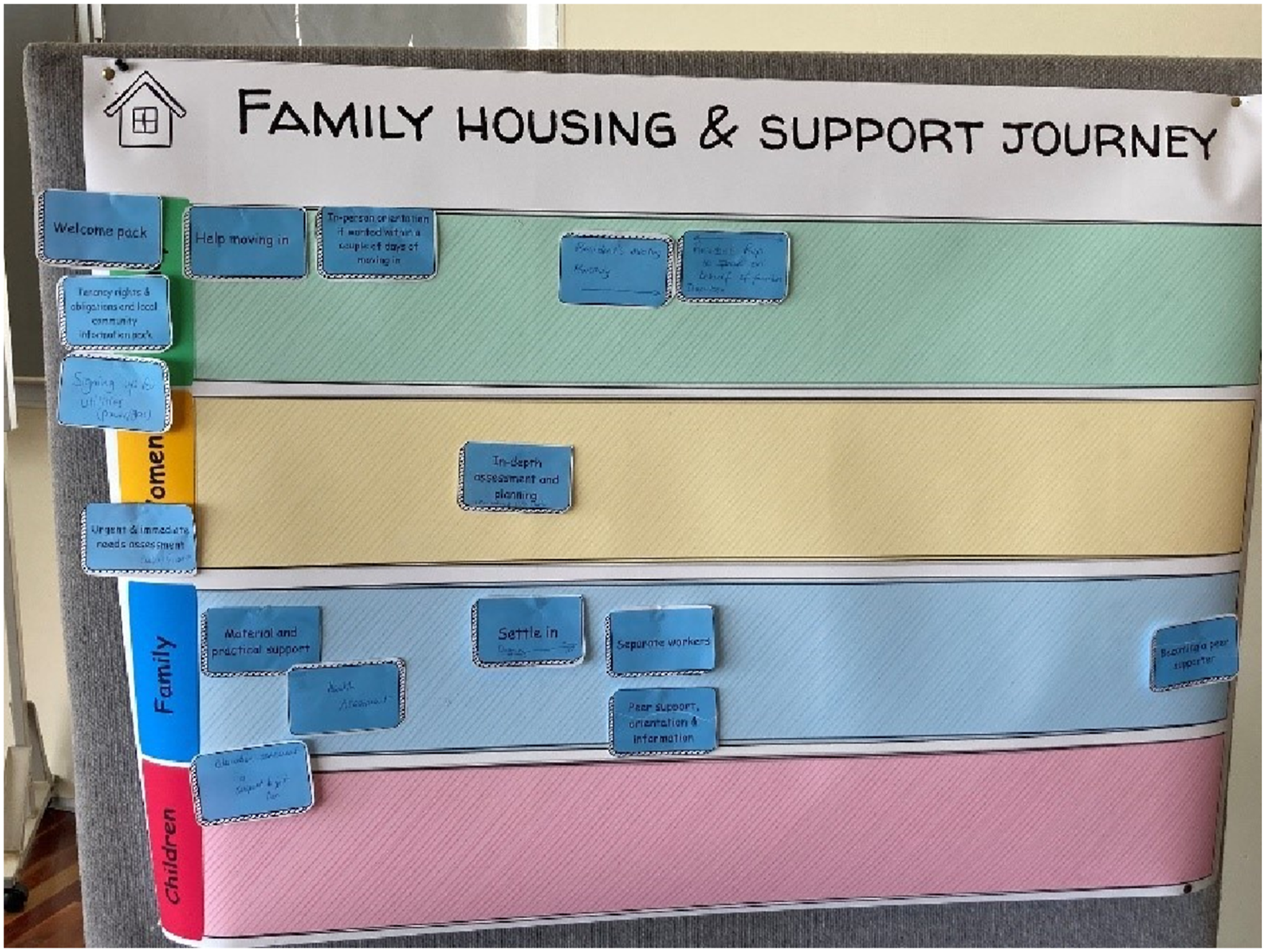
To represent the physical building, we contracted an architect knowledgeable about women’s housing design to develop sketches from the build prototypes (Figure 4). The service elements differed across the sites, with the older women in Sydney focusing on community-based support roles that were consolidated and represented as character personas (Figure 5), and the Melbourne co-designers focusing on developing positive and holistic service interactions that better supported their whole family’s needs. An Example of an Architectural Sketch
These aspects were consolidated and represented in the form of character personas and a service user journey map (Figures 6 and 7). An Example of a Community Support Role Represented as a Character Persona The Service User Journey Map Developed by the Melbourne co-designers
Considering that English was not the first language for most co-designers in Sydney, the architectural sketches demonstrated our commitment to facilitating participation by sharing findings through visual means, not dependent on the English language. These visual illustrations generated significant discussion about what the co-designers considered non-negotiable and preferred, but not essential elements of both the building and service design.
Discussion
Co-design and similar participatory methods are time and resource intensive because they require research teams to de-centre their expertise and share power with participants (Blomkamp, 2018; Sanders & Stappers, 2012; Steen, 2013). In this research, there was significant preparation time and collaboration between the research team to develop an approach to the method that privileged the women’s lived experiences and needs during the workshops. In articulating our shared disciplinary values of social justice, human rights, and practicing reflexivity in the early stages of the project, we could therefore make methodological decisions related to recruitment, the physical workshop environment, or lines of enquiry that supported the overall aims of the project and facilitated ‘safe enough’ workshop activities for the women to imagine secure housing. An important consideration for researchers looking to co-design in sensitive contexts is including sufficient time in the beginning stages of the research to establish effective researcher relationships and shared understanding of researcher values. This might include defining principles that support trust building and relationships with co-designers or exploring their own positionality. Importantly, our partner, GSANZ provided us with the freedom to be methodologically responsive and trusted our approach.
As a research team, we identified several operational principles, including sharing power, seeing the women as whole people, co-creating safety and trauma responsiveness, and embodying ethical standards in research that supported our efforts to demonstrate trustworthiness. We posit that these principles underpinned and enabled the relationships that were developed with – and between – the women. Co-design methods including storytelling, prototyping, and visual illustrations supported collaboration between the co-designers, as well as the development of tailored housing build and service models in each location. The data generated through these methods were particularly indicative of the relative emotional and physical safety the women felt to contribute their expertise and ideas for what constitutes ontological security. Thus, an important consideration for co-design research and practice is that relational processes should both accompany and strengthen collaborative data collection methods, thus enabling a shift from potentially extractive research and toward responsive, reflexive, holistic inquiry (Dietkus, 2022).
By privileging the experiences and knowledge of the co-designers, we believe the decision to visually represent the women’s ideas was a turning point in stimulating their imagination of ontological security in a housing build and service. Contracting an architect (at extra expense to the research team) to create composite sketches of each group of women’s prototypes particularly enabled the co-designers to envision – and provide feedback on – material representations of what they would want to feel at home. Visually representing data, common in co-design, was helpful in this research as it made tangible the women’s tacit and latent knowledge (Sanders & Stappers, 2012), or strategies (Power, 2023) to encounter ontological security in the home in a non-sensationalised or marginalising manner. Refining these sketches in workshop three opened space for the women to correct our interpretations, created dialogue and a shared understanding, and made explicit to them that their knowledge, experiences, and views would determine our recommendations to GSANZ. Future researchers may also consider visual artefacts as both a representation of co-designers’ ideas, as well as a key research output and knowledge translation tool.
Our approach to researching with the women revealed the potential of co-design to contribute to material change. Importantly, this research has informed the development of capital works by GSANZ, to build more than 40 affordable and tenure-secure dwellings for older women, in western Sydney. These developments include localised interventions to support older women’s wellbeing in the community. In co-design research, even in instances where authentic power-sharing and collaboration is limited by institutional context, there is still the possibility that relational, innovative, and reflexive approaches can create meaningful change.
Limitations
While this study provided an opportunity to reflect on the possibilities of co-design for power-sharing and reflexivity, we equally encountered tensions and challenges that may limit the applicability of similar methodological decisions to other contexts. The first tension was related to what we needed to produce as researchers (data and a prototype for building design and service response), and what the women needed (long term, safe, and affordable housing). The method assisted us to meet the project aims, yet systemic constraints determining housing availability and affordability defined the women’s previous and current experience of housing. As the women were not guaranteed housing from their participation in this research, this was communicated to them during recruitment, yet we often sat with the discomfort of asking the women to imagine and dream but not receive. Secondly, while we are equipped to facilitate sensitive conversations due to our social work and human services training, and in relation to our fields of research and practice, co-creating trauma responsive and safe enough spaces required significant effort and may challenge traditional expectations of the researcher-participant relationship. A practical application of disciplinary values contributed to our unique approach when supporting the women to share their stories, such as modelling curiosity over judgement, and ensuring the women received emotional support should they experience distress. A key consideration for co-design researchers is to plan for and be responsive to the emergent emotional needs of participants and ensure researchers are responsive and capable of enacting these methods.
Conclusion
While there is growing interest in co-design within the housing and homelessness sector, women’s lived experiences and understanding of ontological security rarely inform the design, implementation, or evaluation of long-term, safe, and affordable housing. Imagination, as a core component of co-design, is central to developing desired future outcomes (Steen, 2013), such as permanence and continuity in housing. Throughout our research with women in Sydney and Melbourne, we observed their ability to imagine potential housing and services that promote ontological security, based on their previous experiences of homelessness, being housed and what they longed for in a home but were yet to experience. Through the co-design workshops we noted key moments in which relational, dialogic, and practical methods and decision-making seemed to enable the women’s imagination of safe, long-term, and affordable housing and support, in which we consider trust building as a foundational component to this approach. These moments also present co-design as a potential approach for values-led research practice with minoritised populations. In highlighting our methodological approach and supported by key moments and interactions within the workshops, co-design may be a useful methodology that not only facilitates imagination, but can proactively include elements of ontological security in the design of building and service responses. We advocate for trauma-informed, culturally responsive and gendered approaches when co-creating ‘safe enough’ spaces for sharing what does – and does not – constitute ontological safety, and suggest that a principled, relational approach is foundational for women to dream and imagine the material and immaterial facets of a secure home.
Footnotes
Acknowledgements
The authors thank the 21 women in Sydney and Melbourne, without whom this research would not be possible. We acknowledge the contributions and support of Good Shepherd Australia New Zealand as the project funder, and SSI for their support in recruiting and resourcing the Sydney workshops. We thank Samantha Donnelly for her artful and sensitive sketches of the women’s imaginings. This research was conducted on the traditional lands of the Gadigal, Dharug, and Bunurong/Boonwurrung people.

Ethical Consideration
This research received ethical approval from RMIT University (26180 and 94810).
Consent to Participate
Research participants provided both verbal and written consent.
Funding
The authors disclosed receipt of the following financial support for the research, authorship, and/or publication of this article: This work was supported by the Good Shepherd Australia New Zealand under Grant [number PRJ00001553].
Declaration of Conflicting Interests
The authors declared no potential conflicts of interest with respect to the research, authorship, and/or publication of this article.