




Abstract
This article provides new insights into the use of participatory research for concept formation. Specifically, I employ a unique approach that combines capabilities approach–based questions with techniques from quantitative survey methodology. This innovative method, participatory concept calibration with quantitative framing, enables richer qualitative responses from participants as we calibrate the concept of quality of life for this population. The article reflects on the potential of this methodological approach to involve participants in defining and calibrating concepts that are then applied in research and policies that affect their communities. After describing the selection of the study population of people with a migrant background in Barcelona, I provide a detailed account of the interview question design, the use of translated and subdivided flashcards, and the integration of quantitative framing within the qualitative study. To illustrate the utility of this combined method, I present findings showing participants’ differentiation of certain capability subdivisions, as well as thick qualitative responses guided by quantitative framing. Notably, participants validate Martha Nussbaum’s list of central human capabilities as relevant but, when using quantitative framing, they adapt and expand these capabilities to highlight experiences of violence, discrimination, and (lack of) access to housing. These findings suggest that quantitative framing gives participants an entry point through which to analyse and engage with complex concepts like those used in the capabilities approach. Thus, participatory concept calibration, including the use of quantitative framing as discussed here, can empower qualitative research participants to actively shape knowledge production.
Introduction
Recent decades have seen a growing interest in incorporating research participants in the co-creation of knowledge, known as participatory research, first emerging in the social sciences (Kindon et al., 2007; Wadsworth, 1998) and currently growing beyond them into life sciences (Cornish et al., 2023). Participatory research is a methodology that seeks to replace the power imbalance of the traditional model of a researcher seeking knowledge from research subjects with a co-creative model in which research participants are active partners in the co-production of knowledge (Cornish et al., 2023; Lenette, 2022; MacDonald, 2012). Furthermore, the aims of participatory action research reach beyond the production of knowledge for its own sake to seeking change in order to improve the situation of the participants and their communities.
One research area in which participatory approaches are highly valued is the capabilities approach to quality-of-life assessment. The capabilities approach proposes a multidimensional measurement of criteria to assess quality of life, most commonly presented as a list of capabilities, that is, things that people are able to do and to be (Nussbaum, 2011; Nussbaum & Sen, 1993; Sen, 1993). Researchers who employ the capabilities approach are increasingly using participatory methods for the selection of capabilities to define quality of life in context (Greco et al., 2015; Robeyns, 2005, 2006; Sollis et al., 2021). However, the philosophical basis of the capabilities approach can be difficult to understand, and one paradigmatic list of capabilities, Nussbaum’s Central Human Capabilities (2011), is written in somewhat technical philosophical and legal language that can be obscure.
The method presented here, participatory concept calibration with quantitative framing, aims to enable participants with varying education backgrounds to engage deeply enough with complex concepts to be able to co-create knowledge in a participatory way. This paper illustrates this method in a study with 20 participants in Barcelona that used traditional participatory methods to propose capabilities relevant to their context, and then piloted participatory concept calibration with quantitative framing to calibrate the concepts presented in Nussbaum’s list.
In the next section, I offer a review of the literature relevant to participatory concept calibration and quantitative framing. Then I detail the methods I employed in applying these tools in an empirical study, followed by the main results and a discussion thereof. I conclude with limitations and suggestions for future research. The materials I used for the empirical study are available in the appendices to this paper.
Literature Review
Participatory Research Methods
Many participatory research tools exist to guide researchers aiming to employ participatory methods, incorporating non-academic participant researchers (Vaughn & Jacquez, 2020). Research tools exist for various points in a study, from identifying the problem or the needs of the community, to designing the study and developing research questions, producing or collecting the data, disseminating the results, and, in the case of participatory action research, taking action to improve the situation of participants or their community (Oosterhoff, 2022; Ospina et al., 2022). This paper proposes a new tool that can be used during the conceptualizing phase of research.
Participatory research largely aims at communities, and as such tends to involve group or community methods (Duea et al., 2022; MacDonald, 2012). This study, however, involves people who share certain characteristics, but who do not form a community: adults who grew up in the city where they currently live (in this case, Barcelona), and who have at least one parent who immigrated from outside the country (also known as people with a migration background or the second generation). The participants in this study could be considered an interest group, but not a community. Therefore, this article proposes a participatory tool that can be used with individuals.
Within the capabilities approach, participatory research tools exist for selecting relevant capabilities (Greco et al., 2015; Robeyns, 2005), assigning weights for index creation (Greco, 2016), evaluating policies (Greco, 2018; Mazigo, 2017), and taking action to change policies (Martinez-Vargas et al., 2022). This article proposes an additional tool to help participants calibrate existing concepts, such as a capabilities list, to better fit their context. This new tool empowers participants to engage more directly with capabilities as they have been theorised, rather than relying on simplified explanations as is currently practised (Brummel et al., 2023; Del Moral-Espin et al., 2017).
Concept Formation and Measurement
There is a rich literature in comparative politics regarding the formation and definition of concepts. At their core, complex concepts are both multidimensional and multilevel (Goertz, 2020), existing at various levels of abstraction (Collier et al., 2008; Sartori, 1970). Concept formation approaches differ between qualitative and quantitative researchers. Qualitative research tends to focus on the meaning or definition of concepts, breaking them into their constituent parts, while quantitative research leans more towards their measurability, seeking indicators that can be quantified by numerical data (Adcock & Collier, 2001; Goertz, 2006; Goertz & Mahoney, 2012). In both, decisions about which aspects belong in the definition of concepts are made by researchers themselves (Bevir & Kedar, 2008); concept formation in social research does not tend to be participatory, with the exception of the participatory wellbeing frameworks of the capabilities approach described above (Sollis, 2023).
To measure concepts empirically, it is important to differentiate between concepts-by-postulation and concepts-by-intuition (Blalock, 1990; Saris & Gallhofer, 2020). Concepts-by-intuition are directly defined, whether through sensory information like temperature, norms, judgments, feelings, or behaviours, and therefore can be directly measured (Saris & Gallhofer, 2020). With regards to quality of life, it can be treated as a concept-by-intuition and measured through a simple question: ‘Would you say overall you have a high or low quality of life?’
Concepts-by-postulation, on the other hand, are made up of different parts or aspects, and ‘receive their meaning from the deductive theory in which they are embedded’ (Blalock, 1990). In this sense, we can also treat quality of life as a concept-by-postulation, which we can define according to the theory of capabilities, that is, the capabilities approach, that one’s quality of life depends on one’s capabilities to do or to be certain things.
To measure a concept-by-postulation, Saris and Gallhofer (2020) further distinguish between formative and reflective indicators. Formative indicators refer to the constituent aspects of the concept-by-postulation, in our case, the capabilities, which influence the overall concept, in our case, quality of life. That is, if one has high capabilities (formative indicators), one has a high quality of life (concept-by-postulation). Reflective indicators do the inverse: they refer to aspects that reflect the concept-by-postulation, so if one has high quality of life (concept-by-postulation), one is likely to recommend one’s living conditions to others (reflective indicator).
In this study, we treat quality of life as a concept-by-postulation and attempt to calibrate it for measurement through formative indicators: the relevant capabilities.
Capabilities Lists
The capabilities approach defines quality of life by the capabilities that people are able to do or to be (Nussbaum, 2011; Nussbaum & Sen, 1993; Sen, 1993). Among capabilities researchers, there is a debate about how best to select which capabilities are valuable or relevant, which can be summarized into two main strategies (Claassen, 2020): deriving a context-based (also called ‘bottom-up’) list for a specific situation (Robeyns, 2005), or applying a philosophically reasoned universalist list which can be ‘further specified by the society in question’ (Nussbaum, 2011).
Context-based lists often draw on participatory methods to elicit capabilities, commonly using interviews, focus groups, or a combination thereof (Boni & Frediani, 2020; Clark & Hodgett, 2019; Greco et al., 2015; Husbands et al., 2024). These studies frequently use open-ended questions to draw out participants’ ideas of what a ‘good life’ is, or what capabilities are relevant to them (Sollis, 2023). The process of capabilities selection is a form of concept formation, and thus participatory selection is a form of participatory concept formation.
It is much rarer to encounter participatory research involving universalist lists like Nussbaum’s (2011). There have been some instances of presenting research participants with pre-existing capabilities lists, many working with children in presenting a simplified list and asking them what is missing (Andresen & Fegter, 2010; Biggeri et al., 2007; Del Moral-Espin et al., 2017), or using an innovative board game with simplified definitions of capabilities (Brummel et al., 2023). However, each of these simplifies the wording of the capabilities to make them understandable to people without a university education in philosophy, thereby diluting or attenuating the carefully considered original definitions.
This paper aims to fill this gap by tackling the problem of how to make theorized capabilities accessible to nonacademic participants whilst keeping the nuances of a conceptually complex formulation, to allow for participatory concept calibration. It draws from a larger study that combined the context-based and preexisting list methodologies to derive a new, synthesized list of capabilities (Fortes, 2025).
Use of Scales in Qualitative Research
In quantitative behavioural research, the goal of measurement scales is to condense research subjects’ responses into quantitative values that can be analysed in the aggregate using statistical tools (DeCastellarnau, 2018; Stevens, 1946; Weber et al., 2022). Therefore, scale and questionnaire design in quantitative research focuses on the efficiency of the measurement, how easy a scale is to use and how quick, whilst maintaining reliability (DeCastellarnau, 2018; Krosnick, 2018; Weber et al., 2022).
Qualitative research, however, seeks thick descriptions, not condensed numerical responses, and therefore generally does not use scales. In this study, however, I invert the quantitative condensation of responses into numbers and instead ask participants to use numbers as a starting point from which to express their reasoning verbally, thereby providing thick descriptions of how they conceive of capabilities. I call this tool ‘quantitative framing’, described in the Methods section of this paper.
Methods
This article draws on data from semi-structured interviews with Barcelonians whose parents immigrated from outside Spain or who themselves immigrated as children, conducted during 2022 in Barcelona. Employing participatory research methods, in which the population of study is itself involved in the production of knowledge and which have been shown to expand research participants’ agency and capabilities (Sollis et al., 2021), I conducted semi-structured interviews, allowing respondents to steer the conversation (Boni & Frediani, 2020), and engaged in what I call ‘participatory concept calibration’, in which the definition of a complex concept is calibrated in collaboration with research participants. In addition, I introduce ‘quantitative framing’ as a tool to aid in participants’ conceptual engagement and to elicit richer qualitative data.
As an immigrant myself, a child of immigrants in my home country, and a grandchild of immigrants to my parents’ home countries, I was able to build trust with my research participants by being open about my history and demonstrating my personal, not just academic, knowledge of the bureaucratic and social experiences of having a migration background. While my similarity to the research participants helped enable co-production of knowledge and minimize power dynamics, this background necessarily influenced not only my choice of research topic, but also my perspective in conducting research, heightening my sensitivity to the treatment of people with a migration background as ‘objects’ of study or ‘problems’ to be solved. It may also have given me a confirmation bias when participants brought up issues that I myself have faced, or when they described the positive aspects of belonging to different communities simultaneously as children of immigrants. My being a woman may have facilitated access to certain participants, but it may have also created barriers in accessing others. For example, I was advised repeatedly that researchers find it challenging to find women of Pakistani background in Barcelona willing to participate in research, but did not experience this difficulty myself. Meanwhile, no men of Chinese background were interested in speaking with me for this research.
In total I interviewed 20 participants, who all grew up in Barcelona with at least one immigrant parent. I conducted most interviews in person, though four participants requested the interview to take place online, so for those four I used the Zoom meetings platform. Whilst I was initially concerned that online interviews could make it more difficult to connect with participants and earn the trust necessary for them to discuss sensitive topics with me, I found these fears to be unfounded. For example, while the first online interviewee initially limited the topics she was willing to discuss on the informed consent form, such as health, during the course of the interview she changed her mind and asked to amend her informed consent to include the previously excluded topics and went into detail about them. Similarly, another online interviewee felt comfortable enough to discuss sensitive topics around sexuality and even requested a follow-up online interview to go into more depth. For the participants’ comfort, I conducted the interviews in the language of their choice 1 ; for interviewees who did not express a preference or immediately begin in one language I defaulted to Spanish. Thus, I conducted 15 interviews in Spanish, 4 in Catalan, and 1 in English. For this paper, I have translated the specific quotes I use into English.
All participants read and signed an informed consent form in the language of their choosing before beginning the interview. To gain participants’ trust and put them at ease when speaking about sensitive issues around immigration or health status, sexual orientation, political and religious beliefs, and so forth, I did not record the interviews nor use interviewees’ names. For interviews in person, I took notes by hand throughout the interview, and for those online I took notes on the computer. 2 Notes included not only what interviewees said but also relevant observations of their body language and physical interactions, which were taken into account when determining which capabilities were pertinent to defining quality of life for this population.
To protect participants’ privacy, I assigned a number and letter (e.g., 1A) to each participant and used these aliases exclusively in all notes and data analysis; their names only ever appeared on the informed consent forms. Later, in response to valuable feedback, I assigned aliases to the participants to respect their humanity and demonstrate how their migrant background was often reflected in their names, which had real-world consequences (Fitó, 2020). For most participants, I imitated their real names by assigning them aliases according to their parents’ nationality, drawn from the Spanish National Statistics Institute’s list of most frequently used names by nationality (Instituto Nacional de Estadística, 2023); one participant, however, had a Spanish name despite her Chinese heritage, so I chose a similarly Spanish alias for her.
Sample Selection
As this was part of a larger study intended to discover shortcomings in the integration paradigm when compared to a quality-of-life assessment using the capabilities approach, particularly as applied to people with a migration background, the selection criteria involved having been born in or arrived in Barcelona as a child or teenager and having at least one immigrant parent. All participants were adults, aged between 21 and 39 at the time of the interviews.
To account for possible variation in how people with different migrant backgrounds may experience life in Barcelona and therefore may value different capabilities, I sought to include participants from different regional backgrounds. Using data provided by the Catalan Statistics Institute, I selected one country from each region within the 15 countries with the largest immigrant population in Barcelona between 1 January 2000 and 1 January 2020 (Institut d’Estadística de Catalunya, 2024). Thus, from Europe, I selected Italy (mean of 19,732 Italian immigrants residing in Barcelona between 2000 and 2020); from Latin America, Ecuador (mean of 16,186 Ecuadorean immigrants); from South Asia, Pakistan (mean of 15,429); from East Asia, China (12,997); and from Northern Africa, Morocco (12,501). Several researchers specializing in migration studies in Barcelona alerted me that many people who use Italian citizenship for bureaucratic purposes are dual citizens hailing from Latin America, and that this could skew the data and make it appear that there are more Italians than people from other European countries. To balance this, I included additional participants from countries beyond the initial five, including from two additional European countries. I included two countries from the Asian continent because they were each represented in the top three countries of origin by population in Barcelona on 1 January 2020, and because East Asians and South Asians are very different from each other in terms of cultural history, language, and physical appearance, all of which may affect their experiences. Meanwhile, I did not include any countries from the Middle East, Sub-Saharan Africa, nor Oceania in my main sample, as no single country of origin within these regions had an immigrant population in Barcelona greater than 1000 people until 2010, so their children would not yet have reached adulthood and would therefore be excluded from my research population of adults with a migrant background who grew up in Barcelona (Institut d’Estadística de Catalunya, 2024). Each participant had at least one parent who hailed from – or themselves came as children from – one of these countries.
The sample selection involved a combination of purposeful and snowball sampling. To find participants, I reached out to my personal network of friends, colleagues, and acquaintances, to ask if they knew people with at least one parent from the chosen countries. Once I started interviewing people, I asked each participant to recommend further participants meeting the inclusion criteria. In this way, I was able to reach individuals without relying on immigrant-focused organizations, which could skew results. While this did not lead to a representative sample, it did bring participants with varying levels of participation in political or social organizations. I also hoped to find many ‘well integrated’ people to examine variation in quality of life when integration levels are similar.
From the five selected countries, I interviewed 5 people with a background from Ecuador, 3 from China, 4 from Morocco, 3 from Pakistan, and 1 from Italy. For the additional interviews, from the Latin American region I interviewed 1 person with a Mexican background; from the African region, 1 with a background from Côte d’Ivoire; and to balance the uncertainty around the numbers of Italian immigrants, from the European region I interviewed 1 person with a French background and 1 with an Irish one. Of the 20 participants, 8 were born in Barcelona, 1 was born in another part of Catalunya, 1 was born while her parents were traveling but arrived in Barcelona as an infant, 5 arrived in Barcelona before the age of 12, and 5 arrived as teenagers. Fourteen of the participants were female and six, male.
Interview Questions
Each interview consisted of three parts, comprising the questions I used to guide the interviews, plus a warmup and a close (see Appendix A). Following best practices in capabilities-focused participatory research, I began the interviews with open-ended questions asking participants about important aspects of a high quality of life and about things they think people should be able to do or to be in order to have a high quality of life (Biggeri et al., 2007; Clark & Hodgett, 2019; Del Moral-Espin et al., 2017; Greco et al., 2015). The phrasing of these questions deliberately did not employ capabilities language, as it was highly unlikely that the participants would be familiar with the capabilities approach and explaining it could prejudice their responses. Rather, these questions guided participants to reflect on values – what ‘high quality of life’ means to them – and to offer their own list of capabilities – ‘things you think people should be able to do or to be’ – without prior interference (Clark & Hodgett, 2019). Following Robeyns’ (2017) methodology of selecting context-based relevant capabilities, I then primed participants to think about their status as people with a migration background and elicited suggestions of capabilities that are specifically relevant to them in comparison to people whose parents were born and raised in the country. The responses to these initial questions allowed me to collect context-based capabilities derived from the participants themselves.
In the second part of the interview, we engaged in what I call participatory concept calibration with quantitative framing, described in detail in the following subsection. Here, I asked participants to evaluate their own capabilities according to Nussbaum’s (2011) list of central human capabilities (see Appendix A). This served two purposes: it allowed participants to evaluate their own quality of life, which I could later compare or contrast with their assessment according to the integration paradigm (Fortes, in press); and it gave participants an accessible entry point to calibrating the concept of quality of life according to capabilities. Then, based on capabilities research (Del Moral-Espin et al., 2017), I ended this section by asking whether there was anything missing from the list of capabilities that they thought was relevant to quality of life. The answers from this second part of the interview were incorporated into the analysis calibrating the concept of quality of life to create the new capabilities list.
Finally, I closed each interview with a structured questionnaire assessing their integration using indicators derived from European Union policy documents and databases (Action Plan on Integration and Inclusion 2021-2027, 2020, Action Plan on the Integration of Third Country Nationals, 21, 2016, Declaration of the European Ministerial Conference on Integration, 2010, European Commission: Eurostat, 2011, OECD/European Union, 2018) and additional indicators derived from the EU Report on the consultations on integration and inclusion of migrants and people with a migration background (ICF Consulting Services Limited, 2020). 3 The questionnaire also gathered sociodemographic information (age, city of birth, age at which they moved to Barcelona, Spanish citizenship status, parents’ cities of birth, participation in social associations). The interview concluded with a final open-ended question asking if there was anything they thought I should have asked them related to their quality of life. Closing in this way allowed participants to provide additional insights from their own personal perspectives that may have been missed by the larger-picture questions at the beginning (Clark & Hodgett, 2019).
After the interviews, I input all transcribed interview notes into NVivo software and used inductive coding and thematic analysis to capture the elements participants brought up (Thomas, 2016). Notably I did not use deductive coding; that is, I did not apply Nussbaum’s list of ten capabilities to the interview data. Instead, through the coding process, I sorted different elements from the interviews into inductive categories, which I then compared to Nussbaum’s list of central human capabilities. This comparison determined whether each Nussbaum capability was supported or needed adjustment and suggested additional capabilities missing from her list, thereby calibrating the concept of quality of life.
Participatory Concept Calibration with Quantitative Framing
Through participatory concept calibration, the participants in the semi-structured interviews and I collaboratively established a definition of high quality of life for people with a migration background in a large European city, in this case Barcelona, using the capabilities approach.
In addition to the open-ended questions at the beginning and end of the interview, described above, participatory concept calibration involved helping participants engage directly with the complex concepts presented by Nussbaum’s (2011) capabilities. To accomplish this, I employed two phases to make these philosophical concepts accessible to people without a background in political philosophy or law, or even a university education.
In the preparatory phase, I translated each capability into both Spanish and Catalan, so participants could choose to engage in their native languages. I then broke each one into its constituent parts, presenting these in bullet points, and finally printed and laminated flashcards with one capability per card, so participants could engage with them one by one (see Appendix B).
In the assessment phase, I borrowed a technique from quantitative methods and applied an interval rating scale to each capability. Interval scales preserve a set distance between items, for example assigning numbers from zero to ten, so it is possible to use statistical measures of the mean, quartiles, and standard deviations of responses. For each flashcard, I asked participants to evaluate, on a scale from one to four, with one being not at all capable and four being fully capable, to what extent they felt they had that particular capability in their own lives. Importantly, although the interval rating scale was presented numerically, I encouraged participants to explain their reasoning as they deliberated which number to choose, thus providing rich descriptions for qualitative analysis.
Quantitative research has determined that interval scales using even numbers of response options give information about direction (capable or not capable), and if there are more than two options, also intensity (totally capable is more intense than somewhat capable, though in the same direction) (Garner, 1960). Using rating scales with more than two options, as opposed to dichotomous scales, has been shown to require more interpretative effort from the respondent (DeCastellarnau, 2018), and respondents take longer to respond to even-numbered scales (Krosnick, 2018), in part because they cannot choose a neutral option (Kusmaryono et al., 2022). For these reasons, I chose to use an even-numbered rating scale, to oblige participants to think through their choices, particularly when faced with the obligation to choose one direction or the other, and I encouraged them to deliberate out loud.
The purpose of this quantitative framing was not to assign numbers to participants’ capabilities, but rather to give them something more concrete with which to grasp the concept of capabilities, so they could then reason with the capabilities themselves and offer their own perceptions and assessments. I informed participants that I intended to analyse their qualitative responses, and the numbers were simply for reference.
After piloting this approach in the first few interviews and presenting the flashcards in the same order as Nussbaum’s published list, I noticed that participants began to engage more fully with the concepts when discussing Practical reason (sixth in Nussbaum’s list) and Emotions (fifth) than Life (first) and Bodily health (second). Therefore, I decided to present the flashcards beginning with Practical reason and Emotions, followed by Life, Bodily health, and the rest of Nussbaum’s capabilities in order of her publication.
Throughout each interview, I took detailed notes on what participants said, regardless of whether they were direct responses to the questions. Most importantly, during the capabilities self-assessment, I did not simply write down the number each participant assigned to evaluate their capabilities; instead, I encouraged them to share their reasoning, and took notes. These quantitative framing–aided discussions provided the heart of the participatory concept calibration, which culminated in a new capabilities list defining quality of life for this population.
From this participatory concept calibration, I was able to derive a new list of 12 capabilities defining quality of life for people with a migration background in Barcelona (Fortes, 2025). In the following section, I present and discuss the results of using this method, participatory concept calibration with quantitative framing. 4
Results and Discussion
Participants’ responses to the interview questions in the first part and engagement with the capabilities list in the second part led to changes in which capabilities were relevant to define quality of life for this population.
When engaging with the subdivided flashcards, participants spontaneously assigned different values to different sub-sections, or bullet points, within the same flashcard, particularly when they determined one to be different from its companions. These variations pointed to a need to differentiate some of Nussbaum’s capabilities into discrete capabilities in order to reflect participants’ reality (see Figure 1). Subdividing the capabilities allowed participants to conceptualize them more easily and to self-assess with greater granularity than the block definitions in the original text. Combining this with the quantitative framing tool allowed us to determine that some capabilities needed to be redefined, and some sub-definitions needed to become standalone capabilities.
5
Participants’ Valuations Using Quantitative Framing Point to Emerging Capabilities. The capability highlighted on the far right of each chart corresponds to the valuation of a bullet point extracted from Nussbaum’s capability(ies) valued on the left. Participants noticeably valued these subdivisions (right) differently from the rest of the capability (left and centre), pointing to the need to reconfigure the capabilities list. Source: Prepared by the author based on original data from interviews.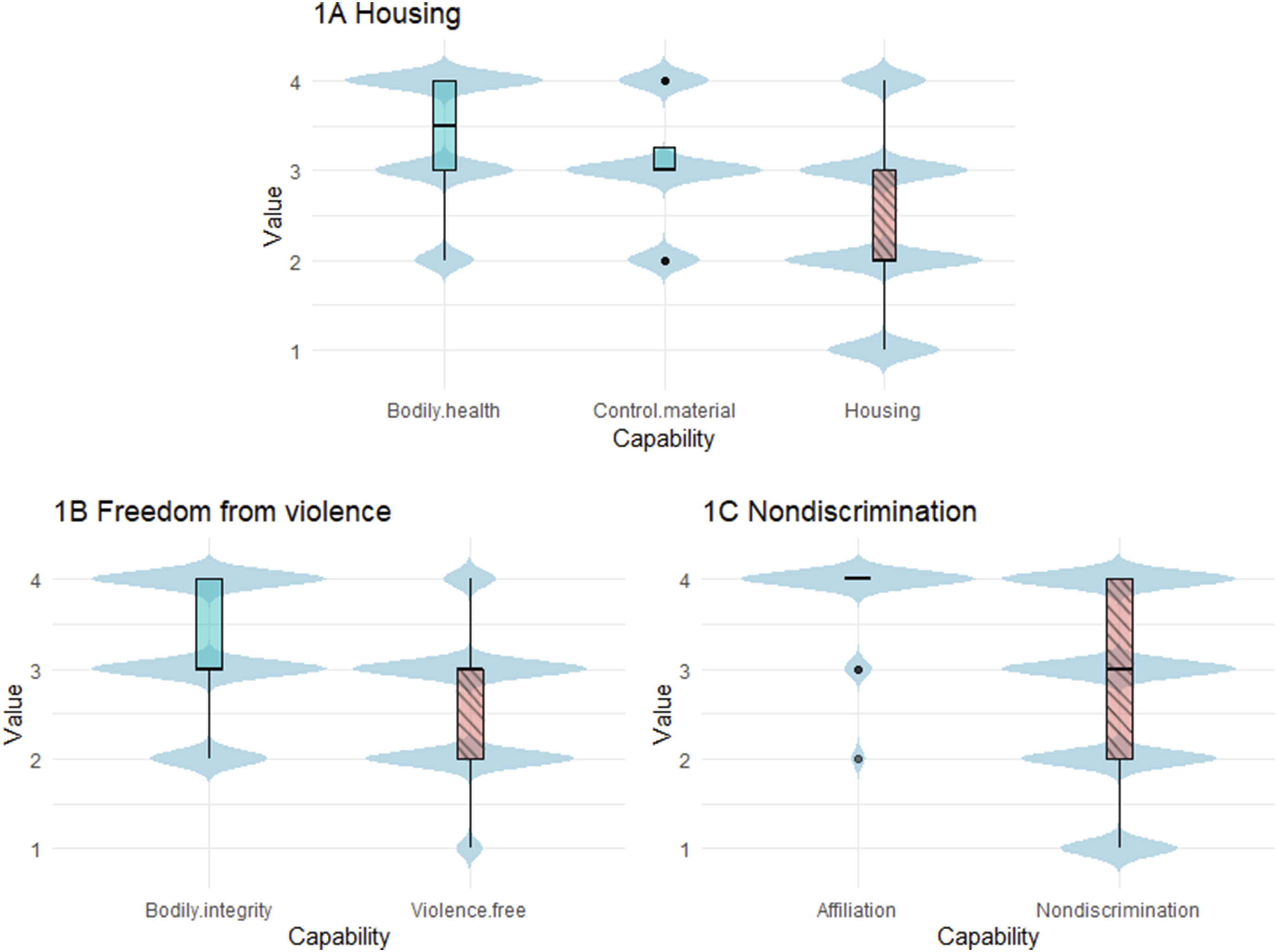
For example, Nussbaum’s definition of Bodily health includes ‘to have adequate shelter’, and her Control over one’s environment: Material includes ‘Being able to hold property (both land and movable goods), and having property rights on an equal basis with others’. Participants rated these housing-related sub-definitions much lower than the rest of the definitions. Figure 1(A) shows their ratings of Bodily health and Control: Material without the housing-related points (left and centre), compared to their ratings of the housing-related points (right). Similarly, Nussbaum’s definition of Bodily integrity includes ‘to be secure against violent assault’. Figure 1(B) shows respondents’ ratings of Bodily integrity without that sub-definition (left) and only that sub-definition (right). Finally, Nussbaum’s definition of Affiliation includes ‘Having the social bases of self-respect and non-humiliation; being able to be treated as a dignified being whose worth is equal to that of others. This entails provisions of non-discrimination on the basis of race, sex, sexual orientation, ethnicity, caste, religion, national origin and species.’ Figure 1(C) shows respondents’ ratings of Affiliation without that sub-definition (left) and only that sub-definition (right).
Within the interviews themselves, 34-year-old participant Li
6
exemplifies this process as she uses quantitative framing to assess her capability of Control over one’s environment (see Appendix A for the full list of Nussbaum’s capabilities with definitions). Nussbaum (2011) divides this capability into two parts, A. Political, and B. Material, and I further subdivided the definition on the flashcard as follows (see Figure 2 for a photograph of a participant using the Spanish-language flashcard): (a) political - being able to participate effectively in political choices that govern one’s life - having the right of political participation, protections of free speech and association (b) material - being able to hold property (both land and movable goods), and having property rights on an equal basis with others - having the right to seek employment on an equal basis with others - having the freedom from unwarranted search and seizure - in work, being able to work as a human, exercising practical reason and entering into meaningful relationships of mutual recognition with other workers. Participant Using Flashcards of Nussbaum’s Central Capabilities, Subdivided and Translated.

Li was born in Barcelona to Chinese parents. She has a university degree and works in the migration field. She mentioned to me that people with a Chinese background would be very unlikely to participate in my research because ‘they are not used to being interviewed for studies’ and in order ‘to not be the object of study’, and she confided that she had only agreed to participate because we knew someone in common. During our interview, which we held at a café near the city centre, she was conspicuously wary of the location of her purse and whether it could be stolen, a common concern among those living in or visiting Barcelona. Although theft is often nonviolent, I noted this body language and its coexistence with her self-evaluation of being completely safe from violent assault, a rare assessment compared with other participants (see Figure 1(B)).
Li spoke longingly of becoming a homeowner, but said it is currently out of her reach. In her response to part B of the capability of Control over one’s environment, Li provides a representative example of how participants used the bullet points to calibrate this capability: The first one, if I could put 0 I would, so I guess 1. For the second, 4. Third, 4. I feel totally free. Fourth, 4. It’s what I look for in professional relationships and what I try to promote on my team.
Here, like many other participants, Li separated the bullet point referring to property ownership from the rest. Together with participants’ tendency to separate the ‘adequate shelter’ bullet point from the others in the capability of Bodily health, along with further discussion, it became clear that Housing was a separate, standalone capability important for defining quality of life for this population (see Figure 1(A)).
Meanwhile, Li’s response to part A of the Control over one’s environment capability demonstrates the richer qualitative data that can come from quantitative framing and encouraging participants to thinking through why they assign certain numbers: The first one, 2. I think I have the capability to participate effectively in political elections, but I’m not interested in politics. The second, 4. I have the right. Freedom of expression is a delicate topic. No matter how much this freedom is promoted, I don’t think it’s real. So let me amend that: 2.
Notably, participants validate Martha Nussbaum’s list of central human capabilities as relevant but, when using quantitative framing, they adapt and expand these capabilities to highlight experiences of violence, discrimination, and (lack of) access to housing (see Figure 1).
Beyond the redefinition of capabilities driven by the bullet points, quantitative framing also offered a specific advantage: detailed responses describing the rationale behind choosing specific numbers.
Another participant, Luis, illustrates how quantitative framing leads to rich information regarding how he conceives of ‘the good’, a notoriously complex philosophical concept. A reserved participant who hesitated to speak, 30-year-old Luis arrived in Barcelona from Ecuador at the age of 9 through family reunification, following his father and brother. He enjoys his work as a night-shift nurse at one of Barcelona’s main hospitals, for which he earned a vocational degree (‘formación profesional’) after secondary school.
Quantitative framing – being able to present his assessment through numbers and to think aloud as he assigns the values – gives him a foothold to express his philosophical views. His self-assessment of Practical reason, which Nussbaum (2011) defines as ‘Being able to form a conception of the good and to engage in critical reflection about the planning of one’s life. (This entails protection for the liberty of conscience and religious observance.)’ is: Three. Without exaggerating, 4. Maybe before I travelled, before I moved, I would have said 1 or 0. But having seen other places, met people with different cultures and thoughts, has opened my mind. With regards to religion, I was raised in a Christian family. The Bible is very clear. For example, on the issue of homosexuality, it’s very clear. But after having travelled and met other people, I see it differently. Now I can put myself in their shoes. There are a lot of people who can’t, and I used to consider myself one of them. In the end it’s about respect. It’s based on respect. Everyone will answer to God.
Meanwhile, the choice of only four options on the interval scale drove some participants to deliberate between options 2 and 3, both non-extreme choices that excluded a neutral middle. In some cases, participants could not choose one direction over the other, but the ensuing struggle offered important insight into their thinking.
For example, Shazia is a 30-year-old woman of Pakistani descent whose parents moved to Barcelona before she or her siblings were born. Growing up in Barcelona, she noticed that very few people of Pakistani descent attended university, so she volunteered to help guide people from her community through the logistics of applying and studying at the university level. In our interview, when rating her capability of Other species, strongly resisted choosing between 2 and 3, explaining: Two-and-a-half. Because yeah, it would be a 6 out of 10. Because yeah, but, to be able to […] put it into practice: to be able to afford it financially speaking. Living in a city, there isn’t much interaction with animals. The interaction would be, for example, buying food. I’m not vegetarian, but I do care about these things. Halal, for example, everything is done so the animal won’t suffer. Also, milk, eggs, everything organic is more expensive. And maybe you can’t afford it. You could try to minimize those things, but they are so rooted in what we eat. We are contributing to an industry that’s a bit, that’s pretty cruel. No matter how much it matters to you, if you’re contributing to that, it’s not fair to put a 3.
In each of these cases, quantitative framing noticeably influenced the manner in which participants engaged with and responded to the questions they were asked.
Conclusion
While the open-ended questions I used are based on an established tradition in capabilities research (Alkire, 2005; Biggeri et al., 2007; Clark & Hodgett, 2019; Robeyns, 2005, 2017), there are fewer tools available to researchers looking to co-create knowledge with participants who may not have the academic background to engage directly with complex concepts. Applying quantitative framing like the interval scale used here, combined with breaking larger concepts into their constituent parts, can give participants a handhold with which to grasp the concepts well enough to calibrate them collaboratively, that is, to engage in participatory concept calibration. In addition, multiple participants commented on how much they enjoyed the opportunity these interviews offered them to think about ‘bigger questions’ in life and told me they recommended the experience to their friends.
Through the interviews, participants validated Martha Nussbaum’s list of central human capabilities as relevant but, when using quantitative framing, they adapted and expanded these capabilities to highlight experiences of violence, discrimination, and (lack of) access to housing. As expected, obliging participants to choose between an even number of options enabled rich qualitative data as they deliberated aloud. Unexpectedly, dividing the capabilities into bullet points also gave them a handle with which to manipulate the concepts and revise them into capabilities that better reflected their reality.
Although all of the participants in this study had some level of tertiary education, none had studied philosophy or law at the university level or beyond. For example, Luis was trained to be a nurse, and Antonio, born in Barcelona with an Italian father, was a university student in architecture when we spoke. And yet, through participatory concept calibration with quantitative framing, all were able to engage with the complex concepts of Nussbaum’s (2011) list of central human capabilities and shape a new capabilities list that more accurately reflected quality of life for people like them.
As any study, this research had limitations, particularly relating to the sampling method. A sample of 20 individuals is in no way representative, and less so when using a snowball sampling method. The gender imbalance of 14 women to 6 men may have influenced the findings unintentionally. However, many participants discussed aspects that did not affect them directly and yet were relevant to calibrating the concept: for example, many men brought up the issue of sexual and gendered violence against women, and people from all backgrounds discussed housing discrimination against people of Moroccan heritage. Thus, whilst including more male participants may have added some insights, it is unlikely to have changed the results of the study. Similarly, although all efforts were made to take accurate and comprehensive notes, including reading back certain quotes to the participants, not recording the interviews limited the ability to verify statements and quotes and may affect data reliability. Also, allowing participants to select their own aliases would have offered them more agency within the research.
This study opens avenues for future research. For example, with the newly calibrated concept of quality of life, one could design a large-N quantitative study to create an explanatory model to determine which policies or which socio-demographic factors influence quality of life. Given the purposeful sampling method used here, all participants were well integrated children of immigrants, which includes having some level of tertiary education, although in some cases that corresponded to vocational training and in no cases included philosophy or law. Future research with more excluded populations, those with less education, and employing larger sample sizes could test the validity of participatory concept calibration with quantitative framing to determine whether it is applicable to qualitative research with other populations. Finally, in this study and this particular methodology, the focus was on calibrating the specific capabilities that together define quality of life. Thus, the weighting of different capabilities was not addressed. Further research could take advantage of existing tools, both participatory (Greco, 2016) and statistical (Krishnakumar, 2021), to determine the relative importance of each capability within the list.
These new tools, participatory concept calibration and quantitative framing, can be useful to social science researchers beyond the capabilities approach. Quantitative framing on its own can be used, even in non-participatory research contexts, as a tool to elicit rich descriptions for qualitative analysis in any interview setting. For example, qualitative researchers seeking a deeper understanding of interviewees’ opinions about the subject of study can employ quantitative framing to encourage thick descriptions of why an interviewee chooses to rate something a certain way. Meanwhile, participatory concept calibration can be employed to adjust and align expectations around what is important in a particular context. For example, a participatory study on housing accessibility could employ participatory concept calibration to help individuals from the community engage with the complex legal texts governing tenants’, squatters’, and landlord’s rights, zoning, and other regulations to determine what housing accessibility means to them and how they want to approach it.
This research also has policy implications. Part of participatory action research includes taking action to improve the situation of participants or their community (Oosterhoff, 2022; Ospina et al., 2022). In this vein, I took the results of this study to both the local city government of Barcelona and the regional government of Catalonia to advocate for assessing the quality of life of people with a migration background and for implementing policies that could affect their capabilities directly.
By providing participants with the means to engage more directly with complex concepts and contribute to their formation and calibration for measurement, participatory concept calibration and quantitative framing add to the toolbox of participatory research.
Supplemental Material
Supplemental Material - Participatory Concept Calibration: How Quantitative Framing Can Help Elucidate Richer Data in Qualitative Interviews
Supplemental Material for Participatory Concept Calibration: How Quantitative Framing Can Help Elucidate Richer Data in Qualitative Interviews by Eva Fortes in International Journal of Qualitative Methods
Footnotes
Acknowledgements
The author would like to thank the research participants for their generosity in sharing their experiences, their time, and their thoughts to calibrate the concept of quality of life for use in future research and policy applications. The author is also grateful to Drs. Matthias vom Hau and Flavio Comim, as well as the reviewers, for their comments on earlier drafts of this paper.

Ethical Considerations
This research received ethics approval from the Institutional Committee for Ethical Review of Projects (CIREP) at Universitat Pompeu Fabra, with reference number X2020005313 and approval number 222.
Consent to Participate
Before starting interviews, participants gave informed written consent to participate in the study, to the processing of special categories of personal data, to the reuse of their personal data, and to the publication of identifying data such as image or voice. All participant data was anonymised before publication.
Funding
The author disclosed receipt of the following financial support for the research, authorship, and/or publication of this article: The project that gave rise to these results received the support of a fellowship from ”la Caixa” Foundation (ID 100010434). The fellowship code is LCF/BQ/DR20/11790006.
Declaration of Conflicting Interest
The author declared no potential conflicts of interest with respect to the research, authorship, and/or publication of this article.
Data Availability Statement
The datasets used and analysed in this article are available from the author on reasonable request.
Supplemental Material
Supplemental material for this article is available online.
Notes
References
Supplementary Material
Please find the following supplemental material available below.
For Open Access articles published under a Creative Commons License, all supplemental material carries the same license as the article it is associated with.
For non-Open Access articles published, all supplemental material carries a non-exclusive license, and permission requests for re-use of supplemental material or any part of supplemental material shall be sent directly to the copyright owner as specified in the copyright notice associated with the article.
