




Abstract
This paper applies a critical realist philosophical position to collect and analyse data from 34 children and young people with disabilities about the child protection and welfare issues associated with internet use. This study utilised a blend of methods for data collection and a defined data analysis frame which is presented in this paper. This data analysis frame offers learning about how qualitative findings can be applied to critical realism, explaining the position of causal mechanisms within the digital realities of children and young people with disabilities. The purpose of this paper is to add to emerging critical realist methodological literature by delineating the data collection processes involved in doing research with children and young people with disabilities and by providing a step-by-step guide to qualitative data analysis through a critical realist lens. This paper offers learning for academics, researchers, and policymakers interested in engaging children and young people with disabilities in qualitative research.
Keywords
Introduction
A critical realist philosophical approach was used in a funded research study to examine the expressed views of children and young people with disabilities about their internet use, positioned within a child protection and welfare background. This topic is complex, poorly researched, and overlooks the lived experiences of children and young people with disabilities. This paper focuses on the methodological process, specifically data collection and data analysis. An account of the detailed findings of this study is available in Doolan Maher, Flynn, and Byrne (under review-a). Further discussion that addresses digital child protection and welfare risk for children and young people with disabilities is available in Doolan Maher, Flynn and Byrne (under review-b). Henceforth, reference to ‘the study’ pertains to the qualitative study that underpins this paper as opposed to reference to “this paper,” which sets out the methodological process of data collection and analysis with a critical realist lens.
Critical realism is put forward as a middle ground alternate to positivism and interpretivism. The adoption of the critical realist philosophical approach can be viewed in nursing and health sciences (Parlour & McCormack, 2012; Williams et al., 2017; Ryan, 2024; Rajab Dizavandi, 2021), social work and social sciences (Blom & Morén, 2010; Houston, 2001; Oliver, 2012; Samsonsen & Heggdalsvik, 2024), as well as business and management research (McAvoy & Butler, 2018; Ryan et al., 2012; Saxena, 2019). Moreover, critical realism has been applied on an individual basis to the core concepts within this research topic; disability (Bhaskar & Danermark, 2006; McKechnie, 2007; Shakespeare, 2013), internet use (Eynon, 2023; Wheaton & Kreps, 2023) and child protection and welfare (Samsonsen and Heggdalsvik, 2023; Walker, 2004). However, overall, less attention is paid in the literature to the methodological processes within critical realism. Here, the work of Fryer (2022), Christodoulou (2024), and Wiltshire and Ronkainen (2021) informs this paper, providing key methodological guidance on the data analysis frame presented later and used to address a qualitative study on internet-related child protection and welfare risks for children and young people with disabilities.
This paper intends to add to emerging literature on the application of a critical realist position to data collection and analysis, as well as focusing on the critical realist application to data analysis within a funded qualitative research study. While it does not provide an exhaustive account of critical realism, it nevertheless establishes critical realism as an appropriate choice of philosophical framework for the study. For example, this qualitative study captured the expressed views of children and young people with disabilities, which are, by their nature, subjective, contextual, and shaped by diverse life experiences. This can be seen to be in opposition to a positivist approach, which posits that knowledge is truth, definite, harmonious with reality, and accurate (Park et al., 2019). While positivism may offer a structured way of knowing, it tends to overlook the complexities that exist within children and young people’s rich, varied, and non-linear views of their digital worlds.
Several methodological debates in literature offer insights into critical realist application to qualitative research relative to social constructionism and positivism (Cruickshank, 2012; Lawani, 2021; Saleh, 2009). Social constructivism and social constructionism are philosophical paradigms where the world has no meaning until it is constructed by individuals’ or groups of individuals’ social activity (Berger & Luckmann, 2016; Gergen, 1999). The questions raised by Berger and Luckman, “What is real? How is one to know?” (1996, p.13), have particular significance when related to critical realism’s epistemological and ontological premises. Tensions lie in their epistemological positions, for example, critical realism posits reality exists independent of human knowingness, while social constructivism/ social constructionism emphasises human construction and interpretation of reality (Elder-Vass, 2012; Taylor, 2018). Ontologically, the layered view of reality that is mind-independent and can only be partially known through research (Bhaskar, 1975) is different from social constructivism/ constructionism, whereby reality is constructed through interaction (Berger & Luckmann, 2016; Gergen, 1999). Critical realism and social constructivism can co-exist compatibly, specific to structures and mechanisms that underlie social phenomena (critical realism) that can be interpreted and given meaning by individuals (social constructivism) or groups (social constructionism) (Bogna et al., 2020).
The rationale for adopting a critical realist approach to this research study is not in opposition to social constructivism/ constructionism or positivism per se; it is based on its particular fit for this research topic. Peters et al. looking at constructionism and critical realism applied to business networks point out that “this is not a deliberation of which orientation is ‘right’ or ‘wrong,’ but instead how our understanding (or basic assumptions) informs (and reproduces) real-life research practice”(2013, p. 340). Specifically, internet use, by its very nature, is shaped by structural mechanisms such as socio-infrastructural/socio-economic influences, which exist and materialise in hidden algorithms, market-driven by tech companies to keep their consumers online longer. These structures have implications for the digital realities of children and young people with disabilities.
On a practical level, Stavropoulos et al. (2021) highlight functional aspects of internet use such as socialisation (friendships, romantic/ sexual relationships), instrumental (real-life needs such as health), and entertainment (gaming, audio-visual recordings). In the context of this paper, the internet is defined as ‘a network of interconnected networks that can communicate with one another thanks to shared protocols and standards’ (Perarnaud & Rossi, 2024, p. 2175). The authors feel that a critical realist lens is of great utility to understand causal powers, often hidden, that impact children and young people’s digital experiences.
This study is framed within the child protection and welfare domain, which incorporates the risks associated with internet use for children and young people with disabilities. Houston posits that critical realism reconciles objectivism to bring ‘our attention to the deep-seated causes of harm or the underlying mechanisms that, when activated, give rise to situations involving risk’ (2001, p. 219). Child protection and welfare within this paper is guided by UNICEF’s unequivocal statement that ‘every child must be protected from violence, exploitation and abuse on the internet’ (2022, no page). This statement about child protection and welfare online aligns well with this research study, as it is clear, succinct, and non-ambiguous in its ambition.
Furthermore, a broad conceptual understanding of disability (Goodley, 2013; Shildrick, 2012), positioned at the complex intersection of internet use, child protection, and welfare, underpins the scope and direction of this research study. The social, human rights (Degener, 2016) and the non-tragedy model of disability (Flynn & McGregor, 2017; Swain & French, 2000) guide its way. This broad view of disability is essential in the context of the internet itself, as it is non-discriminatory in terms of its users, ensuring children and young people with disabilities who are severely underrepresented in research can express their views about their digital lives.
More specifically, the UNCRPD definition aligns with this research study as it states that ‘Persons with disabilities include those who have long-term physical, mental, intellectual or sensory impairments which in interaction with various barriers may hinder their full and effective participation in society on an equal basis with others.’ (2007, p. 4).
A broad spectrum of disablement is reflected, which aligns well with critical realism as a deeper understanding of a phenomenon is sought. For instance, mental health is included in this definition, which is often not visible but can enormously impact a person’s participation in society. People who self-identified as having a disability and those with hidden disabilities were also included in the study.
Having set out the landscape, we progress with a justification of how a critical realist approach was conceptually applied in the research study that explored internet-related child protection and welfare risks for children and young people with disabilities.
Critical Realism Justified and Conceptually Applied
Clark et al. (2008) offer five tenets on which critical realism is based. In an attempt to conceptually apply critical realism to this research study, a brief description of each tenet is presented, specific to the complex intersection where child protection and welfare, disability, and internet use meet. The first tenet of critical realism refers to ‘the existence of independent social and physical reality: reconciling the objective and subjective values’ (Clark et al., 2008, p. 68). In other words, the view of critical realism is that social structures exist but are independent of or stand outside of the individual. These structures, such as class, culture, and discrimination, exist regardless of human knowledge or understanding. Critical realism posits that the truth is out there but is always mind-independent. Things exist, separate from our beliefs or our accounts of them (Clark et al., 2008). For example, living in a country where access to the online world is limited or censored, for example, China, Russia, and North Korea (Bischoff, 2022), will impact a person’s online experience; however, they may not be aware that socio-political forces are influencing their access. Similarly, the roll out of fibre broadband increases accessibility of internet use and is a government-driven initiative in Ireland, the country where this study is set; this directly impacts how a young person with disabilities experiences their internet. However, this government initiative, driven by numerous elements including Sustainable Development Goal 10, may not be observable to children and young people with disabilities. Hence, within critical realism, structures are present that apply influence irrespective of whether this is known or accepted by human beings (Clark et al., 2008).
The second tenet relates to ‘a stratified emergent generative ontology: understanding reality and causation’ (Clark et al., 2008, p. 69). Bhaskar (1978) argues that critical realism has three distinct ontological layers: empirical, actual, and real, which have significant epistemological repercussions. The empirical level is explained as what we see and experience; the actual level is the underlying structures that may stem from the real level and are responsible for what we see and experience, or what we may not see or experience (may be unobservable). Finally, the real level is the underlying structures and mechanisms responsible for what we see and experience (Ton et al., 2021). To gain a deeper understanding of the intersection between internet use and child protection and welfare risks related to disability, one needs knowledge from all three of Bhaskar’s ontological levels {empirical, actual, real}. The data collection and data analysis processes outlined in the next section of this paper attend to this layered view of ontology.
Furthermore, the omnipresence of the internet in the lives of children and young people with disabilities aligns itself with the critical realist perspective, specifically in relation to the empirical, actual, and real levels. In the real domain, the digital world exists and is growing irrespective of whether children with disabilities, their parents, or professionals experience it. Moreover, children and young people’s experiences of the digital world (empirical domain), coupled with the nature of online networks (actual domain), have changed the perception of temporality in social interactions. This perception draws on continual presence (real domain), reshaping how people experience constant presence and awareness in the digital spaces (empirical domain). Hence, by using critical realism as the philosophical premise for the qualitative study, the authors attempt to ‘explain’ how the internet might pose child protection and welfare risks for children and young people with disabilities through Bhaskar’s stratified ontology, namely the empirical, actual, and real domains. Added complexity exists here in trying to keep up with a fast-paced, ever-evolving, and advancing digital world.
The third tenet of critical realism focuses on “an explanatory–focused open system view: understanding deep causation in a complex world” (Clark et al., 2008, p. 71). Critical realism unequivocally recognises the open nature of the social world in which multiple factors exist and connect in vastly complicated and changeable ways within context and over time (Clark et al., 2008). Furthermore, Sayer states that within critical realism, there exists an outside world. In both everyday life and social science, we frequently explain things by reference to causal powers (2000, p. 14). In this study, children and young people with disabilities provided insights into the nature of reality, which is their view of their online world. The research findings exist within a universal, open social world; the research participants and the researcher will experience only a portion of this world. Unobservable causal powers within an open world can be explained in relation to the digital domain. Only a portion of the online world is known to users who engage with it; hidden algorithms deeply embedded in the internet are powerfully influential in ensuring individuals stay online longer (Aiken, 2022; Kiberd, 2021; The New York Times, 2020). The impact of this hidden domain within the online world is more pronounced and dangerous when it is combined with the added vulnerabilities and complexities that exist for people with disabilities (Borgström, 2021; Chadwick, 2019; Heiman & Shemesh, 2019; Wells & Mitchell, 2014). The final section of this paper exemplifies how two of the qualitative research findings that stem from this study are enhanced by the researcher’s understanding of the importance of the deeper level of ontology within child protection and welfare risk associated with internet use for children with disabilities.
The fourth tenet of critical realism is the recognition of complex agency and structure interactions (Clark, Lissel and Davis, p. 72). Simply put, critical realism recognises factors that are within individuals as well as factors that are contextual. For example, the context of the COVID-19 pandemic changed the online behaviour of children all over the world (Adıbelli & Sümen, 2020; Chawla et al., 2021; Ozturk & Ayaz-Alkaya, 2021; Rideout et al., 2022). The physical, biological, social, psychological, environmental, economic, and cultural influences that exist for children with disabilities are some of the mechanisms within the actual, real and empirical domain that this research aims to address. Critical realism acknowledges the social constructivists’ perspective of the individual transforming their everyday worlds; yet the role of social factors sets critical realism apart, allowing for a more in-depth account of social life (Houston, 2001). The complex nature of risk associated with internet use by children with or without disabilities forms a part of the caseloads of child protection and welfare professionals. Critical realism offers a broader view of the complex internal and external mechanisms at play specific to these phenomena; however, there exists a lack of clarity, a sense of ambiguity on how to respond to such complex online safeguarding concerns (Dimitropoulos et al., 2022; El-Asam et al., 2021; Taylor et al., 2020). The application of critical realism in this research study aims to gain a broader insight into structure and agency at play within the child protection and welfare realm for children with disabilities using the internet.
The fifth tenet emphasises ‘methodological eclecticism and post-disciplinary study’ (Clark et al., 2008, p. 72; 2003, p. 100; 2006, p. 45). The qualitative research approach used in this study is chosen so that the reality of the online child protection and welfare risks for children with disabilities can be viewed in a manner that pays attention to complex mechanisms at play as these concepts intersect in an open system. Lawson refers to an open system as one that occurs ‘in a world that is open and complex, unforeseen developments are always occurring’ (2003, p. 100) as opposed to closed systems, which Mearman describes as being ‘cut off from external influences’ (2006, p. 45). Such complex open systems may include the nature and view of disability, inclusive of hidden disabilities, the complexity of child protection and welfare concerns that may stem from professionals’ and parents’ breach of children’s data privacy, or the progressive advances of the digital world moving into the metaverse, a virtual reality space and the advancement of artificial intelligence. Findings from this research project are presented with the understanding that they represent a view of agency and structures at play within child protection and welfare, disability, and internet use. This particular tenet is developed upon later in this paper using Margaret Archer’s (1995) Structure, Culture and Agency framework. The findings of this qualitative study are based on the open nature of the social world in which multiple causal factors exist and connect in vastly complicated and changeable ways within context and at one point in time.
The layers of mechanisms at play in a complex open system allow the researcher “to explore the variety of modes of co- and multiple determination in fields such as disability research” (Bhaskar & Danermark, 2006, p. 295). The layers of mechanisms at the intersection of child protection and welfare and internet use for children and young people with disabilities are explored through qualitative interviews informed by critical realism. The journey taken to present structural mechanisms that impact children and young people’s digital experiences, specifically the data collection and analysis processes involved in this study, is presented next.
Data Collection
A qualitative approach was employed to elicit the views of children and young people with disabilities (n = 34) aged between 12 and 17 years. This research study incorporates an eclectic approach by including elements of dyadic (Caldwell, 2014), semi-structured in-depth (Longhurst, 2009), and problem-centred interviewing ( Witzel & Reiter, 2012). Vignettes were also used; these are fictional short stories (O’Dell et al., 2012) relating to internet use by young people, which participants were asked to comment on. Two separate successful ethical applications were made for this research study, one from the Research Ethics Committee in the School of Social Work and Social Policy, Trinity College Dublin, and another from a national disability services provider in the country where this research is set (Ireland). Due to the sensitive nature of this topic, utmost attention was paid to the well-being of the children and young people with disabilities who participated in the study. A social worker was available to participants who came through the national disability services provider, and a wellbeing plan was designed outlining procedures should a young person become upset during the interview process. This plan identified local supports available to participants if they required them after the interview process. We now define the core conceptual framework before describing how a critical realist lens was methodologically applied.
Danemark’s instrumental paper on ‘Interdisciplinary research and critical realism the example of disability research’ (2002, p. 56) offers learning about the application of disability research to uncover hidden mechanisms allowing for explanations rather than descriptions in research. This research study used a primary purposeful sampling technique (Patton, 2002) to recruit children and young people with disabilities to express their views about their internet use. Professional contacts were utilised to recruit participants, reverse snowballing occurred whereby young people who participated passed on information about the research to their friends who then used contact details to ask for information and request permission to participate in the study. Our initial target number of participants of 20 was surpassed, demonstrating the desire of children and young people with disabilities to participate in the research process. Six young people participated in this study through a gatekeeper from a national disability provider, 29 young people were recruited through purposeful sampling.
Frauenberger (2015), referring to the complex nature of disability from a critical realist perspective, urges reflection to increase understanding of ‘disabled experiences’ (2015, p. 93). Inclusive methodology is essential here; Salmon et al. (2018) demonstrate an approach whereby research participants had a few options available to them. Two such options included children and young people with disabilities opting to participate either individually or with a supporter present, resulting in 16 young people taking part in the interview unaccompanied, 1 young person selected a trusted person to be present, and 17 young people chose for their parent to be present. Concerning the 34 young people with disabilities who participated in this research, there were 7 children/ young people with physical and sensory disabilities, 11 children/ young people with intellectual and learning disabilities, and 16 children/ young people with autism spectrum disorder, ADHD, and mental health disabilities. The nature of disabilities was categorised according to participants’ self-identification during the data collection phase of the study; these are not intended to be mutually exclusive categories, nor is there the intention to overlook the complexity and intersectionality of disability experiences. In fact, the author’s use of the UNCRPD broad definition of disability, as mentioned, takes “on a more meaningful and inclusive understanding of disability, which considers several domains of functioning, including those related to psychosocial well-being” (UNICEF, 2023, Para 3).
To address insider bias, acknowledgment of researcher positionality is important (Collins & McNulty, 2020). As advocated by Collins and McNulty (2020), the author who conducted the interviews engaged in reflective consideration, recognising the influence and impact of being a parent of children with disabilities, a social care practitioner within the disability sector, and a researcher conducting the research practice of this project.
Andrew Sayer, a significant contributor to the development of critical realism, criticises the notion of ‘value-free’ social research, claiming all research is ‘value-laden’ (Sayer, 2010, pp. 28, 149-150). He promotes attention to power imbalances and positionality, especially when doing research with marginalised groups (Sayer, 2000). The positionality and power dynamic within the research relationship was attended to in this study using Roger Greenway’s (2018) reflective model. Young people steered the interview in their chosen safe places and spaces. Interview questions were not asked in a linear manner and vignettes were not used with all the participants. The researcher was led by the children and young people and their ability to express their views, expressions were observed and recorded forming an important part of the data. Interviews took place on trampolines, in dens, at kitchen tables, while walking, with pets and whilst attending to farm animals. A data management plan was put in place and the names of children and young people with disabilities who participated in the interviews were changed to protect their identity.
Smith and Elger (2014) recognise interviewing actors in critical realism as a means of accessing empirical representation through lived experiences. In this study, the individual’s autonomy was respected and the method of interviewing, which included dyadic, semi-structured, in-depth, and problem-centred interviewing as well as vignettes, was deemed appropriate to capture children and young people with disabilities’ experiences of the internet. Information about the research study, including details about interview questions, data management and the overall purpose and function of the study, were provided to each young person in advance of the interview using universal design principles.
Smith and Elger explain ‘that critical realists seek to utilise interviews and other social research methods both to appreciate the interpretations of their informants and to analyse the social contexts, constraints and resources within which those informants act’ (2014, p. 6). The qualitative interview produces knowledge through the social interaction between the researcher and the participant (Kvale & Brinkmann, 2009, p. 162). Semi-structured interviews require the interviewer to have a prepared list of questions and topics, which can be asked in different ways with different interviewees. Semi-structured interviews were used as they increased the flexibility and the responsiveness of the interview while keeping the interview on track, improving the reliability and credibility of the data, whilst also promoting researcher reflexivity and positionality (Longhurst, 2009).
‘Critical realists also view agency as relational, which gives rise to the concept of ‘collective agency’ – focusing on the collectivity or cooperation of people in taking actions. This type of agency is indeed helpful in understanding the capability of people with severe disabilities (Ton et al., p. 195). Here, Caldwell promotes the use of dyadic interviewing as a means of accommodating people with intellectual disabilities’ choice and self-determination within the research process. The agency of children and young people with disabilities was recognised, they chose who they would like to support them to do the interview, as ‘it does not hold people with intellectual disabilities to the unrealistic expectation that they be ‘able’ to participate in the interview while unsupported, ‘independently’(Caldwell, 2014, p. 492).
Sayer (2010) places significance on how social positioning has an impact on knowledge, recognising social contexts and power dynamics as having influence on how knowledge is constructed and understood. Within this, Ton et al. state that ‘People with disabilities have unique and invaluable insights into the complexity of their disabled experience’ (2021, p. 192). Flexibility within the interview process was necessary to ensure that children and young people with disabilities participating in the interview had the freedom to express their views in their unique individual manner. A deeper analysis of researcher positionality occurs within the Problem Centred Interview (PCI) perspective; hence, elements of this approach were adopted alongside the semi-structured, dyadic, in-depth interview process. A Problem Centred Interview (Witzel & Reiter, 2012) is not dissimilar to the semi-structured interview; however, emphasis is placed on the researcher’s knowledge, or familiarity with the subject area, whilst also placing enormous value on research participants’ lived experiences. Problem-Centred Interviewing (PCI) has been accepted as an elaborate manner of collecting oral data.
PCI is adopted within this study as it assists in understanding the lived experiences of children and young people with disabilities within their digital world, while also allowing for exploring causal or hidden mechanisms within this reality. The intersection between disability, internet use, and child protection and welfare is ‘little explored ’; hence, a problem-centred approach was used in the form of the researcher acting as the ‘well-informed traveller’ (Witzel & Reiter, 2012, p. 10). This form of interviewing begins with the researcher’s knowledge of background information, yet the trip made, and the story told about it afterwards will depend on the people met on the journey and their insider (research participant) knowledge (Witzel & Reiter, 2012). Problem-centred interviewing encourages the interviewer to listen, be attentive, to wait, to keep interpretations open, and to seek revision in an interview process that is egalitarian. It promotes trust so that the meaning associated with the research problem/question is explored in a collaborative manner (Witzel & Reiter, 2012).
Each question had a visual representation and was printed out using a large font and placed in the view of the young person with disabilities participating in the interview. Vignettes are described by O’Dell et al. (2012) as short stories with a fictional character or fictional scenarios that relate to the research study. In this study, two vignettes with fictional characters and fictional scenarios were portrayed visually. Vignettes allowed for deeper exploration of children and young people with disabilities’ views about online interactions in the context of social dynamics in group chats and parental decision-making.
From a critical realist perspective, Harrits and Møller explain ‘vignette experiment as a way to bring forward a meticulous and nuanced analysis of how social and cultural contexts and categories are causally linked with micro institutional interpretations and practices’ (2021, p. 542). Vignettes used in this study are fictional, not drawn from real-life events, but designed to reflect common themes and challenges in children and young people’s online experiences. Vignettes provided a context for children and young people with disabilities to express their views in a manner that was less personal and non-threatening (Hughes, 1998). Vignettes also allow researchers to study sensitive topics, allowing participants control over disclosure of personal information (O’Dell et al., 2012). The topic of internet use is a sensitive one, evoking both positive and negative emotions for children and young people with disabilities during the interview process. Here, the importance of the well-being plan, as mentioned earlier, came into play.
Critical realists, as opposed to positivists and relativists, strive to use in-depth information collected from qualitative interviewing methods to explain social world phenomena (Bhaskar, 1978). Brönnimann suggests that ‘a more transparent method for interview questions can lead to increased validity and afford replicability of mechanism-based theories resulting from empirical realist research’ (2022, p.1). Interview questions were developed with a focus on the ontological premise, such as people, events, culture, and structure (Brönnimann, 2022). Research questions encompassed a critical realist lens in preparation for the interview process. The questions ' wording and structure changed depending on the research participant’s communication preferences. Complexity existed in framing the research questions in a manner that was accessible, for example, plain English and visuals for each question were used to engage children and young people in the research study. The onus was on the researcher to thoughtfully consider each research question’s design, integrating a critical realist perspective. This critical realist lens was applied in the data transcription and analysis as the researcher used it as a guide, writing reflections/ notes throughout these processes. Examples of interview questions alongside the researcher’s application of them to a critical realist lens are provided below; • • • •
An example of one of the vignettes used in this study included the following:
“Tom and Emma are playing their favourite online game. Tom's mum said he could chat to Emma, but if people he didn’t know joined in their conversation, Tom was told he had to leave the game. Emma loves talking to people online. She has made friends online and plays with them all the time. Sometimes they say nasty things, but Emma laughs or says something nasty back. Tom only talks to Emma when he plays the game. He does not tell his mum about the other people in the game because he does not talk to them. Tom does not like some of the bad language, but he loves the game”. Questions asked included: What do you think about the rule Tom's mum made? What do you think about Emma chatting to strangers online? Do you think Tom should tell his mum about the nasty comments and bad language? The researcher applied a critical realist lens to this vignette to understand the layered reality concerning parental control, online safety concerns, and digital agency.
Later in this paper, reflections on mechanisms that drive negative online interactions from the perspective of the research participants and the complex intersection where agency, social norms, and hidden mechanisms exist are discussed. First, the data analysis process requires attention and is presented in detail in the next section.
Data Analysis
The critical realist approach regards data as informative of reality. Still, it goes further, requiring the researcher to interpret the data to reveal underlying structures or hidden mechanisms at play to reveal the whole reality of young persons with disabilities. Braun and Clarke (2006) posit that thematic analysis (TA) can be used from several epistemological perspectives, such as social constructionist, phenomenological, and realist. Braun and Clarke’s (2019) article ‘Reflecting on reflexive thematic analysis’ explains that they intended to offer their approach, endorsing flexibility in the doing of TA. They do, however, emphasise researcher transparency in articulating the theory informing their approach and how exactly they applied TA. Their book ‘ Thematic Analysis: A Practical Guide (2021) consolidates and offers a practical framework and a robust guide to reflexive thematic analysis. Braun and Clarke (2006; 2019; 2021) inform the data analysis process of this research study. Critical realist approaches to data analysis are emerging, and within this, the work of Wiltshire and Ronkainen (2021), Fryer (2022), and Christodoulou (2024) also informs this study. Braun and Clarke’s (2006) thematic analysis method of identifying, analysing, organising, describing, and reporting themes is developed upon by Fryer (2022) to create a five step model of TA that encompasses an ontological realist approach to data analysis.
This research study pays attention to Braun and Clarke’s reflexive TA (2019, 2021) whilst adopting Fryer’s (2022) 5-step method to code data using a critical realist lens with each step set out as follows: • • • ◦ 3.1: applies data-driven descriptive codes. (Applied codes are given a number C1, C2…...) ◦ 3.2: ◦ 3.3: • •
Critical realism advocates the seeking out of causal explanations in research (Bhaskar, 2008). Fryer’s (2022) viewpoint that social research should move from exploring people’s experiences to producing causal explanations plays out in step 1 of his data analysis frame. Christodoulou argues that ‘causal knowledge of a research area for which there is no previous theoretical knowledge might also be exploratory’ (2024, p. 40). Previous knowledge at the intersection of child protection and welfare, disability, and internet use is at best weak; thus, the question ‘How might internet use pose child protection and welfare risk for children and young people with disabilities? seeks out causal explanations (Doolan Maher, Flynn and Byrne, under review-a). Braun and Clarke are clear in their statement that ‘quality reflexive TA is not about following procedures ‘correctly’ (or about ‘accurate’ and ‘reliable’ coding, or achieving consensus between coders), but about the researcher’s reflective and thoughtful engagement with their data and their reflexive and thoughtful engagement with the analytic process’ (2019, p. 594). Reflective and thoughtful engagement occurs throughout coding, analysis and reporting of data provided by children and young people with disabilities in this research study.
The middle ground between positivism and social constructivism/ social constructionism plays out in the language used to explain the data analysis process applied within the research study. For example, reference to validity, a term commonly used within positivist research warrants further explanation. The process of data analysis delineated here refers to validity as the importance of staying close to the perspective of the young person with disabilities. Fryer (2022) refers to descriptive validity as ‘asking whether your codes accurately describe the data’ (2022, p. 372). Wiltshire and Ronkainen (2021) promote researcher reflexivity as essential to rigour and validity in critical realism. Fryer (2022) further posits that the doing of rigorous TA as a solo researcher or as a team member poses no problem if attention is paid to the justification of the conclusions based on theoretical, descriptive, and interpretive validity. Fryer’s (2022) step 2 requires the researcher to familiarise themselves with the data by skim reading and writing down initial thoughts and questions. Greenways (2018) ‘Four F’s’ reflective tool was adopted after each interview. Data was placed in a frame that included a reflective column. The researcher used this reflective column to apply the critical realist lens, aligned with each research question and the vignettes described earlier in the paper.
Data Analysis Frame

This approach to data analysis is not linear (Fryer, 2022); therefore, there was constant movement between data, codes, and themes to reflect on the validity of the research process. In this research study, the development of codes occurred after every third interview. To manage the large volume of codes that existed within the 34 interviews, each code was ascribed a number, for example, applied codes C1, C2…, developed codes CD1, CD2…., and reviewed codes CR1, CR2…… In total, there were 862 codes applied (C), 202 developed codes (CD), and 24 reviewed codes (CR) that formed six themes. For practicality purposes, each interview and every sentence within the interview were numbered. Therefore, participant quotes have numbers in brackets after them, for instance, 3.45 will mean interview three, line 45. This was important for usability of this large data set. We move forward at this juncture to explain how the application of a critical realist lens had implications for the findings of this qualitative study.
Critical Realist Application to Findings
Ultimately, using this data analysis framework, findings can be presented in a manner that allows for the identification of causal mechanisms, reflecting children and young people with disabilities’ experiences through various events that are evidenced by their expressed views in the data. One worked example of how research findings can be represented in this manner is adopted from Wiltshire and Ronkainen (2021) and shown in Figure 1 below. Research Findings Through a Critical Realist Lens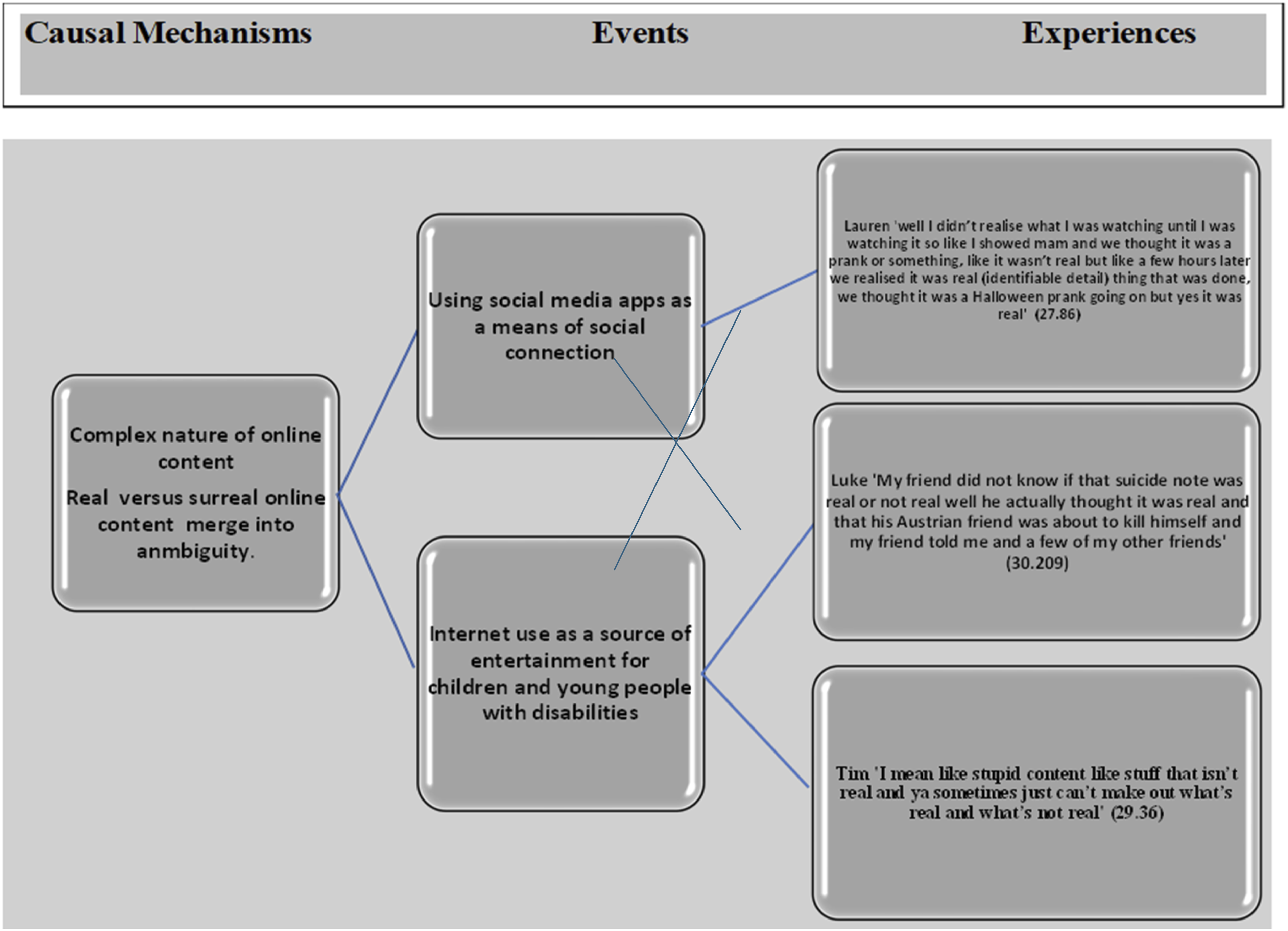
Hidden or causal mechanisms in this example for children and young people with disabilities relate to a poorly regulated internet landscape that pushes content onto social media platforms (real domain). The events that allow these hidden mechanisms to occur are driven by a sociocultural context within a digital world where children and young people with disabilities rely more heavily on it for social and entertainment purposes than their nondisabled peers (actual domain) (eSafety Commissioner, 2023; Doolan Maher, Flynn and Byrne, under review-a).
The application of Margaret Archer’s (1995) framework provides a better view of this mechanism, presented from a Structural, Cultural, and Agency (SCA) level. Structurally, this mechanism is embedded within the design of digital platforms, whose algorithms prioritise engagement, the push to keep children and young people online often blurring the distinction between reality and fiction. Culturally, this ambiguity feeds into widespread societal anxieties about the dangers of online spaces, leading to moral panic (Phippen, 2025), parental restriction of children’s internet use, and/or restrictive legislation. The outcome directly impacts children and young people’s digital experiences due to digital exclusion/ restriction based on parental and societal fear. Children and young people with disabilities use their agency to resist, adapt, or self-advocate. If change occurs, Archer (1995) calls this ‘morphogenesis’. If there is no change, a state of reproduction occurs, which Archer calls ‘morphotasis’. The quotes by Tim, Luke, and Lauren (empirical domain) offer the researcher a deeper view of the impact of internet use from a child protection and welfare perspective, specific to their lived experiences.
Another example from the findings is presented to clarify further how this data collection and analysis frame identifies causal mechanisms that impact children and young people with disabilities’ digital lives, related to accessibility barriers, including platforms with complex means of communication, such as Snapchat (Doolan Maher, Flynn and Byrne, under review-a). This represents discrimination in the Snapchat application design, prioritising digital communication norms that exclude some children and young people with disabilities from using it (causal power at the ‘real’ ontological level of critical realism). Social media trends are the drivers for the Snapchat application (events at the ‘actual’ ontological level of critical realism). Snapchat is reported to be one of the most popular apps used by teenagers in recent times (Gallagher, 2025). Children and young people with disabilities express their views and frustration about the complexity of the digital literacy rules required to use this digital application (experiences at the empirical level of critical realism) (Doolan Maher, Flynn and Byrne, under review-a).
Additionally, when applied to Margaret Archer’s (1995) SCA framework, structural digital design that lacks any form of disability input is shaped by tech industry norms. These norms encourage a culture of fast-paced digital interactions that constrain children and young people with disabilities’ agency, whereby they respond in different ways, such as avoidance of Snapchat, limited use of it, or seeking help. In this case, ‘morphostasis’ is being reproduced as structures and culture remain rigid, reflecting the reactive agency of children and young people with disabilities who withdraw, are passive, or adapt to complex social media applications such as Snapchat. An example of how ‘morphogenesis’ (Archer, 1995) or change may occur would be through the adoption by tech companies of the ‘Child’s Rights by Design initiative’ (5 Rights Foundation and Digital Futures Commission (DFC) that incorporates digital principles that consider the rights of all children in the design and development of digital products (Digital Futures Commission, 2022).
Finally, six core themes relating to this study were explored further using a critical realist lens (Doolan Maher, Flynn and Byrne, under review-a). These themes include 1. parental, school, and friendship influence, 2. exposure, management, and impact of problematic behaviour, harmful and dangerous content online, 3. level of engagement -supportive, fun interactions and therapeutic internet use, 4. Online activities and accessibility, 5. online identity and privacy, 6. view of reality, time, and communication processes online
Conclusion
This paper offers a description of the conceptual, theoretical, and methodological framework employed to engage 34 children and young people with disabilities in a qualitative research study about their internet use through a critical realist lens. The combination of approaches used for the data collection and analysis is described in detail, offering a framework that seeks to enhance understanding of doing qualitative research with children and young people with disabilities. Specifically, this paper provides a step-by-step guide offering a data analysis framework that incorporates a critical realist philosophical perspective to address the deprived research topic of internet-related child protection and welfare risks for children and young people with disabilities. The application of critical realism throughout the methodological process of this study, from the development of interview questions to data analysis, produces structural and causal mechanisms with selected examples discussed in the latter part of this paper. Moreover, this paper is presented as an addition to the emerging literature on critical realist methodological approaches in social research. By clearly and transparently laying the methodological foundations that guide the application of a critical realist lens, within a qualitative research study that centered on the internet use of children and young people with disabilities within a child protection and welfare framework, we aim to enhance learning for academics, policymakers and researchers alike working in this field.
Footnotes

Funding
The authors received no financial support for the research, authorship, and/or publication of this article.
Declaration of Conflicting Interests
The authors declared no potential conflicts of interest with respect to the research, authorship, and/or publication of this article.