




Abstract
Keywords
Background
Approximately half of adult mental disorders begin during adolescence – 50% by age 14, and 75% by age 18 (Kessler et al., 2015), making this a key time at which to intervene to promote mental health, and to prevent or reduce later poor mental health outcomes. Young people are currently experiencing increasing levels of mental health distress: recent studies suggest that young people have a high rate of self-harm, and suicide remains the leading cause of death across young populations (Doyle, Treacy & Sheridan, 2015; Newlove–Delgado et al., 2021). Furthermore, poor mental health has a significant impact on young people’s educational achievements, substance use and abuse and interpersonal relationships (Earls, 2001; Murali & Oyebode, 2004).
Despite this rising prevalence of mental health difficulties in the young, mental health service needs for young people remain unmet even in the economically wealthy societies (e.g. the UK, the USA, Australia, Switzerland, etc.) (Verhulst et al., 2003). In the UK, barriers to accessing mental health support amongst young people include lack of mental health practitioners and staff, concerns about confidentiality and trust, a preference for informal sources of help and mental health stigma (Salaheddin & Mason, 2016). In particular, young people from lower socio-economic backgrounds are disproportionally affected by both mental health issues as well as lack of mental health support (Brown & Carr, 2019).
Increasingly, supportive school environments have been suggested as playing an important role in addressing mental health concerns among young people (MacNeil, Prater & Busch, 2009; Bonell et al., 2019; Brown & Carr, 2019; Hudson, Lawton & Hugh–Jones, 2020). In 2014, a Cochrane review of health-promoting school interventions (including curriculum components focussing on environment and community) reported positive psychological and physical student well-being outcomes, such as reduced bullying, increased physical activity and reduced body mass index (Langford et al., 2014).
The concept of a health-promoting school has been supported globally (WHO, 2015). This holistic approach involves not only health education via the curriculum but also having a school environment and ethos that are conducive to health and well-being by engaging with families and the wider community, as well as recognising the importance of this wider environment in supporting children and young people’s health. Indeed, school climate or culture is the most tractable of the school level characteristics that are associated with the mental health of school students (Ford et al., 2021; Wong, Dosanjh, Jackson, Rünger, & Dudovitz, 2021). Studies of discreet interventions delivered into schools to improve mental health have been found to have a small or no effect (Caldwell et al., 2019). One possible explanation is that these studies did not sufficiently address aspects of the school environment that provide barriers to the intervention becoming embedded, or that are determinants of poor mental health themselves.
It is therefore important to develop interventions that focus on and ‘disrupt’ the whole school system (Hawe, Shiell, & Riley, 2009) to create significant and sustainable improvement. An earlier systematic review undertaken by our research team (Anderson et al., 2019) examined aspects of educational settings beyond the taught curriculum that were most important for mental health. Although there are a limited number of studies that have gone beyond pilot or cross-sectional designs, the review revealed that interventions which focus on creating positive relationships among students, and between students and teachers, and which include students actively in decisions relating to school life, have the potential to improve mental health (Bonell et al., 2019; Hampton et al., 2010). These socio-cultural elements of school life are increasingly understood to be important for student health and well-being, both of which contribute to and make up a positive school culture.
School culture and climate are separate but overlapping concepts, with climate being viewed from a psychological and behavioural perspective and culture from an anthropological one, comprising the values and norms of the school (MacNeil et al., 2009). In their review of school climate research, Thapa and colleagues (2013) identify five dimensions: (a) Safety, (b) Relationships, (c) Teaching and Learning, (d) Institutional Environment and (e) the School Improvement Process. Their review shows that school climate can affect a wide range of emotional and mental health outcomes (e.g. rates of absenteeism and exclusion) and can contribute to effective risk prevention and health promotion work (Thapa, Cohen, Guffey, & Higgins-D’Alessandro, 2013).
In the UK, school culture was recently the focus of research commissioned by the Department for Education as a potential means of improving the educational achievement of disadvantaged pupils. The research concluded that high-performing schools demonstrated greater cohesiveness, sense of shared purpose and values amongst all staff, pupils and parents, as well as high staff morale, suggesting that these aspects of school culture can influence school effectiveness (Baars, Mulcahy, Menzies, 2018). Similarly, there is compelling evidence for the impact that school culture has on substance use among students, which in turn affects health and education outcomes (Markham, Bonell, Fletcher, & Aveyard, 2017).
Much of the current research on school climate and culture is based in the United States, and many authors (e.g. Thapa et al., 2013; Freiberg, 1999) highlight ongoing limitations. Thapa and colleagues (2013 conclude that there is little consensus about how to define a positive and sustained school climate, or the school climate process and the dimensions that need to be regularly measured in research and improvement efforts. In our study, we will be referring to the term school culture rather than climate as this term is consistent with terminology used by the Department of Education in the UK and has been predominantly used in qualitative health research studies (Schoen & Teddlie, 2008). Furthermore, an existing body of research (Schoen & Teddlie, 2008; Deal & Peterson, 1999) emphasises that it is important to consider the relationship between the psychosocial and the demographic factors in schools, particularly because shared beliefs and values (traditionally associated with the term ‘culture’) are directly influenced by the physical environment, social system and staff/student populations (traditionally associated with the term ‘climate’). As such, our approach to the definition of school culture involves both psychological and anthropological factors specific to each school (e.g. student feelings and experiences of belonging to school community) as well as how the latter intertwine and/or relate to the demographic settings of the schools (e.g. information about the geographical and physical environment of schools and staff/student populations, including gender, ethnicity, culture, religion, mental health/well-being support needs, etc.).
To study the aforementioned complex facets of school culture, we will employ participatory action research (PAR). Participatory action research enables researchers to combine theory and practice, action and reflection by developing practical solutions to address concerns and issues within communities (Jacobs, 2016). In this sense, PAR method is transformative rather than merely informative (Baldwin, 2012): It is used to change and disrupt collaborative and participative processes within a specific context and/or environment. There is a growing body of educational research utilising PAR which shows benefits to stakeholders (Jacobs, 2016), for example, to include parents’ voices in special education system (Ditrano & Silverstein, 2006), to develop appropriate interventions through family–school partnerships with economically disadvantaged and culturally and linguistically diverse families (Ho, 2002) and to actively involve students in creating environments that promote mental health (Berg, Bradford, Robinson, & Wells, 2018). Building on this existing research, we will utilise a PAR approach in four English secondary schools to identify the key factors that contribute to positive school culture and to introduce activities and changes to further support and improve student mental health.
Finally, although our study will not explicitly focus on the impact of the COVID-19 pandemic on school culture and student mental health, it is important to acknowledge that the introduction of remote (online) teaching has significantly disrupted school cultures on a global scale (da Silva Vieira & Barbosa, 2020). As of yet, little information is available about how schools adapted to teaching during the pandemic (for further details, see NFER review on school responses to COVID-19; Sharp et al., 2020), and whether students and staff received substantial pastoral and mental health support throughout this time. We anticipate that findings from our study will shed light on issues such as lack of socialisation between school staff and students as well as different (both positive and negative) ways in which remote learning affects school culture.
Our study will address the following research questions: What are the key components of school culture that impact on student mental health? What changes or interventions can be made to improve school culture and mental health outcomes for students? What is the process by which school culture impacts on young people’s mental health? Is a PAR approach feasible and effective as a methodology for instigating positive change to school culture?
Method
Design
In this qualitative study, we will develop ‘PAR’ groups in four English secondary schools. The PAR groups will facilitate a shared understanding of the culture in their school and develop activities or interventions intended to improve it. A qualitative study will be conducted alongside the PAR groups to address the four research questions. This will include qualitative semi-structured interviews with school staff, parents and members of PAR groups, focus groups with students, observations of PAR groups and a review of school documents pertaining to mental health and inclusion.
Participatory Action Research Approach
Act–Observe–Reflect–Plan Cycles in Participatory Action Research.

We aim to further knowledge by exploring whether a PAR approach is a feasible and effective way in which to create a school culture that fosters and promotes student mental health. We anticipate that our research findings will contribute to public health policy and practice in the following ways: By identifying the key factors that contribute to positive school culture; Through the development of a logic model that identifies the mechanisms by which school culture can improve mental health; By showcasing the processes and benefits of young people’s involvement in both research and organisational decision-making, using participatory methods, with a particular focus on young people most likely to be marginalised; Through the provision of a toolkit that can be used by schools and other educational settings wishing to conduct their own PAR to improve school culture and student mental health.
Settings and Participants
We will work in partnership with a young people’s mental health charity, which has links with many local schools, to recruit four schools, based on the following criteria: They are state-funded secondary schools in the area in which the charity works (Academies or local-authority maintained). The senior leadership team demonstrates a commitment to participating in the project and all the activities that entail.
We will aim for diversity across the four schools in terms of Ofsted (schools’ inspectorate) rating, educational performance measures and socio-demographic profile of students attending the school. Schools will receive £1000 in recognition of their participation on completion of the study. Recruitment of schools began in September 2020, with final data collections anticipated in December 2021.
The PAR Process
In each school, we anticipate the PAR group will comprise up to eight students from across all school years. Up to four members of school staff will also be involved in the meetings to ensure that the group has the power to facilitate the changes that they identify. These staff members are likely to be those with responsibility for student well-being (pastoral support, PHSE lead, head of year and form tutor). Each group will be assigned a facilitator from the mental health charity, who will work with each group over the course of a school year. Facilitators will support the PAR groups to: Develop a shared understanding of school culture in their school. Develop initiative(s) aimed at improvement in school culture. These will be determined by each group, and could include introducing a new policy, practice or procedure. Agree the data to be gathered by the PAR group within the school for observation and reflection stages. Support the PAR groups to reflect on the success (or otherwise) of their initiatives before refining and/or developing and implementing new initiatives.
The PAR groups will meet twice every half term (14 meetings in total) to follow the Act–Observe–Reflect–Plan cycle with the support of the facilitator.
The research team will provide initial training for the PAR group facilitators. In addition, the team will meet with the facilitators one day per school term to provide ongoing support and supervision, in particular to support the PAR groups’ data collection and evaluation of the initiatives and changes they have instigated.
Data Collection
Pre-PAR data collections
Interview Topic Guide Summary.
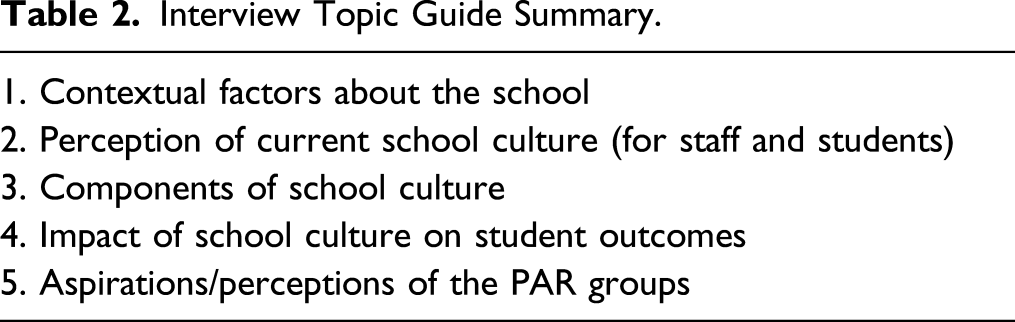
In addition, in each school, the research team will conduct a focus group with up to 10 students focussing on the same questions. These focus groups will last for 1 hour and will deploy participatory tools to engage students in a discussion of what school culture means to them, factors that indicate a positive (or unhealthy) culture and the impact of this on student mental health. Participants will be drawn from across the school years and will not include any students involved in the PAR group. For a step-by-step summary of our data collection and methodology, see Figure 1. Step-by-step data collection and analysis flow chart.
The research team will also undertake a documentary review of school policies, Ofsted reports, student survey data (where available) and other data collected by the schools. These qualitative data and documentary review will inform a baseline qualitative report on the existing culture of participating schools before the implementation of the PAR process. The logic model and definition of school culture and its component parts emerging from this stage of the work package will inform the resources to be used in the first PAR meetings.
Data Collection During PAR
Study team members will observe the first and last PAR meetings, and a minimum of two other meetings of each group, noting what the groups discuss, how engaged members are, how decisions are made and how each stage of the PAR cycle works in practice. The PAR group facilitators will provide the study team with a short written report following each meeting, capturing the main topics of discussion, how engaged the group were and where the group are on the PAR cycle.
Post-PAR Data Collection
At the end of the PAR year, the qualitative interviews with school staff and parents and focus groups with students will be repeated with the same participants, this time with additional questions about the implementation of the PAR-led initiatives and their perceived effect on the school culture and student mental health. Participants will also be asked to comment on their perception of the feasibility and effectiveness of student-led initiatives as a methodology for instigating positive change to school culture. This will include a discussion of the impact on schools (e.g. staffing and resources) of implementing the PAR approach and any intervention/policy change or other initiative that resulted from it.
In each of the four schools, up to five interviews with members of the PAR groups will be undertaken, to explore the functioning of the PAR group including how decisions were made; the group dynamics including the role of staff and student members; facilitation of the group; nature of initiatives intended to impact on culture and mental health; the success or otherwise of these; and barriers and facilitators to the use of PAR as a means of impacting school culture. Respondents in each school will include the group facilitator, two student members and two staff members.
For each school, the facilitators will complete an end of PAR report covering 1) an overview of the PAR cycle(s) in each group (including how decisions were made, what the groups wanted to change and why, barriers and facilitators to making these changes, understanding their impact on school culture and how information on this was gathered), and 2) reflections on the PAR approach (including participation of staff and students in the group and organisational and structural factors influencing the implementation of PAR) and perception of feasibility of PAR in schools.
Data Analysis
Our research study will use thematic framework analysis (Srivastava & Thomson, 2009; Spencer, Ritchie, O'Connor, Morrell, & Ormston, 2014; Gale, Heath, Cameron, Rashid, & Redwood, 2013). Framework analysis is a qualitative method, which seeks to identify commonalities and differences in qualitative data by drawing out descriptive and/or explanatory conclusions clustered around themes (Gale et al., 2013). Framework analysis involves a matrix output (cases, themes and cells which summarise data and provide structure for the research) and a priori issues (e.g. organisational and integration issues pertaining to school culture and mental health support). Research utilising framework analysis may generate theories; however, the main focus is to describe and interpret events, actions and processes occurring in a particular context and setting (Ritchie & Spencer, 1994).
An initial thematic framework will be developed by one researcher, informed by the data transcripts, research questions and topic guides. A short summary of each theme will be developed to describe the data it is intended to capture. These will be shared with the wider research team, who will test the framework on two transcripts each, noting any ill-described themes, and gaps or overlap across sub-themes. This process of framework refinement will be repeated until the team are confident that it encompasses all the data in the transcripts, the data within each theme are coherent and there are clear distinctions between subthemes. Once finalised, a matrix of cases and themes will be populated with verbatim and summarised data from the transcripts, as well as analytical notes made by the researchers (‘charting’). Charting reliability will be tested by all researchers charting the same two transcripts and comparing the contents of each cell to ensure that consistent application of themes and data capture.
A critical realist (CR) approach will be used to interpret findings from the study. Critical realist is a performative epistemology which, unlike social constructionism, assumes that there is a real world ‘out there’ (i.e. with real ‘agents’ and causal relationships that have not been constructed through discursive practices). Critical realist acknowledges that we cannot think about the world independently of our ideas and beliefs, and, as such, tracing social and linguistic practices and their relationship with theories, classifications and interpretations is essential to CR analysis (Sayer, 1992). Critical realist is particularly suitable for research exploring change in complex social phenomena, including the effectiveness of policies and interventions in schools (see for example, Parra, 2018).
Ethical Considerations
Ethical approval to conduct the study was given by the Faculty of Health and Medicine Research Ethics Committee (FHMREC) at the University of Lancaster (Ref: FHMREC19100). All participants will be asked for written consent before they participate. We will provide parents with information sheets about the study, and we will obtain parental consent for participation in a PAR group or a focus group.
As the study involves young people actively participating in an ongoing research process, we will discuss with the PAR group facilitators the importance of ensuring that consent is an ongoing process rather than an initial, one-off action, and that it will be constantly reviewed, with participants free to withdraw at any time. The PAR group facilitators in this study are experienced and trained in group work with young people relating to mental health difficulties. Participant information sheets will be prepared for the members of the PAR groups explicitly detailing their right to withdraw at any time or to choose not to engage in any activity. By involving school staff in the PAR meetings and activities, we anticipate that this will prevent young people from engaging in any actions that might be considered a breach of school rules. We will not be asking young people about their personal experiences of mental health difficulties during PAR meetings or data collections, and therefore we do not anticipate disclosures that would create a safeguarding concern. However, if the facilitators or research team become concerned about any young person during the study, we will alert the safeguarding lead at the school and discuss whether it is appropriate for them to continue to be involved.
Discussion
This study is based on PAR methodology that puts young people and school staff at the heart of the research process. The members of the PAR groups will identify what needs to change within their schools and will take action to monitor these changes. The findings from this study will therefore contribute to our understanding of the key features, details and dynamics of the PAR approach to school culture improvement (and mental health outcome improvement more generally) and examine possible causal pathways from the interventions in schools to observed (and perceived) outcomes in both school culture and student mental health. Specifically, we will consider how inclusive the PAR approach is (e.g., in relation to Black, Asian and minority ethnic students and those from more deprived socio-economic backgrounds) and the extent to which the school culture changes may lead to a reduction in mental health inequalities. These findings will inform the development of the school culture toolkit, which will comprise: Definition of school culture and its components in the context of English secondary schools Logic model describing the mechanisms through which improvements to school culture can improve student mental health Guidance on the use of the PAR approach to school culture improvement, including resources for schools running PAR groups and case study examples from schools involved in this work.
The toolkit will serve as a guide for other schools interested in improving their school culture for the benefit of student and staff members’ mental health by setting out the PAR process and including case studies of changes that our PAR groups made. We will pursue and share the toolkit on education and public health platforms, to make the toolkit widely available for school use by school staff, health policy makers and practitioners.
We anticipate that our findings will increase communication between students and school staff regarding current barriers to effective mental health support and promotion of existing pastoral/mental health interventions. Beyond this, our research seeks to understand what kind of interventions and changes can be implemented by students and staff (including non-pastoral staff) in the schools to improve not only individual mental health experiences and outcomes but also broader school culture components, such as relationships with peers and teachers, inclusivity, curriculum, behavioural and disciplinary actions, COVID-19 measures and impact, parental involvement, etc. Therefore, given the current lack of mental health support for young people in the UK (Verhulst et al., 2003; Salaheddin & Mason, 2016), our findings will offer insight into how schools can identify and prevent poor mental health experiences and build further on the concept of a health-promoting school.
Topic Guide for parent Interviews (pre- and post-PAR activity in the school)
These interviews will explore respondent’s perceptions of the relevance of the components of school culture identified from the literature to their own school setting, their school’s performance with respect to these components and what changes they anticipate might be achieved by the PAR initiative. The interview topic guide will also focus on participants’ perception of the factors that contribute to or inhibit the development and maintenance of a positive school culture and the impact of school culture on student well-being. The draft logic model will be shared with respondents for initial review. Respondents will also be asked to consider potential measures or indicators of school culture.
At the end of the PAR year, the qualitative interviews with school staff will be repeated with the same participants, this time with additional questions about the implementation of the PAR-led initiatives and their perceived effect on the school culture and student mental health. Respondents will also be asked to comment on their perception of the feasibility and effectiveness of student-led initiatives as a methodology for instigating positive change to school culture. This will include a discussion of the impact on schools (e.g. staffing and resources) of implementing the PAR approach and any intervention/policy change or other initiative that resulted from it.
Note: This topic guide is indicative and will be subject to incremental change as new findings/information emerge during the research. It is a guide to the topics to be covered during the interviews (and not a script) therefore the order of topics, and the precise manner in which they are addressed, will be flexible according to the circumstances.
• Clarify how many children at school and for how long; • Parent involvement with school (as parent, member of PTA, volunteer or other).
• How would respondent describe the culture in the school; ∘ For students in general; ∘ For your child(ren); ∘ For parents; ∘ For staff, as a place of work? • Any recent changes (and what might have caused them)? • What in their view are the main influencing factors on school culture? • Any activities/interventions to influence school culture in the school that respondent knows of? ∘ Drivers for these; ∘ Success/impact.
(At this point in the interview, the researcher will share a draft logic model developed by the research team illustrating a) key components of school culture ;b) mechanisms through which school culture may influence student mental health; c) impact of school culture on student mental health; and d) the PAR approach to school culture.
Components of school culture. For each one, respondent will consider whether they agree this is a key component of school culture and their perception of this factor in their child’s school).Components to include: ∘ School discipline and fairness of application; ∘ School rules and norms; ∘ Availability of caring adults; ∘ School leadership and staffing; ∘ School belonging; ∘ Physical environment that supports well-being; ∘ Safety; ∘ Availability of targeted support for students at risk of poor mental health; ∘ Support for minority groups (race, gender, sexual identity, disability, socioeconomic and/or cultural differences) – inclusion and support; ∘ Anti-bullying initiatives (includes online); ∘ Relationships: • Between staff • Staff–student • Student–peer • Staff–parent ∘ Student involvement; ∘ Teaching and learning styles; ∘ Social and emotional earning (PHSE; RSE); ∘ Parent involvement; ∘ Civic/community activities; ∘ Policies. • Are there other important components of school culture missing from the model? • Which components would the respondent see as essential for (rather than simply contributing to) a positive school culture? • Would they remove any components from the model? Why? • Considering the potential impact of a positive school culture on student mental health – respondent to comment on each component, focussing on how (if at all) they think school culture can influence this outcome; if it does in their child’s school; how these outcomes might be demonstrated/measured/perceived. Outcomes on student mental health to include the following: ∘ Feeling physically safe; ∘ Feeling socially/emotionally supported; ∘ Self-esteem; ∘ Positive and supportive relationships; ∘ Challenging behaviours; ∘ Risk behaviours; ∘ Anger/aggression; ∘ Bullying/victimisation; ∘ Mood; ∘ Motivation to learn/engage. • And non-mental health outcomes may include the following: ∘ Absenteeism rates; ∘ Exclusion rates; ∘ Academic performance. • Are there any student outcomes missing from this list?
The logic model also identifies potential mechanisms through which school culture may impact on mental health. For example, improving school culture may: Encourage values of inclusivity, equality, empowerment and respect; Create an environment in which creativity and innovation are valued; Reduce factors that contribute to poor mental health (stress, bullying etc.).
For each one: Does the respondent agree/disagree that this is how student mental health may be influenced? Is this realistic? Is this what happens/might happen in your child’s school? What are the facilitators for change (factors that support having a positive impact on student mental health)? What are the barriers to influencing student mental health?
Prompts to include factors such as resources, staff time, pressure on academic outcomes/school performance, influences on mental health outside the school and prioritising culture/mental health.
If necessary, interviewer to explain the PAR groups and how they will operate in school, including goals and objectives. How does the school currently involve young people in decision-making? What are your perceptions of the PAR approach to school culture? ∘ Advantages of method; ∘ Disadvantages of method. What are your aspirations for the PAR group? ∘ Outcomes for students involved; ∘ Outcomes for staff involved; ∘ Outcomes for school as a whole. What ideas/initiatives do you think the PAR group might suggest? ∘ If different, what activities/initiatives should they suggest? What needs to be in place to support the PAR group having a positive influence on school culture and student well-being? What are the potential barriers and how might these be addressed? How might the impact of the PAR group on school culture/student well-being be measured?
How aware are you of the work of the PAR group in your school over the last year? ∘ Why is this (If participants do not know much about PAR groups, the researcher will give a brief overview)? What initiatives did the PAR group suggest? ∘ Were any initiatives refused/declined? Why? Of those that were implemented: ∘ What were these? ∘ Why do you think they were chosen? ∘How successful or otherwise was the implementation? • Barriers/facilitators to this. ∘ What was the impact of the initiative (s): • On school culture? • On staff/student well-being? • Other outcomes (including parents)? ∘ How do you know? • Perception; • Evidence gathered. If there were positive outcomes for student mental health, were these: ∘ Experienced by all students? ∘ Differentiated by age, socio-economic status, ethnicity and academic performance? ∘ With this in mind, do you think the PAR approach has impacted on inequality in mental health outcomes for students in your school? What are your perceptions of the PAR approach to school culture? ∘ Advantages of method; ∘ Disadvantages of method. What do you think the impact was for members of the PAR group? ∘ Outcomes for students involved; ∘ Outcomes for staff involved. If your school was to run the PAR group again, what changes would you make? How feasible is it for other secondary schools to implement the PAR approach to school culture improvement? ∘ Resource (staff time/money); ∘ Motivation/priority; ∘ Impact on student time/curriculum. What needs to be in place to support a PAR group in having positive influence on school culture and student well-being? What are the potential barriers and how might these be addressed? How might the impact of the PAR group on school culture/student well-being be measured?
Topic Guide for school staff (pre- and post-PAR activity in the school)
These interviews will explore respondent’s perceptions of the relevance of the components of school culture identified from the literature to their own school setting, their school’s performance with respect to these components and what changes they anticipate might be achieved by the PAR initiative. The interview topic guide will also focus on participants’ perception of the factors that contribute to or inhibit the development and maintenance of a positive school culture, and the impact of school culture on student well-being. The draft logic model will be shared with respondents for initial review. Respondents will also be asked to consider potential measures or indicators of school culture.
At the end of the PAR year, the qualitative interviews with school staff will be repeated with the same participants, this time with additional questions about the implementation of the PAR-led initiatives and their perceived effect on the school culture and student mental health. Respondents will also be asked to comment on their perception of the feasibility and effectiveness of student-led initiatives as a methodology for instigating positive change to school culture. This will include a discussion of the impact on schools (e.g. staffing and resources) of implementing the PAR approach and any intervention/policy change or other initiative that resulted from it.
Note: This topic guide is indicative and will be subject to incremental change as new findings/information emerge during the research. It is a guide to the topics to be covered during the interviews (and not a script) therefore the order of topics, and the precise manner in which they are addressed, will be flexible according to the circumstances.
Clarify current role and responsibilities; Length of time at current school and previous experience; If appropriate, role and responsibilities in relation to child well-being and mental health.
School type – academy, part of MAT or LA-maintained; Size; Leadership–structure of senior leadership team; Influence/involvement of governors/parents; Demographics of local area/school students; Academic performance and Ofsted rating; Impact of all of these on school culture; How is school culture prioritised (or not) in this school and what influences this? Does your school have any policies that relate to school climate?
How would respondent describe the culture in the school: ∘ For staff, as a place of work? ∘ For students? ∘ For parents? Any recent changes (why)? Is there anything you have done differently last term or during this current lockdown that has created a better school culture? What in their view are the main influencing factors on school culture? Any activities/interventions to influence school culture: ∘ Drivers for these? ∘ Success/impact?
(At this point in the interview, the researcher will share a draft logic model developed by the research team illustrating a) key components of school culture; b) mechanisms through which school culture may influence student mental health; c) impact of school culture on student mental health; and d) the PAR approach to school culture).
• Components of school culture (for each one, respondent will consider whether they agree this is a key component of school culture; their perception of this factor in their own school (policies/interventions to support this/whether it is working well/contributing to a positive school culture or not/could be improved). Components to include the following: ∘ School discipline and fairness of application; ∘ School rules and norms; ∘ Availability of caring adults; ∘ School leadership and staffing; ∘ School belonging; ∘ Physical environment that supports well-being; ∘ Safety; ∘ Availability of targeted support for students at risk of poor mental health; ∘ Support for minority groups (race, gender, sexual identity, disability, socioeconomic and/or cultural differences) – inclusion and support; ∘ Anti-bullying initiatives (includes online); ∘ Relationships: • Between staff • Staff–student • Student–peer • Staff–parent ∘ Student involvement; ∘ Teaching and learning styles; ∘ Social and emotional earning (PHSE; RSE); ∘ Parent involvement; ∘ Civic/community activities; ∘ Policies. • Are there other important components of school culture missing from the model? • Which components would the respondent see as essential for (rather than simply contributing to) a positive school culture? • Would they remove any components from the model? Why? • Considering the potential impact of a positive school culture on student mental health – respondent to comment on each if they perceive school culture can influence this outcome; if it does in their school; how these outcomes might be demonstrated/measured/perceived. Outcomes on student mental health to include the following: ∘ Feeling physically safe; ∘ Feeling socially/emotionally supported; ∘ Self-esteem; ∘ Positive and supportive relationships; ∘ Challenging behaviours; ∘ Risk behaviours; ∘ Anger/aggression; ∘ Bullying/victimisation; ∘ Mood; ∘ Motivation to learn/engage. • Non-mental health outcomes may include the following: ∘ Absenteeism rates; ∘ Exclusion rates; ∘ Academic performance. • Are there any students outcomes missing from this list?
For example, improving school culture may: Encourage values of inclusivity, equality, empowerment and respect; Create an environment in which creativity and innovation are valued; Reduce factors that contribute to poor mental health (stress, bullying, etc.).
For each one: Does the respondent agree/disagree that this is how student mental health may be influenced? Is this realistic? Is this what happens/might happen in your school? What are the facilitators for change (those factors support having a positive impact on student mental health)?
If necessary, interviewer to explain the PAR groups and how they will operate in school; goals and objectives. How does the school currently involve young people in decision-making? What are your perceptions of the PAR approach to school culture? ∘ Advantages of method; ∘ Disadvantages of method. What are your aspirations for the PAR group? ∘ Outcomes for students involved; ∘ Outcomes for staff involved; ∘ Outcomes for school as a whole. What ideas/initiatives do you think the PAR group might suggest? ∘ If different, what activities/initiatives should they suggest? What needs to be in place to support the PAR group having a positive influence on school culture and student well-being? What are the potential barriers and how might these be addressed? How might the impact of the PAR group on school culture/student well-being be measured?
How aware are you of the work of the PAR group in your school over the last year? ∘ Why is this? What initiatives did the PAR group suggest? ∘ Were any initiatives refused/declined? Why? Of those that were implemented: ∘ What were these? ∘ Why do you think they were chosen? ∘How successful or otherwise was the implementation? • Barriers/facilitators to this ∘ What was the impact of the initiative(s): • On school culture? • On staff/student well-being? • Other outcomes (including parents)? ∘ How do you know? • Perception; • Evidence gathered. If there were positive outcomes for student mental health, were these: ∘ Experienced by all students? ∘ Differentiated by age, socio-economic status, ethnicity and academic performance? ∘ With this in mind, do you think the PAR approach has impacted on inequality in mental health outcomes for students in your school? What are your perceptions of the PAR approach to school culture? ∘ Advantages of method; ∘ Disadvantages of method. What do you think the impact was for members of the PAR group? ∘ Outcomes for students involved; ∘ Outcomes for staff involved. If your school was to run the PAR group again, what changes would you make? How feasible is it for other secondary schools to implement the PAR approach to school culture improvement? ∘ Resource (staff time/money); ∘ Motivation/priority; ∘ Impact on student time/curriculum. What needs to be in place to support a PAR group in having positive influence on school culture and student well-being? What are the potential barriers and how might these be addressed? How might the impact of the PAR group on school culture/student well-being be measured?
Footnotes
Appendix 2. Draft Logic Model for School Culture
Acknowledgements
We would like to thank Off the Record for ongoing support with our study and ARC West’s Young People’s Advisory Group for reviewing data collection methods and tools.
Authors’ contributions
TJ, JK and ML conceived the study. TJ, JK, ML, LS, EGS and GK drafted the data collection tools. GK developed the paper. All authors contributed to the paper writing and approved the final version.
Declaration of Conflicting Interests
The author(s) declared no potential conflicts of interest with respect to the research, authorship, and/or publication of this article.
Funding
The author(s) disclosed receipt of the following financial support for the research, authorship, and/or publication of this article: This study is funded by the National Institute for Health Research (NIHR) School for Public Health Research (Grant Reference Number PD–SPH–2015). The views expressed are those of the author(s) and not necessarily those of the NIHR or the Department of Health and Social Care.
Ethics approval
Ethical approval to conduct the study was given by the Faculty of Health and Medicine Research Ethics Committee (FHMREC) at the University of Lancaster (Ref: FHMREC19100).
