




Abstract
Across a range of disciplines, researchers are employing participatory approaches to better align studies with community needs. For example, a growing body of education scholarship has outlined the value of research-practice partnerships as venues for addressing urgent problems of practice. While such partnerships represent a promising strategy for advancing equity, effective collaboration across research and practice is complex to realize. In this paper, we examine data from two partnership projects to identify strategies for actualizing participatory qualitative methods. Collaborative analysis across our projects revealed possibilities related to three strands of qualitative partnership research: gaining and sustaining access to politically complex spaces, maintaining authentic reciprocity, and making meaning across data. Within each strand, we offer in-depth examples and considerations for researchers across a range of disciplines about how to foster partnerships that promote equitable transformation. As opposed to being prescriptive, we hope to spur reflection across participatory qualitative research teams and support shifts towards more imaginative and humanized methods.
Introduction
Across a range of disciplines, researchers are employing participatory approaches to better align studies with community needs (Macaulay et al., 1999; Reason & Torbert, 2001; Vaughn & Jacquez, 2020; Wallerstein & Duran, 2006). For example, a growing body of education scholarship has outlined the value of research-practice partnerships as venues for addressing urgent problems of practice (e.g., Coburn et al., 2013; Coburn & Penuel, 2016; Henrick et al., 2017; Penuel et al., 2015). While such partnerships represent a promising strategy for advancing equity (Farrell et al., 2021), effective collaboration across research and practice is also complex. Challenges of partnership work include varied priorities across members, turnover at participating organizations, difficulties obtaining data, and time-intensive facilitation (Cohen-Vogel et al., 2018; Denner et al., 2019; Wentworth et al., 2022). In addition to these challenges, qualitative researchers engaged in participatory work often navigate the “space between,” occupying both insider and outsider status with participants (Dwyer & Buckle, 2009). In light of these complexities, we examine extensive qualitative data from two education partnership projects to identify strategies for actualizing participatory qualitative methods.
As described in more detail in the Methods, one partnership is a national group of state education agency leaders and researchers. Within this partnership, the first author serves as a researcher and participant collaborating with state-level education leaders to improve multilingual learner (ML) policy and practice across the country. The second partnership is situated within a school district with an increasing ML student population, and includes district and school leaders, educators, families and students. The district-level partnership’s goal is to create opportunities that strengthen the educational experiences of ML students. Through providing methodological insights across these two research partnerships, we aim to support qualitative researchers with developing and sustaining reciprocal partnerships within and beyond the education field. Aligning with Tuck’s (2009) framing of desire-based research, our objective is to illustrate the complexities and dualities of engaging in participatory research.
We begin by grounding our work in the literature on participatory research and research-practice partnerships. Then, we present the conceptual framework guiding our analysis, followed by an overview of each partnership. We then share findings focused on possibilities across three strands of our qualitative partnership research: gaining and sustaining access to politically complex spaces, maintaining authentic reciprocity, and making meaning across data. Within each strand, we offer in-depth examples and considerations for researchers across a range of disciplines engaged in partnerships. In this article, our goal is for scholars and practitioners to reflect on their roles in partnership and understand how to make meaning across the complex data stemming from participatory work.
Participatory Research
While a comprehensive overview of participatory research is beyond the scope of this paper 1 , our work draws upon the definition of participatory research as an approach that centers “direct collaboration” with participants to jointly engage in “systematic inquiry” geared towards action or change (Vaughn & Jacquez, 2020). Instead of positioning research as for or on communities, participatory research is conducted in meaningful partnership with communities (Reason & Torbert, 2001). In such work, the knowledge and expertise of community partners are integral to the research, and collaboration is grounded in trust and mutual respect (Macaulay et al., 1999). Further, decisions are made jointly and democratically throughout the research process including determining research goals and design, collecting and analyzing data, and sharing findings.
Within participatory approaches, research is not positioned as neutral and instead aims to solve complex problems through joint knowledge production that can “change social reality” (Bergold & Thomas, 2012). Outlining the features of participatory action research, Chevallier and Buckles (2019) call for “leaving the ivory tower of academia and grounding the inquiry process in the messy journey of collective action, critical thinking and learning by doing” (p. 8). Across participatory approaches, collaboration can be complex as researchers and community partners navigate issues of participation and consent, power dynamics, and systemic inequities such as racism (Wallerstein & Duran, 2006). Effectively navigating these challenges requires that researchers approach collaboration with humility and integrity, uplift community expertise, and remain committed to co-learning. To strengthen the field of participatory research, Vaughn and Jacquez (2020) call for descriptions of how researchers make choices related to methods, tools, and collaboration processes, including identifying challenges and supports. In this paper, we shed light on specific strategies we undertook to support participatory qualitative research within an increasingly popular form of such work: research-practice partnerships.
Developing and Sustaining Research-Practice Partnerships
Disrupting traditional silos and hierarchies across research and practice, research-practice partnerships (RPPs) foreground collaboration between researchers and practitioners focused on addressing urgent problems of practice in education (Coburn & Penuel, 2016; Cohen-Vogel et al., 2018). RPPs involve deep and ongoing relationships in which researchers and practitioners share authority and jointly determine the focus of their work (Coburn & Penuel, 2016). Summarizing the promise of RPPs, Farrell and colleagues (2021) define RPPs as long-term collaborations bringing together researchers and practitioners with a diversity of expertise, “aimed at educational improvement or equitable transformation through engagement with research” (p. 5). More specifically, equitable transformation refers to changing education systems or practices in ways that reduce disparity across dimensions of inequality (e.g., race, language, disability status, class, gender, sexual orientation, etc.). Centering the needs of students, families, educators, and communities is core to such transformative work (p. 07).
Cooper and colleagues (2020) highlight how the improvements generated through RPPs have the potential to impact not only the researchers and leaders engaged in the partnership but also the communities they serve. Reflecting this transformative potential, they examined four networks engaged in RPP work and found that partnership “enabled opportunities and outcomes for educational improvement that would otherwise have been unachievable” (p. 23). Importantly, both researchers and practitioners play a role in realizing the potential benefits of RPPs through the process of “joint work” in which new routines are developed to support the goals of the partnership (Penuel et al., 2015).
Within education research, RPPs are a promising strategy for promoting equity-focused change. However, these partnerships are also complex. Researchers and practitioners typically come from organizations with different cultures and priorities (Denner et al., 2019), as well as distinct goals (Cohen-Vogel et al., 2018). Challenges within RPPs may include organizational turnover, trouble accessing usable data, difficulty coordinating meetings across schedules, and conflicting timelines between researchers and organizations for accomplishing work (Farrell et al., 2019). RPPs must also attend to their environments, as policy and reform climates can influence or create instability for RPP activities (Yurkofsky et al., 2020). Perhaps most importantly, trust is a central foundation for reciprocal partnerships seeking to address problems of practice (Henrick et al., 2017). These trusting relationships are complex to develop, as they “do not occur naturally or immediately but require a significant investment of time and effort” (López Turley & Stevens, 2015, p. 10).
Shedding light on the effort required to support RPPs, Wentworth and colleagues (2022) recently outlined the many responsibilities of brokers who facilitate RPP collaboration, including developing and sustaining partnership infrastructure. Focusing specifically on the role of qualitative researchers as brokers, previous research demonstrates how qualitative methods can serve as a powerful mechanism for understanding participants’ experiences, strengthening RPP relationships, and informing adjustments to the shared project (Weddle et al., 2021). While such work is promising, the authors call for additional research to identify effective strategies for fostering and sustaining collaboration across a range of partnership contexts.
Answering this call, in this paper we examine our participatory qualitative research approaches across two distinct levels of the education system (state and district). While both partnerships are situated within education, we write from the vantage point of qualitative researchers committed to supporting equity-focused research approaches across a range of disciplines. This paper reflects our experiences developing and sustaining long-term research partnerships as early and mid-career faculty situated at large research universities. Across our research, we reject traditional notions of neutrality and objectivity and instead grapple with the relational, contextual, and often personal dimensions of research aimed towards disrupting inequities. To better understand these complexities of partnership research—as well as the potential to co-construct new possibilities through participatory approaches—we draw on the conceptualization of “otherwise possibilities” in qualitative research (Green, 2020).
Conceptual Framework
“Otherwise possibilities” represent alternative approaches to participatory qualitative research that center imagination and creativity to promote equitable transformation (Green, 2020). These possibilities were developed through research that attended to and celebrated the experiences and assets of youth of color, providing a helpful frame for considering humanized approaches within our partnerships with leaders and educators. Importantly, our two partnerships focus on improving education for youth who often experience marginalization: multilingual learner (ML) students. Across our partnership work, we grapple with Green’s call to invoke our imaginations to “transform current qualitative research paradigms toward an otherwise way of thinking, knowing, being—one that could better help us make sense of us, others, and the world” (p. 125). As outlined below, Green operationalizes “otherwise possibilities” through three commitments. These commitments have relevance for participatory research across a range of fields including education, public policy, health, the arts, and beyond.
The first commitment is Double Dutch methodology, which highlights how researchers embrace the fluidity and duality of their roles and positionalities as both researchers and participants. Such an approach allows “space for flexibility, authenticity, and a process for reflexivity” (Green, 2020, p. 119). Instead of positioning research as static, Double Dutch methodology creates space for the dynamic ways that researchers interact with participants throughout engagement in participant observation. This commitment also includes recognizing the multiple roles and experiences researchers bring with them to the research context. For Green, this meant trusting and building upon her “relevant prior experiences as a community organizer, youth worker, and workshop facilitator” when engaging in participatory research (p. 119).
The second commitment is to shift from damage-centered frameworks towards desire-based frameworks (Tuck, 2009) that humanize participants and center the complexities and contradictions of their lives. This may involve considerations of participants’ stories and experiences beyond the traditional boundaries of a research site. Specifically, Green (2020) shares an example of how online exchanges with a youth participant created opportunities for a more desire-based research approach that centered care and understanding. She encourages researchers to consider how “unofficial” data sources may serve as pathways to honor complexity and avoid one-dimensional pain narratives.
The third commitment provides further encouragement to refuse pain narratives by engaging in Projects in Humanization (Kinloch & San Pedro, 2014). Such projects use storying and listening to highlight participants’ full realities (e.g. both provocations and possibilities). Green (2020) calls for researchers to consider how qualitative research can be “less about collecting stories of pain, neglect, or deficiency and more about engaging in Projects in Humanization that center relationships across researcher, participant, and communities” (p. 125). As reflected in this quote, such projects require that researchers consider their own stories and positions within participatory research as well as how participants’ complex experiences reflect multitudes.
Together, these three commitments can help build towards more imaginative and humanized approaches to qualitative research. Complementing “otherwise possibilities,” we also draw on the concept of liminality to deepen our understanding of research partnerships and qualitative methods. Liminality, a concept we draw from Turner’s (1967) anthropological research, refers to transitional phases where individuals find themselves “betwixt and between” established fixed points in space-time and structural classification (p. 9). Turner saw liminality as a period of anti-structure—when social norms and hierarchies are suspended. Individuals exist in an ambiguous, undefined state outside normal structures of status and identity. In this state of in-betweenness, known as liminality, we argue that researchers can gain valuable insights that can help their participatory work to be more sustainable and reciprocal.
Methods
Our work is situated in two partnerships that employ a qualitative participatory approach. Both research-practice partnerships align with the definition of “long-term collaboration[s] aimed at educational improvement or equitable transformation through engagement with research” (Farrell et al., 2021, p. iv), with a specific focus on improving education for multilingual learner (ML) students. As noted earlier in this paper, we examine two cases that represent different scales of partnership research: a micro (district) context and a macro (national) context. Within both partnerships, participants were navigating complex education politics. Specifically, partners were facing broader tensions about education related to race, racism, and diversity, including debates about Critical Race Theory 2 (Weddle, Hopkins, Lowenhaupt, & Kangas, 2024). In some instances, partners were also navigating xenophobia (prejudice against people from another country) and anti-immigrant sentiments (Oliveira & Segel, 2022).
Across these two partnerships, we bring a commitment to engaging in participatory scholarship that promotes equity. More specifically, both partnerships are grounded in an asset-orientation about students and families, centering the strengths that they bring to their learning communities. Further, we aim to center relationality in our work, or “how social phenomena are from and through relationship, always” (Ríos & Patel, 2023, p. 10). In the section below, we provide more details about each partnership as well as our roles within them.
Overview of Research Partnerships and Relationality
The second author (Oliveira) is situated in the district-level partnership, which focuses on understanding and collaboratively creating the necessary supports for the most recent wave of Latin American migrant families and students in a city in the U.S. Northeast. Within this partnership, the goal of equitable transformation is focused on the development of bilingual programming and culturally responsive family engagement practices. This involves collaboration across three main tiers: teacher education, student experience, and family engagement practices. To gather data for the district partnership, over 50 interviews were conducted with various stakeholders, including teachers, guidance counselors, multilingual coaches, principals, students and other school staff from eight schools in the district. Over 120 hours of observations in meetings, classrooms, and district based events were collected. Additional participants included members of departments such as multilingual services, community outreach, family engagement, and counseling services.
Oliveira and district partners collaboratively built an agenda that included data collection, staff training, and data “share-backs” with parents and families. The district had a clear goal of understanding the barriers of expanding bilingual education in their schools. In alignment with this goal, the author worked alongside members of the multilingual department to build a partnership that distributed the tasks of data collection across the multiple interest-holders. For three years, Oliveira had multiple roles in the district partnership while conducting research inside school and district buildings, classrooms, playgrounds, hallways, and cafeterias. The goal of the work was twofold: to gather data to understand the experience of multilingual learners in the district, and to support the development, training, and implementation of programming for students, teachers and families.
The first author (Weddle) is situated in the state-level partnership, which is a national group that includes 22 state education agency leaders from across all regions of the country who work in roles focused on multilingual learner (ML) education. This cross-state partnership also includes researchers and policy experts who share a vision for equitable transformation: elevating ML students in statewide policy and practice. Since June 2020, the partnership has engaged in efforts to support leaders’ use of research evidence to serve ML students amidst highly politicized issues such as racial equity, language policy, and immigration (Weddle, Hopkins, Lowenhaupt, & Kangas, 2024).
Data from the state partnership includes over 80 interviews and 100 hours of meeting observations collected since June 2020. Weddle serves as co-facilitator of this cross-state partnership, and has a professional background informing state and university-level education policies, as well as prior experience supporting RPPs. She was invited to join the cross-state partnership by the Council of Chief State School Officers because of these experiences, alongside four other researchers with expertise related to ML leadership and policy. In her role as co-facilitator of the RPP, she works collaboratively with state leaders to develop agenda items based on their current problems of practice, identify relevant research that may support their work, and develop evidence-based leadership resources.
Analysis Across Research Partnerships
Drawing on the framing of otherwise possibilities in qualitative research (Green, 2020), we engaged in a collaborative analysis process to identify strategies for navigating the complexities of participatory qualitative methods. Our collaborative process began with presenting separate papers during the same panel at the American Education Research Association (AERA) annual conference. Both of our presentations included reflections on our engagement in partnerships focused on promoting equity for ML students. During the discussion portion of the session, we connected about the complexities of developing and sustaining mutualistic partnerships with educators and leaders across levels of the education system. This conversation spurred our imaginations about shedding light on how researchers engage in participatory qualitative work. We discussed a shared desire to think across projects as an “otherwise” way of analysis that could help us “make sense of us, others, and the world” (Green, 2020, p. 125). We were also excited about the potential interdisciplinary implications of our methods, as researchers across many fields are increasingly employing participatory and community engaged approaches.
To collectively develop this paper, we engaged in iterative cycles of sense-making conversations over the period of 12 months along with memoing to push one another’s thinking about our partnership experiences. In the first conversation, we shared reflections about strategies that had supported our engagement in partnerships. We also raised complexities shaping this work, including ethical dilemmas inherent in participatory qualitative approaches such as protecting confidentiality and navigating multiple concurrent roles with participants (Taquette et al., 2022). At the end of our first meeting, we agreed to read Green’s (2020) framing of otherwise possibilities, and to engage in memoing about how these themes relate to our work. Moving beyond summaries of data (Miles et al., 2019), this analytic memoing helped us to identify strategies for developing and sustaining partnerships. In each of our 60–90 minute analytical conversations we aimed to strike a balance between preserving the richness of our contexts and identifying meaningful systematic threads across our data. Gaining access, maintaining reciprocity, and co-constructing meaning became relevant themes across our work.
Deepening our iterative analysis process, we then came together to review our reflections and developed three main assertions about enacting participatory qualitative methods. To build out these assertions, we each went back to our own participatory data sets to identify examples that expanded upon and complicated our initial claims. Throughout this process, we foregrounded connections to the commitments outlined in Green’s (2020) framework: Double Dutch methodology, desire-based frameworks, and Projects in Humanization. We located ourselves in a liminal space where our own identities shifted constantly—researcher, partner, implementer, notetaker, scheduler, friend, trainer, facilitator among others—complicating notions of stable and linear partnerships. Honoring these commitments, our findings center the “complexities and contradictions” of participants’ experiences (e.g. hardship, joy, and everything in between) to promote nuanced portrayals of partnership.
Findings
Analysis across our two partnerships revealed strategies for engaging in three aspects of participatory qualitative research: gaining and sustaining access to politically complex spaces, maintaining authentic reciprocity, and making meaning across large qualitative data sets. In the following sections, we provide detailed accounts of how we engaged in each strategy within our participatory studies. We also make explicit connections to the commitments undergirding otherwise possibilities in qualitative research, helping illustrate how these commitments can be enacted in practice.
Gaining and Sustaining Access to Politically Complex Spaces
Within both partnerships, collaboration with participants required extensive relationship building and attention to the political complexities of partners’ work. To support relationship building, our work centered on critical listening (Green, 2020), as participants shared both their struggles and dreams for ML equity. This critical listening helped to promote understanding and trust among researchers and practitioners, a key foundation for partnership work (Henrick et al., 2017).
State-Level Reflections
In the cross-state partnership, I (Weddle) was originally invited by a professional association to co-facilitate a series of meetings focused on upholding ML students’ civil rights during the COVID-19 pandemic. Through this initial collaboration, members jointly decided to pursue a long-term research-practice partnership. Importantly, the partnership stemmed from organic desire for collaboration across states and with researchers. State leaders requested that the original series of meetings be extended, with one noting “I don’t know what I would do without this group.” This person was the only ML-focused leader in her state education agency, and thus viewed colleagues in ML-focused roles across other states to be key thought partners in her work. In this sense, my and other researchers’ access to the group was contingent upon the space being useful for supporting our partners’ work.
Illustrating the fluidity of roles within participatory spaces, I often functioned as both a researcher and an administrative support who “made meetings happen,” “took the best notes,” “moved the work forward,” and “helped foster connection.” While these responsibilities are rarely foregrounded in research methods courses, they are central to building a foundation for collaboration. These collaboration responsibilities (e.g., note-taking, facilitating discussions, following up on next-steps, etc.) reflect engagement in Double Dutch methodology, as I navigated the duality of serving as both a researcher in the space as well as a participant striving to support the partnership with running smoothly.
My responsibilities shifted over time as the partnership almost tripled in size over 3 years. To adjust to the larger group, I helped to develop new collaboration routines focused on small group collaboration (see Weddle, Hopkins, & Goldstein, 2024). Just as the initial partnership activities were aligned with leaders’ current work, small group collaboration focused on leaders’ current problems of practice. During the research situated within this cross-state partnership, maintaining participants’ confidentiality has been central to sustaining collaboration. Trusting relationships are critical, as several state leaders describe feeling more comfortable engaging with researchers who they have collaborative relationships with compared to prior experiences engaging with “outside” research efforts. One member working in a politically conservative state explained that she was only willing to discuss her work with researchers that she trusted, as her role supporting ML students was becoming increasingly tenuous amidst statewide political debates about teaching related to race, racism, and diversity.
District-Level Reflections
In the district level partnership, I (Oliveira) was initially asked to support the district efforts through the multilingual department. Because staff in the district’s office held different beliefs on how to support multilingual recently arrived immigrant students, I proposed a data collection design that was built alongside the different district stakeholders to understand their sometimes opposing positions. Within this complex work, participants proposed research questions that were directly related to practice and implementation.
Initially the district was interested in a quicker timeline to recommend policy and programming in order to respond to newcomers arriving in their city. In collaboration with the multilingual department and district leadership, we co-developed a one year data collection project that included interviews and observations, as well as professional development and data shares. A member from the multilingual department mentioned that their department felt strongly about starting a new bilingual program in different schools, but they had a hard time showing systematic evidence as to why a new program was needed. As many school districts are, this one had a restrictive budget, educators were pressed for time, and other initiatives such as new curriculum were being implemented at the same time. Thus, I co-led the district’s efforts to conduct data collection, organize analysis processes, and present findings to the community.
The space was politically charged as elected officials were sometimes present in meetings and data-share sessions. During one town hall a parent raised her hand and asked, “why are you trying to start a new language program? If they [immigrants] arrive here they must learn English, not the other way around”. The district counted on me to explain the research and advantages around multilingualism and a multicultural community. Alongside the district, I was able to respond to the questioning parent and engage in a productive discussion based on the preliminary findings of my qualitative work. One educator present in the meeting explained to me after that she viewed my position as a research partner as—while not neutral—less politically charged and emotional than other roles. Reflecting on the fluid and varied roles I occupied as a qualitative researcher in this district was integral to sustaining access to the space.
Maintaining Authentic Reciprocity
Reciprocal partnerships must be “mutually beneficial, with an emphasis on the real, positive outcomes for communities in both the short and long term” (Tuck, 2009, p. 424). Across both of our partnerships, we remain attentive to partners’ needs, challenges, and visions for change to ensure joint work is meaningful.
District-Level Reflections
To develop and maintain reciprocity in the district level partnership, collaboration focused on co-constructing data collection efforts. Co-construction helped to uncover barriers that hinder students’ progress, as well as factors that advance equity for immigrant students. This collaborative research process recognized and honored perspectives from educators, families, students, and leadership. Reciprocity meant coordinating gatherings and data share-backs with the larger community where diverse interests were at the table, and as the researcher, I (Oliveira) did not dictate the order of the work. Thus, reciprocity was established not when hierarchies of power were eliminated, but when they were acknowledged and problematized.
An important step throughout this work was to constantly change and adapt when entering each context within the district. As a researcher speaking with parents, students, educators, and administrators who sometimes had opposing views on how to support newcomer immigrant students, my work was not to stay distant and detached. Quite the opposite. Often, I played an active role in addressing challenges within the district. For example, in one meeting with administrators who worked in the Parent Information Center (PIC) it became clear that the staff there were rarely included in programming discussions. However they were the first people newcomer immigrant families interacted with when trying to enroll their children in schools. My role in helping address this challenge was to provide a constructive critique about how district leadership may be missing an important perspective in their programmatic decision-making.
By offering the critique above, I challenged the hierarchical ways in which the leadership in the district were engaging (or not) with their staff. This showed participants in the Parent Information Center (PIC) that as a researcher my commitment was to the wellbeing and success of their entire enterprise, not just one department or leader. One staff member who worked at PIC told me, “hopefully you don’t get in trouble for bringing these issues to the surface.” In this sense, my hope as an ‘outsider’ researcher was not to quietly maintain the status quo but rather to support the district with addressing key challenges mediating their work.
State-Level Reflections
Within the state-level partnership, maintaining reciprocity hinged on focusing our collaborative work on leaders’ current problems of practice (e.g. developing systems of support for refugee students, improving the use of state funds, advocating for ML students within broader statewide literacy initiatives, etc.). In addition to focusing our meeting time (and asynchronous work) on addressing these problems of practice, the partnership is also designed around a shared set of beliefs about students. Aligning with Green’s (2020) call for researchers to engage in Projects in Humanization that highlight individuals’ nuanced and holistic experiences, the state partnership is grounded in a shared commitment to elevating ML students’ many cultural, linguistic, and experiential assets. This value is particularly important given that many state leaders are navigating contexts that frame ML students as “disadvantaged” or “low-performing.” The partnership intentionally aims to move beyond these damage-centered narratives by focusing our work on promoting students’ access to—and positive experiences within—rigorous and culturally responsive learning environments.
To help ensure that the collaborative research process was not extractive, the cross-state RPP prioritized developing practical resources such as leadership guides and webinars before co-authoring any academic journal articles. Further promoting reciprocity, members of the partnership are interviewed annually to provide feedback on the routines and outputs of the group, informing the ongoing facilitation of the partnership. Finally, members have the option to engage in the partnership without being a part of the formal research. These decisions help to ensure the partnership remains focused on supporting leaders’ work, as opposed to prioritizing research outputs over the needs of participants.
Making Meaning Across Qualitative Data
Leading research efforts within the two partnerships involves navigating large and complex qualitative data sets. In our reflective analysis process for this paper, we both shared examples of grappling with questions about what “counted” as data within our partnerships, and how to ensure participants’ ongoing consent. In both partnerships, sense-making was supported by frequent opportunities to discuss emerging findings. Emerging themes were shared with all members after each round of data collection, and participants confirmed, challenged or suggested revisions to assertions. Throughout the process of generating and sharing findings, it was critically important to maintain participants’ confidentiality across all data sources.
We both engaged in three important steps when analyzing the data collected within our partnerships. The first step was contextualizing each perspective shared from the point of view of the participant. For example, in the state-level partnership it was important to attend to how individual leaders’ experiences and actions were mediated by their current state political climates. The second step supporting our meaning making was to document the liminal space we both occupied in our partnerships as facilitators, researchers, participants, and organizers. This liminality meant that our positions in a given moment depended on the perspective of each one of the participants. We reject the assumption that researchers occupy a single identity within participatory work, and instead aim to foster otherwise possibilities in how we make sense of our fluid roles.
The final analysis approach we both engaged in was facilitating share-back data sessions with participants. These sessions provide a critical opportunity to gain feedback on initial themes and assertions related to our research questions. In both partnerships, we were careful to maintain participants’ confidentiality during these share-back sessions by removing identifying details (not only names, but also references to identifiable roles or activities). Further, we provided multiple channels for participants to share their feedback such as full-group discussion and individual Google form responses. These sharing sessions welcomed participants into the meaning-making process as opposed to positioning analysis as an independent activity for the researcher.
Within the state-level partnership, meaning making has also been supported by moving beyond one-dimensional framings of state education leaders as bureaucrats. Reflecting Projects in Humanization, I (Weddle) aim to shed light on these leaders’ agency. While state leaders face many silos and “red tape” in their work, they also engage in strategic advocacy to improve education programs and support. Addressing both the challenges and the bright spots of their leadership is integral to accurately depicting their complex work. Finally, opportunities for me to engage with leaders beyond the formal boundaries of the RPP have served as pathways to honor participants’ complexity (Green, 2020). Examples of such interactions include receiving a call on the weekend to serve as a thought partner for a state leader navigating new legislation banning the word “equity,” attending a leader’s dissertation defense to celebrate her work, and connecting with a leader over a meal to discuss career goals. While such examples are not formal aspects of research, they undoubtedly shape the relationships and perspectives grounding participatory work.
Discussion and Conclusion
Considerations to Actualize Otherwise Possibilities.
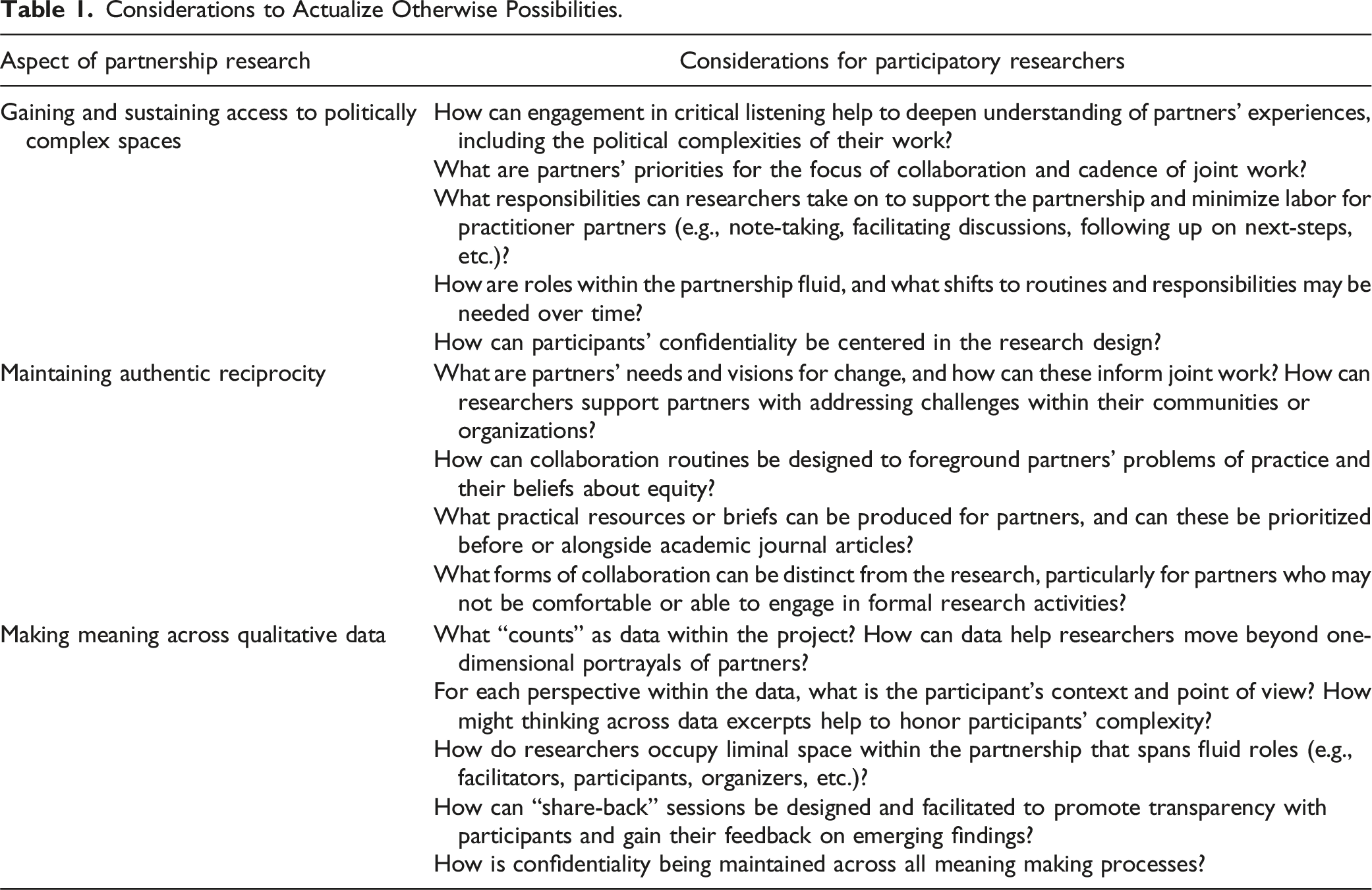
Reflecting on the considerations outlined in Table 1, we offer several implications for theory and future research below.
Implications for Theory
This study advances theory on qualitative research methods by operationalizing “otherwise possibilities” (Green, 2020) across two participatory studies. Importantly, thinking across two projects was itself an otherwise possibility, as we pushed one another’s imaginative thinking through sharing our lived experiences navigating our distinct research partnerships. Our collaborative analysis and findings revealed three themes to expand theory on participatory qualitative methods: gaining and sustaining access to politically complex spaces, maintaining authentic reciprocity, and making meaning across qualitative data. Maintaining reciprocity also meant honoring diverse interest-holders’ voices and co-constructing efforts to address barriers and advance equity. Rather than imposing external agendas, we engaged in research processes that were continually adapted in response to community input and concerns. Making meaning collectively further avoided one-dimensional narratives by contextualizing multiple perspectives and participants’ fluid roles. Overall, our findings point to the importance of flexibility, critical listening, and relationship-building when engaging with participants as both researchers and partners. Qualitative methods were strengthened by recentering participants’ agency, as well as the complexities and contradictions of their experiences throughout the research process.
Deepening our contributions to theory, we make explicit connections between our approaches to participatory research and the commitments undergirding otherwise possibilities: employing a Double Dutch methodological stance, approaching research from a desire-based framework, and using storying to shift from pain narratives towards Projects in Humanization. For example, we highlight how sustaining access to politically complex spaces required engaging in Double Dutch methodology to fluidly transition across researcher and participant roles. Our work also highlights how fostering mutuality within our partnerships was supported by invoking Projects in Humanization that helped us to honor the full and nuanced realities of our collaborators. Moving beyond one-dimensional conceptualizations of participants also required that we think beyond the typical boundaries of “what counts” as data. Through providing practical insights about our engagement in these commitments, we hope to support other researchers with actualizing otherwise possibilities in their qualitative work.
In addition to deepening theory on qualitative methods, our work also expands the literature on research-practice partnerships (RPPs). While a growing body of scholarship addresses the complexity of RPPs (e.g., Cohen-Vogel et al., 2018; Denner et al., 2019; López Turley & Stevens, 2015), less is known about how to effectively develop and sustain such collaborations, particularly when partnership work grapples with politically complex topics such as ML education. Our findings shed new light on how to build authentic relationships, maintain confidentiality, and make sense of large amounts of qualitative data within politically-charged partnership contexts. Our work also expands current RPP literature by grappling directly with how researchers within partnerships can enact desire-based frameworks that center the complexities and contradictions of participants’ lives. Across our two partnerships, this deeper understanding was informed by opportunities to connect beyond the formal boundaries of the research and provide support in their broader professional and personal lives.
Implications for Research
While the humanized approaches to participatory qualitative research that we describe in this paper have been powerful for both us and our collaborators, we must also acknowledge that this work is time and labor-intensive. Wentworth and colleagues (2022) recently outlined the many responsibilities of brokers who facilitate collaboration across research and practice. Responsibilities include attending to partners’ capacities to collaborate and use research as well as developing and sustaining partnership infrastructure. Aligning with this perspective, our reflections across projects shed light on the care and labor needed to support partnerships, much of which is often not visible in published journal articles.
Recognizing the time-intensive realities of sustaining partnership, we recommend that university leaders grapple with current incentive structures for faculty. Traditional tenure expectations are often in tension with the time it takes to build authentic, mutualistic research partnerships. Too often the structures of academia encourage researchers to “parachute from one community and topic to another” (Ochoa, 2022, p. 7) in service of projects and funding as opposed to relationships. Yet mutuality and “rich possibilities” for learning and change are often connected to deep and long-term engagement with communities (Ríos & Patel, 2023). What might it look like for universities and research funders to support the relationship building and care needed to develop and sustain such long-term mutualistic partnerships? And how might faculty and doctoral programs better prepare graduate students to engage in such work?
As we look towards future research, we encourage individuals engaged in participatory methods to consider and build upon the approaches shared in this piece. Our analysis was situated in two on-going partnerships with high (voluntary) engagement. What could be learned from examples of partnerships that face challenges with participation, or decide not to move forward? Further, our projects share a focus on advancing equitable transformation for ML students and families. We recommend that future considerations of otherwise possibilities in participatory qualitative research be situated in partnerships across other education contexts or disciplines. Such work may help to further advance Green’s (2020) vision to leverage “our data, our dreams, and our possibilities to bridge the gap between the academy and marginalized communities” (p. 125). Finally, it is important to reiterate that while we aim to inspire action, our goal is not to be prescriptive. As opposed to viewing the strategies presented in this paper as static or linear, we hope to spur helpful reflection and dialogue within and across partnerships.
Footnotes
Acknowledgments
We would like to thank the leaders, educators, families, and students who generously contributed their time and perspectives to this research.
Author Contributions
Each author contributed to the following activities: Designing the inquiry, collecting the data; performing analysis, writing the manuscript.
Declaration of Conflicting Interests
The author(s) declared no potential conflicts of interest with respect to the research, authorship, and/or publication of this article.
Funding
The author(s) disclosed receipt of the following financial support for the research, authorship, and/or publication of this article: This work was supported in part by the William T. Grant Foundation, grant number #203216.
