




Abstract
Nearly sixty years after its introduction by Jacques Derrida, deconstruction remains difficult to apply, due to its resistance to being reduced to a method, analysis, or critique. This resistance stems from its opposition to logocentrism and epistemic closures. Nevertheless, deconstruction must be applied to exist, posing an inherent paradox. Although existing scholarships have proposed various ways to apply deconstruction, many either fail to align with it or are too vague in outlining practical applications. Acknowledging these challenges, this study proposes a minimal model for applying deconstruction in research. The model conceives deconstruction as an aporetic and iterable double-reading strategy, offering an approach that can guide future applications. Unlike other discourse methods that focus on causes, effects, or ideological functions shaping reality, power, identity, or knowledge, deconstruction interrogates the very conditions that make discourse possible. To this end, the proposed model draws on Derrida’s notion of double-reading, comprising two parallel and iterable readings: Double Commentary and Disruptive Reading, which focus on exposing and destabilizing the binary logic embedded in discourses to disrupt their structures of meaning and open them to supplementary interpretations and undecidables, interpretations that resist closure and fixation. By presenting a model with an open and flexible strategy, this study contributes to making deconstruction more accessible as a research practice for Discourse Studies while remaining aligned to deconstruction.
Introduction
The study of discourse has evolved into a diverse and interdisciplinary field, encompassing various approaches that seek to understand how language constructs and reflects reality. Structuralist approaches, influenced by Saussurean linguistics, initially conceptualized discourse as a stable system governed by internal rules that generate fixed meanings (Saussure, 1959). This approach was later challenged by post-structuralist approaches, which emphasize the fluidity and contingency of meaning, recognizing that discourse is shaped by historical, political, and ideological contexts (Fairclough, 1992; Fairclough & Wodak, 1997; Foucault, 1972; Laclau, 1996; van Dijk, 1990; Wodak & Meyer, 2015). While these approaches critique the notion of discursive stability, they often assume that meaning can be temporarily fixed through hegemonic articulations, institutional power structures, or ideological formations.
Within this evolving landscape, deconstruction, introduced by Jacques Derrida (Derrida, 1998), provides an alternative reading strategy that resists the fixation of meaning and disrupts the hierarchical structures that sustain discursive authority. Unlike post-structuralist approaches that analyze how discourses are constructed and construct knowledge (Foucault, 1970), social reality (Wodak & Meyer, 2015), power dynamics (Fairclough, 1992; Laclau & Mouffe, 1985), behaviors and practices (van Dijk, 1990), as well as culture and identity (Lacan, 1966; Laclau, 2005; Stavrakakis, 2007), deconstruction focuses on the conditions that allow meaning to appear coherent and stable in the first place (Derrida, 1998). By exposing the exclusions, contradictions, and deferrals inherent in signification, deconstruction reveals that meaning is never fully present but is continuously deferred through an interplay of binary oppositions (Derrida, 1978). This is what Derrida calls différance, which challenges the coherence and rationality of discursive formations by demonstrating that their stability relies on the exclusion of alternative meanings, contradictions, and tensions (Derrida, 1988).
While it is undoubtedly difficult to understand Derrida’s writing, it is up to the idea of deconstruction not to be understood but to be done, to happen, which is why its implementation is necessary(Derrida, 1985). Nevertheless, its application in Discourse Studies has been limited to a philosophical exercise, a conceptual element within discourse theory, as a form of analysis and critique, and as a reinterpretative reading strategy for social change, leaving behind its capability to function as a research strategy. This can be explained by deconstruction’s resistance to methodological standardization and its rejection of fixed and close interpretations, which have raised questions about its reproducibility and analytical rigor (Atkins, 2003; Bornedal, 2019; Cornell, 1992; Posselt & Seitz, 2019; Searle, 1977). However, this does not preclude deconstruction from being employed in Discourse Studies. On the contrary, Derrida himself recognized deconstruction as a strategy, asserting that it must “take place” to exist (Derrida, 1985). We build on this recognition by recognizing deconstruction as a double-reading strategy (Derrida, 1988) which engages with discourse structures to expose their internal logic while simultaneously disrupting them, thereby opening them to supplementary readings and inherent undecidability.
Based on this, the research question guiding this paper is how deconstruction can be applied as a research strategy in Discourse Studies. To address this, we develop an aporetic and iterable model for applying deconstruction that preserves its openness and resistance to closure. The model is based on Derrida’s double-reading, which consists of two readings: Double Commentary and Disrupting Reading. The model adopts a minimal interpretation of the strategy to facilitate its reproducibility. To prove our model’s strategy and show its alignment with deconstruction, we present an example of how to apply it by retrieving Derrida´s reading of law (Derrida, 1992).
The structure of this paper is as follows: Section 1 contextualizes deconstruction within Discourse Studies, outlining its theoretical distinctions from post-structuralist approaches. Section 2 elaborates on deconstruction’s double-reading strategy, detailing its role in unveiling and disrupting discursive structures. Section 3 presents the proposed model, explaining its components and demonstrating its applicability through a case study. Finally, Section 4 reflects on the contributions and limitations of deconstruction as a research strategy, considering its implications for discourse analysis and future research directions. By introducing a model with a deconstructive strategy directed to Discourse Studies, this paper aims to provide a means of unsettling stable and hegemonic discourses.
Deconstruction & Discourse Studies
The study of discourse as an academic field is relatively recent, emerging in the last century (van Dijk, 1988). However, Discourse Studies have evolved from early structuralist approaches to become an interdisciplinary and diverse field of research (Akerstrom Andersen, 2003) that examines how language is articulated, constructed, and interpreted, and how it reflects, is shaped by, and shapes reality (Keller, 2013). Early approaches, influenced by Saussure an linguistics (1959), see discourses as essential (Heidegger, 1962) and stable structures governed by internal rules that determine universal, transcendental, and fixed meanings through differential relationships (Saussure, 1959, p. 58). This perspective shifted with the emergence of post-structuralist approaches in the latter half of the 20th century, including Foucault’s Archeology of Knowledge (Foucault, 1972), the theory of discourse of the School of Essex (Laclau & Mouffe, 1985; Stavrakakis, 2007), Functional Discourse Analysis (van Dijk, 1990), or Critical Discourse Studies (van Dijk, 2009; Wodak & Meyer, 2015).
Post-structuralist approaches understand discourse as a dynamic and contingent social construction that both shapes and is shaped by language (Halliday, 1985; van Dijk, 1990), knowledge (Foucault, 1972), power dynamics and structures (Laclau & Mouffe, 1985; van Dijk, 2009; Wodak & Meyer, 2015), and culture and identity (De Cleen & Stavrakakis, 2017; Lacan, 1966). Post-structuralist approaches reject fixed or essential meanings, emphasizing instead the instability of signification and the political struggles involved in meaning-making. Rejecting universal, fixed, or essential meanings, these approaches emphasize the contextual and contingent nature of discourse, diverging from structuralist thought by arguing that meaning is not natural or absolute, but rather constructed within contested terrains where dominant interpretations marginalize alternative discourses (Groszewski, 2015; Khan & MacEachen, 2021; Slemon, 2025). For example, Foucault’s notion of power/knowledge illustrates how discourse legitimizes particular forms of knowledge through institutionalized practices and historically situated formations (Foucault, 1972). Similarly, the Essex School (Laclau & Mouffe, 1985) theorizes discourse as a field of hegemonic articulations, where competing political forces struggle to fix meaning around nodal points within contingent and antagonistic contexts. In contrast, Functional Discourse Analysis examines how language functions to enact social meanings through patterned choices that reflect cultural and communicative contexts (Halliday, 1985; van Dijk, 1990). Meanwhile, Critical Discourse Studies approach discourse as an ideological mechanism through which dominant social groups construct and circulate meanings that sustain social hierarchies and marginalize dissenting voices (Fairclough & Wodak, 1997; van Dijk, 2009; Wodak & Meyer, 2015).
Among the approaches to discourse that challenge structuralism is deconstruction, introduced by the French thinker Jacques Derrida (1998). Like other post-structuralist approaches, deconstruction rejects the assertion that discourses can have logocentric and transcendental meanings with rational, universal, inherent, and absolute signification (Johnson, 1981, pp. viii–ix). Instead, deconstruction considers discourses as unstable due to the contradictions, exclusions, and tensions of their signifying structures (Derrida, 1998, p. 41). Similarly, as poststructuralism, deconstruction highlights that this instability arises from how meanings gain authority and legitimacy in a competitive space where different interpretations vie for dominance. Yet the focus here shifts as deconstruction posits that the hegemony is gained in an interplay of binary oppositions, where certain discourses impose themselves over others (Derrida, 1998, p. 23).
Therefore, for deconstruction, meanings are never fully present, essential, or ultimate, as there are always repressed elements beyond the margins of any assumed stable structure, creating a binary logic between present/absent and dominant/repressed meanings, wherein the former assumes hegemony (Derrida, 1978). This contrasts with other post-structuralist approaches, which, despite emphasizing contingency and rejecting rigid structures, often retain an explicit or implicit assumption of discursive stability. For instance, Foucauldian discourse analysis assumes discursive stability within historically bounded (Foucault, 1972). Similarly, the Essex School treats meaning as temporarily fixable through hegemonic articulations and chains of equivalence that structure political identities (De Cleen & Stavrakakis, 2017; Laclau & Mouffe, 1985). Functional Discourse Analysis presumes that meaning can be systematically mapped through recurring linguistic patterns that serve communicative functions (Halliday, 1985; van Dijk, 1990). Meanwhile, Critical Discourse Studies, despite its critical stance, often operate under the assumption that meaning can be identified and extracted through analysis (Fairclough & Wodak, 1997; Wodak & Meyer, 2015).
Deconstruction, in contrast, opposes any fixation, recognizing that the understanding of meaning only occurs at the moment it is interpreted and by whom it is interpreted (Derrida, 1998, p. 293). As Derrida asserts, “deconstruction takes place everywhere it [ça] takes place, where there is something” (Derrida, 1985, p. 3). This means that discourses gain significance according to textual, authorial, and the reader’s intentions (vouloir dire), and contexts, cultures, and languages (Derrida, 1998, pp. 209–210), while being continuously reconstituted through history, being reproduced differently every time (Derrida, 1998, p. 130). Thus, deconstruction’s rejection of transcendental signification and stabilization keeps discourses open-ended, which is the central objective of deconstruction.
Unlike other discourse-analytical approaches, such as Foucauldian discourse theory (Foucault, 1972; Khan & MacEachen, 2021), Functional Discourse Analysis (Halliday, 1985; van Dijk, 1990), Critical Discourse Analysis (Fairclough & Wodak, 1997; van Dijk, 2009; Wodak & Meyer, 2015), or the Essex School discourse theory (De Cleen & Stavrakakis, 2017; Laclau & Mouffe, 1985), deconstruction does not study discourse by analyzing how it produces social realities, legitimizes power relations, or performs communicative functions. While these approaches focus on how discourse operates to shape ideologies, institutions, or interpersonal meanings, whether through hegemonic articulation, historical contingency, or grammatical systems, deconstruction concerns itself with the structures of signification that make such operations thinkable in the first place. It does not aim to critique ideology, trace causal effects, or interpret communicative intent. Instead, it interrogates the binary oppositions, exclusions, and metaphysical hierarchies that stabilize meaning, revealing how discourse is always already (toujours déjà) in flux, evolving, adaptable, and polysemous, lacking inherent logocentric significance (Derrida, 1998, p. 89).
In other words, deconstruction seeks to unveil and disrupt the assumed discourses by exposing and opening the structures that grant them stabilization and hegemony (Derrida, 1998, p. 40). It does it by unveiling and disrupting their structures, through a force called différance, the disruption of the different and deferral of meanings that, through a hierarchical binary logic, gives them coherence and authority (Derrida, 1978, p. 161). This disruption leads to the opening of discourses to iterable interpretations called supplements (Derrida, 1998, p. 157), as they add a new meaning to now the recognized incomplete discourse. Deconstruction also uncovers undecidables (Derrida, 1995, p. 147) or meanings that simultaneously embody presence/absence, dominance/repression.
The open, adaptable, and fluid nature of deconstruction contributes to another mode of reading for Discourse Studies, positioning itself as a means of unsettling stable and hegemonic discourses. It also serves to challenge foundational assumptions, unveil binary oppositions, expose tensions in discursive constructions, and critically reflect on dominant and repressed meanings. Moreover, deconstruction introduces concepts such as différance that can be further applied in Discourse Studies, expanding the theoretical tools available for analyzing meaning and its deferral. However, its openness and fluidity raise questions regarding its practical application, while also attracting criticism for its perceived subjectivity, ambiguity, inconsistency, and nihilistic tendencies (Atkins, 2003; Bornedal, 2019; Cornell, 1992; Posselt & Seitz, 2019; Searle, 1977). Nevertheless, deconstruction has and continues to be applied in Discourse Studies, proving its adaptability and potential for reproduction, provided that its inherent contradictions and indeterminate nature are acknowledged and engaged with.
Deconstruction’s Applications in Discourse Studies
Deconstruction has primarily been associated with textual analysis, as Derrida centers on texts in most of his early works (Derrida, 1978, 1981, 1982, 1998). However, deconstruction extends to all systems of signification. As Derrida explains, “what I call ‘text’ implies all the structures called ‘real,’ ‘economic,’ ‘historical,’ socio-institutional, in short: all possible (meaning) referents” (Derrida, 1988, p. 148). This broader conceptualization allows deconstruction to be applied for Discourse Studies, engaging not only with written language but with the structures that produce meaning across various domains.
From a deconstructive perspective, discourse is not a fixed system of meaning but a contested space where meaning is continuously created and articulated through différance, deferring meaning and preventing it from ever being fully stabilized (Derrida, 1995). In contrast to post-structural Discourse Studies, which analyze how hegemonic discourses structure knowledge (Foucault, 1972), power (Laclau & Mouffe, 1985), social practices and functions (van Dijk, 1990, 2009; Van Leeuwen, 2016), ideology (Wodak, 2015), as well as identity (Lacan, 1966; Mouffe, 2023; Stavrakakis, 2007), deconstruction disrupts these formations by exposing the dominant and repressed articulations that sustain them, demonstrating that meaning is never fully present and that its coherence is an illusion supported by hierarchical binary logic (Derrida, 1998).
Previous applications of deconstruction vary. Some scholars approach it philosophically without formalizing concrete forms of application, in alignment with deconstruction’s resistance to being reduced to a method or analysis. De Man (1983), for instance, applies deconstruction to literary studies, introducing the concepts of blindness and insight to highlight textual contradictions. Fritsch et al. (2018) extend it to ecological thought, introducing eco-deconstruction as a new mode of reading that interrogates how exclusions and oppositions structure dominant discourses about nature. These engagements with deconstructions contribute to expanding its use as a philosophical exercise but pose challenges to putting it into practice beyond constant inquiries.
From a discursive approach, Laclau and Mouffe’s theory of Discourse (1985) incorporates deconstructive elements like undecidability to demonstrate how hegemony functions, thus selectively applying deconstruction. However, their engagement with deconstruction remains partial, as they reject the notion of infinite deferral of meaning, arguing instead that meaning can achieve temporary fixation through hegemonic articulations. Additionally, while they acknowledge that meaning is shaped by oppositions, they contend that it is not necessarily structured through single binaries but rather through chains of equivalences and differences (Laclau & Mouffe, 1985, p. 63), thus diverging from the concept of différance. Their use of deconstruction, therefore, serves as a reference, rather than a full engagement, to develop their discourse theory.
Similarly, though with an analytical and critical purpose, other scholars have retrieved some elements of deconstruction to propose their applications. Nancy (1991) pioneered in employing deconstruction to analyze the assumed stability of political and social organizations, such as the community, introducing the concept of désœuvrement (Nancy, 1991, p. 154). Kennedy (1991) introduced it in Critical Legal Studies to critique the assumed neutrality of legal reasoning and doctrine, introducing the concept of argument-bites, which aligns with deconstruction’s critique of binary logic (Kennedy, 1991, p. 327). Meanwhile, Munslow (2006) applied deconstruction in historiography, critiquing the metaphysics of presence to argue that history is not an objective reconstruction of the past but a discursive construction shaped by language, discourse, and textual mediation (Munslow, 2006, pp. 39–41). Although they provide new applications of deconstruction and expand it by proposing new concepts, they fail to engage with it as they do not fully embrace its radical undecidability, nor do they resist the impulse to reconstruct or stabilize meaning, which deconstruction persistently opposes.
As a form of social reinterpretation, other scholars have used deconstruction to propose radical changes in social systems. For example, Butler (1999) pioneered in applying it to feminism and queer studies, utilizing binary logic to demonstrate that gender is discursively constructed and performative (Butler, 1999, p. 25). However, her approach departs from deconstruction, as she ultimately seeks to resignify gender categories for strategic political intervention rather than indefinitely defer their meanings. Similarly, Leff (2019) uses deconstruction as a tool for social change, proposing a new discourse on environmental rationality as an alternative to the dominant capitalist paradigm (Leff, 2019, p. 37). His approach, however, seeks to replace one discursive construction with another, whereas deconstruction resists the substitution of meanings.
Recent studies have applied deconstruction in similar ways to those described, whether as a philosophical exercise, as proposed by de Man (1983) and Fritsch et al. (2018), or by incorporating deconstructive concepts such as aporia (Charteris, 2014; Wang, 2005), différance (Vinolo, 2025), iterability (Ayuto, 2015; Peterson, 2024), pharmakon (Tormey, 2018), or Derrida’s ghost interpretation (Hodkinson, 2021) into discourse analysis. As a conceptual element within discourse theory, as introduced by Laclau and Mouffe (1985), deconstruction has been explored in studies examining its role in expanding ethical and rational choices (Robb, 2024), or enabling the simultaneous openings of two discursive structures (Portá Caballé, 2023). Similarly, deconstruction has been used as an analysis and critique (Kennedy, 1991; Munslow, 2006; Nancy, 1991), including applications in geography (Persaud, 2019), political studies (Haynes & Hietanen, 2023; Olivas Osuna, 2021), and economics (Ordem, 2021). It has also been used as a reinterpretative reading strategy for social change (Butler, 1999; Leff, 2019), as seen in feminist and gender research (Jacobs & Andrews, 2021), on environmental research (Clark & Lynes, 2023), and on studies deconstructing economic models and practices (Céspedes, 2020).
Despite its multiple engagements, the introduction of reproducible strategies to apply deconstruction remains distant in all these uses. This can be attributed to their partial engagement with deconstruction, as well as their contradictory or selective applications that focus on analysis, critique, or reinterpretation. This limited application as strategy, however, can also be explained due to deconstruction’s inherent resistance to methodological structuring (Derrida, 1985, pp. 2–3), its dynamic, open, and evolving nature, and its openness that raises questions about its replicability and rigor (Derrida, 1978, p. 26). However, deconstruction can only exist through its application (Derrida, 1985, p. 3). For this reason, Derrida rather understood deconstruction as a “strategy” (Derrida, 1988), recognizing the limitations that prevent its application.
Deconstruction: An Aporetic and Iterable Double-Reading Strategy
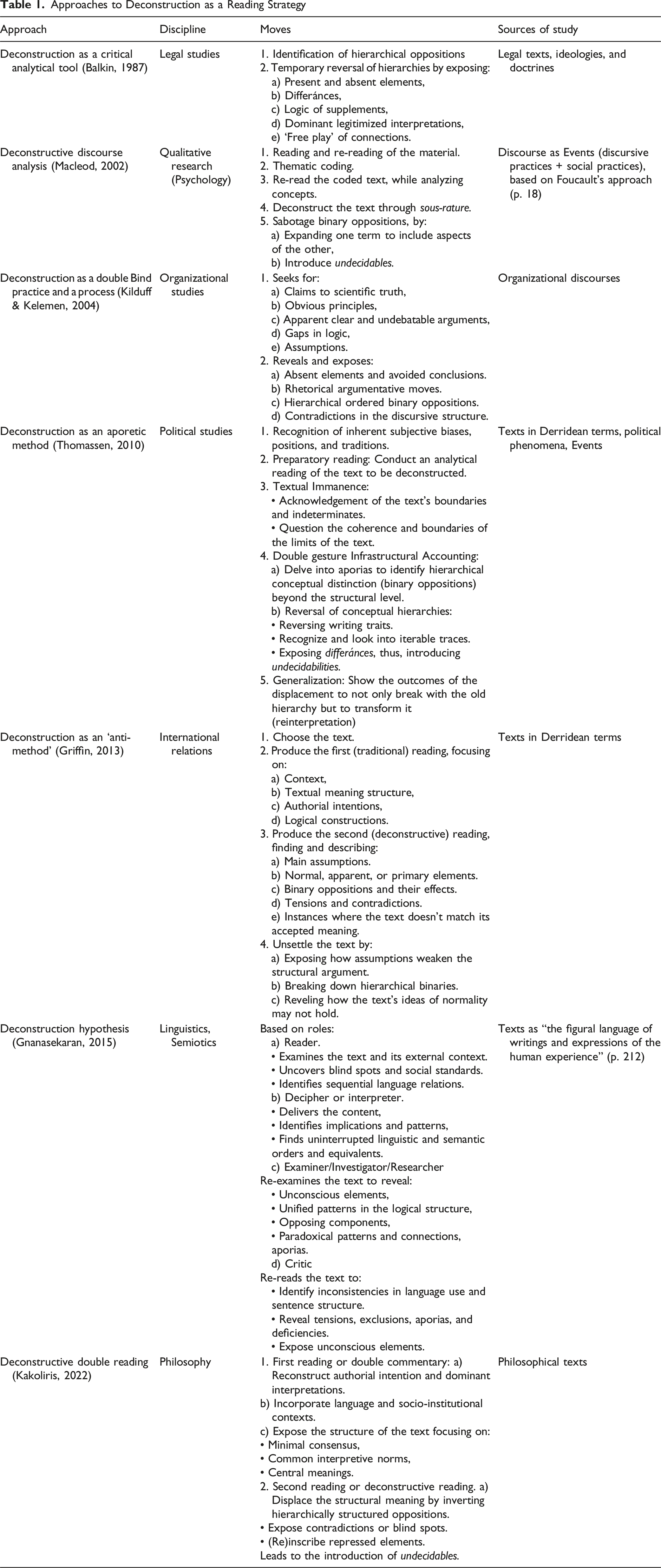
Previous studies have laid the groundwork for a reproducible application of deconstruction; however, they have yet to fully engage with their theoretical foundations. Critchley (2014), for example, reinterprets deconstruction as an ethical practice, for it aims to open to marginalized and excluded meanings. While he does not privilege one way of applying deconstruction, he nevertheless thinks that his implementation is indispensable. The approach of deconstruction as a practice is also evident in Balkin’s (1987) work, in which he insists on employing deconstruction as an analytical tool to identify elements that are present and absent, as well as differences, supplements, and dominant interpretations in the field of Legal Studies. Yet he offers little concrete guidance on how to apply it, instead advocating analyses that yield substitutive reinterpretations, an approach at odds with deconstruction’s aim to unsettle rather than replace prevailing meanings. A similar partial engagement with deconstruction is found in Kilduff and Kelemen’s (2004) approach to reading organizational discourse. They propose to produce readings to unveil absent elements, rhetorical strategies, hierarchical binary oppositions, and contradictions. However, they are not detailed on how, nor do they engage with key deconstruction concepts such as iterability, or vouloir dire, thereby limiting their alignment with deconstruction, rather focusing on its potential outcomes.
From a systematic and quasi-scientific approach, various scholars outline specific readings, moves, gestures, or roles to conduct the deconstructive reading. Macleod (2002), for example, proposes unveiling binary oppositions to arrive at undecidability, incorporating discursive techniques such as coding to expose discursive structures. However, she does not fully acknowledge or integrate deconstruction’s inherent resistance to being employed as a structured research strategy. Thomassen (2010) and Griffin (2013) recognize these limitations, describing their strategies as aporetic and non-methodological while still providing standard and systematic moves to apply deconstruction. Their approaches include preparatory readings to contextualize discourse (Thomassen, 2010) and a concluding analysis after the deconstructive reading to situate findings within broader social contexts (Griffin, 2013), aligning with discourse techniques and methods.
In an attempt to diverge from traditional methods and sequential procedures, Gnanasekaran (2015) proposes that researchers adopt multiple roles when conducting deconstructive readings. These roles, such as reader, decipherer, or investigator, include analytical and critical functions, not aligning with deconstruction’s non-prescriptive resistance. Rasiński (2011) and Kakoliris (2022) remain closer to Derridean deconstruction by retrieving Derrida’s concept of double-reading, emphasizing its two readings while resisting the inclination to prescribe specific strategies for its application, not solving the question of how to apply deconstruction. The following sections delve into this question by presenting deconstruction as a double-reading strategy that can be applied through two readings, addressing the challenges of its implementation by recognizing its aporetic implementation and iterability.
Deconstruction as a Double-Reading Strategy
Deconstruction can be understood as a dynamic and iterative strategy that necessitates application to exist, while simultaneously resisting logocentric closure and stability (Derrida, 1985, pp. 2–3). Derrida asserts that deconstruction must be enacted through a double-reading, which involves “two texts, two hands, two visions, two ways of listening (écoutes). Together at once and separately” (Derrida, 1982, p. 65), however, he did not provide a concrete strategy to apply it. Kakoliris (2022), in recognizing deconstruction as a double-reading, argues that it should be conducted through two distinct readings, each with its own elements, which he carefully delineates. However, in alignment with deconstruction’s resistance to prescriptive methods, he refrains from introducing specific steps or a fixed route for their application.
This paper aligns with the recognition of deconstruction as a double-reading strategy in various ways. It is a double strategy in the terms Derrida highlights as it operates both within and beyond the structure of texts, engaging with the absent/present, and dominant/repressed discourses. It is also double because it engages with the double intentions of discourses, or in deconstruction’s terms, with the vouloir dire, the intentions of the text and the author, as well as those arising from the reader’s interpretation (Derrida, 1988, pp. 5, 8). Likewise, it is a double-reading because it involves two readings. One that Derrida identifies as Double Commentary (Derrida, 1988, p. 143) and another one that we recognized as Disruptive Reading based on its objective (Caputo & Derrida, 1997, p. 80). These readings are also dual, not by the frequency or order of their application, but because they represent distinct but interconnected readings that should be conducted in parallel and independently, thus diverging from the systematic and standardized procedures of traditional methodologies.
The Double Commentary (Derrida, 1988, p. 143) seeks to reproduce the vouloir dire of discourses both within and beyond their margins. To achieve this, the reading exposes the dominant and hegemonic meaning structures that govern them—the explicit layer of discourse that asserts itself as authoritative and self-evident. However, while engaging with presence and dominance, the reading simultaneously reveals absence and repression, uncovering the implicit elements that remain concealed or marginalized within the discourse. This results not only in the unveiling of hegemonic discourses but also brings forth the ones that have been suppressed. The Double Commentary, however, is not neutral, but as its name indicates, it is double, in the sense that it reflects the textual and authorial intentionality shaping the discourse through the interpretation of the reader. Therefore, rather than simply replicating the discourse’s meaning, this reading reproduces. As Derrida states, “‘Doubling commentary’ is not a moment of simple reflexive recording that would transcribe the original and true layer of a text’s intentional meaning... No, this commentary is already an interpretation” (Derrida, 1988, pp. 143–144). Thus, the Double Commentary destabilizes the illusion of determinacy, rational coherence, and transcendentalism of discourses, exposing how the discourse is founded and functions according to its own present/dominant and absent/repressed logic.
The Disruptive Reading, for its part, focuses on disrupting the reproduced structure (Caputo & Derrida, 1997, p. 80). To do so, it identifies hierarchical binary oppositions and displaces them through différances, the force that unsettles and defers the oppositions (Derrida, 1978). This displacement does not seek to merely invert the hierarchy or replace one dominant meaning with another. Instead, it exerts pressure on the contradictions, tensions, and omissions within oppositional structures, thereby unsettling their assumed coherence. As Derrida explains, “What disrupts the totality is the condition for the relation to the other. The privilege granted to unity, to totality” (Caputo & Derrida, 1997, p. 12). This reading, therefore, does not aim to substitute fixed meanings by reinverting the binary hierarchy but rather to reveal the conditions through which meaning is constructed, opening it to supplementary interpretations and undecidables.
This double-reading is what this study recognizes as the strategy to apply deconstruction. However, applying it in scientific research still presents some challenges, as its openness and anti-logocentrism can be perceived as vague, inconsistent, or lacking rigor. Moreover, its reliance on context, language, culture, intentions, and temporality prevents standardization and full replicability. Nevertheless, deconstruction can and should be employed as a reproducible double-reading strategy, albeit with necessary adjustments to account for these nuances. This double-reading does not seek to negate or destroy meaning but rather to expand the field of interpretation, where meaning remains provisional, contingent, and subject to continual revision (Caputo & Derrida, 1997, p. 129).
Deconstruction: An Aporetic and Iterable Strategy
Although recognizing deconstruction as a research strategy enables its application, it contradicts the aversion of deconstruction to be reduced to a set of procedures and an ordered, systematic, and rational logic to be applied. This is because if deconstruction were reduced to a fixed methodology, it would cease to be deconstruction. Nevertheless, deconstruction paradoxically must be put into practice to exist. As Derrida explains: “Deconstruction does not exist somewhere, pure, proper, self-identical, outside of its inscriptions in conflictual and differentiated contexts; it ‘is’ only what it does and what is done with it, there where it takes place,” (Derrida, 1972, p. 141).
To address these tensions, we align with the recognition of deconstruction as aporetic (Thomassen, 2010). This means that there exists no stable or predetermined set of procedures ordered for its application, as deconstruction remains perpetually open to reinterpretation. Instead, its enactment is dynamic and contingent, resisting systematicity, universality, or consistency (Derrida, 1998, p. 157). Likewise, it entails recognizing that as a strategy, deconstruction is not aimed at analyzing, critiquing, or examining discourses but rather actively intervenes in their structures to disrupt them, opening discourses to supplementary readings, including those yet to come (á venir) (Caputo & Derrida, 1997, p. 42). Consequently, deconstruction does not yield definitive or regular outcomes; rather, it exposes the inherent fluidity and openness of discourses, thereby averting any final closure (Derrida, 1998, p. 92). Therefore, deconstruction does not presuppose absolute foundations or fixed judgments, foregrounding instead the undecidability of discourses (Derrida, 1988, p. 111) given that its application necessitates embracing its contradictions and undecidability, understood as the impossibility of final closure.
The aporetic understanding of deconstruction also necessitates its recognition as iterable. That is, deconstruction cannot be replicated consistently as a method but is instead reproduced with variations, or in Derridean terms, it is iterable. This entails that each application takes a different form depending on its context, temporality, intention, culture, and language (Derrida, 1988, p. 53). By embracing iterability, the double-reading never remains identical, thus circumventing the strict rigor and methodological consistency expected in scientific studies (Catalano & Waugh, 2020; Derrida, 1998, p. 157; Greckhamer & Cilesiz, 2014; van Dijk, 1997). Instead, its application is flexible, adaptable, and subject to reinterpretation in response to the contingencies shaping its deployment. As a result, its outcomes are never uniform but rather singular, as each iteration generates new supplements and underscores the undecidability of meaning, ensuring that discourses remain perpetually open to further readings and interventions (Derrida, 1998, p. 316).
By recognizing deconstruction as an aporetic, iterable double-reading strategy, we contend that it can be applied and reproduced in Discourse Studies without contradicting it. This characterization, however, may raise concerns regarding rigor, replicability, validity, and consistency, criteria typically expected in discourse research (Catalano & Waugh, 2020; van Dijk, 1997). Yet deconstruction resists such theoretical determination (Derrida, 1988, p. 9) and far from constituting a limitation, we see this resistance as deconstruction’s principal contribution to Discourse Studies.
Introducing the Model
To address the question of how to apply deconstruction in Discourse Studies while acknowledging its resistance to structured methodologies, we develop a model for applying it, grounded in a double-reading strategy (see Figure 1). The model is based on the contributions of Derrida (Derrida, 1978, 1981, 1982, 1988, 1998), incorporating elements from other scholars (Griffin, 2013; Kakoliris, 2022; Macleod, 2002; Thomassen, 2010). This model does not aim to meet scientific expectations (Catalano & Waugh, 2020; Greckhamer & Cilesiz, 2014; van Dijk, 1997), but it can help provide some degree of certainty and transparency by presenting a reading strategy that, although aporetic and iterable, can be reproduced. This aligns with the deconstruction’s objective of not seeking to produce consistent, universal, and closed outcomes, but to facilitate its reproduction, ensuring that every reading remains unique, contingent, and open to transformation. Model Reading Strategy for Discourse Studies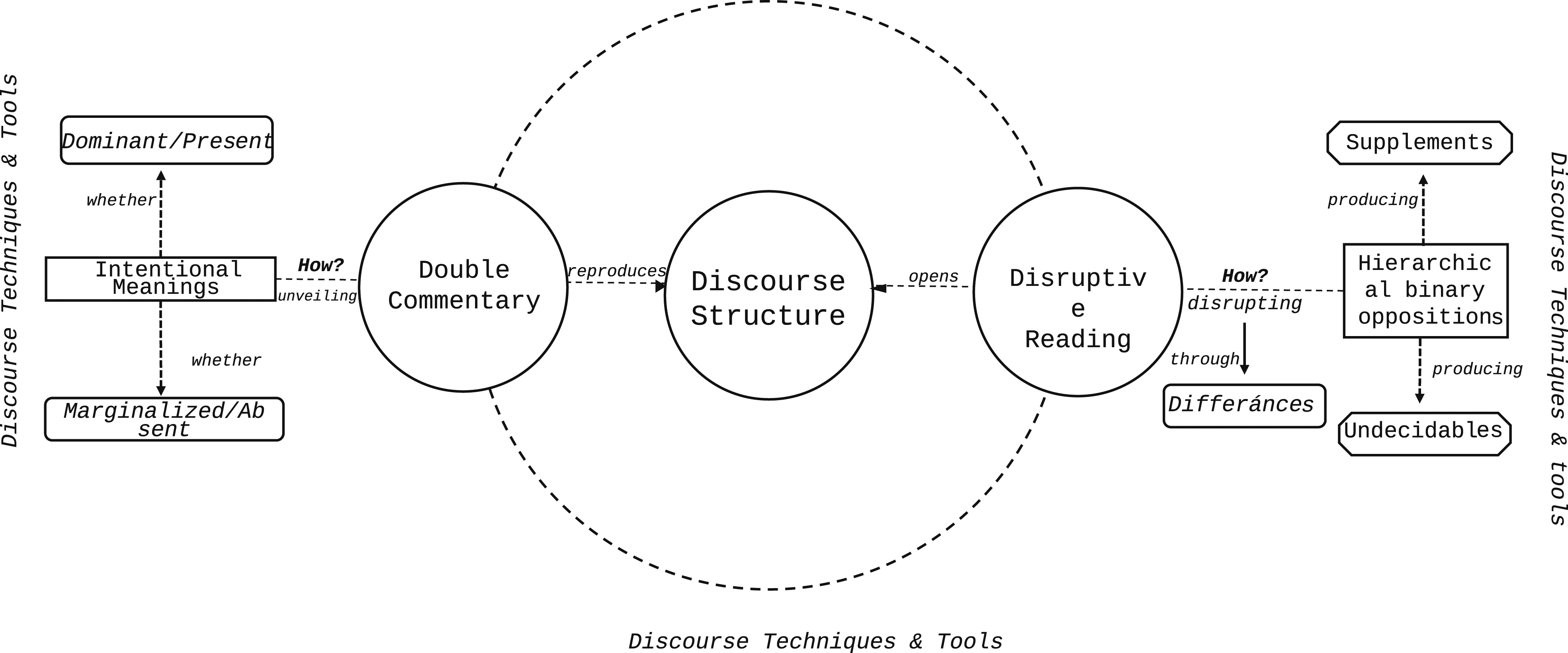
To achieve this, the model adopts a minimal strategy to double-reading (Sartori, 2009), which means that it only includes the readings that can allow deconstruction, integrating the necessary additional terms and secondary concepts as much as possible. With this broad and general approach, we aim to ensure that our model can be iteratively applied, allowing for variations and adaptations introduced by external factors, the double-readings themselves, and the readers, thus broadening its potential uses. Moreover, maintaining a minimal model can also serve to respond to the scientific expectations of discursive methods by presenting a reproducible strategy (Catalano & Waugh, 2020; Greckhamer & Cilesiz, 2014; van Dijk, 1997).
The decision to present a model for applying deconstruction as a research strategy arises from the need to balance its inherent resistance to becoming a method with the necessity of providing a reproducible application. Rather than relying on steps (Griffin, 2013; Macleod, 2002), guidelines (Balkin, 1987; Kilduff & Kelemen, 2004), moves (Thomassen, 2010), roles (Gnanasekaran, 2015), or a dual reading(Kakoliris, 2022; Rasiński, 2011), the model offers a way to reflect the dynamic, open-ended, and parallel readings of deconstruction, integrating other important elements while avoiding ordered procedures, standardization, and rigid applications. Our model also serves to retrieve the complexity of deconstruction (Kakoliris, 2022) and simplify it for discourse research, providing a clear understanding of how to apply it, maintaining its minimal necessary elements intact. Our model thus facilitates an aporetic and iterable engagement with the double-reading strategy, allowing researchers to explore how discourses both construct and deconstruct their meanings (Caputo & Derrida, 1997).
Explaining the Model
At the core of the model lies Discourse Structure, as its unveiling and disruption constitute deconstruction’s principal contribution to Discourse Studies. Its central placement reflects the dual function of discourse, as both the space where meanings are stabilized and the site of their deconstruction. By positioning the Discourse Structure centrally, the model highlights that discourse is never fixed but is always in a state of tension between consolidation and destabilization.
Next to the Discourse Structure lies in a parallel position, the double-readings of deconstruction: Double Commentary and Disruptive Reading. This disposition was chosen to reflect the simultaneous and dynamic application of both readings, resisting sequential and closed-end procedures. The readings are based on deconstruction’s double-reading strategy. The Double Commentary (Left) centers on unveiling the hegemonic structure by unveiling both the Dominant/Present and by defect the Marginalized/Absent Meanings & Vouloir Dire of discourses. This reading does not challenge the discourse directly but instead reproduces the structure and how it operates. Disruptive Reading (Right) engages with the Hierarchical Binary Oppositions that emerged from the Double Commentary and disrupts them through the force of différances, which unsettles, dismantles, and defers the binaries by pressuring their contradictions and tensions. This reading produces Supplements, or additional readings, and sometimes Undecidables. They both destabilize the dominant discursive structure, opening its fix and rigid closure.
Our model provides a discursive turn to deconstruction by focusing on discourses as the central object of the readings, in alignment with deconstruction application to all units of signification. It also incorporates Discourse Techniques & Tools positioned at the periphery of the model. Their marginal placement signals their optional application, available for scholars who seek a degree of structure, rigor, validity, and reliability (Greckhamer & Cilesiz, 2014) while recognizing that deconstruction ultimately operates beyond these logocentric constraints. The model does not propose specific techniques or tools, leaving it open to researchers to decide which ones to apply, if they do not contradict or interfere with the deconstructive readings.
The model is open, non-linear, and dynamic, as it does not impose a fixed number of readings, avoids presenting sequential steps, rigid movements, or ordered procedures that culminate in replicable and consistent research outcomes, nor does it prescribe an endpoint to interpretation. This is visually represented by the circularity of the model, and the parallel positioning of the readings, as well as in the distanced placement of the expected outcomes, positioned in hexagons up and down Hierarchical Binary Opposition. This was done to place focus on the Discourse Structure. The dotted arrows reinforce the openness and continuous movement of the model, illustrating how deconstruction disrupts fixed margins and rejects rigid borders, thus remaining open to constant application.
The Model & Derrida: Deconstruction of Law
To exemplify how the model aligns with deconstruction, but also to show its applicability, we used it in Derrida’s text Force of Law, where he engages with how law sustains itself through a discourse structure that presents authority as self-justified (Derrida, 1992, p. 7). Our proposed model, which places the discourse structure at the center of deconstruction, mirrors Derrida’s recognition of the legal system, which he claims constructs itself as a domain of reason, necessity, and legitimacy, concealing the underlying performative force that grants it authority. Derrida articulates this through the concept of the mystical foundation of authority, emphasizing that the law’s legitimacy does not rest on an external ground but on its performative enactment: “Simple reason tells us that nothing is just in itself; everything crumbles with time. Custom is the sole basis for equity, for the simple reason that it is received; it is the mystical foundation of its authority. Whoever traces it to its source annihilates it” (Derrida, 1992, p. 12).
In opposition to traditional methods, Derrida does not analyze, critique, or reject the law’s claims but instead reproduces its logic, exposing how it sustains itself. This aligns with our model’s Double Commentary, which engages with the dominant/present and marginalized/absent meanings in discourse to reveal how it gains authority. Derrida follows this reading when he posits that law has been constructed as an embodiment of justice: “If justice is not necessarily law (droit) or the law, it cannot become justice legitimately or de jure except by withholding force or rather by appealing to force from its first moment” (Derrida, 1992, p. 10). By foregrounding the law’s internal claims, Derrida makes visible the mechanisms that legitimize law through justice, which he claims are done by authority and violence.
To disrupt the Hierarchical Binary Opposition of law/justice, Derrida applies the force of différances, aligning with our model’s Disruptive Reading. Derrida destabilizes the binary by showing that while law operates within a framework of codified norms, justice is an elusive, incalculable demand that always exceeds the law. He argues that “justice is not necessarily law (droit)” (Derrida, 1992, p. 10) and that law is deconstructible, but justice is not because law is a system of rules that can be interpreted, revised, and critiqued, whereas justice remains an infinite, aporetic ideal (Derrida, 1992, pp. 14–15). He explains that justice, unlike law, is never fully present; it is always deferred, existing only as an evolutionary concept that continuously shapes and is shaped by discourse (Derrida, 1992, p. 15). Derrida exemplifies this with divine justice and moral justice, both of which function as aspirational yet unattainable ideals that exist outside of legal frameworks. Divine justice, he explains, is often conceived as absolute and transcendent, yet it remains inaccessible within human institutions (Derrida, 1992, p. 42). Similarly, moral justice is historically invoked to ground law in universal principles, yet it, too, is contingent on interpretation and lacks any fixed presence (Derrida, 1992, p. 49). Because justice is always to come (à venir), it resists deconstruction, not because it is stable or foundational, but precisely because it never fully manifests as an object that can be deconstructed (Derrida, 1992, p. 27).
Law, by contrast, is always subject to deconstruction because it derives its authority from a foundational violence that cannot be fully justified, what Derrida calls the mystical foundation of authority: “There is no law without enforceability, and no enforceability of the law without force,” (Derrida, 1992, p. 6). However, this force is neither fully legitimate nor illegitimate, exposing the inherent instability of the law’s authority. The tension between law and justice manifests in undecidability, where law should be performed, yet no rule can fully determine what is just because, in sum, laws are structured and general, whereas justice demands singularity. This undecidability opens the logocentric stability of law, as by relying on an opposition that is permanently à venir and relies on interpretations and contexts, the performance of law cannot be fixed, universal, or rational. This becomes evident in judicial decisions, where each case that comes before a judge is unique and cannot be resolved through the mere application of a pre-existing rule. Instead, the very act of applying the law transforms it, as the decision is shaped by the judge’s interpretation, the specifics of the case, the temporal context, and the language in which it is articulated. Every court ruling is therefore a paradoxical act: it simultaneously enforces the law while reinterpreting it, introducing a supplementary meaning that alters its trajectory and sets a new precedent. This is why justice remains “the experience of the impossible,” an undecidable that is never fully realized but always deferred.
Approaches to Deconstruction as a Reading Strategy
However, the example presented does not illustrate how discourse techniques or tools can be incorporated into the deconstruction of discourse, as Derrida resisted using rigid methodologies. Nevertheless, if readers wish to apply them, they can do so in several ways. In the deconstruction of law, for instance, binaries can be mapped and charted to facilitate the readings. An intertextual analysis can also be conducted to trace how legal concepts, such as justice, force, and enforceability, shift in meaning across different texts. Similarly, a mapping of contradictions can be conducted to pinpoint moments where legal reasoning collapses under its logic. Meanwhile, a keyword analysis could also be conducted to identify rhetorical patterns such as paradoxes, double meanings, or ambiguous formulations. The door remains open to other techniques and tools, provided they do not compromise the deconstructive reading but rather enhance its application and its focus on opening closed logocentric and transcendental discursive constructions.
Discussion
This paper has examined how deconstruction can be applied as a research strategy in Discourse Studies while maintaining its resistance to transcendental and logocentric fixation. To address this question, we have drawn on Derrida’s double-reading (Derrida, 1982, p. 65) to present a model that adopts an aporetic and iterable strategy, guiding researchers in applying deconstruction without reducing it to an analysis, critique, or method (Derrida, 1985, p. 3). This is particularly relevant given that Discourse Studies often equate methodological rigor and validity with systematicity and replicability (Catalano & Waugh, 2020; Greckhamer & Cilesiz, 2014), assumptions that deconstruction challenges. In contrast, our model, by centering on a minimal interpretation of double reading, provides a flexible and adaptable strategy that can be applied by readers every time and everywhere they apply it (Derrida, 1985, p. 3).
Our model aligns with existing literature (Butler, 1999; de Man, 1983; Fritsch et al., 2018; Kennedy, 1991; Laclau & Mouffe, 1985; Leff, 2019; Munslow, 2006; Nancy, 1991) by demonstrating that deconstruction can extend beyond its textual origins to Discourse Studies, adhering to Derrida’s understanding of texts as encompassing all units of signification (Derrida, 1988, p. 148). Furthermore, it reinforces this discursive turn by incorporating techniques and tools from Discourse Studies. However, these elements remain peripheral, ensuring that they do not compromise the integrity of deconstruction but instead serve as supplementary aspects.
By recognizing deconstruction as a research strategy, our model surpasses its existing uses in Discourse Studies where it has been applied as a philosophical exercise and approach (de Man, 1983; Fritsch et al., 2018), as a conceptual element for discourse theory (Laclau & Mouffe, 1985), as a form of analysis and critique (Kennedy, 1991; Munslow, 2006; Nancy, 1991), and as a reinterpretative reading for social change (Butler, 1999; Leff, 2019). Therefore, providing a way to reproduce it to read and open discourses.
Our recognition of deconstruction as a research strategy is not exceptional; Derrida himself called it a “moving strategy” (Derrida, 1985, p. 2), highlighting that it has to “take place” to exist (Derrida, 1985, p. 3). Previous scholarship has also recognized that deconstruction has to be applied either as an analysis (Balkin, 1987; Macleod, 2002), practice and process(Kilduff & Kelemen, 2004), aporetic method (Thomassen, 2010), non-method(Griffin, 2013), hypothesis(Gnanasekaran, 2015), or double-readings (Kakoliris, 2022; Rasiński, 2011), yet their lack of a concrete strategy or limited engagement with deconstructive concepts, along with tendencies toward rigid procedures and systematization, have complicated its reproducibility and, at times, contradicted deconstruction itself.
Our model addresses these challenges by providing a way to apply deconstruction while remaining aligned with it. It does so by (1) recognizing deconstruction as an aporetic reading strategy, (2) employing a double-reading strategy, and (3) ensuring that its reproducibility remains iterable. Our model acknowledges the paradox of needing to apply deconstruction while resisting its reduction to a structured method. This recognition led us to develop a model rather than a prescriptive set of steps, processes, or guidelines, as a visual representation better reflects the openness, adaptability, and dynamism of deconstruction. The model avoids sequential, universal, or systematic applications, instead employing circular, parallel, and interactive readings. The model’s circular design, as well as its use of dotted lines and its parallel construction, emphasizes this, allowing readers to adapt the strategy and to keep it open to future readings.
Our contribution to existing research is further reinforced by our reliance on a double-reading strategy. While double-reading has been previously addressed in previous research (Derrida, 1982; Kakoliris, 2022; Rasiński, 2011), our approach differs as it focuses on discourses and takes a minimal approach, while recognizing deconstruction’s complexity. Our model reflects this by centering on Discourse Structures, linked to Double Commentary and Disruptive Reading, and their necessary elements to be conducted. Our model’s broad and general approach reinforces the openness and iterability of the double-reading strategy, enabling readers to integrate other elements and concepts of deconstruction or to incorporate other discursive techniques and tools. Likewise, the centrality of our strategy in Discourse Structures further highlights this adaptability, as deconstruction focus relies on its exposure, disruption, and opening, regardless of the readings or elements that might be involved with it, thus leaving the door open to further reinterpretations of our model, in alignment with deconstruction aversion to closure.
In this regard, the centrality of our model in Discourse Structures, also highlights deconstruction’s main contribution to Discourse Studies, not only because it explicitly engages with discourses, but because in comparison to previous approaches and methods, deconstruction does not engage with how discourses are shaped and shape knowledge (Foucault, 1970), social reality (Wodak & Meyer, 2015), power dynamics (Fairclough, 1992; Laclau & Mouffe, 1985), behaviors and practices(van Dijk, 1990), or culture and identity (Lacan, 1966; Laclau, 2005; Stavrakakis, 2007), but rather it delves in how discourses construct and sustain themselves by delving in their very structure (Derrida, 1998). Not with the focus of analyzing, criticizing, or examining it, not to reinvert its hegemony logic, change or influence social reality, or build new reinterpretations (Derrida, 1985) but to open up their transcendental and logocentric construction to allow future readings á venir (Caputo & Derrida, 1997, p. 42), neutralizing the binary logic that provides them coherence and authority by applying différance (Derrida, 1978, p. 161).
Finally, by recognizing the double-reading strategy as iterable, the model highlights that its application is always influenced by language, context, intentions, and temporality (Derrida, 1998, p. 293). This means that the application of the model is not consistent, but rather it changes each time, everywhere, and for every reader when applied. This is because our proposed model does not seek to stabilize discourses, instead, it aims to foreground the impossibility of final discursive constructions, revealing the exclusions, contradictions, and tensions that sustain them and offering an iterative reading strategy that can be continually reproduced (Derrida, 1988, p. 53). This resolves the tension between replicability/reproducibility and closure/openness of previous applications of deconstruction as a research strategy by illustrating that while each deconstructive reading is unique, it can still follow a minimal approach through a double-reading strategy that is iterable.
Despite the contributions of our model, we acknowledge potential criticisms and limitations. Deconstruction scholars may argue that any attempt to systematize deconstruction contradicts its anti-structural stance and resistance to logocentrism. However, we contend that deconstruction, while resisting rigid methodology, must still be applied in some form to exist (Derrida, 1988, p. 9), so although relying on a strategy, our model attempts to maintain its alignment with deconstruction by maintaining our strategy open, adaptable, and minimal, only providing the elements that can allow its reproducibility, without compromising its flexibility and future reinterpretations. Deconstructive scholars might also argue that Derrida and other scholars (Kakoliris, 2022; Rasiński, 2011) have sufficiently addressed the double-reading. We recognized this, however, our study aims to take deconstruction to Discourse Studies, providing a way to apply it in that field, which uses it as a research strategy, remains limited, taking a minimal approach that can simplify deconstruction complexity for it to be reproducible.
For their part, discourse scholars might raise questions about existing approaches that already account for contingency and instability (Fairclough & Wodak, 1997; Foucault, 1972; Laclau & Mouffe, 1985), as well as binary logic (Lacan, 1966), and hegemonic constructions (Foucault, 1972; Laclau & Mouffe, 1985; Wodak & Meyer, 2015). We recognize this, however, while post-structuralist approaches recognize contingency, their focus is not strictly limited to opening discursive structures, as deconstruction is, and they still assume some form of temporary discursive stability, whether in the form of hegemonic articulations (Laclau & Mouffe, 1985; Stavrakakis, 2007)), regimes of truth (Foucault, 1972), or ideological formations (Fairclough, 1992; Wodak & Meyer, 2015). In contrast, deconstruction rejects even provisional stability (Derrida, 1998, p. 23), and it is not centered on how hegemonic constructions and binary logic affect and reflect societal reality but on how they stabilize discourses.
Additionally, our model may also raise questions about its subjectivity, apparent relativism, and iterability, as it keeps its application open, intentional, adaptable, and inconsistent. We acknowledge that our model does not conform to conventional expectations of methodological rigor, replicability, or validation (Catalano & Waugh, 2020; Greckhamer & Cilesiz, 2014; van Dijk, 1997), because deconstruction is not identical, nor universal, nor can it be systematically applied. Deconstruction varies every time, everywhere, and by whom it is applied (Derrida, 1985, p. 3). Our model, however, provides a strategy that can guide readers in applying deconstruction, which can help to provide more transparency and certainty to deconstruction. Likewise, by integrating discursive techniques and tools, as proposed by previous research and our model (Griffin, 2013; Macleod, 2002), readers can respond to the expected scientific rigor while conducting their readings, as long as they do not interfere with deconstruction. The model, thus, can help respond to some extent to the logocentric doubts, however, it cannot fully address them because it is precisely deconstruction’s rejection of traditional methods and scientific constraints that make the double-reading what it is and the whole purpose of conducting it. So instead of limitations, they should be recognized as contributions.
Future research could refine the model to align with specific objectives, contexts, and intentions, as it allows for tailored applications. Additionally, as this paper was merely methodological, applying the model in empirical multidisciplinary studies can enhance its practicality and empirical approach, further strengthening our model’s contributions to Discourse Studies. Incorporating more detailed discursive techniques and tools could also improve the model’s specific application in the field, but that will depend on each reader and should not interfere with deconstruction. Meanwhile, integrating other deconstruction elements and concepts can further reinforce the application of the model, enabling scholars to better disrupt and open discourses.
Conclusion
This paper has explored the application of deconstruction (Derrida, 1998) as a research strategy in Discourse Studies, emphasizing its potential to unsettle and open discursive structures while resisting closure, stabilization, and logocentrism. Recognizing the historical challenges associated with applying deconstruction as a systematic research approach, this study has sought to bridge the gap between deconstruction’s theoretical complexity and its practical applicability. By developing a model for an aporetic and iterable double-reading strategy, this study offers a way to engage with deconstruction while maintaining its open-ended and dynamic nature.
The model introduced in this paper builds on Derrida’s concept of double-reading (Derrida, 1982), providing a structured yet flexible approach that aligns with deconstruction’s theoretical premises. The Double Commentary engages with the present/dominant and absent/repressed meanings within a discourse, while the Disruptive Reading applies différance (Derrida, 1978) to destabilize hierarchical binary oppositions, generating supplements and undecidables that prevent the fixation of meaning. Through this dual approach, the model does not analyze, critique, or reinterpret discourse; instead, it reveals its underlying logic and disrupts its assumed stability, ensuring its perpetual openness to future readings and interpretations.
This study contributes to Discourse Studies by demonstrating the significance of applying deconstruction, as it facilitates an understanding of how discourses are structured and articulated within binary logic. Deconstruction also serves as a critical tool for challenging hegemonic and established assumptions, revealing and reproducing absent or repressed discourses, and prompting reflection on how dominant discourses acquire authority and legitimacy. Since deconstruction engages not only with meaning but also with vouloir dire—the explicit and implicit authorial and textual intentions as interpreted by the reader—it enables an intentional reading of discourses. Furthermore, by introducing différance as a force that defers and transgresses the logocentric construction of discourse, deconstruction disrupts coherence by exposing contradictions, exclusions, and tensions. In doing so, it opens discourses to continual reinterpretation and signification, producing supplementary readings and undecidables. This leads to a différance-oriented reading that extends beyond closed, transcendental, and universalist discourses.
Unlike post-structuralist approaches that still assume provisional stability in discourse—whether through hegemonic articulations (Laclau & Mouffe, 1985), ideological formations (Fairclough, 1992; Wodak & Meyer, 2015), or regimes of truth (Foucault, 1972)—deconstruction resists such assumptions by focusing on the inherent instability and iterability of meaning (Derrida, 1988). The model introduced in this study provides a way to apply deconstruction iteratively, acknowledging that every application of the double-reading is shaped by its context, language, and the reader’s interpretation, thus ensuring its continued adaptation and relevance.
Despite its contributions, this study acknowledges several challenges. Deconstruction scholars may critique any attempt to formalize or systematize deconstruction as contradictory to its resistance to structured methodologies (Derrida, 1985). However, as Derrida himself emphasized, deconstruction must “take place” to exist (Derrida, 1985), necessitating some form of strategic application. The model developed here seeks to strike a balance by offering a minimal, adaptable framework that allows deconstruction to be applied while preserving its aporetic and iterable nature. Meanwhile, discourse scholars may question whether the model meets expectations of methodological rigor, reproducibility, and validity (Catalano & Waugh, 2020; Fairclough & Wodak, 1997; Greckhamer & Cilesiz, 2014). This study contends that deconstruction does not conform to conventional methodological constraints but offers a distinct approach that prioritizes openness, adaptability, and the exposure of discursive structures.
Future research can refine and expand the model by integrating additional deconstructive elements or adapting it to specific contexts within Discourse Studies. Empirical applications across various disciplines could further illustrate its potential, while interdisciplinary engagements may enhance its theoretical depth. Ultimately, this study underscores the value of deconstruction as a research strategy, highlighting its capacity to reveal and disrupt discursive structures, challenge hegemonic assumptions, and ensure that meaning remains open to continual reinterpretation.
Footnotes

Author Contributions
•
•
•
Funding
The authors received no financial support for the research, authorship, and/or publication of this article.
Declaration of Conflicting Interests
The authors declared no potential conflicts of interest with respect to the research, authorship, and/or publication of this article.