




Abstract
Narrative inquiry offers a rich and rigorous approach to making meaning of the everyday. This article extends the present terrain by suggesting that different narrative meaning-making processes can be layered and unlayered across individual and aggregate narratives. To illustrate this novel approach, geography teachers’ curriculum-making stories were constructed, deconstructed, and then reconstructed. The construction of a set of geography curriculum-making narratives required the use of an outsider, and then an insider, lens. A second outsider lens was used to deconstruct the narratives and link them to broader social, cultural, and historical events. The deconstruction exposed that, in the face of curriculum power struggles, teachers often struggled to take ownership of the geography curriculum. Reconstructing their stories revealed potential strategies for understanding and resisting curriculum control and developing a sense of professional self-worth. Overall, the methodological challenges and benefits of doing narrative research in education from both outsider/insider perspectives are demonstrated. The iterative application of different lenses forms part of a “negotiated” analytical approach that offers an innovative way to analyze everyday stories by setting them within the contexts of broader social change.
Narratives help people make sense of their world within the contexts and specificities of their own experience. Mitchell (1981, pp. ix–x) describes narratives as “modes of knowledge emerging from action,” while Bruner (1986, p. 69) suggests that “one of the primary functions of narrative is to hold cognition, emotion and action together.” Grounded in the methodologies of constructivism (Bruner, 1991) and phenomenology, narrative research challenges the myth of the single story and supports knowledge diversity and multiple truths. By embracing different knowledges (histories and geographies), narrative research creates space for marginal voices (Webster & Mertova, 2007, p. 103) and destabilizes the power and privilege of the “grand narrative.”
Narratives provide complex answers to complex questions (Fowler, n.d.). The construction of narratives, and their subsequent deconstruction, requires careful handling. This article describes some of the methodological challenges and benefits of doing narrative research in education, from an outsider/insider perspective. Research that aims to minimize the “bias” of subjectivity positions the researcher as the “outsider” (Smith, 1999, p. 137). The outsider is regarded as “neutral” and less involved in insider politics (Smith, 1999, p. 10). When entering the space of others, as “phenomenological strangers” (Sparkes, 1994, p. 170), it is assumed the outsider has the ability to observe the “taken for granted” and to “make the familiar strange” (Stenhouse, 1975). In narrative research, the dialogic process between storyteller (insider) and story-listener (outsider) can shape each other’s identities (Bakhtin, 1981, 1984). The outsider becomes coproducer of insider narratives and together the storyteller and the story-listener/writer cocreate meaning.
Narratives of Education
Narrative research in education encourages teachers “to reflect deeply about their situations” and “find themselves in the crucible of daily pedagogical practice” (O’Dea, 1994, p. 167, in Fowler, 2010). Connelly and Clandinin’s (1990) seminal article, Stories of Experience and Narrative Inquiry, was among the first to use the approach in an educational context. Their research looked at ways in which teachers’ narratives shaped and informed their practice. They argued that “stories are the form in which teachers most often represent experiences” and that “stories…surround and envelope teachers” (Clandinin, Pushor, & Murray-Orr, 2007). In other words, teachers’ knowledge is largely held tacitly, in a narrative form (Elbaz, 1983). By telling stories and inquiring into teaching practices, narrative research has the power to make the known strange and open up teachers’ lives to new possibilities (Clandinin et. al., 2007).
In addition to narrative studies that have explored the lived experiences of teachers (Bell, 1997; Clandinin & Connelly, 1992; Connelly & Clandinin, 1990, 1999; Elbaz, 1990; Gallas, 1997; Jalongo & Isenberg, 1995; Leggo, 1991; Tompkins, 1998), others have researched student narratives (Hopwood, 2012; Hutchinson, 1999; Murray Orr, 2005), narratives of subject pedagogy (Brooks, 2007; Le Mare, 2007), parent narratives (Pushor, 2001), and stories of educational institutions (Samuel & Mariaye, 2016).
Being “an Outsider Within”
The co-construction of narratives is a key tenet of narrative research (Clandinin & Connelly, 2004; Squire, 2008) and requires the outsider to share their own story (Riessman, 2008, p. 21). This not only builds trust but also forms part of the reflexive process. As an “outsider within,” the influence one’s position has on the processes of participant selection, storytelling, story selection, and transcription and narrative construction must be acknowledged. In short, entering the space of others can create complex power dynamics and this needs to be recognized. In order to illustrate these complexities and unpack the methodological challenges of constructing and deconstructing education narratives, this article draws on the author’s research into the forces that shape the pedagogical practices of geography teachers in Seychelles.
Narratives of Geography Education in Seychelles
The hybrid nature of Kreol language, culture, and politics is an integral part of everyday life in Seychelles and is undoubtedly the result of the combined forces of colonialization and globalization. The nation’s French- and English-based colonial history is mixed with a legacy of one-party socialism and is now fused with contemporary aspirations to be a “knowledge-based society”(Ministry of Education, 2014, p. 35). This peculiar, paradoxical mélange shapes teachers’ everyday experiences. Within the education system, the forces compel the French-based Kreol speaking people to use English as their principal language in the classroom. By using English, and maintaining Cambridge International General Certificate of Secondary Education (IGCSE) and “A” level exams, the education system makes claim to international legitimacy, often at the expense of teachers’ and students’ sense of curriculum ownership (Thiem, 2009).
In the face of curriculum power struggles, the study explores how teachers could acquire ownership of the geography curriculum. In response to Hargreaves (2003) and Sachs’s (2003) call for teachers to be given opportunities to “tap into” their imaginations and to reflect critically on their roles as educators in complex and rapidly changing societies, the researcher asked geography teachers to share their curriculum-making experiences. Their stories serve as strategies for understanding and resisting powerful discourses (Chase, 2005, in Denzin and Lincoln, 2005) and for developing a sense of professional self-worth (Sachs, 2003, p. 132).
Personal and Public Narratives
To make meaning of the experiences of geography teachers and to understand the broader context of their professional lives, both personal and public stories of geography education in Seychelles were gathered. Teachers who chose to collaborate, within the boundaries of British Education Research Association’s professional research code of ethics and the University College London Institute of Education’s ethical protocols, consented to share their personal stories of geography curriculum making. Story-telling sessions were audio-recorded and transcribed. The transcriptions were verified by each storyteller, then synthesized and re-storied into distinct narratives ready for deconstructive analysis. The individual stories captured teachers’ “lives as experienced” and drew on the “constructed nature” of personal “meaning-making” (Dhunpath & Samuel, 2009, p. ix). To complement the personal narratives, a public narrative of geography education, representing geography teachers’ “lives as told,” was also crafted using stories accessible in the public domain (online etc.). These stories were gathered from sources with a vested interest in geography education, such as the Seychelles Government, civil society, and the media. The stages of data collection, narrative construction, deconstruction, and reconstruction were cyclic and iterative (Clandinin &Connelly, 1989, p. 14), as illustrated in Figure 1. Continual reflexive examination and reevaluation was required to create new ways of thinking about teachers’ experience, practice, and knowledge. The next section discusses, in more detail, the process of narrative data collection and analysis.
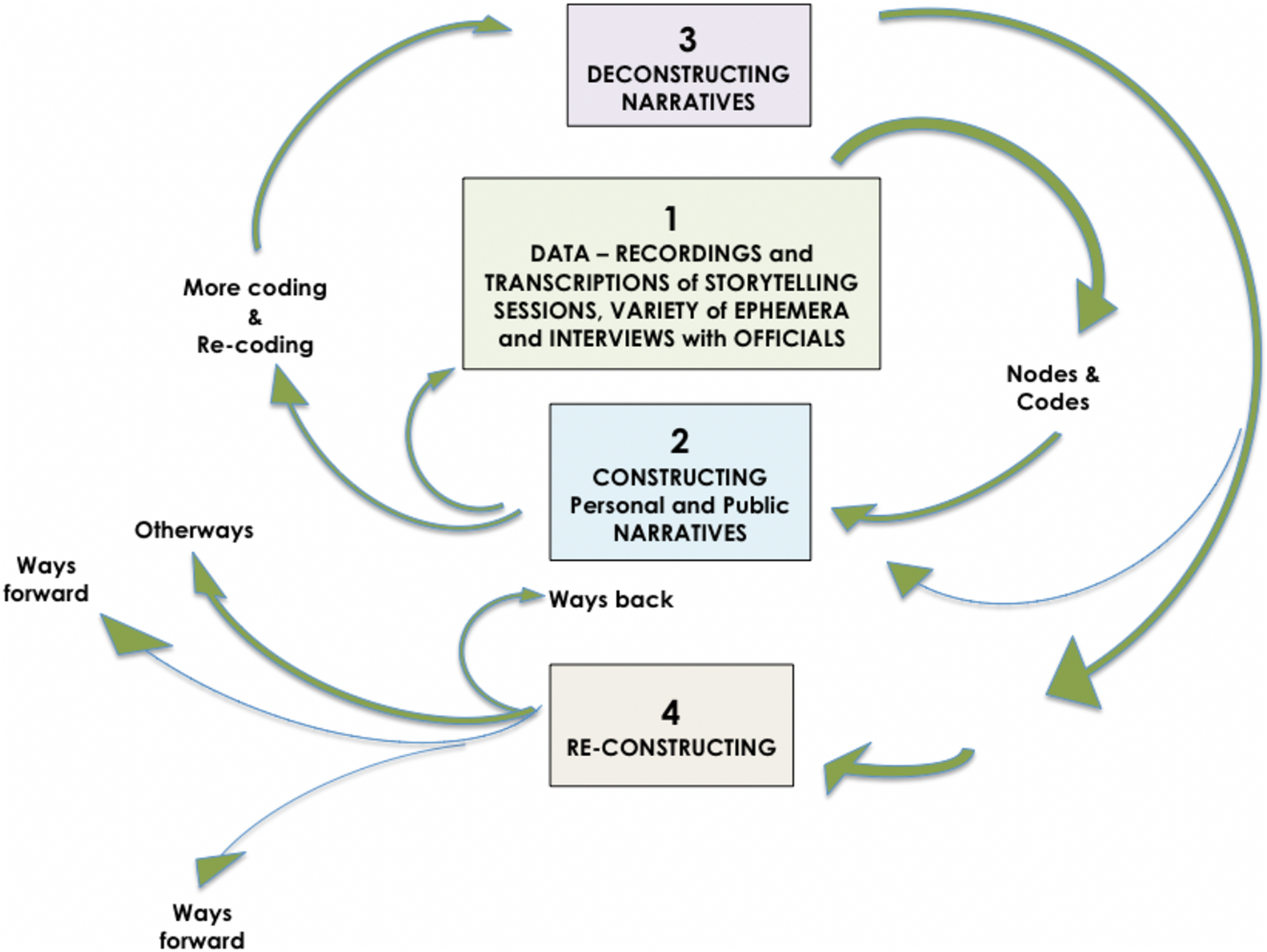
Narrative stages.
Data gathering (Stage 1)
Teacher self-selection
Given the small number of secondary schools in Seychelles, it was possible to send letters to all schools, inviting all geography teachers to share their stories. Teachers who responded were provided with detailed information as to the purpose, parameters, and practicalities of the research, and informed consent was obtained. Face-to-face meetings were then arranged with the 12 geography teachers who agreed to collaborate in the study. Eleven of the 12 were from state schools and 1 was from a private secondary school. Ten of the 12 teachers taught geography up to IGCSE, 1 taught “A” level and 1 taught IGCSE geography in a further education institution. In addition, of the 12 teachers, 8 were Seychellois and 4 were expatriate. The teachers were not treated as a representative sample as this is not a prerequisite for narrative research. Sampling, in the strict, positivist sense, was not necessary. Instead, teachers were chosen for the purpose of understanding their geography curriculum-making experiences and how they made sense of their professional lives as geography teachers (Longhurst, 2003, in Clifford & Valentine, 2003, p.123). As such, teachers self-selected, and their prolonged collaboration indicated a willingness to both share their stories and support the study.
Storytelling sessions
Sharing personal stories can be a challenging experience. Teachers can find it difficult to tell stories that expose faults in professional practice or struggles in the act of teaching (Fowler, 2010). A researcher must acknowledge their role as a “guest in the private space” of their collaborator’s world (Stake, 1995, p. 103). A strict code of ethics, in terms of safeguarding teachers and being respectful of their points of view and opinions, must be followed. Teachers should not feel distressed or dishonored when sharing their experiences. During the sessions with geography teachers, care was taken to ensure their stories did not become too demanding or too tangential, and they were made aware of the ethical boundaries of sharing stories. Freedom to be noncommittal was also ensured and, at their request, teachers were given time to reflect more deeply about their experiences (Webster & Mertova, 2007, p. 86). Teachers who chose to stop sharing their stories felt at ease to do so, without regret or recrimination. This process of building trust and earning respect is paramount in narrative research (Gergen & Gergen, 1988), as it serves as a prerequisite for the privilege of retelling stories on teachers’ behalf (Sharp, 2009). Similarly, the right to recount teachers’ stories would not have been earned if conversations had been conducted without explicit reference to the purpose and persuasion of the study (Samuel, 2009, p. 6).
At the first storytelling session with each of the 12 teachers, broad questions were asked (Chase, 2005, p. 662, in Denzin & Lincoln, 2005), such as “How did you become a geography teacher?” “Critical event” and “sensitizing” questions (what? who? how?) were also asked, along with some theoretical and some practical questions (Webster & Mertova, 2007, p. 87). During the act of sharing stories, the interpretive process began (Riessman, 2008, p. 23). While listening, particularities within a story guided responses and subsequent questioning. Thus, the outsider’s preconceptions came into play and these, in turn, shaped the way the stories were told and received (Riessman, 2008, p. 24). It became apparent that the teachers’ stories were imitations or representations of their experiences, reenacted for the outsider researcher. With no way to provide the researcher with access to the events or experiences that formed part of their stories, teachers presented mimesis or mediated versions of these events (Riessman, 2008, p. 22). Cognizance of this allowed the researcher to unpack some of the multiple voices and subjectivities contained within the stories (Bakhtin, 1981).
Transcription
Transcription transfers complex verbal exchanges (dynamic or “messy” talk) into linear, written forms of representational text and is, thus, a deeply interpretive process (Riessman, 2008, pp. 28–29). The same stretch of talk can be transcribed in many ways, depending on the researcher’s theoretical and methodological approach and purpose (Riessman, 2008, p. 29). In the study, storytelling sessions were conducted in English, although some switching of language was used. Seychellois are English, French, and Creole speakers, and the author’s familiarity with the Creole language, accent, and phraseology meant conversations could take place more fluently. Where inferences were not immediately clear, especially in the use of Creole metaphor, the teacher was asked to clarify meanings. Teachers approved of conversations being audio-recorded and were assured of their anonymity, through the use of pseudonyms, and of sensitive information being included in the final narratives only with their consent.
Each audio recording was transcribed, using NVivo (Version 10), a qualitative data analysis computer program. To provide clarity and make sense of certain passages of conversation, especially when expressions could not be sensibly transcribed verbatim, grammatical and linguistic restructuring was carefully carried out. Methods for involving other data and meaning, such as the storyteller’s intonation, body language, and hesitations, were not employed, meaning the textual representations of teachers’ stories were partial and incomplete (Cole, 2012). Despite this, the substance of each story was preserved. By only capturing the essence of each story, however, the transcriptions remain highly interpretive constructs (Riessman, 2008, p. 28). Furthermore, as cocreator of the transcriptions, the outsider is inextricably entwined in the teachers’ stories (Samuel, 2009, p. 12).
To mitigate the risks of overly distorting the transcriptions or misrepresenting or misappropriating teachers’ stories, each transcript was shared with the original storyteller. This allowed for a collaborative approach to the verification and validation of the final narratives. One teacher requested that a section of a transcription be removed because details were considered too sensitive. During this process of verification, it became clear that teachers could choose to “strategically mimic a different identity” (Samuel, 2009, p. 16) to the one adopted during storytelling sessions. This switching of identity can be problematic, in cases where there is a tendency to “mask the truth” and downplay or overplay certain aspects of experience. The “foregrounding” or “backgrounding” of certain events and opinions could occur in order for teachers to portray a more “negative” or “positive” image of their situation, serving their own agenda or the perceived agenda of the outsider. This mimetic condition is indicative of the “internal dialogue” that teachers engage in, as they share their stories (Samuel, 2009, p. 16).
Data for a “public story”
Publicly available information about geography education, from government plans and policies, curriculum documents, published reports, classroom textbooks, press statements, newsletters, newspaper articles, social media blogs, and websites were collected. Interviews were also conducted with key geography education officials at the Ministry of Education and teacher educators at the University of Seychelles and the Seychelles Institute of Teacher Education. The data gathered from these varied sources were synthesized to form a public narrative. The next section explains the second stage of the narrative inquiry: narrative construction, starting with the personal narratives followed by the construction of the public narrative.
Construction of the personal and public narratives (Stage 2)
To make meaning from the everyday familiarities of teaching, Clandinin and Connelly (1989, p. 14) explain that researchers may need to reappropriate teachers’ stories. The process of reappropriation allows researchers to examine, more forcibly, the phenomena of the study. So, in order to understand how geography curriculum making is interpreted and experienced in Seychelles, teachers’ stories had to be drawn together to create distinct narratives. This analytical process, described below, involved the following iterative activities: coding and identification of themes, thematical framing of each narrative, and reflexive questioning.
Coding and identification of key themes
To construct a set of distinct narratives, teachers’ stories were individually examined to identify critical events and experiences. Using an outsider lens, prior theoretical and epistemological standpoints, embedded in the original research questions, were used to guide a first reading (Braun & Clarke, 2006, p. 84; Owens, 2011). From this preliminary reading, explicit (etic) concepts and experiences were noted. During a second reading, applying an insider lens, guided by teachers’ input and reflection, implicit (emic) knowledge emerged. Both etic and emic data were coded, and a tally of code frequency was kept (see Figure 2, for a sample of the name and frequency of emergent codes).

Sample of emergent codes.
The mechanics of coding were supported by NVivo. Each meaningful element in each transcript was marked as a node and given a label (code). The nodes were then sorted, rearranged, and filtered on the basis of their code name. Using NVivo at the narrative construction stage of the analysis was an illuminating experience. Being able to code and link ideas and events enhanced the search for commonalities and discrepancies in teachers’ stories. Initial and subsequent codes were then compared, amalgamated, relabeled, and reevaluated until eventually key codes signified broader themes or synergies. In short, separate stories were “collected together,” in a systematic and iterative way, so that more insightful and discrete narratives could be created (Clandinin & Connelly, 1989).
In addition to using NVivo, hand-drawn diagrams (see Figures 3 and 4) were created to help sort ideas into more recognizable themes. Drawing diagrams helped to organize thoughts and to play with ways to construct the final narratives. The first hand-drawn diagram explored the relationships between geographical knowledge, teachers, and their educational context, within the broader context of Seychellois students and their parents. The second hand-drawn diagram (Figure 4) located geography teachers, educators, and officials within a “community of practice.” Figure 4 shows a preliminary short list (inner circle) of teachers whose stories would become the final narratives. Surrounding the inner circle are the words GEOGRAPHY and KNOWLEDGE, which acted as two cornerstones during the narrative construction phase.

Teachers, geographical knowledge, and context.

Community of practice.
A digital version of the second hand-drawn diagram was produced (see Figure 5), representing, on the right side of the outer circle, the 12 geography educators who shared their stories (using pseudonyms). The arrows pointing to the inner circle indicate whose original stories were synthesized to produce the final personal narratives of those named in the inner circle. For example, the stories of two geography teachers, Hilda and Elva, were used to construct Marianne’s final narrative. The left side of the outer circle lists key ministry officials and teacher educators who were also interviewed as part of the public narrative.

From personal stories to final narratives.
Thematic framing of narratives
Broader units of analysis (i.e., themes) were developed from the codes (Boyatzis, 1998). Coding with NVivo proved more systematic in nature, but the creative playing with ideas using hand-drawn diagrams proved highly productive in terms of identifying core themes and critical events. These themes and events were then synergized and used to frame each personal narrative (see Figure 6). Passages of text from the source stories were crafted together around each of the broad themes to form each narrative. For example, Simon’s narrative, drawn mainly from the stories of Kristine and Lewis, conveyed a story of geography curriculum and assessment in Seychelles. Each narrative, however, was not limited to its theme. To ensure authenticity, certain events, experiences, and opinions, while not directly related to the specific theme, were also included. Synthesizing individual stories, while affording an extra layer of teacher anonymity in the intensely personal context of small island society, principally allowed for a richer expose of how geography education is interpreted and experienced. The amalgamation process, however, may have denied room for some stories to be told.

Narrative themes.
To safeguard the authenticity and verisimilitude of the final narratives (Webster & Mertova, 2007), further steps were taken during their construction. Careful cross-referencing with the original transcripts formed a fundamental part of the construction process, ensuring that teachers voices were not lost or backgrounded. While time-consuming, the cross-referencing process was considered a rigorous method for validating and corroborating the personal narratives. To illustrate this, extracts from Simon’s narrative, concerning geography curriculum and assessment, are reproduced, below, with references to the source stories of Lewis and Kristine. The notations L1 and K1 refer to Lewis’s and Kristine’s transcripts, where LN109-111, for example, signifies the line number in the respective transcript. I’ve been teaching geography for more than 15 years, first in secondary schools, where I was mainly teaching the IGCSE classes, and now at post-secondary, teaching A’ level. I love teaching geography because it has always fascinated me. Geography is down to earth and all around us and we can see it easily (L1 LN109-111). For example, when I talk about degradation, my students can see it and when I do volcanoes, even if we don’t have any in Seychelles, I can show my students footage of a volcano erupting (L1 LN114-115). With geography there is so much to know about the world so I use many case studies not just the ones from the textbook. That’s what I did with my S5 students and they used to say “Sir, will they (Cambridge) know about this?” and I would reply “it’s not whether Cambridge will know about it, but whether you know what you are writing, if you are writing sense, if you are writing things that are true.” We changed from the Cambridge O level syllabus because it was too restrictive, so fewer students could attempt O level geography. It was not really designed to reach the maximum number of students. The IGCSE programme, at least for geography, is better designed (L1 LN396-399). It tries to balance quantity and quality of students. But even though the IGCSEs are easier, I think the level of education is slowly going down. Students are not performing at IGCSE (EFG2 LN255-256)…I’ve heard teachers are now restricting the number of students they enter for Cambridge, to try to improve the percentage of passes at IGCSE. With less students doing the IGCSE, the results won’t look so bad, so it gives a better impression. Also I know the Cambridge IGCSE is expensive; it costs 1,250 rupees per subject per student, so there is the financial aspect as well. The Ministry is planning to evaluate teachers on their students’ results, so maybe that is another reason why only the best students are being selected to do IGCSE (L1 LN412-418). Simon then shared his experience of teaching A’ level geography… I think the main reason for the poor performance it is to do with the students we select for A’ level. The entry criteria should be a minimum of 4 Cs at IGCSE but after we select students that qualify with this criteria the Ministry tell us we need to lower the criteria to 2 Cs and 2 Ds. You see the ministry are under pressure from parents. The ministry knows parents will appeal the decisions and often students are accepted after the appeal, so some postsecondary schools will even go as low as E and F grades. For A levels I think we shouldn’t go lower than three Cs and a D at IGCSE (K1 LN152-161). Since the criteria was lowered we’ve had a big rise in the number of students doing A’ level geography. A few years ago there would be about 40 students and they would all have at least a C at IGCSE but now we have about 60 students and only about 30 of them have a C grade or above (K1 LN164-174). We’ve not had any direct contact with Cambridge although recently some people from Cambridge came to train the A’ level English and science teachers. We asked about training for geography but we were told that due to financial constraints it was not possible at the moment. My colleagues tell me they’ve not had any training in geography A’ level for the 11 years they’ve been teaching! (K1 LN56-61).
Constructing a public narrative
A second NVivo database was created to store and process the interview data collected from Ministry officials, as well as education policies, curriculum documents, and newspaper articles related to geography education in Seychelles. Dividing the public, “declared” data set from teachers’ personal narratives allowed each to be treated as a distinct entity. Once critical events were identified during the coding of public documents and interview transcripts, the process of constructing a public narrative became possible. One critical event that emerged, for example, was the switching from Cambridge “O” level to IGCSE Geography in 2005. In order to form a more coherent public account, the themes used for framing the personal narratives were used to construct a public narrative. An extract from the public narrative, related to the theme of geography curriculum and assessment, is presented, below: …recognition of the decreasing popularity of social science and stagnating exam performances, prompted the Ministry not only to launch the Social Science Fair but to also convene a “Social Science Teacher’s Club.” The Today newspaper attended the launch of the Fair and the inauguration of the Club, commenting that: Officials say that the decrease in enrollment (sic) for IGCSE in the public school system have been quite alarming, with only 117 students out of a population of 1160 taking History…In contrast, larger numbers…are sitting for Geography but the grades range mostly between D and G. The subjects’ unpopularity is believed to be due to factors such as teaching or learning techniques and the lack of promotion of these subjects outside the classroom. (Today, June 23, 2014) The newspaper goes on to quote Dr Odile De Commarmond, Director General of CCATS, who said that “the public at large is questioning the knowledge base of our youth on the history and geography of Seychelles” while the newspaper also quoted Dr Dorothy Felix, Senior Policy Analyst and geography specialist, who stressed that “the Fair will promote the subjects and bring together the teachers, as well as develop students’ knowledge and skills through investigations, research work and interpretation of data” (Today, June 23, 2014).
Reflexive and ethical questioning
While a public narrative was produced from “official” sources of data, representing traditional sources of knowledge about geography education, it must be acknowledged that any narrative, whether public or personal, is contingent on the powers of storytelling. These powers include the acts of remembering and forgetting, neglecting and amplifying, or even distorting information and past experiences (Riessman, 2008, p. 29). In the context of the study, these powers resided not only with the collaborating teachers, education officials, and the researcher but also within published documents and artifacts. The combined capacity of these to influence the telling and writing of stories raises issues about the authenticity of the narratives. To mitigate these concerns, the researcher was deeply reflexive during each stage of the narrative inquiry (Mishler, 1986). There was a constant questioning of the research agenda and the framing of teachers’ stories (Squire, 2008), as well as the positioning of the researcher as both “insider” and “outsider” (Smith, 1999, p. 137). Ethical concerns about the possibility of being too immersed in the lives and community of the collaborators (Hammersley & Atkinson, 2007, p. 16) were also considered. The following examples illustrate the types of reflexive questioning that took place during the storytelling stage: What were teachers’ motives for sharing their stories? Were teachers denied space to tell their stories if they felt these did not match the research agenda? Were all collaborators treated equally? Were questions framed in ways that extracted stories the researcher wanted to hear? Was discussion of certain topics foreclosed if judged to be irrelevant, too sensitive, or too personal?
An awareness of being a “guest in the private space” (Stake, 1995, p. 103) of teacher’s required the researcher to honor the principle of respecting all points of view and opinion. Earning the respect and gaining the trust of collaborators is a prerequisite for attaining the right to retell stories on the collaborator’s behalf (Sharp, 2009). The re-storying process not only allowed for the deeper analysis of how geography curriculum making is interpreted and experienced in Seychelles but also served to protect individual teacher’s identities. Given the intimacy of professional relationships and the concentrations of power in small island communities, measures had to be taken to avoid any repercussions for those participating in the study. Being consciously reflexive of these circumstances lowered the risk of breaching teachers’ trust. Through a reflexive approach, therefore, the chances of “bad faith” narratives (Craib, 2004, p. 64–67) were reduced, while opportunities for understanding both the teachers and the researchers’ working knowledge of themselves was enhanced (Atkinson, 1998, p. 1).
Narrative deconstruction (Stage 3)
During construction, a formative layer of interpretation and theorization helped create the distinct narratives. Within this period, a priori categories of meaning, from a preemptive, “outsider” perspective (Samuel, 2009, p. 12) were applied, followed by “insider” meanings, coming from the teachers’ stories themselves. These deliberate meanings, containing intrinsic subtleties, contradictions, and prejudices, both within and between teacher’s stories of geography education, provided the dynamism needed to produce each narrative (Smith, 2005, p. 3). A subsequent phase of narrative deconstruction added a deeper layer of interpretation and theorization. Closely associated with the French philosopher Jacques Derrida (1930–2004), deconstruction is an analytical maneuver for exposing and challenging the conceptual rigidity and hegemony of “the single story”(Barnett, 2009, p. 147). By assuming that meanings and knowledge are not fixed or stable, deconstruction attempts to show that meaning is conditional and contextual, revealing multiple realities (Hammersley & Atkinson, 2007, p. 12).
Derrida (1998) regarded narratives not simply as neutral texts that have structure but as modes of thought that are agentive and political (Bruner, 1997). Narratives legitimize meaning because narratives rely on institutionalized sets of meaning, which, in turn, marginalize “other” meanings (Shapiro, 2009, p. 321). In the study, the deconstructive analysis explored what was going on, in terms of meaning, beneath the personal and public narratives (Winter, 2013, pp. 184–185). So, while an initial outsider and then insider lens was used to generate narratives from participants’ intended meanings, a second outsider lens was used to go beyond these meanings and explore what the narratives had omitted, excluded, marginalized, or ignored (Winter, 2013, pp. 184–185). This interplay of both “outsider” and “insider” analyses can be described as a “negotiated” analytical approach to narrative inquiry (Samuel, 2009, p. 13; as illustrated in Figure 7).

Interplay of outsider/insider analyses. Source. Samuel (2009, p. 13).
The use of a second outsider lens, during the deconstruction phase of analysis, helped to link the narratives to theories and broader discourses that shape education in Seychelles (Riessman, 2008, p. 189). To do this, the deconstructive analysis unpacked the personal and public narratives using the dimensions of temporality, sociality, and place (Connelly & Clandinin, 2006, pp. 479–480). The temporality dimension linked the geography education narratives to Seychelles’ colonial and postcolonial past and helped uncover how geography teachers located themselves within their present and future. The authority and power held by the Ministry of Education proved to be a definitive aspect of teachers’ lives. While mature geography teachers, trained during a period of postcolonial nation building, expressed a sense of resilience and resourcefulness, younger teachers tended to feel powerless and resentful. They saw little prospect of gaining control of the curriculum and were not able to predict the future nature of either the geography curriculum or assessment. This lack of power seemed to limit geography teachers’ ability to evaluate their own positions and contributions to geography education.
“Place” and “sociality” provided two further dimensions for deconstruction. When examined, the personal narratives revealed a complex and sometimes troubling notion of Créolité being played out in geography classrooms, where opportunities for students to explore, question, and problematize the notion of Créolité were denied. The essentialization of Creole identity, through the denial of “other” interpretations, increased the sense of “parochialism,” where geography students showed little interest in learning about other cultures and places. Perversely, the narratives also revealed a deep level of frustration with a curriculum that provided almost no opportunity to discuss local human geography issues. Instead, teachers used case studies of controversial issues from elsewhere, which may partly explain why students tended to prefer physical geography topics, especially if these included local fieldwork.
Narrative reconstruction (Stage 4)
The juxtapositioning of narratives with broader social, cultural, and historical events moved the deconstructive analysis beyond the immediate spaces of geography teachers’ lives. The final phase of reconstruction created space for the reimagining of practice through a future-orientated lens (Tamboukou, 2012, p. 2). This refocusing opened up possibilities for improving geography teaching and learning (Fowler, 2010). For example, while many teachers felt excluded from geography curriculum conversations, a few were keen to engage in “subversive” dialogue in order to challenge the curriculum status quo and develop a greater sense of professional self-worth. This small group of resilient geography teachers were willing to try new ideas and challenge established practices. One area where this was demonstrated was through the sharing of fieldwork and coursework experiences. The group explored ways to move beyond “instrumentalist” geography fieldwork, conducted solely to meet international exam expectations, to rather view fieldwork and geography enquiry as an embedded practice across the Seychelles geography curriculum. This shifting understanding of the deeper importance of fieldwork was achieved as part of an “unconventional” teacher training activity, where geography teachers from both private and state schools worked collaboratively.
Conclusion
The analytic processes of narrative construction, deconstruction, and reconstruction revealed many of the intrinsic and extrinsic forces shaping geography education in the Seychelles. Whiles Seychelles’ education system earns international legitimacy by being part of England’s supranational “educational space,” educational ownership and governance is undermined. Through the use of narrative inquiry, the complexities of geography curriculum ownership and control were explored. A wide collection of teachers’ stories was synthesized into a smaller number of cogent personal narratives, while publicly declared data sources were amalgamated to form a distinct public narrative. During narrative construction, an outsider lens was used (an “emic eye”), then an insider lens (an “etic eye”). This constituted a “negotiated” (Samuel, 2009, p. 13) or an “in-between” (Chilisa, 2012, p. 25) analysis. A second “outsider” lens was employed during the processes of deconstruction and reconstruction. While the layering and unlayering of different meaning-making processes proved challenging, the narrative inquiry offered a profound way to analyze teachers’ stories and to make the personal political. By bringing both public and personal narratives into dialogue, the research provides testimony to the richness, complexity, and rigor of narrative inquiry.
Footnotes
Acknowledgments
I thank Professor Michael Samuel, Guyanne Sinon, and the peer reviewers for their valuable comments on preliminary drafts of this article.
Declaration of Conflicting Interests
The author(s) declared no potential conflicts of interest with respect to the research, authorship, and/or publication of this article.
Funding
The author(s) received no financial support for the research, authorship, and/or publication of this article.
