




Abstract
This paper echoes the worldview of post-qualitative study and aims to demonstrate an alternative way of doing transcription that addresses the rhizomatic feature of language. Conventional qualitative study based its foundation on representationalism which believes the transcript replicates the observed phenomena so that researchers can uncover the truth hidden under the transcript. However, post-qualitative studies on transcripts criticize the representationalist assumption as it fails to address the constantly changing nature of things. With the influence of French philosopher Deleuze and Guattari’s concept of the rhizome, post-qualitative studies use rhizoanalysis to highlight the connection and becoming of the phenomen. However, most of the rhizoanalysis on transcripts only engages with the changing nature of the content of things but not that of language. To understand how rhizomatic language can be addressed in a transcript, this study engages with a 7-s speech of an undergraduate student in a CLIL/EMI program in Japan and aims to address the potential in her language that precipitates the becoming of the language in the transcript. With this rhizomatic approach in transcription, this paper demonstrates the possibility of freeing language from normative constraints and open transcriptions and languages to be actualized into multiple forms that yet-to-come.
“In truth, signifiance and interpretosis are the two diseases of the earth or the skin, in other words, humankind’s fundamental neurosis.” Deleuze and Guattari (1987, p.114)
Introduction: From Representation to Postqualitative
Transcription has been prevalently used in qualitative studies, especially those with interview approaches, for being as “a power act of representation” (Oliver et al., 2005, p. 1273). The debate on transcription, thus, is heavily built on this representationalist base without question. For example, the early debate between naturalized transcript, which transforms the spoken linguistic form into a written language, and denaturalized transcription, which keeps the spoken linguistic form to represent the oral origins (Bucholtz, 2000), concerns how much the transcript should represent the phenomen rather than whether the transcript could represent it. The pursuit of representationalism is also illustrated in the studies that highlight the nonverbal elements in the transcription. Transcripts that demonstrate contextual descriptions, actions (Denham & Onwuegbuzie, 2013) and images (Norris, 2002) aim at maximizing the replication of the observed phenomena with these elements. The representational function of the transcript is left unquestioned as the necessary foundation to enable the researcher’s interpretation of the phenomenon that it claims to represent. The debate on the researcher’s interpretation of the transcript is oriented toward the critique of objectivity. While Bucholtz (2000) questioned the objectivity of the transcription and the politicality of factors that influence the transcriber, researcher’s reflexivity and positionality started to be emphasized in qualitative studies including their awareness of factors such as social standards, beliefs and practices that influence researchers’ interpretation (Widodo, 2014). This framing of transcription still roots itself in the idea of representationalism because it assumes the exact phenomena beyond linguistic forms can be recorded into the linguistic forms that are transcribed as data, which serves the purpose of researchers’ interpretation.
This belief in representationalism and interpretation is the disease according to Deleuze and Guattari (1987) as it assumes the staticity of phenomena that is able to detach itself from the changing world rather than the flux of phenomena that addresses the relational features. In his famous quote, “No man ever steps in the same river twice, for it’s not the same river and he’s not the same man”, the Greek philosopher Heraclitus (cited in Portugali, 2021, p. 13) addresses the constant changing nature of the phenomena and the subject who engages with the phenomena. Representationalism, thus, reduces the changing phenomena into sets of fixed linguistic forms by claiming the linguistic system “represents” the phenomena (MacLure, 2013). It also downplays the role of materiality of the phenomena by hiding it behind linguistic systems and making it inaccessible (Hekman, 2010). The belief in representationalism and interpretation, thus, is like taking a photo of a flowing river from the point of the bank and starting to establish discourses about the photo as if the photo is the river itself, regardless that the river already flows into a different one after the photo is taken.
This belief can date back to the belief in the image of a rational thinking subject (Masny, 2016) that was constructed during the Enlightenment era. Originating from the Protestant Reformation where individuals are empowered as independent subjects who use their raison to directly connect with God, this image of a rational thinking subject constitutes the foundation of nature science where nature is framed as the object under the control of human beings (Horkheimer & Adorno, 2002). In a similar fashion, to believe the transcript represents the exact same phenomena that are not changing is to justify that researchers could uncover the meaning under this static transcript. It is to reduce the complicated reality to an object of human ration and put it under the control of rational human subjects via sets of linguistic systems. Thus, the critique of representationalism and interpretation is to ask how can researcher engage with the constantly changing nature of things; what are alternative ways of engagement other than descriptions and coding; and what can researchers do if they do not interpret the transcript?
With a critical stance on representationalism and interpretation, a group of researchers (e.g., Bodén & Gunnarsson, 2021; Masny, 2013; Pierre, 2021) call for post-qualitative research as an alternative research method that goes beyond the conventional humanist idea of research and embraces the indeterminate flux of being, namely, the becoming of things. According to Pierre (2021), a post-qualitative inquiry “has no pre-existing research designs, methods, processes, procedures, or practices because it is not a methodology at all…but, rather, with the onto-epistemological arrangement and concepts of poststructuralism and its descriptions of key philosophical concepts such as ontology, epistemology, human being, rationality, truth, discourse, language, freedom, and so on (p. 163).” Following this logic, a group of postqualitative study aim at bringing a new ontology of subject decentered, which shifts away from the dominant image of human beings as rational thinking subjects, and becoming, which acknowledges the constantly changing nature of phenomena, into data transcript. Harrison (2022) presents the contextualized transcript with data in its raw form rather than as the cut pieces. With the idea of “becoming with data”, Harrison (2022) privileges the synthesis of transcript and theory without any interpretation or analysis from the researcher. The transcript, thus, is regarded as resources that join the researcher in the process of thinking rather than the object that passively waits for researchers to uncover what is hidden in it (Taguchi, 2012). Hofsess and Sonenberg (2013), in a similar fashion, connect words in transcripts with theories where the researchers play with the transcript rather than interpret it. Presenting the visual flow of data/words, Hofsess and Sonenberg (2013) welcome any novel connections and expressions that emerge from the data. Masny (2013) further applies the virtual aspects of the rhizome to data presentation in research. Rather than seeking a representation of the phenomena through data, Masny (2013) focuses on the potential of the data - what data has yet to present. Masny (2013) asks in the research, “What could happen next?” (p. 341), to sparkle any possible becoming that yet-to-come. All these research shifts away from interpreting the data and embraces the connecting and changing nature of the phenomena. As such, postqualitative research embraces the constantly changing, unknown and unanticipated nature of things, which allows researchers to open to not-yet-thought creativity in engaging with the world (Benozzo, 2021).
Despite all the attempts, most of the research only addresses the changing nature of the phenomenon while leaving the changing nature of language – the expression of the phenomenon – underexplored. This changing nature of the expression is mentioned by Deleuze (1990) where he illustrates the constant disquibrillance between signified and signifier as becoming. In this paper, I will first explain the theoretical frameworks that this study is based on, including the idea of rhizome, which is the onto-epistemological concept for most postqualitative research on transcription, and the concept of potentiality, which explains the changing nature of the phenomena and the language. With these theoretical frameworks, I will then illustrate a rhizomatic transcript that highlights the rhizomatic feature of language itself of 7-s speaking of a student whose first language is Japanese in an EMI class in Japan. With this new approach on transcript highlighting language, I will present how this approach resonates with the onto-epistemological stance with most of the postqualitative research on the transcription while expanding the postqualitative onto-epistemological stance to the aspect of language. I’ll end this paper with how this approach opens more possibilities for new creation of language and things and how it leaves challenges for further application.
Theoretical Framework: Rhizome and the Potential in Becoming
The onto-epistemology of becoming that most postqualitative research hinge on can be dated back to French philosophers Deleuze and Guattari’s concept of rhizome. According to Deleuze and Guattari (1987), the rhizome is a worldview that regards things as composed of directions in motion, which is different from the idea of a tree that regards things as starting from a root and thus looks for the root that things can be reduced to. Different from the worldview of a tree, the rhizome is constantly moving lines that have no beginning or end. It is different from a network where points connect the lines. Lines in the rhizome are constantly moving where they would disrupt and be disrupted by other lines, but they do not stop at the points. Lines in the rhizome pass through the points and continue moving forward into multiplicated directions where they connect with other lines. When lines connect and disconnect with other lines, it is formed (or deformed) by the connections and grows into various forms.
According to Deleuze and Guattari (1987), the rhizome is an “acentered, nonhierarchical, nonsignifying system (p. 21)”. It is nonsignifying in the sense that the rhizome addresses the becoming – the constantly changing and multiplicated moving nature of both the content of the things (the materiality of the phenomenon) and the expressions of the things (the linguistic system that is attached to the phenomenon). It, thus, invalidates representationalism as it assumes nothing fixed under the rhizome to be uncovered. In other words, the world view of rhizome does not ask “What it is” but rather “What it does”. The effects are the fundamental concern of the rhizome. Moreover, the rhizome is also nonhierarchical as it does not have any vertical relations among the lines. Lines are all connected to each other which disturbs the force to form any independent entity with a fixed boundary, the consequence of which destabilizes the foundation of establishing hierarchy. In this sense, the onto-epistemological view of rhizome facilitates decentering humans as the dominating things such as transcriptions and invalidates the interpretation of human beings. In addition, it is acentered because it does not grow from a certain root. Lines in the rhizome connect and pass other lines that head to various directions, which is termed as multiplicity by Deleuze and Guattari (1987). This multiplicity addresses the non-linear, non-single direction of things that heading in various directions that cannot be pre-determinate.
This multiplicated changing nature is best illustrated through the virtual aspect, or the potential, which is a status that is yet to be actualized. It is because of the existence of things that are not actualized that things are able to change and change in various directions that are nonpredictable. This point is illustrated by Italian philosopher Giorgio Agamben who pointed out the significance of understanding potentiality as detached from actualization (Attell, 2009). While the actualization - what things are – stays as the focus in the philosophical tradition, Agamben (1999) emphasizes the indispensable existence of potentiality in nature when analyzing Aristotle’s work on dynamis (potential) and energeia (actualization). For instance, Agamben (1999) interprets Aristotle’s idea of vision as a sensation of both lights – with the presence of the colours - and darkness – with the absence of the colour. The fact that human beings see no colour in the darkness does not mean their ability to see colours disappears and they cannot see colours. Rather, the human being’s ability to see colours is suspended, which in the case of light can be actualized. In other words, while the actualization turns out to be the focus of attention such as the ability to see, it is significant to acknowledge that the potentiality such as the ability to see the darkness always already exists at the same time. In this sense, this potential is prior to the spatio-temporal state of affairs through which it might or might not actualized (MacLure, 2013). In other words, the state of affairs where the potential encounters would lead to its actualization into various unpredictable forms, which address the becoming of things.
While this potential should not be reduced into actualization because it always already exists, the potential should not be understood as an outside cause that leads to the change of things, but as an element that precipitates the becoming that is contained in the things themselves. The potential inside things is best illustrated in quantum physics theories which question the certainty of the existence of the observed object. Before quantum physics, the physical condition of things such as their position and momentum was regarded as existing independently without influence from the observers and the apparatuses that used to observe them (Barad, 2007). However, quantum physicians such as Schrodinger show the position of particles – the micro-level objects – is presented in an indeterminist way as the probability of density (Barad, 2007). In other words, the position of an observed object is caught by human vision as a probability shown in that position with also the probability of being shown in other positions. The present in a position in a specific time-space is not a fixed present but a high probability of present while the probability of present in other positions is also possible but low. In other words, in quantum mechanics, the physical existence of an object does not lay on a fixed position but rather on a spectrum that consists of different degrees of probabilities. The high probability of one position of existence does not negate the probability of the other position of existence. This potential – the probability of existence in other positions – is regarded as a physical reality that constitutes subsequentially novel facts (Epperson, 2004). The potentiality, when interacting with the measurement apparatuses, goes through the passage to the actualization, which is the outcome that can be observed at the end of the measurement (Epperson, 2004). As such, the present that is captured by human vision in one position does not deny the potential in it where the presence can be actualized in other positions. In other words, the potential is contained in the things despite their actualization and might (or might not) be actualized through unpredictable situations that precipitate the constant becoming of things.
With this onto-epistemology on becoming, which addresses the constantly changing nature of things that are precipitated by potential, Masny (2013) coins the term rhizoanalysis in postqualitative studies to address the becoming in the observed phenomena that are nonsignifying, acentered and nonhierarchical. It thus shifts away from representationalism which pursues a correct form of interpretation and connects the research itself to the constantly changing phenomena (Baugh, 2005) to ask what it produces and how it functions (Masny, 2013). As such, rhizoanalysis aims at deterritorializing methodology as a research event that proposes new directions of thinking and new directions of questioning (Leander & Rowe, 2006). It positions itself not as a method that has a pre-decided way of conducting research (Masny, 2016) but addresses what is yet to emerge (Sellers, 2015). Against this background, a group of postqualitative studies illustrate the possible yet-to-come events. For instance, Leander and Rowe (2006) emphasize the unpredictable movements of text that emerge and yet-to-emerge throughout and beyond the literacy performance; Svenlin and Jusslin (2023), resonate with MacLure (2013), open to witness how their data glow throughout and beyond the process of collaborative writing; Masny (2013) highlights the virtual-actual interactions in data palpation.
However, the becoming that most of the postqualitative studies address only focus on the content of things while the becoming of the expression of the things is left underexplored. In other words, despite the potential of the content of things demonstrated, all the potentials are reduced to a form of language that matches with the linguistic norms of pre-established languages (such as the English language or the Japanese language) that seem to have determinate meaning associated with the linguistic forms. For example, Leander and Rowe (2006) illustrates the becoming of students’ texts in terms of how they rhizomatically connected with other texts that appeared in different moments before and after the texts and how this rhizomatic connection offers the possibility of different forms of “buy”. Yet, despite the attempt to break the sequential relations among the texts, the transcription that appears in the study still consists of pre-established linguistic forms with fixed linguistic rules of normative languages. In other words, the becoming of linguistic forms themselves and the potentials precipitate this becoming is underexplored.
The potential in the language, including the potential in both linguistic forms and meanings, plays an essential role in the becoming of things. As Massumi (2002) mentioned, “Expression is abroad in the world – where the potential is for what may become” (pp. xxi.). When Jackson and Mazzei (2022) emphasize the significance of sensing the potential of unthought, they highlight the necessity of a novel form of expression because writing functions as worlding - expressions constitute the world through the form of language and the content of the language. This expression, which appears as languages that constitute things as a part of them, shares its rhizomatic feature which contains the potential that precipitates the becoming of things. Language has been regarded as in a fixed relationship between signifier and signified for a long time where one signifier, such as one word, is regarded to have a fixed relationship with one or multiple images that it refers to. However, language does not stay as fixed as its potential precipitates it into various motions. In his book Logic of Sense, Deleuze (1990) use example such as “something”, “aliquid” or “it” to show the disequilibrium between signifier and signified. For instance, the content of “it” can shift into unpredictable things without the constraints of the linguistic form “it”. This disequilibrium does not only exist in pronouns but also in proper nouns from a phenomenological perspective. Merleau-Ponty et al. (2013) illustrates how meaning extends and is open to extension through perceptual experiences (Howell, 2015). For instance, the apple I saw on the desk today would reconstitute and extend the idea of the word “apple” in my mind together with surrounding elements. When I use the word “apple” the next time, it no longer has the exact same meaning as before. Aligning with this logic, Deleuze (1990) illustrate the “floating signifier”, which refers to signifiers that do not fix to a signified (such as the word “it”) and also signifiers that do not yet match with any signified, and the “floated signified”, which refer to a new form of content that is yet to match with any signifier and thus “without being thereby known” (p. 52). This yet-to-match between signifier and signified constitutes the virtual parts of language, which is the place nonsense occurs (Smith, 2022) as it is the words or contents that are yet unknown to pre-existing languages. This nonsense is in a dynamic moving process with the genesis of sense. While the potential of expressions and contents start to be actualized in various directions, expressions start to address themselves as it is separated from the content. This thus opens the possibility for the sense to emerge when the actualized expression matches with the actualized contents (May, 2005). Since the potential of both contents and expressions keep being actualized (or stay as potential without actualization) in various directions, the nonsense would occur again due to the discrepancy. As such, the potential in expression contributes to the rhizomatic change of the language, which precipitates the co-emerge and co-transformation of the language itself and the world it is worlding.
However, the potential in language, especially in the linguistic forms, is rarely illustrated in the practice of transcription even with the research that attempts to break the norms of established languages. The research on translanguaging, which attempts to address the boundarylessness among languages, still ends up transcribing data with linguistic forms that can be reduced into established languages despite containing more than one language (c.f Duarte, 2020). The multimodality trend in linguistic research also adds meaning-making elements such as gestures, images or pauses in the transcription (c.f. Tai & Li, 2021). Yet, these transcriptions did not address the becoming of either language or contents, which leads back to the representational expectation of the transcription that serves the function of researchers to interpret. The research that addresses the becoming of the language still focuses on the meaning of language instead of the becoming of linguistic forms. For example, when Masny (2013) illustrates the assemblage of the French language and English language, the researcher and the father actualize the French sentence “Je t’aime” and English sentence “I love you” that the participant uttered, the potential of the linguistic forms themselves is left unaddressed. In other words, the transcription in the study does not address the potential of the participant uttering language that does not match with normative French Je t’aime” or normative English “I love you”. How about the possibility of the participant uttering “Je d’aime”, “Ge t’aime” or “I love whou”? How about the possible meaning these potential linguistic forms open the language to?
Echoing philosophers such as Massumi, Manning, Deleuze and Guattari, Jackson and Mazzei (2022) call for the activation of expression-to-come. The expression-to-come is what leads to a new worlding. This expression-to-come, however, does not come from nothing (Massumi, 2002). This new language is always in the process of becoming itself and thus exists in a trace (Barad, 2007) that is related to the established languages. Following this logic, I aim to play with the transcript to think how might the transcript be different from the humanist research (Hofsess & Sonenberg, 2013) that not only engage with the potential of contents but also the potential of language, including the potential in both the meaning and the linguistic forms. How might we address the becoming of language itself that can bring a new way of worlding? How might we imagine language differently to free it from the restraint of the established languages that frame language as with fixed boundaries?
The Scene
With these questions in mind, I circulated classroom observation recruitment to my colleagues, one of whom introduced me to a professor, Mike, who was teaching a CLIL/EMI course on English language teaching pedagogy in a post-secondary educational institution in Japan. With Mike’s consent, I attended the first week of his course and explained the purpose of the visit and the general information of my research for 5 min at the beginning of the class. I mentioned that a consent form with details on this research and their will on class observation, voice and video recording would be distributed and students could return the consent form at the end of the class or the next class. Mike and I emphasized that whether they agree to participate in my research would not influence their grades since I am not working in the department and Mike would not have access to their consent forms. Due to absences and late return of consent forms, video and voice recordings were not taken until the 4th week after I received consent from all students. For recording, I placed two video cameras in the front of the classroom for each class and I also placed 3 IC recordings at random tables during students’ discussions. With the understanding of the student’s right to prioritize learning in the classes, I refrained from disturbing any students’ discussion in the classes and focused on taking field notes as an observer. The field notes record the arrangement of the classroom including the sitting plan and the places of IC recordings. The process of the class and the actions of students were also recorded. I especially focused on noting down students who shifting their languages. At the end of the semester, I distributed a recruitment for interviews and three students agreed to have an online interview with me in addition to Mike.
This class was conducted in English by Mike who was born in Canada and came to Japan twenty years ago. There were 15 students in the class, the majority of the student body was from domestic Japan who use Japanese as their first language. Translanguaging occurs the most of time in this course. Mike positioned this class as a course between CLIL and EMI, as a result of which, he did not restrict the language usage of his students to a single named language. On the contrary, he encouraged students to use various technologies to help them understand their textbook about English teaching pedagogy that is written entirely in English. Mike even spent one class for students to try out ChatGPT when it became a hot issue in the educational field. Since Mike was capable of basic daily live conversation in Japanese, he sometimes used brief Japanese phrases in his conversation with students. As students all understand the course is about English teaching pedagogy rather than learning the English language itself, most of the students comfortably used Japanese or constantly switched between English and Japanese in addition to gestures in their conversation.
With a special interest in the rhizomatic feature of language, I will present the language of Zoe, one of the students, in a conversation during the class discussion. I will start with Zoe’s linguistic trajectory and her understanding of language that she shared with me during the interview at the end of the semester. I will then present the context where Zoe’s language took place. With these explained, I will demonstrate a 7-s transcription of Zoe’s speech. The transcription does not aim at representing a decontextualized language but a language with potential that connects to other elements including me as a researcher with my own life trajectory and my research concern, the context of the course based on my field note and the life trajectory the Zoe mentioned in her interview. The purpose of illustrating Zoe’s language is neither to propose a “correct” way of doing the transcript nor to argue the transcript represents what Zoe’s language is. Instead, the transcript illustrated below is an attempt to illustrate the potential in the language and inquire about our thoughts on the transcription and language, casting the question: how could we think about language differently?
Zoe was a student who participated actively in the class in the sense that she would respond to Mike’s questions in the class even when nobody else did. In the interview with Zoe at the end of the semester, she mentioned her interest in communicating with people around the world. Zoe’s grandfather was from the Philippines and Zoe herself was born and raised in the Philippines until the age of 7. Her family moved to Japan after she turned 7 years old and built their own family business in Japan. Zoe recalled the communication she had with people from various backgrounds, such as the Philippines and Vietnamese, who worked for her family business. Zoe mentioned that she used English in most of the situations when communicating with people from various backgrounds and this type of cultural communication is something she enjoyed. She also developed this desire to communicate with people all over the world and was planning to do working holidays to achieve this goal.
For this class she took with Mike, Zoe mentioned that it was common to use various linguist resources in this class as Mike made it very clear at the beginning of the semester that all kinds of language usage are allowed in this class. For her usage of the English language, Zoe claimed that it would be better for her to talk to Mike in English since Mike might not be able to understand conversations in Japanese. For her Japanese language usage, Zoe mentioned that she felt the need to translate the sentences in her textbook about English teaching pedagogy into Japanese language to facilitate her understanding. When I pointed out in the interview that Zoe seems to utilize various linguistic forms and mix them together, she replied that this way of using language is more efficient for communication.
The Rhizomatic Transcription of Zoe’s Language
To engage deeply with Zoe’s language, the transcription captures a 7-s language occurrence of Zoe in one discussion she had with her friends. This discussion occurs in a class which was designed with a 30-min review of key concepts with a lecture by Mike, and a 30-min self-review session for students to discuss with each other for the 30-min mid-term exam that followed the discussion. The use of both Japanese and English language caught my ears throughout the discussion session. This is worth noting that this transcription of Zoe’s 7-s speech aims at addressing the rhizomatic feature of language, which includes the potential and its connection to other events that precipitate the constant change. In this sense, the transcript of Zoe’s 7-s speech is a changing line connected to the context of the classroom and the discussion that is described based on my field note; it is also connected to Zoe’s narrations about her linguistic trajectory that she mentioned in the interview; it is also connected to my linguistic trajectory and my research interest since I also act as a force to precipitate Zoe’s language into various directions as a researcher who obverse and transcript the language.
The voice and camera record presented that Zoe started a conversation with her classmates Helen and Irene about an activity they encountered in an English language class when all the students were spending time reviewing the key concepts concerning English teaching pedagogy in their textbook. Zoe was explaining this activity to Irene where students were asked to listen to what other groups present and elaborate the content into a more complicated version to present themselves. Zoe applied English, and Japanese, facial expressions and gestures to restate what they were required for the activity. Helen was adding how this activity caused her stress while Mike walked pass through their group trying to help different groups of students with their lesson review. When Zoe and Helen noticed Mike was beside them while they were complaining about the stress the activity caused for them, they all laughed. Mike tried to tie the idea of stress back to the activity design of English language teaching pedagogy and Helen applied the English language to explain the difficulty of this activity to Mike while Zoe tried to add the positive side of this activity. All three students were laughing as Zoe applied all her linguistic resources to talk to Mike and Mike confirmed his understanding by repeating what Zoe said in English. Mike ended the conversation by linking this activity back to Vygotsky’s concept of Zone of Proximal Development (ZPD) before he moved to other groups and the discussion topic swift to the contents in their textbook.
I was sitting in front of my laptop with the recording and video open which shows this process to me. After my class observation of the whole semester’s classes and my constant research interest in the rhizomatic feature of language, I tried to engage with Zoe’s language through a transcript in Figure 1 that constitutes Zoe who was trying to explain to Mike the positive aspect of the activity that she and Helen were talking about. “バット(but)” she said, with the potential word “but” in the English language that she might have in her mind. She looked at Helen, who explained the activity was challenging for her to Mike in English just before Zoe started to speak, and Zoe continued, “こう(this way)”. Zoe then moved her hands back and forth - or probably just slightly shook her hand in front of her chest. She uttered the word that presented itself as “エクスチェンジ(exchange)” to my ears, with the potential of the English word “exchange” that Zoe might have in her mind. Helen stepped in and said “product”, which might refer to the presentation in the class activity they needed to deliver as a group, with her hands moving forward trying to express giving out things. This word arouses Zoe’s speaking of “yeah product” while she shifts her sight from Helen to Mike and utters “その (well)”. Mike moved his left hand to the right side and his right hand to the left side to indicate “exchange”. At the same time, Zoe continued to say “thinking, different thinking” with a very short pause between the words, which might contain the Japanese word シンキング(thinking)” that could have been uttered. Mike nodded his head, and Zoe continued “グループごとで(in groups)”. She finished her words with a laugh and her hands covered her mouth. While her eyes shifted to Irene, she said “そう、色々なグループのものを吸収できた (yeah, we were able to learn from different groups)”. All three students then turned their sight to Mike who was standing behind them and all three students burst into laughter while Zoe said “Sorry, sorry” when she looked at Mike. Mike confirmed by saying “So you can find out what other groups are thinking” and Zoe said “yeah, yeah, yeah” before Mike continued to explain how this activity links to Vygotsky’s concept of ZPD. The rhizomatic transcript of Zoe’s language.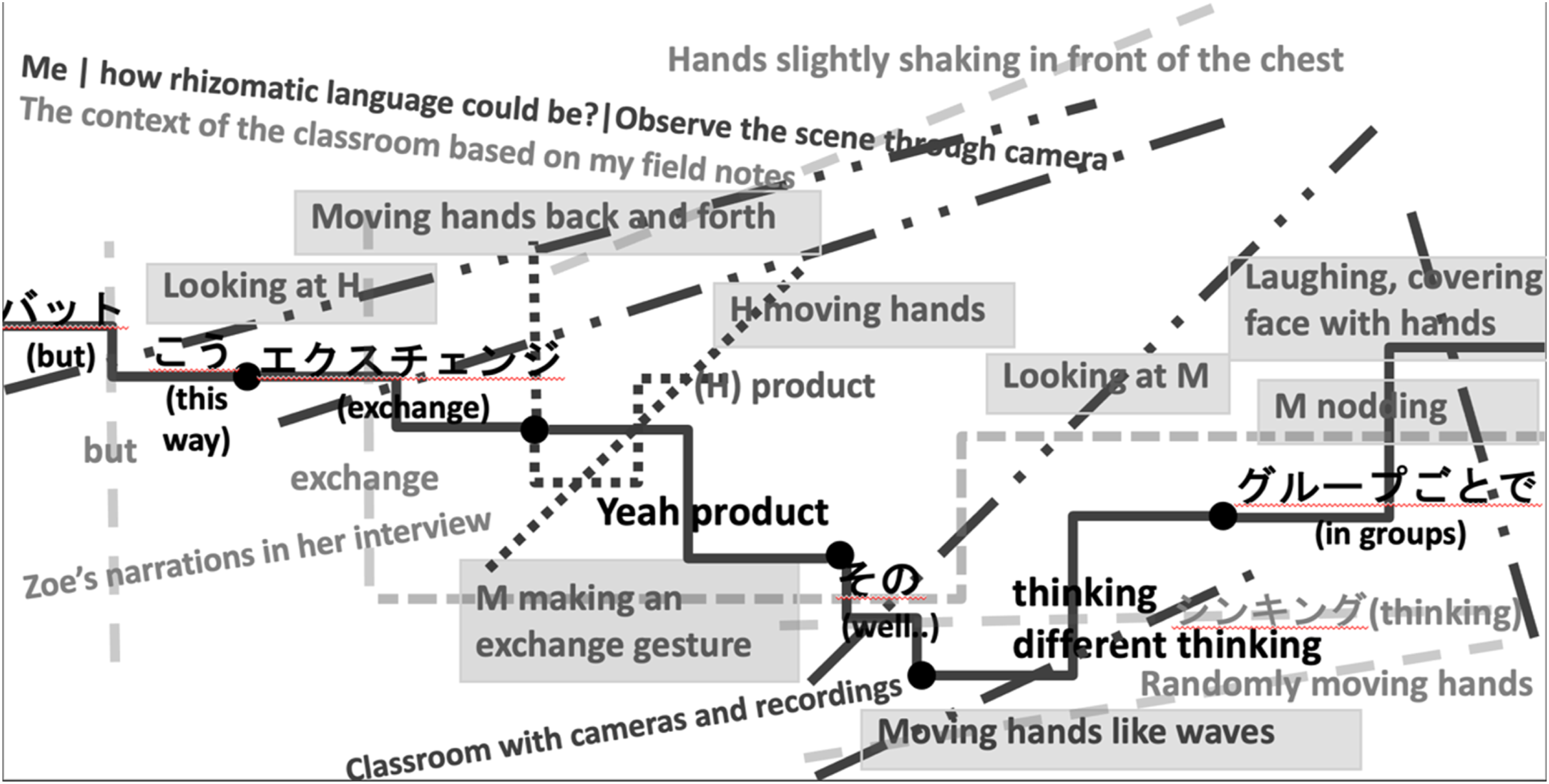
This 7-s speech of Zoe echoes the worldview of rhizoanalysis and the postqualitative study in general which aims at shifting away from representation and interpretation in order to address the becoming of things. It illustrates how Zoe’s language moves as lines that connect to other moving lines such as her gestures, other individuals’ speech including Helen and Mike, Zoe’s narrations of her life trajectory, my life trajectories, my field notes and cameras and videos that present Zoe’s speech to me. These connections demonstrate the acentered feature of Zoe’s language as it moves into multiplicated directions without a clear beginning or an end.
In this sense, the transcription is nonsignifying as it addresses the becoming of Zoe’s language through the concept of potential. In other words, this transcript does not aim to present a “correct” description of what Zoe actually said but rather a dynamic move of what Zoe’s language could have been. For example, the transcript has no intention to show whether Zoe uttered English “but” or Japanese “バット(but)” but rather how Zoe’s language actualized and could be actualized in various directions including English “but” or Japanese “バット(but)” or something in-between with all other elements happened before this 7-s, such as Zoe’s life trajectory, or after this 7-s, such as me as a researcher looked at videos, audios and other data. Interestingly, the linguistic norms that are ascribed to both Japanese and English languages best illustrate the idea of potential and the rhizomatic feature due to the phonetical similarities between these norms. The modern Japanese language contains three writing systems: katakana (the angular syllabary of the Japanese language), hiragana (the cursive syllabary of the Japanese language), and Kanji (the Chinese logographic writing) (Hosokawa, 2021). As phonetic syllabaries, katakana and hiragana can be used to describe pronunciations of audiolingual words. While hiragana is often used to represent and simplify words in the Japanese language for those who do not recognize Kanji such as children, katakana is often used to represent the phonetic elements in words in other languages than Japanese. This phonetic feature of katakana enables Japanese speakers to incorporate words in other languages into the Japanese language, some of which are stabilized as legitimized loanwords while some of them are not. Those words that are not legitimized in the Japanese language exist in a fluid state where different katakana can be applied, and the words themselves can disappear after a period of time. During the interview at the end of the semester with Zoe, she repetitively mentioned that it is common for her to utilize all the elements she can to communicate, especially in this course. Zoe mentioned, for example, that she would try to pronounce words in an “English-ish” way when talking to Mike with whom she thought it was better to communicate in English. When I mentioned an example of words such as “ネゴシエーション (negotiation)” which sounds like katakana to my ears, Zoe explained that she used this word because the English word “negotiation” is written in their textbook and she felt it would be easier for her and her classmates to understand compared to translate the word in Japanese. Interestingly, Zoe mentioned that the word “ネゴシエーション (negotiation)” is not a common Japanese word and might not make sense to people outside of this classroom. In other words, it is a word that appeared in the class for once which does not fix as legitimized Japanese language. As such, this bridging of words in other languages and words in Japanese enables words to exist in a spectrum with legitimized Japanese and another language as their different extremes.
While Zoe’s language contains the potential of being at any point of this spectrum, it is actualized in various directions through its connections to other elements in this transcript. For instance, Zoe possesses both Japanese words “バット(but)” and “エクスチェンジ(exchange)”, and English words “but” and “exchange” that she encountered in her life trajectory when she was speaking: her life experiences living in Japan; the conversations she had with people working in her family business; the English classes she had throughout her education. Before this 7-s speech, Zoe was explaining to Irene about the activity in her memory together with Helen who explained her feeling of stress in the Japanese language, most of her Japanese words were actualized together with her hands moving and her daily conversation with Helen and Irene. The English words were also actualized through the context of an English-speaking class where the materials and the language used by Zoe were in English. When Zoe described the activity to Irene, she applied the English phrase “more complicated”, which might be the phrase used in that actual class. When Mike disrupted three students’ discussions on the activity in English language class with his presence, he contributed to the larger actualization of Zoe’s English language as she explained in the interview that she thinks Japanese might not work well for Mike to understand. This situation pushed Zoe’s language into more words that match the norms of the English language such as the word “product” or “thinking”. The actualization of Zoe’s language was also realized through the gestures such as moving her hands back and forth when she uttered “エクスチェンジ(exchange)” or moving her hands like waves when she said “thinking, different thinking”.
Another element that facilitates the actualization of Zoe’s language is me, who acted as a researcher who recorded and reported Zoe’s language through observations, various data and this paper. My linguistic trajectory and my understanding of language act as a force to push Zoe’s language in a certain direction. Grew up on a southern island in China, I speak a local language - Southern Min language – with my parents and relatives. Due to the language policy where Mandarin Chinese is set up as the official language, I use Mandarin Chinese as my dominant language in public places including schools. Like other Asian students, I underwent English classes that are mandatory in compulsory education and ended up majoring in English literature as an undergraduate. With a passion for language learning, I also acquired Japanese and Korean during my undergraduate study, in addition to French as my second foreign language. After my undergraduate, I came to Japan to pursue my graduate study in linguistics where all classes and research materials are in either Japanese or English. These two languages became the major language I use in my life. Going through my doctoral project on native-speakerism, my passion for pursuing native norms of a particular language has decreased while my understanding of language itself become more dynamic and fluid. This understanding of the changing nature of language led me to step into Zoe’s classroom with a question of seeing the becoming of language. I, who shared a similar linguistic experience with Zoe who encountered the phonetic bridging between English and Japanese language, precipitates the actualization of Zoe’s language as how it is shown in this transcript.
Addressing the elements that precipitate the realization of Zoe’s language and the potentials that indicate the possible spectrum of the realization of Zoe’s language, this transcript attempts to inquire how could Zoe’s language be otherwise. Echoing Schrodinger’s equation in quantum physics where the position of the physical objects only reflects a probability (Barad, 2007), the appearance of the words in one position in the spectrum does not represent a fixed position but rather a potentiality of the position, which does not deny the potential of the appearance in other positions. For example, this potentiality of language is shown in Zoe’s speech in the transcript where the appearance of the words “バット(but)” and “エクスチェンジ(exchange)” do not deny the potential of the words “but” and “exchange”. The words “バット(but)” and “エクスチェンジ(exchange)” were actualized in the transcript through Zoe, who uttered the words, the video that mediated Zoe’s utterance of the words with all other elements such as gestures and objects, which captured by my hearing and sight. In other words, if it were the other situation, for example, not me but another person who was doing the transcript, or not the video camera but another camera with different sound quality, the language in this transcript might be actualized into alternative forms such as “exchange” or something between “exchange” and “エクスチェンジ(exchange)” rather than appearing as “エクスチェンジ(exchange)”. As such, this transcript not only demonstrates how Zoe’s language is actualized with all the elements involved but also shows the potential in linguistic forms in Zoe’s language that opens it to be actualized in other forms or other meanings.
The Potential and the Challenge of Rhizomatic Transcription
The transcription that addresses the rhizomatic feature of language through potential shifts away from representationalism and interpretation that capture language into a fixed form and open language up to a dynamic movement that illustrates its becoming. In a non-rhizomatic transcription, Zoe’s language would be presented as “バット、こう、エクスチェンジ product, その, thinking, different thinking (But…this… exchange product… well… thinking, different thinking)”. This transcription reduces the dynamic nature of language into a fixed form where each of the words and its order attaches the linguistic form to a particular meaning. In this sense, this transcription creates the impression that it exists as the only linguistic form attached with the only possible meaning that is constrained by the forms. However, given the complicated linguistic experiences of Zoe and the numerous elements connected to Zoe’s language to precipitate its realization, the non-rhizomatic transcription denies the alternative possible linguistic forms and meanings in Zoe’s language and constrains it under the linguistic norms produced through normative linguistic description.
Addressing the potentials in the transcription thus emancipates Zoe’s language and opens up the possibility for Zoe’s language to move in multiplicated directions. For example, with the potential and all other elements shown in the transcription, the transcription connects Zoe’s language to the readers of this paper who precipitate the realization of Zoe’s language with their own linguistic experience and all other elements in the environment when they read this transcription. Thus, a rhizomatic transcription is nonhierarchical in the sense that it does not objectify Zoe’s language into passive fixed linguistic forms that wait to be interpreted by readers or researchers who are regarded as the only agencies. Rather, it positions readers and researchers as elements that connect to Zoe’s language which are actively realized into multiplicated directions. The realization of Zoe’s language with me in this paper, for example, does not deny the existence of the potential, with which Zoe’s language can be actualized in an alternative way. The ability to see the darkness is the premise of the ability to see the light and the fact that human beings can see the light does not deny their ability to see the darkness, the existence of which enables them to sense the light in various degrees when the ability is actualized with different conditions. The illustration of the potential in Zoe’s language is thus a resistance to the linguistically normative restraints on Zoe’s language.
The rhizomatic transcription, however, has its limitations as it still bases itself on linguistic words that match with the normative linguistic rules. For example, two poles of “バット(but)” and “but” are based on the norms of English and Japanese languages; the explanation of all elements that precipitate the actualization of Zoe’s language is described in normative language; even this paper itself is written entirely in a normative language. However, as Massumi (2002) pointed out, the creation of expression does not come from nothing. It is to start from a cluttered world and shift to a slightly different angle, and the wabbling of this new direction will then bring new possibilities. The rhizomatic transcription in this paper does not intend to show a “correct” way of doing transcript, but to plug in a slightly different transcription to conventional ones for the purpose of opening the possibility of other alternative transcriptions.
This rhizomatic approach can be challenging in a humanist-oriented and capitalist-dominated society, which values the accumulation of human knowledge and the “usefulness” of practices while devaluing activities that do not contribute to these two (Tesar, 2020). Shifting away from representationalism and interpretation, a rhizomatic transcription practice can be devalued as it fails to provide a concrete answer of “what it is” that satisfies the humanist desire to know. It also fails to satisfy any practical usefulness that requires an immediate application in the capitalist market. In other words, it does not offer fixed sets of methods that can be replicated and accumulated as capital in the academic market.
However, this mismatch with both conventional humanist research and the marketized academic industry appears precisely because this transcription follows the worldview of postqualitative study and aims at sparking novels ways of thinking (Masny, 2013) on transcription and language itself. As Pierre et al. (2016) emphasizes, while most research seeks the immediate applications of any new ideas that are presented, the rhizoanalysis inquires: how can we think differently? While the postqualitative studies appear to provide “nothing” due to the absence of fixed sets of methods, it opens up the potential that can be transformed into anything (Bodén & Gunnarsson, 2021). Echoing Deleuze and Guattari’s (1987) idea of creation that resonates with a language that is unintelligible in a conventional sense, the rhizomatic understanding of language aims less at providing a language that matches the current understanding and demand of language such as functioning as an immediate meaning conveyor. Instead, it aims at opening the possibilities of language and inquiring how we can reimagine language differently; how we can think of language differently in the sense that it will no longer confine language and its speakers under the judgement of normative languages (such as the English or the Japanese language).
This re-imagination of language as becoming open to various actualizations brings another challenge that this rhizomatic approach faces in an ethical sense. While the rhizomatic approach aligns with the ethical account of diminishing the unequal power relationship between researcher and participants (Mauthner, 2019), it fails to weaponize linguistic minoritized groups to fight in a humanist-oriented society. To start, the rhizomatic approach positions both researchers and participants as one of many elements that contribute to the actualization of the potential in both linguistic forms and meanings. This positioning, thus, flattens the power dynamic between the two and frees participants and their language from possible exploitation by the researchers in an ethical sense. However, the worldview of rhizomatic language that can be actualized in various forms exposes the language of minoritized groups to the hegemonic power of normative languages. For example, languages for Indigenous people can hardly be recognized without a set of fixed norms to document the language and to claim it as subjective to their ownership. This rhizomatic approach of transcribing the language can then easily weaken minoritized languages and their speakers’ position in a society where language is discussed from a humanist perspective of ownership.
Nevertheless, Barad (2007) proposes a post-humanist understanding of ethics which emphasizes the understanding and the subsequential accountability of humans and objects engage partially, not wholly, in the knowledge-making and world-making practices. Following this logic, the rhizomatic approach of transcription, which positions humans and objects as one of many elements that precipitate the actualization of language, demonstrates that the speakers and the norms of hegemonic normative language are only partially, not wholly, engage in the formation of language. This approach to the becoming of language, thus, engages in a new perspective of ethics on language that depowers the linguistic norms of hegemonic languages and the fundamental idea of the ownership of language. As Agamben (1993) mentions, “Every written work can be regarded as the prologue (or rather, the broken cast) of a work never penned, and destined to remain so, because later works, which in turn will be the prologues or the moulds for other absent works, represent only sketches or death masks (p. 3).” This rhizomatic approach to transcription and to language itself is a call for engaging with language, understanding of language, and related concepts such as the ownership of language that are yet to come.
Footnotes
Author Note
The instructor who helped this research is introduced by colleges.
Acknowledgments
I would like to express my heartfelt gratitude to all participants who agreed to help with this research. I would like to thank all scholars I met in conferences or research meetings who gave me kind advice on this paper.

Ethical Statement
Funding
The author(s) disclosed receipt of the following financial support for the research, authorship, and/or publication of this article: Rikkyo University partially support the fee for open access for this paper.
Declaration of Conflicting Interests
The author declared no potential conflicts of interest with respect to the research, authorship, and/or publication of this article.