




Abstract
This article focuses on a method of data collection that exists in the margins of qualitative research: story completion. Story completion has a background of usage within disciplines such as psychology, feminist theory, and psychotherapy. However, this method is still uncommon and underutilized and has not been widely put to work as an approach for qualitative education research, despite its rich potential as a tool for accessing participants’ meaning-making. In this article, I argue that story completion can serve as an interesting and flexible method for researchers across the disciplines, particularly for those looking to adopt a post-structuralist lens, concerned with discursive discovery: the surfacing of discourses individuals draw upon to write. I introduce and explain a divergent approach to doing story completion from that described elsewhere in the literature, where a story completion exercise is enhanced by the addition of a traditional semi-structured interview. I also share an experimental approach to data analysis: using a rhizomatic perspective to analyze story completion data. Ultimately, I argue that story completion, the story-mediated interview, and a more experimental analytical approach offer exciting new directions for qualitative researchers to pursue.
Introduction
Story completion can be viewed as an innovative, exciting, and flexible method for qualitative researchers, and yet this method has not been widely adopted. Indeed, it is only recently that the method has come to prominence within psychology research, heralded as a method with “exciting promise” (Braun, Clarke, Hayfield, Moller, & Tischner, 2018) and described playfully by Clarke, Braun, Frith, and Moller (2019, p. 1) as “the best new method for qualitative data collection you’ve never even heard of.” Further, this method has not been widely used by educational researchers (the author’s home discipline), and yet it has a wealth of possibilities for researchers across the disciplines. This article considers these possibilities and examines how a story completion method can be used. This method is illustrated with data from a study exploring undergraduate students’ experiences of their educational transitions into and through higher education (Gravett & Winstone, 2019). This research project represented the beginning of an evolving understanding of the possibilities afforded by story completion research. In particular, this research offered the opportunity to experiment with a new and specific approach to story completion through the use of a story-mediated interview method. In this method, story completion is combined with semi-structured interviews during which participants are invited to reflect upon their experiences of writing the stories. This research study also offered the opportunity to engage with a relatively new approach to data analysis.
Within this article, I also examine epistemological approaches to doing story completion. I contend that story completion can be used as a method of surfacing participants’ meaning-making and as a means to discover the discourses that inform participants’ understandings. As such, I engage in particular with Foucault’s (1969) writings on discourse and authorship, for example, the seminal essay “What is an author.” In doing so, I put to work Foucault’s ideas regarding the relationship of a text within wider discourses, or knowledge systems, as a means to explore the potential of the writing of stories as research data. Throughout, my aim is to share experiences and suggestions for how a story completion method may be used, as opposed to offering a prescriptive framework for doing so. Lastly, I discuss the benefits and limitations of story completion and story-mediated interviews, and I offer suggestions for future research.
Story Completion: Past and Present
The broader field of narrative research, or narrative inquiry, has recognized the value of stories as data for many years. Stories have been taken up as a useful tool by researchers from across disciplinary backgrounds, and the last two decades have witnessed a great increase in narrative research (for further discussion, see Andrews, Squire, & Tamboukou, 2008; Bruce, Beuthin, Sheilds, Molzahn, & Schick-Makaroff, 2016; Eliot, 2005). As O’Toole (2018) contends, “people are storied beings and to generate a more in-depth understanding of people and their experiences, researchers need to begin with their stories” (p. 175). Narrative research, however, is a broad field that has focused on a variety of approaches such as the recording of participants’ lived narratives, autobiographical writing, or stories as written down by the researcher following interview processes. As Andrews, Squire, and Tamboukou (2008, p. 12) explain, “narrative research is a multilevel, interdisciplinary field and any attempt to simplify its complexity would not do justice to the richness of approaches, theoretical understandings and unexpected findings that it has offered.”
Within this multilevel and complex field, story completion exists as a distinct method. Story completion has a background in developmental psychology and psychotherapy. Originating from a specific usage as a form of projective assessment technique (Rabin, 1981, 2001), it was primarily used by researchers interested in looking to discover fixed meanings behind the stories (for a more detailed history of these origins within psychiatry and quantitative developmental psychology research, see Clarke, Hayfield, Moller, & Tischner, 2017). Continuing in the tradition of interpreting stories as revealing hidden meanings, Moore (1995) used a story completion method to explore how stories can be used to reveal the “truth” behind girls’ conceptions of menstruation. However, Kitzinger and Powell’s (1995) research using story completion as a method to explore the topic of infidelity moves away from this approach. Instead, Kitzinger and Powell examined for the first time how stories could be used to access not just the meanings behind the stories but also the discourses that inform the story writing.
Subsequently, we can see a new direction for story completion research emerging, and one with a very different kind of purpose. Although it is flexible enough to fit within differing epistemological frameworks, in more recent work, story completion has largely been employed within a social constructionist framework or been inspired by post-structuralist theory (e.g., see Clarke & Braun, 2019; Frith, 2013; Hayfield & Wood, 2018; Jennings, Braun, & Clarke, 2019; Moller & Tischner, 2019; Shah-Beckley, Clarke, & Thomas, 2018; Tischner, 2019; Walsh & Malson, 2010). However, story completion still remains a relatively unkown qualitative method, and within the literature today, there exist only a limited number of published qualitative story completion studies as detailed above. Furthermore, these studies largely exist within the disciplines of psychology and feminist theory, and a literature search found no published studies that employed story completion as a method within the author’s home discipline of educational research, although interesting research exploring the potential of students' stories via narrative inquiry methods exists within this area (for example, Hamshire et al., 2017). In addition, Clarke, Hayfield, Moller, and Tischner (2017, p. 9) write that “story completion offers scope for methodological innovation” and that “qualitative researchers have only recently begun to fully explore the possibilities that story completion offers.” In this article, I wish particularly to respond to this invitation for innovation and to explore further possibilities for story completion research.
The Story-Mediated Interview Method
I will now consider how a story completion method may be used, and how this method may be flexible enough to be used in a range of disciplinary contexts. In order to do so, I will use examples from a particular educational research study that focused on undergraduate students’ experiences of transitions into and through higher education (Gravett & Winstone, 2019). Furthermore, I will also explain the development of the specific novel approach to story completion that this article wishes to highlight, the story-mediated interview, as well as detailing the experimental analytical approach we adopted.
Context and participants
The first step for researchers adopting a story completion approach will be to determine the participants and contexts in which they wish to address their research questions. In this study, we were interested in discovering how participants made sense of educational transitions, and a longitudinal research project was carried out at two higher education institutions. Participants were new first-year undergraduate students and were asked to complete a story and to take part in an interview at the start of their studies, and then again to complete a story and take part in an interview toward the end of their first year. The study included 11 participants. In this instance, participants were recruited via open e-mail invitation to students across faculties at two institutions. Because of the likely variation in quality and length of story, it has been recommended to recruit at least 10 participants per story stem example (Braun & Clarke, 2013). In this project, the inclusion of two story stems over a longitudinal period, as well as the follow-up interview, served to enrich the first stage of story completion.
Preparing the stories
Story completion involves asking research participants to write a story about a hypothetical scenario. In order to do this, a brief story stem (or stems if doing a comparative study) and a set of completion instructions are provided to participants. Story completion research studies often use story stems written in the third person (as in this study). This allows the topic being researched to be addressed indirectly. Below are two examples of story stems that were used in this particular research study. These stems focus on providing a context for students to discuss a fictional character who is transitioning into and through higher education. However, a wide variety of scenarios could be constructed into story stems thus making this method flexible and open to experimentation.
Story Stem Example—First Story
Alice is a new undergraduate student in her first year of university. She has been struggling to get to grips with university life. Lots of aspects of studying are not as she expected they would be and are different to what she had previously been used to at college. Her personal tutor asks her how she is getting on and she tries to explain how she is feeling.
Story Stem Example—Second Story
Adam is a new undergraduate student coming toward the end of his first year of university. He looks back on his last year. What do you think he might have done or might have happened to him? How do you think he feels about learning and studying at university? One of Adam’s friends asks him how his first year has been. Please complete the story explaining what happens next.
On each occasion, participants were given a different story stem and participants were asked to continue the story. Following Clarke et al. (2017, p. 11), the story stems were written with the goal of achieving a balance between providing the participant with a meaningful context and leaving enough scope for students to be creative as well as to draw upon their own understandings and perceptions of the topic.
Introducing the research process to participants
A key stage of the story completion data collection process is to describe the research process to participants. In her discussion of episodic narrative interviews, Mueller (2019) explains that the researcher should describe the format of the interview, providing an explanation of how requests for stories will be framed, and that this initial explanation “is an important step for fostering comfort, safety, and rapport with the participant” (p. 6). I concurred with this view and felt that when asking participants to complete stories it was important that the researcher explain what is required, and our expectations of the stories, in order to make participants feel as comfortable as possible and in order to ensure we were able to gather useful data. In this study, the researcher also explained the purpose of the subsequent interview, which was to enable discussion of the stories and to find out more about participants’ own experiences. As such, participants were given clear guidelines about how to complete the stories. The creation of these instructions was also inspired by Clarke (2014, cited in Clarke at al., 2017, p. 18) and are detailed below: You are invited to complete a story—this means that you read the opening sentences of a story and then write what happens next. There is no right or wrong way to complete the story, and you can be as creative as you like. I am interested in the many different stories that people can write. Don’t spend too long thinking about what might happen next—just write about whatever first comes to mind. Because collecting in-depth stories is important for my research, please write a story that is at least 10 lines long and spend at least 10 minutes. Thank you.
Completing the stories
The next part of the process is for participants to complete the story or stories. In this study, participants were issued the story stem to complete and were left alone to write. This is a significant difference from other story completion studies, where stories are often issued electronically and can therefore reach higher numbers of participants more easily. However, the purpose of adopting a face-to-face method was to enable the inclusion of the subsequent interviews within the research method. In this project, and perhaps owing to the clear guidelines we offered, all participants engaged well with the story completion task and the majority of stories we collected were detailed, rich, and varied. The stories ranged in length from being the length of two sides of A4 to occasionally being just a half a page. Some included plans and drawings, some were lighthearted in tone, and some were more dark or emotional. Participants also reported that they enjoyed writing the stories. Indeed, this was something of particular interest to the researchers as we were interested in experimenting with a method that we felt would be enjoyable and playful for both staff and students. The method affords research participants an unusual and significant degree of autonomy over the research process. As participants are asked to write their own stories, they are engaged in the research process in a creative way, and therefore the method can be potentially emancipatory for participants as they become active authors of the data. We found that this and the pleasure of reading and writing the stories meant that the research was enjoyable to take part in for staff and students alike.
The story-mediated interview
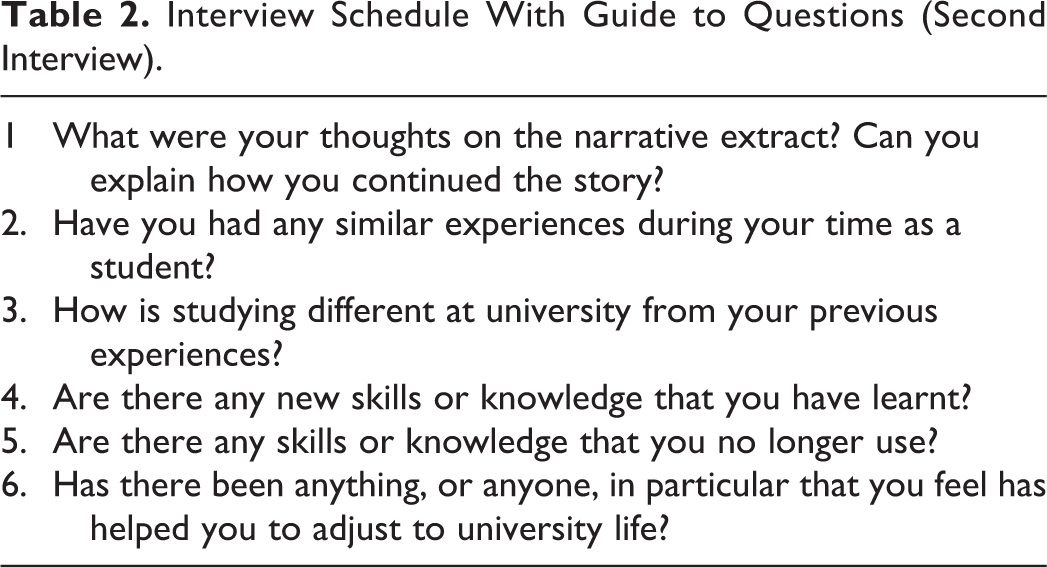
The next stage of the data collection process involved asking participants to discuss their experiences of the research process and their experiences of the topic addressed. The addition of a story-mediated interview is a new approach to doing story completion research. In deviating from previous published story completion studies and deciding to include this semi-structured interview, participants were able to discuss their experiences of the writing of the story and to discuss their interpretation of how their own experiences related to those of their fictional story character. The goal of this was not to attempt to discover the true meanings of the stories. Rather, we wished to provide an opportunity for participants to reflect upon the story completion method and to use the stories as a prompt to generate further discussion of the students’ experiences of higher education, and the discourses, or narratives, that they used to inform the story writing. We wished to explore and experiment in new ways with the interview process: “reflexively examining representational practices at the same time that we rely upon them” (Gubrium & Holstein, 2003, p. 14). Ultimately, we would recommend this method as an approach to doing story completion that provides the opportunity to generate additional insights. Further, the initial story completion task also served as a useful tool to relax participants into the research process and to begin their thinking about the topic before the interviews commenced, as well as forming a crucial part of the data in itself. The semi-structured interview questions that were used are described in Tables 1 and 2. On each occasion, interviews were recorded and then transcribed. Participants’ details were anonymized and are referred to here as Participant 1 (P1), Participant 2 (P2), and so on.
Interview Schedule With Guide to Questions (First Interview).

Interview Schedule With Guide to Questions (Second Interview).
Concluding the data collection
We discovered that, partly due to the researcher building a relationship with participants over time, and partly due to the emotive nature of the research topic that addressed students’ experiences, the interviewer’s presence played a significant part in relations within this study. Indeed, one participant commented that participation in the study itself had offered a meaningful and positive experience; that it had served as a means to build relations with staff and had helped them to cope with their experience of settling into higher education. Thus, the impact of our interactions with the area in which we were researching was that this presence enabled a relationship of trust and openness to develop, and an unexpected additional outcome was also the usefulness of this relationship as a transition intervention.
In this research project, institutional ethical approval was granted for our research to take place. Participants also provided informed consent, and it was made clear that participants could withdraw at any time (two participants subsequently did choose to withdraw from taking part in the second interview, due to personal reasons unrelated to the study). In order to ensure interviewees were comfortable and in agreement with the findings, our results were also externally validated via a member check with participants. On one level, this process can be seen to help manage the subjectivity inherent within the research; by showing “the workings” (Holliday, 2002, p. 48), we attend to issues of validity and demonstrate “rigor.” However, while I was keen to ensure participants were happy with how they had been represented, I also wish to follow Koro-Ljungberg’s (2016) lead in moving toward a rethinking of some of the assumptions of traditional qualitative research methodologies and methodological frameworks. Koro-Ljungberg highlights the value of qualitative research in moving away from the prioritization of the search for truth and validity, in relation to methodological questions. As such, I openly acknowledge here our interpretation of the data is just one interpretation and that meanings may be multiple, complex, and unstable.
Data analysis
Researchers have predominantly employed a thematic analysis approach (Braun & Clarke, 2006) to analyzing story completion data (e.g., Clarke, Braun, & Wooles, 2015; Frith, 2013). Discourse analysis is another method that has also been used effectively (Walsh & Malson, 2010). In this instance, we chose to use an approach that has not as yet been used for story completion research: a rhizomatic data analysis. This experimental analytical approach was inspired by the work of Deleuze and Guattari (1987), and particularly their concept of the rhizome. It has also been inspired by the later work of Maclure (2010, 2013), and Taylor and Harris-Evans (2018) who have put to work a similar analytical approach. The concept of the rhizome signifies the importance of multiplicities, singularities, and fluid connections and offers a critique to arborescent conceptions of linearity and of regularity. A rhizomatic analysis thus “opens a way of working with data in its nuances, differences, singularities, contradictions and difficulties” (Taylor & Harris-Evans, 2018, p. 1257). We sought to work with the data in an attempt to grasp its nuances and irregularities. In order to do this, first, both researchers read through all transcripts and stories independently, identifying data fragments that captured our interest, or as described by Maclure (2010, p. 282), identifying data “hot spots” that “glimmer” and “glow,” “gathering our attention.” The researchers then had a discussion to share these data hot spots that we had gathered from across both the stories and the interviews. During this discussion, we identified together those hot spots that most captured our attention. Such an approach to data analysis deviates from traditional approaches in that the analysis is not concerned with identifying patterns, or reducing complexity, or about reaching an authoritative, conclusive, and representation. Within this approach, the researcher/s actively do not look to prioritize regularities within data. Rather, a rhizomatic analysis enabled us to retain those singularities and multiplicities within the data that we were most interested in examining. Maclure (2013, p. 228) describes this process as an alternative to the search for meanings, patterns, or codes: This potentiality can be felt on occasions where something—perhaps a comment in an interview, a fragment of a field note, an anecdote, an object, or a strange facial expression—seems to reach out from the inert corpus (corpse) of the data, to grasp us. These moments confound the industrious, mechanical search for meanings, patterns, codes, or themes; but at the same time, they exert a kind of fascination and have a capacity to animate further thought.
Discursive Discovery: What Can Stories Tell Us?
At the same time as attending to these micro-experiences that were visible within the data, we were also captured by data hot spots within the stories and interviews where participants appeared to draw upon significant tropes, understandings, and discourses surrounding university transitions. Within a story-completion method, participants are required to employ sense-making resources in order to tell a story, and thus story completion can be particularly useful for exploring assumptions and understandings about a particular topic. As a result, stories written by participants can be theorized as the product of particular textual or oral discourses and can be viewed as a means to illuminate those sociocultural discourses. As such, Foucault’s (1969, 1970) writings on discourse and authorship are relevant here. For example, in his essay, “What is an author,” Foucault (1969) contends that while ostensibly a text “points to this figure who is outside and precedes it” (p. 132), a more complex reading is possible: The subject should not be entirely abandoned. It should be reconsidered, not to restore the theme of an originating subject, but to seize its functions, its intervention in discourse, and its system of dependencies…In short, the subject (and its substitutes) must be stripped of its creative role and analysed as a complex and variable function of discourse. (p. 138)
In this study, it became apparent during analysis that many of the participants’ stories drew upon a repertoire of understandings that referenced conventional discourses surrounding educational transitions, where students have been shown to be often depicted as academically ill-prepared, in need of support to adapt to university life, and as following homogeneous, linear pathways (see Gravett, 2019; Gravett, Kinchin, & Winstone, in press). For example, the students in the stories are often described as having stereotypical difficulties adjusting to university life: “I just feel like I’m not supposed to be here” (P1, first story). Transition is conceptualized as a linear process of adjusting to university norms: “little by little, academics became more manageable” (P2, second story). These discourses also captured our attention within this passage: The beginning of university was quite stressful and scary as it’s very different from college life. The academic style of writing is much more advanced, with assignment and exams requiring more complex knowledge. Living at halls is also scary as there is a wide variety of people to get to know and to interact with people with different opinions which can cause conflict. Adam did find it hard to fit in with everyone and he sometimes felt like an outsider. However, towards the end he feels as if he has settled in more. Now that first year is over he looks forward to what second year will bring. (P5, second story) I just feel like I am not supposed to be here. Almost as though I’m not smart enough or old enough to be a uni student. A lot of students feel like this during the first part of the course. This is why it’s important to immerse yourself in uni life and everything that comes with it. Have you thought about joining any societies? Her personal tutor looked at her normally suggesting he had seen it all before. As a very strong introvert though, Alice never really extended herself socially. She wasn’t a fan of excessive drinking and clubbing which meant she didn’t get on well with her flatmates, at least in a way that was more than acquaintances. She also found a lot of her favorite activities were very isolated. “I like to write and draw but I only really like to do those things on my own.” She said, looking down at her hands. (P1, first story)
Limitations and Ongoing Considerations
In this study, it was possible to discern the impact upon participants of conventional discourses surrounding educational transitions. For example, students are often depicted, in policy, research, and practice, as following linear pathways, and as having homogeneous experiences, and the impact of such narratives made itself felt within our data. In a similar way, story completion methods can offer scope to explore many other contexts in which researchers may be interested in surfacing those discourses and narratives that surround participants’ sense-making.
One significant benefit of story completion as a method is that an electronic version of a story can be easily disseminated to large numbers of participants, and data can be collected quickly and easily in this way. In contrast, as we have seen the story-mediated interview removes this benefit and is just as time-consuming and intensive for the researcher as any traditional qualitative approach. This is therefore an important consideration for researchers to assess exactly how important they consider sample size to be for their particular research aims and to consider carefully what they are looking to achieve from their data. A further limitation of all forms of story completion methods is that analysis can be difficult. Although as we have explored, there are numerous ways of analyzing story data, there is no clear pathway for how analysis should be done and researchers will have to think clearly about their epistemological approach, their theoretical framework, and will also have to transparently justify their analytical decisions.
Similarly, story completion is still in its infancy of development and thus will inevitably be met with some resistance, misunderstandings about what the data can be expected to reveal and about how such research can be approached with suitable methodological rigor. For example, Braun et al. (2019, pp. 151-2) discuss how some reviewers don’t fully understand story completion and have been negative and dismissive of it as a method: the fact that you’re collecting stories, and there’s some real uncertainty among reviewers about what conclusions we were drawing about the status of the stories.…Some aspects of story completion appear to be contestation of the essence of qualitative research. It feels like story completion may be more open to criticism because of its status as a story. (pp. 151-2)
Conclusions
In this article, I argue that both story completion and the story-mediated interview have potential to be more widely used within qualitative research. These approaches offer an entirely different method of doing qualitative research, providing a means to address a topic indirectly by enabling the researcher to access a range of meanings surrounding a given subject. Story completion does not seek to uncover the truth behind respondents’ experiences. Rather, I have explored how these methods can be viewed with a post-structuralist lens that seeks to look for discursive discoveries: those discourses that inform participants’ understandings. In particular, I highlight how the story-mediated interview works to combine the insights of participants with the sense-making that can be understood from story data. Via this complementary approach, participants’ insights as surfaced within the interviews can be compared and contrasted with the sense-making that can be gleaned from the narratives. The stories then also serve as an interesting prop to ask participants to reflect upon. This notion echoes Gubrium and Holstein (2003, p. 14) who suggest that postmodern interviewing may involve “reflexively examining representational practices at the same time that we rely upon them.” The story-mediated interview thus enables a different kind of interviewing, a different kind of, openly reflexive, qualitative research. Additionally, I detail how a rhizomatic analytical approach may be used to capture the multiplicities and singularities of data, and I explain how such an approach is beginning to be experimented with as a means to move beyond a search for patterns and regularities. As such, these methods have significant and underutilized potential to be used within a range of educational research contexts, as well as across the disciplines. A story-mediated interview method was also an enjoyable and fun method for staff to use, enabling the building of relations with participants and the collection of varied and interesting data to read. Further, this method proved to be useful and beneficial for participants too, and one participant commented in particular on its value as a transition intervention. As story completion studies are still limited, I suggest that this method offers further and exciting scope for development, as well as for experimentation within new contexts.
Footnotes
Acknowledgments
I wish to thank Professor Ian Kinchin and Dr. Naomi Winstone for their valuable comments on an earlier draft of this article.
Declaration of Conflicting Interests
The author(s) declared no potential conflicts of interest with respect to the research, authorship, and/or publication of this article.
Funding
The author(s) received no financial support for the research, authorship, and/or publication of this article.
