




Abstract
Sensitive areas of research require sensitive ways of inquiry. Despite the growth of research on obstetric violence, its recognition as a form of gender-based violence continues to be contested and met with resistance. As a problem stemming from gendered power imbalances, we explored obstetric violence from a critical feminist lens, situating the different parts of the exploration such as analysis, presentation and integrated knowledge translation into arts-based research. In this paper, we describe poetic inquiry as an innovative, and effective method for analyzing a large qualitative dataset of thin data on sensitive and/or controversial topics. We applied voice-centred relational analysis to 2,741 open text patient-reported narratives on obstetric violence reported in the nationwide Canadian RESPCCT survey. We present three poetry iterations: sparse IPoems, full IPoems and context poems using the Voice Centered Relational Analysis. Each type of poem and the way of reading them aims to impact the audience in distinct ways by evoking different feelings and approaches to engaging with the participants’ narratives. Drawing on principles of intersectionality theory and standpoint theory, we present a detailed description of our positionalities to give the readers an insight into how we practiced reflexivity while researching a sensitive subject. With this paper we intend to further the discourse and utility of arts-based research, particularly poetic inquiry, in analyzing and presenting open text survey responses.
Introduction
‘The master’s tools will never dismantle the master’s house.’- Lorde (1979, pp. 25)
Arts-based research methods have particular applicability to researching sensitive topics that are challenging to elicit, and when working with marginalized groups whose experiences are unknown or invalidated (Bhattacharya, 2013; Chadwick, 2018; Coemans et al., 2017; Cooms, 2023; Mayra et al., 2022). They can be effective in addressing power inequalities in the research process by minimizing language barriers and centering the participant’s voice (Bhattacharya, 2013; Coemans et al., 2017; Hamilton, 2020; Keifer-Boyd, 2011; Leavy, 2020; Mayra, Matthews, Sandall & Padmadas, 2023). Arts-based research practices are defined as “a set of methodological tools used by researchers across disciplines during any or all phases of research, including data generation, analysis, interpretation and representation. These emerging tools adapt the tenets of the creative arts in order to address research questions in holistic and engaged ways in which theory and practice are intertwined” (Leavy, 2020 pp-ix). Interest in arts-based approaches for health research is growing (Coemans et al., 2017; Fraser et al., 2011), with applications to examine, mental health (Murray et al., 2023), sexual and reproductive health among groups such as adolescents, young women, and sexual and gender minorities (Bhat, 2018; Harley et al., 2023; Lys et al., 2018; Yari et al., 2017). Arts-based methods have been used to generate, analyze and interpret data, as well as disseminate findings, with each of those stages taking myriad forms including visual, performative, and experiential art. Congruent with transformative research frameworks, arts-based methods have been used in intervention research, and more broadly, to promote equity and social justice (Hartley et al., 2023; Logie et al., 2019; Rollins et al., 2009). Yet these approaches have typically been applied to small datasets and are only beginning to be leveraged to raise reproductive and birth justice issues (Fontein-Kuipers et al., 2018; Hogan, 2015; McKenzie, 2021), including obstetric violence (Chadwick, 2017; Mayra, 2022).
Poetic Inquiry
Owton (2017) describes poetic Inquiry as a ‘revitalizing and galvanizing mode of thought for humanistic study and teaching, making available means of engaging with and producing texts that are both very fresh and steeped in poetic tradition’. Poetry provides a template of representation for qualitative data that is a very particular form for understanding embodied experiences (Leavy, 2020). Poetic Inquiry involves a deep listening of the participant’s narratives and turning the narratives into poetry using ‘poetic devices’ (Chadwick, 2017). It enables the readers and listeners to receive the data and the narrative in a different light from a unique perspective. Owton (2020) proposes that poetry allows a reader to ‘step into another person’s experience’ and fully immerse themselves in it by using their senses of touch, smell, taste, hearing, and sight.
There are many forms of poetry based on the paradigm and data, but the most common forms are 1) researcher-voiced, 2) participant-voiced and, 3) literature-voiced (Leavy, 2020). Authors highlight the therapeutic nature of poetry (Etherington, 2004), and discuss that it should not be put on a pedestal but rather that it should be a method accessible to all. Poetic inquiry, unlike the other forms of traditional and quantitative methods of inquiry, pays attention to the nuances of experiences. It is a simple and yet powerful way of connecting and bridging the participants, researcher, listeners and readers (Rapport & Sparkes, 2009).
Voice Centered Relational Method
VCRM is used when creating participant-voiced poetry which represents about a third of poetic inquiry. VCRM is a feminist, relational and narrative method characterized by a series of guided listenings to center the voice of the participant, which recognizes their relation to others and the social structures, while being cognizant of the researcher’s voice and story in relation to the narrative (Gilligan et al., 2003; Hutton & Lystor, 2021; Ross, 2003).
The VCRM is both a method and methodology that originated in the field of psychology and has seen cross-disciplinary iteration and application (Gilligan et al., 2003; Hutton & Lystor, 2021). It attunes researchers to listen to both for the voice of the first person speaker, as well as the contrasting or “contrapuntal” voices. This methodology requires creation of different kinds of poems using direct quotes from qualitative data. One form is the Ipoem, which is constructed by selecting quotes that include the first person perspective or “voice” (Gilligan et al., 2003). The Ipoems are created to convey participant narratives that are representative of the recurring themes found within previously coded text. The purpose is to capture and elevate participants’ voices in a way that evokes readers’ emotions and move them into action. Ipoems are created from sentences starting with ‘I’; they elicit human emotions and experiences that reflect larger societal and relational dynamics and discourses.
VCRM allows the researcher and audience to step into the participant’s world which helps the researcher to empathize when in the process of meaning making (Hogue, 2006). Both VCRM and arts-based depictions of the themes are particularly impactful as the varying details presented through these poems, and related illustrations, allow readers to use the senses of sight, touch, hear and be moved by the power of these narratives (Hogue, 2006; Poindexter, 2002).
VCRM has traditionally been used to analyze in-depth interview transcripts involving a relatively small number of participants (Mayra et al., 2021). However, thematic and content analysis, which are usually applied to larger qualitative datasets of thin data, may not adequately center marginalized voices; recognize the researcher roles, experiences and vulnerabilities, or evoke responses to the subject to the same extent that VCRM has the potential to, through poetic inquiry (Leavy, 2020). Germane to the subject of this current research, VCRM was chosen in this study for its transformative intent-listening and potential to elevate marginalized and silenced voices of women, trans, and gender nonconforming people.
In this paper, we detail how VCRM was adapted for use with a large volume of thin data from a pan-Canadian community-based participatory study, representing a range of marginalized voices in a high income country. Highlighting both strengths and limitations to our approach, we describe how the application of VCRM and poetic inquiry to the analysis of responses to open-ended survey data on obstetric violence can (a) center and elevate participant voices, (b) situate the researcher positionality and reduce researcher vulnerability when engaging with a difficult subject, and (c) galvanize audiences into action, in distinct and novel ways. By doing so, we highlight how VCRM is particularly well positioned to study sensitive, difficult and potentially traumatic subjects by recognizing sensitivities surrounding the participant, the researcher, and the audience.
Obstetric Violence: A Case Study
Obstetric violence is a feminist concept that encompasses volitional and unintentional behaviors and procedures carried out during obstetric care that cause physical, emotional, or psychological harm to the people who give birth (Freedman et al., 2014; Sadler, 2016; Sen et al., 2018). Equally, it draws attention to systemic problems in the provision of obstetric care that represent violations when viewed at a population level, such as excessive rates of episiotomies and cesarean sections (Diniz et al., 2018; Sadler, 2016). With the examination of power central to how it is operationalized, obstetric violence as an analytic lens, sits at the intersection of structural, institutional, and gender-based violence (Freedman et al., 2014; Jewkes & Penn-Kekana, 2015; Mayra et al., 2022; Oliveira et al., 2002; Sadler 2016; Van der Waal et al., 2023; Šimonović, 2019). Researching obstetric violence is therefore complicated by the sensitive and often stigmatizing nature of the conversations related to reproductive health, as well as the patriarchal values and beliefs that historically have and continue to shape perinatal care and discourses around it, thereby rendering it an illicit topic to explore (Mayra et al., 2021; Pimienta et al., 2023). This is especially relevant in obstetrician-centered models of care, which are hierarchical and “mother blaming”, which can leave women and people who give birth voiceless, powerless and oppressed (Davis, 2008). For these reasons, exploration of obstetric violence is fitting for arts-based methods of inquiry, yet few examples exist in the literature.
A study used arts-based research methods to explore and understand the embodied experiences of obstetric violence in India (Mayra et al., 2022; Mayra, Matthews & Sandall, 2021). It analyzed in-depth narratives from eight participants using body mapping adapted as “birth mapping” (Mayra et al., 2022), as well as poetic inquiry to center women’s voices when reporting on experiences with obstetric violence and decision-making during perinatal care (Mayra et al., 2021). While pregnancy and birth experiences have been well researched through narrative methods, the above study by Mayra et al. (2021) sets precedence for using the VCRM, also known as ‘The Listening Guide’ to study the topic. Together with Chadwick (2017) who studied obstetric violence and birth trauma, and McKenzie (2021) who examined the phenomena of ‘free birthing’, these studies represent an important if not overdue departure from conventional research approaches to examine birth experiences, trauma and injustice through creative, arts-based methods.
Methods
Epistemology
Our study is embedded in critical feminist theory, which enables the interrogation of gender and power, that is central to the understanding of obstetric violence (Jewkes & Penn-Kekana, 2015; Mayra et al., 2022; Schaff et al., 2023; Sen et al., 2018). Critical feminist theory examines and challenges the ways in which systemic power relations, gender inequality, and intersecting forms of oppression are embedded within social, political, economic, and cultural systems. It emphasizes the transformation of unjust structures by critically analyzing how power operates across different contexts and deconstructing these systems of power, while centering the lived experiences and voices of marginalized groups (Crenshaw, 1989; Hooks, 1984; Hartsock, 1983). Critical feminist theory is not reductionist, but rather understands gender through social relations and how together they are produced, reproduced, transformed through living experiences while aiming for liberation, emancipation and empowerment of the oppressed (Katsiampoura, 2024). Many researchers have grounded their research related to women, women’s bodies and obstetric violence on critical feminist theory with this understanding (Chadwick, 2021; Keedle, 2019; Niles et al., 2021; Shabot, 2020).
Our inquiry was also operationalized by tenets of feminist standpoint theory and intersectional theory. Intersectional theory argues that traditional systems of power, such as racism, sexism, and classism, are interconnected and cannot be separated when analyzing inequality. Intersectionality highlights how individuals or groups situated at the intersections of multiple marginalized identities face overlapping and compounded forms of oppression. Crenshaw, who is credited for the intersectionality theory, presents it from ‘two processes: 1) structural intersectionality or the ways in which systems of inequality co-produce one another to coordinate oppressions and privileges; and 2) political intersectionality, how disadvantaged groups resist their domination through strategies that reflect their intersectional positioning in social hierarchies.’ (Grzanka, 2016). Hill (2017) suggests violence as a crucial entry point to understand intersectionality from the theoretical and political angle. As such we also draw on standpoint theory, that notes knowledge is bounded by social and cultural contexts, and those who are marginalized or oppressed, will have their own unique insights to offer to research findings and knowledge translation.
Hence, by applying intersectional and standpoint lenses, we aimed to anchor “the experiences of individuals who are not members of dominant groups with the goal of opening up different ways of understanding by foregrounding ‘marginalized voices’” (Cabrera et al., 2019; Keeling, 2011; Wigginton & Lafrance, 2019). Additionally, we drew on intersectionality theory by recognizing that the participants of the study, and us as researchers, occupy multiple, intersecting identities and experiences which reflect both marginalization and privilege. We were reflexive in recognizing how our experiences and identities influence what we see and problematize as researchers.
Positioning the Researcher
Positionality and Reflexivity
Our intersectional identities as authors include race, ethnicity, age, socio-economic status, citizenship, and language. The primary analysis was conducted by four researchers that includes the first three listed co-authors (KM, TA, BR), two of whom identify as South Asian and one as a Black Canadian woman. All three have experience with qualitative research, and the lead author (KM) has employed arts-based research methods in her previous doctoral work in India. The senior author (SV) is a South Asian midwife and researcher who has provided perinatal services to communities of color and marginalized communities across North America and facilitated numerous community participatory action research studies.
Collectively, we have experience in studying obstetric violence and respectful perinatal care in high, middle, and low income countries and draw on diverse disciplinary lenses to understand it. We have witnessed and/or experienced obstetric violence and positive empowering births, and have encountered and navigated health care systems and policies shaped by colonialism, racism and sexism. We have experienced the gender and power-based inequities and discriminations we address in this paper as care seekers, midwives, researchers, mothers, educators, students, doula and clinician.
Figure 1 shows our articulation of the different aspects of our positioning in our research. Positioning the Researcher (Author’s Own).
Study Context
The methodology described in this paper is illustrated through an analysis of open-text responses within the Research Examining Stories of Pregnancy and Childbearing in Canada Today (RESPCCT) study, a community-based participatory action research (CPAR) project. Embedded in social justice and feminist action research frameworks, CPAR is inherently disruptive to traditional research designs by partnering with and centering the “subjects” of research in all stages of study development and implementation (Demange et al., 2012; Israel et al., 1998; Jolivétte, 2015; Reid, 2004). For RESPCCT, this included community collaboration for the conceptualization of the study, co-design and content validation of study measures, participant recruitment and interpretation of results phases.
This cross-sectional study administered via an online survey between 2020–2022 included several open-text options. A total of 6,096 participants from all provinces and territories completed the survey, including people in the following minoritized populations: Indigenous people (First Nations, Metis, Inuit), racialized, sexual and gender minorities, recent immigrants and refugees, people with disabilities, those with history of substance use, incarceration, housing instability, and/or people living in rural or remote areas. Full details of the RESPCCT study development and methodology are available elsewhere (Clark et al., 2022; Vedam et al., 2024).
The RESPCCT study received 2,741 participant’s narratives that were complex, rich and unique in nature, with references to both obstetric violence and respectful maternity care. Conducting arts-based research, through the use of the VCRM, not only enabled us to open up these rich and multilayered narratives; but also supported guided listening, by creating avenues through which we could listen to participants’ multifaceted experiences. To our knowledge, this is the first time VCRM has been used to analyze survey-based open text narrative responses.
Our goal was to present three different poem structures to elicit a range of feelings from the readers. The three types of poems presented in this paper provide researchers with novel means to enhance understanding of the nature of participants’ experiences. In an effort to employ the principles of Critical Feminist Theory, participants’ language was kept intact throughout the analysis and poem generation process. However, the connection to this work and the principles of Critical Arts-Based theory was not made until the completion of the analysis process and the drafting of the findings when the study team discerned that it was reflective of Critical Arts-Based theory (Finley, 2014). This included endeavoring to use participants’ verbatim language in the description of the findings to center participant voices in all stages of the research, and to ensure the language used was accessible to a wide audience.
Data Analysis
Thematic Analysis
Qualitative analyses were carried out in two phases. Using NVivo R1 software, the first phase of analysis involved KM’s inductive coding of 2,499 English language responses (from 2,741 total) to the question/prompt “If you could change one thing about your care during pregnancy, birth and after birth, what would that be?”. In phase one, KM generated themes and sub-themes (Braun & Clarke, 2019; Braun et al., 2021) informed by typologies published on obstetric violence or mistreatment in childbirth including by Bowser and Hill (2010), Bohren et al.(2015), Clarke et al.(2022), & Freedman et al. (2014). We received responses in 4 other languages, French (222), Spanish (5), Arabic (3) and Chinese dialects (12) that have been translated and being analyzed by native speakers. For example the Bohren et al.’s (2015) classification presents seven key forms of abuses that includes physical, verbal and sexual abuse; stigma and discrimination; failure to meet professional standards of care; poor rapport between women and care providers; and health systems conditions and constraints. All the responses were coded in full, we did not break any responses, regardless of which part of the response matched with a code. Given the length of the responses were fairly short, we did not want to lose the essence. Full details of the coding process and the findings from the thematic analysis will be published elsewhere. In the second phase of analysis that concerns this paper, the study team identified and selected themes from phase 1 that most clearly characterized obstetric violence and respectful care. We conducted the second phase of the analysis by adapting the VCRM.
Voice Centered Relational Method- Study Procedures
VCRM is usually performed on one participant’s narrative. However, individual participant survey responses to the RESPCCT study, for the most part, did not provide enough detail to construct poems from an individual person’s narrative. Rather we created poems to convey common themes that emerged from open-ended responses provided by multiple participants, that serve as a collective narrative while maintaining individual voices.
First, each author selected themes that they wanted to explore in depth within each coded theme, the author read each respondent’s narrative to understand varying descriptions of experiences of obstetric violence. We also examined each narrative for tonality to see whether participant narratives recounted positive, negative, or neutral experiences even though we acknowledge that the question posits that there was something to change. This was done to capture the full range of experiences, and to identify contrapuntal voices (Gilligan & Eddy, 2017), which is central to VCRM. The initial selection of narratives from all narratives coded under the theme was guided by the question: Does the narrative convey details of the experience or emotions surrounding the experience? Selected narratives were then checked against the pool they were selected from with the question: Is the full range of experiences and emotions expressed under the code captured? Are contrasting experiences captured? Are both common and anomalous experiences heard? When arranging the narratives into a poem: What story/plot is the range of experiences conveying? e.g., temporal, positive/negative. If more than one narrative was conveying a similar emotion/experience in similar words, the author made a stylistic choice. While we followed the same stepwise decisions when creating the poems (Box 1), each author chose their sentences, arranged them into poems, and made independent artistic choices.
Concurrently, to enhance quality and consistency we discussed the steps in weekly meetings to ensure the processes the four researchers followed were aligned; and to share researchers’ experience of analysis and impact, as well as alternative options for the order or prioritization of phrases. We then discussed each poem draft, and the process for creation, to maintain internal methodological consistency. The first author provided feedback and guidance based on experience with poetic inquiry and VCRM.
Creation of Poems
We followed the listening guide described by Gilligan and Eddy (2017) when creating the Ipoems (Box 1). Given that our qualitative data is not in a traditional format, with exhaustive transcripts that allow for detailed methods of poetry generation, we adapted VCRM to create different types of poems from our collective short participant narratives. Participant narratives were drawn from themes and sub-themes generated in phase 1 of coding, prioritizing higher order themes related to obstetric violence. To illustrate the process, we present a poem below, from the sub-theme ‘Induction’ under the higher order themes of ‘Birth Environment’ and ‘Structural Violence’.
To create these poems, within each coded theme, we selected individual sentences from participant excerpts, and matched them with other participant excerpts that spoke on the same or similar topics and experiences. Next, we reorganized and amalgamated sentences so that the voices of various respondents were aggregated into a single poem, intended to represent a topic discussed by multiple voices within a collective narrative. We then created stanzas to ensure a poetic rhythm, flow, and form. As the purpose of these poems was to share coherent messages detailing participant experiences, the format of each poem and the way each of the participants’ voices are identified varies.
A set of rules concerning the format of the poems was initially agreed upon, including what each line would represent, and what the indentation of a line, bold text, italicized text, and other forms of punctuation meant. Each new line in the poems, or any new line followed by indented lines, indicates the voice of a new participant. Indented lines indicate impactful statements. Bold text is used to emphasize the feelings and; indented the descriptions of context. The intent is to emphasize/center the feelings that accompanied the statements, such as privacy being violated. We used ellipses (…) in the beginning or end of the Sparse Ipoems and context poems. Further details and a step by step process of creating poems are presented in Box 1.
Box 1: Key analytic steps Phase 1 - Thematic analysis ○ Inductive coding of 2,499 English language responses (from 2,741 total). ○ Generated 171 codes that were divided into themes and sub-themes that were informed by typologies published on obstetric violence or mistreatment in childbirth. Phase 2- Voice Centered Relational Analysis ○ Identified and selected themes from phase 1 that most clearly characterized obstetric violence and respectful care. ○ Followed the listening guide described by Gilligan and Eddy (2017) and Petrovic et al. (2015) when creating the Ipoems: (a) Listening for the self-voice (I, my, me) (b) Listening for the plot (c) Listening for the contrapuntal voice and (d) Looking for the connections between the voices or relations ○ Each author read respondent narratives and created poems to convey common themes of obstetric violence and respectful maternity care, while noting tonality (i.e., positive, negative, and neutral experiences), voice, perspective, and context. ○ Selected one sentence from each participant’s narrative to include in the final poem. In some instances, the same sentence has been repeated for rhythm, emphasis, and creative impact. ○ Agreed on these set of rules for the form(s) that the poems would take, including what each line represents in terms of participants, what indentation means, bold text, italics, and other punctuation. The intent was to emphasize/ center the feelings that accompanied the statements, such as privacy being violated. ○ We selected individual sentences from participant excerpts, and matched them with other participant excerpts that spoke of similar experiences which generated a collective narrative. ○ Organized sentences into “stories” about participant experiences, opinions, and emotions regarding a specific topic. ○ Created stanzas to ensure a poetic rhythm and flow while reading, and to achieve the poetic goal. ○ No changes were made to the language and grammar of the sentences to keep them authentic. ○ Selected a poem title from a phrase or verbatim sentiment based on its ability to capture and convey the poem’s essence. ○ Regular meetings to assess our alignment with the process including discussing the steps, decisions, and artistic choices to maintain internal methodological consistency. ○ Reflexive discussions on our responses to engaging with the data.
IPoem Iterations as Findings
Our findings are presented through three kinds of poems: 1) Sparse IPoems; 2) Full IPoems; and 3) Context poems (McKenzie, 2021). The sparse IPoems remove the context and explanatory details, and only present the voice and feelings. This was to emphasize the emotional and experiential impact such as helplessness, voicelessness, or lack of choice for participants without providing the context. The full IPoems provide an understanding of both the voice and the context in which something is being said. The third poem type only includes the context, an approach we developed to restrict the audiences’ focus to the poem theme, and to exhibit cohesiveness of the nature of experiences reported and the universality of the issue of obstetric violence.
Below we present three iterations of ‘I didn’t know I could say no’. The poems draw from 20 of the over 80 participant narratives that were coded under the theme ‘Induction’, and were chosen to represent the full range of concerns and recurring emotions expressed throughout all 80 narratives. In terms of structure, in the sparse and context versions, each line represents a new participant. In the full poem version, each line that begins at the margins represents a new participant; indentation away from the margin indicates a continuing narrative from the same participant. Indentation was chosen for the purposes of giving form, and to break long sentences while encouraging the reader to reflect on key elements of a single narrative. Ellipses indicate a truncated sentence not used in its entirety.
I wanted to… …I felt like I had to… I was told… I felt i was… I was told… I felt I couldn’t… I ended up… I was… I fully believe… I’m still upset… I would’ve learnt… I would not have… I think my… I wish that… …I would demand… I would have refused… …I would have just waited… I believe…
The sparse IPoem’s function is to draw the reader’s attention to the participant’s emotional state by stripping away surrounding detail and context. This approach centers the participant’s voice of ‘I’. The absence of context may make the readers feel lost and helpless, among other emotions. We intend for the sparse IPoems to enable the reader to sit with a sense of discomfort of knowing these are narratives of obstetric violence but not knowing the context, and only reflecting on what the participant felt. Additionally, the contrapuntal voices found within the participants’ narratives indicate voices of knowing; confusion, powerlessness, acceptance, sadness, determination, resistance and hope.
In the full IPoem we intend to present the whole experience narrated by the participants about a particular theme. The sentences in most cases have not been broken down, unless the participant digressed from a topic or have talked about multiple themes in the same sentence.
The short narrative responses made it difficult to identify and present contrapuntal voices, which is a key aspect and the important third step of the VCRM. This meant that we could not identify as many voices of concord, suspension and discord for each participant, but we did identify for each participant’s sentence a collective contrapuntal voice to represent the solidarity in the voices of concord, suspension and discord.
To capture participants’ relationality to context and structures, we engaged in a series of listening (or reading) sessions where we increasingly assessed the contrapuntal voices found throughout the narratives. We repeatedly read the poems, attempting to replicate the act of listening and re-listening to the sparse and full iterations of the IPoem ‘I didnt know I could say no”, and indicated next to each of the poems lines what contrapuntal voices were identified. We identified voices that represented discord (such as resentment, regret, silence, sadness, powerlessness, acceptance), suspension (anger, frustration, hope) and concord (such as knowing, determination and agency) as shown in Figure 2. However, we ascertained that feelings of discord were more present within the poem than those of concord (Figure 2). Although we hear a sense of solidarity within the sounds of discord about induction that echoes through the narratives of these 20 participants’ experiences, we have limited access to single participants’ narratives and how this impacted their future experiences. Contrapuntal Voices in ‘I Didn’t Know I Could Say No’ (Author’s Own).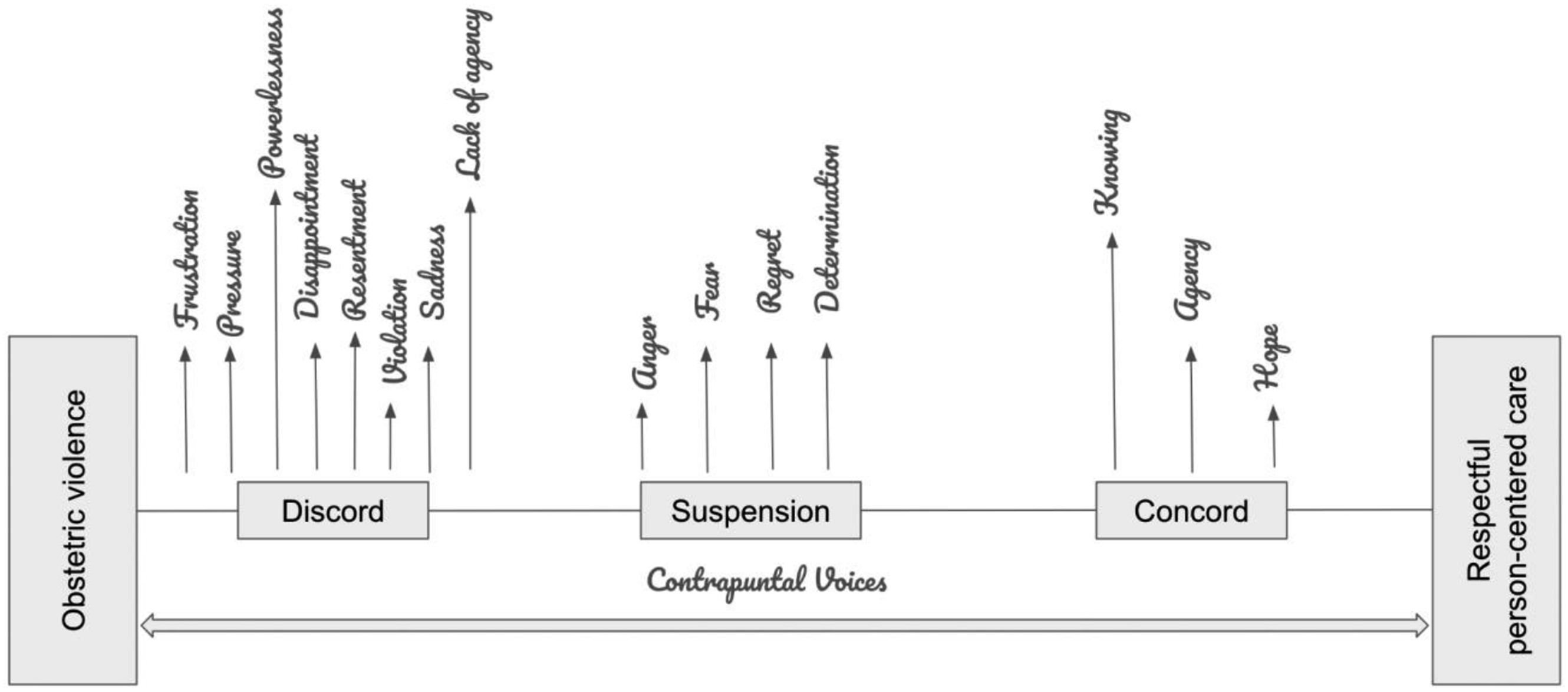
… … … … …my baby would be … …clearly … …contributed to the 4th degree tear. …ultimately … … …learnt more about induction. …pressure to induce labor just because my water had broken. …better chance of breastfeeding if he wasn’t induced. …refused to stop the induction when I asked her to. …time to start labor on my own …at least have had a birth experience closer to what I wanted. …waited until baby was ready… …would have grown more in my belly.
The context poems are created to draw the reader’s attention to the participants’ main problem with their experiences, in this case the experience of induction. However, this iteration of the poem partially excludes the participants’ feelings. Keywords, as mentioned in the methods, are an important part of the process of listening. Here, the keywords are bolded and show one voice or tone indicating a negative experience. Each individual sentence shows what the participants’ experienced during their inductions, and the circumstances in which they experienced them, as observed by the phrases ‘scared into accepting’, ‘bullied into’ and ‘forced to’. An institutional barrier is also highlighted in the context poem, when one participant shared that their care provider stated that ‘baby would be taken from me and put on antibiotics’. The context poem version of ‘I didn’t know I could say no’ is divided into, a) the first stanza where the participant shares the challenges of being induced and b) in the second stanza where they speak of what should have happened or how they could have acted in hindsight. This format makes the challenge of obstetric violence more actionable to make changes and address the specific issues narrated through the poems going forward as they focus just on the problem.
The Value of Discomfort in Obstetric Violence Research- a Discussion
Full IPoems have been criticized for reading like a version of the original transcripts (McKenzie, 2021). Additionally, the use of this method with open text survey data here, introduces the risk of not having enough information or rich enough narratives. However, the methodology adapted in our paper, where sentences from each participants’ narrative were used to build the poems, attempts to address these critiques– drawing across narratives and selecting those with rich detail, and combining them in a way that presents the solidarity between survey participants who shared experiences of labour, birthing and obstetric violence. This adaptation of IPoems enabled us to generate poetry from short narratives. We found that using first person voice (e.g., starting each phrase with “I”) is most effective to capture embodied experiences when the participants share their stories, feelings, thoughts and experiences.
Other critiques of this form of arts-based method refer to these poems as ‘found poetry’, because it is created, often in partnership with participants, and requires the use of participants’ unadulterated language or is generated from literature (Butler-Kisber, 2002). However, we consider this to be a strength of this method because it allows for participatory research while ensuring communities access to an art form that is traditionally reserved for the “elite”.
Poet Laureate Billy Collins stated that poetry is ‘an interruption of silence’ (Leavy, 2020) which is appropriate for any form of gender-based violence, in this case obstetric violence, to break the deafening silence around it. Leavy (2020) further uses the term feeling-picture to the generation of poems carefully and artistically selecting words and arranging sentences with purposeful pauses to skillfully present a social issue by creating sensory scenes. During the writing process, we discussed the best order in which to present the poems to most effectively evoke readers’ feelings, and to attempt to comprehend how the poems’ arrangement may influence these feelings. We decided that ordering them by Full-Context-Sparse would preemptively give away the details and full narratives. Conversely, we determined that the opposite approach of Sparse- Context- Full would not have the same impact if the full poem was read last, as a team member stated “It takes the wind out of the full poem”. Thus, we decided that the Sparse-Full-Context order was most appropriate to illustrate the unique impact of each approach. This order creates a level of anticipation, and a desire to know more of the context, without preemptively divulging the plot in the full IPoem, and while the context poem falls last, it can be viewed as a novel iteration.
Although we experimented reading the poems in different orders, we strongly believe that there is no set order in which they should be read. Instead we recommend that the readers attempt to read the poems in multiple different orders; and then listen to them being read aloud, in their own or someone else’s voice, while writing down how each of the ways of listening and reading makes them feel. We acknowledge that no matter what order these poems are read, the reader may feel discomfort. We encourage the readers to engage reflexively with their feelings. Violence research can not only be discomforting but also traumatizing, depending on the intersections of the researchers’ identities, context and embodied experiences. There is potential in this discomfort to move the needle forward in different ways to address an urgent issue, such as obstetric violence, based on how the person sitting with and experiencing the discomfort is willing to move it into action (Chadwick, 2021).
Discomfort has been conceptualized as an epistemic resource for critical feminist research, which can lead to transformative and just research, particularly for obstetric violence (Chadwick, 2021). Furthermore, recent discourses around the effectiveness of trigger warnings deem them as ineffective (Brigland et al., 2023). Sitting with discomfort, and the intense feelings it generates, could be considered a passage to commit to and be accountable to working towards an end. In contrast, ‘methodologies of the privileged’ (Sholock, 2012) feed in, and may enable the sanitization of obstetric violence narratives, such as by referring to obstetric violence as mistreatment.
Researchers have utilized other forms of arts-based knowledge dissemination methods such as an animated film with scripts and narratives created in consultation with the participants on their experience of complications during the perinatal period (Mackintosh et al., 2018). A scoping review of 71 arts-based studies on health research suggested the broadening of arts-based methods and inclusion into qualitative methods which showed a better audience engagement, rich communication and ensured access of the study findings to people beyond academia (Boydell et al., 2012). While sensitive research with arts-based methods may create discomfort in its listeners, audience and stakeholders, this pathway opens up space for critical reflection, interaction and potential pathways for compassionate solutions.
Finally, Gillgan and Eddy (2016) share that the essence of listening requires developing a bond, or trusting relationship with the participants, and that merely engaging in the act of listening is a form of showing respect. Verbal and written communication is more than the use of words. The sound, the tonality, the unsaid, and the hidden references may not be readily comprehensible, but they are all vital to communication. Through multiple listening sessions, VCRM provides opportunities to intentionally identify each of these components by understanding the contrapuntal voices. Chadwick (2021) talks about this multivocality as a result of embodied listenings in her work by presenting the contradictory nature of women’s birthing narratives through two competing voices namely, the restitution voice (sharing everything being fine) and the fleshy voice (showing the problem parts of the experience). In earlier work, the first author (KM) presented contrapuntal voices through a framework (Mayra et al., 2021); and argued that in order for obstetric violence to be addressed through respectful birthing experiences we will need to see a rise in the positive voices, while replacing the negative and neutral voices.
Positioning the Researcher- a Methodologic Strength
Researchers have attempted to reflect on the sensitive nature of conducting obstetric violence research by identifying and declaring their positionality, while being reflexive of how their intersectional identities and experiences influence their standpoint (Niles et al., 2021; Van der Waal et al., 2023). In this paper, we do this for the dual purpose of understanding the particular measures and care needed to ensure that the research process is in tune to participants’ needs, while simultaneously protecting ourselves from the impact of continuous engagement with obstetric violence as it can be isolating and emotionally draining (Boveda & Annamma, 2023; Holmes, 2020; Yip, 2023). We found this to be especially true while engaging with the topic through arts-based research. The literature describes these feelings of isolation as ‘compassion fatigue’ and ‘burnout’, and explain that it may lead to ‘vicarious or secondary trauma’ (Schulz et al., 2022).
I (first author, KM) started seeking sensitive and feminist ways to explore birthing narratives with women after observing obstetric violence in my places of practice as a student nurse-midwife in India, and after facing a language barrier when trying to talk about these embodied experiences of women with traditional research methods. It wasn’t about finding a common tongue but had more to do with the gender and power-based challenges in sharing experiences.
My (BR) career in perinatal health research in the global south has exposed me to various forms of obstetric violence and to the invasive nature of obstetric practice more broadly. It led me to seek out a physiologic birth supported by midwives during my pregnancy. When developing the poem on induction I could easily see loss of agency and power. I had to be aware of my views on obstetric interventions to allow positive narratives to also be elevated.
My (TA) own intersectional identity is what directly shapes my experiences navigating institutions, and created an awareness of how structural power imbalances impact lived experiences from conception. This personal awareness is what led me to Critical Feminist Theory as a framework, through which I can attune myself to themes of institutional power, access, and mistreatment within participant’s narratives.
My (SV) understanding of the power of poetic inquiry to center the authentic voices of underrepresented communities in research, comes from my own lived experiences as a racialized immigrant, parent, and clinician with over 40 years of witnessing these narratives in real time. My undergraduate thesis was a comparison of voices in ancient poetry from my country of origin with the tomes of William Blake, lauded in the western canon. In my experience, VCRM and Ipoems distill and amplify all of those voices in ways that traditional approaches to knowledge translation lose the urgency and import of findings.
Throughout the analysis process we individually and collectively experienced a level of vicarious trauma as a result of the intrinsically sensitive content and explicit descriptions of disrespect, abuse and violence. The first seven months of coding and thematic analysis with the 2,741 participant narratives was particularly isolating for the first author (KM). Furthermore, the vulnerability we experienced was compounded by two factors; a) our intersectional identities and experiences, as we analyzed instances of obstetric and reproductive violence that resemble our experiences, and are relevant to us as a result of our identities within the broader society; and b) our reality of living in, working in, and navigating systems and institutions (Howard & Hammond, 2019). This includes the academic settings in which we conduct our research, that exist within a colonialist white supremist nation, and produce “weathering” (Forrest-Bank, 2016; Geronimus, 1992). We mindfully sought to create a safe and compassionate space for ourselves where our vulnerabilities could be shared, listened to and acknowledged (Page, 2017). This was a key realization and point of reflection throughout the analysis process.
Community Driven Knowledge Translation
We used our vulnerability, produced by our lived experiences and identities, as a means of reducing “researcher blindness”. That is to say, an inability to understand the complexities of participant narratives that may arise as a result of researchers’ position of privilege stemming from their identities, experiences, and existing power dynamics. As researchers we have access to a level of privilege due to our position, supported by a large educational institution. However, as previously discussed, our positionality is informed by our intersectional identities as racialized, migrant women who have given birth, and have navigated reproductive and obstetric health services. This serves to strengthen our analysis and interpretation of the participant narratives.
Arts-based research should not be subjected to the measures of validity that traditional research is judged by (Leavy, 2020; Morris & Paris, 2022). Exercising reflexivity about our positionality throughout, was a critical way to maintain rigour of our research (Massoud, 2022). We had a team member, independent of our study, check five percent of the data against the codebook to maintain inter-coder reliability, in the coding phase of the study. We presented our methods and preliminary iterations at every step to the steering council members, that includes one of our research analysts. We continued our analysis and created further poems after getting the assurance and confidence that the members found this method and adaptation effective, and a community responsive way to tell community stories. Accessibility of the poems are an important quality criterion to evaluate the poems in terms of their clarity of meaning and how available this meaning is to non-academic people (Leavy, 2020). We achieved that by creating the poems from people’s actual voice and regular language. While the language used is directly from the participants, we retained the interpretive control by choosing which sentences would be selected from the data and in what order they would be presented in the poems (Leavy, 2020). Finally, this adaptation of voice centered relational method to create three types of poems with multiple peoples voices presents what Leavy (2020) describes as crystallization, where the meaning of the poems is not only confirmed by the thematic solidarity of these narratives but also the multi-stakeholder steering council whose reaction to these poetry iterations have been strong, palpable, positive and who have been moved and inspired to use them with their illustrations in various knowledge mobilization forms.
During the RESPCCT study’s data collection and analysis process, the research team continuously discussed utilizing arts-based knowledge mobilization ideas to disseminate the study findings. The process included community participants via the study’s Community Steering Council. Community members have strongly endorsed the use of poems as a means of knowledge dissemination. Previous research supports the use and impact of poetic and visual ways of research and knowledge translation (Ludlow, 2014; Mayra, Matthews & Sandall, 2021; Rose, 2016). Thus, we contracted artists to illustrate some of the poems to make it more impactful, and add a visual component. The following illustration (Figure 3) is for the poem ‘I didn’t know I could say no’. The artist had access to the full poem and has previously worked on initiatives on reproductive justice. Cascade of Interventions* (Illustrated by Aditi Passey). *The Artist has Highlighted the Isolation, Loneliness and Lack of Control Over Choices About One’s Own Body, that Comes With the Pressure to Induce Labour. The Lack of Communication From Healthcare Providers Paired With the Isolation of Being Left Alone With One’s Thoughts and Fears and Not Being Able to Voice One’s Choices, Is Scary. The Artist had Several Discussions With Us to Talk About the Process of Induction and Her Vision From the Early Draft Sketches to the Final Illustration.
As obstetric violence researchers, we strongly believe in the power of poetry as a method to draw attention to its extremity and urgency (Bhattacharya, 2013; Chadwick, 2018; McKenzie, 2021). Arts-based knowledge translation allows people to get a better sense of the embodied experiences by helping the audience to achieve a ‘felt-bodily states produce affective’ response (Richardson, 2000). This attempt of generating empathy increases the impact of the research outcome being conveyed. We have noticed this impact first hand, while presenting our findings in meetings and conferences, when the mood of the room is visibly and audibly shifted as a result of sharing participants’ narratives of childbirth. This is particularly true when themes of obstetric violence are shared through different arts-based research outputs, such as birth maps (or body maps), I-poems, birthing stories, or illustrations. Given that the over 6,000 participants from the RESPCCT study not only represent the study population of interest, but also the study’s primary audience and stakeholders, the poems are a sensitive means of presenting the study findings. Finally, we have experienced that when people with power and influence are confronted with narratives of obstetric violence through arts-based research, it can create a level of urgency amongst them and potentially initiate the desired change in perinatal and birthing practices.
We will continue to present these poems in different forms, with illustrations, with voice recorded, and with related art-works to our stakeholders for an impact at all levels, which will continue to include the community members. We have plans to organize events for knowledge mobilization where stakeholders that include community members, policymakers, care providers, midwifery students and clinicians will be invited and the different poems and their illustrations will be shared through poetry reading, and a display of the illustrations.
Conclusion
In summary, our case study illustrates that with large amounts of qualitative data with shorter phrases, it is possible for researchers to go beyond qualitative content analysis and achieve a meaning making process through the use of VCRM. It is also particularly useful for qualitative data that addresses sensitive subjects. The use of poetic inquiry as an arts-based research method, with VCRM’s emphasis on language and words, is particularly impactful for its ability to stir people’s emotions (Leavy, 2020; McKenzie, 2021).
We present our research of obstetric violence, a significant global health issue, while using an arts-based research methodology, to generate the maximum impact and inspire stakeholders to take action. We note that VCRM is particularly effective for sensitive data. In our experience, community partners connect with and find the poems an impactful means of sharing research. The violent and traumatic nature of obstetric violence experiences becomes clearer as obstetric violence research expands from traditional quantitative and qualitative research methods, to arts-based exploration. The rawness and reality of obstetric violence can be discomforting, methods such as poetic inquiry can intensify its urgency and calls to action.
Footnotes
Acknowledgments
We are grateful to the community steering council members, especially Isabelle Dena who has co-analysed the RESPCCT data, have provided important insights for this manuscript. Sophie Gaur, Shruti Ghosh and Aditi Passey have played important roles in guiding and interpreting the poems into illustrations and arts-based outputs of various forms for knowledge integrated mobilization. Artists are important to our work and their vision is crucial for translating the arts-based findings into outputs that are understandable and impactful for all stakeholders. We are immensely grateful to our 2741 participants in Canada who courageously shared their stories and experiences of perinatal care through the RESPCCT survey.
Ethical Statement
Funding
The author(s) disclosed receipt of the following financial support for the research, authorship, and/or publication of this article: We received funding from Canadian Institute of Health Research (494085, AWD-006440), Michael Smith Foundation for Health Research (RT-2021-1940), Doctoral Research Award and Vanier Canada Graduate Scholarship.
Declaration of Conflicting Interests
The author(s) declared no potential conflicts of interest with respect to the research, authorship, and/or publication of this article.
Data Availability Statement
Available on request.