




Abstract
This article contributes to scholarship on collaborative knowledge-making by documenting our methodological experiences of conducting multiple ethnographies and the emergence of what we describe as a methodology of quilting and vulnerability. We borrowed from critical and decolonial frameworks for knowledge production and knowledge dissemination to
reflect on the organic processes that we implemented to document our polyphonic conversations about the challenges, passions and perspectives of being educational researchers and language teachers. We argue for the use of dialogical interactions, using “quilting” as an aesthetic representation of lived experiences and as a medium through which knowledge creation becomes democratized and supported by interdisciplinary scholarship. In this article, we demonstrate the utility of a methodology of vulnerability in learning about the complexities involved with negotiating identities in collective work in the field of language education. We use the metaphor of the quilting bee to theorize vulnerability in collaborative knowledge production. The ultimate goal of this paper is to inspire educators and researchers to explore other forms of studying themselves and their relationships with their identities, cultures, and languages, especially from international contexts. In the end, as an emerging research collective, we advocate questioning and challenging whose voices are being heard and the power relations involved in collaborative and interdisciplinary research processes.
Keywords
Introduction
This paper was inspired by the idea of a polyvocal approach to research (Samaras & Pithouse-Morgan, 2020) in which various voices are made visible through dialogic encounters rooted in diverse ways of knowing and experiencing the world, especially among researchers and educators. In a sense, our approach was mediated through the mode of narrative by plural but interdependent voices and consciousnesses that supported each other during the global COVID-19 pandemic. To reflect the polyvocal process we engaged in, and to draw the reader into the vulnerability we experienced, reflections on language and identity from each author are woven throughout the paper. As if it were with scraps of cloth, finely spun threads, new textiles, or a needle deftly wielded by an experienced quilter, we invite you, the reader, to sit with us as we work.
In the following sections, we share our journey as a collective, and our reflections on that journey. Our journey of working and learning together is, in and of itself, our main finding, conceptualized within a critical paradigm as a methodology of quilting and vulnerability, thus rejecting the objective depiction of a stable “other” by finding alternatives that encourage reflection in which the embodied, collaborative and reflective aspects of research are experienced (Lindlof & Taylor, 2002). Here, we recognize that other researchers have discussed the centrality of emotion and vulnerability in academic work (Behar, 1996), and we aim to share our experiences with becoming vulnerable in a professional setting. As each author noted at different stages of this work, “even though the topic of our conversations was often about language and identity as teachers and researchers, the details of those findings are not the topic of this paper but rather our process of working together” (Mama). Nonetheless, “our identity texts are what make our paper different, and interesting. It’s all about the stories and how they fit together” (Beatrice). As such, “although we did not set out to write about the process of working together, that’s what happened” (John) and “we found...that the process we engaged with to create knowledge and go about our identities...became a methodology of vulnerability” (Yecid). As a result, “we had to completely forget what we knew about research” (Mela) as “we came to understand the power of engaging vulnerably with colleagues” (April). Ultimately, “we didn’t realize how much we needed one another and how the pandemic would change us. The fact of working with people we trusted came first, and the project (what we would do) came second. The group (who we are) determined what we would work on. You don’t have to know what the product is going to be before you start. If you decide you’re going to let it evolve, you’ll get things you didn’t even expect” (Mela). True to the interwovenness of a quilt, the sections of this paper are cyclical and interdependent.
We begin with a description of the materials we used to craft our quilt: our group positionality and subjectivity. Here, we briefly summarize our reflections about what it means to be researchers and educators. Woven throughout the main sections of the text, individual authors share language identity reflections that tap into the most intimate aspects of our identities, experiences, memories, and feelings. These reflections sparked our curiosity to find alternative forms of researching that resonate with us at an emotional level. We then describe the vital groundwork of our project, the methodology of vulnerability, which grew from our discussions of safe and brave spaces, and which provided us with solidarity, resilience and strength throughout the COVID-19 pandemic. Then, we describe how we came to see ourselves as both quilters and the quilt, using the metaphor of quilting. We talk about how we came to understand our work as a methodology of quilting. We continue with sections that describe our collaborative quilting tools, our process of data analysis, and our proposals and implications. We conclude with a reflection on the methodologies of quilting and vulnerability.
Ultimately, our purpose with our ongoing work is to show that vulnerability is a key aspect in ethnographic research and academic work that resists neoliberal pressures to re/produce impersonal Western forms of knowledge creation and dissemination. It is our intention to challenge, question and resist formal, positivist and traditional academic writing conventions while also wanting to be comprehensible to a wide audience (Kalan, 2021).
Gathering Quilting Materials: Our Positionality
In June 2020, 6 members of the BILD/LIDA research community embarked on an experiment to write a non-hierarchical, collaborative paper to embody and enact an alternative way of being academics, with a view to transforming the very spaces of which we are a part.
The six of us are a diverse group of scholars from different cultural, linguistic, and academic backgrounds. However, academically, we all come from a critical applied linguistics background; professionally, we have all been, and some still are, teachers of additional languages. That is to say, while we all know how to earn our bread and butter by teaching learners or future teachers of additional languages, we have all become interested in questions of power and decolonization as these relate to language. English is the common language in which we work together, but our recent ancestors spoke languages of Africa, South and Southeast Asia, South America, and Eastern Europe as first languages. Some members of our group speak some of these languages as first languages, too. Our entry into our collaborative work was inspired by critical and decolonial epistemologies, including approaches that are anarchist, feminist, and Indigenous. It is not our intention to appropriate these knowledges (see also Kovach, 2009). Quite the opposite, we attempt to advocate, highlight, and amplify knowledges that have been marginalized. As such, with many of the authors coming from backgrounds outside of North America with colonial pasts (e.g., Colombia, the Philippines, Ghana, India), we bring forward our experiences of vulnerability and ontoepistemological histories that have been informed by decolonial, critical and Indigenous scholars (e.g., Denzin et al., 2008; Paris & Winn, 2014; Smith, 1999; Wilson, 2008; Yunkaporta, 2020). These experiences have helped us observe ourselves (e.g., Batac, 2021) and understand the roots of our researcher and teacher identities, as we have engaged in various personal and professional conversations through “quilting our knowledge” (our own term) while supporting each other emotionally through the time of the COVID-19 pandemic.
Paramount was the solidarity we experienced and the camaraderie we established amongst ourselves during this time. Our collective includes someone who finished an M.A. thesis and started a doctoral program during our time together; other in-progress doctoral students at various stages on their PhD journeys—one of whom completed that journey and successfully defended while we were still working together; and a well-established faculty member. We took time to discuss our expectations for communication (which we share in more detail below in the section Quilting means being vulnerable), which helped us to work in a more non-hierarchical way. We rotated leadership roles for each meeting and did our best to make sure everyone had a chance to share their point of view while practicing active listening and non-judgement. As we attempted to reimagine and reinvent a new future, we sought to support each other to survive in a post-pandemic world in which other knowledges and knowledge-making strategies are possible (de Sousa Santos, 2008).
As such, we envision the development of a less logocentric and more community-oriented consciousness. The aim of this article is to share our collective process in this way of working. To enact the process of decolonization and dismantle oppressive hierarchies, this new state of consciousness cannot only be for the favoured few, it must be for everyone (Oviedo Freire, 2019). Hence, we built a quilt of knowledge, embroidered with ideas, memories, and lived and felt experiences, overlaid everywhere with love and respect. In the next section, we share our quilting process.
Stitching and Sewing a Quilt of Knowledge: A Conceptual and Methodological Process for Knowledge Production
We gathered online to discuss our views of belonging, identity, language, and diversity and to experiment with a collective process of generating knowledge. Our first online meeting was in June 2020. Our first 10 meetings were bi-weekly and focused on an iterative and collaborative process of knowledge production. Each meeting was approximately 2 hours long. We continued to meet from December 2020 to June 2021 to reflect and begin distilling our experiences into the text you are reading now. As we worked, we realized that a conceptual framework is not merely a collection of concepts but, rather, a construct in which each of us plays an integral role. With this in mind, we hoped to challenge binary mindsets of what it means to collect data. That is, our reflections within a collaborative paradigm became part of the raw material, but they also became the synthesis, as symbolically we were stitching and sewing our knowledges. We imagined and reconfigured the dialectical nature of synergistic interactions and diverse methods of inquiry and saw ourselves as creators of knowledges through weaving. In a sense, we saw ourselves as “bricoleurs” who “recognize the limitations of a single method, the discursive strictures of one disciplinary approach, what is missed by traditional practices of validation, the historicity of certified modes of knowledge production, inseparability of knower and known, and the complexity and heterogeneity of all human experience,” and we have come to “understand the necessity of new forms of rigor in the research process” (Kincheloe, 2001, p. 681).
We are individuals with diverse worldviews who converged at the intersection of solidarity, vulnerability, and care. In this section, we discuss the elements involved in quilting and how we engaged this metaphor to collaborate and make meaning. During one of our meetings, Mela shared with the group her fascination with quilting, a term given to the process of joining pieces of fabric together through stitching them onto a thick, soft backing, using a needle and thread. The image of the quilt resonated with our group immediately, as we had been stitching and crafting together our diverse thoughts, ideas, and concerns about language, education, and academia. Mela pointed out that quilting can be seen as a methodology. The colorful surface collage of stitched-together fabric that the eye sees is reinforced by the thick warm batting inside, analogous to the solid foundation of previous research that underlies our work, and, in fact, all academic work. The backing piece, traditionally all one solid fabric, situates the physical quilt, as well as the metaphorically quilted research piece, in a local context which is indeed all of a piece by definition, since we were all able to come together to work harmoniously in/through this space.
This metaphor has not been used in this kind of extended way in any previous work that we are aware of. Thus, our work is potentially an original contribution. We intend this manner of metaphorical, collectively grounded quilting process as a demonstration of anti-colonial resistance to more “mainstream” approaches to Western research in which mixing and matching, collaging and creative piecing, are frowned upon and rarely fundable. We have used our own experiences as the raw material of our quilting, to show that many different elements of our pasts, whether painful or pleasurable in memory, can be brought forward into the variegated final product that represents the way we want the world to see us as researchers. To reflect this ideal, Figure 1 depicts our connected photos from a screenshot of one of our Zoom meetings and how we feel stitched together, like a quilt. In the sections that follow, we interweave and stitch our cultural and linguistic identities with this methodological process. Our quilting bee: Stitching and Sewing Identities.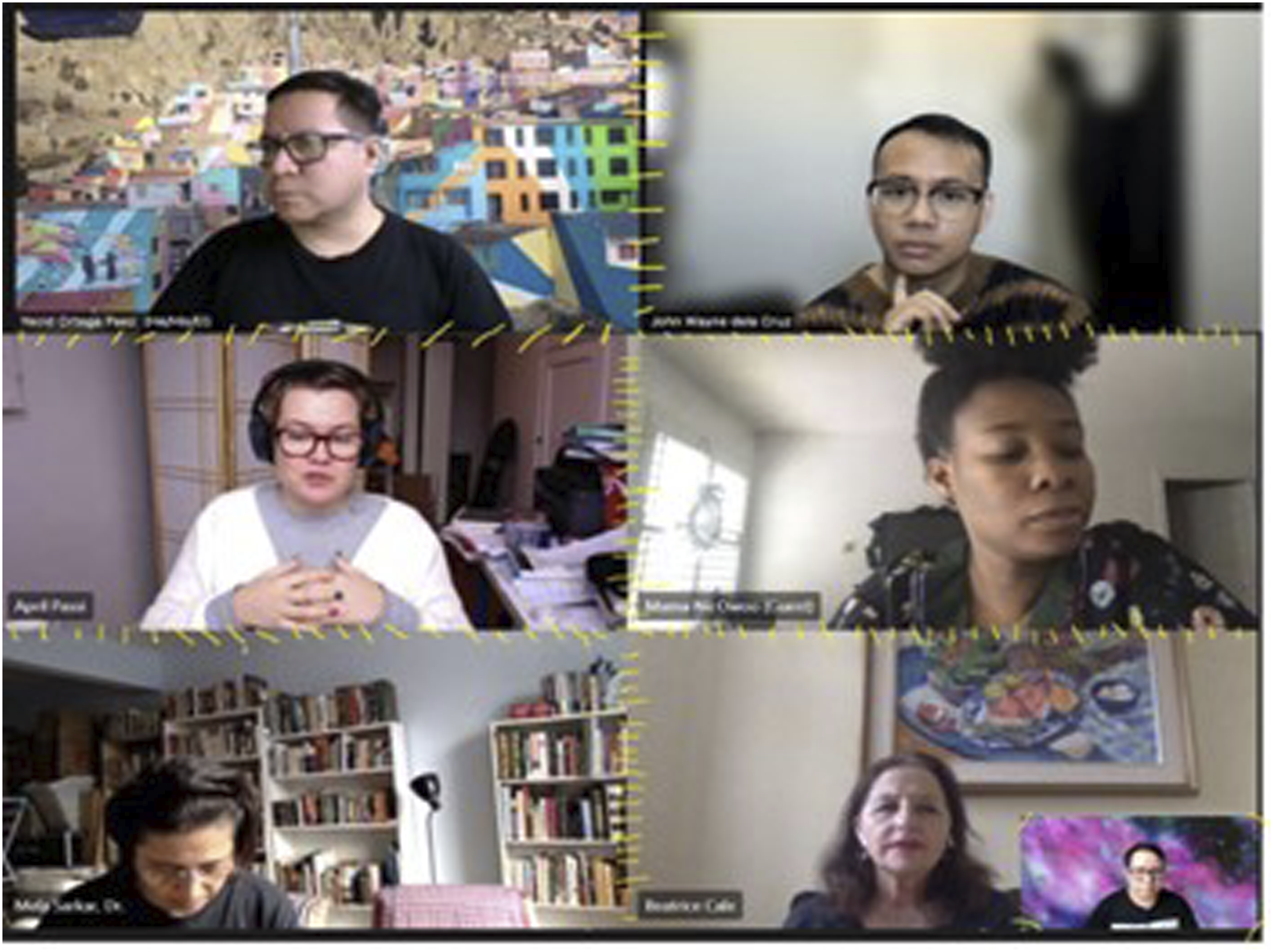
I gravitated toward the study of minoritized languages in Canada as an academic and career focus because of the frustration I felt at not having learned my parents’ first languages, Bengali and Ukrainian, as a child growing up in Toronto, Canada. Our parents spoke only English to us. But it was not until I began working with members of a First Nation (Sarkar, 2017) that I started to become aware of the ways in which speakers of Indigenous languages here and all over the world have been actively prevented from asserting their linguistic human rights. I am only just beginning to confront my own language issues. It’s a journey that will take the rest of my life.
Being a mother and now a grandmother, as well as a career academic (now near retirement), has shaped me as someone who enjoys patching together ideas as well as fabric. Coming from two such disparate and diverse cultural origins meant that hybridity and the juxtaposition of incongruous bits and pieces to create a new whole was the only way I knew how to live. Because of the way it enables meaningful embodiment of this hybridity in a tactile and aesthetically satisfying way, working with textiles has become one of the chief joys of my life (Figure 2). So has working with children! Grandchild with quilt, 2020 (Off to kindergarten).
Thread and Fabric
Our common thread became our conversation during online meetings. At each meeting, we kept threading and stitching together ideas that helped us to build our personal and collective understandings of what it means to be a language educator and researcher. Borrowing from an ethnography of different voices and self-study approaches (Batac, 2021; Sawyer & Norris, 2013; Tidwell et al., 2009) and inspired by anticolonial and Indigenous approaches to research (Archibald et al., 2019; Smith et al., 2018; Wilson, 2008; Yunkaporta, 2020), we used a multi-dialogue approach to engage in conversations and stitch them together. A traditional quilt is a creation that incorporates fabric pieces from many sources: some recycled from older clothing no longer useful in its original form; some modern, perhaps based on traditional models; some completely new and innovative. In this manner, we arrived at the idea of each one of us as a colorful piece of fabric with diverse identities and personalities. We envisioned our experiences, our ideas and even our identities as fabrics to be recycled, transformed, and shared. Quilters strive for both originality and respect for classic patterning in their work. In the same fashion, our group aimed to experience an emergent and truly collaborative way of working together that reflects who we are. We also drew on the traditions of classic academia. We viewed the creation of this piece of writing for publication as a classic pattern that we then innovated upon.
Mama with her grand Akosua Adobea in her home, which also housed a school.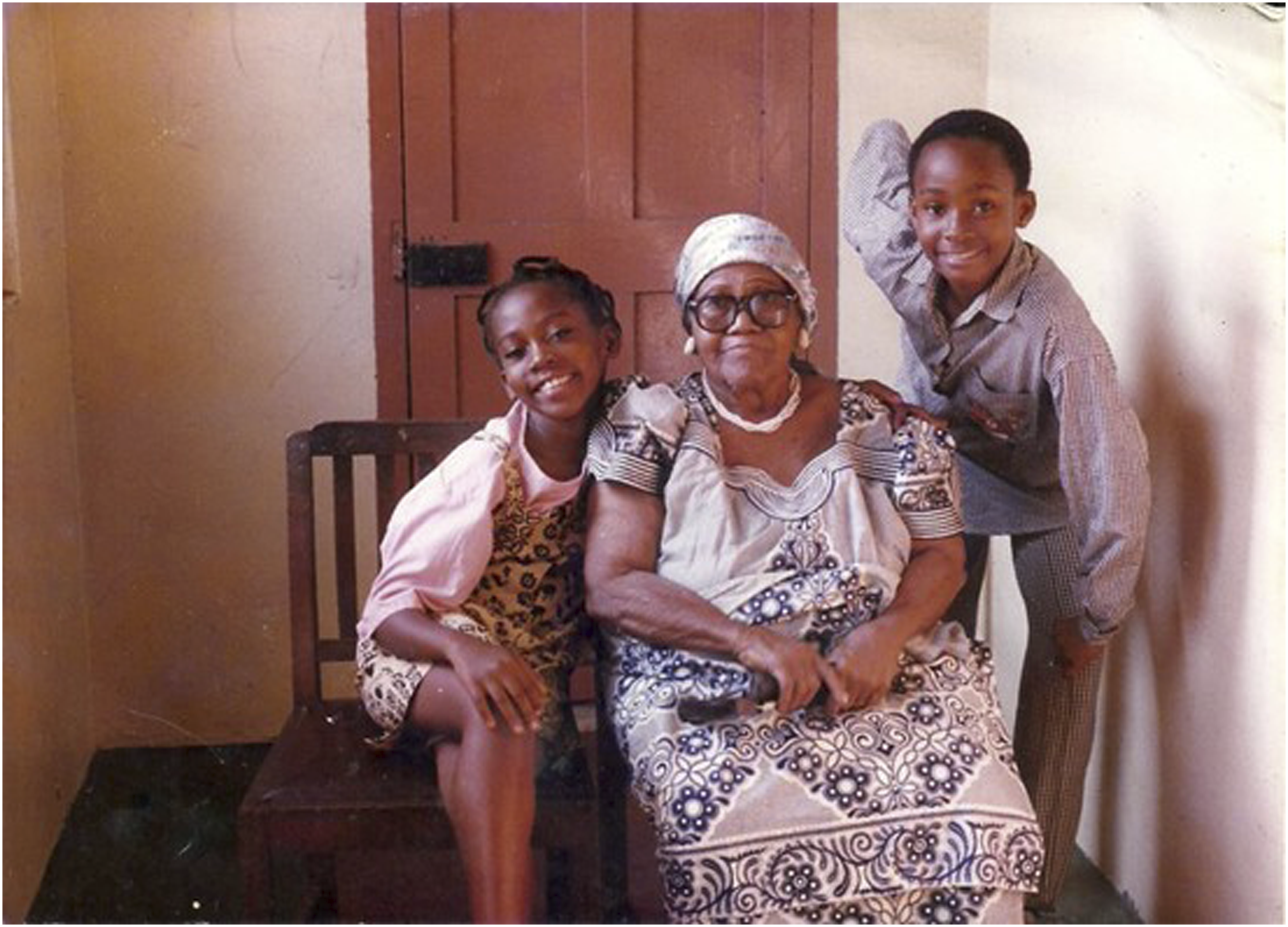
Weaving
Because quilts use cloth, quilters also need to be aware of weaving. Weaving together different strands to create something substantial, strong, and new is also one of the ideas that informed our work during the multi-dialoguing that we engaged in. The scholarship that we have learned from, up to this point, could be said to be the warp of our thinking—the structure that holds it together; the ideas we came up with collectively could be said to be the weft, or horizontal threads that give the visual interest and excitement to woven work. Within decolonial, critical and Indigenous approaches to research, different forms of weaving have been offered as a process to theorize on participants’ own experiences, feelings, and emotions about a phenomenon and to decentralize hierarchical Western forms of knowledge creation (Ryder et al., 2020). Similar research methodologies have been used in the form of braiding/trenzando to describe experiences that inform and shape participants’ personal and intimate practices and ways of educating (Calderon, 2021).
John’s positionality, as a ‘starter pack’ meme.
Yarning
The strands of threads used in weaving can also be referred to as yarn of many different kinds (wool, cotton, linen, hemp), which for us represented our distinct voices. In a sense, yarning (see Yunkaporta, 2020) became one more metaphor that was central to our work together. In this context, it meant telling each other our stories—spinning them out over weeks and months to create the structure of the story and of discovery. We stitched ourselves together into a new community of thinkers, feelers, actors, and educators. This kept us together throughout the difficult pandemic years—recognizing distinct yarns that came together as part of our attempt to do polyvocal, critical and decolonial research.
Kuna fabric from Colombia.
Kauhava, Finland: In 2008, I visited Kauhava, Finland where a church registry employee took me to a house where my great-great grandparents may have lived. I’ve also included a photo of a street sign bearing my family name (something I never see in Canada!). A tea caddy made by my Gaelic and English speaking great-great grandfather, and a teacup from a set that belonged to his wife, my great-great grandmother. They immigrated from Dunoon, Scotland to Canada.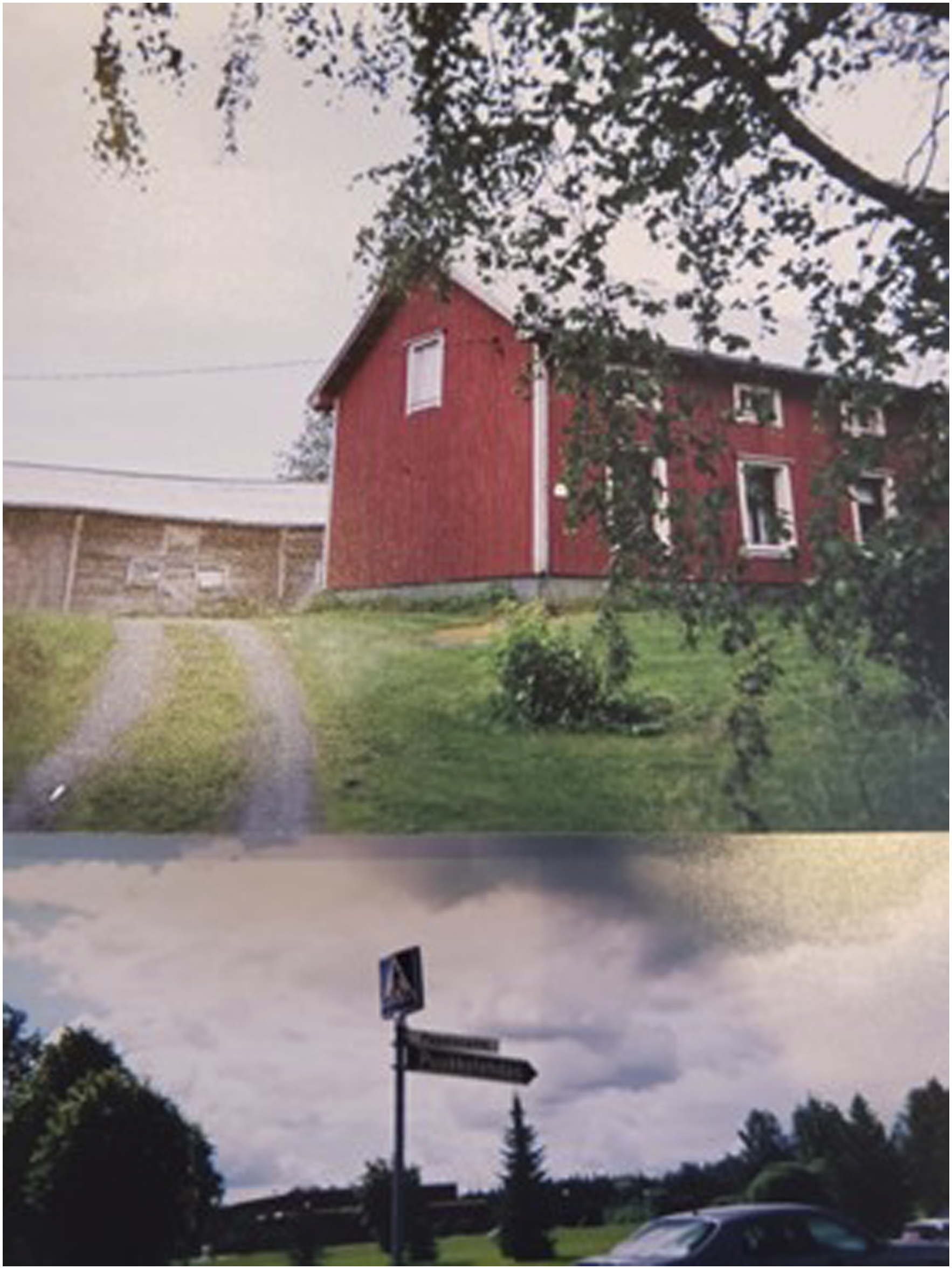

A New Quilting Technique
The quilting we have been doing could perhaps be visually represented by the Kantha-style quilt below (Figure 8). Kantha is a traditional Bengali technique that uses old cotton clothes to create useful garments or blankets. In this version, cotton pieces from Indian clothing are pieced together on warm wool batting to create a blanket that can be used in a Canadian winter. This hybrid approach, using traditional techniques from rural India to help deal with the cold Canadian climate, is a metaphor for our work with each other as hybrid scholars, in search of ways to blend and strengthen our hybridity as we weave our words and ideas together. Both the Global North and the Global South inform and enrich who we have become (and are continually becoming) as scholars. Kantha, a graphic representation of quilting.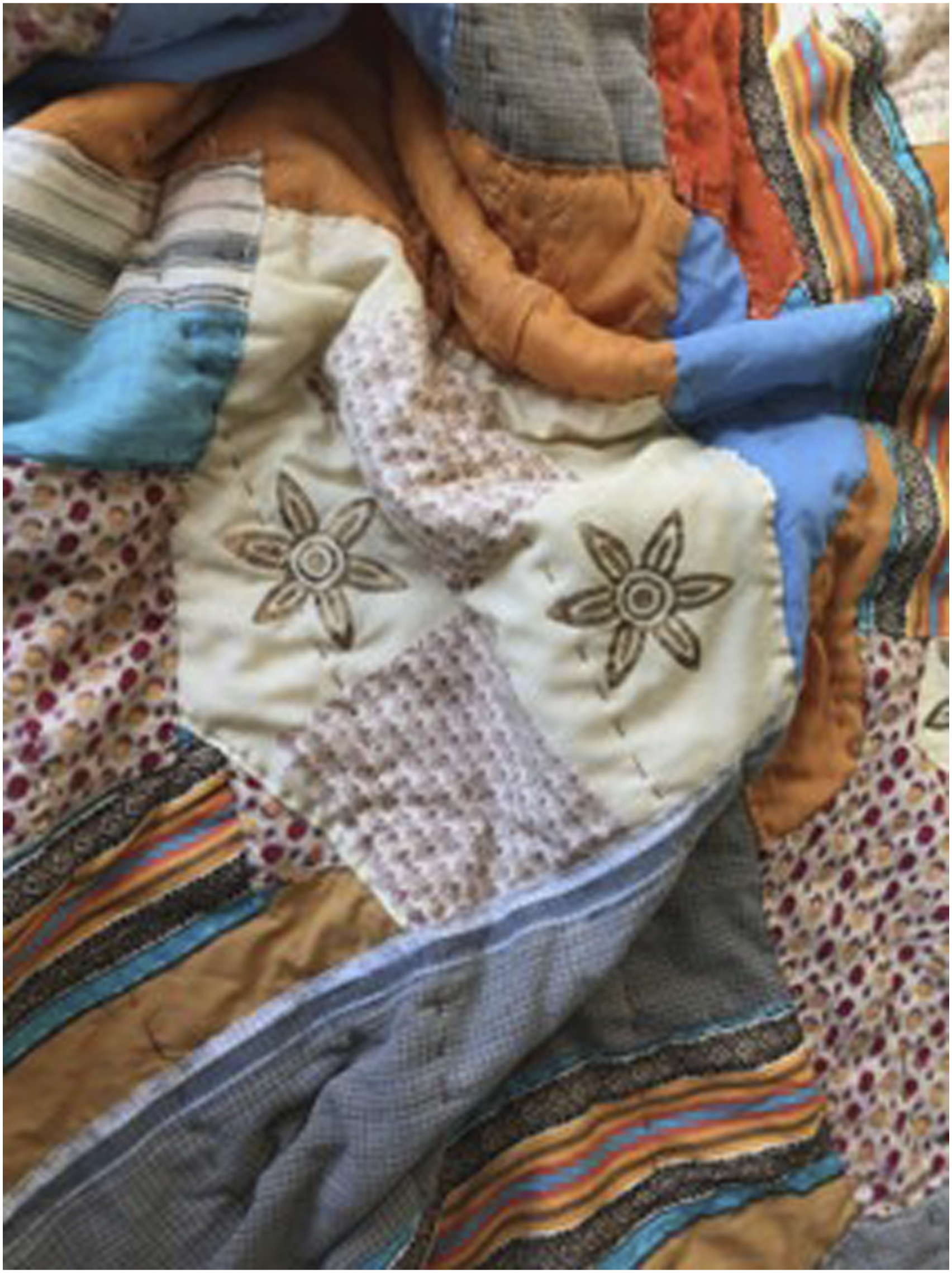
My two uncles.
My parents immigrated to Canada as refugees looking for shelter and new beginnings. Their “homelands” had many names that kept changing depending on which way the political winds blew: Russia, Turkey, Poland, Ukraine, Germany, France. That same wind pushed us around the globe as we simultaneously acquired all these different languages without prejudice along the way.
But I have been thinking about my two unknown uncles, particularly recently, due to the latest ‘discovery’ of hundreds of unmarked Indigenous graves at the sites of residential schools in Canada. They too, were innocent children. Snatched from their families, terrorized and murdered. My uncles were young. They were still children when they were murdered by Nazis. They certainly had committed no crime.
The persecuted one in these histories is almost always the ‘other’, be it the foreigner, the stranger, the one of a different skin, a different religion.
My father was the older brother. He had narrowly escaped from their home in Poland into the Soviet Union thanks to his membership in the communist party. He was welcomed there with open arms as a Marxist comrade, a leader in the Party and an educated agronomist. The Soviets needed his expertise on the collective farms (Russian “kolkhoz”). His brothers were too young and still in school. Their mother insisted that her babies remain with her. They were all educated secular Jews; they owned bookshops in the city, they would be safe. Big mistake.
That I exist is a miracle, and who I am is part tragedy and part a grateful adventurer in life and learning. I have no family. Never had any grandparents, no aunts, no uncles, no close cousins, nothing. And yet, and yet, life is a treat, a joy, a promise for all of us.
I am here, not only to mourn, but also to honour and to remember. Our existence is sacred. To harm a child is incomprehensible. How is it that tribal adherence is criterion enough to determine if one lives or dies? The tribe can be religion, or colour, class, gender, or any other divider.
Part 2: Don’t fence me in. I have always loved to engage. I refuse to pin myself down or be confined. Only I have the right to define who I am. Our identities do not fit into neat boxes. Appreciating a distant song, a language, a custom and a cuisine, there is nothing more thrilling to me. I learn languages easily but without attachment. We are different, we are the same. This is not a popular concept now. People are pulling themselves apart. I reject the separation and embrace the interconnectedness, the interweaving of past and future life: the quilt!
When I returned to Canada after many years away as an English teacher and tour guide in Turkey (Figure 10, left) the reaction of people in North America was exaggerated shock fueled by misconception and ignorance. You lived in Turkey?! A girl alone?! Consequently, I would ask if my keen interlocutor had ever even been to Turkey. The response was invariably a no. But, they insist, what about that guy in the movie, Midnight Express? He gets into trouble and is incarcerated in a nightmarish Turkish prison. Therefore, on the basis of one movie, a judgment is rendered, and a verdict is delivered. People! Where is your curiosity? (left) Life in Turkey; (right) My teacher in Belize, Senor Xocoati.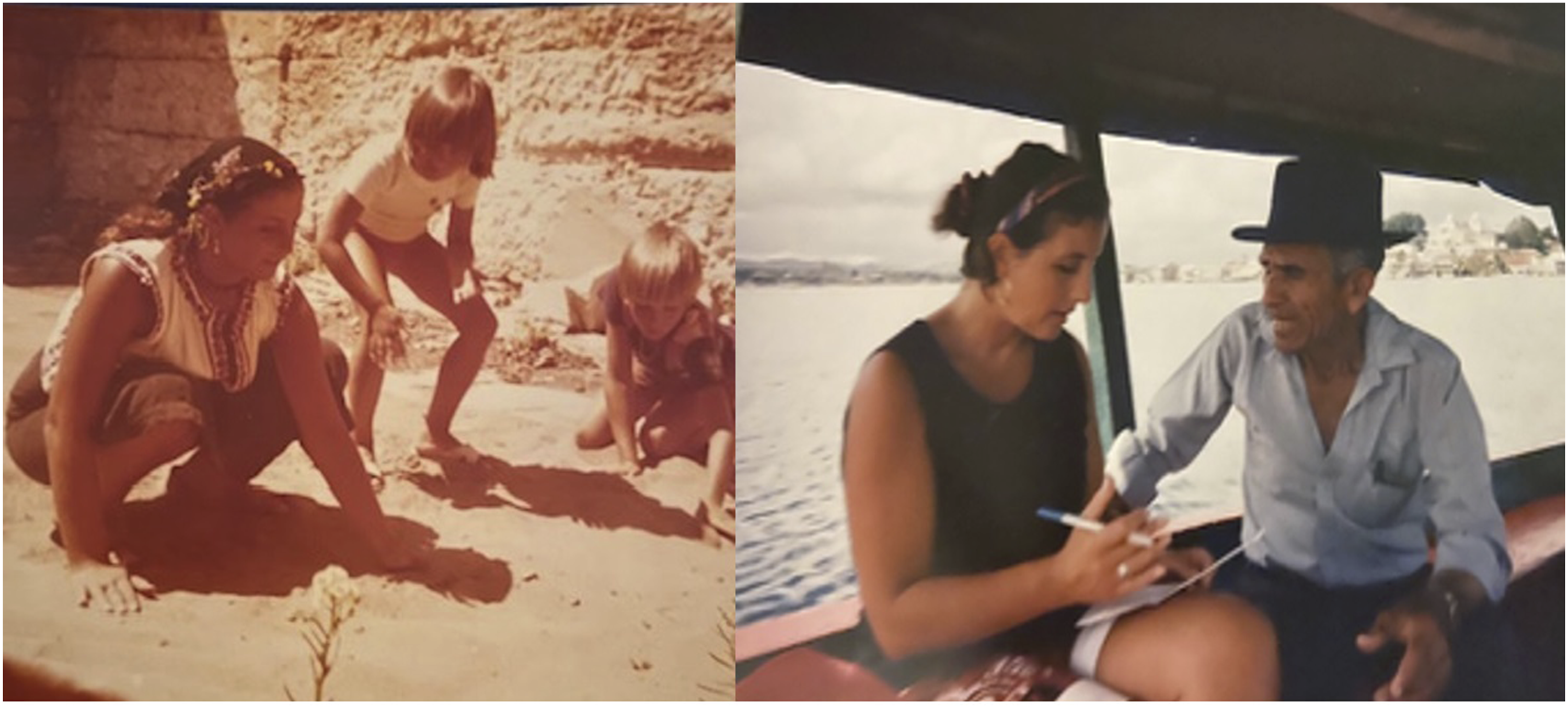
My teachers are spread all over the globe. The shaman from Belize (Figure 10, right) shared his wisdom freely without artifice, without prejudice. He possessed great charismatic powers but was modest and gentle at the same time. This is the education humanity needs.
Scientifically and physically, the atoms of the first starburst are what constitute our actual human make-up. We are one equal body. The idea that there are major differences between us has been broken down by evolutionary biology. This old dusty blanket needs shaking up!
Quilting Tools of the Trade
As polyvocal weavers of knowledge during the height of the pandemic between 2020 and 2021, we used a diverse set of digital instruments to collect and analyze data as we were collaborating; we chose these nine tools to help connect us together across time zones and space, and to match our varied technological literacies.
First, we used the (1) Microsoft Teams platform for recording video conferences, for note-taking and synchronous reflection via the chat function, as well as the integrated (2) OneNote application for asynchronously co-creating and responding to prompts for collaborative writing (and later, for asynchronously reading each other’s responses) about our languages and identities. Further, we designed a multimodal activity to visually put together and share our individual reflections on language and identity. That is, we presented our creations using an online tool called (3) Padlet (Figure 11), which we later realized visually mimicked a quilt and the act of quilting. Screenshot of our “Padlet Quilt” images and text reflecting our creative language and identity activity.
Second, we used several communication tools to plan our monthly meetings and to send and/or share resources with each other (e.g., relevant scholarly readings, potential digital tools for the collaboration, and well-being check-ins). Mostly, we used (4) WhatsApp to delegate tasks to each of the authors regarding writing up and to exchange and negotiate ideas about timelines and due dates. Additionally, we also used (5) Facebook Messenger, (6) our own email applications, as well as a shared (7) Google Drive folder to expand our digital communicative repertoire in instances when WhatsApp did not suffice on its own (e.g., sharing a folder of article readings stored in Google Drive; reaching someone via Facebook Messenger when they are not responsive via WhatsApp; resending dates or tasks via email if our WhatsApp thread buried old information and became too busy with new conversation).
Lastly, we used (8) Microsoft Streams to upload and automatically transcribe video recordings of our online meetings. Once Stream had auto-generated the transcripts, we each worked separately on two or more transcripts to correct transcription errors. Afterward, each of us conducted preliminary content analyses of the assigned transcripts assigned using a shared (9) online Word document (again, via our Teams group). Following the preliminary analyses, each of us went back to a transcript we had not ourselves transcribed, to conduct a second round of analysis, and to collaboratively check where each other’s analyses converged and/or diverged. Once the second round of analyses had been completed, we shared emergent themes in subsequent online meetings, during which we synchronously resolved findings for which the analyses had diverged between the preliminary and second rounds of analysis.
Quilt Sense-Making: Our Approach to Analysis
We followed an ongoing and iterative-inductive process in which we continuously analyzed and reflected on our chat transcripts, recordings of meetings and online messages and identity texts. As O′Reilly (2008) posits, data collection, analysis and writing up are discrete but inextricably linked phases of research. Moreover, we did not follow a traditional methodological trajectory with research questions, data collection, analysis and write-up. Our desire to challenge the binary of data collection/data analysis was evident in the very emergence of our group: we had a desire to explore collectivism, challenge the individualism and isolation of neoliberal academic production, and essentially create a project that rejected hierarchies and linearity. While we believe we achieved our goal, we understand the limitations of trying to express our experience through an academic publication and the conundrum of categorizing an inherently non-linear process of relational knowledge production. Nevertheless, in this section we share details of our sense-making process.
The first part of our process was a fluid process of data generation/data collection/data analysis through a series of 10 recorded bi-weekly meetings over a span of 20 weeks. We then reiteratively reflected on the data we generated over those 20 weeks (e.g., in week seven, we would reflect on what we had discussed and what data emerged in week five, while also creating new prompts for data generation the following weeks). We spent one to 2 hours per meeting discussing ideas, and at the end of each meeting, we set ourselves a reflection question to engage with before meeting again. We used the OneNote application in Microsoft Teams to share and store our reflections and research data. The digital notebook became a layered/quilted artifact (Figure 12). Table 1 outlines our discussion questions from Microsoft Teams and OneNote. Microsoft Teams notebook as a layered/quilted collaborative space. Each tab represents a discussion question for data generation. Later tabs shifted towards analysis. Summary of reflection questions discussed in each meeting.

After the first 10 meetings, we decided to perform a meta-analysis by going deep into the video transcriptions to identify preliminary emergent themes and reflect on them in our future meetings. We divided the recordings of the 10 meetings up amongst ourselves. Individually, we first coded the meeting transcriptions from our assigned videos using in vivo coding (Saldana, 2021), which draws codes rooted in research participants’ own voices (i.e., in our case, the video transcripts). We then synthesized the coded quotations from each transcript into larger themes. Afterwards, we inter-exchanged assigned videos so each of us would have the chance to go over and verify the coding and themes from a video that was not initially assigned to us. We then spent some time during the subsequent meetings to weave and quilt our preliminary individual findings as a group, as well as to resolve disagreements or questions, if any, between the initial coder and the member who went over the initial coding.
Some of the key themes we initially identified were: community building, support, and relationships; defining, creating, and sustaining a safe and brave space; positionality and problematizing identities; belonging and imagined community; different ways of knowing and alternative forms of knowledge production; problematizing ‘canonical’ knowledge; describing our spirit; decolonizing while teaching English; decolonizing the self; reconnecting with family through language; and grief over loss of language and culture. Our initial coding also helped us notice the general structure of our meetings (e.g., how much time we spent discussing different topics during each meeting). Another theme that emerged was that we were spending a great deal of time “checking in”. We had built check-ins into our meetings to establish a safe/brave space, but we noticed that these check-ins were lengthier than we had originally anticipated. This reflected the care and concern for each other that became woven into the fabric of our inter-relationships.
Once we identified these key themes, we continued to iteratively make sense of our data and emergent findings together by ‘quilting’ our thoughts, ideas, and reflections every time we met to talk about said findings, which further helped us reflect on how we were collaborating. In other words, we continued to discuss the themes that were emerging as we reflected on our time together, leading us to distill our key findings. Finally, we inductively and collaboratively organized (“wrote up”) our quilted thoughts, ideas, and reflections in this manuscript according to the following thematic categories: (1) Vulnerability (e.g., decolonizing the self and English language teaching; grief over loss of language and culture; describing our spirit), (2) Safe Spaces and Brave Spaces (e.g., community building, support, and relationships; defining, creating, and sustaining safe/brave spaces; checking-in), and (3) Vulnerability and Research as Open-Ended Processes (e.g., problematizing canonical knowledge; different ways of knowing and producing knowledge). These were the final synthesized themes that surfaced during our interactions throughout the quilting process, and one of the most poignant outcomes that we wanted to share through publication. We further elucidate each of these three themes in the following sections.
Discussion and Conclusion
The section below discusses the product of our knowledge creation, collaborative work and engagement with our emerging ideas. We posit that research does not need to be an isolated practice but quite the opposite, a collaborative and vulnerable endeavour in which all researchers can share their own vulnerability in safe, brave spaces. No knowledge is complete unless it is embodied, felt, and shared. Here, the metaphor of a quilt reflects the many threads (discussions), colours and pieces of fabrics (our identities) that are condensed into one completed symbolic artifact that represents our diverse experiences in moments of vulnerability, struggle and pain.
Quilting Means Being Vulnerable
It is difficult to summarize in words the work of vulnerability that made this project possible, as expressed during one of our meetings (Figure 13). We have found that our commitment to being vulnerable was a vital prerequisite for quilting. This section, therefore, outlines the ongoing affective work we did to create a safer space (for sharing our reflections), which we have called the methodology of vulnerability. John took note of Mela’s reflection on our work as a collective.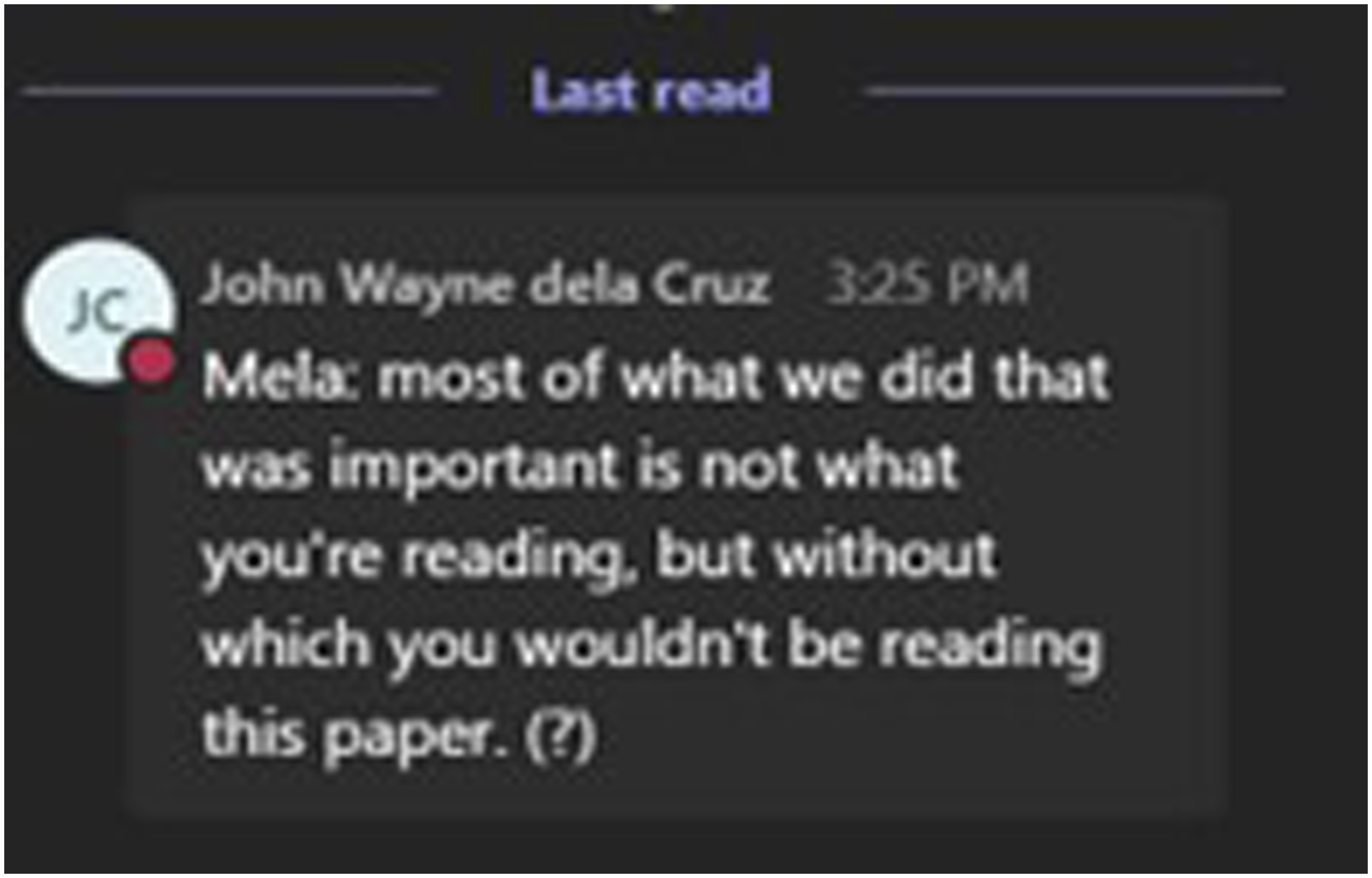
Vulnerability, Safe and Brave Spaces
We began our journey together with a writing activity to reflect on and create our own definition of a safe space (Figure 14). We wove together the concepts of a ‘safe space’ and of ‘vulnerability’ since “to write” (or in our case, to share) “vulnerably is to open a Pandora’s box”; that is, “who can say what will come flying out?” (Behar, 1996, p. 19). As such, we agree with Behar (1996) when she argues that exposing oneself in one’s academic work carries risks, both personally and intellectually. Personal risks entail the uncertainties surrounding the words, actions, emotions, or ideas that could come up during the course of opening ourselves up vulnerably, while intellectual risks entail the risks we take as we collectively attempt to “stretch the limits of objectivity” (Behar, 1996, pp. 12). A screenshot from our conversation about safe spaces in our Microsoft Teams collaborative space.
This kind of intellectual risk-taking has traditionally been taboo in the academy, especially in disciplines such as applied linguistics, with its roots deep in positivist, psychocognitivist traditions and its fear of the unknown and unexplored. As Mike Long wrote in 2003, “...there are ‘critical theorists’ and... epistemological relativists who express general angst with SLA’s [Second Language Acquisition’s] cognitive orientation... while offering no alternative but the abyss” (Long & Doughty, 2003, p. 866, our emphasis). We align ourselves with those relativists, and, by choosing to explore the supposed “abyss,” we enter and transform it, emerging with new approaches to knowledge production.
Given such uncertainties and risks, we recognize that, while we collaborated on creating a safe space, our safe space might be safe for most or some of us but may be unsafe for others. As such, we also found that through our methodology of vulnerability, we quilted together not only a safe, but more importantly, a brave space, wherein we had opportunities to be brave, and to share our stories vulnerably in as safe a space as we could sustain, in order to “take us somewhere we [could not] otherwise get to” (Behar, 1996, p. 14), personally as well as intellectually as critical applied linguists.
Further, we continually returned to the concepts of a brave and safe space, and of bravery and vulnerability throughout the project, to iteratively (re)create and sustain our brave space: On July 20, 2020, Mama said: “No one should be harassed for the way they express their views. But I also think that it's important for us not to be afraid to say something that is on our minds so long as we say it with respect. And sometimes people are also expressing opinions out loud because they're questioning."
As in quilting by hand, sewing together three layers of a quilt (the backing, the batting, and the top) in patterns of hand-sewn stitches is not a quick process, but, rather, is built slowly over time. Imagine the backing: our quest for belonging and community. The batting: our identities and language. And the top: the solidarity among ourselves to be supportive and open, which finally makes a stunningly beautiful quilt that represents who we are.
We found that the protocols for yarning set out by Yunkaporta (2020) − connectedness, diversity, interaction, and adaptation − reflected the elements we needed to build our methodology of vulnerability: Connectedness: Finding one another through a pre-existing group of graduate students and senior academics (BILD/LIDA) helped us to craft a “network of networks,” with different but intersecting narratives, trajectories, knowledge, and vulnerabilities among ourselves. Although some of us were strangers or mere acquaintances in the beginning, we eventually learned to look out for each other. Diversity: We all came from different cultural and linguistic backgrounds and from an array of teaching and research experiences that enriched our multi-ethnography. Interaction: Committing to regular meetings created space and time for personal check-ins, and a commitment to deep listening created the feeling of a brave and safe space to share our individual and collective strengths as researchers, writers and people. Adaptation: A commitment to non-hierarchy through constantly shifting roles from meeting to meeting (e.g., chairing, taking notes, designing tasks, taking the lead) helped us navigate the intricate and unexpected directions in which we were heading.
As we constructed our quilt as a brave and safe space of support and solidarity, we also unbalanced the relations of power so as to level the playing field for all and make sure all voices were heard (Golosky, 2017). We worked together to stitch the quilt, making sure it was strong but also acknowledging our diverse textures and colors (knowledge, identities, languages and heritages). To strengthen these protocols, our methodology of vulnerability also weaves together principles proposed by feminist methodologies (e.g., Beetham & Demetriades, 2007; Lather, 1988; Smith, 1999), polyvocality (e.g., Golosky, 2017; Samaras & Pithouse-Morgan, 2020), and anarchist approaches (DeLeon, 2019; Kinna, 2012). We propose that this methodology of vulnerability is a new and genuinely original contribution, rather than being indebted to existing approaches. The principles we derived from a comparison of our work with the work of others helped us refine the project’s goals of providing mutual support and fostering non-hierarchical power relations as we worked together to challenge isolating and rigid forms of academic writing and research dissemination. Solidarity worked its way into social groups as a practice that expresses our willingness to support others with whom we recognize similarities in a relevant context (Prainsack, 2020). Our solidarity was expressed in terms of empathy because it required us to be vulnerable and really understand the feeling of a connection with others. It made us into a fellowship of people who have something important in common (our teaching and research) while facing our personal crises and finding support in the collective. Figure 15 below provides a peek into our continuous solidarity throughout our research collaboration. Screenshots from our third Teams meeting and the auto-generated transcript in August 2020, when the second COVID-19 wave hit Canada.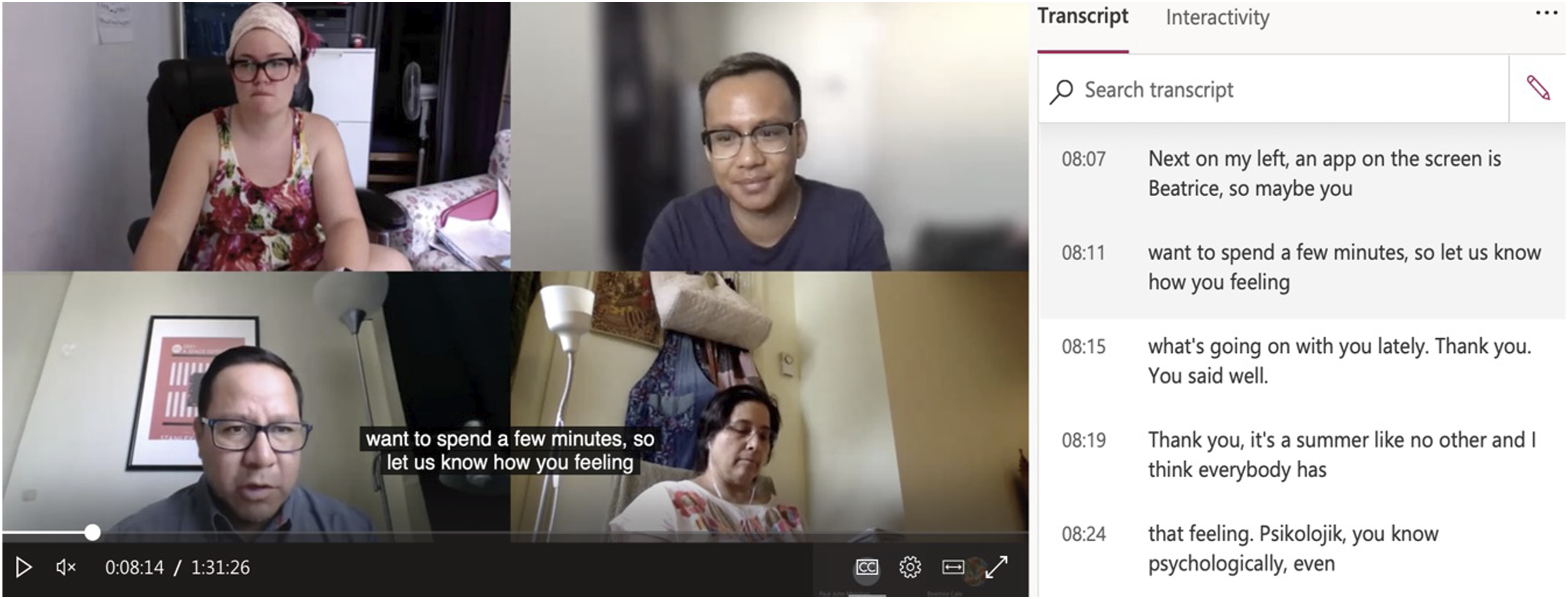
Moving Beyond the Quilt: Vulnerability and Research as Open-Ended Processes
We embarked on this project with open minds and no expectations save a commitment to being respectful and vulnerable. Below, we describe possible research and educational implications of taking the time to engage in vulnerable quilting with colleagues, a humanizing process that recognizes and amplifies all voices.
Qualitative research has been typically about working with the ‘subjects’ of the research, prioritizing objective data collection for the sake of replicable and generalizable findings and academic rigor. However, research trends are shifting towards collaborative knowledge production. Indigenous, decolonial, critical methodologies and participatory action research have embodied this ethos for decades (Fals Borda, 1987) in order to dismantle the hierarchies present when conducting research. We advocate for vulnerable, non-hierarchical and plural forms of knowledge creation and knowledge engagement (de Sousa Santos, 2008; Escobar, 2020). Although we agree that diverse forms of research must be acknowledged, we believe research must go beyond mere acts of collecting, documenting and systematizing data. In a post-pandemic era, research must advocate for the experiences of members of a collective: their identities, their needs, and their own agency, to foster social and personal transformations. In other words, researchers must question and challenge ways of doing research that promote thinking and creating in isolation, ways which may do harm to communities rather than building or strengthening those bonds. Our attempt at a collective quilting to weave new knowledge was one tiny step in the shift we propose, from Western/Eurocentric modes of doing scientific work to collective modes of acknowledging vulnerability as an alternative for liberation and transformation.
The members of this collective have accumulated multiple decades of experience in teaching language and literature at various levels from K-12 to higher education and adult education. We also have experience working with pre-service teachers. Although we did not set out to be a collective, we consider that the work we did together wove us into a professional learning community. Our general goal at the beginning was to discuss language education and to write a paper investigating these topics, and thus we created a safe and brave space to discuss the tension between our professional lives as teachers of English and other colonial languages such as French and Spanish, while also believing strongly in the need for decolonization of language teaching. We shared our personal experiences with cultural and language loss, as well as our experiences being both oppressed and oppressor in different contexts. Our methodology of quilting and vulnerability is rooted in critical and decolonial approaches to research and resulted in collaborative learning, which, during the pandemic years, reduced our isolation, supported our teaching praxis, and helped us see our potential as educators in relation to our students (Hord, 1997). This way of connecting us as educators motivated us to develop a new culture of support that will translate into our work with our own students (Fullan, 1982). We encourage educators, as well as (qualitative) researchers, to come together, collaborate, and connect to create their own support systems. As Yunkaporta (2020) reminds us, only in this way can we come to knowledge sustainably and as such, we learned that the more support we get from our peers, the more resilient we become to supporting our students in their own growth.
Sharing the Completed Quilt
In one of our meetings, Yecid mentioned that having been trained in a top-down, deductive way of conducting and disseminating research, in which knowledge is to be approached with rigorous pragmatism, it was not always easy to take a bottom-up, inductive approach where we had to trust the emergent process of quilting. Rather than come with a pre-existing outline of expectations of what should be done during the quilting, we instead became vulnerable and centered our work on seeing one another as we were, on taking time to care for one another during the COVID-19 pandemic. Our lives, personal and professional, converged. We wonder if our experiences, shared here, will resonate with others. As we hear little Ezra (Mama’s son) griping in the car from Toronto to Montreal during a meeting, we ask ourselves: Are we narcissistic? Is what we have done just for us? Or is it something bigger? In our conversations, cognition is socially distributed (Moore & Rocklin, 1998; Sutton et al., 2010). In this paper, we have attempted to share our journey with a methodology of quilting and vulnerability through a critical lens, which could be used to explore any number of topics. The collaborative process speaks for itself:
As a research methodology, duo-ethnography engages the researcher in a multi-dialogic process that ideally supports a shattering of preconceived views about a particular theme or event and one’s narrative relationship to that theme or event (Norris et al., 2012; Sawyer & Norris, 2013; Sawyer & Norris, 2013). Duo-ethnography as a method is more conceptual than prescriptive. Its method is framed by a poststructuralist approach to research. Such an approach rejects the notion of a single, fixed, and absolute reality existing independently of human consciousness and imagination. Instead, meanings are constructed in the process of interpretation. (Sawyer & Liggett, 2012, p. 629).
Throughout our more than 15 months of online engagement and support, we experienced the “shattering of preconceived views” as we un/re-learned who we are, where we are coming from and who we want to be (come). We learned about the connections between our personal and professional lives. Through respectful, curious, and vulnerable conversations, we learned how our diverse backgrounds enriched our lives, as we learned about each other and learned to respect and understand our differences. We also learned that as a collective, we are stronger. By quilting our perspectives and lives together, we supported one another through struggles and commitments to research and education. Figure 16, below, shows some of our reflective findings in the form of a woven word collage. Weaving our words: References are made to theory and literature (warp), woven with emotional responses (weft).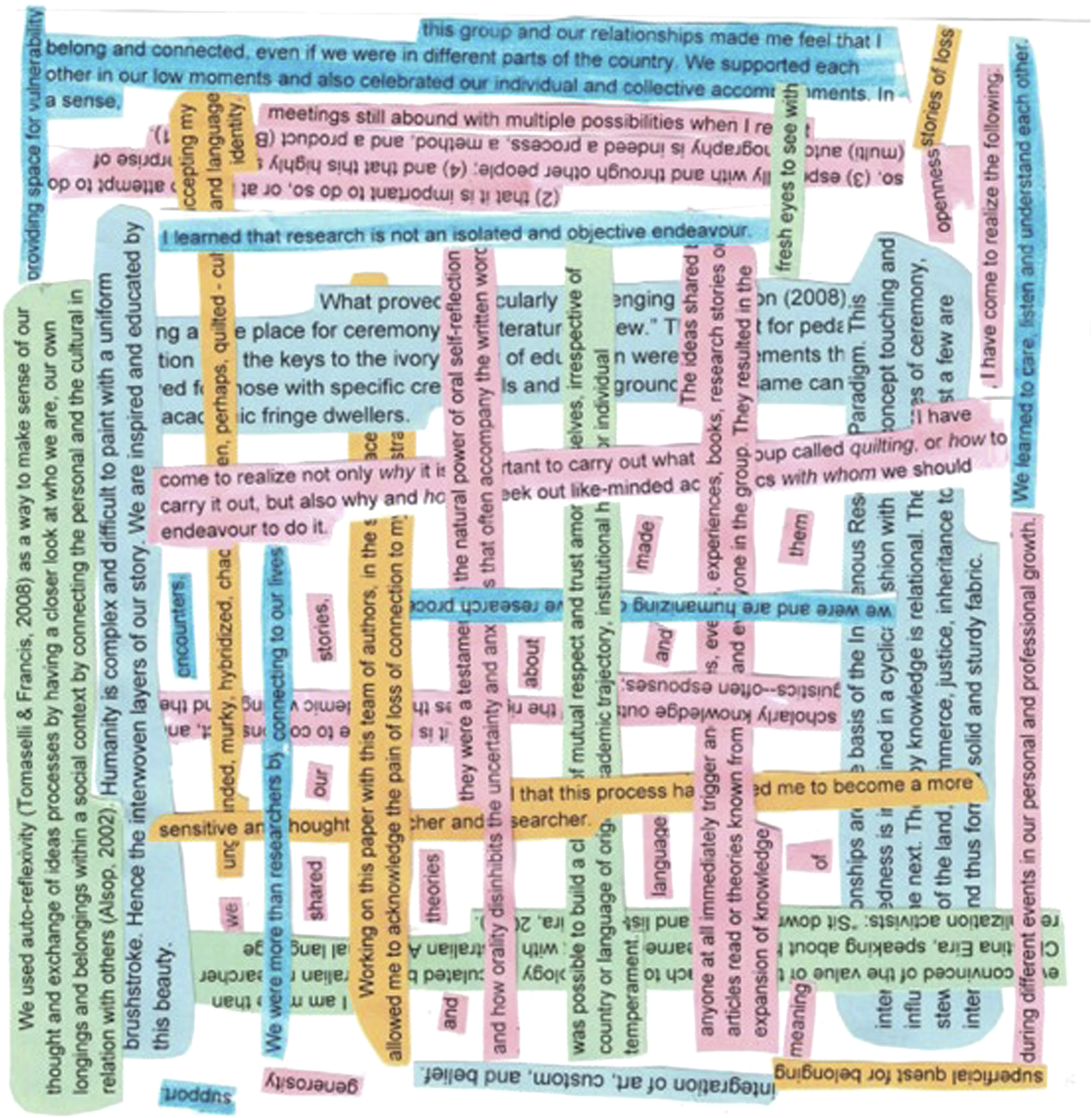
What makes our work scholarly, we wonder? Is it the scholars writing the work, their process, i.e., following conventions, or their use of previous research to advance new theories and pathways to research? As a collective trying to make sense of what it means to be teachers and researchers of language, we believe our experiences helped us to move beyond inflexible notions of what is an acceptable scholarly ontology towards more humanizing forms of connecting, creating, educating and learning. We learned that we are not only bodies doing research and pursuing academic work, but we are family: with all the nonlinear and complicated communication and emotion that family entails. We learned about ourselves as we faced the most challenging thing—the emergence of trauma in the form of a pandemic. Some of us shared memories of our past and present relationships with relatives, friends, colleagues, students and the academic world.
Working as a collective was not always light and easy since our work required supporting one another through deep listening and empathy: the methodology of vulnerability. This means that we had to co-sustain a space where we could all feel safe and brave enough to listen to the retelling of traumatic events in our lives with an open heart, and to respond in support and solidarity. Yes, we sometimes cried together. Quilting our stories made us stronger, braver, more resilient, and hopeful. We will continue our work as a collective beyond this research exercise and hope that sometime soon we will be able to meet again in person. In this polyvocal research exercise, we prioritized cultivating relationships: we know because we are. We were fascinated by the possibility of writing an academic paper that highlighted the collective, the humanizing forces involved in knowledge creation, the beauty of solidarity and the strength of committing to being together. We hope that fellow applied linguists, educators, and qualitative researchers can glean insights from this work, from how we quilted together, riskily, vulnerably yet bravely, to find new ways to interrogate, (re)imagine, and enact (collaborative) knowledge production in the academy—with all its limits and possibilities. In the meantime, we plan to keep quilting moving forward, weaving about topics beyond methodology (e.g., language teaching praxis), and expanding our knowledge quilt.
Our ultimate goal is not to impose or condemn any form of doing research, but to inspire educators and researchers to explore other forms of studying ourselves and our relationships with our identities, cultures, and languages: our relationships with each one. We advocate questioning and challenging whose voices are being heard and the power relations involved in research processes. In the end, what matters is lifting up one another through a commitment to our shared humanity, challenging neoliberal forces that encourage competition and that seek to isolate us, thus creating relational accountability as we design and co-invent safe and brave spaces for personal and professional success.
Footnotes
Acknowledgments
We would like to thank all our reviewers for their generous feedback on drafts of this paper, which helped us immensely as we revised and edited. We would also like to thank our families and friends who supported us in our work as we engaged in this meaningful process of collaboration.
Declaration of Conflicting Interests
The author(s) declared no potential conflicts of interest with respect to the research, authorship, and/or publication of this article.
Funding
The author(s) received no financial support for the research, authorship, and/or publication of this article.

Notes
All the authors in this article are members of the Quilting Collective and shared equal distribution in knowledge creation.