




Abstract
As education researchers increase our focus on affect as a crucial dimension of school practice and pedagogy, we also have the responsibility of taking up the paradoxical nature of seeking to represent and analyze moments of feeling that, by their very nature, evade our understanding. This article explores the question of attending to affect in education research by drawing on research conducted in a seventh grade classroom in a mid-sized city in the western United States, where students were explicitly invited to ground argumentative writing in lived experiences that were significant to them, including those experiences often deemed difficult and thus saturated with affective intensities. Invited to use visual arts-based methods of representing the felt dimension of the project, participants used both color and abstract design as a method for representing the complexity of these affective intensities. The author makes an argument for this visual method of representation that invites students to illustrate their affective experience in ways that maintain its complex, contrasting and often non-linguistic nature.
Keywords
I found Sabrina Ward Harrison’s (2005) book in the darkened halls of the library, minutes before closing. I pulled her art journal from the stacks and sat on the ground to turn the pages as quickly as I could. The announcements were blaring at lingering patrons to proceeded to the check-out area quickly, but I struggled to close the book. I was mesmerized by the big inky loops across pages that had been painted and torn. I stopped to linger on one page that blended messy, uneven lines of writing in ink and pencil with swirls of blue chalk. I stayed with one sentence for a few extra seconds, feeling its resonance with the way my life felt in that moment:
sometimes I feel closed in the trunk of fear. Sometimes I leave the tiny afraid girl inside of myself all alone, betraying myself.
I felt encased in fear too, having just left college a few weeks into a new semester. My anxiety had ramped up so much that I was struggling to sleep and eat and couldn’t slow down my mind enough to grit my teeth and push, push, push my way through to May. I withdrew from classes, returned home to live with my parents for the rest of the semester, and avoided grocery stores and malls, places where I might run into my friends’ parents, who would see on my face that I was not ok.
But now, here, alone, on the floor of the almost empty library I felt just the tiny sliver of space around the anxiety. Somehow, I saw myself in the painted pages and uneven sentences. Sabrina had found a way to make art in the middle of the mess. Maybe I could too.
The next morning, I woke up early to drive to the closest art supply store to buy paint, ink, and a black spiral notebook. My art journal became medicine during this lost, lonely semester. Though I returned to school that winter and finished my degree a few years later, I never forgot crumpling to the floor of the darkened library with Sabrina’s circles of red clay colored chalk and deep indigo ink, colors that felt like water I could drink to give me relief from the thirst of loneliness and fear.
How Do I Describe This?: “Tara Deletes the Story, Then Decides to Write It Again”
Fifteen years later, I found myself on the floor again. Differently this time. Now, well into my graduate work, at a middle school working on my dissertation study, I found myself on my knees with uncertainty, with a question that felt unanswerable. The research project involved vulnerable writing, an invitation to seventh grade students to explore writing about their lives, especially those experiences that are rarely sanctioned in school writing, experiences that might be described as affective. Their teacher, Michael, and I wanted to explore the way this kind of writing might help students uncover an argument for a persuasive essay that is deeply meaningful for them, a teaching practice born partly from my own experience with writing during the difficult season in my life when I found Sabrina’s books.
Michael and I shared a devotion to this pedagogy of vulnerable writing that has roots in challenging life experiences. Michael’s father passed away when he was just a baby and my family has a lineage of addiction and anxiety that has been a central challenge woven across my life. We share these stories with Michael’s seventh grade class, drawing from Elizabeth Dutro’s (2011, 2013) work with reciprocal vulnerability, an invitation to teachers to include aspects of their lives that are often not invited into school writing. This model invites students to take up topics that are important to them, even if it feels risky for writing in school, and involves a recognition that these life experiences are not separate from childrens’ or teachers’ experience with literacy, but are always, of course, present in the classroom, even when left unacknowledged or uninvited.
It is this highly affective dimension of our work together that poses a methodological question for me, taking me to my knees again. It happened one morning, in the early days of the unit after I shared a letter to my grandpa who passed away a few months ago. I described the way I held his hand, the way he squeezed it so that even though he wasn’t talking anymore, I could tell he knew I was there. After I finished reading, I invited students to write a letter to someone they miss. As I walked around the room, I saw letters to grandparents and pets and friends who live far away. And then I paused, as I saw Tara stop typing on her chromebook, highlight a page of writing and press delete, erasing her letter with a quick click.
I could still see what was left on the computer screen: a newspaper article with an image of a young girl, a ring of flowers resting on her head, smiling in an embrace with several other young girls dressed in white flowing dresses. I read the headline about a car accident that pushed an SUV over a bridge into a rushing creek and about the death of the smiling girl in the photo, Samantha.
I knelt down near Tara to whisper my question, and asked if she was a friend of Samantha’s. Tara explained that my intuition was right but then quickly followed by saying, “I actually don’t think I can write a letter to her in school. I wouldn’t want anyone to see me cry.”
I had cried in front of the class as I read my letter, just minutes ago. I felt this way too, that school required me to hide my tears. So, here we were. Both of us feeling the visceral way writing can take us somewhere risky, somewhere we don’t always want to go, but somewhere we also, maybe, already are.
When I returned to my seat to write a quick note about this moment, I found myself typing quickly in my fieldnotes: “Tara highlights writing, hits the delete button and explains, ‘I don’t think I can write about this in school.’” The words looked ridiculous. That wasn’t what happened. There was so much more to this moment. I felt something. Did Tara feel it too? I knew I could ask her and she would give me more words for my fieldnotes. And they would be useful placeholders. I could trust these words to carry some of the meaning of the moment. But I also felt that this moment called for more. I felt this question as a wall that would slow the research until I could explore new ways of answering it: How else could we represent this moment?
Theoretical Approaches to Considering Affect
I turned to affect as a theoretical home for my question. Affect scholars have long pointed to the way affect slips between words, undoing our tidy attempts to describe it with any certainty. As I searched for theoretical approaches to representing affect, I started to see the way affect scholars rely on metaphors as a kind of pointing to affect, rather than clarity of language to label, name, describe. Gregg and Seigworth (2010) describe the fleeting sensations that we experience as “intensities,” both embodied and between bodies. Affect is also described as shimmers (Gregg & Seigworth, 2010), ruptures (Massumi, 2002), impulses, sensations, expectations, daydreams, encounters in something that feels like something (Stewart, 2007). Affect is “sticky”—those experiences “stick” to us and between us (Ahmed, 2004). Such descriptors invite me into an embodied engagement as I read them, since many of these terms evoke the sensorial and call us to experience them in our bodies as we read them, but they are also words that proliferate beyond a single meaning. Stewart’s (2007) list contains 13 ways to describe affect, but ends with the evasive something. By definition, affect requires us to release our need for certainty and asks something else of us entirely. It asks us to experience through feeling. And though I join in this suspicion of language, I am still searching for a way to describe this moment in fieldnotes, to honor this something that happened. I am still seeking a resolution to the central paradox in affect research: how can we aim to represent affect in our research while simultaneously recognizing that affect cannot be easily bound by language?
Ever since my encounter with art journaling on the floor of the library, I have often relied on mixed media to voice those life experiences that slip past words, so I turned to arts-based education research methods to explore a new take on this question of representation. Yet, while qualitative researchers have certainly explored affect in the context of education research (Anwaruddin, 2015; Boldt et al., 2015; Dutro & Bien, 2014; Hollet & Ehret, 2014; Leander & Boldt, 2013; Leander & Ehret, 2018) and researchers have looked at the use of arts-based approaches to attend to embodied dimensions of experience in education research (Knowles & Cole, 2008; Leavy, 2008), there has not yet been a rich source of research that seeks a bridge between these two fields to make explicit what ABER offers us as researchers of affect in schools.
In the following pages, I share my process of theoretical discovery and its application to this research project in a seventh grade classroom. First, drawing on affect theory as a conceptual framework for this paper, I describe the way scholars think about affect as something that is particularly challenging to represent. Next, I describe the context of the persuasive writing unit in which arts-based methods were employed. Finally, I describe two approaches to visual methods of representation and analysis: students’ use of color and abstract design in their representation of the feeling dimension of the writing project, and my photography of street art and city vignettes as an alternative tool for analysis in this project.
The Paradox of Linguistic Representation of Affect
Affect, as a unit of analysis, provides researchers with the paradox I described previously as the desire to value and represent a dimension that evades clarity. The tension between language and affect is one of the primary sets of concerns scholars return to frequently in their explorations of affect, especially in our methodological attempts to write about affect. Seigworth and Gregg (2010) describe this aspect of affect theory,
[as] an attempt to turn away from the “linguistic turn,” this turn toward affect theory is sometimes focused on understanding how the “outside” realms of the pre-/extra-/para-linguistic intersect with the senses (such as touch, smell, rhythm, and motion sense…Frequently, this work focuses on those affective encounters with music, dance and other non-discursive arts (p. 8).
This move away from linguistic ways of knowing also stems from post-structural critiques of language’s failure to map words onto meaning, the critique de Saussure (1972) calls “the gap between the word and the thing” or the sense that there is an arbitrary nature to a signal and its signification (qtd. in St. Pierre, 2000, p. 483). This lack of inherent meaning in language produces a rupture in its use and poses a challenge for researchers working within language as our primary tool of representation.
Scholars extend this recognition of the linguistic gap to the representation of affect, especially to difficult, traumatic experiences, noting that these experiences provide an extenuating example of language’s limits as they exceed language and defy representation (Caruth, 1996; Dutro, 2013). Within affect theory, scholars take up this argument as it relates to translation, noting as Gibbs (2012) does, that such conversion of affect into words produces a “brutality” in relation to the “felt” experience.
Rather than resolving this tension, arts-based research methods have the potential to perform the linguistic failure, by bypassing the use of any language to voice an experience. Bennet (2005) describes contemporary art as a medium that encapsulates this failure without resolving it, since art “does not convey the meaning of a work or the secret of personal experience; rather, the interaction between artist and viewer is “transactive” (p. 8). Art enacts this failure of language to transmit meaning by engaging in a different kind of relationship with the viewer, a transactive one in which the viewer experiences the sensorial dimension of an experience, rather than the purely linguistic one. Art theorists who see contemporary art as something inherently non-representational also recognize the project of art to be an affective, embodied one, what O’Sullivan (2007) argues by drawing on “Deleuzo-Guattarian terms to move the register away from deconstruction and away from representation, the molecular beneath the molar. The molecular understood here as life’s, and art’s intensive quality, as the stuff that goes on beneath, beyond, even parallel to signification” (p. 126). For O’Sullivan, again quoting Deleuze and Guattari, art activates the “bloc of sensations” in spectators, rather than transmitting some kind of predetermined meaning. He places art parallel to signification, a move that evokes Sedgwick’s (2003) argument for the word “beside” as a placeholder that encourages proliferation, for, presumably infinite “besides” have the potential to proliferate as “lines of flight.”
Existing Scholarship on Affect and Arts-Based Methodological Approaches
I see the need for this theorizing of representation of affect in arts-based practices as crucial for this moment in education research. Though still an emerging body of research in the education field, there is increasing interest in the affective dimension of schools, especially within literacy research (Anwaruddin, 2015; Cartun & Dutro, 2015; Leander & Bolt, 2013; Wargo, 2015). While we must be careful about producing hierarchies between arts-based and traditional ethnographic approaches (Irwin & Spinggay, 2008), we can explore arts-based approaches as crucial, but additive to our existing methods of inquiry, especially in our attempts to understand affect which poses challenges to using traditional modes alone.
There are already many scholars within ABER who take up research that explores what I am referring to as affect, but with terminology that differs from that employed by affect theorists. A tenet that permeates ABER is the way in which researchers make use of “emotive, affective experiences, senses, and bodies, and imagination and emotion as well as intellect, as ways of knowing and responding to the world” (Finley, 2005). Various mediums offer different affordances for attending to feeling and sensation. For example, Leggo (2008) describes poetic ways of knowing as “a process of attending sensually and sensitively to life” (p. 171). Though poetic modes certainly draw on linguistic forms of representation, they do so in ways that differ from other linguistic forms of representation “by using words sparsely…[where] words, rhythm and space create sensory scenes where meaning emerges from the construction of both language and silences” (Leavy, 2009, p. 64). Visual methods offer unique potential to represent the sensorial, what Leavy (2009) describes as the visual modes’ “visceral” affordances. In her use of photography to represent stories of women in the early years of the Cuban Revolution, Elvy (2007) observes, that photography offers a language that can transcend linear thought to represent a “felt knowing” that will “carry through past the immediate, when words alone fall short” (p. 147).
Outside of ABER, scholars in education explore the use of research methodologies that draw on modes that we would consider artistic to describe the affective nature of experience, even though this term isn’t taken up explicitly in their work (Ayers & Tanner, 2010). To point to just a few examples of this area of work, Vasudevan et al. (2010) use of photography with young people describing their neighborhoods through images, Jones’s (2012) use of collage with teaching candidates in undergraduate education writing methods courses to respond to fiction, and Mills’ (2015) use of video sensory walks around youth’s community are several examples of arts-based approaches that use neither the language of ABER nor the language of affect theory, but use art as a way to speak to representation of the embodied dimension in education research.
Research Context
I turn now toward describing the specific context where this guiding question regarding representation surfaced.
This paper emerged from data from a qualitative study in a seventh grade language arts classroom in a mid-sized city in the mountain region of the United States. In the context of a persuasive essay unit during the concluding 8 weeks of seventh grade, Michael, the male language arts teacher and I co-constructed and co-taught two class periods with a total of 32 participating students. Michael and I met through a professor in the school of education at the university where I was a doctoral student and Michael completed a master’s degree. After visiting his class weekly in the fall of 2015 to see if the partnership would be a fit, we began planning and conducting the project in the spring of 2016.
The three focal students in this paper’s analysis include two white, Caucasian females and one first generation American female with whose family immigrated to America from Mexico but she was born in America. Both Michael and I self-identify as heterosexual and white.
Michael’s seventh grade language arts course was designed around common core language arts standards with attention to supporting narrative, expository and persuasive genres in the writing curriculum. Within these expectations, Michael and another seventh grade language arts teacher designed much of the curriculum around a social justice framework. Michael confirmed that he was able to innovate within the expectations provided by the district, and he was excited and open to altering aspects of the argumentative writing unit to attend to the affective dimension of argumentative writing. Michael had a lighthearted rapport with students, often including a great deal of humor in his teaching and this connection was reciprocated through students’ disclosure of significant aspects of their lives in their conversations with him.
Centering the Affective Nature of Persuasive Writing
Central to the persuasive unit was our vision for a writing community in which students would feel comfortable including the affective dimension of their lives in their school writing, a practice that would disrupt existing norms around certain topics and feelings not usually sanctioned for school writing (Boler, 1999; Dutro, 2013; Jones, 2012). Situating the art-based education research methods within larger post-structural feminist theoretical perspectives provided me with models of ethical and relational feminist research practices in which researcher vulnerability is implicit in the work and affective and embodied experiences can be woven into the research narrative (e.g. Behar, 1997). Such perspectives offered me the encouragement I needed to include my family’s struggle and recovery from addiction and anxiety in the writing I shared with students. As mentioned earlier, Michael and I designed our instruction around Dutro’s (2011) work on reciprocal vulnerability, an approach that invites teachers to model the inclusion of topics that are rarely endorsed for school writing. The approach addresses a flaw in many writing workshop models in which young people take up a vulnerable writing practice while teacher’s silence maintains existing hierarchies of power. In addition, the approach mitigates against the risk that entire domains of children’s experience are uninvited in writing practice, which can occur even within open-ended approaches like writer’s workshop. By grounding her argument in a critical affective theoretical approach, Dutro (2011) also recognizes the way in which areas of difference further produce hierarchies in school, such as race, sexual orientation and gender identity, while traditional approaches to writer’s workshop do not always recognize the inherent power in uneven expectations around vulnerability. Embedded in this approach is the finding that students deepen their connection with school writing, and challenge themselves as writers, when they draw on important life experiences as inspiration for their writing, even when those experiences might be seen as difficult (Dutro, 2011; Winn, 2011; Wiseman & Wissman, 2011). This approach guided the design and implementation of the persuasive writing unit I describe in the following sections.
After Michael and I shared our own writing with the class, students were supported as they wrote short personal narratives, what we called “small moments” (Oxenhorn & Calkins, 2003) that emerged from open-ended prompts like “describe a time when you felt fear, love or loss” and “write a letter to someone you miss.” Michael and I modeled persuasive arguments tied to our short personal narratives. Drawing on my extended family’s experiences with addiction, I chose to share an argument regarding the kind of support schools might offer children experiencing addiction in their families, and Michael chose to critique the U.S. prison system’s rehabilitation services, an argument grounded in Michael’s narrative describing the way his father died; he was killed by a former resident of a halfway house for recently released prisoners where his father worked as a social worker.
During writing conferences, we supported students in choosing an argument that would have great investment for them and feel closely tied to their “small moments.” Next, students compiled research from online sources and made connections between the research and their own experiences in written responses called “research memos.” Finally, they crafted argumentative essays based on this research.
Color as Imperfect Representation of Affect’s Complexity
Though arts-based approaches were not, initially, a core component of the research design, my early struggles with representing affect, described in my opening vignette, inspired me to bring art materials to the research site near the conclusion of the project. I offered participants 10 colors of acrylic paint, paintbrushes and 8 × 10 pieces of white paper and invited students to paint the way the writing project felt and to write a corresponding artist’s statement to describe their image. As youth crafted images and artist’s statements, I walked around the classroom to observe the emerging pictures, and immediately noticed that nearly 1/3 of the class chose color as a tool for representing affect. That is, many artist’s statements aligned the colors they chose with the affective dimension of the experience. Further, I noticed that most of these images were abstract renderings that placed most of the burden of conveying the meaning of their piece on color, rather than on the use of objects, people, or scenes. In what follows, I describe three students’ drawings to more closely explore the varying ways color became a method for representing affect, and what this might offer researchers interested in centering affect in their work.
Elena’s Use of Color and Abstract Art: Anger as Red
Elena grounded her persuasive essay in her experiences with American immigration policies that produced an ever-present fear that her family will not be able to remain together in the United States (see Figure 1). Elena and her brothers were U.S. citizens, but her parents emigrated to the U.S. from Mexico before she and her brothers were born and had sought U.S. citizenship status without success. Elena described the research process for the essay as a hopeful discovery of the way she might help her family stay united despite mixed citizenship status. Yet, as she explained in an interview, she also felt anger when she encountered anti-immigration sentiment in the form of a U.S. immigration “pro-con” list as part of her online searches, a list that pointed to increase in competition for jobs as one “con” and an influx of talented and skilled individuals from other countries as one “pro.”
Invited to paint an image to illustrate the way the project felt, Elena painted thick red, white and blue lines splattered white paint (see Figure 1). Her image resembled a reimagining of the American flag, with congruent colors and shapes but an alternative design. After she finished her painting, she read me her artist statement, an explanation of the way the color red, specifically, stands for the anger she felt while she read the U.S immigration pro/con list online and while she wrote her persuasive essay arguing for her family’s continued safety.

Elena’s painting.
Though I resist claiming authority to analyze her image, I see the way Elena’s painting exemplified a methodological affordance of color as a window into the affective dimension of the persuasive essay project given the way color offers an alternative to the use of linguistic forms of knowing. Her description of the use of the color red, as the color for “anger” in the painting can help researchers learn more about how the writing process felt and challenge binary perspectives that position the persuasive writing genre as primarily rational and thus somehow distant from feeling. Color was the tool Elena used to voice the affective dimension of the project, and color was also the fulcrum of later conversations we had about her feelings during the project.
In Bertleson and Murphie’s (2010) exploration of the “Tampa crisis,” in which 400 Afghani refugees sought asylum in Australia only to remain in the ship while Australian authorities resisted their entry, they observe the redness of the ship as a refrain, an “uneasy, persistent redness sitting on the horizon” (p. 142). For Bertleson and Murphie, the “red shipness” produces an affective intensity that provides an entirely different aesthetic than, say, a wooden fishing boat. Redness is its own assemblage that “summons up an unusually wide ranging but often-open, ambiguous power to affect and be affected” (p. 139). Here, color remained open rather than tied to a particular, knowable, feeling, but had the ability to affect people who saw the red ship sitting on the horizon. We might stitch associations with a particular color together such that our encounters with that particular color can produce an experience of similar affective intensity that echoes across different contexts. Though these refrains remain open and changing, in no way “mapped” onto specific affective labels, these affective associations with a particular color can become assemblages we might want to label, the way Elena labels red as “anger.”
Of course, in her linguistic description of her abstract image, we learn more about how Elena mapped color to an emotional label, anger, as red. In this way, language played a crucial role in describing her experience. Yet, I noticed that it is the image, and the use of color specifically, that allowed entry into this space of reflecting on, and representing affect. Elena used labels we often associate with emotion rather than affect, and I agree with Massumi’s argument that “emotion and affect follow different logics…affect’s logics are not those of received psychological categories” (qtd. in Bertleson & Murphie, 2010, p. 148). However, I would argue that Elena complicates such labels by choosing to represent affect as abstract color, transcending the use of language and form. Also, such labels are, of course, so pervasive in our culture as tools for discussing felt experiences that it is not surprising that they are provided as the answer to my inquiry on “feeling.” Certainly, we, as researchers, might offer analysis that maintains a logic of affect as “unqualified intensity” (Massumi, 2002, p. 27) even as representation of young people’s thoughts will often require the use of the emotion terms children and youth have available to capture their felt intensities. The closest we might come to representing “unqualified intensity” is abstraction, and Elena’s image is an abstraction of color, with color outperforming language’s limitations in the face of feeling.
Color and Multiplicity in Affective Experience: Tara and Elise’s Rainbows
Tara, the student who chose to write about the death of her best friend in a car crash in the opening vignette, also used color to illustrate the way it felt to write about this accident in school (see Figure 2). In her reflection on the painting, she explained, “I painted all of these colors to show all the ways I felt during the project.” When I asked Tara if the colors felt singularly descriptive of feelings, with each color standing in for a specific feeling or sensation, she explained that they didn’t because she felt “so many mixed emotions.” Tara explained in an interview that, though her mom attempted to talk with her about Samantha, Tara preferred to avoid any conversation about the accident. This project was the first time she had ever spoken or written about the loss of her friend, and not surprisingly, she had complicated feelings about processing it in writing for the first time. Still, Tara expressed that it felt good to write about Samantha and though she had a “hard time with it [the writing project], it helped” and that her feelings about writing about her friend’s death were “hard to explain.”

Tara’s painting.
Interestingly, in Tara’s reflection on her painting, she continued to leave those feelings “unexplained,” never denoting what the colors meant. In this way, she skirted the temptation to reduce affect into a word, a temptation researchers might also face in their tendency to assign codes to feelings. Tara painted the image, noted its complexity and maintained the incomprehensibility of her feelings. Tara’s painting offered me another way of thinking about ABER, as a method of representation that maintains the sense that feelings are multiplicitous, allowing for contradictory feelings in-tension to co-exist in their representation. That is, within one visual frame, she was able to represent the multiple feelings she experienced, without having to privilege one as central. Also, her willingness to leave her feelings unlabeled invites us, as researchers, to reconsider our desire to seek clarity and conclusion. Tara added a tree to her abstract image, offering a sense of hybridity between abstract and representational art, but also left the presence of the image unexplained. Especially when young people are invited to paint affect, their work might require us to maintain its non-linguistic form without using words to interpret intended meaning or draw certain conclusions. Certainly, this multiplicity can pose challenges for researchers in their efforts to analyze abstract art in order to learn more about the affective dimension of students’ experiences. Tara does not offer clarity on the affective dimension of her experience, but she does point to its presence and this choice provides insight on the way affect slips beyond our knowing.
Elise took a similar approach when she painted the way it felt to write about an experience with a gym teacher who segregated girls and boys during gym class, providing significantly different exercise options to each group and positioning girls as less capable than boys (see Figure 3). Elise’s persuasive essay, drawn from this experience in gym class, was an argument for equal funding for boys’ and girls’ athletics. Like Tara, Elise used a rainbow of colors to represent the affective nature of the project, and the research process, in particular. In her interview, she noted that after reading an article opposing equal funding for girls’ and boys’ athletics, “I just want to throw this computer across the room.” After writing about an article that affirmed her stance in her persuasive essay, she explained “I could just hug this computer.” Elise’s feelings for her computer pointed to feelings-in-tension as she conducted research. Yet, Elise did not label these changing intensities in her interview as “frustration” or “anger” or “affirmation.” Through her use of parallel curved lines of differing colors, her image also maintained a sense of simultaneity of intensities across the project. Though Elise used the language of emotion in her artist’s statement, she also painted an image that points to the potential for affect to exist as overlapping bloom spaces of intensities co-existing even as they contrast (Stewart, 2007). Elise noted the coexistence of feelings in space/time, explaining, “it has a lot of feelings that represent feeling happy, sad…and a splatter of angry.” The dots of paint that stand for anger overlap on top of the other colors, in a move that disrupts linearity or singularity in these affective intensities.

Elise’s painting.
Both Tara and Elise used multiple colors as a way of pointing to the feeling dimension of their experience with writing, but each refused to label the colors as specific feelings. Semiotics can be a territorializing force as language can offer the appearance of clarity through the use of concepts and labels. De-territorializing semiotics and meaning in art requires us to interact with art on the level of aesthetics, and to skirt the edges of research processes that lays claim to clarity. Rather than offering The Truth about the affective nature of experience, abstract art allows distance from this clarity, a lower-case version of truth that points to the felt dimension of an experience but does not offer a certain claim. This is especially important in working with young people, who are often asked to draw images for researchers so that such images can stand in for clarity to inform a project’s findings (Eldén, 2012). Instead, abstract art invokes an entirely different perspective in which we can value what young people hope to say about affect in school, while also maintaining the ambiguity that is inherent in these felt experiences.
Zepke (2014) offers that abstract art is unique in that it affords forefronting sensation over meaning, given its break with representation. He explores the mechanics of abstraction this way: “It is by using line and color against its representational functions that painting expresses the immanence of inorganic life directly in a sensation. This involves freeing color from its overcoding by the line so that form emerges through the modulation of color as a set of different relations and freeing the line from its representational function so as to give it a non-stated movement” (p. 226). Abstract art’s formless dimension offers the opportunity to experience life as sensation, without form as such an overbearing filter of that experience. Abstract paintings do not resolve the “gap between the word and the thing,” as much as they metaphorically represent this gap, perform this gap by using formlessness and color instead of words to demonstrate its message.
In her analysis of the feminist avant-garde movement of the 1960’s, Best (2011) offers a strong argument for abstract art’s unique ability to speak to affect. Critiquing scholars who have called this period of abstract art “affectless” because of its abstract nature, Best argues that the nature of their work as “minimal” is exactly what makes their work so successful at pointing to affective encounters. Yet, Best also offers a caveat to her claim, drawing on philosopher Edward Casey, who complicates the idea that art is a “direct communication of the artist’s feelings” noting that the art object isn’t a direct transmission of the artist’s feeling. Abstract images hold the potential for viewer to be affected, but the affective event is inherently an encounter with the viewer made all the more interactive by the absence of overt meaning in the work. The absence of semiotic clarity is a vacuum that privileges experiencing art as sensation, outside of a linear transmission of an overarching message.
Without such a linear transmission of meaning, researchers must tread carefully when thinking about color as a source of information. Rather than seeing color as a positivist data point for analysis, color offers an entry point for young people to share the affective dimension of the experiences they are having in school. Kathleen Stewart’s (2007) description of a group that meets for color therapy points to this approach to using color as an avenue for discussion since “people who are really into color therapy don’t read color as symbols or codes. They don’t care what colors “mean.” They’re fooling around with the forces that be to see what things are made of. They want to send things in alchemical motion. They’re talking things over with like minded people” (p. 33). Color, in this context, is entry for “talking things over.” Rather than mapping color onto affect, we can use color to point to feeling.
Tara, Elise, and Elena use color as a starting point for talking about the affective nature of the experience of writing about deeply important topics in school. Though I had not envisioned color as the method that would facilitate this conversation, they used color in this way, and I took notice, following their lead and honoring their method as I turned toward my own process for reading, analyzing and (re)presenting their images.
Color Typtics as Method of Analysis: A Collaboration of Youth Artist, Street Artist, Researcher Artist
Once I observed that so many of the young people participating in the writing project were drawing heavily on color as their method to discuss the affective dimension of their writing, I began looking for ways to represent my understanding of their affective experience, without reducing it or oversimplifying it with linguistic analysis. In this section, I turn to a description of how I attempted to craft a method of analysis from the young people’s use of color and my interest in the connection between arts based methods and the affective dimensions of persuasive writing. During this process of analysis, I was in the midst of developing my own craft of digital photography, and I was frequently visiting an area in a nearby city covered with enormous murals by street artists. I immediately saw a similarity between the way many of the street artists were utilizing color in their work, and the way young people had described color as representative of affect. I was reminded of photographer Sophie Calle’s project The Blind in which she asked people with vision impairment to describe something beautiful, and then used these descriptors as inspiration for her own photographs. With young people’s artists’ statements as the descriptors for my project, I took photographs of street art that reflected the colors children centered in their artists statements and photographs of everyday objects I encountered that would honor the student’s vision. Using the artists’ statements as guiding descriptors, I began composing tryptics with the street artist’s image, the student’s painting, and my own photograph. Using their intuition as inspiration, I aimed to center young people as authorities on their affective experience and their artistic methods for using color to represent that experience.
As a method of analysis, I chose to include images of street art in the tryptic because I saw the way young people’s persuasive writing often took up critiques of injustice in their lives in the same way that street artists often paint similar critiques. Initially, I was reminded of Mark Jenkins’s piece “Giving to the Poor” a street art piece he painted between an ATM machine and an area where people without homes often gathered to sleep to emphasize the economic disparities in the city (Burnham, 2010) and Banksy’s Santa’s Ghetto in Bethlehem project that aimed to make the Israeli separation wall easier to see (Parry, 2010). In these examples, I noticed the way art provides a dual purpose for supporting change as it works on the public consciousness to help us see the ways in which rigid structures, institutions, and politics need to be critiqued while, at the same time, offering the medium with which to craft our resistance (hooks, 1994). This paired motivation is an inherent part of the street art movement and one that I saw as ideologically aligned to young people’s artwork, since these images were drawn as an illustration of the affective nature of the persuasive pieces they wrote, many of which were commentaries on injustice in our world.
With Elena’s, Tara and Elise’s use of color as inspiration, I looked for street artists who used similar colors in their paintings (see Figure 4). Rather than search for images that would match the young person’s image in form, I used the artist statement to find objects that would help me privilege the colors they captured (see Figure 5). In this way, I honored the fact that they valued the abstract nature of color, since color was often what they centered in their artist statements.

Tryptic inspired by Elena’s artist statement.
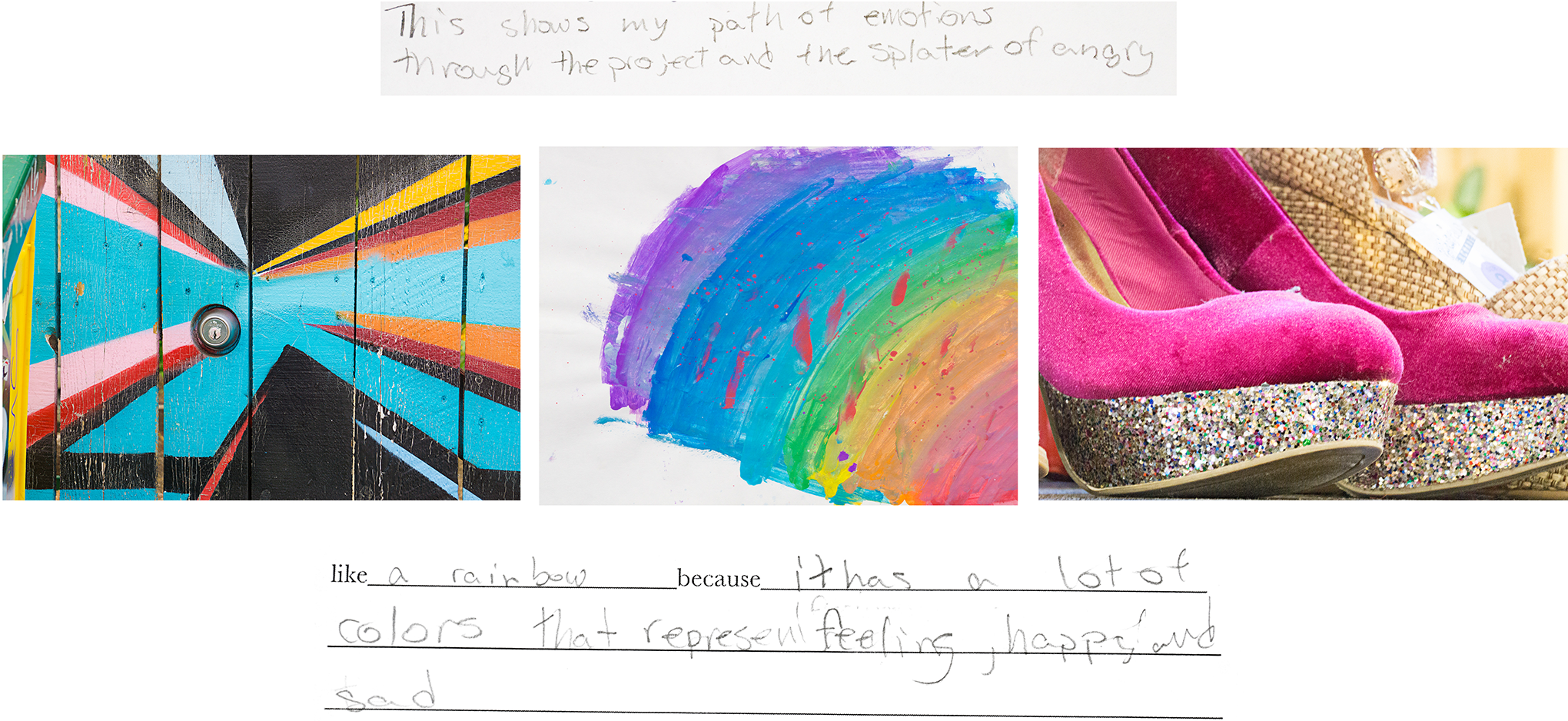
Tryptic inspired by Elise’s artist statement.
Tara’s statement contained the same attention to color’s affordances as a way to discuss affect as abstract, but she also described the object in her drawing, a tree (see Figure 6). She offered no further explanation on how a tree serves as a metaphor for the affective dimension of the project, and in this way, the inclusion of the tree is also an ambiguous symbol, potentially an abstraction as well. The semiotic role of the tree disappears and it stands without explanation. I sought a tree as a subject of my photograph that would help honor Tara’s decision to use the tree as an affective symbol in her drawing.

My tryptic inspired by Tara’s artist statement.
Rather than offering the product as a representation of the affective dimension of the writing project, I saw the process of taking photographs and building the triptychs as my way of seeking to better see this, often invisible, dimension so that I would be able to honor their vision. The final collage of three images and the artist statement are a product, of course, that communicates the affective nature of this writing practice for several students, but I feel it necessary to avoid any temptation we might have to offer these collages or the students’ paintings as representations of affect in a definitive way. I would argue, rather, that they attempt, through color and text, to stand as a kind of witness to the something students felt as they wrote and their intuitive use of color to communicate this affective something.
Implications for Education Research: Art as Metaphor for Affective Complexity
Just as I began this methodological meditation by calling out the paradox of researching affect in the classroom, I want to end, again, by noting how strange it is to try to describe what I understand to be beyond representation. Still, what we look for often reflects the values we hold, and so the affective dimension of the classroom, students, teacher and writing was far too present with me to abandon in this process of sharing the research experience or in students’ representations of their experiences writing about the affective nature of their lives. So, in an attempt to support and encourage research interested in critical affect in an educational setting, I describe my process of intentionally choosing visual methods that would not resolve complexity, but perhaps, even perform it. Visual art offers a kind of metaphor for this complexity and these tensions of non-linguistic, indescribable, abstract, changing, in-tension affective intensities.
Though the arts-based approaches I catalogue in the previous section are particularly focused on the sensorial and embodied imension of experience, I agree with Irwin and Spinggay’s (2008) caution to resist the tendency to set up a binary with traditional modes of research by suggesting that the arts are suited for embodied forms of research, while traditional modes are not. Rather, my exploration here emphasizes what the visual arts can offer us as we explore affect in education research, not to claim it is an ideal method that precludes other ethnographic approaches.
Finally, in bridging critical affect as a theoretical lens with arts-based approaches to research, I see the importance of supporting young people’s central participation in research, a move that invites youth to voice their own perspectives through their visual art, sonic stories, drama, poetry, narrative and dance. Practices that many young people already find meaningful can be applied toward youth-led artistic reflection on a research question, community problem, or project. Especially for those of us wanting to place critical affect in the center of our research, there is an imperative to hand over the materials, spill them on the table and get out of the way lest we risk continuing to reproduce existing inequities in the way we take ownership over representation in the research. Some foundational leaders in the field point to the question of experience, noting that perhaps arts-based practices should be utilized only by professional artists (Eisner, 2002). Yet, as this project illustrates, arts-based methods offer new insights on how young people are experiencing the affective nature of pedagogy and curriculum, so the risk of an imperfect rendering of an image must be weighed against this loss of insight.
Of course, the irony in art-based research on affect is that we can all work together to bring our sense of how “it” happened and how we felt about it into a picture or poem or story and this will bring the moment into focus. We can look at the layers of experience, opinions, artifacts, words, video, interviews and fieldnotes and then try to arrange them into a mosaic, placing each tile together. But, when we stand back and squint at the image, we suddenly remember that there is no possibility for it to ever, really, fully come into focus. We are better off squinting so the image remains hazy; the inherent tensions will keep it from coming into focus.
Still, despite the hazy image, we are struck by it—how beautiful, how complex, how, somehow, lower case “t” true.
Footnotes
Declaration of Conflicting Interests
The author(s) declared no potential conflicts of interest with respect to the research, authorship, and/or publication of this article.
Funding
The author(s) disclosed receipt of the following financial support for the research, authorship and publication of this article: Publication of this article was funded by the University of Colorado Boulder Libraries Open Access Fund.
