




Abstract
Intersectional theory effectively highlights the need to address the most marginalised communities through research, identifying key areas of privilege and oppression, and confronting it through praxis to advance social justice. Attempts at operationalising the theory for implementation have been diverse, but systematic frameworks to operationalise intersectionality remain sparse. This study seeks to provide a framework to operationalise the implementation of intersectionality in health equity research. Embedded within a citizen science approach, this paper suggests the use of the Socio-Scientific Progression by Leveraging on Intersectionality and Citizen-led Equity-driven (SPLICE) Research Framework, which aims to operationalise values of intersectionality into seven key principles for implementation throughout the research process: “Research Co-Creation,” “Safety For All,” “Reflexivity,” “Growth for All,” “Dynamic Ecological Context,” “Interlocking Systems of Oppression,” and a “Community-First Approach”. This paper takes reference to a collaboration research case study example investigating the use of Theatre of the Oppressed for Gay, Bisexual and Queer (GBQ) Singaporean men in 2023, to consider how this framework was developed and can be implemented in research studies. An accompanying checklist is developed to guide researchers in their implementation of the SPLICE framework.
Equity-related projects have centred intersectionality because it accounts for the interaction between social identities and interlocking systems of oppression. Researchers have adopted diverse approaches in broaching the values advocated by intersectionality as a field; however, the inconsistent approaches adopted have raised questions about whether studies are truly intersectional when they do claim such associations. Concerningly, key values pushed forth by intersectional scholars are growingly being lost because of these diverse approaches.
Recognising the importance of bridging these inconsistencies, this paper aims to synthesise the conceptual frameworks of citizen science approaches and intersectionality, using a research case study to investigate the framework’s applicability.
Existing Conceptualisations of Intersectionality
Intersectionality scholarly discourse began in the 19th century as a response to the racialized elements of oppression against African-American feminists, which had been completely unacknowledged within the largely White-dominated civil rights movements (Davis, 1983). Long before intersectionality had been given its academic nomenclature, Sojourner Truth delivered her historic “Ain’t I a Woman” speech, in which she protested the White erasure of her identity as a woman due to her Blackness (Crenshaw, 1989). In contradicting both the traditional notions of womanhood portraying the feminine figure as physically weak and incapable of engaging in intellectual discourse, her rebuke of sexist discrimination also took on a racial dimension.
Modern conception of intersectionality began taking shape as scholars developed theories surrounding the multiple overlapping systems of hierarchical oppression (Collins, 2000), and jointly served to worsen living conditions for Black women (Combahee River Collective, 1977/2009). Characterised as a framework that sought to synthesise critical theory and social action, pioneering research-practitioners such as Collins and Crenshaw suggest that ideas such as race, gender and class, framed as “systems of power”, are interdependent, and interact to produce complex social inequalities that cannot be analysed through a binary, comparative lens (Collins, 2019; Crenshaw, 1989). The intersectional frame may also be utilised to assist with improving comprehension of multiply-marginalised identities and the organisation of inclusive community projects (Terriquez, 2018). This necessitates the use of intersectionality’s analytic lens as a heuristic when addressing social afflictions.
Intersectional scholars have emphasised that projects affiliated with intersectional frameworks must necessarily advance social justice — whether it is in the form of epistemic resistance or advancing social justice from within the community (Collins, 2019). Specifically, intersectional projects must centre the voices of and advance the welfare of multiply-marginalised communities, with the understanding that these community members are experts of their own experiences (Bowleg, 2012; Collins, 2019). Significantly, these projects should work towards the goal of “facilitat[ing] the inclusion of marginalised groups for whom it can be said: “when they enter, we all enter” (Crenshaw, 1989, p. 167). This goal presents a necessary dialectic that intersectional scholars should aim to balance, where projects should aim to address the nuanced social context for all populations, yet, the eventual outcome should be to uplift the most marginalized population across global contexts in order to achieve intersectionality’s social justice principles.
Marrying Intersectionality to Citizen Science
As scholars consider how best to methodologically embed equity into their work, one framework that has been increasingly cited is that of citizen science (Tan et al., 2024). Falling under the umbrella of community-based participatory research (CBPR) approaches, citizen science approaches encourage academics to engage individuals who live the identities of interest throughout the research process to democratise knowledge (Toubiana & Ruebottom, 2022). In choosing individuals to engage rather than community members situated in specific community groups, scholar-practitioners are given the opportunity to acknowledge and challenge power inequities from an intersectional lens, ensuring that marginalised communities within community groups benefit from capacity-building opportunities and are selected for representation in citizen science projects (Pastor et al., 2022; Rice et al., 2019; Tan et al., 2024).
The principles of citizen science align itself closely with the goals of intersectionality as an analytical strategy. Chong et al. (2025) designed a Citizen Science Framework intended to inform how implementation science researchers can best employ citizen science principles into their research. While Chong and colleagues’ study translates Goodman and colleagues’ (2020) eight engagement principles into operational terms, values of intersectionality were not embedded as a core consideration as part of the framework.
Goal of Current Study
This study seeks to answer the following research question: How best can the values of intersectionality be methodologically integrated into citizen science-oriented research? This study provides an update to Chong and colleagues' (2025) model: we consider aspects of intersectionality that can be operationalised in research studies, before matching the areas where they coincide with the Citizen Science Framework.
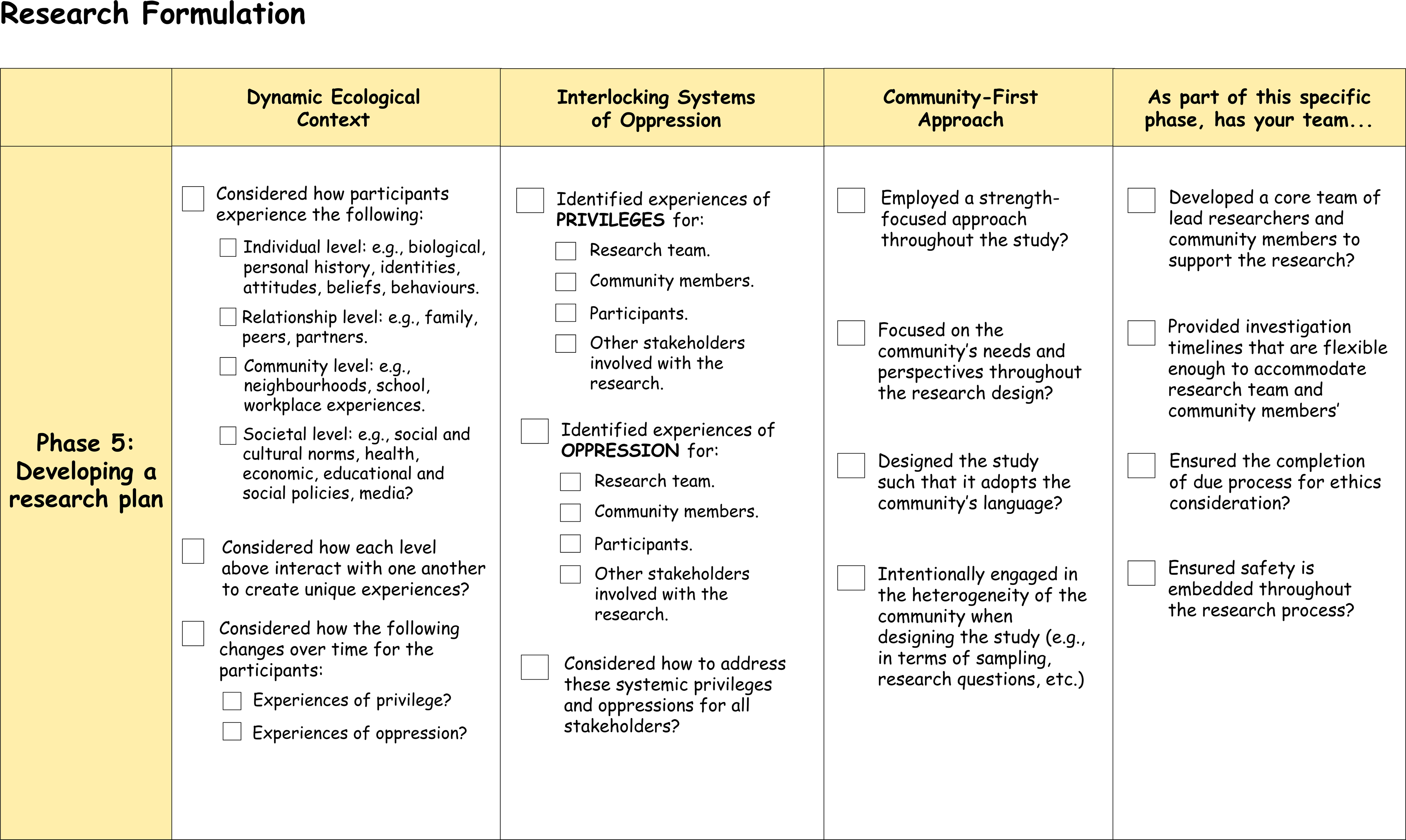
Derived from existing literature surrounding suggestions and actionables offered to implement intersectionality, this paper will first discuss the SPLICE Framework’s key methodologies, principles, and aims, as well as its integration of intersectional and citizen science concerns. The paper will then explore how the SPLICE Framework may be operationalised, utilising the Youth Theatre Project as a case study. Figures 1–4 provides a checklist we have developed to assist with researchers aiming to adopt our SPLICE Framework into their research project.1 Ultimately, we see citizen science and intersectionality as complementary approaches to building a research project that serves to advance knowledge and impact for multiply-marginalised communities. SPLICE Considerations During the Research Leadership and Positionality Phase. SPLICE Considerations During the Research Formulation Phase. SPLICE Considerations During the Research Execution and Analysis Phase. SPLICE Considerations during the Dissemination and Impacts Phase.


The SPLICE Framework: What It Is
Titled “Socio-Scientific Progression by Leveraging on Intersectionality and Citizen-led Equity-driven” (SPLICE) framework, a total of seven key concepts were identified to govern this framework: “Research Co-Creation,” “Safety For All,” “Reflexivity,” “Growth for All,” “Dynamic Ecological Context,” “Interlocking Systems of Oppression,” and a “Community-First Approach.”
Principles Governing the Framework
The existing seven principles derived from intersectionality closely align with existing literature on operationalising intersectionality.
“Research Co-Creation” and “Community-First Approach” has been core to many intersectionality studies, as an emphasis to involve community members and to empower through research has been critical to intersectionality as praxis. These two principles have been traditionally addressed through community-based participatory methods (CBPR) given CBPR’s ability to centre the community’s lived experiences, voices, needs and knowledge, providing space to empower the community (Fernández-Sánchez, 2023; Fine & Torre, 2019; Fleming et al., 2023; Ricks et al., 2022; Ruhland et al., 2023).
The idea of “Reflexivity” was introduced with the recognition that the researchers’ identities and experiences will grant them power — changing the dynamics between themselves and the researched communities — necessarily influencing how research is conducted and disseminated (Atewologun & Mahalingam, 2016; Rice et al., 2019). The goal of reflexivity is to acknowledge that there cannot be complete objectivity in any research study. Instead, critically reflecting on how the researchers’ specific positions and power influence the research process highlights the strengths and limitations of the project (Carstensen-Egwuom, 2014; Rodriguez & Ridgway, 2023). We think meaningful reflections throughout the research process takes the idea of reflexivity one step beyond “positionality statements,” which is traditionally used as a mode of requiring researchers to consider their social positions and how that influences their research process, holding researchers accountable only at the research dissemination stage (Boveda & Annamma, 2023; Secules et al., 2020).
“Safety For All” suggests that all stakeholders — including researchers, researched communities and participants, as well as involved community stakeholders — should have their holistic safety accounted for when engaging in intersectional research. In the face of stigma and minority stress, multiply-marginalised community members may already face safety compromises in multiple spheres; safety measures are hence especially necessary in such contexts (Crenshaw, 1991; Pelcher et al., 2021). Ethics review guidelines place an important emphasis on the notion of ensuring safety for participants (e.g., Panel on Research Ethics, 2022) and accounting for risks inflicted on the broad community (e.g., Resnik & Shamoo, 2011), but less is accounted for regarding the safety of researchers, community members and stakeholders who may be indirectly involved in the research. This gap has been increasingly highlighted by researchers working with traumatised individuals, and we echo the need to take on a broader lens when considering safety in intersectional research (Cullen et al., 2021).
This framework also includes a key idea of “Growth for All,” which originates from the idea of empowerment of the most marginalised communities. Intersectionality scholars have emphasised that intersectional projects must necessarily see their work as praxis — platforms to advance social justice for the most marginalised (Collins, 2019; Crenshaw, 2019). We have chosen the word ‘growth’ instead of ‘empowerment’ when considering how advancement of welfare can take place. Discourse around empowerment attends to marginalised individuals and groups who may seek to engage in collective action to gain greater control, resources, rights, and goals that help achieve them achieve better equitable standing in society (often framed in discussions of power) (Douglas et al., 2016; MacPhee et al., 2017; Maton, 2008). While important and ideal, our framework also seeks to accommodate intersectional projects with smaller-term goals — where the foci might better develop growth (personal, professional and any other form of growth relevant to the individual and community’s interests) rather than orienting itself towards empowerment.
The choice to adapt Bronfenbrenner’s (1994) social ecological model to refer to a “Dynamic Ecological Context” emphasises on the recognition that each sphere within the ecology continually interacts with one another, and each of these spheres as well as the ecology as a whole is constantly changing with time, shaping the context of privilege and oppression one experiences. Such a model better accounts for Collins’ (2019) emphasis on social context, complexity, and relationality in intersectionality — which highlights the need to look into the changing dialogical engagement between identities, individuals, communities and broadly social forces in intersectionality-rooted projects.
The principle of “Interlocking Systems of Oppression” directly adopts the Combahee River Collective’s language, further guiding the understanding that systems of oppression are interdependent and intersecting, influencing experiences of power and social inequality in a complex social context for marginalised communities (Collins, 2019). Adopting interlocking systems of oppression as a lens helps to further emphasise moving away from singular approaches that neglect the other areas of oppression taking place concurrently, instead encouraging the holistic recognition of the unique convergence of identities shaping one’s experience across their ecology (Bowleg, 2008, 2012; Crenshaw, 1991; Evans-Winters & Esposito, 2019; Shields, 2008; Thacker & Duran, 2020).
Envisioning SPLICE’s Implementation in Research
Figure 5 summarises these concepts, how they can be applied throughout the research process, as well as key considerations in their implementation. Figure 6 then synthesises our findings with Chong and colleagues' (2025) model of citizen science, to consider which specific phases within the Citizen Science Framework could explicitly introduce values of intersectionality. While implementing these concepts into each phase of one’s research, researchers should continue centring Collins’ (2019) principles of social inequality, power, relationality, social context, complexity and social justice.
2
Operationalising Intersectionality Into the Research Process With the SPLICE Framework. Integrating Values of Intersectionality Into Chong and Colleagues’ (2025) Citizen Science Framework.

Research Methodology and Leadership (Phases 1 to 4)
In considering aspects of research leadership and positionality, they align strongly with Phases 1 through 4 within Chong and colleagues' (2025) Citizen Science Framework. In order, these Phases include: “Developing a Research and Implementation Pipeline,” “Stakeholder and Resource Mapping,” “Delegation of Expertise” and “Creating Plans for Equity”. In these phases, Chong and colleagues (2025) called for a discussion on community, academic and funding priorities, before considering human and logistical resources required and available for the project execution. Thereafter, the team advocated for citizen science research projects to delegate work based on the appreciation that both community partners and academic stakeholders are experts in their own rights, before taking an active effort to make plans to ensure all stakeholders are equitably recognized for the effort they have invested into the research (Chong et al., 2025). SPLICE integrates the values of “Research Co-Creation,” “Reflexivity,” “Growth for All” and “Safety for All” to support these four phases (Figure 1).
Research Co-Creation
A central philosophy driving the SPLICE Framework is the preservation of self-determination, conceptualised as providing target communities with the autonomy to accurately represent itself to the public, and to empower community members to be directly involved within the research process. Taking LGBTQIA+ populations as an example, lead researchers should aim to introduce LGBTQIA+ community members of diverse backgrounds into the research team. This allows for the research team to better represent the heterogenous perspectives of the target community, whilst enabling the equitable inclusion of multiply-marginalised LGBTQIA+ community members.
Reflexivity
Intersectional scholarship has highlighted the criticality of leveraging on the diverse identities involved in such work, through incorporating reflexive thinking throughout the research process, which addresses the dynamic constructs of power imbalances. The SPLICE Framework recommends practising reflexivity in reference to the dynamic ecological model (later discussed), in order to acknowledge the different layers of individual’s identities and experiences. Researchers are invited to observe and confront how their privileges and oppressions may influence their academic perspectives, as well as the power dynamics that may arise as a consequence. The goal of employing reflexivity is to identify methods through which researchers who possess privilege can use their positions of privilege to empower those who have been further marginalised in the research process.
Growth for All
In line with intersectionality’s goals as praxis to front social justice and advance the welfare of marginalised communities, SPLICE research should aim to empower and develop community members where possible. This can involve the careful selection and placement of community researchers in different projects based on the skill sets and knowledge that they would acquire over the course of the project, which they would in turn be able to support the community with. While acknowledging that this may not always be possible in the short-term, a longer-term outlook and planning in terms of how research can benefit the target marginalised community of interest should be explicitly integrated into the research process.
Safety for All
In acknowledging the interlocking systems of oppression that drive the lived experiences of queer community members, a key aspect when developing research projects and teams is ensuring safety for all. From this section’s perspective, we argue for the need to also account for researchers’ safety, an oft-neglected aspect in research execution.
Research Formulation (Phase 5)
In thinking about the research formulation stage, this parallels the Citizen Science Framework’s Phase 5 (“Developing a Research Plan”). At this phase, researchers should centre the considerations of including a “Dynamic Ecological Context,” recognising and addressing “Interlocking Systems of Oppression”, and taking a “Community-First Approach” (Figure 2).
Dynamic Ecological Context
The SPLICE Framework builds upon current social ecological models to encourage researchers’ consideration of their ‘Dynamic Ecological Context’. This value emphasises investigating how experiences differ across systems within the model (the ecological factors), but also how they may interact and change across time (temporal considerations). This value opens up opportunities for the research done to provide greater insight into opportunities to intervene, and in turn create greater equity.
Interlocking Systems of Oppression
Intersectionality literature highlights the influence of interlocking systems of oppression on experiences of marginalisation and privilege. Researchers should acknowledge the awareness, or lack thereof, that individuals may have with regards to privileges and oppression experiences, and how their different social identities interact to produce these unique outcomes.
Community-First Approach
Acknowledging that intersectional research addresses community members with marginalised identities, it is then necessary to place the community first throughout the research process. This means centring the community’s voices, needs and perspectives. In research design, this involves researchers intentionally engaging with the heterogeneity of the community to recognize its diversity of experiences, even if the central focus of the research may be on the community’s shared identity. Researchers adopting a community-first approach can also place an emphasis on acknowledging communities’ strengths and capabilities, shifting away from a pathological narrative of marginalised communities and moving towards a more holistic and representative approach towards such groups.
Research Execution and Analysis (Phase 6)
The process of research execution and analysis of results aligns with Phase 6 of the Citizen Science Framework: “Generating Evidence and Analysis”. Within this phase, key principles include “Safety for All,” “Dynamic Ecological Context,” “Interlocking Systems of Oppression” and “Community-First Approach” (Figure 3). This section will discuss how these previously discussed principles can be adapted to support an intersectional implementation of the research execution and analysis process.
Safety for All
Intersectional research presents a conundrum between anonymity and representation: participants’ anonymities needs to be preserved in order to protect participants, given their vulnerable or marginalised status, yet visibility may help empower their voices to ensure that their unique experiences are being acknowledged. When considering research execution and analysis under SPLICE, researchers should provide an appropriate balance of anonymity and visibility through consulting individual participants’ needs and requests. Further, researchers should implement community-sensitive safety protocols which account for physical, psychological, emotional, and relational safety for all stakeholders in the research process.
Dynamic Ecological Context
It is strongly suggested that the community’s Dynamic Ecological Context is considered throughout the entire research process, and not limited to the formulation of the study. In incorporating this philosophy during the execution of studies and analysis of results, each participant’s unique experiences of oppression and privilege can be better contextualised within their given times and contexts.
Interlocking Systems of Oppression
Researchers should also actively consider how their methodologies address systemic oppression. Throughout the research process, there should also be an active effort to integrate intersectional language. During analysis, methods used should employ transversal rather than additive approaches to acknowledge how marginalised and privileged identities interact (rather than add on or subtract) to create unique experiences of individuals.
Community-First Approach
As previously discussed, researchers striving for intersectionality in the work should centre the community in their work, by partnering and involving community groups during research design, recruitment, and direction. Such research should also use the community’s language and reflect the community’s capacity, so as to ensure that eventual outputs meet the needs of the community of interest. Additionally, researchers need to move past a pathological lens that has historically cast marginalised populations in a poor light, to focus on the strengths of the community.
Dissemination and Impacts (Phase 7-8)
A big part of knowledge production is in its dissemination format and considerations of impacts in the longer term: how information is communicated may make a critical difference whether the findings positively impact the community. This final segment then closely aligns with Phases 7 to 8 of the Citizen Science Framework: the “Dissemination and Translation” of results, as well as how to introduce “Plans for Sustainability and Impact” (Figure 4). This section covers how to adopt a “Community-First Approach” in the final phases of research studies, through reviewing the approaches utilised in the case study with regard to the dissemination and sustainability of the research.
Community-First Approach
Within the context of research dissemination, centering the community involves the careful consideration of the language and lens used in order to accurately interpret and report the results of studies that involve marginalised communities. Whilst impartiality and integrity should remain central to all research work, researchers should be conscious of the implications of their work on these communities and their members. Considering these implications involve two key approaches: ensuring that the representation of these communities is in line with the community’s needs and perspectives, as well as recognising the capabilities of the community. In doing so, the strength-oriented approach previously discussed is highly critical in ensuring that marginalised communities are represented in a light that holds promise for their growth, in line with the Dynamic Ecological Context previously discussed.
Beyond this, potential practical applications for marginalised communities and stakeholders should also be central to the discussion and dissemination of results. With intersectionality providing a means to uncover the oft-ignored privileges and oppressions, discussion on how to address such inequity should be a key aspect of the work of intersectional researchers.
Methods
The Case Study
The current article investigates the SPLICE framework using an explanatory case study, illustrating how the SPLICE framework can be adopted and implemented within research settings. This case study looks at a collaboration research conducted between David Puvaneyshwaran, a social work Masters’ research student, and kayos kollective, 3 a research group based in Singapore that focuses on LGBTQIA+ topics, in an effort to tease out key concepts that ensure the appropriate application of intersectionality into research. An abductive approach was adopted, where SPLICE’s general framework informed the implementation of the study; at the same time, the framework was further developed as ground up data informed adjustments that were required for the framework to be concretised (Hurley et al., 2021; Yin, 2018).
This article draws from David and kayos kollective’s study on the Youth Theatre Project (NUS-IRB-2023-50) applied in Singapore, which aimed to examine the shifts in critical consciousness among participants before and after participating in a Theatre of the Oppressed (TO) workshop. The five-session workshop featured curated theatre games and activities inspired by Boal (1992) and Rohd (1998), and was conducted over a 2-month period. These activities were designed to facilitate rapport and trust building to build a supportive community (Puvaneyshwaran, 2024), as well as to facilitate critical reflection and motivation (Freire, 1970).
The current article adopts a reflective lens to look at how the experience of executing the study has guided the kayos kollective team in developing a framework that guides the planning and execution of research studies based on principles of intersectionality.
A Note on Epistemological Considerations
As a methodological consideration, we have intentionally avoided discussing issues of epistemologies. We appreciate that this may be a contentious decision, given the emphasis of intersectional scholars on epistemology. However, we hope to advocate for the belief that every epistemology will benefit from an intersectional angle, and we apply a pragmatic approach in encouraging the interweaving of intersectionality whenever and wherever possible.
Results
This section details the application of the SPLICE framework within the Youth Theatre Project case study.
Research Methodology and Leadership (Phases 1 to 4)
Research Co-Creation
The SPLICE approach was first utilised during the Youth Theatre Project (YTP), where David and Shao Yuan (as kayos kollective’s representative) convened on the idea of privilege, particularly in relation to the privileges that they had as leaders of the research project. In response to this, the leads began discussing how the study could be conducted in a manner to achieve the goals previously discussed.
This discussion was translated into action in the form of providing a closed invitation for community members to support the project. Volunteers project staff members were invited based on their interests and availability, as opposed to traditional markers of experience (such as educational history or research experience). The leads also intentionally invited LGBTQIA+ individuals from traditionally underrepresented communities (such as racial minorities, neurodivergent individuals, et cetera) to partake in the execution of this study.
Four volunteer project members (Xuan, Abbrielle, Nishath and Hoky) were recruited to support the project, with ages ranging from 18 to 27. Using racial demographic markers as applied in the Singaporean context, one volunteer belonged to a racial minority community, and two self-identified as neurodivergent. Volunteers either possessed Cambridge Advanced Levels, Diplomas, or equivalent educational attainments. As will be discussed in a later section on Growth for All, staff members were provided support and training from the two leads (David and Shao Yuan) who provided mentorship and guidance throughout the research process.
Reflexivity
Group reflections were used to support research members’ awareness about how their biases, privileges, oppressions, and lived experiences may influence the execution of the research. A group approach was used with the understanding that interpersonal querying and sharing would allow for greater awareness of the self and team. This then served to bring to light the blind spots that might be missed during self-reflection.
Reflection sessions included discussion on how each member’s perspective influenced the topics included within the TO workshop, as well as how personal understanding and knowledge pertaining to the topics may influence the workshop process. Additionally, time and effort were dedicated towards recognising how shared and divergent identities between volunteers and the YTP project team shaped the workshop and research process, as well as how such experiences had contributed to the learning of both parties. Reflection sessions also centred on how team members’ experiences (and lack thereof) either provided them with areas of learnings or resonance and discomfort during the workshop process.
Growth for All
This process was initiated in the YTP after careful consideration by the two leads on what was limiting community-based research. The leads explicitly set out the goal to provide in-depth training to volunteer project staff members, with the intention of empowering them to be able to conduct their own research or TO work after the project. This training process involved two primary components: specific skills training, as well as personalised mentorship by the two leads, both of whom had minimally one to 2 years of research experience alongside an Honours degree. The mentorship served to ensure that all team members were able to produce outputs that not only met the requirements of the projects, but also addressed the volunteers’ individual interests.
Safety for All
Safety protocols took the form of pre-discussion of triggering topics, as well as regular psychological state checks. Project leads conducted regular assessment of the team’s state prior to, and after each meeting, to create a culture that emphasised the well-being of team members throughout the research process. Where voiced out that they had any concerns, the two leads would then follow up with the project team members. To support this, both lead staff members had also previously received training to support individuals in distress, with Shao Yuan and David having both worked as mental health professionals. Beyond this, the two leads took an active role creating a safe space within the project staff group, as well as in promoting bonding between team members. This then contributed to an informal support system between the project team members that served as a buffer against potentially triggering moments during the study.
Research Formulation (Phase 5)
Dynamic Ecological Context
For the YTP, the study centred the dynamic ecological contexts of the participants through investigating their experiences of perceived inequality, egalitarianism, motivations and support networks across gay, bisexual and queer men’s lifespan across the social ecological model. Each theme conscientiously inquired from the participants on how their individual, interpersonal, community, cultural and institutional environment influenced their experiences and perspectives at each stage, and how each segment of their environment may interact to create unique outcomes for themselves.
The YTP study also principally centred the idea of the dynamic ecological context by adopting biographical semi-structured approaches within the workshop itself. For instance, one key activity, “power shuffle,” required participants to move across the space in response to how much they identified with various statements of marginalisation. This activity sparked discussions on the differing levels of oppression and privilege each participant experienced. They also reflected on how these positions of privilege shifted across differing contexts. The biographical semi-structured approach to the workshops ensured that rather than assuming a static experience of oppression arising from one’s marginalised identities, they highlighted how experiences of privilege and oppression can change as a result of changing context, perspective, and growth for the participant.
Such questioning methods ensured participants were conscientiously considering how social ecological influences in their lives impacted their experiences across time. Through the use of such methodologies, participants’ data suggested how the lack of, or minimal influence, on each sphere may also be indicative of one’s experience of privilege rather than oppression across one’s lifespan.
Interlocking Systems of Oppression
The first step taken towards addressing interlocking systems of oppression in the YTP study involved inviting participants to share their sociodemographic information, such as their self-identified ethnicity, sexual orientation, gender identity, and nationality. The research team then invited participants to keep in mind how their social identities may have influenced their everyday experiences across each activity.
Beyond exploring the role of interlocking systems of oppression on just the self, participants were also challenged to consider if within the GBQ+ community itself, there may be subpopulations that may be facing greater levels of stigma and oppression as a result of their intersectional identities. These conversations encouraged participants to stop and reflect on how their experiences of privilege and oppression may have influenced differing outcomes for themselves as compared to other queer community members.
Community-First Approach
In Singapore, current research into LGBTQIA+ topics often centres the younger, middle-class, educated, cis-gendered, Chinese gay man. In recognising this phenomenon, the project team sought to create opportunities within the study for community members of more diverse backgrounds to share their stories, recruiting through snowball sampling and explicit recruitment advertisements specifically inviting individuals of diverse backgrounds and identities to participate in the study.
The participants’ needs and perspectives were also centred throughout the workshop process. This involved giving participants opportunities during the activities to highlight their self-identified needs across their social ecology (such as legal needs, social support needs, as well as other needs). These points were then prioritised as focal points throughout the activity discussion. In doing so, the project team also sought to provide participants with the space to discuss their concerns and experiences, thereby providing participants with the cathartic experience of open and unjudged disclosure.
The discussions also adopted a strength-based approach towards the questions utilised, such that whilst the discussion was participant-driven, TO facilitators directed participants to consider more about their resiliency throughout their experiences. This also allows for facilitators to support participants in recognising their own strengths, and grow from the reflection process involved in the discussions.
Research Execution and Analysis (Phase 6)
Safety for All
Within YTP, safety was emphasised through a wide range of options available to participants, as well as the implementation of psychological safety measures for both participants and the project team. The study emphasised for all participants to use pseudonyms throughout the research, but gave the participants the option to be self-identified through our quotes should they specifically request so. Participants were also given the opportunity to skip any questions or activities they feel may be triggering or unsafe for them to engage with during the workshop. Additionally, all facilitators were trained with psychological safety training to ensure that participants could be supported should they be triggered in the course of the discussion, and safety persons from the project team were always on-site during the workshop.
Dynamic Ecological Context
As previously discussed, the dynamic ecological approach adopted during the workshops also provided an unintended benefit for the participants, as they were invited to process difficult experiences from their past, allowing themselves to trace when or why they may possess certain perspectives or experiences leading up to the time of the workshop. Many participants had reflected that the workshop process was ‘cathartic.’
Post-workshop, an inductive approach was first adopted to analyse the data, before drawing relationships with existing conceptualisations of each of these themes locally and regionally, to develop an understanding that remains authentic to the local sociocultural context. In the data analysis process, the data analyst also tried to make a conscientious effort to consider the different positions of participants in their given time and space, in terms of the social ecological factors that may be influencing their responses.
Interlocking Systems of Oppression
The study employed semi-structured TO workshop sessions to allow for the flexibility for participants to drive the direction of the workshop discussions in a way that best accounts for their experiences of privileges and oppression. Additionally, with the understanding that the language participants use is often tied closely to their understanding of their positions of privilege and oppression based on their identities, workshop facilitators made an active effort to mirror the language and word choice of participants in their facilitation.
During analyses, efforts were taken to ensure reflexivity. The data analyst critically considered their personal views and values before engaging with the data, and consciously took on a strength-based approach to understanding the participants’ responses. This approach ensured a more empowering and inclusive understanding of the feedback. Furthermore, the data analyst made a point to honour the manner in which participants chose to describe their intersectional experiences during the coding and analysis process. In doing so, the data analyst aimed to ensure that experiences were accounted for from a transversal perspective, rather than simply considering them from an additive lens.
Community-First Approach
The study was grounded in the principles of citizen science; as shared previously, community members were included throughout the research process to ensure that community inputs were included from design to analysis. The project team members were consulted throughout the design of the research structure, process, and questions to ensure they always reflected the community’s language and met the community’s capacity and needs. They were also workshop and discussion co-facilitators alongside the lead researcher.
At the end of the five TO workshop sessions, participants were given the opportunity to advocate for any gaps in the workshop discussions, such that they were able to capture needs that the existing workshop discussion questions may not have considered. They also gave feedback on the different sub-communities within the LGBTQ community that may benefit from the workshop.
Dissemination and Impacts (Phase 7-8)
Community-First Approach
In considering how to best support the community’s development with the results, the project team acknowledged the limitations of academic publication in effecting significant ground-level change. To address this, a community-facing presentation was proposed, in order to better inform the gaps in needs faced in the everyday experiences of GBQ+ men.
With this dissemination need in mind, the team then sought to embed key everyday themes in the study that intentionally cut across experiences that are influenced by structures and interpersonal experiences across one’s social ecology. In doing so, this presentation then also seeks to inform what LGBTQIA+ community members and allies can do for one another given the findings.
Rooted in this community-facing presentation is also a commitment to consider the implications of diverse identity influences on the outcomes observed and identified. The framing of the different experiences also placed around the theme of resilience, in order to recognise the strength of LGBTQIA+ community members, even in the face of strong adversity.
Discussion
The current case study highlights how the current framework can effectively concretise principles for advancing intersectionality in research, translating values of intersectionality advanced by intersectionality scholars into actionables. The case study also highlights how the SPLICE framework neatly integrated principles of citizen science with intersectionality.
Alignment With Literature on Operationalising Intersectionality
For our case study, through our centering of “research co-creation” and a “community-first approach,” we found ourselves better being able to address the experiences of our community of interest, the LGBTQIA+ community, in its authentic, heterogenous form, deriving findings that highlight the shared experiences of marginalisation but also honouring the unique differences when interwoven with one’s experiences of privilege and oppression in other identities. As previously shared, the alignment of the two principles with existing literature further justifies its application with the Citizen Science Framework (see next section), based upon the basic principles of citizen science (a CBPR approach; Chong et al., 2025).
On “reflexivity”, we find that meaningful reflexivity did enhance research quality, as our research and community team members held each other accountable to consider how their personal experiences and values may have influenced the research process that they conducted. It is also through these reflection sessions that researchers and community members were able to uncover some limitations of their own viewpoints, allowing them to push boundaries beyond their usual frames of thinking. We caution against the sweeping requirement for all researchers to include a positionality reflection in their papers as an intuitive mode of ensuring reflexivity in research. In our case study, the authors were based in a country where the Parliament had just decriminalised their anti-sodomy law, Section 377A, in 2022 (Goh, 2022; Lim & Seet, 2023). In the said society, clear laws remained in place preventing LGBTQIA+ individuals from having the same legal rights as non-LGBTQIA+ individuals (e.g., housing, marriage; Rajeswari, 2017). A request for positionality (particularly in relation to their gender and sexual identities) in these particular contexts may in fact pose immediate danger to their safety. We ask instead that authors engage in critical reflection that is meaningful for the project and the community, yet remains safe for the authors, and we ask that journals, publishers, and reviewers focus on the element of critical reflection instead of requiring a positionality statement at the cost of authors’ safety.
On “safety for all,” aligning with past literature speaking to the need for focus on safety (e.g., Crenshaw, 1991; Cullen et al., 2021; Pelcher et al., 2021), our research findings similarly highlight the need for safety measures to be built in as some participants, given their identities (age, religion), may still face compromised psychological and even physical safety should they be found to have participated in our study. However, our findings also highlight the need to take a broader view of safety — to break conventions of only thinking about participants’ safety and to begin deliberating about researchers’ safety as well.
On “growth for all”, we find this principle aligning closely to our studies’ community members’ mentalities — while most of our community members who completed our projects do not foresee themselves moving onto bigger social justice projects, they have at least indicated that the experience has helped them grow their skills and social network, building relationships they foresee they will carry with them for a long time. Participants also indicated that sharing their responses to reflexive questions had helped them advance their own understanding of personal and societal issues. In integrating “growth for all” as a core principle, we hope that intersectional projects can include projects that may not achieve the goal of creating change on a social justice level, but still benefit marginalised communities in terms of individual and community growth (Collins, 2015, 2017, 2019).
On “dynamic ecological context”, expanding on the argument made regarding the need to account for time and interacting experiences across each sphere of the social ecology when discussing social context (Bronfenbrenner, 1994; Collins, 2019), our case study findings similarly reflected the explicit acknowledgment of these changing circumstances within the realities and lived experiences of marginalised communities. In offering the opportunity to reflect on how experiences were continually changing and interacting with each sphere’s on one’s changing social ecology across their lifespan, our study was able to acquire a richer appreciation of how one’s experiences with privileges and oppression as well as their strengths and resiliencies when responding to such experiences of oppression.
On “interlocking systems of oppression” — a key tenet of intersectionality to be addressed (Bowleg, 2008, 2012; Crenshaw, 1991; Evans-Winters & Esposito, 2019; Shields, 2008; Thacker & Duran, 2020)—, our findings echo the benefits of considering experiences whilst accounting for these complexities, stepping away from a singular lens and thinking about how one’s LGBTQIA+ experiences interact with their other identities of privilege and marginalisation, we have acquired perspectives on how within marginalised populations, there may be heterogeneous and unequal experiences of stigma depending on how their identities may be placed in other areas of privilege and oppression. In choosing to integrate a conscious awareness towards the effects of interlocking systems of oppression, intersectional researchers will better be able to capture the uniqueness and diversity that accurately reflects the lived experiences of marginalised communities of interest.
Alignment With Values of Citizen Science (and Framework)
Chong and colleagues' (2025) Citizen Science Framework was first adopted as a framework of reference given its ability to line up to Goodman and colleagues’ (2020) eight engagement statements where consensus was achieved regarding how and when citizen science principles are met, which Figure 7 replicates. We find that the intersectionality values we aim to propagate complement neatly with the suggested actions of the Chong and colleagues' (2025) Citizen Science Framework. Detailed Figure of Chong and colleagues' (2025) Citizen Science Framework.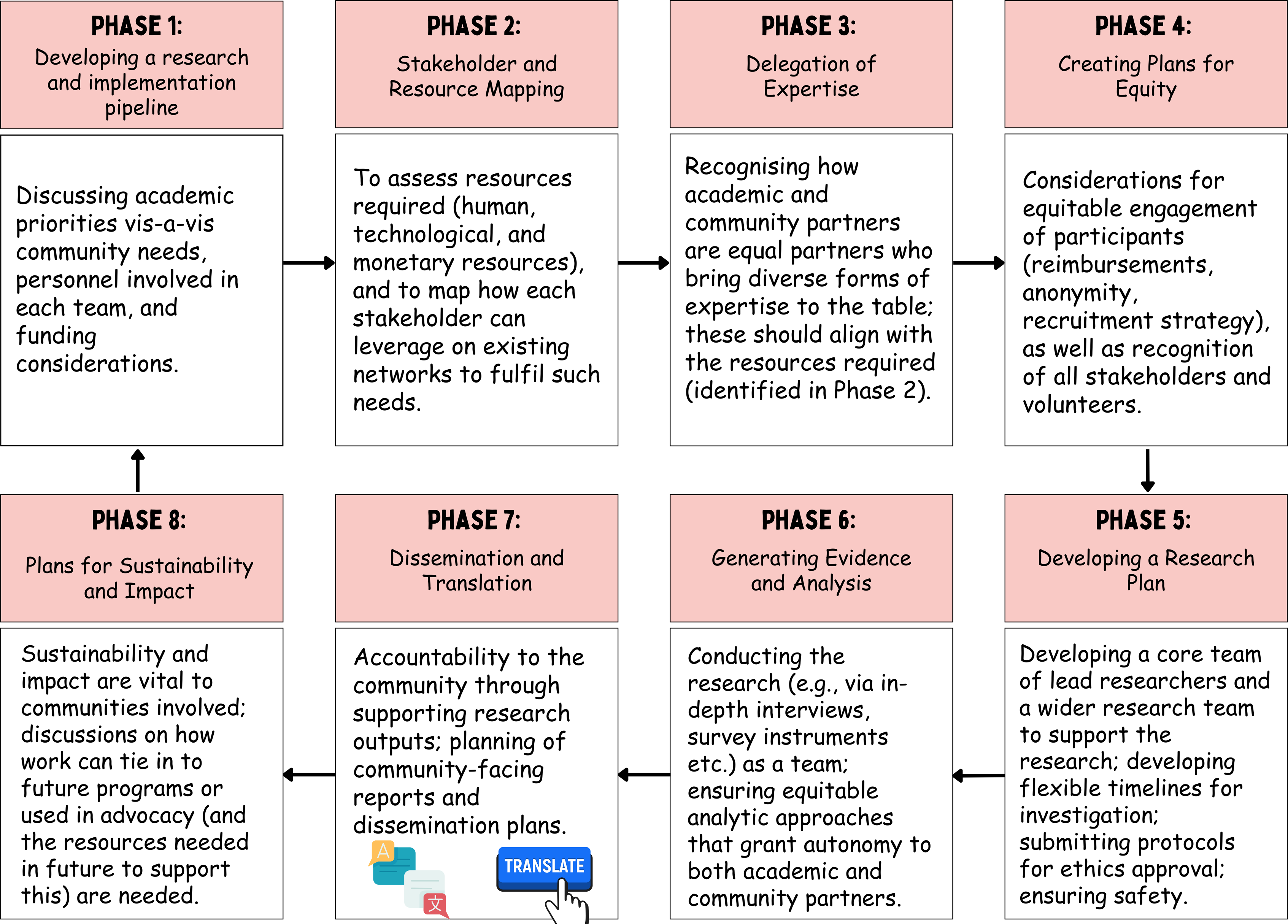
The intersectionality principles we are advocating for neatly complements the operational action Chong and colleague (2025) suggested as part of their framework from Phases 1 to 4. For instance, research co-creation lines up exactly with the call to equitably include community members into the research, incorporating a stronger emphasis on including diverse representation from within the community. Growth for All further highlights the need to develop and empower community members when addressing the community’s priorities. Our newly built framework adds to the Citizen Science Framework by calling for an increased emphasis on safety for all (including stakeholders) and systematic reflexivity as accountability. These two principles are critical in acknowledging the involvement of researchers, community members as participants alike — not only does it offer an opportunity to deliberate the effects of positionality, which the current Citizen Science Framework places less of a focus on, but it further highlights the need to account for all stakeholders’ interests in the process of the research.
In Phase 5, Chong and colleagues' (2025) highlighted the need for diverse team dynamics, to consider providing for logistical flexibility (e.g., timelines, protocols) and centring safety in the process. These actionables provide considerations into ‘who’ should be doing the research. We build on the thought process, encouraging researchers to address “what” is being researched in this phase. For example, we ask researchers to think about how systems of interlocking oppression interact with one’s dynamic ecological contexts i.e., how experiences of privilege and oppression across each level of the Bronfenbrenner’s (1994) social ecological model interact and change across time. We also call for researchers to centre a community-first approach, adopting the perspectives and language used by the community and intentionally engaging with their heterogeneous makeup and needs, but also highlighting their strengths and resiliencies where possible. We see these values as being feasible and aligned with the principles behind the advocated research team makeup by the initial Citizen Science Framework, adding value to the framework.
In Phase 6, the Citizen Science Framework emphasises how research execution and analysis should create opportunities to ensure the autonomy and input by both academic and community partners (Chong et al., 2025). Our adapted SPLICE framework further highlights processual considerations we should integrate alongside the above-mentioned considerations. We return to advocating for safety for all — where we re-emphasise the need to consider safety for all stakeholders through protocols and anonymity/visibility considerations, as well as the need to adopt a community-first approach, where we ensure that we continue to call for partnership with relevant community groups to ensure heterogenous and representative samples are recruited. Beyond that, across the research execution and analysis, suitable adaptation to remain sensitive towards participants’ experiences of oppression and privilege in a given place, time, and context is necessary. This includes ensuring that an intentional transversal approach is adopted, rather than an additive one. The current adapted framework provides a clearer picture on steps to integrate into one’s research execution and analysis to ensure they adhere closer to citizen science and intersectionality principles.
Chong and colleagues' (2025) Phases 7 and 8 asks for researchers to remain accountable to the community and plan for dissemination and sustainability plans that tie into the community’s work. This aligns with what we propagate in our community-first approach, which asks researchers to centre the community’s needs first when deciding on dissemination and sustainability plans.
On top of considerations at each phase, we continue asking researchers to centre their research design and execution around the values of social inequality, power, relationality, social context, complexity and social justice. While we had aimed to embed values — as promulgated by Collins (2019) — into our SPLICE framework, we acknowledge that the broad interpretations of these values may create different implementation approaches beyond our suggestions. We encourage a deeper engagement by considering what each of these values mean to individual research projects, and to adapt and adjust our framework according to the researchers’ interpretations insofar as they honour the goals of intersectionality as a field, as an analytical framework and a praxis (Collins, 2019).
Significance
This paper uniquely positions itself within the burgeoning field of intersectional method design through its dual integration of citizen science’s principles and intersectionality’s key constructs, to produce an operational framework that seeks to guide equitable research on a granular, phasic level. In synthesising the inter-related principles and constructs of citizen science and intersectionality, our SPLICE framework bridges common pitfalls of misdefinition and ambiguous implementations of the latter, forwarding best practices for research application at every phase of research from conceptualisation to execution.
We also seek to contribute a Singaporean and Southeast Asian perspective to the application of intersectionality. Recognising that discourse surrounding intersectionality has been primarily developing within the Euro-American paradigm, we find that this has not been the case for our local and regional contexts. Resultantly, we take an exploratory approach to the implementation of intersectionality in localised contexts, while encouraging further research on the topic within regions and nations under-represented in intersectionality studies. We recognize that this merely acts as a first step in trying to achieve the aspiration of addressing nuanced context and intricacies of individuals’ experiences while trying to uplift the most marginalised to advance social justice for all. Nonetheless, we see this as a meaningful venture in trying to provide one option for social science researchers to adopt when attempting to achieve these goals, should intersectionality be central to their research agenda.
Limitations
The study in itself is limited by the disciplinary expertise (concentrated in Psychology and Public Health) as well as the case studies made available for reference — originating from a queer-focused research group based in Singapore, the types of themes we derived were rooted to our specific contextual experiences, which we recognize may not account for the experiences of other marginalised communities in other cultural contexts.
Also, we acknowledge that the frameworks cannot dictate exact steps to be taken — rather, we aim to provide clearer guidelines on areas to consider in each phase of research. While we do not claim that this framework offers a panacea to integrating intersectionality principles into every research study, we believe that the framework and checklist offers a concrete first step that future citizen science and intersectionality researchers may consider adapting for their use in their relevant disciplines.
Conclusion
Despite intersectionality’s critical role in advancing equity in health research, researchers have struggled to systematically operationalise the theory into implementable frameworks. Using the Youth Theatre Project as a case study, this paper sought to provide an integrated framework that aims to honour the principles of intersectionality whilst drawing connections to Chong and colleagues (2025) Citizen Science Framework. With the newly-developed SPLICE framework, this paper seeks to provide a clearer direction for researchers key considerations they should account for in intersectional health equity research, and encourages versatile adaptation of the framework depending on the project’s needs. Future researchers may look into experimenting applying this framework into their respective research, to provide suggestions on how adaptations could be made to fit specific disciplinary and topical requirements.
Footnotes
Authors’ Note
Are you citing our paper? Please kindly refer to us as Chong, Goh, Lye, and Queer-leagues (2025) if you’re so willing [adapted to whatever citation style you may be using]. We would like to recognise the many community members who made this possible – the least we can do is include them in the citation rather than subsume them under “et al.” Thanks! - From Chong, Goh, Lye, and Queer-lleagues (2025).
Acknowledgments
Credits to kayos kollective’s volunteers, who inspired the development of this paper.

Ethical Statement
Ethical Approval
NUS-IRB-2023-50 (Approved), NUS Institutional Review Board, National University of Singapore.
Consent to Participate
All participants indicated consent to participate through digital consent, as per required as part of the ethics approval.
Funding
The author(s) received no financial support for the research, authorship, and/or publication of this article.
Declaration of Conflicting Interests
The author(s) declared no potential conflicts of interest with respect to the research, authorship, and/or publication of this article.