




Abstract
Since the onset of the COVID-19 pandemic, a growing number of health researchers working with participatory visual methods (PVM) such as Photovoice and Digital Storytelling (DST) have shifted from in-person to online and hybrid settings. The purpose of this scoping review was to explore what the existing methodological literature tells us about these adaptations. Our review was oriented around two research questions: (1) What practices and adaptations have been implemented to create and deliver participatory visual methods projects, namely Photovoice and Digital Storytelling, in online and hybrid settings? (2) What are the ethical and equity considerations for promoting community member engagement in online PVM? We searched six international databases for peer-reviewed methodological articles published in all years, and a total of 32 articles met our inclusion criteria. Findings reveal that many adaptations were focused on methodological experimentation and extra planning and preparation. Ethical and equity considerations for promoting community member engagement focused on opportunities for flexible practice adaptations as well as recognizing potential tensions and tradeoffs. The review findings suggest that while there are reasons to be optimistic about the possibilities for increasing reach, accessibility and inclusivity in online PVM initiatives, ambiguities exist regarding participatory engagement, methodological adherence, and the sustainability and future of these methods in online settings. Future qualitative research should explore the experiences of PVM project teams along with further engagement with the post-pandemic literature as it emerges.
Keywords
Introduction
Participatory visual methods (PVM) are increasingly utilized in the field of health research, reflecting a growing recognition of the value of meaningfully engaging people with lived experience and creating research for social change (Archibald & Blines, 2024; Boydell et al., 2012, 2016). PVMs have been used to explore a variety of health and social issues such as cancer (Poudrier & Mac-Lean, 2009), HIV/AIDS (Teti, 2019), anti-racism (Rolón-Dow, 2011) and mental health (De Vecchi et al., 2016). While there are a variety of visual methods and approaches that fall under the broad PVM umbrella, Photovoice and Digital Storytelling (DST) represent two of the more popular methods in community-based research and health promotion initiatives (Castleden et al., 2016; West et al., 2022). Photovoice, which has a longer pedigree in the literature, involves individuals taking photographs (usually in response to specific questions or prompts) and then discussing, analyzing, and exhibiting them in group settings (Wang, 1999). DST involves creating 3–5 min first-person narrative videos comprised of images, text, voice-overs, sound and music (Gubrium & Harper, 2013). While they involve distinct processes and produce different artistic outcomes, both methods traditionally take place in group workshop settings, and both seek to prioritize the collective voices of participants as knowledge experts, by involving them in issue identification (photo-taking and video-making), analysis (discussion of visual artifacts) and dissemination (sharing of findings via photos and videos) (Gubrium & Harper, 2013; Liebenberg, 2018). Drawing on Freirian and participatory action research traditions, these methods seek to amplify participant voices and foster critical dialogue, making them well-suited for projects focusing on advocacy or knowledge translation. Through encouraging creativity, connection, ownership and agency, PVMs such as Photovoice and DST can support the creation of more democratic research cultures, empower community members and help build capacity for social action and system change (Gubrium & Harper, 2013; Switzer et al., 2024).
Spurred primarily by the COVID-19 pandemic, numerous Photovoice and DST initiatives have shifted from in-person to online or hybrid settings. This scoping review explores how research teams have adapted their health and social justice-related Photovoice and DST initiatives to online and hybrid settings and considers the ethical and equity implications of these adaptations for working with diverse communities. While some researchers had explored online or hybrid PVM prior to the pandemic (e.g., Lichty et al., 2019), the literature reporting on such initiatives was limited, with the bulk of publications emerging since 2020. The COVID-19 pandemic forced research teams to adapt their initiatives online in sudden and unexpected circumstances, adding additional layers of complexity to the processes (Burkholder et al., 2022; Gubrium & Gubrium, 2021; Switzer et al., 2024). While recent reviews have mapped the literature on adapting qualitative (Davies et al., 2020) and participatory (Hall et al., 2021) research methods online, this is the first review that we are aware of that focuses on adaptations of participatory visual methods, specifically Photovoice and DST.
Methods
Our scoping review followed the methodological guidance provided by Arksey and O'Malley (2005), utilizing their five-step framework which has subsequently been enhanced by Levac et al. (2010): (1) identifying the research question(s); (2) identifying the relevant studies; (3) study selection; (4) charting the data; (5) collating, summarizing and reporting results. We also incorporated the optional sixth step by consulting with a panel of multidisciplinary experts including academics and community members with experience working with PVM. We used the Preferred Reporting Items for Systematic Reviews and Meta-Analysis extension for Scoping Reviews (PRISMA-ScR), which is provided as a supplemental file (see Supplemental Table S1).
Stage 1: Identifying the Research Question
Two research questions guided our review: (1) What practices and adaptations have been implemented to create and deliver participatory visual methods projects, namely Photovoice and Digital Storytelling, in online and hybrid settings? (2) What are ethical and equity considerations for promoting community member engagement in online PVM?
Stage 2: Identifying Relevant Studies
Our search strategy was developed by a medical librarian in consultation with two other authors, according to the 2015 PRESS Guidelines (McGowan et al., 2016). A total of six international databases were searched in January of 2024: Ovid MEDLINE, Ovid Embase, Ovid PsycINFO, Clarivate Web of Science, ProQuest IBSS – International Bibliography of Social Sciences and EBSCO CINAHL. The first 500 results from Google Scholar were extracted using the Publish or Perish application (Harzing, 2007). Medical subject headings, Emtree terms, CINAHL subject headings, PsycINFO thesaurus terms and free text words related to photovoice, digital storytelling, virtual/hybrid online methods and qualitative research methods were used to retrieve relevant records. No limitations to publication year and language were applied. A PRISMA flow diagram outlining our search and selection process is provided in Figure 1. A sample search strategy is provided in Supplemental Table S2. Reference lists of all included articles were also examined and methods experts were consulted to identify additional relevant studies. PRISMA flow diagram for article selection process.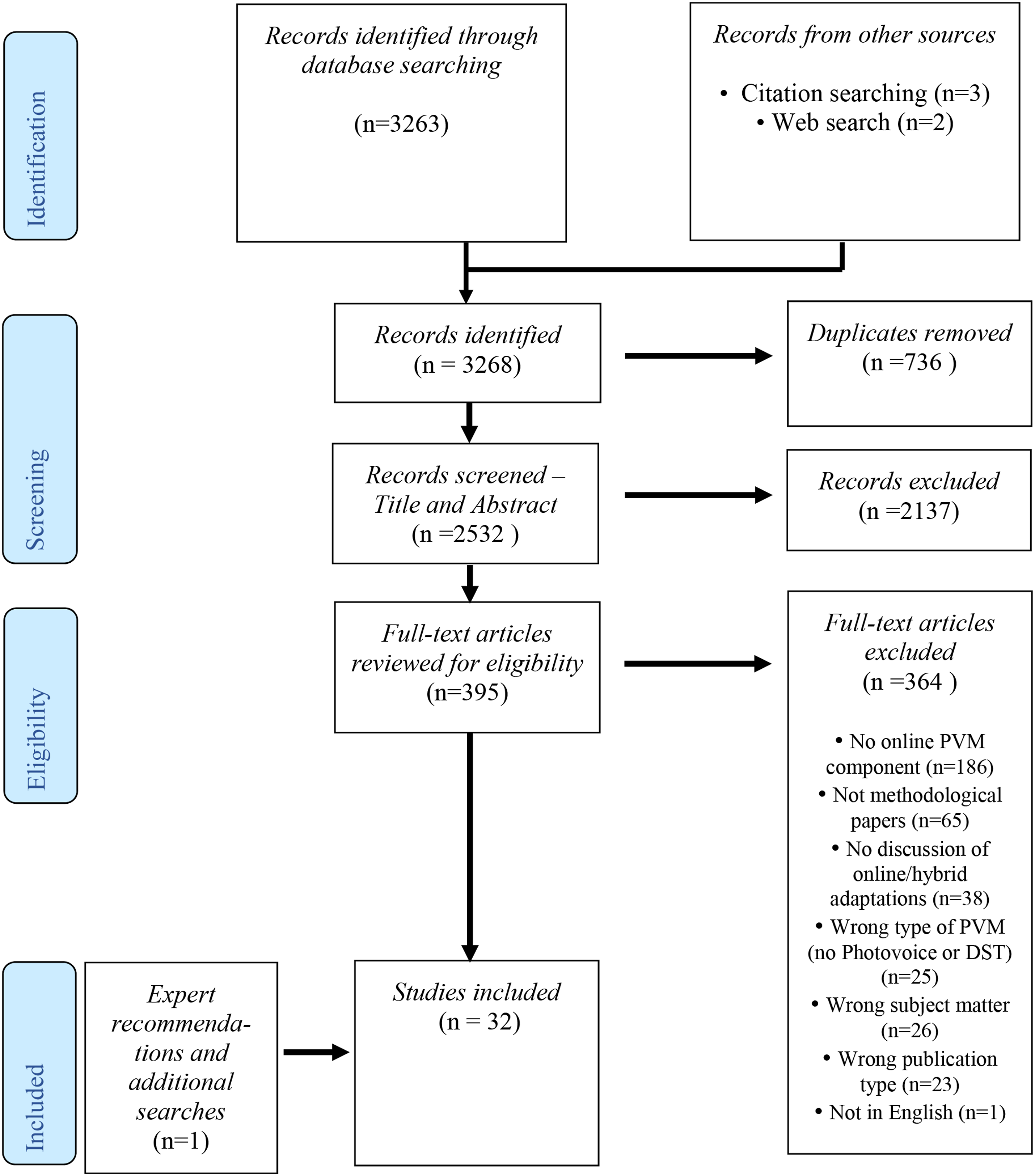
Stage 3: Study Selection
Our initial inclusion criteria were as follows: any English language article published anytime in a peer-reviewed journal and: (a) involving DST and/or Photovoice taking place in online or hybrid settings; (b) focusing on health and wellness or social justice; (c) providing details about the specific adaptations of DST/Photovoice to online or hybrid settings. All types of publication in a peer-reviewed journal were included. Book chapters and non-peer-reviewed work such as theses and dissertations, grey literature and conference abstracts were excluded. Additionally, we excluded articles where the only online aspect of the initiative was end of project Knowledge Translation and Exchange (KTE)—since our focus for this review was on study design rather than dissemination—or where the aim was to evaluate the use of PVM for teaching purposes. Our screening process was iterative in nature, and as detailed below, we further refined our inclusion criteria and completed additional rounds of screening as we became more familiar with the existing literature; this is common practice in the scoping review method, which is more flexible than other types of systematic reviews (Gottlieb et al., 2021).
A total of 3,268 articles were identified through our search. After removing duplicates (n = 736) 2,532 records remained for screening. The screening process was completed in Covidence, and was piloted by three authors who independently screened the first 200 titles and abstracts and then met to resolve conflicts before continuing record screening. After title and abstract screening of all articles, 395 articles were included for full-text review. All full-text articles were independently screened by two authors. After disagreements were discussed and consensus reached, we identified 104 articles for initial inclusion. However, as most of these articles included only minor details about online/hybrid adaptations, the team decided to further narrow down the eligibility criteria to include only methodological papers, i.e., articles in which the methodological implications of online/hybrid adaptations of PVM were at least one stated objective or primary focus. At this stage, two authors independently re-screened the 104 remaining articles using the narrower inclusion criteria and eliminated a further 68 articles. One additional article was identified after the screening process was completed, and the final number of articles included in the review was thirty-two.
Stage 4: Charting the Data
A data table was created by the first author to facilitate structured data extraction and was piloted with three other authors. The following information was charted: (a) author, date and country of study; (b) article objective; (c) topic of the PVM project; (d) adapted setting (online or hybrid) and reason for adaptation; (e) tools, devices and software used for communications; (f) key practices and adaptations reported; and (g) equity and ethical considerations for online/hybrid participatory visual methods work with communities. The table is provided as Supplemental Table S3.
Stage 5: Collating, Summarizing and Reporting the Results
We began by providing a basic descriptive summary of the included studies, following Levac et al.’s (2010) recommendation. To answer our research questions, we engaged Braun and Clarke’s (2006) six-step thematic analysis framework. Team meetings were held to discuss and refine emergent themes and subthemes prior to writing up the findings. This was an iterative process, and further refinements were made throughout the writing and editing stages.
Stage 6: Consultation Exercise
A team of researchers and community partners with experience in PVM were consulted on the study selection process, and a bibliography of included articles was distributed for feedback and suggestions on additional literature.
Results
Descriptive Overview of Included Studies
Our review included 32 articles published between 2019 and 2024; details for each study are provided in Supplemental Table S3. Twenty-six articles discussed online or hybrid Photovoice adaptations, five articles discussed online or hybrid DST adaptations, and one article discussed adaptations to both methods. Twenty-nine of the 36 projects referenced were conducted entirely online (excluding KTE) while seven involved a hybrid project design model. Thirty-one of the 32 articles cited the pandemic as at least one reason for working in online or hybrid settings. The majority of the 36 projects were conducted in the USA (n = 17) and Canada (n = 8), three studies were conducted across multiple countries, two in Australia, and one study was conducted in each of the following countries: Cook Islands, Malaysia, the Netherlands, Philippines, South Africa and Turkey. Among articles reporting project sample sizes, these ranged from four to 144 participants.
Of the 36 projects, twenty-seven (22 Photovoice and five DST) included a synchronous component, meaning at least one activity involved real-time engagement and interaction among members of the research team and participants, while four (all Photovoice) were conducted entirely asynchronously, meaning that participants engaged in project activities on their own time and without live interaction with research team members or other participants. For the remaining five projects, the reporting was not clear on this. Zoom was the most used software platform for meetings, workshops, one-on-one interviews and other synchronous communications (n = 21). Other software used instead of (or in addition to) Zoom for synchronous communication included Microsoft Teams (n = 2), FaceTime (n = 1), and WhatsApp (n = 1). Eight projects did not report the software used.
Major Themes
Themes and subthemes.

Methodological Experimentation: Exploring Digital Platforms and Tools, Asynchronous Engagement, and Recalibrating Online Workshop Designs
Digitalization Across the Project Life Span
With the day-to-day work of PVM projects moving to virtual spaces, digital tools and software replaced physical materials such as photo prints, flip charts, chalkboards and whiteboards. For Photovoice, some of the changes reflected an evolution in the method that was already underway and not exclusive to online adaptations, such as allowing participants to use their smartphones or tablets for taking and submitting photos (Black & Faustin, 2022; Boamah et al., 2022; Breny & McMorrow, 2022; Cai et al., 2023; Cai & Marks, 2021; Call-Cummings & Hauber-Özer, 2021; Chen, 2022; CohenMiller, 2022; Dare et al., 2021; Earnshaw et al., 2023; Ferlatte et al., 2022; Foster et al., 2022; Jahangir et al., 2022; Oliffe et al., 2023; Ottoni et al., 2023; Pasco et al., 2023; Poku et al., 2023; Spyreli et al., 2024; Waegh et al., 2023; Zha et al., 2022). Interestingly, while traditional Photovoice involves participants taking photographs during the project, several initiatives (Chen, 2022; Oliffe et al., 2023; Pasco et al., 2023; Polat, 2022) shifted to allowing photos to be sourced from participants’ personal collections or the Internet (public domain).
One popular feature was the screen sharing function of Zoom, used to display and discuss participant photos (Cai et al., 2023; Dare et al., 2021; Ferlatte et al., 2022; Oliffe et al., 2023; Ottoni et al., 2023; Pasco et al., 2023; Poku et al., 2023; Waegh et al., 2023) as well as consent forms for both methods (Boamah et al., 2022; Valdez & Gubrium, 2020; Waegh et al., 2023). Screen-sharing to facilitate photovoice conversations appears to have been a generally smooth process across reported studies, even being reported as a “data collection e-efficiency” in one study (Oliffe et al., 2023, p. 5).
Photovoice and DST are multi-stage methods that involve some form of homework and assignments. Facilitators rely on between-session check-ins to ensure that participants have the support they need and to advance project activities. Working online, many PVM practitioners engaged digital tools and technologies to perform these check-ins, and there were also additional touchpoints incorporated into some projects. For example, authors discussed the use of text, email and video message prompts and reminders for Photovoice participants to select and submit their photos (Earnshaw et al., 2023; Oliffe et al., 2023; Pasco et al., 2023; Spyreli et al., 2024), for follow-up discussions regarding photo submissions (Foster et al., 2022; Lichty et al., 2019), and to provide homework and technical support in between workshops (Jahangir et al., 2022). While many DST and Photovoice projects incorporated scheduled check-ins between meetings and workshops, there was also an increase in non-scheduled touchpoints. The use of these virtual check-ins was cited as important for building trust and rapport among participants and between research team members and participants (Durant & Kortes-Miller, 2023; Gumede & Sibiya, 2023; Jahangir et al., 2022; Mansfield et al., 2024; Poku et al., 2023; Sitter et al., 2023; Waegh et al., 2023).
A number of articles discussed the importance of utilizing the Zoom chat function, breakout rooms or instant messaging via phone, to contact participants who showed signs of distress or of needing support through their facial cues, body language, or other signs such as having their cameras off when they normally had them on (Becot et al., 2023; Breny & McMorrow, 2022; Dare et al., 2021; Poku et al., 2023; Polat, 2022). One of the more creative in-session check-ins involved the use of visual emotion cards by DST facilitators who displayed these on screen and asked participants to share how they felt about each group activity (Maragh-Bass et al., 2022).
Asynchronous Work: Supporting Flexibility, Engagement and Inclusivity
Experimentation with asynchronous activities (i.e., not occurring together in real-time) was a common trend across studies that were conducted virtually, and in four Photovoice projects, the online work was conducted entirely asynchronously (CohenMiller, 2022; Earnshaw et al., 2023; Lichty et al., 2019; Rivera et al., 2022). Among these was Lichty et al.’s (2019) hybrid Photovoice initiative with youth, which was the only project included in this review that was designed and fully undertaken online prior to the COVID-19 pandemic. The authors used a blogging website to facilitate the sharing of photos and narratives, and asynchronous engagement occurred through various mechanisms, including participant opportunities to positively rate submissions (using the ‘thumbs up’ icon) and provide online feedback within a set time window (Lichty et al., 2019). Among the DST initiatives included in this review, none were fully asynchronous (that is, all included at least one synchronous activity). However, Gumede and Sibaya’s (2023) exploration of student self-care in a South African university during the pandemic through digital stories was designed almost entirely asynchronously. To accommodate student lifestyles and schedules, the only synchronous activity was the initial one-on-one online introduction and DST training session.
One of the affordances of asynchronous Photovoice is that there is the possibility of allowing participants to submit their photos and captions anonymously, for example via a website, as Earnshaw et al. (2023) chose for their work with people living with HIV. As they noted, this option lessened the potential risks associated with participating in an initiative on a highly stigmatized topic. Social media was also a popular (albeit less anonymous) platform for facilitating asynchronous activities. For example, in a Photovoice initiative exploring climate resilience in the Philippines (Cai & Marks, 2021), participants used Facebook to share photos and narratives on their own time. Similarly, other initiatives used Instagram accounts where participants could share photos with hashtags instead of captions (Call-Cummings & Hauber-Özer, 2021; Foster et al., 2022).
Alternative Project Configurations and Timelines
Several Photovoice projects utilized one-on-one online photo elicitation interviews instead of group conversations (Oliffe et al., 2023; Ottoni et al., 2023; Pasco et al., 2023; Sorcher et al., 2023; Spyreli et al., 2024; Valdez & Gubrium, 2020). Other projects maintained the group conversation format but supplemented these with one-on-one interviews (Boamah et al., 2022; Cai & Marks, 2021; Polat, 2022) or provided options for participants to choose from either format (Chen, 2022). In two studies, group photovoice activities were eliminated altogether for some participants who chose one-on-one standard interviews to reduce the time commitment required (Chen, 2022; Ottoni et al., 2023). In one project, the Photovoice assignment conversations followed a two-on-one format; research team members who were situated in New Zealand conducted remote individual interviews with Indigenous youth in the Cook Islands, who were joined by another local research team member to provide cultural context and support (Waegh et al., 2023).
Among the projects that retained a group discussion component, adaptations were made to group size and composition as well as the online meeting length and time between each virtual session. Generally group sizes for online sessions were smaller, had shorter time limits (often 2 hours per session), and with longer intervals between meetings when compared to in-person Photovoice sessions (Black and Faustin., 2022; Chen, 2022; Dare et al., 2021; Ferlatte et al., 2022; Jahangir et al., 2022; Poku et al., 2023; Polat, 2022). Justifications for these types of changes often revolved around the research team’s efforts to balance equal opportunities for participation with avoiding screen and virtual meeting fatigue, particularly during the early pandemic when many daily activities were taking place online.
For DST initiatives, articles similarly reported changing the length and cadence of online workshops. In-person, DST workshops often take place over 3–5 full-day workshops. When adapted online, workshops often were carried out over a longer time period, held further apart, and lasting shorter durations (Durant & Kortes-Miller, 2023; Mansfield et al., 2024; Maragh-Bass et al., 2022; Valdez & Gubrium, 2020). Another area of experimentation with online project configuration that was prevalent among both Photovoice and DST initiatives was the separation of larger groups into smaller, temporary (and sometimes impromptu) sub-groups to inspire and facilitate creativity and discussion among participants. Most commonly, research teams used Zoom’s breakout room feature (Becot et al., 2023; Cai et al., 2023; Dare et al., 2021; Mansfield et al., 2024; Maragh-Bass et al., 2022; Poku et al., 2023). However, Poku et al. (2023) reported that participants resisted using breakout rooms because they did not want to miss out on what was being said among other groups. Similarly, Lichty et al. (2019) reported that they had intentionally separated participants into small groups, wherein each group was only able to access the photographs and discussion posts of their group, and yet participant feedback highlighted that they would have preferred to more broadly share photos and engage with the other groups.
New Roles and Responsibilities
Another area of methodological experimentation reported in the included studies was the creation of new roles and/or delegation of new responsibilities among research team members, to ensure that synchronous online sessions ran smoothly, to facilitate safe spaces, and to ensure that participants were supported in the remote tasks associated with their photo and digital story assignments. Online meeting platforms generally have multiple built-in channels for communication, and some research teams opted to have specific team members or facilitators responsible for monitoring the different channels, such as the chat and hand raising functions in Zoom (Becot et al., 2023; Breny & McMorrow, 2022; Call-Cummings & Hauber-Özer, 2021; Dare et al., 2021; Earnshaw et al., 2023). As some articles highlighted, given the participatory underpinnings of methods like Photovoice and DST, it was particularly important to ensure that participatory contributions were not overlooked due to unintentional oversights like missing a message in the chat box; delegated facilitators monitoring these activities lessened this risk (Black & Faustin, 2022; Breny & McMorrow, 2022; Dare et al., 2021). Additionally, several research teams designated individuals to monitor written communications and user screens for signs of distress (Becot et al., 2023; Cai et al., 2023; Dare et al., 2021; Jahangir et al., 2022). One study reported the inclusion of a counsellor who joined online group sessions and was available to speak separately with participants requesting individual support (Dare et al., 2021).
As part of the method, Photovoice and DST often require photo-taking or story-boarding homework between sessions. In online Photovoice and DST, especially in entirely virtual (and in some cases asynchronous) project designs, many research teams assigned or hired additional individuals dedicated to providing ongoing and ‘after-hours’ virtual support for participants as they worked on their photo and digital story assignments (Dare et al., 2021; Durant & Kortes-Miller, 2023; Gumede & Sibiya, 2023; Jahangir et al., 2022; Poku et al., 2023; Valdez & Gubrium, 2020). Jahangir et al. (2022), for example, in their Photovoice work with Black youth in the USA, assigned a point person for each youth participant from the research team, who served as the first point of contact for check-ins and homework assistance. In Gumede and Sibaya’s (2023) largely asynchronous DST initiative exploring life as a student amidst the COVID-19 pandemic in South Africa, the research team took turns working a ‘night shift’ where they were responsible for responding to evening and late-night email and text queries from participants, commonly occurring among university students.
Planning and Preparation: The Importance of Accounting for New and Unexpected Challenges and Circumstances
Practice Makes Perfect
Several articles highlighted the importance of preparing for online or hybrid PVM activities using test runs, piloting and even role-playing among the research team prior to project implementation (Becot et al., 2023; Black & Faustin, 2022; Breny & McMorrow, 2022; Cai et al., 2023; Dare et al., 2021; Poku et al., 2023). Practice sessions were held in addition to ensuring that all technology was running smoothly prior to online workshop meetings, with authors citing their lack of familiarity with online conversation dynamics as the rationale for pre-workshop rehearsals (Dare et al., 2021). The opportunities to practice beforehand were not limited to just the research team; for example, in Dare et al.’s (2021) Photovoice initiative, participants were given time to test the private messaging function with the counsellor prior to Photovoice sessions. As Breny and McMorrow (2022) observed, test runs of a photo-sharing activity with participants allow “time to identify and solve problems before participants attempt to share photos that are particularly meaningful to them” (p. 238).
Additional Participant Training and Orientation
PVMs like Photovoice and DST often place emphasis on preparing and training participants in the techniques and ethics of the various steps, such as photography and video editing. As research teams moved this work online, many reported incorporating additional online-specific participant training into their protocols (Becot et al., 2023; Boamah et al., 2022; Breny & McMorrow, 2022; Cai & Marks et al., 2021; Cai et al., 2023; Call-Cummings & Hauber-Özer 2021; Chen, 2022; Dare et al., 2021; Earnshaw et al., 2023; Foster et al., 2022; Gumede & Sibiya, 2023; Mansfield et al., 2024; Oliffe et al., 2023; Pasco et al., 2023; Poku et al., 2023; Sitter et al., 2023). For example, Poku et al. (2023) used their Photovoice onboarding process with their youth participants to identify their technological skills and needs. They then adapted their online training curriculum accordingly to include lessons and practice with software and tools used for sharing, storing and discussing photos online. In Mansfield et al.’s (2024) DST initiative with women from racialized communities undergoing breast cancer treatment, facilitators held multiple one-on-one meetings prior to the start of the workshops, rather than just a single onboarding session. Interestingly, while the original plan for the project had been to provide technical training during group workshop sessions, participants “prioritized sharing their contextualized, lived health experiences over discussions of technical topics such as video editing”, that were alternatively addressed during individual one-on-one sessions (p. 4).
While some researchers relied primarily on written training materials (Becot et al., 2023; Cai et al., 2023; Ferlatte et al., 2022; Spyreli et al., 2024), others used more creative measures; Dare et al. (2021), for example, experimented with role-playing and recording a mock online Photovoice session, and distributing it to participants in advance to provide guidance and familiarization with the process. Two articles reported the use of video instead of written instructions (Call-Cummings & Hauber-Özer 2021; Earnshaw et al., 2023). Some research teams also provided dedicated social media training (Cai & Marks, 2021; Foster et al., 2022) or online meeting facilitation training with people with lived experience, who then went on to co-facilitate workshops (Pasco et al., 2023; Sitter et al., 2023).
Importantly, onboarding activities explored in this review were not exclusively online; in some hybrid initiatives, training and orientation was conducted in-person (Lichty et al., 2019; Poku et al., 2023; Sorcher et al., 2023). Poku et al. (2023), for example, held small-group photo walks outdoors with a professional photographer at the start of their project (due to COVID-19 social distancing measures). Lichty et al. (2019), in their pre-pandemic initiative, completed all training with participants in-person even though the Photovoice activities occurred online and asynchronously.
Opportunities for and Impacts of Flexibility in Methods
Accessibility and Inclusivity
Studies widely reported on the affordances for accommodating diverse participation and accessibility needs when the work was online. For example, flexible scheduling was a frequently cited benefit of working online, since Photovoice and DST often have multiple touchpoints, and coordinating times for in-person workshops can be complicated given childcare, work, school, and transportation factors (Black & Faustin, 2022; Breny & McMorrow, 2022; Call-Cummings & Huber-Ozer, 2021; Chen, 2022; Dare et al., 2021; Gumede & Sibiya, 2023; Mansfield et al., 2024; Maragh-Bass et al., 2022; Oliffe et al., 2023; Poku et al., 2023; Polat, 2022; Sitter et al., 2023; Spyreli et al., 2024; Valdez & Gubrium, 2020). Asynchronous studies also highlighted the enhanced accessibility of online PVM designs due to flexible scheduling, and indeed, some researchers cited people’s ability to participate on their own time and terms as a key reason for choosing an asynchronous model (CohenMiller, 2022; Lichty et al., 2019). Beyond time and scheduling considerations, research teams also had greater geographical reach for recruitment goals (Breny & McMorrow, 2022; Cai & Marks, 2021; Chen, 2022; CohenMiller, 2022; Lichty et al., 2019; Maragh-Bass et al., 2022; Oliffe et al., 2023; Pasco et al., 2023; Poku et al., 2023; Sitter et al., 2023; Sorcher et al., 2023; Spyreli et al., 2024; Waegh et al., 2023; Zha et al., 2022).
There were also technological features that researchers reported utilizing to provide more welcoming and inclusive virtual spaces; for example, multi-language interfaces (Earnshaw et al., 2023; Zha et al., 2022). The use of Zoom’s chat function was observed as supporting those who were unable or did not wish to contribute verbally (Jahangir et al., 2022; Poku et al., 2023; Polat, 2022). Several articles noted that because of the range of technologies and tools available for online PVM work, researchers had both an opportunity and a responsibility to make decisions that enabled more equitable participation (Black & Faustin, 2022; Breny & McMorrow, 2022; Cai et al., 2023; Chen, 2022; Gumede & Sibiya, 2023; Jahangir et al., 2022; Lichty et al., 2019; Maragh-Bass et al., 2022; Waegh et al., 2023). In many initiatives, especially those working with youth or older adults, the age of participants were considered when planning for technology (Cai et al., 2023; Chen, 2022; Ferlatte et al., 2022; Gumede & Sibiya, 2023; Lichty et al., 2019; Maragh-Bass et al., 2022). Many researchers also reported making technology and software decisions based on availability, accessibility and cost to decrease participation barriers (Cai et al., 2023; Lichty et al., 2019; Poku et al., 2023; Valdez & Gubrium, 2020; Waegh et al., 2023; Zha et al., 2022).
Reducing Research Hierarchies through Increased Agency and Decision-Making
Many articles reported increased agency and decision-making opportunities for research participants as the work moved online. Many adaptations highlighted in the included articles involved participants being asked when, where, and how they wanted to participate in the work as it moved online. For many studies reviewed, participants were also involved in decisions about the larger design and implementation of online projects, rather than leaving the decisions in the hands of the research team alone (CohenMiller, 2022; Ferlatte et al., 2022; Gumede & Sibiya, 2023; Mansfield et al., 2024; Maragh-Bass et al., 2022; Poku et al., 2023; Polat, 2022; Sitter et al., 2023). Teams relied on both formal and informal participant feedback mechanisms to make impromptu changes and adjustments to the study design (CohenMiller, 2022; Ferlatte et al., 2022; Gumede & Sibiya, 2023; Mansfield et al., 2024; Maragh-Bass et al., 2022; Poku et al., 2023; Polat, 2022; Sitter et al., 2023). For example, Ferlatte et al. (2022) sought an REB amendment to allow participants to submit their Photovoice submissions using Messenger after some participants pushed back against being required to use email for photo submissions. Similarly, Polat (2022) reduced her planned eight-session Photovoice format to seven sessions when participants expressed that they felt seven sessions was sufficient. Additionally, some authors highlighted how they established virtual group meeting norms collaboratively with participants rather than the research team creating these alone (Dare et al., 2021; Poku et al., 2023), with some reporting the use of interactive tools like Google Jamboard (Maragh-Bass et al., 2022) and virtual sticky notes (Black & Faustin, 2022) to enhance collaboration.
Participants were also given more latitude for moment-to-moment forms of participation. For example, for online synchronous activities, participants were often given the choice of whether they wanted to have their cameras on or off, even though researcher preferences were generally for them to remain on (Breny & McMorrow, 2022; Call-Cummings & Hauber-Özer, 2021; Gumede & Sibiya, 2023; Maragh-Bass et al., 2022; Poku et al., 2023; Spyreli et al., 2024; Waegh et al., 2023). Similarly, many research teams reported leaving the decision of which device to use for joining meetings and/or check-ins, in the hands of participants (Becot et al., 2023; Cai et al., 2023; Chen, 2022; Durant & Kortes-Miller, 2023; Ferlatte et al., 2022; Ottoni et al., 2023; Poku et al., 2023). Scheduling decisions for synchronous activities were also often decided on by participants rather than around researcher schedules, venue availabilities or other considerations that often dictate decision making around in-person initiatives (Boamah et al., 2022; Call-Cummings & Hauber-Özer, 2021; Gumede & Sibiya, 2023; Jahangir et al., 2022; Oliffe et al., 2023; Poku et al., 2023; Sorcher et al., 2023).
Methodological Tensions and Tradeoffs
Design Choices Versus Methodological Adherence
Adapting projects to an online setting often meant making design choices that created a potential tension with the methodological underpinnings of Photovoice. Some articles that discussed projects involving a shift to one-on-one Photovoice formats explicitly recognized and addressed the methodological implications (and potential limitations) of this adaptation (Chen, 2022; Liegghio & Caragata, 2020; Oliffe et al., 2023; Pasco et al., 2023). As Chen (2022) acknowledged, “with group discussions and reflections being the cornerstone of Photovoice by facilitating participant sharing and connections, allowing individual participation inevitably reduced the participatory elements of the research” (p. 9). Similarly, Pasco et al. (2023), who chose to hold one-on-one photo elicitation interviews in their online Photovoice initiative with diverse young adults in Arizona, highlighted the lack of opportunities for participants to converse and engage with one another as a key limitation of their project, and they recommended the use of focus group formats in future work.
A key area of reported experimentation was around the source of photos used for Photovoice, including allowing internet-derived photographs, using older photos that were not taken directly in response to a Photovoice prompt, and in two cases artwork or personal artifacts instead of photographs (Call-Cummings and Hauber-Özer, 2021; Polat, 2022). Apart from being a departure from the Photovoice impetus to literally place cameras in the hands of participants, some of these adaptations raised new questions. Specifically, two articles (Chen, 2022; Oliffe et al., 2023) discussed ownership and consent particularly for internet-derived photos. Oliffe et al. (2023), for example, noted that only 13 percent of participants in their study took new photos in response to the Photovoice prompts, with the remainder using either older photographs or images derived from the Internet. While recognizing the potential methodological tensions, the authors also commented on the possible benefits of less orthodox approaches to photovoice; they noted that, “while men’s distance from traditional photography was evident, their reflexive processes were apparent in the detailed accounts that they provided for their chosen images. Evident here was the shifting nature of participatory action—whereby the men diversely decided their photographic processes and products” (Oliffe et al., 2023, p. 7).
A number of other design adaptations for online PVM were cited in our review as potentially undermining the level and depth of engagement for participants, as will be explored next.
Online Environments as Facilitator Versus Barrier to Meaningful Community Engagement
Another notable tension was the question of whether and to what extent it was possible to foster meaningful engagement, connection and a sense of community through online interactions. For example, Foster et al. (2022) admitted that their use of multiple social media platforms for photo sharing and captioning left participants unclear about “when and what to post where”, and they reported that the complicated process may have also posed a barrier to engagement (p. 1738). As they noted, using a single platform may have enabled more thoughtful and in-depth discussions. Polat (2022), who used screenshots to capture artwork and objects shared by participants during workshops cautioned that this could also lead to researchers misrepresenting participants’ intentions; thus, Polat recommended that research teams using this option should validate the screenshots and researcher interpretations with participants. Lichty et al. (2019) cautioned that their use of youth blogs may have discouraged contributions from those who prefer spoken communication, and they urged researchers to seek out ways to accommodate diverse preferences in future online asynchronous Photovoice initiatives.
Some researchers highlighted the opportunities for online community building, such as Foster et al. (2022) who noted that social media-based Photovoice submissions “moved the images and conversation immediately into the public sphere”, which was effective in inspiring and mobilizing the larger community around community redevelopment (p. 1731). Waegh et al. (2023) also pointed to the community-building potential of social media, noting that their Facebook group chat helped bring together participants and project partners in their Photovoice initiative. Lichty et al. (2019) observed that blog contributions from youth in their project became more thoughtful and analytically rich over time, thus indicating that this space was conducive to joint learning.
Other researchers, however, highlighted the additional steps required to bring communities together online and create an inclusive and inspiring environment (Breny & McMorrow, 2022; Call-Cummings & Hauber-Özer, 2021; Chen, 2022; Durant & Kortes-Miller, 2023; Ferlatte et al., 2022). Chen (2022), for example, whose Photovoice initiative involved both online and in-person participation, lamented the difficulties with achieving robust and sustained engagement among participants during the online meetings. As observed by Call-Cummings and Hauber-Özer (2021), by moving their work to online spaces, they lost the unique opportunities for the kinds of organic (and often impromptu) community building that had occurred in-person, such as when gatherings held at a school attracted the attention of bystander students who subsequently joined their photovoice initiative. And while watching for potential signs of participant distress applies to all PVM work regardless of the setting, studies in this review reported how upholding this responsibility was more challenging in online spaces, where it was more difficult (and when cameras were off, impossible) to read body language or facial cues (Call-Cummings & Hauber-Özer, 2021; Chen, 2022; Durant & Kortes-Miller, 2023; Gumede & Sibiya, 2023; Polat, 2022).
Online Technologies as Facilitator Versus Barrier to Inclusive Research Practices
Another tension that was prevalent was the role of technology used in online and hybrid environments in either facilitating or hindering inclusive PVM research practices, particularly as they related to working with underserved communities. For example, many of the papers questioned how to reconcile the fact that while more diverse voices and perspectives could potentially be heard through initiatives that were online or hybrid (by virtue of these projects being able to reach more communities through remote access), some populations with less access to or experience with the necessary technologies could be isolated and excluded from these same initiatives (Becot et al., 2023; Call-Cummings & Hauber-Özer, 2021; Chen, 2022; CohenMiller, 2022; Dare et al., 2021; Ferlatte et al., 2022; Jahangir et al., 2022; Liegghio & Caragata, 2020; Maragh-Bass et al., 2022; Poku et al., 2023; Spyreli et al., 2024; Waegh et al., 2023). Some researchers reported steps to mitigate these potentially exclusionary tendencies of online PVM by loaning devices to participants or providing them as a form of honoraria (Poku et al., 2023). However, this represents a costly endeavor for projects that often have limited budgets to begin with, and some studies reported the loss of prospective participants solely on the basis of device access (Call-Cummings and Hauber-Özer, 2021; Polat, 2022).
Discussion
This scoping review has presented a range of findings and lessons learned from methodological papers discussing online and hybrid adaptations of PVM. While the Photovoice and DST initiatives explored in this review covered a range of geographical and cultural settings, with diverse communities, and implemented for different purposes, it is notable that all but one study (Lichty et al., 2019) occurred during or in the early aftermath of the global COVID-19 pandemic. Thus, the majority of the methodological adaptations and adjustments reported in this review were initially driven by the pandemic’s physical distancing requirements. The proliferation of methodological papers in the last few years discussing online and hybrid adaptations of Photovoice and DST reflects the significance of this moment for these methods. Moreover, the considerations around ethics and equity that research teams grappled with were often intertwined with questions about the health, safety and overall well-being of those involved in their initiatives amidst a global health emergency.
The findings of this review highlight how these methods have been disrupted since 2020. The implications of these disruptions are especially notable for Photovoice, which prior to 2020 had not, as a method, changed significantly since its emergence in health research. This point is illustrated by Foster et al. (2022) who reviewed Photovoice studies published in peer reviewed journals between 2004 and 2020, and noted that over this period, “the transition from film to digital photography was the only notable evolution in the method. Populations…varied, but the method remained relatively stable” (p. 1731). In contrast to 2004–2020, the last 4 years, amidst the COVID-19 pandemic, have seen Photovoice modified at every stage of the process, from design to dissemination. As this review has highlighted, the foundational and central Photovoice concept of putting cameras in the hands of participants to later discuss as a group—has been stretched and altered to include a broad range of photo-sourcing and discussion formats.
The adaptations identified in this review illustrate the flexibility of Photovoice and DST, but they also raise ambiguities about the future of online PVM. Further research might explore the strengths and challenges of conducting these methods online to determine to what extent they should continue to be conducted in online (or hybrid) formats. Design choices are reported as context-dependent (for example, populations of interest, geographical reach, topic of focus) as well as informed by research team and community member needs and preferences. However, it might also be worth asking whether those choices represent such a far departure from in-person practice that they no longer align with the core principles of the adapted method. Consider, for example, the prevalence of both photo elicitation and one-on-one interviews, instead of group Photovoice discussions, reported in our review. A 2018 “State of the Methods Paper” urged readers not to conflate photo elicitation, defined as “the use of photographs (pre-existing or made for the research) as prompts in individual or group interviews” with Photovoice, since the former is not informed by participatory action research (Liebenberg, 2018, p. 7). And a recent “review of reviews” on Photovoice identified “inconsistent adherence to the Photovoice method” as a key critique in the (pre-pandemic) literature and highlighted the use of one-on-one interviews in lieu of critical group discussions, as a primary example of this (Seitz & Orsini, 2022, p. 281). Notably, while many of the included studies acknowledged that these changes for online Photovoice raised questions about methodological adherence, these were often framed as decisions made out of necessity (the pandemic), and fewer papers went on to explicitly address whether or not these represented best practices outside of the pandemic context, and whether and how they should be utilized moving forward. With one-on-one and photo-elicitation formats being increasingly adopted for online Photovoice in the post-pandemic context, it may be beneficial for researchers to engage in a dialogue about whether and to what extent there is a place for these formats in the method moving forward, especially if online Photovoice and DST are here to stay.
While there were some tensions and questions raised about methodological adherence in online PVM adaptations, there were also promising findings that were highlighted in this review. Many of the online and hybrid practices led to improved access for individuals and groups who had previously been excluded from, or faced barriers to fully participating in, in-person Photovoice and DST initiatives. Moreover, our review pointed to the ways in which power dynamics shifted and research power hierarchies were sometimes reduced, as a result of moving activities online. Crucially, however, these effects of online adaptations did not simply happen automatically; they required intentionality by researchers and co-researchers involved in the design and facilitation of online Photovoice and DST projects. Other studies conducted prior to the pandemic have explored the intentional role of the researcher, or research team in both designing, and facilitating Photovoice methods in in-person environments (Switzer, 2019). The same argument could be extended to online environments. For example, while some of the features of online meeting software can lend to a less hierarchical environment (Muranaka, 2024; Pocock et al., 2021), online group discussions are not inherently more democratic than those taking place in-person; the studies in our review highlighted the purposeful steps that facilitators took, such as creating participant-only breakout rooms (Cai et al., 2023), training peer-facilitators to co-facilitate workshops (Sitter et al., 2023) or even simply stepping back, muting themselves, and allowing the “group to gel” (Black & Faustin, 2022, p. 244). Online technologies are not neutral and can make power dynamics in participatory processes more opaque, and visible, simultaneously (Switzer et al., 2024).
Finally, with many Photovoice and DST projects being adapted online by researchers who had little to no prior experience conducting these methods online, this allowed for an adoption of a joint learning approach amongst teams and participants. Here, research teams, participants and community members collectively experimented with new tools, technologies, logistics and conversation formats together. Other research has documented how the conditions created by the pandemic encouraged participatory research teams to rely on the strengths and skill-sets of community members and community partners when working in unfamiliar online environments, thereby offering up the potential for recalibrated power dynamics, increased participant autonomy, and engagement (Do et al., 2024; Jahangir et al., 2022).
Limitations and Future Directions
This review mapped out the methodological literature on adapting Photovoice and DST to online and hybrid settings, but by excluding non-methods papers that focused only on substantive findings, it is possible that additional comparisons between in-person and online approaches and other insights on online/hybrid adaptations to these methods in the broader literature were missed. For example, while the included articles offered some observations and reflections on privacy related risks and the complexities of obtaining consent online, these discussions pertained largely to qualitative methods in general, rather than to the unique considerations related to the Photovoice and DST methods. A larger knowledge synthesis of all studies reporting online/hybrid adaptations of PV and DST, including papers reporting substantive findings, may yield some more detailed insights and strategies for protecting participant privacy when they are sharing their stories and artistic outputs online. Furthermore, while we sought to explore both online and hybrid study designs, the majority of initiatives discussed were purely online, which was likely due to the pandemic restrictions limiting opportunities for any in-person gatherings. Additionally, there were many more articles focusing on Photovoice than on DST, which may be partly due to the fact that DST is a newer (yet burgeoning), method in health and social justice research (Hutson & Hankins, 2019).
We also recognize that by narrowing our focus to only the pre-dissemination stages of Photovoice and DST and not exploring online KTE, we excluded a component that is integral to these methods (Gubrium & Harper, 2013; Wang, 1999). However, it is worth noting that the majority of articles in our review spoke very little about or did not report at all on their KTE outcomes or plans. The lack of reporting on KTE in some PVM research has been identified and problematized previously (Gubrium & Harper, 2013; Liebenberg, 2018; Seitz & Orsini, 2022), so the issue is not unique to recent online/hybrid work. Additionally, the ethical risks and implications of online dissemination are complex, and had not been adequately grappled with in the literature even prior to the pandemic (Teti, 2019). Future research should explore the KTE-related implications of online PVM, as well as the longer-term outcomes of online/hybrid PVM projects. Such studies could present an opportunity for further reflection, as well as for sharing ideas about the future of PVM given changing technological advancements and online meeting norms.
Finally, it is important to acknowledge that because many of the articles included in this review were written amidst a global pandemic, and at a time when adapting PVM to online settings was a new and evolving challenge, research teams may have been largely occupied by the immediate logistics and practicalities associated with working online. This may have limited their capacity for thoroughly exploring the differences between in-person and online work, or engaging in deeper, critical reflection. The opportunities for more nuanced analysis may now be more accessible to researchers engaging in online and hybrid PVM initiatives, as they are able to apply the lessons learned from earlier experiences. As additional publications emerge, there will be an opportunity to engage in further reviews (including non-systematic reviews such as narrative or critical literature reviews) and to provide more robust engagement with the methodological tensions and other implications of transitioning PVM to online and hybrid settings.
Conclusion
This scoping review of methodological literature on adapting Photovoice and DST to online and hybrid settings has identified a range of practical insights, challenges, and lessons learned. Our findings highlight that while there are many promising practices and potential benefits of implementing PVM via online or remote means, some of the adaptations raise questions about whether and to what extent they stray from community-based and participatory underpinnings of the methods. The current review provides a starting point for opening up conversations among those who aim to work with PVM in online and hybrid settings while also attending to the social, theoretical and philosophical foundations of these methods.
Supplemental Material
Supplemental Material - Adapting Participatory Visual Methods to Online and Hybrid Settings: A Scoping Review and Thematic Analysis
Supplemental Material for Adapting Participatory Visual Methods to Online and Hybrid Settings: A Scoping Review and Thematic Analysis by Kristina Fuentes, Shreya Mahajan, Sarah Switzer, Gurleen Saroya, Antonia Giannarakos, and Elizabeth Mansfield in International Journal of Qualitative Methods
Supplemental Material
Supplemental Material - Adapting Participatory Visual Methods to Online and Hybrid Settings: A Scoping Review and Thematic Analysis
Supplemental Material for Adapting Participatory Visual Methods to Online and Hybrid Settings: A Scoping Review and Thematic Analysis by Kristina Fuentes, Shreya Mahajan, Sarah Switzer, Gurleen Saroya, Antonia Giannarakos, and Elizabeth Mansfield in International Journal of Qualitative Methods
Supplemental Material
Supplemental Material - Adapting Participatory Visual Methods to Online and Hybrid Settings: A Scoping Review and Thematic Analysis
Supplemental Material for Adapting Participatory Visual Methods to Online and Hybrid Settings: A Scoping Review and Thematic Analysis by Kristina Fuentes, Shreya Mahajan, Sarah Switzer, Gurleen Saroya, Antonia Giannarakos, and Elizabeth Mansfield in International Journal of Qualitative Methods
Footnotes
Declaration of Conflicting Interests
The author(s) declared no potential conflicts of interest with respect to the research, authorship, and/or publication of this article.
Funding
The author(s) disclosed receipt of the following financial support for the research, authorship, and/or publication of this article: This work was supported by the Canadian Institutes of Health Research (CIHR), through a project grant (award #183750) awarded to Dr. Elizabeth Mansfield.

Supplemental Material
Supplemental material for this article is available online.
References
Supplementary Material
Please find the following supplemental material available below.
For Open Access articles published under a Creative Commons License, all supplemental material carries the same license as the article it is associated with.
For non-Open Access articles published, all supplemental material carries a non-exclusive license, and permission requests for re-use of supplemental material or any part of supplemental material shall be sent directly to the copyright owner as specified in the copyright notice associated with the article.
