




Abstract
This article explores the practical application of Bruno Latour’s “tools of discernment,” designed to facilitate open collective inquiry without preconceived outcomes. These tools aim to enhance understanding of complex social phenomena, often called “wicked problems,” by encouraging participants to self-describe their experiences and perspectives. This approach allows for individual expression, constructing collective narratives, and pursuing societal solutions. In Bordeaux, research focused on young people’s engagement and aspirations. Researchers employed discernment tools alongside a non-participatory observational approach, meticulously documenting interactions and discussions. The abductive process enabled a real-time understanding of young participants’ social dynamics and concerns, highlighting essential themes such as the multifunctionality of public spaces and the impact of digital technology on social relations. In Montreal, the study addressed systemic racism and discrimination using discernment tools. Written contributions were analyzed to identify recurring themes and underlying dynamics. This process ensured participants’ voices were accurately represented, resulting in 38 recommendations for institutional recognition and action against systemic racism. The deployment of discernment tools in both cities demonstrated their effectiveness in capturing individual experiences and fostering collective understanding while addressing complex societal challenges. However, challenges such as participant engagement and interpretive bias require adaptive planning and critical reflection. This article demonstrates the potential of discernment tools in participatory social science research, advocating for inclusive and iterative methodologies to tackle complex societal issues. Additionally, it proposes a deployment protocol to foster constructive dialogue, improve understanding of complex social dynamics, and facilitate the development of workable solutions.
Keywords
Introduction
Contemporary social challenges are increasingly complex for decision-makers and researchers. They resist simple solutions and require advanced methodologies to understand the full intricacies of the phenomena involved. This article illustrates this complexity by addressing young people’s aspirations and fighting racism and discrimination. Bruno Latour has extensively investigated the intricate dynamics between the researcher and the subject, transcending conventional demarcations. In the latter part of his career, he introduced innovative methodologies, such as “discernment tools”, which are designed to refresh our perspectives on societal issues. Although these methodologies offer fresh insights, their application in practice has remained insufficiently documented. This article endeavors to elucidate and implement these approaches by analyzing two empirical studies: one conducted in Bordeaux, which focuses on the well-being of young individuals, and another in Montreal, addressing systemic racism and discrimination.
A conversation with Bruno Latour provided precious insights, notably prior to the release of his book “Où atterrir ? Comment s’orienter en politique” (“Where to Land”) (2017). Latour encouraged us to embrace an empathetic stance towards our research fields, challenging prevailing notions of citizen disengagement. He underscored the necessity of acknowledging contemporary forms of engagement and delineated the impact of spaces, objects, and networks on citizens’ interactions and everyday experiences. These concepts were pivotal in formulating the current methodological proposal regarding discernment tools. Bruno Latour mobilized discernment tools to address the question “How can we rebuild a post-pandemic society?” by proposing the little questionnaires during the pandemic. Unfortunately, he passed away before he could produce an analysis. This article shows how these tools were used to answer two questions: “What do young people think?” and “How can we fight systemic racism and discrimination?” These studies thus highlight the suitability of discernment tools in authentic and diverse contexts.
The discernment tools suggested by Bruno Latour are characterized by fostering open collective inquiry without preconceived expectations of the outcomes. The inductive nature and protocol of these tools do not allow for the formulation of hypotheses a priori. However, as we will discuss in a dedicated section of this article, the formulation of the question is a determining part of the protocol. Their purpose is not merely to compile disparate opinions but to facilitate the meticulous depiction of scenarios and the execution of small-scale studies to augment discourse. These tools are neither traditional questionnaires nor standard surveys; they serve instead as aids for self-reflection. The objective is to craft a tangible, well-founded representation by amalgamating and overlaying the gathered descriptions. For Latour, the process transcends simply voicing a spontaneous opinion; it involves delineating and amplifying a scenario through targeted inquiries. Only after this, by employing methods to merge responses, thereby crafting the landscape through the overlay of multiple descriptions, can one formulate an embodied, concrete political stance—but not beforehand. This methodology aims to pioneer new modalities of societal observation and to encourage a “taste for the future,” echoing the aspirations of Max Weber (1919), who attempted to bridge academic research with political engagement.
The practical application of Bruno Latour’s “tools of discernment” remains an open question in empirical research. The scholarly discourse is rich with theoretical debates surrounding Actor-Network Theory and other Latourian concepts (AlArasi & Buliung, 2023; Bruni & Teli, 2007; Cresswell et al., 2010; France & Haddon, 2014; Tummons, 2021); however, it lacks in presenting concrete empirical studies applying these frameworks to address societal challenges in the post-pandemic landscape or other complex social issues. Moreover, despite Latour’s emphasis on the significance of all actors in the social fabric, including non-human elements within social networks, there is scant research on the effective integration of such elements—technologies, spaces, and objects—into research methodologies targeting societal matters (Gertenbach, 2023; Marres, 2020; Møller Hartley et al., 2023).
The empathetic approach toward research subjects and the acknowledgment of emerging forms of engagement, as advocated by Latour, have yet to be adequately examined, particularly in studies concerning youth or racial discrimination. There is a clear need to devise methods incorporating empathy into sociological research and evaluate their effects, aligning with Latour’s proposals (McCaffree, 2020; Weisz & Cikara, 2021; Zaki, 2020). Additionally, the utility of Actor-Network Theory in fostering tangible, embodied political articulations, especially in the realm of post-pandemic societal recovery, has been underutilized, notwithstanding its centrality in Latour’s recent decade of work (Latour, 2021a).
Furthermore, the extension of Latour’s methodologies beyond sociology, particularly into interdisciplinary realms involving psychology, political science, and communication science, is yet to be thoroughly examined. This gap underscores the imperative to extend Latourian frameworks across diverse disciplinary landscapes to address multifaceted societal challenges (Egholm Lund, 2023; Keulartz, 2023; Neyrat, 2018). Consequently, a pivotal research question arises: How can discernment tools facilitate independent social inquiry by participants and aid in formulating concrete solutions and a deeper comprehension of complex social issues while also considering the researcher’s role in these evolving processes?
Accordingly, this article delves into the transformation of Latourian social theories into research and social construction methodologies, explicitly focusing on addressing “wicked problems.” It initiates a review of such complex issues, underscoring the necessity for multidimensional and transdisciplinary strategies. Subsequently, the article details the application of Latour’s “new cahiers de doléances” or “discernment tools,” spotlighting their success in engaging youth in Bordeaux and combating racism and discrimination in Montreal. The methodology, findings, and challenges in leveraging these tools within qualitative research are scrutinized. The article concludes by exploring the potential for participatory research in social sciences, accentuating the unique contributions of discernment tools to comprehend and resolve intricate social issues.
Transforming the Latourian Social Approach into a Research and Social Construction Method
Research and Dialogue Methods to Address the Complexity of Social Phenomena
Before exploring the methodological framework, we must comprehend the concept of “wicked problems,” as introduced by Rittel and Webber (1973). These are complex, multifaceted, and interdependent challenges that elude definitive solutions. Characterized by uncertainty, interconnectedness, and societal ramifications, such problems manifest in climate change, social inequality, and pandemics. Addressing these dilemmas necessitates moving away from linear or sector-specific approaches and advocating for a multidimensional and transdisciplinary methodology (Head, 2022; Head & Alford, 2015). For researchers, this entails the development of protocols that not only monitor, analyze, and document these issues in their full complexity but also devise interventions considering the multitude of variables and perspectives involved (Chan, 2023; Skaburskis, 2008; Wexler, 2009). By embracing this strategy, research not only assumes the role of an observer but also acts as a participant in resolving these wicked problems, providing tools that facilitate autonomous social inquiry and an exhaustive examination of societal issues.
Utilizing qualitative research tools that capture participants’ perceptions is particularly effective for addressing “wicked problems.” Latour’s framework helps elucidate human-environment dynamics but challenges researchers to innovate their protocols (Vallée-Tourangeau, 2023). This approach aligns with Callon’s “hybrid forums” concept, viewing development challenges as intertwined issues requiring diverse and inclusive solutions. Hybrid forums (Callon & Barthe, 2005; Callon & Rip, 1992) offer a collaborative space where stakeholders can converge to address complex issues, incorporating varied perspectives and expertise to enable more contextualized solutions.
In this era of disruption, the capacity to sustain effective collaboration between researchers and participants, despite geographical distances, underscores the adaptability and robustness of participatory methods. These strategies, echoing the philosophies of Latour and Callon, accentuate the imperative to revamp research methodologies (Donovan, 2014b) to ensure they remain open and adept at capturing the lived complexities of participants. Adopting a more accessible and collaborative methodology facilitates a better confrontation of development issues, often marked by their complexity and interconnectivity.
Hall et al. (2021) further highlight this necessity, observing how the COVID-19 pandemic has intensified the obstacles faced in conducting participatory research while stressing the critical nature of upholding collaboration and discourse between researchers and participants, even under restrictive conditions. This underpins the argument for employing hybrid forums to tackle complex challenges, ensuring that participants’ perspectives and experiences form the cornerstone of the research and development trajectory.
Moreover, research conducted by Rustage et al. on participatory methodologies in developing health interventions for migrants underscores the hurdles related to inclusivity and democratic engagement in research. Their findings emphasize the variability and occasional insufficiency of migrants’ active participation, highlighting the challenges in genuinely involving participants in the research process. This scenario necessitates a more diligent application of participatory principles, consistent with the frameworks advocated by Latour and Callon, to ensure that qualitative research effectively navigates wicked problems by incorporating participants’ viewpoints. These studies underscore the significance of integrating qualitative research instruments that respect and amplify participants’ perceptions to accurately decode and address the intricate challenges of our era.
From the “New Cahiers de Doléances (Grievance Books)” to Discernment Tools
Latour’s insights have significantly influenced various stages of our research. His seminal works, “Laboratory Life” (Woolgar & Latour, 1988) and “Politiques de la nature: Comment faire entrer les sciences en démocratie” (Latour, 1999), underscore the complexity of contemporary societies and the crucial role of interdisciplinarity in comprehending the dynamics between society and the environment (de Vrieze, 2017; Flower & Hamington, 2022; Niederman, 2022a). In examining what he terms “critical zones,” Latour further insists on the imperative to reassess relationships and reevaluate dominant paradigms between humans and nature (Latour, 2021b).
Actor-network theory (ANT) presents a holistic view of social interactions, acknowledging all entities’ contributions to the collective construction of reality (Callon, 1986; Law, 1992). This approach, spotlighted by Bruni and Teli (2007) and augmented by Akrich’s exploration of the mediating roles of technical objects (Akrich, 1992), illuminates our interactions with the environment, urban spaces, and technology. ANT fosters a multiplicity of voices and perspectives, promoting active engagement in research and contemplation of social dynamics (Harman, 2007; Tummons, 2021).
Latour’s discourse, especially in the final decade of his career, emphasizes a future-oriented approach. His concept of the “parliament of things” advocates for including many perspectives in decision-making processes, emphasizing every actor’s significance and refusing to marginalize minority voices (Latour, 2018a). This philosophy requires involving all stakeholders and reflecting on how to honor their goals within scientific and political frameworks. His endorsement of “Critical-Dissensual Collaboration” invites reconsideration of conventional viewpoints and active collaboration where science, policy, and diverse actors intersect to shape social realities (Niederman, 2022b; Restivo, 2011; Richard & Bader, 2010; Tresch, 2013). Recognizing the agency of all stakeholders fosters an environment for active citizen participation in policy-making (Love, 2006; Whiteside, 2011).
In “Où atterrir ? Comment s’orienter en politique,” Bruno Latour introduces the concept of “nouveaux cahiers de doléances” to navigate our political landscape amid environmental and societal crises. This method aims to empower individuals and communities to articulate their stance within a complex global context. The “new cahiers de doléances” draw inspiration from the historical documents compiled in France in 1789, allowing citizens to document their grievances, needs, and aspirations. Latour adapts this concept to address contemporary challenges, charting citizens’ concerns, values, and expectations.
This approach presents a significant challenge for researchers: creating a methodology that facilitates individual perspectives and fosters a collective understanding reflective of specific territorial contexts. It requires balancing individual accounts and constructing a cohesive narrative that encapsulates the diversity and intricacy of these stories. Latour’s framework supports a methodology that honors individual experiences while striving for a communal synthesis that gives meaning to the entire community. In his later work, he advocates for open-ended inquiries and inclusive methodologies. The methodology section elaborates on the framework aligned with these principles.
Articulations and Complementarities Between Discernment Tools and Qualitative Research Methods
Interactions and Contributions of Latour’s Discernment Tools With Established Qualitative Methodologies.

Discernment tools promote self-description and attachment mapping, complementing established qualitative methodologies. Analyzing these interactions reveals how they collectively address complex social phenomena or “wicked problems.”
As shown in Table 1, Grounded theory (Glaser & Strauss, 1967) and Inducing patterns (Capra & Luisi, 2014) focus on the emergence of theories from data. Discernment tools enrich these methods by providing participant-constructed data, facilitating the discovery of complex social dynamics and patterns, and fostering a deeper understanding of social interactions.
Narrative inquiry (Clandinin & Connelly, 2000) and life history research (Bertaux, 1981) focus on personal narratives and life stories. Detailed descriptions of discernment tools provide contextual depth that reveals the interplay between personal experiences and societal structures. Similarly, ethnography (Geertz, 1973) and visual ethnography (Pink, 2007) capture lived experience through immersive and descriptive methods. Discernment tools add introspective depth, enhancing understanding of cultural and social contexts. Autoethnography (Ellis & Bochner, 2000) uses personal narratives to explore subjective experiences. Discernment tools fit well with this approach, as they offer detailed individual reflections that reveal often hidden social dynamics, contextualizing personal experiences within broader social frameworks.
Participatory action research (Reason & Bradbury, 2001) and case study research (Yin, 2003) emphasize active participation and understanding of context. Discernment tools enrich these methods with detailed perspectives, promoting practical solutions and encouraging the co-construction of knowledge. In addition, content analysis (Krippendorff, 1980) and discourse analysis (Fairclough, 1992) reveal themes and power dynamics. The wealth of data provided by discernment tools enables these analyses to be deepened, identifying inequalities and tensions in social interactions, thus enriching thematic and discursive analyses.
Overall, discernment tools provide a comprehensive protocol for addressing complex societal issues or “wicked problems” (Rittel & Webber, 1973). By revealing underlying dynamics, they reinforce methods such as narrative inquiry and discourse analysis, uncovering hidden power structures and social dynamics.
Method: Discernment Tools to Move From “Cahiers de Doléances” (Grievance Books) to “Cahiers des Charges (Design Brief)”
Presentation of the General Protocol
This study’s methodological approach stems from an initial paradox: Despite Bruno Latour’s prominence in the social sciences, he perceived himself as lacking legitimacy when it came to probing the intricacies of citizen participation (as discussed in a webinar by the “Institut de la concertation et de la participation”— Latour, 2020).
Nonetheless, this methodology draws upon prior efforts to which Latour has made significant contributions. For instance, the “Méthode des Désaccords Féconds” (“Fertile Disagreement Method) proposed by Viveret (2021) promotes active engagement with citizens, eschewing a preconceived agenda in favor of spontaneity and empowering participants to articulate their concerns. This technique encourages participants to find common ground on issues they disagree on, thereby acknowledging that the complexity of problems often stems from deep-seated yet navigable disagreements.
Furthermore, we reference the initiatives led by Hélène Combe (Combe de la Fuente Martinez, 2014), which aimed to orchestrate citizen workshops to assess territorial wealth. The research queries posed were: • What resources did we possess in the past that are absent today? • What resources do we have today that were not available in the past? • Which assets have we successfully preserved? • What is of paramount importance? • What would represent the most significant loss? • Which treasures do we aspire to bequeath to future generations?
While focused on social entities, the open-ended nature of these inquiries facilitates self-description. However, the procedure—from defining benchmarks to their application—is often more crucial than the outcomes. The researcher’s role and policymakers’ ability to act on these findings remain ambiguous, with significant challenges in interpreting and conveying participants’ aspirations.
During the COVID-19 pandemic, Latour proposed a self-description tool consisting of six open-ended questions for citizens. 1 Participants were encouraged to compare their responses with others. This initiative involved artists and researchers (Latour, 2019). Given its open-ended nature and Latour’s passing in 2022, there is an urgent need to solidify the methodological and operational frameworks for discernment.
The ensuing methodological proposition is crafted to facilitate the concrete articulation of “cahiers de doléances” and their subsequent translation into actionable plans, or “cahiers des charges. (design brief)”
The initial stage of this methodology involves
The subsequent phase is
Following this is the
The final step entails the
The “new cahiers de doléances” are disseminated within the community to stimulate dialogue, reflection, and communal solutions. This strategy prioritizes individual and collective introspection and democratic deliberation, differing from Actor-Network Theory (ANT). It seeks to empower citizens, helping them discern their priorities and motivating active engagement in political and social spheres based on personal experiences and concerns. This method is substantiated by two empirical studies: one in Bordeaux, France, addressing youth-related issues, and another in Montreal, Quebec, tackling systemic discrimination.
Case Selection Criteria
The main aim of this article is to demonstrate the application of the discernment tools methodology. According to Yin’s (2003) typology, these are multiple explanatory case studies designed to understand the underlying mechanisms and complex dynamics of the social phenomena under study, using diverse contexts to illustrate the flexibility and applicability of discernment tools. Adopting an explanatory approach, these case studies explore how and why discernment tools can be effective in real-life situations, offering detailed and nuanced insights into their operation and impact. Consequently, the selection of case studies is based on two complementary pillars.
Firstly, they enable us to present real-life situations in which using discernment tools has proved particularly appropriate. In Bordeaux, the study focuses on the needs and aspirations of young people, a demographic group often marginalized but essential for the future development of public policies. Historically, the social sciences have often viewed youth as a transitional period, a passage from childhood to adulthood, marked by the gradual conquest of independence and adult responsibilities (Furlong, 2013; Woodman, 2022). This approach tended to view youth as a homogeneous group, a passive recipient of societal influences (Cote & Levine, 2015). However, contemporary researchers have nuanced this perspective by recognizing young people as active social actors capable of negotiating and reshaping their environment (Cook et al., 2022). This dynamic allows us to understand better the diversity of youth experiences, influenced by gender, class, ethnic origin, or geographical context, and their ability to resist, innovate, and create new forms of relationships and identities (Cuervo et al., 2022; Wyn & Woodman, 2006).
In Montreal, the focus is on the fight against systemic racism and discrimination, major societal issues exacerbated by recent citizen mobilizations. Systemic racism refers to structural inequalities and discrimination rooted in societal institutions and practices that systematically disadvantage racialized groups (Henry & Tator, 2006). This phenomenon has been exacerbated in Montreal by events and citizen mobilizations calling for a profound re-evaluation of discriminatory policies and practices (Labelle, 2019). Studying these dynamics through the tools of discernment allows us to capture the individual experiences of racialized citizens and understand the institutional mechanisms that perpetuate these inequalities (Gérin-Lajoie, 2020). By employing a participatory methodology, discernment tools facilitate the identification of power dynamics and structural discrimination, enabling participants to formulate concrete proposals for systemic change (Reason & Bradbury, 2001). The Office de Consultation Publique de Montréal (OCPM) documented in 2019 the importance of these consultations in capturing citizens’ experiences and perspectives on these critical issues (OCPM, 2019).
In both cases, discernment tools captured the specificities of individual experiences while facilitating a collective understanding of the issues, demonstrating the effectiveness of this methodology in real, complex contexts (Latour, 2019).
Secondly, these case studies illustrate complex and diverse situations, both in terms of the nature of the audience and the nature of the issues addressed, demonstrating the adaptability of discernment tools. Bordeaux and Montreal offer a variety of geographical and cultural contexts, which is essential for studying the dynamics of citizen participation in different environments (Yin, 2003). In Bordeaux, the involvement of young people in formulating public policy highlights the ability of discernment tools to mobilize and give voice to an often underrepresented public (Galland, 2011). Indeed, youth, seen as a “new age of life” marked by significant social and educational transitions, requires an approach that recognizes its diversity and multiple trajectories (Chevalier & Palier, 2014). In Montreal, the fight against systemic racism and discrimination is an issue of prime importance, made even more relevant by recent social movements that have highlighted the structural injustices present in society (Benimadhu, 2020; Henry & Tator, 2010).
In Bordeaux, Addressing Young People’s Grievances with Young People
Background
Stakeholders responsible for the development and execution of youth policies in Bordeaux engaged us to analyze the existing frameworks designed to address the needs of the city’s younger demographics. The primary objectives were to assess and enhance their engagement with Bordeaux’s youth. Two fundamental goals drove this initiative: first, to discern the needs and ambitions of young individuals precisely, and second, to evaluate and refine the city’s strategic approaches to youth policy. While the overall methodology employed a variety of tools, including public policy evaluation, this section will specifically focus on the application of discernment tools, which represented the sole qualitative survey targeting young people.
Given the particular characteristics of the intended demographic, namely young individuals and even children, we were required to employ questions that were both straightforward and comprehensive, thus ensuring that every participant could express themselves and contribute. To this end, we used the SPIRAL method (Societal Progress Indicators for the Responsibility of All).
Method
The SPIRAL method, conceived by the Council of Europe in 2005 and analyzed by Tomozii and Huang (2022), is a participatory technique for defining and measuring social cohesion. Combe trialed it in Mulhouse, France, from 2010 to 2012 (Combe de la Fuente Martinez, 2012). This method aligns with Latour’s ambition for methodical open discussion workshops. It enhances our understanding of participatory dynamics and civic engagement. SPIRAL engages community stakeholders to identify essentials for well-being through participatory workshops, fostering collective accountability.
This collaborative method resonates with hybrid forums (Callon & Barthe, 2005; Callon & Rip, 1992), structuring how diverse groups coalesce and engage in decision-making and complex problem resolution. We aimed to create an environment where Bordeaux’s youth could share experiences and actively contribute to solutions, addressing complex, multifaceted challenges.
Additionally, according to Latour’s vision for accessible discernment tools (Latour, 2017), the SPIRAL methodology employs straightforward and direct inquiries that, when merged, culminate in a tangible and embodied political narrative—albeit gradually.
The first step in our method involved • What makes you feel good? • What makes you feel bad?
Participants were asked to ponder each question and jot down their immediate thoughts on Post-it notes.
The subsequent phase was
Following this was the
The final step was to • Given all that has been discussed, what actions are you taking, or what should be done, to improve everyone’s well-being?
Participants wrote their responses on Post-its of a different color. They again faced the wall (or blackboard) to articulate their recommendations aloud, linking them back to the self-description phase.
In total, 13 workshops were conducted in Bordeaux, engaging 112 participants aged 12 to 23. These workshops were held across various districts, with participants ranging in age and gender. Some examples include a session in the Chartrons/Grand Parc/Jardin Public area with three females aged 13–16, a Bordeaux Centre session with four participants aged 18–23 (one female, three males), and a Nansouty St Genès session with 7 participants aged 18–24 (four females, three males). The workshops also included mixed-gender groups, such as the Interquartier summer Jobs session with 80 participants aged 16 and above. The diversity of locations and participant demographics gathered a broad range of insights and experiences.
The researcher acted as a non-participating observer, following Gold’s (1958) principles of complete observation. This approach ensures neutrality and objectivity, allowing for a nuanced analysis of group dynamics and discussions (Angrosino, 2007). All observations, interactions, and expressions were meticulously documented in notebooks, as advocated by Emerson et al. (2011). This detailed record-keeping enables a comprehensive understanding of participants’ viewpoints and concerns, enhancing transparency and reproducibility, which are essential for validating findings and incorporating them into the broader knowledge base (Sanjek, 1990).
The study concluded with a final forum where youth participants, municipal representatives, and hosting entities converged to validate and collaboratively construct outcomes. This forum encouraged joint efforts, allowing participants to form groups and devise initiatives to improve the lives of Bordeaux’s youth. The co-creation stage emphasized collective responsibility and cooperation. Insights generated by these groups were compiled, discussed, and prioritized, resulting in a co-designed program that was unanimously endorsed. Although not mandatory, participants eagerly pursued this step.
In Montreal, Understanding and Responding to Systemic Racism and Discrimination
Background
In the spring of 2018, following a surge in citizen activism, a collective of individuals and organizations in Montreal invoked the right of initiative to call for a public consultation on systemic racism and discrimination. The submission of a petition signed by 22,000 people led the city to appoint the Office de Consultation Publique de Montréal (OCPM) to oversee the process. This initiative aimed to provide a platform for Montrealers to voice their opinions and suggest measures to combat these issues. We were tasked with developing a framework and toolkit for citizens to organize their discernment workshops, which is the focus of our presentation.
Method
The first step was • One or more real-life scenarios that foster inclusion and equity, • One or more situations that lead to racism, exclusion, or discrimination.
Following this, the next phase involved
The subsequent step entailed
The final phase was dedicated to Extract from the participants’ methodological guide, with suggested quadrants for positioning action proposals, source: https://ocpm.qc.ca/fr/r%26ds.
In conclusion, 34 citizen contributory activities were organized in August and September 2019. These sessions assembled 60 teams comprising 700 participants and proposed 297 potential solutions.
In the Montreal framework, the researcher adopted a non-participatory approach, remaining detached from the collection process and acting as a post-process data analyst. This strategy minimizes the researcher’s impact, ensuring data reflects participants’ views and experiences (Hammersley & Atkinson, 2019). Although it limits direct interaction, it requires precise interpretation of data without immediate context (Silverman, 2005). This approach also necessitates meticulous recording and analysis of all materials to fully understand participants’ concerns and solutions (Emerson et al., 2011).
Data Analysis and Interpretation in Bordeaux
In Bordeaux, data analysis was based on both the researchers’ observation logs and the data generated by the participants themselves. Researchers were deployed to observe the workshops as non-participants, methodically documenting interactions, self-descriptions, and emerging discussions (Angrosino, 2007). Given the pace of the meetings, all data collected were immediately transcribed after each workshop and integrated into NVivo software (Bazeley & Jackson, 2013).
This approach enabled near-real-time analysis, where the research team could observe results and identify observation nodes, enabling an abductive approach (Timmermans & Tavory, 2012). This method involved building, verifying, and refining hypotheses as new data were collected and analyzed. This constant iteration between data collection and analysis enabled us to adjust the research questions and deepen our understanding of the complex social dynamics revealed by the young participants (Strauss & Corbin, 1998).
Data Analysis and Interpretation in Montreal
In Montreal, a dual approach was used for data analysis. On the one hand, a team of analysts from the Office de Consultation Publique de Montréal (OCPM) produced a study report and recommendations booklet based on participants’ contributions (OCPM, 2019). On the other hand, a more scientific approach was implemented to document the process and analyze the written contributions. This analysis required using QDA Miner and WordStat software to study the lexical field of written contributions (Péladeau, 2021). These tools enabled lexical analysis, identifying recurring themes, underlying dynamics, and relationships between discourse elements (Silverman, 2005).
The combination of these software tools provided a detailed and structured view of participants’ concerns and proposals, complementing the analysis carried out by the OCPM team. By integrating these complementary approaches, the process enabled a comprehensive and nuanced analysis of the data, ensuring that participants’ voices were accurately represented and policy recommendations were based on a multidimensional understanding of the issues of systemic racism and discrimination (Bonilla-Silva, 2014; Henry & Tator, 2010).
Results and Discussion
Results and Non-Results of Discernment Tools in Bordeaux and Montreal
Integrating discernment tools into established qualitative methodologies significantly enriches the research process. For example, the inductive nature of discernment tools aligns well with grounded theory (Glaser & Strauss, 1967), providing rich data for theory generation through detailed participant descriptions and self-reflection. In narrative inquiry (Clandinin & Connelly, 2000), discernment tools enhance the contextual depth of personal stories, revealing underlying social dynamics and individual experiences. The flexibility of generic qualitative research (Caelli et al., 2003) is also complemented by the open-ended, participant-driven nature of discernment tools, enabling a deeper understanding of complex social phenomena.
The participatory approaches adopted in Bordeaux and Montreal illustrate the ability of qualitative research to tackle complex, multidimensional problems, often referred to as “wicked problems.” Such issues resist straightforward solutions and involve interconnected attributes, necessitating methods that go beyond conventional research and problem-solving strategies (Rittel & Webber, 1973).
In Bordeaux, regardless of background, young individuals concurred on four main concerns associated with four specific “artifacts” as shown in Figure 2. The “commercial street” emerged as a significant socialization place but also symbolized the conflict between ownership and alienation, emphasizing the multifunctionality and symbolic significance of public spaces to the youth. The “smartphone” was identified as critical, representing the contradiction between connection and vulnerability, highlighting digital technology’s role in shaping social relationships and identities. Moreover, mentioning “sanitary pads” as a transitional artifact underscored the value of addressing everyday matters in participatory research to uncover disparities and unmet needs. Recognizing these artifacts and the subsequent dialogues aims to unveil the latent societal structures perceived by their users and enhance understanding of the interactions between individuals and urban environments (Lefebvre, 1991; Massey, 1994). In this diagram, artifacts are represented by light-blue nodes and themes by light-green nodes. Gray lines indicate relationships between artifacts and themes.
The results obtained in Bordeaux reveal similarities with recent empirical studies that have used participatory methods to understand the complex social dynamics of young people. Firstly, the SPIRAL method, used to engage young people and gather their perceptions, aligns with previous research demonstrating the effectiveness of including young people in public policy formulation (Combe de la Fuente Martinez, 2012; Tomozii & Huang, 2022). By encouraging free expression and collaboration, this participatory method enables a better understanding of young people’s specific needs and aspirations to develop tailored public policies (Cuervo & Wyn, 2014).
The recognition of “artifacts” such as the shopping street and the smartphone as important places and tools for young people’s autonomy and socialization echoes Serres’ (2012) work on young people and technology, where young people are described as “Little Thumbs,” adept at using digital technologies for communication and social engagement. These findings are also consistent with studies by Furlong (2013) and Woodman (2022), who highlight the importance of technology in constructing young people’s identity and social relationships. Indeed, young people’s use of smartphones, as observed in this study, reflects the dynamics of socialization and autonomy that these technologies facilitate (Katz et al., 2020; Livingstone et al., 2018), enabling young people to navigate complex social networks and develop their digital identities (Odgers et al., 2020).
Findings about the importance of public parks and female sanitary protection highlight young people’s specific health and well-being needs, confirming Galland’s (2011) observations about the diversity of trajectories and values among young people. By examining these artifacts, our study shows how young people perceive and interact with their urban environment, offering insights into the social and spatial dynamics that construct their experiences (Lefebvre, 1991; Massey, 1994). Public spaces such as parks influence young people’s mental and physical health, offering places to relax and socialize that are essential to their overall well-being (Thompson et al., 2008). In addition, access to sanitary protection highlights the importance of considering the specific needs of young girls, an aspect often overlooked in public policies (Sommer et al., 2015).
In Montreal, the process culminated in forming 38 recommendations, which consolidated the 297 operational proposals submitted by the participants. This significant output underscores the capacity of hybrid forums to harness spontaneous expression to generate tangible suggestions. The primary recommendation, which calls for institutional acknowledgment of the systemic nature of racism and discrimination, showcases how such methodologies can contribute to substantial political and social reforms. The proposition to establish a Commissioner to fight racism and discrimination indicates a step toward the institutional organization of responses to the identified challenges. Specifically, converting citizens’ concerns into explicit recommendations exemplifies how hybrid forums can act as conduits between personal experiences and public policy, enhancing the comprehension and handling of issues as intricate as systemic racism and discrimination (Forester, 1989, as cited by Healey, 2008). The efficacy of these forums in yielding precise, actionable recommendations attests to the utility of participatory research in transforming social complexities into focused, pertinent actions (Innes & Booher, 2004).
A noteworthy observation from the results in both Bordeaux and Montreal is the nature of topics that participants omitted. This “absence of results” stirred some bewilderment among researchers and local policymakers alike. In Bordeaux, it was unexpected that young individuals did not autonomously address subjects like the environment, social and economic issues, employment, sexuality, or drug use. Similarly, the participants did not spontaneously mention urban planning, sports and leisure, and civic engagement in Montreal. The absence of anticipated themes highlights the authenticity of participants’ inputs, emphasizing the need for a more open and unbiased approach to community consultation.
Addressing complex social issues such as systemic racism and discrimination remains a considerable challenge for researchers and policymakers alike. These issues, deeply rooted in institutional and social structures, require innovative and inclusive approaches to be fully understood and addressed (Bonilla-Silva, 2014; Henry & Tator, 2010). The case where a population takes up this subject and asserts a right of interpellation, as in Montreal, is rare (Labelle, 2019). The fact that the City of Montreal responded to this interpellation by launching a public debate is even more exceptional (OCPM, 2019).
The use of discernment tools made it possible to offer a process combining citizens’ self-referrals and more traditional public debate formats. This dual mechanism offered an inclusive platform for citizens to express their experiences and concerns while enabling institutions to gather rich and varied qualitative data. This process shed light on power dynamics and structural discrimination and provided a basis for formulating concrete policy recommendations (Forester, 1989; Reason & Bradbury, 2001). Using hybrid forums (Callon & Barthe, 2005) has effectively transformed individual concerns into concrete political action, thus contributing to significant social reforms (Healey, 2008; Innes & Booher, 2004). Some of these recommendations include the creation of an Anti-Racism Commissioner, the integration of gender and intersectional analysis (ADS+), increasing the representation of visible and aboriginal minorities in decision-making bodies, ongoing training on racial and social profiling for municipal staff, and the establishment of regular monitoring and reporting mechanisms on the progress of antidiscrimination policies.
The process and results also addressed issues of intersectionality, a dimension often overlooked in public debates on racism and discrimination. Intersectionality refers to how various forms of discrimination, such as those based on race, gender, class, sexual orientation, and other identities, intersect and interact to create unique dynamics of oppression and privilege (Collins & Bilge, 2020; Crenshaw, 2013).
This participatory approach highlighted not only experiences of racial discrimination but also how other forms of marginalization amplify these experiences. For example, racialized women shared testimonies illustrating how their experiences of racial discrimination were compounded by sexism, making their interactions with public institutions even more complex and painful (OCPM, 2019). Similarly, young people from ethnic and social minorities described how the combination of their identities influenced their access to educational and professional opportunities, often in restrictive ways.
The omission of specific topics should be viewed as a good fit in the methodology rather than as a distinct attribute of the participatory approach grounded in the principles of discernment tools. The absence of specific themes signifies the participants’ inputs’ genuine and unguided nature. This aspect is critical as it underscores that the outcomes of participatory methods accurately mirror the real and immediate concerns of the participants, devoid of influence by the researchers’ or policymakers’ preconceived notions or expectations (Fischer, 2000; Flyvbjerg, 2001).
This “absence of results” validates the authenticity of the participatory process. It emphasizes the necessity for researchers and decision-makers to reconsider their anticipation and adopt a more receptive, unbiased stance towards understanding community issues, especially considering the intricate complexity of the phenomena under study, which inherently complicates the prediction of results or the preformation of potential solutions (Gibbons, 1994; Nowotny et al., 2011). These omissions expose the limitations of preset agendas and the importance of an approach that fully honors the spontaneity and priorities of the participants. The absence of anticipated themes invites a reassessment of traditional consultation and community engagement methods.
Difficulties, Biases, and Limitations of Discernment Tools
The deployment of discernment tools was full of challenges. The ensuing table delineates the primary challenges or bias risks encountered alongside proposed mitigation strategies derived from the reference literature. This comprehensive analysis of findings and mitigation strategies unveils the intricate nature of discernment tools within research contexts. Although these tools facilitate genuine participant engagement, they also introduce distinct challenges concerning data mobilization, bias, and interpretation.
Synthesis of the Main Difficulties and Biases Linked to Using Discernment Tools and Identifying Mitigation Strategies.

Biases inherent in research, including confirmation, selection, and interpretation biases, demanded unwavering attention. Reflective practices, inclusive recruitment methods, and enhanced qualitative analysis competencies were imperative (Englander, 2016; Foronda et al., 2016; Morrow, 2005; Negrin et al., 2022). Ongoing feedback processes and robust researcher-participant collaboration aided in validating and refining data interpretations (Braun & Clarke, 2006; Patton, 1999; Rantanen, 2013).
Limitations linked to the researcher’s non-participation and collaboration challenges underscored the significance of joint analysis and collective knowledge construction. Participating in co-analysis workshops promoted a unified understanding of findings and encouraged stakeholder endorsement of outcomes (Kindon & Kesby, 2007; Reason & Bradbury, 2005).
The intricacies of qualitative data collection and analysis, including perspective bias, interpretation of silences, and data saturation, required attention. Diversity in research teams, thorough qualitative analysis, and precise data saturation criteria enhanced outcome validity and reliability (Madriz, 1998; Major, 2023).
While discernment tools offer significant opportunities to investigate complex issues, they demand meticulous methodological preparation and an embrace of varied experiences. Integrating strategies to mitigate inherent challenges is crucial (Lincoln & Guba, 1985; Merton, 1973).
Proposed Deployment Protocol for Discernment Tools
This proposal outlines a flexible, non-prescriptive protocol adaptable to the unique demands of each study, informed by our accumulated experience.
Phases of Implementation of Discernment Tools.
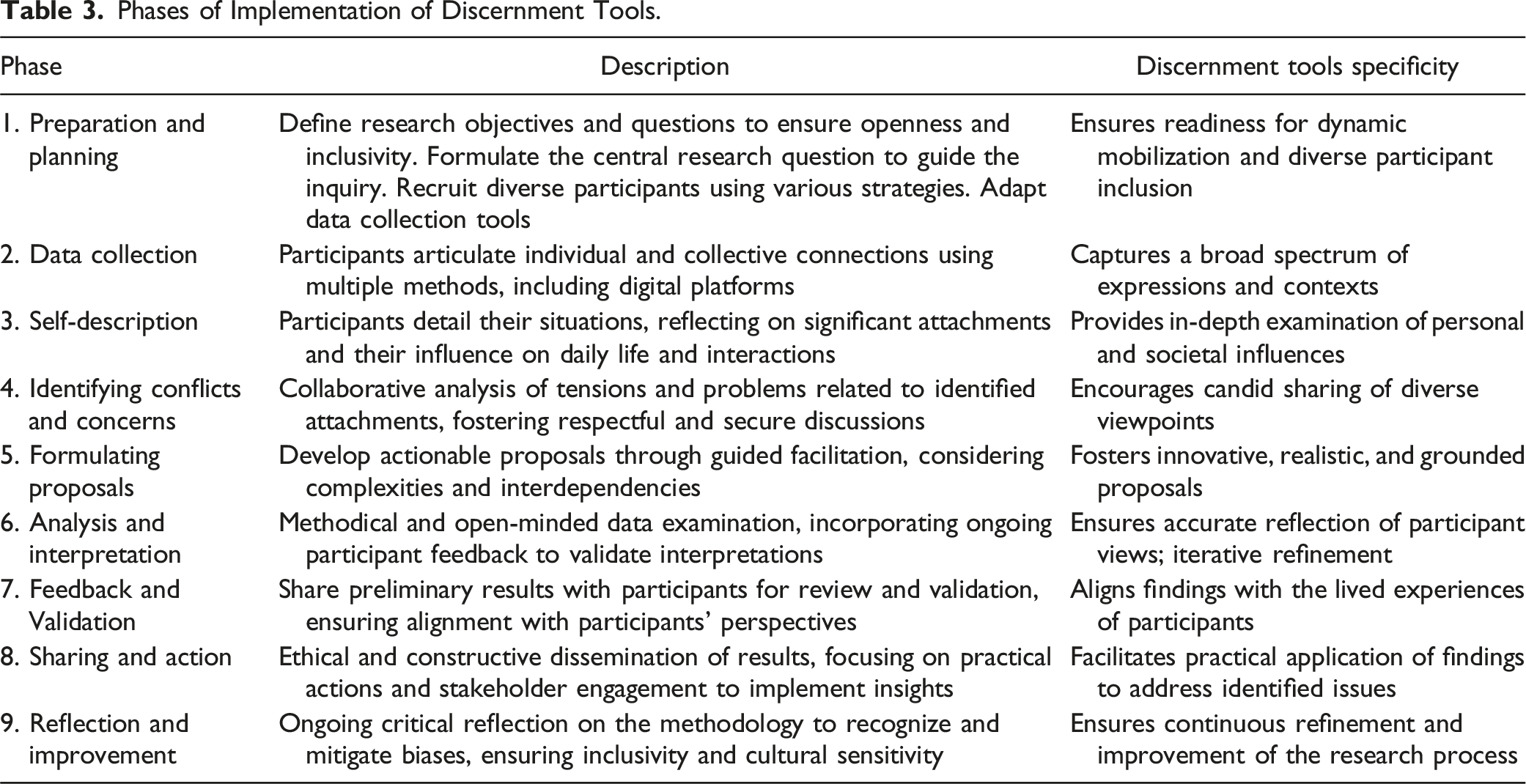
In Phase 1 of Preparation and Planning, a critical and specific step is the formulation of the central question. This step is fundamental, as it guides the entire inquiry process and ensures the research’s relevance to the participants’ concerns and experiences. Here are a few criteria to help formulate a core question: • The question allows participants to explore and describe their attachments—those significant elements of their daily lives and environments. This focus on attachments is a specific feature of discernment tools aimed at revealing the networks and interconnections between individuals and their contexts. • The question is designed to identify and analyze conflicts and concerns. It should help to highlight tensions and areas requiring collective intervention, a key aspect of understanding complex social dynamics. • The question encourages participants to describe themselves and their surroundings. This self-description is essential for mapping networks and interconnections, which is fundamental for discernment tools. • The question opens the way to concrete, constructive participant suggestions based on individual and collective learning from the previous stages.
In our ongoing work, we have formulated the following questions: “How do members of your community perceive and react to the impacts of climate change in their daily lives?” Participants identify tangible (resources) and intangible (values) elements affected here. The question reveals tensions, notably between local economic activities and issues of greening or pedestrianization. Participants describe their daily routines, and the process encourages them to formulate individual or community proposals, up to and including resilience strategies. The whole process is unguided.
Another question asked in an organizational setting is: “What are the main factors influencing your mental health and well-being, and what solutions do you propose to improve these aspects in your community?” This question identifies elements of both professional and personal life that affect mental health and impact the organization. It reveals tensions, including in the appreciation of what is good or bad for each person in highly subjective aspects. Participants are quick to describe personal stories that underpin often profound arguments. Here, participants also come up with operational proposals independently of hierarchies and without any intervention from the researcher.
The second important point concerns data analysis. It presents certain specificities compared to other qualitative methodologies. Although the treatment of qualitative data remains constant, the absence of intervention by the researcher during discussions and the importance given to self-description and non-participant observation are elements to be considered.
In physical encounters, the researcher adopts a position of non-participant observation. This role focuses attention on several aspects: the conduct of self-descriptions, the way discussion topics emerge spontaneously, the metalanguage of participants as they address various topics, and power dynamics and actor games within groups. Even non-participant observation requires scientific rigor to capture these complex dynamics accurately. The contributions of disciplines such as ethnography and anthropology show that observation is a prerequisite for constructing knowledge in the social sciences (Diaz, 2005). This approach enables an understanding of the phenomenon under study despite the challenges inherent in subjectivity and potential bias.
In cases where the researcher is absent, documentation relies on the participants themselves. A variety of materials can be used to capture discussions and are freely offered to participants, including audio and video recordings, detailed note-taking, as well as photographs and drawings to illustrate discussions and attachments. This method requires careful preparation and clear guidance to ensure the data collected is complete and useful for subsequent analysis.
The absence of an initial hypothetical framework may call for an inductive approach similar to Grounded Theory (GT). This method generates concepts and theories from raw data. However, GT is not free of pre-existing frameworks and remains sensitive to theories and concepts (O’Reilly et al., 2012). “Theoretical sensitivity” implies continuously comparing data with evolving concepts and theories (Tummers & Karsten, 2012). As Glaser and Strauss conceived, GT encourages an open but informed approach, gradually incorporating ideas from the existing literature (Suddaby, 2006) from which results can be discussed. Patton (2005) reminds us that, to be accepted by the field, the researcher must possess solid skills in the field being studied.
Prospects for Participatory Research in the Social Sciences
In conclusion, the deployment of discernment tools within the contexts of Bordeaux and Montreal effectively addresses the gaps identified in the initial examination of Latour’s theoretical contributions. These tools have facilitated an exploration of complex, multidimensional issues. In Bordeaux, the application of discernment tools enabled young individuals to articulate their interactions with non-human entities, such as smartphones, thereby embodying Latour’s theories on the roles of non-human actors in social dynamics. This phenomenon is corroborated by scholars such as AlArasi and Buliung (2023) and Marres (2020).
Similarly, the Montreal case study underscores the practicality of Latourian frameworks, notably Actor-Network Theory, in engaging with systemic issues like racism and discrimination through participatory avenues. This aligns with Latour’s endorsement of empathy in research and the active involvement of participants, addressing the empirical application shortfall in Latour’s methodologies concerning current social challenges, as noted by McCaffree (2020) and Weisz and Cikara (2021).
The insights from these case studies enrich the discourse on participatory research, highlighting the efficacy of discernment tools in drawing community members into meaningful engagement and deepening the understanding of their lived realities. These outcomes resonate with Latour’s advocacy for research methodologies that bridge scientific investigation with political involvement, reflecting Weber’s aspiration (1919).
Nonetheless, the utilization of these tools underscores the necessity for adaptable planning, inclusiveness, and a reflective approach to analysis to address the intricacies of wicked problems. This requirement aligns with the broader academic call for methodologies extending beyond conventional boundaries, encouraging a multidisciplinary approach to tackle societal issues effectively, as Egholm Lund (2023) and Keulartz (2023) recommended.
The application of discernment tools in participatory social science research demonstrates significant potential in addressing complex challenges while respecting the realities and inputs of community members. Looking ahead, the amalgamation of established and participatory methods presents a viable path for navigating the complexities of contemporary societal challenges, mindful of these methodologies’ inherent limitations and challenges.
Future adaptations of discernment tools could pivot towards digital and international settings, reflecting the growing influence of information and communication technologies. Additionally, these tools could be further explored for their potential to mediate dialogue among diverse, sometimes conflicting, groups, thereby fostering more inclusive and sustainable solutions to societal issues.
While offering insights into social dynamics, discernment tools are accompanied by limitations, such as the dependency on participants’ engagement levels and the potential for overlooking central themes. This highlights the importance of skilled facilitation and thorough analysis by researchers.
The evolving role of researchers in mediating social dialogue and addressing complex challenges underscores the need for multifaceted skills, balancing facilitation with analytical acumen to inform effective policy and interventions. (Ansell & Gash, 2008; Booher, 2018; Reason & Bradbury, 2005) This necessitates ongoing scrutiny of methodologies and reflections on enhancing inclusive, participatory research responsive to community needs.
Discernment tools and participatory methods provide promising avenues for social science research, particularly in dissecting complex social dilemmas. The experiences from Bordeaux and Montreal underscore the role of community involvement, researcher reflexivity, and methodological ingenuity. As we progress, exploring innovative combinations of traditional and participatory approaches while conscious of their respective challenges and limitations will be essential. Ultimately, participatory research aims to forge spaces where participants’ perspectives are heard and integral to fostering a more transparent, inclusive science and society.
Footnotes
Declaration of Conflicting Interests
The author(s) declared no potential conflicts of interest with respect to the research, authorship, and/or publication of this article.
Funding
The author(s) received no financial support for the research, authorship, and/or publication of this article.
