




Abstract
Gender-based violence (GBV), or violence perpetrated against someone based on their gender stemming from gender norms and/or unequal power dynamics, impacts women worldwide. It is well documented that during reproductive years, women face a heightened risk of experiencing GBV; however, the impacts of these experiences remain complex. While some literature points to negative health impacts for both mothers and children following experiences of GBV, other research has revealed that for some women, being a mother serves as a source of strength in addressing violence. More research is needed to address this dichotomy in findings, however, many barriers to research participation exist for this vulnerable population. Arts-informed research, a method underscored by empathy, support, and holding space for participants, has been identified as potential conduit to break down potential barriers. Therefore, the purpose of this qualitative, cross-sectional study was to explore the process of arts creation as an arts-informed research method among mothers with experiences of GBV. Guided by Thorne’s interpretive description, 13 mothers created a visual art form that reflected their experience of mothering in the context of GBV, before, during, and after which participants were encouraged to journal about the experience. Following the art creation, individual, semi-structured interviews were conducted via Zoom to explore the process of art creation and interpretation of the art form. Analysis revealed two distinct but interrelated themes, including: (1) the process of participating in the art creation; and (2) the process of journaling to create. The arts-informed research process afforded new insights, including those that are typically not accessible through traditional qualitative data collection methods. Future research should explore structural factors that exist that enable mothers with experiences of GBV to fully participate and benefit from arts-informed methods.
Introduction
Gender-based violence (GBV) is the most prevalent human rights violation in the world and is understood to be violence perpetrated against someone based on their gender stemming from gender norms and/or unequal power dynamics (WAGE, 2021). Gender-based violence can take on many forms, including physical, economic, sexual, as well as emotional abuse (WAGE, 2021). Worldwide, it is estimated that 35% of women experience violence (WHO, 2013); however, in Canada, this number is higher with an estimated 44% of women experiencing some form of violence during their lifetime (Cotter, 2021). While evidence suggests violence can be experienced at any time during the life course, women of reproductive age have the highest prevalence with four in ten women between 15- and 35-year reporting having experienced violence at least once in the last 12 months (American College of Obstetricians and Gynecologists, 2012; Cotter, 2021). Given this heightened risk of violence during reproductive years, this is particularly concerning as the average age of becoming a mother in Canada is 31 years (Statistics Canada, 2023). This points to the reality that for many women, mothering co-occurs with experiences of violence.
The relationship between motherhood and violence is complex. While violence can occur at any time during motherhood, evidence has consistently demonstrated that violence pre-pregnancy is the best predictor of violence during pregnancy and beyond (Daoud et al., 2012; Lévesque et al., 2022). The experience of violence during motherhood is influenced by the nature of the trauma, individual experiences, and the available support systems (Broughton et al., 2022; Jackson et al., 2024; Rodrigues, 2014; Siwik et al., 2022). It has been well established in the literature that trauma impacts emotional regulation, maternal-child attachment, and interpersonal relationships, all of which impact mothering (Berthelot et al., 2015; Gurtovenko & Katz, 2020; Samuelson et al., 2012). While the body of literature exploring the intersections of mothering and GBV is limited, evidence has begun to connect experiences of GBV with negative physical and psychological health for mothers (Afifi et al., 2014). This is not surprising given the literature of the physiological and psychological symptoms of trauma, such as hyperarousal, hypervigilance, intrusive thoughts, and emotional numbing which can all negatively influence a mothers ability to nurture children, maintain healthy boundaries, and manage stress within the mother-child relationship (Montserrat & Casas, 2017; Plant et al., 2018; Wuest et al., 2015) A study by Archer-Kuhn et al. (2022) reported women experiencing violence often become emotionally disconnected as a means to survive their abusive partners, but that this disconnection was not limited to their partner, and was found to also impact their children.
While trauma can challenge a women’s ability to mother, it is important to note that this is not inherently true for all mothers. Specifically, for some women, being a mother has been described as a source of strength – encouraging them to address the violence (Anderson et al., 2012; Herbell et al., 2020). Emerging research has identified that for women, becoming a mother or watching the violence begin to indirectly impact their child created a turning point in the intimate partner relationship, empowering mothers to leave (Mantler & Jackson, 2020). The inconsistent findings and limited research related to the consequences of mothering in the context of GBV points to the reality that the context of mothering while experiencing violence and grappling with trauma remains poorly understood (Fish et al., 2009; Hooker et al., 2016; Irwin et al., 2002; Lapierre, 2010). Furthermore, to understand mothering in the context of GBV requires a nuanced approach that enables all mothers to share their experiences.
Not all mothers experiencing GBV feel comfortable participating in research. A barrier to research participation for women who experienced GBV is the risk of re-traumatization and stigma (Jackson et al., 2023; Russo & Pirlott, 2006; Weber et al., 2022). Participation in research exploring the effects of GBV can be retraumatizing for women, as often they need to recount their abusive histories (Weber et al., 2022; Williams et al., 2020). This is further compounded in the context of motherhood, as mothers are widely judged for the decisions they make, or do not make, in relation to their children, both by themselves and by broader society (Jackson et al., 2023, 2024). Together, the stigma associated with violence and maternal decision-making impedes research participation resulting in a dearth of literature on mothers’ experiences of violence as well as an underrepresentation of diverse mothers within the literature.
There is a need for researchers to actively break down actual and potential barriers impeding mothers from participating and to disrupt conventional methods which often serve to perpetuate stigma (Stangl et al., 2019). Arts-informed research, a method of inquiry traditionally used in spaces where complexity abounds, is underscored by empathy, support, and a willingness to hold and give space to participants (Knowles & Cole, 2008), has been identified as potential avenue to break down barriers to participation. Arts-informed research is characterized by a commitment to both reflection and artistic representation (Knowles & Cole, 2008). As discussed by Huss and Sela-Amit (2018), including art in research can allow for the co-production of knowledge with service users in three ways: (1) through an increased understanding of service users’ social contexts; (2) through the creation of embodied knowledge and of voiced emotions; and (3) through the creation of embodied, emotionally driven, and reflective experiences which serve to broaden the scope of capturing participants’ experiences. In essence, arts-informed research follows a natural process affording participants the opportunity to explore their experience using form creation in lieu of words. Arts-informed research has the potential to overcome barriers in research as the focus shifts from recounting experiences of violence, to exploring the interpretation of their experience.
Mothers experiencing GBV face unique challenges and research in this space is lacking, in part due to barriers to research participation. While there is limited research exploring how mothers with experiences of GBV share their stories, there is no research to date exploring the use of arts-informed research with this population. This is a pressing research gap that has direct implications for supporting mothers who have and are experiencing GBV. As such, the purpose of this study was to explore the process of arts creation as an arts-informed research method among mothers with experiences of GBV.
Methods
Study Design
This qualitative cross-sectional arts-informed study was guided by Thorne’s interpretive description to collect and analyze data (Thorne, 2016). The study was conducted between April 2022 and November 2022. Below we provide an overview of methods specific to data collection for the present analysis. Upon reasonable requests, access to the data associated with this manuscript can be to the corresponding author.
Sampling and Recruitment
Purposive and snowball sampling techniques were employed wherein participants were recruited via advertisements posted on social media and invited to share study details with members of their social networks who met the eligibility criteria (Palinkas et al., 2015; Valerio et al., 2016). Seventy participants expressed interest in the study, with a total of 13 participants being recruited for the study. Given the novelty of arts-informed research methods in this context, there were no sample sizes to drawn upon; however, the sample size of this study is consistent with previous interpretive description-based research in the area of GBV (Secco et al., 2016; Tham et al., 2010; Thorne, 2016).
Eligibility
Eligible mothers included those who: 1) experienced GBV; 2) had internet access; 3) spoke and read English; 4) were 18 years of age, or older; 5) agreed to be audio-recorded during a one-to-one interview; and 6) agreed to sharing of created art forms for the purposes of knowledge mobilization. There were no exclusion criteria for this study.
Participants
Participants in this study were from Ontario, Canada, and were an average of 41 years of age (ranging from 25-55 years). Participants were generally well-educated with all but one participant having a college degree/diploma. Two participants identified as Indigenous, seven as Caucasian, one as Hispanic/Latina, one as Asian, four identifying as “other”, and one participant did not answer. With respect to sexual orientation, two participants identified as bisexual, eight as heterosexual, one as pansexual, one as queer, and one as “other”. Most participants lived in in urban centres in southwestern Ontario (n = 11), and one participant lived rurally. Of the participants, nine mothers had children residing with them full-time, and two participants were not living with their children. One participant chose not to report their living arrangement with their child (ren).
Procedures
List of Semi-Structured Interview Questions.
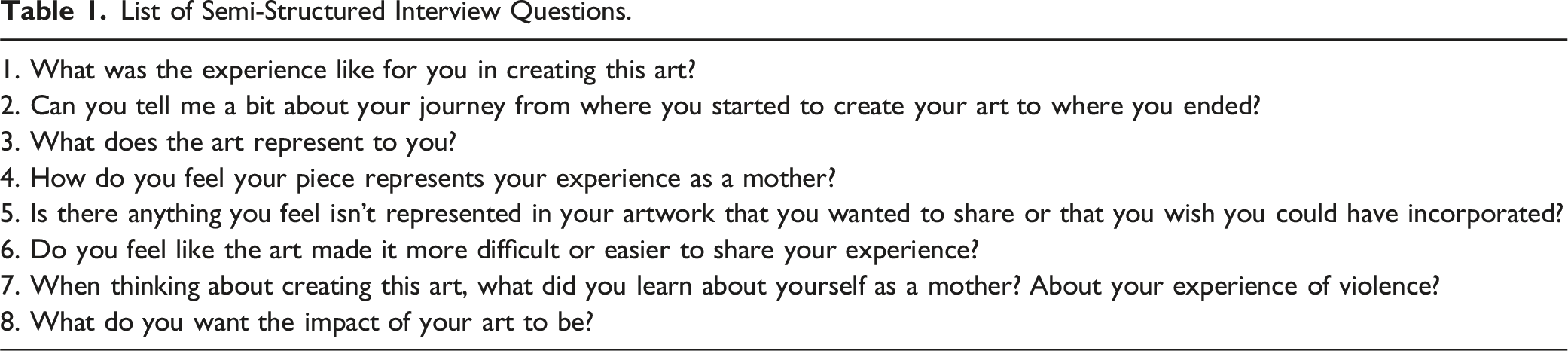
All interviews were audio-recorded and transcribed verbatim. Each transcript was anonymized prior to the analysis process. To reduce barriers to participation a $30 Amazon e-gift-card was provided in recognition of the time to each participant. All art supplies and the cost to ship art pieces were reimbursed up to $100.
Data Analysis
Interpretive description following Thorne’s approach and principles of auditability, fit, dependence, and transferability (per Guba & Lincoln, 1989) guided the analysis. Transcripts from interviews were organized using Quirkos qualitative analysis software (Quirkos, 2021) and pseudonyms were created for each participant. The 13 files were each independently coded by two of the four researchers. Initially, each researcher was assigned two transcripts and a partner who read the same transcript. Coding was done individually and then reviewed with the partner. Subsequently, the larger group met to create a preliminary coding structure with definitions and discuss the applicability and fit, with revisions being made as necessary. This two-step process was repeated until the coding team was confident that the coding structure sufficiently covered the data and was informed by literature and context-a fundamental principle of interpretive description. Next, all transcripts were assigned to two researchers for analysis. Once all transcripts were analyzed, Quirkos files from all researchers were merged and queries were run to provide reports on code and data related to the concept of ‘process’ (Quirkos, 2021). The research team engaged in discussion to theorize the relationship and structure of the data and extract meaning from it, an approach consistent with interpretive description (Thorne et al., 1997).
Results
Our analysis revealed two distinct, but interrelated aspects of the process of art creation among mothers with experiences of GBV, namely the process of participating and the process of journaling to create. Participants described the process of participating in this arts-informed methodology as offering them: 1) a way be included in research, when typically, their voice is excluded; 2) a transformative experience; and 3) a way to help others. The process of journaling to create was described based on the three stages of creation: 1) prior to the art being created-journaling was used to organize thoughts; 2) during creation-journaling was a way process their art creation experience and consciously shape their narrative; and 3) after the art was created-journaling was a way to bring closure to the experience. Overall, this process was ‘good’ for the participants, but there was a struggle among participants to complete what was being asked of them.
The Process of Participating
I thought it was pretty cool because… I didn’t realize how I went through it all. Like I didn’t really think about it, how I have worked through certain things, and I have grown up a little more and I have matured in certain ways that I didn’t even realize I was going to as like way back then as opposed to now where it’s like wow, I can’t believe I really came that far. ∼ Zoey
A Means for Inclusion
The process of art creation afforded participants, who typically self-exclude, an opportunity to participate in the research. Specifically, participants discussed how it was difficult to talk about experiences of abuse, and as such, they do not choose to participate in research despite wanting to have their voice heard. Having art as the medium and catalyst for discussion helped one participant feel comfortable to participate, she explained, I think [making the art piece] made it a little bit easier. It’s something else to talk about instead of just diving right into the abuse. Because you guys have never even really asked any specific questions about that, so it’s a good way to kind of talk about it without going into a lot of details (Brenda).
The inability to talk about experiences of violence despite a marked desire to share their story was reiterated by other participants. Rayna explained how her poor health often precluded her from participating in studies that rely on verbal communication, as she struggles with words. Rayna shared that she does not typically participate in studies because of her disability, saying, “So I think because words often fail me now as part of my disability”. The process of using art-creation as an art-informed methodology opened the doors to participate for participants who are typically excluded but desire the opportunity to share their stories.
A Transformative Experience
Participating in a study was a difficult decision for many participants, that culminated in women journeying through anxiety about the creation process, struggling to share their art, and realizing the value in arts-informed research. Specifically, women described at the outset that while they were excited to participate in this novel approach to research, once they were faced with starting to create an art piece this shifted to nervousness to both create and share their work. Dupa described feeling anxious after sending the art piece to the researchers, and the reality of how following through for her was an act of bravery saying, “And so I don’t know that felt pretty brave when I think about it now, I don’t know, there you go, I was having a brave moment”. Once the art was created, mothers struggled to share their art pieces as it was an emotional journey. Saundra described this struggling saying, “I was struggling at the beginning to even show people or do it… it was very emotional at moments”. However, as mothers began to share their art pieces and through journaling and interviews with the research team, many realized the transformative impact that the arts-informed method had, “there’s sort of this pride that there’s worth in expressing yourself in uncomfortable ways. So, I think the process was wonderful… it’s transformational and I think it needs to be offered a lot more” (Rayna). Ultimately, through the transformative experience of participating in this research, women felt empowered in their experiences.
A Way to Help Others
Mothers elected to participate in this study as way to help others experiencing GBV. Specifically, the shared reality of violent experiences led women to the common goal of wanting to help others. Participants wanted to share their experiences to encourage others that their circumstances can change. Brenda described this saying “I’m proud of it. I’m happy that you can use it and I have the hope that it might help somebody if it can. I hope that it would”. This was reiterated by other participants who described wanting to participate to provide a beacon of hope for other women saying, “I’m going to use this experience to encourage other women and girls who are going through some- maybe something similar, … I felt like I could give someone hope” (Desiree). Another participant nearly decided to not take part in the study but ultimately, it was the potential benefit to others that led her to participate. Anita explained, “I wasn’t going to, you know, create art for other people – that’s scary – but then I made myself do it ...it’s kind of exciting just to share with other people. It feels good to me” (Anita).
The Process of Journaling to Create
Journaling is like Sharing Your Thoughts with Yourself. ∼ Desiree
Prior to Art Creation
The importance of journaling at the outset of the art creation process was underscored by participants as being useful to both help organize their ideas and emotionally prepare themselves for the process. Leena described that through journaling she was able to work through her ideas of what to create sharing, “[journaling] even helped me gather my ideas about a lot of these things, 100%”. This was important as mothers described sometimes feeling overwhelmed with the possibilities of what to create, which was a stumbling block to getting started. Through journaling Caitlyn was able to focus her ideas, which then helped her to get started, she used journaling to “rein it in, I had a lot of ideas”. Beyond sorting through the possibilities for the art creation, participants also used journaling to reflect on what they wanted the art piece to portray. Lan shared, “I think it’s so important to sit with yourself and just reflect”. This was particularly important to participants given the emotionally heaviness of creating an art piece to reflect their experiences of GBV in the context of mothering. Participants talked about needing to journal to get in a place emotionally to be able to participate fully and safely, with Saundra sharing, “I think that the journal allowed me to get my house in order emotionally”.
During Art Creation
Journaling throughout the art creation process allowed participants to process not only what they were creating but also to shape and re-shape their narrative. Pria shared that journaling afforded her time to process during the art creation saying, “so in my journal I kind of wrote what I was feeling and how it brought back kind of memories from before”. Beyond just the processing of what was being created, journaling also offered participants insights, allowing them to better understand connections they had made through art but were not consciously aware. Lyric captured the realization through journaling while creating, sharing, I just looked at the pictures and could know exactly what I meant… and like one of the things I noticed was that even the things that like some of the things that are damaging, they’re not always damaging. Sometimes they’re damaging, but sometimes they help.
This shaping and re-shaping of their narrative was possible because it was captured in their journaling, allowing women to realize how the art creation was changing and morphing during the process. This reshaping and refinement of the art piece and associated meanings allowed women to control their story. Dupa explained this process saying “[the theme of the art] really changed as I thought more about this art project here, that changed a lot… I do see the value in [journaling] and how [the art piece] changed and evolved along the way.”
After Art Creation
The process of journaling after the art creation helped mothers to reflect on their experience and bring closure. Lyric eloquently summed her reflection on the experience saying, “I’m stronger than I thought I was”. For other participants, taking the time to put words to their experiences of GBV in the context of mothering was easier once the art was created. The art piece, for some mothers, acted as a catalyst to find the right words to express themselves. Brenda explored this reality saying “[journaling] kind of helped me explain the painting itself because I knew what it meant but I didn’t have words for it at the time. So, sitting down and actually going through and writing it out really helped kind of bring that to fruition”. For others, the act of journaling helped them have a sense of completion by creating an end to the process. Desire described her intentionality with the ending of the art creation process by using affirmations in her journaling. This allowed her to forefront her personal growth journey, giving her control over her story. Desire explained, “Well, because at the end of it all, I am – I’m a better person, and those affirmations, they’re just reminders of who I am now, and who I wanted to be”.
Discussion
The exploration of the process of arts creation among mothers with experiences of GBV revealed that this process facilitated participation among participants who typically self-exclude from studies, was personally transformative, and helped women to give back. Further, participants described the impact of journaling throughout the art creation process revealing that: prior to creation, journaling afforded them the opportunity to organize their thoughts and prepare to participate; during art creation, journaling help women to process how their art captured their experiences allowing them to careful shape and re-shape their narrative; and after art creation, journaling offered women closure for the experience. The process of art creation as an arts-informed research method approach was overall well-received by participants and offers the opportunity to capture new insights that are not available using traditional data collection methods. This research illuminated the power of the arts-informed research process, not only in terms of the depth of data collection, but also the profound and transformative impact it had on participants. As women reflected on their experience, they were better able to consciously shape the narrative of their violent experience which, in turn, brough closure.
Arts-informed research methods are typically utilized and associated with knowledge mobilization. This is in large part due to the powerful and evocative nature of art, and the ability to engage audiences (MacGregor et al., 2022). However, the use of arts-informed methods extends beyond knowledge mobilization and has been used to enhance data collection in qualitative studies (Dickson, 2021; Eaves, 2014; Yılmazlı Trout, Tose, Caswell, & Christensen, 2022). The use of arts-informed methods has been highlighted as a way to facilitate participation in the research process among traditionally marginalized populations (Ajodhia & CohenMiller, 2019). To the authors’ knowledge, this is the first time an arts-informed research method has been applied to the GBV and mothering contexts wherein the art creation was used to facilitate, instead of augment, data collection. Given the participants’ overwhelmingly positive response to this process and the reality that participants who typically self-exclude from studies elected to participate, this underscores the potential of this art-informed method.
The transformational process of participants creating art has been well-established in the literature (Eaves, 2014; Rydzik, Pritchard, Morgan, & Sedgley, 2013) and was replicated in this study. In seminal work in arts-informed methods, Lawrence (2012) explored how art intentionally evokes emotion and encourages imagination which helps individuals challenge assumptions. Challenging assumptions about oneself, is arguably the first step in reshaping identity or personal narratives. A study by Howells and Zelnik (2009) explored the impact of participants with mental illness creating art pieces and discovered that through this creation, they were able to build new identities. While participants in this study did not report building new identities, they did use the arts-informed process to shape and reshape personal narratives around their experiences of GBV and mothering. This unique application offers preliminary insights into the applicability for arts-informed methods in supporting women in navigating traumatic experiences, beyond the scope of art therapy.
Women who participate in GBV research often cite a main motivator as wanting to help women who are in similar circumstances. In a study by Shillington, Yates, Jackson, Tryphonopoulos, and Mantler (2024), altruism was found to the main motivator for participation in a study capturing women’s experiences of violence during the COVID-19 pandemic. This was identified as the motivation for participation for women in this study; however, unique to this study was that women saw how their art could tangibly be shared to support that ultimate goal.
Journaling has been established as method in qualitative research. Traditionally, it has been used by researchers to document field notes that explore the research process and to engage in self-reflection (Bacon, 2014; Capous-Desyllas & Bromfield, 2020). In addition, journaling has been used by study participants as a means to explore their experiences with a study or intervention (McCann, 2015). The approach in this arts-informed method was a combination of both aforementioned processes. It was utilized by participants to both self-reflect on the process of art creation but also to explore the arts-informed method. Participants underscored the utility of this pairing or arts creation and journaling as it afforded them intentional space to explore and make meaning of their experiences.
Recommendations
Our findings highlighted the process this arts-informed method and journaling among mothers with experiences of GBV. Mothers reflected on their experience and provided suggestions to improve and extend the reach of this process. First, individually, mothers identified the utility of the arts-informed method as it afforded people who traditionally experience barriers to participation the opportunity to share their story. Further, mothers identified the transformational nature of this experience, suggesting that it should be available to everyone. Arts-informed methods paired with journaling offers a low cost (less than $100 per person to cover art supplies) intervention for mothers experiencing GBV to not only engage in processing their experiences but also supporting their ability to reclaim and reshape their narratives.
Limitations and Future Research
It is important to contextualize the benefits of the arts-informed method process, within the context of this sample; namely, that all the mothers had time available to them to intentionally participate in this study over a period of 8 weeks. Further this sample lacked geographical (all participants were from Ontario, Canada) and other kinds of diversity. As such, depending on socioeconomic status, age of children, and other intersectional responsibilities, participating in an arts-informed research study might not be available to all women. It is important for future studies to explore the structural factors that exist that enable mothers with experiences of GBV to fully participate and benefit from arts-informed methods.
While the arts-informed methods in this study afforded participation for some participants, recruitment was a challenge none-the-less. Initially, the goal was to recruit 20 women; however, after 8 months recruitment was stopped due to a prolonged lack of interest. Lack of interest in participating in this study could be due to many factors, including the numerous studies being conducted on GBV during and post-COVID, safety issues for mothers to participate, and general appeal of participating in a study where journaling and art creation were required. Of those participants who did not choose to participate after initially expressing interest and shared why their decision had changed, they advised they were withdrawing due to the time commitment. Most participants who expressed interest but did not participate did not share with the research team the reasons behind this decision. Future research should explore more in-depth the potential barriers to participating in arts-informed research in this context, and how these barriers can be removed.
Conclusion
This study offered a novel way to capture mothers’ experiences in the context of GBV. Mothers overwhelmingly enjoyed the process of the arts-informed research methodology coupled with journaling as it afforded them not only the opportunity to participate, but was also a transformative and tangible way to help other women in similar circumstances of violence. Further, the process of journaling throughout the arts-informed research method was not only practical in that it helped mothers to focus their ideas and organize their thoughts around the art creation, but in that it also allowed participants to better understand and intentionally shape their personal narratives around their experiences of violence in the context of mothering. This process of arts-informed research was well received by participants with many highly recommending the process to others. The arts-informed research process also afforded new insights, including those that are typically not accessible through traditional qualitative data collection methods.
Footnotes
Acknowledgements
We would like to thank all the women who participated in this project and shared not only their stories but also their immense talent. We are privileged to have been able to sit in awe of the art you created.
Declaration of Conflicting Interests
The author(s) declared no potential conflicts of interest with respect to the research, authorship, and/or publication of this article.
Funding
The author(s) disclosed receipt of the following financial support for the research, authorship, and/or publication of this article: This project was funded by a [Western University] internal research grant.

Data Availability Statement
Data sharing not applicable to this article as no datasets were generated or analyzed during the current study