




Abstract
Keywords
Background
In the last two decades, applications with essential oils via olfactory and skin – mostly referred as aromatherapy (AT) – are of rising interest as a supportive treatment in medicine and nursing. This is reflected in the increased research activity and numerous available reviews on AT covering topics such as palliative care needs (Armstrong et al., 2019; Candy et al., 2019), dementia (Ball et al., 2020), or supportive treatment options for people with cancer (Baykal & Comlekci, 2020; Boehm et al., 2012; Chen et al., 2016; Cheng et al., 2022; Li et al., 2022; Toniolo et al., 2021). Subjective perceptions of users regarding essential oil applications, however, seem to be underrepresented in empirical research on AT (Czakert et al., 2022b). The potential benefits and challenges of evoking individual experiences with AT have not yet been considered explicitly in corresponding research to our knowledge. One reason for this may be the specific challenge associated with conducting empirical research on the effects of AT.
The effects of AT are assumed to work via two principles of action. The first is triggered via the olfactory system. Odor is recognized to stimulate emotions and memories through the activation of the limbic system. Effects triggered by odor are based on three different psychological mechanisms that may interact with each other. The mechanisms are (1) subjective evaluation of the odor (hedonic valence), (2) conditioned and memory-dependent reactions (semantic mechanism), and (3) expectancy (placebo effect). These above-mentioned odor-related effects are set in motion via olfactory intake and subjected to individual and cultural influences and expectations attached to the odor (e.g.: Hänsel, 2010; Heuberger, 2021; Jellinek, 1997). The olfactory effects are, thus, strongly individual in expression and type (Heuberger, 2021). The situation is different when it comes to the pharmacological effects of essential oils that are dependent on the specific composition and properties and, therefore, are similar to each user (ibid.).
Given the individual psychologically-based effects, the collection of olfactory experiences provides a special methodological challenge; it is both difficult to verbally put odor into words (Zimmermann, 2018), and to describe the inner responses to odor to the appropriate complexity and depth. Sometimes, the psychological reactions are hardly registered and/or associated with a smell, because olfactory experiences are latent experiences to a large extent. Since the ability to even perceive and then explain complex responses to odor is limited, finding a way to support participants put their olfactory experiences into words may be crucial for qualitative data collection. Hence, as an additional objective of the initial study Individualized aromatherapy for women with gynecological cancers in aftercare: a qualitative-focused mixed-method study (arth4WOMEN) (Czakert et al., 2022a), we decided to develop a data-collection method to explicitly support the participants’ perceptions and expressions of their olfactory experiences. The new data-collection method was developed to be embedded as one separate part of the semi-structured interview concept of the initial study arth4WOMEN.
Initial Study arth4WOMEN
The development of the new data collection approach took place within the qualitatively-focused, mixed-method study arth4WOMEN. The study explored the effects, opportunities, and challenges of individualized AT in the aftercare of women with gynecological cancers, including breast cancer. Eighteen participants between 39 and 77 years old with breast (n = 6), ovarian (n = 11), and uterine (n = 1) cancer received five essential-oil products between June and September 2021 for individual use over four weeks respectively. After the application period, qualitative semi-structured interviews were conducted. Symptomatic burdens of the women were quantitatively documented and assessed via the questionnaire Measure Yourself Medical Outcome Profile (MYMOP2) (Hermann et al., 2014) before and after the application period. The design and results of arth4WOMEN are described and discussed elsewhere (Czakert et al., 2022a).
Orientation and Inspiration – Phenomenology, Arts, and Writing
The methodological orientation of the newly developed data-collection method presented here was guided by phenomenology, as was the qualitative approach in the initial study arth4WOMEN. The phenomenological orientation allowed insights into the subjective experiences and perceptions of the participants with aromatherapy, given the context of the world around them. The epistemological interest of an approach based on the philosophical foundation of phenomenology is the description of a research interest (phenomenon) in its essential characteristics and manifestations from a multi-perspective approach, based on subjective perceptions (Neubauer et al., 2019). Using a phenomenological approach, this study aimed to explore the essential characteristics and expressions based on subjective experiences with AT from a multi-perspective approach.
Given the challenges outlined above, we sought an innovative, creative way to elicit subjective perceptions of olfactory experiences in data-collection. Inspired by the discourse found in Arts-informed Research (AIR) and Arts-based Research (ABR), arts seemed promising for providing a creative and novel approach from a research standpoint. Arts-informed Research uses inspiration for qualitative research through art forms, artwork, and artistic genres in order to advance knowledge (Cole & Knowles, 2011). One distinction of AIR from ABR is that art is integrated into the research, but it does not form the basis of the investigation (Cole & Knowles, 2011; Nguyen, 2018). Arts-oriented approaches have gained increasing attention in the context of health research in recent decades (Boydell et al., 2012). The reason for the increasing interest in AIR are likely to be found in its potential to increase knowledge regarding the complex, (inter)subjective and dynamic human experiences (Cole & Knowles, 2011) which has important relevance in health research. For this purpose, AIR combines approaches from both the arts and the sciences. That includes arts-based methods, strategies, and perspectives to support and improve research or part of the research process – for example data-collection, representation of the results, analysis, or conceptualization (Knowles & Cole, 2008; Leavy, 2015). Depending on the purpose and content of the research interest, as well as the expertise of the researchers, various forms of arts may be used to expand and extend conventional qualitative methods (Boydell et al., 2012). Emboldened by AIR, we looked to Creative Writing (CW), because CW helps to guide written expression of what is experienced, thought, and felt through creative approaches. Creative Writing techniques have the potential to make inner processes more tangible, accessible and understandable (Ruf, 2016). Over the past two decades, CW has gained increasing interest in health research alongside expressive writing, poetry therapy, and bibliotherapy (Heimes, 2012). In addition, CW has become embedded as an approach in the complementary medicine field. (Sampson & Visser, 2005). While CW in health-related research has been primarily used as an intervention with focus on different outcomes, such as mental health (Williams et al., 2020), mental health in cancer patients (Nesterova et al., 2022; Peckham et al., 2017), improvement in mood (Zhu et al., 2020), and as an educational tool (Cowen et al., 2016; De la Croix et al., 2011; Kerr, 2010), it is less common as a methodological approach (Fleming et al., 2004; Hurt et al., 2019; Owens, 2021; Sion et al., 2020; Thomas et al., 2020; Welch et al., 2018). To our knowledge, CW has not been used as a methodological tool to apply to an oral interview situation. Given the outlined benefits of CW, namely the translation of inner processes into words, we decided to draw inspiration from strategies used in CW, and to adapt them for an oral interview situation.
For the development of a CW-based data-collection method the Health-promoting Creative Writing Course, based at Charité – University Hospital Berlin, was selected as a first step. The salutogenesis-oriented writing course addresses women with gynecological cancers. Sample demographic of this already existing CW-course group and the targeted sample demographic for the background study arth4WOMEN was decisive for the choice of the course as a basis for the further method development. The structure and content of the long-standing course can be summarized as follows: the concept is structured with elements from biographical and creative writing and contains content from positive psychology. Findings from psychoneuroimmunology, resilience, happiness, and creativity research are also embedded into the courses’ content and structure. The components are integrated into a staged system of writing instruction. The thematically guided and therapeutically supported writing approach aims to support women in coping with the diagnosis and treatment of cancer constructively, and tapping into sources of inner strength during treatment, recovery, and survival (Diehm et al., 2019). The particular long-standing group of women with gynecological cancers meet once a month in a regular session to reflect on and work through illness and treatment-experiences under the guidance of a creative writing expert and leader of the group (SD) and with therapeutic support from a specialist in psychosomatic medicine and psychotherapy (AP).
Research Purpose and Questions
The purpose of this study was to develop a new data-collection method to support participants’ perceptions and expressions of their olfactory experiences for the study arth4WOMEN. In the long term, the aim is to provide an approach that helps to deepen and broaden insights into the potential and challenges of AT as a supportive treatment.
Against this background, the following questions guided our method-development process: I. Which creative-writing exercises are suitable to perceive (latent) and express olfactory experiences? II. How can these exercises be adapted for a verbal interview situation? III. What lessons can be learned from the new data-collection method?
Methods
To address the guiding research questions, we developed the data-collection method in five steps, which are summarized in Figure 1. The Standards for Reporting Qualitative Research (SRQR) checklist (O’Brien et al., 2014) for quality assurance purposes guided the process. Development, implementation and evaluation of the Olfactory Journey in five steps.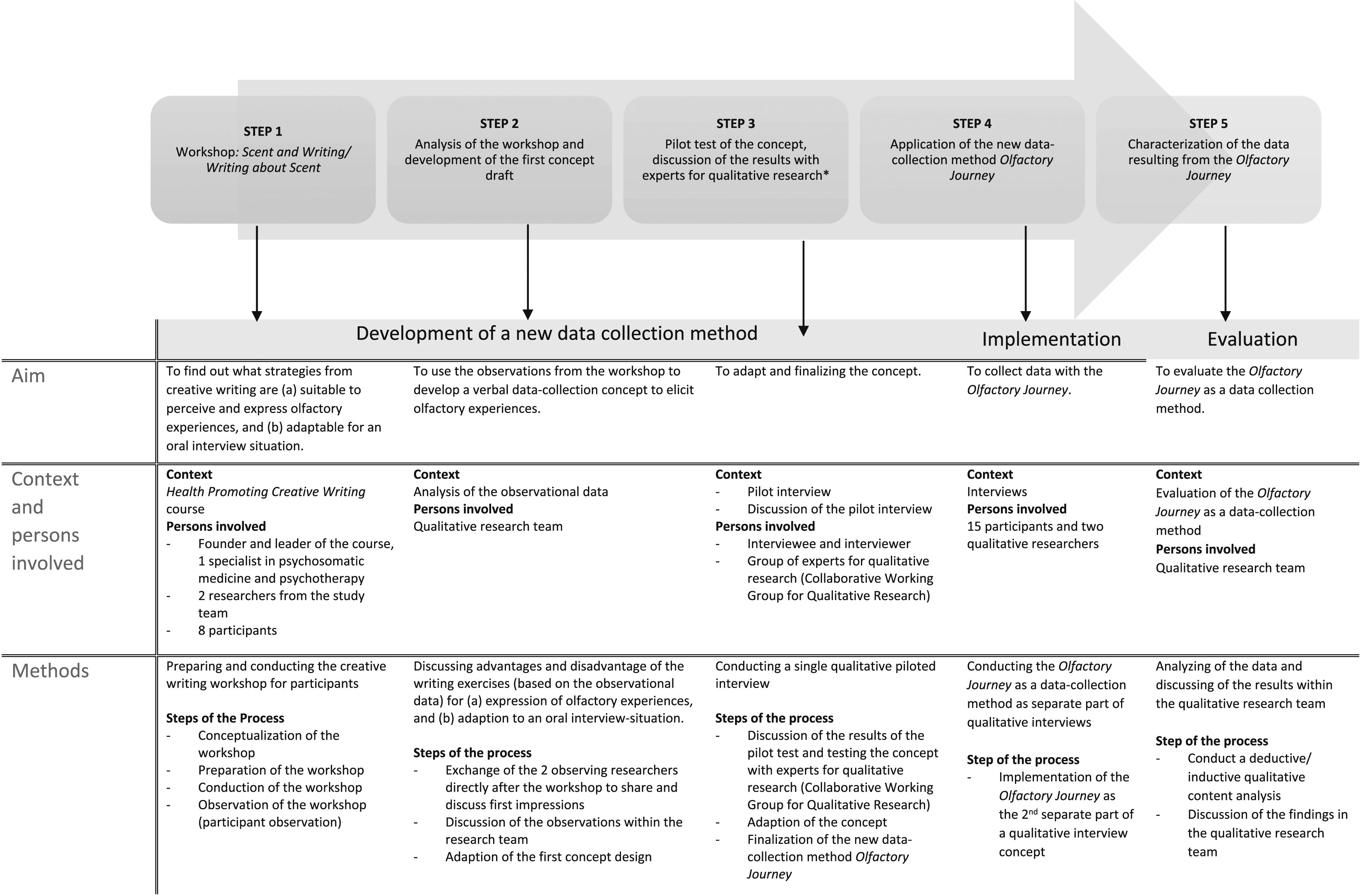
Conceptualization and Realization of the Workshop “Scent and Writing/ Writing About Scent”
Workshop Structure.

The workshop was conducted with the regular participants of the CW course (n = 8) on a voluntary base. They were briefly informed about the intention of the workshop in a letter. Informed consent for participation was obtained in January 2021 through the group leader, and again at the beginning of the workshop. About four weeks before the workshop was held, all participants received a scent-stick from Primavera® with a randomly selected essential-oil blend. They were asked to use it as regularly as possible in their daily life to experience the fragrance. The workshop, held via digital meeting on February 4th, 2021, was conducted by the leader of the group (SD) and therapeutically supported (AP). Further, it was accompanied by two researchers (JC, SB) who documented the meeting as participant observers (Kawulich, 2005). A predeveloped fieldnote documentation form structured the observation into essential topics. The topics were based on the workshop structure and the underlying research questions. Both researchers introduced themselves to the group before the workshop started and clarified the context by briefly describing the content of the background study arth4WOMEN, explaining the intention of the workshop, and answering participant questions. Participants were led through a total of five selected writing exercises that were associated with the scent of their essential oils. The participants were encouraged to smell the products before and during the exercises. In an open discussion at the end of the workshop, participants were asked to describe how they perceived the use of essential oils as a background for writing about scents, and which exercise they found most helpful in putting their olfactory experiences into words. Both the observation of the workshop and the content of the open discussion were included in the observation notes that shaped the methodological development.
From Creative Writing to the New Data-Collection Approach “Olfactory Journey” (OLFJ)
In
During
Results – On the Scent Trail
The final version of the OLFJ is based on the results of the workshop, the pilot test, and discussions with qualitative research experts. In the analysis of the workshop, three considerations were made as to which creative writing exercises proved suitable for perceiving and expressing (latent) olfactory experiences, and which did not: 1. The exercises “Scent-Cluster” and “Little Eleven” (Table 1) proved promising in terms of narrative depth and breadth of expression of olfactory experiences. The experiences stimulated by the writing exercises seemed to be able to unfold in creative expressions. However, these exercises focused on a written process that did not easily translate to an oral interview situation. Moreover, they seemed to require a certain amount of practice and routine with writing, which may not be accessible to all potential participants. Therefore, and in order not to overburden recruited participants with overwhelming tasks for which they might not be prepared, the idea of including short writing exercises as part of the interview situation was ruled out. 2. The exercises “Scent-Adjectives” and “Serial Writing” (Table 1) were found to both be easily transferable to a verbal articulation without requiring additional preparation or practice. Yet these were found to potentially prompt the participants to give particularly short answers with adjectives or sentence completion. Consequently, the exercises were not deemed suitable for eliciting olfactory experiences. 3. The exercise “Scent and Pictures” (see Table 1) showed the greatest potential for supporting descriptions of olfactory experiences. For instance, metaphorical associations connected the olfactory perceptions to parts of the pictures in the workshop. The pictures also served as an initial stimulus for narrative descriptions stemming from the smell, whereby the olfactory experience focused on longing, feelings, and memories. Thus, the pictures seemed to function as a tool. They supported the participants to find words for their olfactory experiences and to describe them.
Against this background, the workshop led to the conclusion that pictures could be a helpful medium for talking about olfactory experiences. However, feedback from the participants highlighted the limitation of pre-selected pictures that may or may not resonate with every individual. In order to foster the creativity for each participant without preparation with the available approach, we decided to avoid any specifications that added restrictions in the data collection process. We incorporated these lessons into our method-development by adapting the exercise “Scent and Pictures” to stimulate individual inner visuals by a scent trigger (essential oil) and to simultaneously bring the inner visuals into focus through a guided instruction.
Other minor adjustments made after the pilot interview and the discussion of the results with experts in Qualitative Research included (a) enabling longer pauses to allow inner visuals to emerge, and (b) providing more guidance to participants, if needed, through additional questions and instructions.
Procedure of the Olfactory Journey
Olfactory Journey.

(3) After the OLFJ, the participants were asked to describe and explain their inner images or pictures that they perceived in reaction on the smell and explain everything connected with what the smell evoked within them. Visual and olfactory perceptions could thus be related and clarified reciprocally. After a prompted free narrative, a return to the conventional interview dynamic was then again adopted to ask questions and deepen understanding of the descriptions. Thematically appropriate follow-up questions were asked to articulate the experience with greater specificity, such as: how the image and details of the picture/s affected the participants, or what the detailed differentiation of the visual elements in relation to the chosen fragrance was.
Characteristics of the Data Obtained Through the Olfactory Journey
Characteristics of the Collected Data.

Overall, the OLFJ was found to support the perceptions and expressions of olfactory experiences: This was expressed by most of the participants through highly figurative language that contrasted and compared different topics stylistically, including memories, colors and light, nature, and places. In addition, physical reactions to the OLFJ (relaxation, sensation of temperature and taste, hearing sounds), and emotional responses (feelings of happiness and well-being) were reported. In two cases, the OLFJ did not appear to be successful in generating internal visuals in response to an olfactory stimulus, as was clear from the participants’ use of nonfigurative language when talking about their experiences. These narratives were characterized by simple phrases and repetition. Only one participant refused participation of the OLFJ, stating that she herself was “just not suitable for this kind of thing” (TN01).
Discussion – About the Trails Contextualization and Continuation
Eliciting olfactory experiences is methodologically challenging because they often take place on an unconscious level and are difficult to express. As an integrated project of method development within the initial study arth4WOMEN, we therefore developed a new methodological approach, inspired by AIR (Cole & Knowles, 2011). We aimed to include an arts-informed approach in our data collection to support perceptions and expressions about olfactory experiences. Hence, we tried different creative strategies from CW to support the experience and expression of olfactory experiences using creative and linguistically based means. In the specifically designed workshop “Scent and Writing/Writing about Scent” (table 1), we found that the combination of scent and pictures is particularly well-suited to elicit verbal expression of the olfactory experiences. In a multi-stage process based on these findings, we developed a data-collection method that we termed the Olfactory Journey (OLFJ) to encourage more vivid description of inner visuals. By directing the participants’ focus first to a scent stimulus and then providing guided instruction concentrating on the visualization, feelings, and perceptions the scent provoked, descriptive articulations about scent resulted. In a last step with the interviewer, probing questions deepened the understanding of the meaning of the scent and inner visuals. The underlying assumption was that reaction, emotion, and memories triggered by odors are easier to perceive, express, and explain with the help of self-created inner pictures and visuals. An innovative feature of the OLFJ as a data collection method, thus, lies in the reciprocal interchange and support of olfactory and visual experiences that have just been initiated by an olfactory stimulus, embedded in the OLFJ.
While the approach does not seem to be successful with every participant, responses to the OLFJ showed that the approach is, indeed, promising as a data-collection approach that aims to elicit, strengthen, and express olfactory experiences. The participants’ reactions further indicate that the OLFJ, although conceptualized as a data-collection method, might also have potential as a health-improving intervention. These two points are discussed below to answer the research question: What can be learned from using the new developed data-collection method OLFJ?
The Olfactory Journey for Data-Collection
As a data-collection method, the OLFJ was successful in guiding the focus of almost all participants to inwardly perceived images and experiences that emerged under the influence of an olfactory stimulus. These inner visuals served as a medium for participants to make olfactory experiences more accessible and experiential. The expression of what was brought up internally by the OLFJ is reflected in a language with many pictural associations, characterized by contrasts and comparisons (Table 3). The ability to facilitate the expression of unconscious, tacit knowledge and emotions through the use of visuals in data-collection is already known in health-related qualitative research (Pain, 2012; Rees, 2018). The term visual methods describes the use of visual materials in a research process (Rees, 2018). However, this does not involve the use of internally conjured, but rather images from drawings, photographs, collages, graphic novels/comics, and videos (Cristancho & Helmich, 2019; Pain, 2012). The use of internal visuals demonstrates the innovative and unique data collection approach of OLFJ.
As a data-collection method, OLFJ can be described to simultaneously generate and collect the data at the same time. Additionally, the approach to olfactory experiences by the OLFJ supports the creative part of the methodological approach through the object of investigation itself: the olfactory experience. This assumption is supported by research about strengthening creativity in creative writing (Gonçalves et al., 2017). The stimulation of creativity through olfactory cues (Gonçalves et al., 2018) might thus be helpful to deepen the range of inner experiences, and to support the creative approaches to explain the very same. This may be described as an interlocking cycle in which a stimulus is used to trigger a creative process that leads to a better understanding of the stimulus itself (Figure 2). Accordingly, the use of olfactory stimuli to enhance creativity seems quite worthwhile in AIR and should be further explored. The same applies to the in-situ approach of data collection on olfactory experiences during the experience itself. Interlocking cycle of odor and creativity.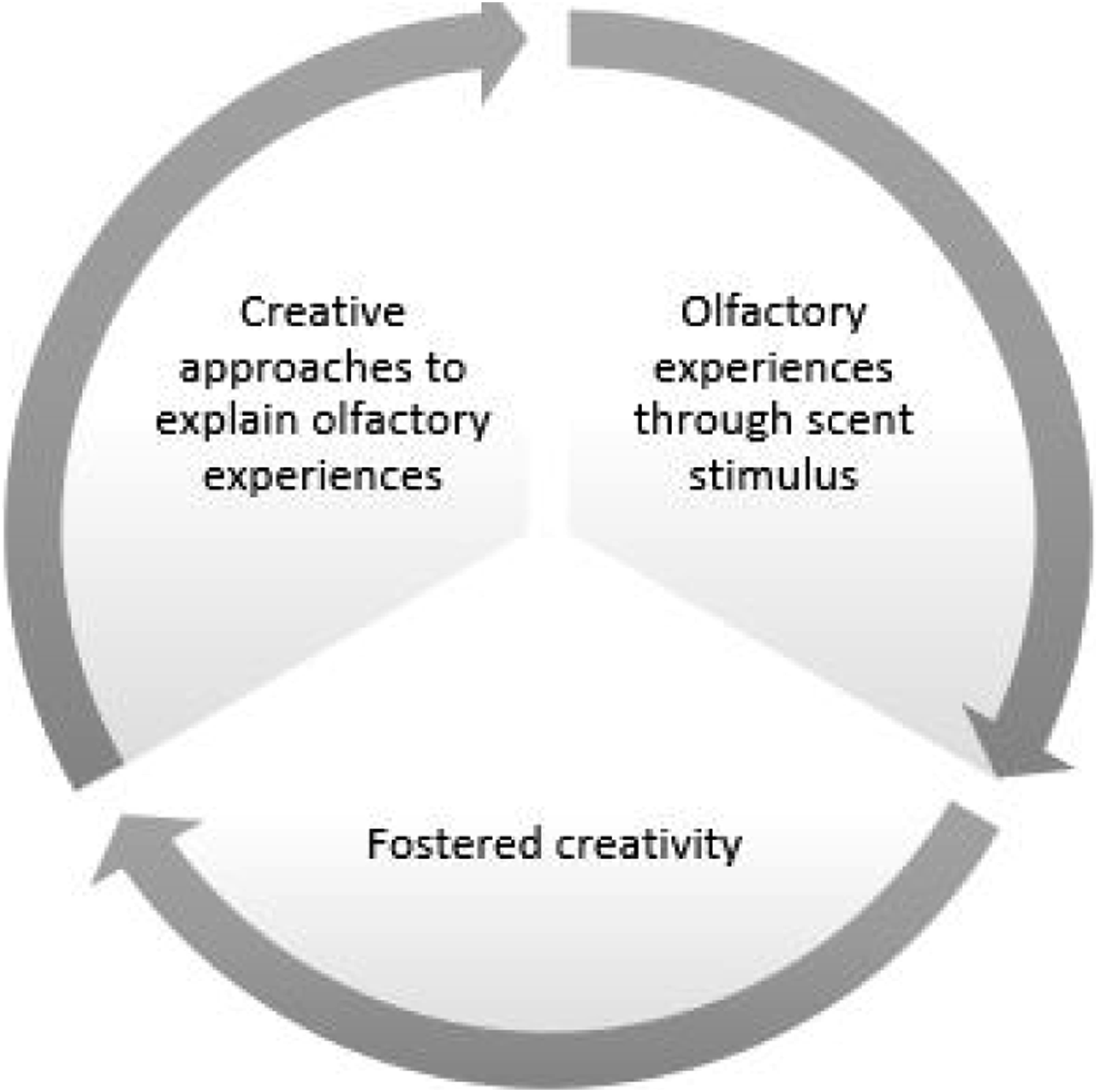
Another interesting aspect of the data collected with the OLFJ was the frequent link between the described internal visuals, biographical memories, and emotion. This phenomenon can be explained by an effect, known as the Proust Phenomenon. It describes the unexpected, unintentional, and inexplicable (Jellinek, 2004) effect of odor on emotion and memories., “whereby a currently perceived odor causes the spontaneous recollection of a past event” (Hackländer et al., 2019). Such memories, evoked by an odor-stimulus, are described to be particularly strong and rich given their emotional character and contextual information (Bartolomei et al., 2017; Herz, 2012). The link between smell and memories that emerged from the OLFJ, could be intentionally applied in other data-collection methods where memories are at the center of the research interest, such as in narrative interviews (Rosenthal & Loch, 2002). A purposeful activation of the Proust Phenomenon by odor stimuli has the potential to help to elicit memories along with the associated emotions to support access and richness of the data collection. However, the phenomenon is assumed to be unpredictable (Jellinek, 2004). Whether this potential can nevertheless be used for data collection of biographical content should be the subject of future research.
In discussing the findings, it is important to mention that although the OLFJ approach was successful for most participants, it did not work for everyone. In two cases, the participants used nonfigurative language that allowed few insights in their olfactory experiences. At this point the question arises, how the OLFJ may be further adapted for participants for whom the data-collection method was unable to yield the intended data richness. However, it should be kept in mind that not all people may have access to creativity that is linked to linguistic expression. Linguistic expression might be challenging for some participants. Thus, in addition to the language based OLFJ, there is a need for other ways to make olfactory experiences accessible for research. Art-informed approaches might offer further inspirations here. At the same time, it is important to be aware that nonfigurative language that does not reveal much about the inner experiences, may not necessarily point to a failure of the OLFJ as a data-collection method, but rather to the way scent is experienced. In order to achieve more clarity, future research may work to triangulate OLFJ with other methods of data collection (Flick, 2018).
Moreover, OLFJ led participants to experience physical sensations during implementation (Table 3). The awareness that data-collection methods may cause a physical and emotional influence on participants is not new in methodological debates, particularly in the context of qualitative research. There are arguments, for instance, about how interviews are a form of social action (Deppermann, 2013), can provide a dialectic process of knowledge production (Brinkmann, 2007), or have an therapeutic effect during the interview (Hutchinson et al., 1994; Kurtz et al., 2013; Perry & Bigelow, 2020). However, the stress reducing character of the OLFJ cannot be assumed to lie solely in the interaction between the researcher and the participant. Rather the stimulus given by the OLFJ, and potentially the effect of the odor, may also be an important part of the participants’ responses. Odor may show influences on the mental state (Tsushima et al., 2021) and the Proust Phenomenon may be accordingly associated with positive (e.g., comfort, happiness) or negative (e.g., anxiety) psychological reactions. In addition, there are indications that physical reactions, such as a slowed heartbeat corresponding with positive memories are triggered by scent stimulation (Matsunaga et al., 2011). These indications are also reflected in the results of the OLFJ. This phenomenon needs more investigation to further understand the potential of OLFJ for stress reduction, relaxation, and well-being.
Limitations
In our methodological approach OLFJ, we used AIR as a source of inspiration only for collecting data, and not for other parts of the research process such as conceptualization, analysis, and dissemination (Lapum, 2014). Applying the approach as an integrated approach to the entire research process, not simply for a source of inspiration during data collection, might be promising in terms of a deeper understanding of the content of interest. Further, we cannot exclude that the process, content, and atmosphere of the first part of the interview-concept in the initial study arth4WOMEN (Czakert et al., 2022a) had an influence on the newly developed OLFJ, especially given the nature of interviews as a social action between interviewer and interviewee (Deppermann, 2013). Hence, it remains an open question how the OLFJ may work as a stand-alone data-collection method, which should be taken up in future research. Moreover, although the developed data-collection method OLFJ shows first promising potential to capture olfactory experiences, questions about reliability and validity of the concept remain open. Hence, reliability and validity should be investigated in future research to establish trust and confidence in the approach.
Conclusion
To support access, elicitation, and expression of olfactory experiences, which are difficult to conduct, we developed the oral data-collection method OLFJ. The orientation to arts-informed research and inclusion of creative approaches to explore these olfactory experiences proved to be helpful. The OLFJ showed potential for encouraging oral expressions of olfactory experiences, however, it does not work for every participant. More creative approaches to explore olfactory experiences, as well as other experiences that take place subconsciously, in research are needed. Odor stimuli should be considered a supportive strategy in data collection to elicit (auto)biographic content and strengthen memories and emotions.
Footnotes
Acknowledgments
We would like to thank the participants from the workshop “Scent and Writing/ Writing about Scent” and from the study arth4WOMEN who took part in the Olfactory Journey. Further, we thank the Collaborative Working Group for Qualitative Research, part of the Qualitative Research Network of Charité – Universitätsmedizin Berlin, Germany, for their support through the valuable exchange and discussions on the Olfactory Journey as a data-collection method.
Declaration of Conflicting Interests
The author(s) declared no potential conflicts of interest with respect to the research, authorship, and/or publication of this article.
Funding
The author(s) disclosed receipt of the following financial support for the research, authorship, and/or publication of this article: The arth4WOMEN project, where the method development took place, was financially supported by the company Primavera. The company had no influence on the research design, the conduct of the study and the analysis and presentation of the results.
