




Abstract
This study explores the utility of the I-poem methodology to investigate subjective well-being in children and adolescents with ADHD in South Africa during the COVID-19 pandemic. Subjective well-being in this population has been studied extensively via quantitative methodologies. In addition, narrative studies, discourse and theme analysis, participatory and visual method studies have also contributed to deeper understandings in the field. The current study seeks to contribute to knowledge creation within this field of non-numerical studies in an attempt to decentralise the voice of researchers and highlight the voices of participants. In the I-poem methodology, self-report ratings of children and adolescents with ADHD between the ages of 10 and 18 years old (n = 376) during the COVID-19 pandemic in South Africa was captured in an open-ended question. Data was analysed through the researcher’s creation of themed I-poems. The findings delineate broad categories of positive, negative and neutral feelings of subjective well-being during the pandemic. Notions of subjective well-being are related to themes of home, school, social life, self-growth and reflection, experiences of change, rules, extra-curricular activities, concerns, loss, finances, the new normal, and emotions. The study illustrates the utility of the I-poem methodology to illuminate dimensions of well-being that may otherwise remain invisible. The study also amplifies the potential of the I-poem methodology to be used in conjunction with, and complementary to, other research methodologies.
Keywords
Introduction
There are many studies that investigate the quality of life of children and adolescents with ADHD (Hakkaart-van Roijen et al., 2007; Wehmeier et al., 2010; Yang et al., 2013). However, there are few studies specifically examining the well-being of children and adolescents who have been diagnosed with ADHD, and the majority of those that have been conducted have obtained their data from parent-report well-being measures (Herbell et al., 2020; Peasgood et al., 2016), with only a few that have focused on patient-report methods of procuring data (Barfield & Driessnack, 2018; Peasgood et al., 2016).
The studies exploring ADHD children and adolescents’ well-being indicate the general conclusion that their well-being is poorer than their neurotypically developing peers (Herbell et al., 2020; Peasgood et al., 2016). The specifics of the studies did vary, however. Herbell et al. (2020) found that only 6.3% of children with mental, emotional and behavioural disorders (54.4% of whom were diagnosed with ADHD), were flourishing optimally and that this was positively influenced by constructive habits of parental coping and negatively affected by parental aggravation, often stemming from their child’s difficulties. Using the Child Health Utility (CHU-9D) with the EuroQol-5 Dimensions for Youth (EQ-5D-Y), Peasgood et al. (2016) found that, compared to matched controls, children and adolescents with ADHD have significantly poorer outcomes and difficulty in school, have sleeping issues, often feel worried and sad, are perpetrators as well as victims of sibling bullying, and have a negative overall view of their life and family.
Barfield and Driessnack (2018) carried out a study whereby 20 children between the ages of 7 and 11 with a diagnosis of ADHD, were asked to draw a picture and tell a story about what makes them happy and what makes their life ‘really good’. The results garnered themes of connectedness – particularly with family – , fun, action-related activities and nature/the outdoors (Barfield & Driessnack, 2018). These compelling findings tell us, although implicitly, what children themselves feel contribute towards their sense of happiness and subsequent well-being.
The overall purpose of this study was to explore the subjective well-being of South African children and adolescents with ADHD during the COVID-19 pandemic. Additionally, the aim was to obtain these experiences of subjective well-being from the young people themselves, and to showcase the experiences in the form of I-poems, as well as to compare the findings to those of other studies investigating similar topics. Specifically, the utility and efficacy of I-poems in depicting the young people’s lived experiences and evoking ‘felt sense’ in the reader was explored as part of the study’s aim. How subjective well-being presents in children and adolescents with ADHD during the COVID-19 pandemic, was the guiding research question.
What are I-poems?
In 1982, psychologist Carol Gilligan published one of her most prominent works entitled ‘In a Different Voice’, where she expressed the necessity of incorporating feminine voices and their complex lived experiences into the psychological framework, particularly with regard to developmental and moral psychological theory (Gilligan, 1982). This arose through Gilligan’s (1982) various studies with women; women contemplating abortion, women’s moral judgements, and women’s rights and responsibilities. She saw how the field of psychology was inequitably dominated by male opinion and that theory development was based on the study and voices of men, voices that were simply generalised to women by default of belonging to the common category of ‘humankind’ (Gilligan, 1982, 2018). Thus, the feminist ‘Listening Guide’ method of qualitative research analysis, and with it the use of I-poems in conveying the uniqueness of each voice, were born (Brown & Gilligan, 1992).
The ‘Listening Guide’ leads the focus by assessing the psychological features of the subject, how they navigate the specific terrain of inquiry and what parts of their subjective experience speaks to the researcher’s explorations. This ‘Guide’ is a way of engaging with the participant and their data through close listening, active responding and contextual positioning (Gilligan, 2015). Where both the ‘Listening Guide’ and the I-poem were used informally in ‘In a Different Voice’, they are now considered a more established mode of inquiry into the nuanced experience of those partaking in qualitative research focussed on psychological inquiry. The poem gets its name from the fact that each line in an I-poem typically begins with ‘I’, emphasising the subjective, distinctive and thus non-generalisable nature of the content to follow the I-statement (Gilligan, 2015; Gilligan & Eddy, 2017; Koelsch, 2015). I-poems are created using a systematic, step-by-step approach that is relatively easy to follow, while at the same time being flexible and adaptable to the researcher’s aims, purpose, and subject matter (Edwards & Weller, 2012).
The I-poem method demonstrates its numerous advantages as it allows the researcher to create poems with the respondents’ voices and experiences, thus engaging with the data in a more emotional and creative manner, as well as producing results of a qualitative nature that provide a level of insight that quantitative analysis and objective data cannot produce (Edwards & Weller, 2015; Koelsch, 2015; Kucan, 2007). Qualitative inquiry and I-poems specifically, enable ‘felt sense’ from the participants which transfers into the reader; varying degrees and contours of feelings that arise through subtle sensations in the body and its awareness to space and context, and are ‘felt’ in the participants words (Gendlin, 1978). Similarly, Richardson (1993, 2001) describes how words can be felt, how they can subtly touch us in our bodily sensations so that our experience of the words’ meaning in context mirrors, or at least resonates, with that of the words’ creator. These words in the form of poetry takes this ‘felt sense’ a step further, reaching parts of the human psyche that simple prose, and certainly quantitative research, cannot (Faulkner, 2019; Freeman, 2001, 2011, 2014).
The ‘Listening Guide’ and I-poem methods do have their downsides, however. Each in-depth step in the process requires the researcher to engage with that specific individual’s voice alone, and to contain the meaning and emotion in context when writing the participants’ subjective experience in an I-poem. On a practical level, the time and energy-consuming nature of the method and the three different ‘listenings’/‘readings’ that are required – ordinarily resulting in having fewer participants in research utilising this method of inquiry, where often more voices aid in realising the complexity and variety of the topic being investigated – contributes to some of the method’s disadvantages (Edwards & Weller, 2012).
Many studies along a wide spectrum of topics have since incorporated various forms of the ‘Listening Guide’ and/or I-poems as their method of research inquiry and analysis, topics ranging from the anger of adolescent girls regarding school related injustices (Brown, 1998), the relationships between boys (Way, 2001), modern mothers belonging to traditional religious affiliations (Halbertal, 2002), alleged child maltreatment and the resultant family crisis interventions (Van Puyenbroeck et al., 2014), and how couples cope with cancer diagnoses (Kayser et al., 2007). In keeping with the original aim of the ‘Listening Guide’ method as revealing and lifting that of the oppressed female voice, several studies have focused on this population as a direction of investigation: Woodcock (2005, 2010) examined themes of agency in relating to the body, as well as the notion of school environments as controlling in the eyes of teenage girls in the United States. Magano (2013), in conjunction with the current study’s geographical location, explored a student’s multifarious journey studying towards a PhD at a local university using ‘The Listening Guide’ in featuring the female voice.
In the current study, an open-ended question asking respondents their experience of living in a pandemic, was analysed using a necessarily adapted version of ‘The Listening Guide’ and a combination of the I-poems and ‘it was poems’ method (Edwards & Weller, 2015; Gilligan, 1982). Figure 1 Due to the anonymised and online nature of the current study and the large number of participants, the process of each step was adapted to suit these circumstances. The ‘listenings’ were instead ‘readings’, and active responding was not possible. The researcher instead focused on cultivating the ‘felt sense’ with each participants’ response while simultaneously orienting herself within their lived experience by engaging with their quantitative information (age, gender, category of school attended, intervention received/not received for ADHD symptoms, school attendance during the pandemic, and so on) while conducting each reading and creating the I-poems. The study sought to explore a research methodology that could potentially provide nuanced insights into the well-being of children and adolescents with ADHD. As detailed through the above-mentioned studies, the use of I-poems to explore and reveal subjective experience is well documented, and was thus deemed suitable. Steps in ‘The Listening Guide’ method of qualitative inquiry.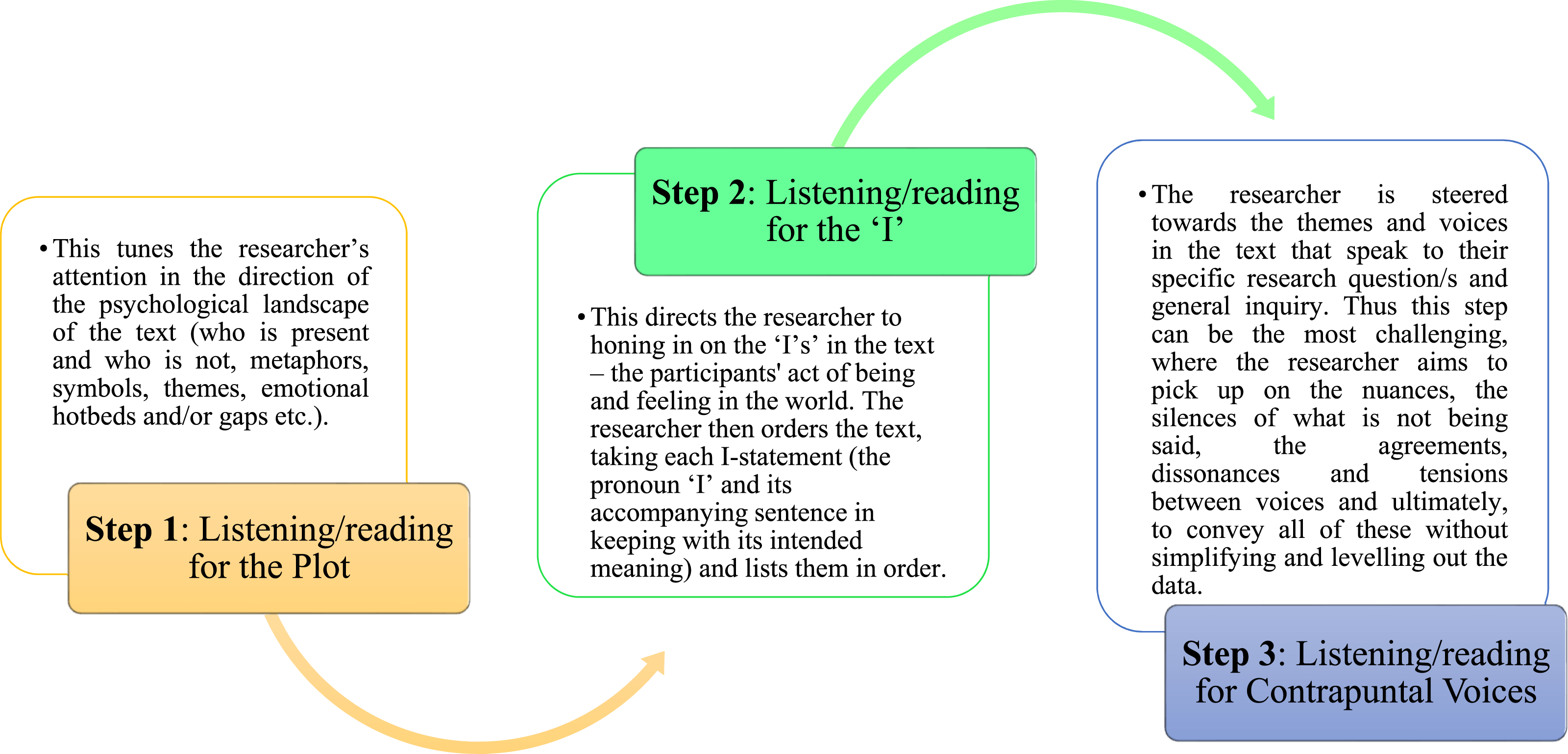
Contemplating Well-Being Measures
A particular concern among many is the seeming interchangeability of the terms ‘happiness’, ‘well-being’, ‘quality of life’, ‘life satisfaction’ and ‘wellness’. This is evident in the definitions outlined in various measures assessing the constructs mentioned, and contributes to the proliferation of the constructs and mesh of similar questions used in many of these measures, thus further complicating their delineation. This often results in difficulty distinguishing well-being specific measures from those of the other aforementioned constructs. Moreover, advanced epistemological and ontological frameworks of well-being become necessary in constructing the measures and interpreting the data collected (Cooke et al., 2016; Diener; Fernandes et al., 2012).
Well-being in its basic form encompasses an individual’s state of overall happiness and contentment with regards to the psychological, social and environmental aspects of one’s self and one’s life, and the dynamic interplay between these aspects on an emotional appraisal level. The closely related concept of quality of life encompasses the same states and aspects as well-being, but rather on a cognitive appraisal level, as an individual perceives themself in the different areas of their life (Diener et al., 2009; Minkkinen, 2013; The World Health Organisation Quality of Life Assessment Group, 1994).
Well-being and similar construct measures do not typically contain question items or take into account the factors of familial financial security, an individual’s sense of safety and security, basic needs being met, and family functioning or lack thereof (Cooke et al., 2016; Webb & Wills-Herrera, 2012). Cromhout et al. (2022) found that well-being measures and the operationalisation and findings thereof, could differ across age groups, suggesting that some well-being measures are more suitable for individuals of certain developmental stages than others, thus garnering varying degrees of reliability and validity in the results. Similarly, it is argued that well-being measures cannot always be reliably used across cultures, posing a disadvantage for the accuracy of data for those measures which are not developed in the context in which they are used (Cummins; Rothmann, 2013). Such complications are particularly evident with indigenous cultures, whose well-being is not necessarily determined nor influenced by factors outlined in the Western theoretical frameworks inherent in the vast majority of well-being measures, such factors including filial piety (Yeh, 2023), spirituality (Dudgeon et al., 2017; Ohajunwa & Mji, 2018), the concept of the relational-collective self (a balance between autonomy and being part of a community) (Ohajunwa & Mji, 2018), kinship and family, and culture (Dudgeon et al., 2017).
Further, Pavot (2018) describes some salient issues in measuring subjective well-being, citing transient factors as having the most effect on individuals’ responses to items. Factors such as an individual’s current mood and emotional state as influencing results, as well as the specific situation in which the assessment of well-being takes place, are such transient factors mentioned. In their own research, however, both Eid and Diener (2004) and Lucas and Lawless (2013) disregard such factors as current mood states as having a less than significant impact on the results obtained by subjective well-being measures. Factors that influence the specific situation of the assessment include factors that can be mitigated and cancelled out, depending on the research design, methodology and the researcher’s purpose. For example, social desirability of ‘being happy’ is mitigated in anonymous survey designs as compared to face-to-face interviews, and ensures larger sample sizes to further allay the influence of such transient factors, both of which factors – a large sample size and anonymity – are characteristics of the current study.
Methods
Collecting Data for I-Poems
A couple of noteworthy diversions of this study in comparison to the original and subsequent uses of the ‘Listening Guide’ method and creation of I-poems, are that the data were collected from online questionnaires rather than interviews or focus groups, and so the I-poems are the voices of a far larger group of people than its usual research entails; the I-poems thus take on a ‘we’ group collective, while still remaining true to the subjective ‘I’ voices and experiences.
The beginning of the questionnaire delineated the inclusion criteria of the study’s participants which the parent/s and/or guardian/s were requested to confirm. Participants were required to be between the ages of 10 and 18 years old, have ADHD (any type) as reported by a specialist, understand English at a Home Language or First Additional Language level, and be enrolled in school across any of the nine provinces in South Africa.
Descriptive Statistics (Frequencies and Percentages) for the Sample’s Demographic Information.

Note. N = 376.
The People Behind the I-Poems
How the I-Poems Were Analysed
The open-ended question in the questionnaire, ‘How has living in a pandemic made you feel’, was analysed qualitatively. To incorporate the varied responses given in answer to the open-ended question, I-poems were combined with ‘it was-poems’ (Edwards & Weller, 2015; Gilligan, 1982). First, responses were separated into three categories: positive, negative and neutral responses, after which the positive and negative responses were sub-categorised into various themes. Positive and negative responses were delineated by the main feeling word and/or adjective in the sentence. For example, the words ‘fun’, ‘nice’, ‘good’, ‘happy’, ‘enjoy’ in a sentence, either with an explanation that followed or just the word itself, were categorised as positive. Similarly, words such as ‘bad’, ‘bored’, ‘sad’, ‘scared’, ‘frustrated’, ‘not good’ and so on, were classified as negative. Several responses had both positive and negative aspects, and these were separated as per the above delineation process. Neutral responses denoted those that explained general feelings and experience of sameness, along the lines of no change having had occurred in the respondents’ lives and perceptions. Two responses, ‘I put on weight’ and ‘I got a littel [sic] bit chubby’, were classified as neutral as no explanation as to the feeling of this occurrence accompanied these responses. A combination “it was/I-poem” was then created for each category of positive, negative and neutral, with themes clustered together in stanzas (Edwards & Weller, 2012; Gilligan, 1982).
The positive responses contained themes of school, social, self-growth/reflection, emotions and other. More specifically, these themes encompassed the following: the pleasure of staying home and various positive implications thereof; for various reasons, the preference for online school; the enjoyment of being with and spending time with family (social); the opportunity for reflection in various forms, such as newfound gratitude for one’s life and family, as well as self-growth such as practising skills or learning new skills; one word or short phrase positive emotion and experience words: other experiences that did not fit into the above categories.
The negative responses contained themes of change, rules, social, home, school, extra-curricular activities, concern, loss, finances, new normal, emotions and other. More specifically, these themes encompassed the following: negative effects of the pandemic; the specific dislike of obligatory hygiene laws, primarily the wearing of masks, as well as sanitising; craving social interactions and missing family and friends; the dislike of having to stay indoors and at home for lengthy periods without reprieve; the aversion and challenges with online schooling; the displeasure of not being able to partake in extra-curricular activities and sports; general concern for the world, oneself, one’s family and friends; loss in the form of loved one’s passing away due to the virus or due to the implications of the pandemic; financial worry and/or loss due to parents’/guardians’ financial and job-related issues; fear that the pandemic and its implications will continue and become the new normal way of life; one word or short phrase negative emotion and experience words; other experiences that did not fit into the above categories.
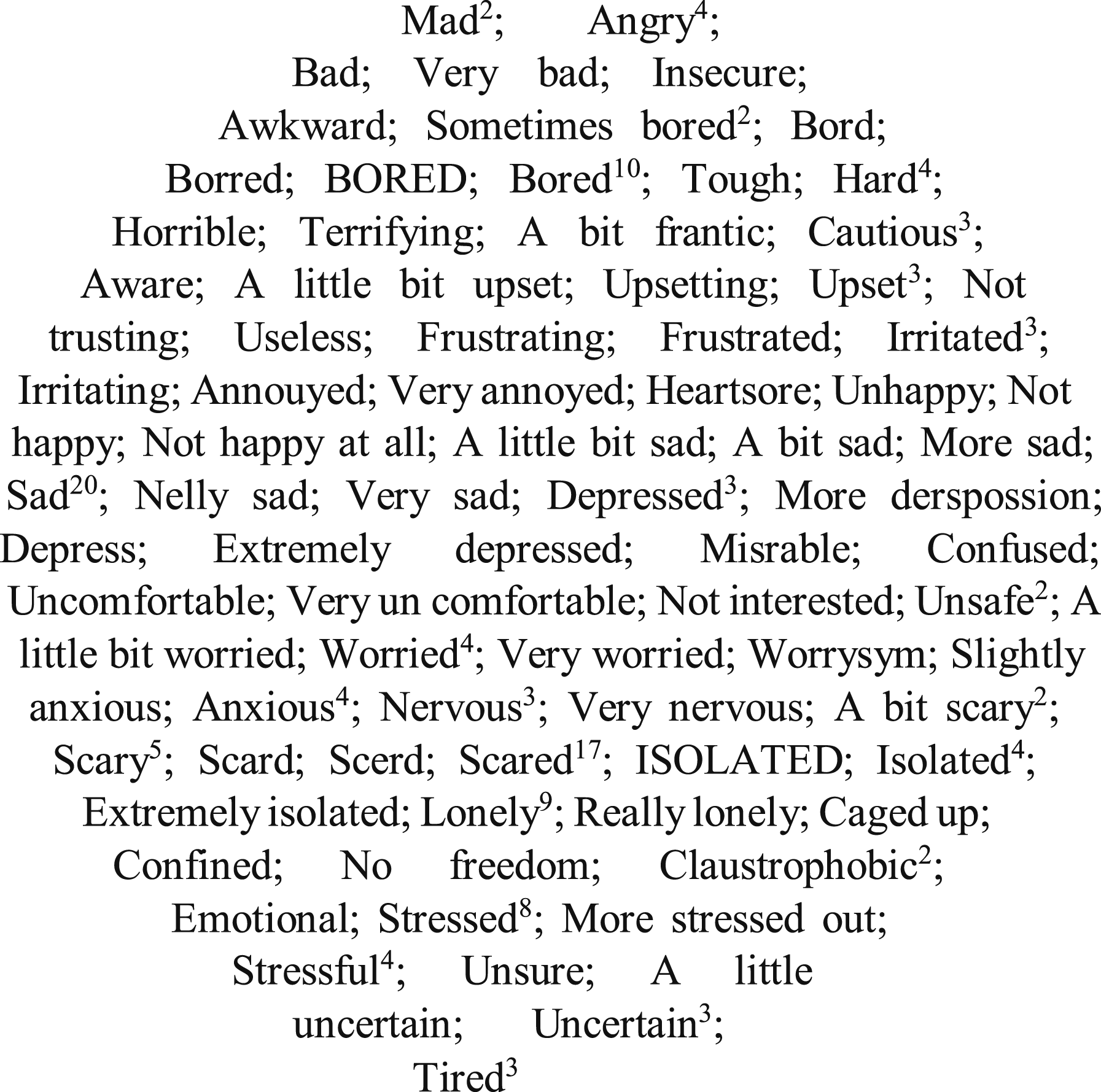
Every respondent’s response (n = 349) was incorporated into the ‘it was/I-poems’. The context and thus the meaning and essence of all the responses were kept as originally written by each respondent; by this it is meant that feelings and explanation words associated with certain experiences were kept together and not separated, as should be evident when reading the poems. As per the style of I-poems, the responses were used exactly as they were written by the respondents; no words were added and only unnecessary function words and repetitions were excluded from the poems. As such, spelling, grammatical and other errors were purposefully left unattended. This too serves to more fully engage the reader, in that they are drawn into the authentic lived experience and narrative of the respondents; engagement is thus ensured on a more personal and emotional level. Also in line with general I-poems, there is no particular structure or scheme to these poems, and they follow a free-verse poetry form (Edwards & Weller, 2015; Gilligan, 2015; Koelsch, 2015). Where there were exact or almost exact feelings and/or experiences written by respondents, these were combined together with a numeric superscript inserted next to the feeling/experience indicating the number of respondents who felt/experienced the same aspects of the pandemic. The poems are entitled ‘Living in a Pandemic’…’the GOOD’, ‘the BAD’, and ‘the NEUTRAL’, respectively.
With regards to the positive and negative ‘it was/I-poems’, each main theme of change, rules, social, home, school, extra-curricular activities, concern, loss, finances and new normal – for the negative ‘it was/I-poem’ – and school, social, and self-growth/reflection – for the positive ‘it was/I-poem’ – were interspersed with stanzas encompassing the combined themes of emotions and other (denoted by italicised text) so as to separate the themes in avoiding monotony and thus make for more impactful reading. Many responses were simple one-phrase or one-word responses, and these were clustered together as a list of sorts at the end of the poem, in such a way that the author hopes the impact will be greater than having incorporated the emotion and experience words elsewhere in the poem, where they may become lost.
Due to the online and anonymised nature of the research as well as the large sample size, verifying representativeness via member checking or respondent validation was not possible. Thus, trustworthiness and rigour were safeguarded through various methodological strategies, including integrity through continuously analysing and accounting for researcher bias in the creation of the I-poems, meticulous keeping of records and steps in the research and I-poem creation process, and ensuring that the meaning – as understood by the researcher – and context of each participants’ response was kept in its original form. Thus, descriptive validity was met in that the researcher did not embellish or distort participants’ responses, and interpretative validity was met in that the researcher engaged in constant, conscious efforts of sensitivity to capture the meaning of each young voice that took part in the research (Coleman, 2022; Hayashi et al., 2019; Maxwell, 1992; Morse et al., 2002; Noble & Smith, 2015; Rezapour Nasrabad, 2020).
Making It Visible and Bringing It all Together
It’s a mixed feeling situation…it has had its downs2…
I feel sad2 because a lot has changed4 my life has completly changed I changed a lot erritated because it changed our lifes it changed everything it just changed my world sometimes it feels abnormal nothing is the same
Everything is very restricted the struggle of all these rules… Overwhelmd. I hate sanitiser I feel a little bit annoyed, irratated because when The sannitizer gets on a cut it is sore I have to sanitiz things and my hands I just don’lt like it. Masks is a issue, its red bad I don’t like11, hate!2, really hate wearing a mask I feel terrible, sad3, uncomfortable, clustruphobic2, unhappy, irritated, stressed, annoyed2, not nice because we have to wear masks, stupid masks I feel unsafe, its painful because it feels like you can't breathe like it drains me and sufficates me It made me feel traped. It is very difficult…the masks I can’t have fun at school just because of the mask my mom and dad nagging to wear mask over my nose and sandising I’m tired of wearing mask I want to not wear a mask.
It has been horrible at times
a lot of bad moment
I often experience extreme loneliness
I was left with my thoughts and I don't like my own thoughts
It made me feel alone
even when I know that ppl care about me but I don’t feel it
I don’t like it
5
.
I felt sad2 and it was hard, because a lot of events got canceled we were not around people I hate it because no social life, social interactions made life pretty boring having to social distance is so hard, difficult, stressful it makes me feel upset The boredom of not seeing other people became overwhelmingly exhausting I can’t touch and reach out to people who feel upset. I am a very social person, an interactive person I love to spend a lot of time with people I have lost alote of friends during this time Covid made me feel very lonely. I missed my friends8 my family3 my teachers my school I missed going out with friends parties with friends I MISSED MY FRIENDS. It made me feel bored3, depressed2, sad13, alone, stressed, frustrated2, bad, isolated, terrible, not nice2, lonely3, because I could not see14, visit3, play with5, go to, be with3, talk to, have contact with, spend time with, hug2 my friends30 because I could not see/visit2 my family7, relatives I sTarted To get sad and lonely cuz I am The only chiled. I couldn’t go and see the people I love and care about, the people I want to see I’m sad because I always have to stay apart from each other I bon’t like to stay a miter aways from my friends Not nice to live like this I loved going to school after the pandemic to see my friends I NEEDED TO SEE MY FRIENDS + BE WITH PEOPLE.
Being stuck at home was a curse hard to get out of the house had to stay home the whole time I cant go to places like we used to2 to have fun3 for entertainment not even the shops couldn’t go or do anything. It’s very boring3 cause you have to be indoors all the time nothing to do4 I bearly had enything to do wanted to get out the house I hated wen I could not go out I felt like we are in prison …we were just sleeping and just eating at home. Was not nice had to stay indoors I felt isolated2, lonely, frustrated!3, mad, anoyed, angry, unhappy, to stay inside house to stay indoors we could not go anywhere4 I couldent leve the house We we trap inside I felt locked in, caged I was by my self and got into my head …extremely depressed. It was not easy at all…I felt trapped3 because could not go outside2 because Im an outside person, I can't live my life in a building I just have to go out I felt sad, confined cause I could not go outside to play2 …I live in a flat It is just hard being trapped with people we see everyday under one roof …we get on eachothers nerves and almost commit murder. I fear, don’t like, am scared going out my house to go to public spaces of big public gatherings Because of the virus… I am scared of what might happen I am nervous when people look at me I feel unsafe to show my whole face in public I am very corsious of doing secieal stuff when we started going out again I become extremly anxouis very aware of any virus coming near me.
It made my life miserable
I fell into depression
I had been in an abusive household during lockdown…
I realised the impact of not having somebody to talk to about the mental strain I’d been experiencing
I didnt feel well at all.
I used to enjoy school I hated2, I battle to do online school, online learning homeschooling with my mom. It made things worse because we could not go to school I wanted to go to school affected my school work I like, enjoy being at/going to school with my friends and teachers do different Things speak to friend It made me feel angry, sad3, confined, frustrated, because I couldn't go to school4 not to be able to play with my friends at school miss my friends. I missed school3, normal school a lot I felt nervous …uncertainty of when we could return to school Now has gotten better at we are back at school I love school. I felt isolated from the right to learn online school was hard5, very stressful, boring2, difficult2, draining there is too much homework I don't understand everything struggling to concentrate no social interactions to distract from school work learning things in groups became overwhelmingly exhausting struggle to find motivation hard getting new information it made me feel stupid it’s harder to stay focused when there isnt a person speaking directly to you Doing schoolwork at home was not the same My enjoyment for school has gone down a lot. I have missed out on a lot of learning and I feel behind lots of time has been lost the pandemic set our education far back I was a top student before COVID Now at school I feel that I cant keep up2 I cant cope everything moves so fast there’s hardly ever time I can’t keep up with the pace I work so hard but I feel like it's never enough I feel like I am going to fail everything has become more difficult I miss a lot of school because I often feel sick its more difficult I am not prepare for exams my Mark’s dropped I find classes too long I feel tired all the time made me clustruphobic with the seating school work that has been a lot we still cant change classes the masks feel like drains me…I oftin fall asleep in class I miss out on important work, fall behind I have gotten lazy with school work. Its Horrible This pandemic…Feels like you are being punished for something you did not do.
It has made me feel in a weird space because we are living in a constint fea
afraid at what might happen sometimes
worrying and waiting
It was stressful and still is.
The pandemic has taken a lot of in-school opportunities …made school hard to enjoy Sport isnt that same as it used to be… can really effect people with ADHD as sport helps cope I hate covid, I was miserable, frustrated2, bored, depressed, because I could not play soccer do most sport activities do horse riding do many extra-murals do my sport do swimming do sport at school – cancelled.
It was the most trying time globally I was sad2, uncomfortable, scared7, very scared, worried3, so worried, afraid2 for my family of losing friends and family for my family that they will get sick that I will lose my parents to loose my family or friend about what could happen to me and the people around me that me or my family would get sick and die because people that I now myt dea and I can't do aniething of people we love a dying of getting sick2 about my Grandpards that I would get covid thet somothing might happen to me because I don’t want any of my family to get sick about my favourite person- Granny …not being able to see her made me sad. It was very scary, not nice when my family got covid I had covvid 19 viras family falling ill with covid its side affects made my dad have a heart attack Covid my mom had it, it was very bad …she was admitted in hospital. It made worry more about what happens around me I was scared4, worried, sad6, angery, upset, about whats going to happen to other people everyone is going to die because of all the people who have died because there was so people dieing cause people were dying left and right about bad things like people dying because we lost of a lot people because it got lots of old people sick because lots of people were dying that people were dying in such an uncomon way so many people died with people passing away to live during a time where millions die It was very hard. To many people die we lost many people I feel bad for the people who are sick and the hospitals others loses there jobs I feel terrible The situation is traumatic It feels like it the end of the world.
I find it very difficult to control my mood at times
It has
put an emotional preassure on me
made me feel more stressed than it should
made me have anixty
gave me a lot of stress
gave me a lot of anxiety
Emotionally damaged.
I felt sad5 that people I love have died2 because I lost everybody that I love that got sick cause my ouma and uncle past away because of covid lost some familly and friends as i lost my Grandad and Uncle It was horrible, terrible, difficult lots of loved once's passed losing friends lost some familly and friends i lost my grandmother …i could not even say goodbye because of the pandemic I hate it.
It was not nice
2
I used to enjoy most things…
school was good
life was all around great
Now I only enjoy the things close to me
life has gotten Way Worse
Its been a struggle.
Its been struggles here and There I lost hope financialy I cant do hores riding… my family cant afford it anymore I thort that the share price will fall and my mom will loose her jod I am annoyed becuse we ar struggeling to get money… that was a big change for me It was tough… my parents worked very hard.
I feel tired:
it’s placed more pressure on me then the other years
very tired of everything
We tried to read book by trying to calm ourselves… to adjust it tryly a new normal of content I feel scared, afraid that things won’t go back to normal2 it won’t end2 its never going to end I feel like it will stay the same for years but hoping not I want to be Back to normal2 Everybody saying life us back to normal NO its not I’m scared because we (the world) don't know whats coming next.
My worse two years
I am more worried about my future
I stress for the nearst furture
I have been less and less positive of whats going to happen to me after school
I’ve lost so much positivity that my imagination has made false worlds.
It made me feel isolated from the real world out there
I feel
3
, felt
2
like I am in a closed room
locked up and over protected
like locked away sort of
like I am in a small circle
that all my freedom has been taking away.
I feel like I’m only in the beginning of an outbreak
I wish
the pandemic never came
it never happened
covid-19
will end
the pandemic will go away
I hate COVID-19!
It can’t be put into one emotion
there is one to meny feelings, you can't just pick one…
It
was/is,
I felt/feel:
Living in a Pandemic…the NEUTRAL
Its been interesting I put on weight, got a littel bit chubby I don’t know what to say… Its been, I felt pretty much normal not much different pretty much the same no difference really mostly the same still chatted with friends and family via what's app video calls the same11 did not affect me that much sometimes I do not notice the mask on my face I never cared much about pandemic as long I am fine and my family is okay normal no different fine2 hasent realy changed that much i relliy dident care about it i just waiched tv the whole year. Nothing2/not much2 has changed3, not much difference it doesn’t bother me much I didn’t mind living in a pandemic I feel like Ive just got on with it it hasnt really affected me3... since no-one close to me died of covid-19 except that we wearing makes and sanitasing ect I still go to school my mom still has a job income is comin in life hasn’t been that different for me I didnt feel a diff to be honest People really over reacted over the pandemic.
Living in a Pandemic…the GOOD
It’s a mixed feeling situation…it has had its ups2…
I loved, was happy not being near people2 Im a lot less akward helped me enjoy my own company I no longer feel as self conscious like everyone is judging I’m more introverted My self-esteem has improved drastically.
It made me feel
no pain
I was calm and peaceful.
It was fun
and I was happy not to go to school4, to have online school4, homeschool my own schedule, in my own time no social pressure I could control - noisy kids muted the best year of my school carrier.
I liked, loved, enjoyed, was happy being at home8 with family10, my mother, my parents2; becoming closer4 play games2 be with cats baking free on the farm arts and crafts woodwork playing online with my friends staying in my pj’s all day laughing to wriot my book call my friends all the time bkf and indoor trainer to think about my future Being stuck at home was a blessing … happy that I spent enough time with my dad before he passed.
It made me feel
‘okay-ish’ GOOD, okay
3
, good
2
, fine.
it was
somewhat easier to consentrate fun at times, fun, betu fun.
It brought big changes
I like wearing mask's because they can have cool designs on them
aveturly I got used to covid
its getting a little better,
definitely better,
I feel better
I believed everything would be alright.
It made me feel
sort of normal again
2
a bit happy
happy
4
like everything will be okay.
I feel more comfortable with myself doing most things talking to people around the people I care about to sit still in environments longer. It has made me feel good more aware to know to prevent. With all this time… improve my skill eager to leurn new skill’s focuse on my health gym reading what I’m gonna do next year self-reflect ponder about what I can do …for the better I got happy and excited. I have learnt a lot; I have lost a lot; I have gaind a lot; I have forgotten a lot; I have gotten closer to God I have learnt one simple thing: Atttitude of gratitude I will always be thankful for life I appreciate my family more greatful for every day opportunity to enjoy the simple life greatful for covid teaching unity in family I appreciate time with my friends more I am happy to still have my Mom, Dad, family and teacher.
It made me feel
much less stressed
rather pleased and chilled great.
it tuaght me a lot of things about life, to be patient understanding and Peaceful I have overcome my gaming addiction I feel like a better person2 I know more about myself I am more confident than ever that I have what it takes to succeed.
Discussion
Findings from this study offered both unique insights, as well as alignment with the themes and findings of other studies looking at the same population of children and adolescents with ADHD during the COVID-19 pandemic. The study by Korpa et al. (2021), for instance, saw the majority of their sample as suffering from overall adverse mental health. The emotional mood states of sadness, boredom, irritability, anxiety, and little interest/enjoyment in children and adolescents with ADHD during the pandemic as reported by their parents (Melegari et al., 2021), were all mirrored in this study’s sample of young people, with sadness and boredom being the two more prominent emotional states that respondents themselves reported feeling. This was seen in the numerous one word responses from the young people in the study – ‘unhappy’, ‘not happy at all’, ‘a bit sad’, ‘sad20’, ‘very sad’, ‘depressed3, ‘extremely depressed’, ‘BORED’, ‘bored10’ - as well as many similar sentiments. Also consistent with this study’s findings, boredom was considered one of the top frustrations experienced by adolescents and young adults in the USA, according to both child- and parent-report (Sibley et al., 2021). Parents in the study by Sciberras et al. (2020) saw stress related to the pandemic as concomitant to increased irritability, anxiety, nervousness, worry, fatigue, negative thoughts and diminished enjoyment in activities, all of which were self-reported to varying degrees by this study’s sample. Shah et al. (2021) also reported increased irritability in their sample during the lockdown in India, as reported by the parents of the children and adolescents with ADHD. Depressed mood, sadness and loneliness were emotional states reported fairly frequently by this sample, as akin to the study by Sciberras et al. (2020). Higher levels of anxiety were found by Navarro-Soria et al. (2021), and Bobo et al. (2020) too saw anxiety as associated with worse well-being, results similar to this study’s self-reported feelings of anxiety and similar emotions such as nervousness and worry.
Various risk factors associated with the mental health, emotional and psychological well-being, life satisfaction and quality of life of children and teenagers with ADHD were cited by previous studies and were echoed by many young people in this study. These risk factors encompassed the following: less exercise and less time spent outdoors (Navarro-Soria et al., 2021), difficulty socially isolating (Korpa et al., 2021; Navarro-Soria et al., 2021; Sibley et al., 2021), Covid-19-related worry, increased parent-child and family conflict, and tension in the household (Korpa et al., 2021). As these studies found in their own investigations, such risk factors could have contributed to the negative emotions experienced by the young people in this study, as evident in the negative ‘it was/I-poem’. School closure and the implications thereof was a common theme in many studies that was too seen in this study’s findings, specifically, various difficulties with the online mode of learning and the changes it wrought (Bobo et al., 2020; Korpa et al., 2021; Navarro-Soria et al., 2021; Sibley et al., 2021).
A primary positive implication of the pandemic and the subsequent lockdowns imposed worldwide, was being able to spend more time with one’s parents and family (Sciberras et al., 2020; Shah et al., 2021; Sibley et al., 2021), a finding that was reflected in the responses of the young people in this study, as demonstrated through responses such as ‘I liked/loved/enjoyed/was happy being at home8 …with family10, my mother, my parents2…becoming closer4’ and ‘Being stuck at home was a blessing…happy that I spent time with my dad before he passed’… Another positive aspect cited by previous studies and several respondents in this study, was having a flexible schedule (Bobo et al., 2020), and being less busy and generally calmer (Sciberras et al., 2020). Some of the respondents in this study alluded to their enjoyment of school closures and online learning as improving their well-being due to less social and school-related pressures, a finding which both Bobo et al. (2020) and Sciberras et al. (2020) noted in their sample.
The theme of self-growth and reflection was found by Arnout and Al-Sufyani (2021), who saw heightened spiritual connection, increased gratitude and improved emotional strength and resilience from self-report methods in their Saudi Arabian adult sample. This general self-growth and reflection theme was not evident in previous studies with children and adolescents with ADHD, however, it was indeed seen in this study’s young participants: ‘With all this time…eager to leurn new skill’s…focuse [sic] on my health…self-reflect’ and ‘I have learnt a lot, I have lost a lot, I have gaind a lot, I have learnt one simple thing, the attitude of gratitude…I will always be thankful for life…grateful for covid teaching unity in family…I am more confident than ever that I have what it takes to succeed’.
The theme of concern was not noted in the studies conducting research with children and adolescents with ADHD specifically, however, it was a finding reported in the general child and adolescent population during the pandemic, all by studies utilising self-report methods (Bourion-Bédès et al., 2021; Magson et al., 2021; Vogel et al., 2021). Also through self-report, Tang et al. (2021) found that Chinese children and adolescents without ADHD valued the extra time afforded them to spend on hobbies, interests and personal activities – which was replicated in this study – where the studies looking specifically at children and adolescents with ADHD did not mention such findings.
Transcending the many similar findings of the current study to those of others, were numerous insights that this study alone discovered; many responses and themes were not directly mirrored in other known studies, and herein lie some of this study’s uniqueness. These included the feelings of confinement reported by several young people, as denoted by responses such as ‘I felt locked in, caged…I was by myself and got into my head’, ‘I felt trapped3…Im [sic] an outside person, I can’t live my life in a building’, ‘trapped with people we see everyday under one roof…we get on eachothers nerves and almost commit murder [sic]’ and ‘being stuck at home was a curse’, as well as other similar words and phrases. An emotional state and experience that came up often in this study’s young population was the feeling of being scared and the situation of the pandemic as being scary, which other studies did not allude to: ‘I am scared…going out my house…to go to public spaces’, ‘Because of the virus, I am scared of what might happen…I am nervous when people look at me…I feel unsafe to show my whole face in public’. The dislike of the rules and regulations put in place due to the pandemic was another theme that was seemingly not found in other studies; there were many responses outlining the dislike of masks and sanitising that an entire theme was necessarily made to encompass them, with some potent examples being: ‘the struggle of all these rules…very restricted’, ‘masks is an issue, I don’t like/hate!2 wearing a mask…stupid mask’, ‘it feels like you can’t breathe, like it drains me and sufficates me [sic]’, ‘it is very difficult…my mom and dad nagging me to wear mask over my nose and sandising [sic]’ and ‘I hate sanitiser…when it gets on a cut it is sore’. Further, the theme of loss and finances did not emerge explicitly in the findings of previous studies on the same topic and with the same population, while it clearly manifested in the current study. Responses such as ‘I felt sad2 that people I love have died…I lost everybody that I love that got sick’, ‘It was horrible, terrible, difficult…lots of loved once’s [sic] passed…Grandad…uncle…ouma…I could not even say goodbye to my grandmother because of the pandemic…I hate it’ and ‘I lost hope financialy [sic]…my family cant [sic] afford it anymore…I though that my mom will loose her jod [sic]’, ‘we are struggling to get money…my parents worked very hard’ illustrated these themes through the unveiled emotions elicited by the loss of loved ones and financial uncertainty.
All these themes and experiences are very personal in their manifestation, and thus are more likely authentically reported by the actual persons to whom such experiences occur, and who in turn experience the accompanying emotions. Therefore, it could be that these experiences, emotions and themes unreported by other known studies emerged due to one of the unique hallmarks of this study: the sample themselves reported their own personal experiences of the pandemic, and did not rely on parents’ perceptions of their children’s experiences. These self-experienced responses assisted in determining common emotions and themes and linking them to other studies, which in itself provided much insight. However, here emerged perhaps the most unique aspect of the study, whereby every participant’s voice was ‘seen’ and heard through the creation of I-poems, portraying the palpable and unfiltered emotion and distinct experiences of the young people who took part in this study. The study demonstrated the phenomenal utility of I-poems in eliciting Gendlin’s (1978) ‘felt sense’ in the reader such that the intimacy between the reader and the young participants’ embodied experiences was unrivalled to simply reporting themes as indications of well-being. The creation of the I-poems was incredibly time consuming, and ensuring that the meaning of each participants’ response remained as originally intended while incorporating so many responses in a coherent manner was the most challenging aspect of this method. However, the freedom afforded in the unstructured and free-verse nature of the I-poems and the dynamic affect they created acted as a strength that surpassed the challenges the method engendered. Thus, new and markedly personal experiences of an under-researched and significant population came to light through this study’s findings, specifically through the creation of I-poems and supplemented by common themes and emotion words.
Conclusion
The use of the I-poem (and 'it-was poem') methodology in this study highlights the multi-dimensionality of the subjective well-being of children and adolescents with ADHD during the COVID-19 pandemic; the expressly personal experiences and accompanying emotions of each participant was brought to life through the creation of the I-poems in a way that other types of research methodologies, certainly quantitative and even other qualitative, would have been unable to emulate. The poems depict positive, negative and neutral feelings of subjective well-being in the participants to various degrees, encompassing numerous themes such as school, social, self-growth/reflection, emotions and other (positive) and change, rules, social, home, school, extra-curricular activities, concern, loss, finances, new normal, emotions and other (negative). Many of these themes, experiences, emotional states and risk factors were mirrored in a number of other studies investigating similar topics – overall worsening of mental health and well-being and the associated risk factors of less exercise, less time spent outdoors, difficulty socially isolating, pandemic-related worry and increased family conflict and tension; emotional mood states of sadness, boredom, loneliness, anxiety, and diminished enjoyment in activities; themes of spending more time with family, having a flexible schedule, being less busy, enjoyment and challenges of school closures and online schooling, and self-growth and reflection. Some themes and experiences, on the other hand, appeared to be specific to this study’s findings – confinement, dislike of rules and regulations due to the pandemic, the loss of loved ones, and financial insecurity/decrease in socioeconomic status. In conducting this research, the findings add to the body of knowledge concerning the subjective well-being of children and adolescents with ADHD in South Africa and globally, as well as contributing to the novel research of this vulnerable population’s well-being in light of the COVID-19 pandemic and its impact thereof. The themes and responses assist those who live with (parents, siblings) and those who work with (educators, psychologists, other professionals) youth with ADHD to understand and empathise with these individuals on a deeper level, likely leading to enhanced well-being for both parties. Further research that explore I-poems in conjunction with other research methodologies is encouraged.
Footnotes
Declaration of Conflicting Interests
The author(s) declared no potential conflicts of interest with respect to the research, authorship, and/or publication of this article.
Funding
The author(s) disclosed receipt of the following financial support for the research, authorship, and/or publication of this article: The publication fees of this article were provided by publication funds of the second author at the University of Pretoria, South Africa.
