




Abstract
COVID-19 ushered in public health guidelines restricting face-to-face contact and movement, and encouraging social distancing, all of which had implications for conducting field-based research during the pandemic. For qualitative researchers, this meant adapting conventional face-to-face methods and resorting to virtual variations of the same in adherence to stipulated COVID-19 health protocols. Virtual qualitative research introduced new concerns and logistical challenges. This paper presents critical reflections on experiences of conducting qualitative research during the pandemic, from the perspectives of a cohort of postgraduate fellows. A critical reflection framework was utilised to explore fellows experiences and meanings ascribed to their experiences. The research findings illustrate three overarching processes which, in turn, shaped ways of thinking, doing and being. First, explicating tacit assumptions about their anticipated research journeys and interrogating these. Second, shifts in power differentials demonstrated by role reversal between researchers and participants, and between fellows and supervisors as they re-negotiated their positionalities in virtual research spaces. Third, context specific sense-making, in which - narrative accounts support the notion of knowledge as a social construct. Our findings have important implications for qualitative research practice. Our study documents methodological nuances and social implications of conducting qualitative research during COVID-19 and in a-South African context. In addition, our study exemplifies the use of critical reflection in qualitative research practice in the specific context of postgraduate academic research. Further, our study illustrates how the use of technology shapes qualitative research protocol development, data collection and analysis phases.
Introduction
The onset of COVID-19 and attempts to curb its spread ushered in public health guidelines restricting face-to-face contact and movement, and encouraging social distancing, all of which had implications for conducting field-based research during the pandemic (Pocock et al., 2021; Varma et al., 2021). For qualitative researchers, this meant adapting conventional face-to-face methods such as in-depth interviews, observation and focus group discussions and resorting to virtual variations of the same in adherence to stipulated COVID-19 health protocols (Moises, 2020; Sy et al., 2020). Virtual qualitative research introduced new concerns and logistical challenges. These included technological challenges related to researchers’ knowledge, skills and access to virtual data collection tools, internet connectivity and quality of data (Greeff, 2020; Rahman et al., 2021). In addition, there were concerns around virtual interactions such as online distractions, challenges in gaining access to and establishing rapport with participants virtually, and the absence of non-verbal cues when utilising audio platforms without video options (Pocock et al., 2021; Rahman et al., 2021). Further, ethical challenges relating to obtaining informed consent and data security in virtual spaces were reported (Greeff, 2020).
During this period several published articles provided information on various aspects of doing qualitative research during the pandemic. At the start of our study, we conducted an open search of articles addressing qualitative research during COVID-19 and sampled a few interesting studies, which we then categorised based on their content. One category of publications was conceptual papers. These included a systematic review on the experience of conducting qualitative evidence synthesis during the pandemic (Biesty et al., 2020), articles furnishing information on practical considerations for conducting virtual qualitative research during COVID-19 (Greeff, 2020; Newman et al., 2021; Varma et al., 2021), studies foregrounding challenges (Sah et al., 2020; Santana et al., 2021) and others demonstrating the value of qualitative methods in research during a pandemic (Teti et al., 2020). A second category of publications focused specifically on methods-related issues (Lobe et al., 2020; Moises, 2020; Pocock et al., 2021; Webber-Ritchey et al., 2021), including information on tools and methods available for virtual data collection and ethical implications of the same (Lobe et al., 2020). A third category of studies presented first-hand experiential accounts of conducting qualitative research during COVID-19, highlighting how qualitative research and methods were adapted to facilitate continuation of ongoing research (Rahman et al., 2021) and new research conducted during this time (Jairath et al., 2021; Rania et al., 2021; Roberts et al., 2021; Rolf et al., 2021).
The conceptual and methods studies were a useful roadmap in navigating the unfamiliar terrain of qualitative research during the pandemic. The experiential studies showcased real life scenarios of scholars’ qualitative research in different contexts, underscoring the necessity of adapting available research methods and tools for contextual relevance. In all three categories of studies, perspectives from Africa were conspicuously absent despite several ongoing research activities in the continent. Our study contributes to this gap by examining qualitative research experiences during COVID-19, from the perspectives of a small cohort of doctoral and postdoctoral students at a South African university.
The aims of this study were to: (1) Describe the experiences of conducting qualitative health research during COVID-19 from the perspectives of a cohort of four postgraduate (public health) students (2) Critically reflect on meaning-making processes around these experiences (3) Highlight lessons learnt from these research experiences.
In so doing, we hoped to contribute to qualitative methods discourse in two ways. First, by illuminating methodological nuances of qualitative research during COVID-19 in a South African context. Second, by exemplifying the value of critical reflection in qualitative research practices in the specific context of postgraduate academic research.
Context
Our specific context is South Africa, where COVID-19 public health protocols included varied levels of lockdowns each with specified restrictions (Greeff, 2020; Haider et al., 2020; Stiegler & Bouchard, 2020). The lockdown in South Africa, described as the most restraining lockdown in Africa and one of the strict globally, oscillated from levels 5–1 with levels 5 and 4 being the most stringent, where all persons were confined to their residences with the exception of healthcare personnel and those in need of emergency medical care (South African Government, 2022; Stiegler & Bouchard, 2020). This, in turn, shaped research regulations adopted by institutional review boards, for instance suspension of all non-therapeutic research involving human subjects during lockdown levels 5 and 4 (Faculty of Health Sciences HREC, 2020).
In this study, we explored qualitative research during COVID-19 as experienced by a small cohort of doctoral and post-doctoral fellows from the University of Cape Town (UCT). The students are part of the ‘Building Research in Inter-Disciplinary Gender and HIV through the Social Sciences’ (BRIDGES) Programme, a 5-year NIH funded (D43) programme housed in UCT’s Division of Social and Behavioural Sciences, School of Public Health. Doctoral degrees and postdoctoral studies in South Africa are fully research-based and, as such, the fellows were engaged in various aspects of their research during COVID-19 as detailed in the results section. The research team, all of whom are co-authors of this manuscript, comprised the lead author, who was involved in supervising and mentoring the fellows in addition to serving as the BRIDGES programme manager, four postgraduate fellows (authors b-e) who included three doctoral students and one postdoctoral research fellow, and a BRIDGES co-investigator and senior researcher listed as the last author.
Theoretical Approach
We utilised critical reflection, a qualitative research approach, for this study. Critical reflection stemmed from the discipline of social work and is consonant with broader qualitative research knowledge paradigms, which ontologically embrace relativism in acknowledging the existence of multiple subjective realities that are socially constructed (Gilson et al., 2011; Hickson, 2016). Epistemologically, qualitative research knowledge paradigms support the notion that knowledge is co-constructed in the process of interaction between researchers and participants, including reflexivity as a component of meaning-making and supports research in natural rather than experimental environments (Gilson et al., 2011; Hickson, 2016).
Critical reflection, as conceptualised by Fook and colleagues, is a postmodernist approach which considers knowledge a social construction, foregrounds the role of language in representation of dominant discourses, and embraces non-binary meaning-making (Askeland & Fook, 2009; Beres & Fook, 2020; Fook, 2015). Critical social theory, a component critical reflection, engages with the notion of power and how this plays out among various individuals and groups (Beres & Fook, 2020; Fook, 2015). Critical reflection entails reflective practice, which calls for explication and examination of individuals’ assumptions and reflexivity, which necessitates introspection in a bid to understand how individual pre-suppositions influence interactions with others in various social contexts (Beres & Fook, 2020; Fook, 2015).
The context of the BRIDGES Programme, intertwined with the use of critical reflection as a theoretical framework, yielded a unique relational environment characterised by informal, collegial relationships among fellows and supervisors, including the programme manager. In BRIDGES, a coordinated peer-supported PhD and postdoctoral fellowship programme, fellows were actively involved in decisions about how the program operates, based on their needs. This relational context is illustrated further in the methods and discussions sections.
Methods
Critical reflection is infused informally into various elements of the BRIDGES Programme. Biweekly fellows’ meetings, biweekly supervision meetings, regular peer review and mentorship meetings all functioned as spaces for critical reflection. Following the first few fellows’ meetings, the programme manager and - fellows discussed the idea of documenting parts of fellows’ academic journeys in the form of brief baseline interviews. The interviews, which form our first data set, explored individual fellows’ expectations as they commenced postgraduate studies in 2020, including ongoing and anticipated challenges, hopes, feelings and fears. With fellows’ consent, the interviews were conducted and audio recorded by the programme manager (JNG) and a colleague in the programme. Each fellow received a copy of their interview transcription. Reflections shared during these baseline interviews were revisited during supervision meetings as well as mid-year and end-year review meetings with the supervision team and individual fellows. Snippets from these interviews are presented in the first sub-section of the results section titled ‘pre-COVID-19’.
In 2021, informal conversations about fieldwork experiences culminated in the idea of writing a paper about these experiences. During the BRIDGES 2021 Symposium, all the co-authors met and agreed on what they wanted to do, how they intended to do it, roles and responsibilities of all co-authors and tentative timelines. Conceptualisation of the study and determining the themes for in-depth interviews (IDIs), which formed the second data set, was done collaboratively. The last co-author (NL), a BRIDGES co-investigator and experienced researcher, guided this process. Fellows and the interviewer had a few weeks to think through the IDI themes so that during the actual interviews, the interviewer (JNG) and each of the fellows reflected critically on their lived experiences. These interviews, each of which took approximately one and a quarter hours, constitute a major part of the results section. Each fellow gave verbal consent for the interview, including consent for audio-recording. The IDIs were, in essence, an extension of various bits of narrative accounts shared during biweekly fellows’ and supervision meetings, and a culmination of critical reflection activities and processes.
Critical reflection involves reflexivity in the sense of considering how one’s positionality, including one’s pre-understandings, shape the research process (Beres & Fook, 2020). As an academic supervisor and programme manager who had been closely involved in the fellows’ academic journeys, JNG’s pre-understandings included assumptions based on interactions with fellows at individual and group levels, and her own sense-making around these interactions. The interviewers’ reflections are weaved into the discussion section.
Data analysis incorporated a critical reflection framework. This necessitated exploring a layer below the descriptive data and interrogating this data in the quest for overt and covert assumptions inset in narrative accounts of fellows’ lived experiences. This process entailed paying close attention to the various ways through which language revealed individuals’ social constructions of their subjective realities and how power played out in various research interactions and contexts (Beres & Fook, 2020; Fook, 2015). One of the IDI questions delved into reflexivity by exploring how individuals’ presuppositions shaped their research experiences.
Ethics
Throughout our process, we considered the ethical conduct of research in various ways. First, we opted for a participatory approach where all the co-authors were involved in all parts of the knowledge construction process, including the decision whether or not to proceed with the interviews and write up, workshopping around possible types/thematic content of research questions and methods that would be appropriate in capturing experiential accounts, reviewing findings (member checking) and making decisions about content to be included or not. For instance, co-authors pointed out sections that needed reframing to avoid misunderstanding. Second, each co-author had a say in what should be included. For instance, we adhered to a fellow’s recommendation that we exclude one data set of short stories previously published in a public online repository, because these stories might inadvertently disclose their identities, which may have negative ramifications on their continued engagement with community members during their research. Third, all co-authors’ consent was sought at each stage of the process, for instance, requesting to record each fellow’s statement consenting to participate in the interviews, and through member checking of emerging data and all reiterations of the manuscript. Finally, only data drawn solely from co-authors’ reflections of their own lived experiences is included in this manuscript.
Results
In our discussion of emerging themes, we superimpose key COVID-19 milestones as parallel metaphors to illustrate the various ways in which the pandemic shaped parts of fellows’ research journeys (See Figure 1). Postgraduate fellows’ experiences of research during COVID-19.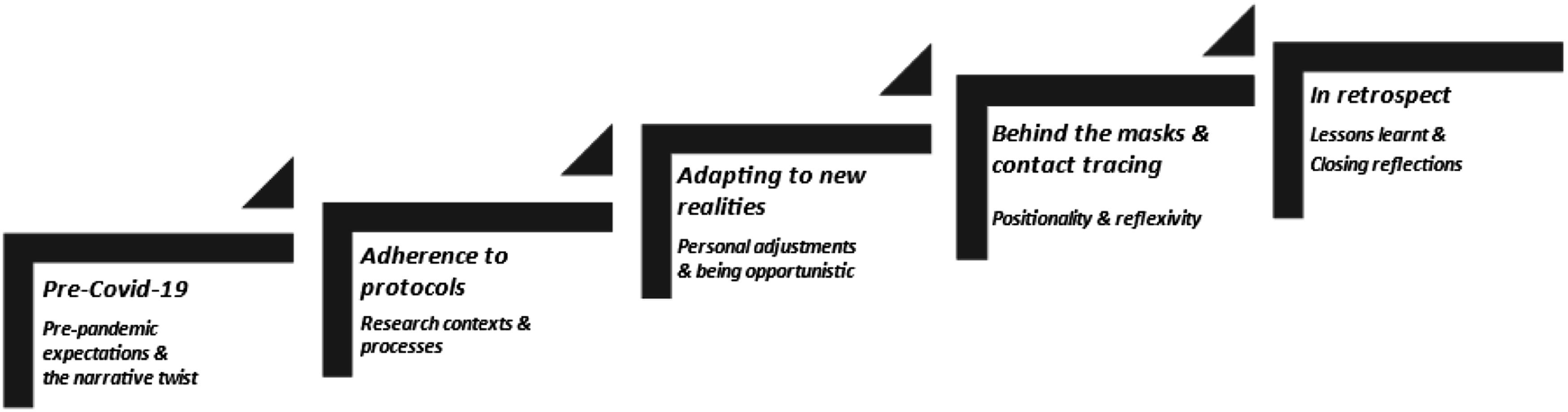
In subsequent paragraphs we discuss each of the themes with corresponding metaphors and data excerpts as supporting evidence.
Pre-COVID-19: “But because I have never experienced something like that before…”
As noted in the introduction, BRIDGES fellows commenced their postgraduate studies at the beginning of 2020. During our first annual symposium in March 2020, we conducted brief baseline interviews with the fellows to establish their expectations as they commenced their academic programs. The following excerpts illustrate some of the fellows’ expectations framed as anticipated challenges, hopes, feelings and fears:
These excerpts reflect the typical concerns of postgraduate students in institutions of higher learning, and implicit assumptions about how their academic journeys would unfold. The excerpts shed light into the research context at the broader socio-political context of unrest in communities marked by mass action, the institutional context of being part of a research context where peer support was expected, and at the intrapersonal context of internal angst related to academic performance. At this point, COVID-19 did not feature in their narratives not because they had not heard of it but rather because the gravity of the situation was not yet part of their lived reality.
The end of symposium marked a narrative twist as the reality of the impact of COVID-19 began to dawn:
The narrative twist is evident in the use of binary constructs to convey individuals’ social constructions of their dawning realities (Beres & Fook, 2020; Fook, 2015). This is encapsulated in the shift of perspective from the initial acknowledgement of COVID-19 as a disease that is far removed from ‘us’, that was affecting ‘them’ out there, to the shocking realisation that ‘it’s something that’s going to start affecting us all’. This included Africa; right down to the level of the BRIDGES Programme, as co-investigators from USA scrambled to leave South Africa after a symposium, amidst talks of national lockdowns in a bid to control disease spread. This narrative twist heralded a shift in perspective as previous confidence that “we’re strong” gave way to feelings of vulnerability upon realisation that the pandemic was “going to start affecting us all.” At this point, the relative unfamiliarity of doctoral and postdoctoral studies seemed to pale in comparison with the unfamiliarity of COVID-19 in the sense of having “never experienced something like that before.” In subsequent sections, we discuss how COVID-19 shaped fellows’ experiences of conducting qualitative research.
Adherence to Protocols: “I should have been…, but instead…”
In South Africa, COVID-19 protocols included a five-level nationwide lockdown with restrictions on movement and activities ranging in a continuum, as described in the context section. National COVID-19 protocols mandated at institutional level impacted research contexts and processes, necessitating a change of plan from what ‘should have been’ to the next available alternative:
At a pragmatic level, lockdown restrictions meant delays for fellows like Lulu, who had been cleared for fieldwork prior to the lockdown, but were required to apply for protocol amendments to change their methods to virtual research, which was a source of frustration. Virtual research ushered in a new set of context-specific challenges, including cell phone network connectivity problems, nationwide intermittent power outages (load shedding), which further hampered cell phone network connectivity, non-responsiveness of participants and use of shared phones leading to limited access.
In the process, assumptions about research procedures from ethics approval to fieldwork and assumptions pertaining to the research context such as phones being available and network services being operational were put to the test as fellows adhered to COVID-19 protocols and attempted to navigate in this new terrain. These assumptions implicitly point to power hierarchies implicated in adherence to protocols. Lulu who, under normal circumstances, would have been in control of her research process and actively engaged in fieldwork was rendered powerless by institutional protocols requiring additional clearance due to the new COVID reality. Similarly, Moyo, who assumed that she would have more control over her research interviews, experienced a toppling of power hierarchies in the virtual context where participants seemed to determine if/when they would be interviewed or not. Both excerpts convey a sense of powerlessness in the face of COVID-related circumstances that were beyond their control.
Social distancing, a measure introduced to alleviate the spread of COVID-19 by limiting physical contact, translated into restrictions on face-to-face research in favour of virtual research. Paradoxically, virtual research techniques such as telephone interviews, WhatsApp interviews and diaries which were intended to maintain safe interactions between researchers and participants instead produced technological ‘screens’, rendering it difficult for fellows to maintain a sense of connectedness with participants:
For Tenda, the lack of physical presence and interaction between her and her research participants yielded a somewhat detached virtual relational space she thought may have contributed to participants’ reticence or refusal to respond to invitations to participate in the Whatsapp component of her study. Moyo’s meaning-making process involved reflecting on her presuppositions and acknowledging how these were challenged by unexpected responses from her participants. Based on her preunderstandings, Moyo’s positionality as a relatively ‘rich’ researcher offering incentives to participants ought to have placed her in a position of relative power over her needy participants but to her surprise, participants’ demonstrated power through what she deemed ‘exercising their agency’.
In relation to qualitative research practice, Tenda and Moyo’s experiences suggest that virtual research was fraught with challenges and, as such, face-to-face research might have rendered it easier to maintain interpersonal connections with research participants. However, Lulu’s contrasting narrative presents a counter-perspective:
The virtual space seems to have served as safe space making it easier for young participants’ disclosure about some of their struggles. Drawing from her previous experience working with young people, which constitutes some of her presuppositions, Lulu speculated that the ‘screens’ afforded by virtually mediated research interactions may have enhanced conversations around sensitive topics. Tenda, Moyo and Lulu’s accounts all illustrate the notion of knowledge as a social construct and power of language in accentuating dominant discourses about researcher-participant interactions.
Adapting to New Realities: “One of the considerations…”
Fellows’ research experiences did not occur in a vacuum but rather were intricately interwoven with their personal lives, necessitating personal adjustments:
In the previous section, we highlighted Lulu’s predicament when the start of her fieldwork was delayed when she had to apply for an amendment due to adjustment of national COVID-19 lockdown levels which translated to the prohibition of face-to-face research. Even so, Lulu’s shift to virtual research was not entirely an inconvenience but actually proved advantageous in light of her illness experience which left her feeling vulnerable. In Moyo’s case, illness of a close family member had ramifications on her research process when she assumed the role of primary caregiver:
Moyo’s dilemma was palpable as reflected on the impact of caring for a gravely ill close family member, concluding that the few months’ delay in her research was a worthwhile sacrifice. At an existential level, and particularly in the face of life-threatening illness, family took precedence over her academic project.
For Tenda, adapting to new realities meant being opportunistic in the sense of capitalising on available resources, despite lockdown regulations which constrained people to their homes:
The use of metaphor and binaries to capture the ramifications of personal space constraints due to lockdown restrictions is exemplified in this excerpt. The literal [physical] and metaphorical [mental] claustrophobia experienced by Tenda in her new home-work space, followed by moving to a bigger apartment enhanced her research ideas and created and opportunity to do a lot ‘because there was nothing else to do.’
‘Behind the Masks’ and Contact Tracing: “It’s quite layered…”
In the same way contact tracing played a significant role in various seasons of COVID-19, virtual research was marked by the accentuated role of gatekeepers as ‘contract tracers’ in the sense of linking researchers to participants during the lockdown. With regulations restricting face-to-face research engagement to curb spread of COVID-19, fellows were forced to rely on gatekeepers to assist with introductions to relevant community stakeholders and recruitment of participants. Fellows’ interactions with gatekeepers were coupled with a heightened sense of individual self-awareness in the reflexive sense of ‘who am I and how did my presence influence my research experience?’ This inevitably entailed negotiating their positionalities and social identities as ‘semi-insiders’ in the field:
Zumba’s multi-layered narrative offers a historical, socio-political background of what she terms the racial context in South Africa, where whiteness is associated with privilege. Against this background, she positioned herself as a black South African researcher who benefitted from having a white gatekeeper to assist her navigate in her research context, a black local township. As she told her story, Zumba struggled with the idea of ‘othering’ as evidenced by her initial observation that it was the gatekeepers’ position of privileged whiteness, in contrast to her relatively underprivileged blackness, that helped her gain entry into the field, followed by a retraction of the statement and later a reinstatement of her viewpoint, with an example to validate her point.
In this excerpt, which shows how knowledge is socially constructed, Zumba propagated a dominant narrative and by so doing inadvertently maintained status quo by positioning herself relative to the gatekeeper. However, she was cognizant of the possibility that a black person could be afforded honorary white status based on certain characteristics but deemed herself ineligible for such honorary status. A similar idea of fluidity of status based on colour and socio-economic strata is encapsulated in what has been described as Brazil’s ‘pigmentocracy’ where socio-economic status determines perceived status of blackness or whiteness, with possibility of honorary whiteness ascribed on the basis of affluence (Lima, 2007).
In a contrasting account of what she considered a case of mistaken identity, Moyo reflected on her interactions with the gatekeeper who helped her access her research participants:
Inset in this conversation is Moyo’s interpretation of her experience: the assumption that being black implied that one was from the township (neighbourhood where black people live), which the gatekeeper seemed to have assumed. Consequently, he [gatekeeper] expected Moyo, as one residing in a township, to be acquainted with and, as such, not to be unduly perturbed by noise, captured by his statement ‘you know how it is’. Moyo’s response was to remain silent and maintain status quo to avoid any negative repercussions of disclosing her true identity as a ‘semi-insider’ who was accorded insider status by virtue of being black despite not meeting the second criterion of living in a township. In this sense, silence served to maintain a sense of equality and power balance due to perceived similarity.
Like Zumba and Moyo, Tenda also grappled with her positionality and, in this case, as an outsider. Tenda, whose research was clinic-based, raised concerns about the timing of conducting in-person research during COVID-19: the ethics of attempting to go into to the clinic space:
Tenda utilised language powerfully in positioning herself as an outsider intruding the clinic space with her research agenda by ‘extracting data from overburdened, overwhelmed staff and vulnerable patients.’ This excerpt illumines implicit pre-suppositions about her relative position of power as a researcher and more so in the local public health clinic research context where, based on our experience, (1) researchers are often reliant on staff as gatekeepers who are mostly healthcare workers (2) hierarchical protocols in the health care systems may oblige gatekeepers to assist researchers whose research has been approved by the Department of Health and ratified by facility managers. The timing of Tenda’s research in the middle of a pandemic ushered in an ethical dilemma conveyed in her rhetorical question ‘do I do this at all?’
In Retrospect: “I might not have gone for that, but…”
Fellows’ meaning making processes included accounts of insights gained from their experiences, as they reflected on the question about what they might have done the same or differently if it were not for COVID-19. This entailed engaging with initial versus emerging persuasions about virtual research and reflecting on changes that may or may not have occurred during the course of fieldwork. Zumba, who resisted virtual research until lockdown restrictions left her with no choice, was quite clear about her persisting preference for face-to-face research. However, at a pragmatic level, she retrospectively appreciated her virtual research experience:
Moyo, who was set on experimenting with virtual research even prior to COVID-19 restrictions on face-to-face research, maintained her preference for virtual research:
Even so, her experience left her more aware of the challenges akin to virtual data collection. The need for flexibility is implied in both accounts: flexibility in attempting virtual interviews in Zumba’s case, and flexibility in navigating the challenges of virtual research in Moyo’s case.
The theme of flexibility recurred frequently in fellows’ narratives. Zumba captured the essence of flexibility in her metaphorical description of lessons learned from her experience of qualitative research during the pandemic:
The concept of malleability, conveyed in the analogy of ‘becoming like water’, featured in all the fellows’ experiences. Lulu’s closing reflection at the end of her interview, which resonates with the voices of the other fellows and the interviewer, serves as a fitting coda:
Discussion
This study explored experiences of conducting qualitative research during COVID-19 from the perspectives of a cohort of four postgraduate (doctoral and postdoctoral) public health fellows. The critical reflection framework provided a mental space for personal reflection, including incessant questioning of individual pre-suppositions and positionalities throughout the entire process. Meaning making involved three overarching processes, exemplified in the five COVID-19 milestones detailed in the results section, which culminated in transformed ways of thinking, doing and being. Firstly, explicating tacit assumptions and interrogating them. Secondly, shifts in power differentials and thirdly, context specific sense-making. These three overarching processes incorporate the four main theoretical strands the of critical reflection framework, namely: reflective practice, which entails articulating implicit and explicit assumptions; reflexivity, that is, consideration of one’s positionality and how this influences the research process; critical social theory, with a focus on power and power-related discourses and nuances, and; postmodernism which entails deconstruction of thought processes by analysing the role of language in social construction of lived experiences (Beres & Fook, 2020; Fook, 2015). Each of these thematic processes is discussed in subsequent paragraphs in a dialogical style where the interviewer’s [JNG] reflections, in first-person narrative style, are weaved into each of the processes.
In the first thematic process, fellows’ narratives revealed various tacit assumptions about their anticipated academic journeys, for example, initial assumptions presented in the ‘pre-COVID-19’ theme in the results section, including the idea that COVID-19 was not a clear and present threat but rather was ‘out there’. There were assumptions that their PhD and postdoctoral journeys would be mundane with the conventional challenges experienced by postgraduate fellows, assumptions about how qualitative research ought to be conducted and how interview interactions would progress in terms of researcher-participant interactions. These assumptions, which may not have been initially apparent, were brought to the fore with the onset of COVID-19, as fellows’ grappled with the realities of conducting qualitative research during a pandemic, as detailed in the results section themes ‘adapting to new realities’ and ‘in retrospect’. These findings resonate with previous studies in which virtual research during the pandemic evolved into the new ‘conventional’(Moises, 2020; Sy et al., 2020). The transition to virtual data collection necessitated re-visiting the assumption that virtual research would facilitate increased access to participants in light of challenges experienced (Roberts et al., 2021; Vindrola-Padros et al., 2020).
As the interviewer and one closely involved in supervising the fellows and day-to-day running of the BRIDGES Programme, I must admit my initial scepticism about running a virtual academic programme during the pandemic and doubts about the quality of PhDs and postdoctoral fellows that would emerge from the programme. Based on my pre-understandings as a doctoral and postdoctoral fellow groomed in the traditional academic model where face-to-face data qualitative methods such as interviews, focus group and participant observation were hailed as the gold standard, it was difficult to fathom how a different model would operate. For several months, I was one of the faculty members who openly promoted this dominant ‘gold standard’ discourse, urging fellows to have face-to-face research as their ‘plan ‘A’ and only consider virtual research (plan ‘B’) as a last resort. In retrospect, I identified this as a projection of my discomfort with the unfamiliar, which I sub-consciously attempted to mask by pushing to remain in my familiar comfort zone.
Meanwhile, conversations about virtual research were taking place among fellows in the cohort and in some of our individual supervision and group fellows’ meetings. These were uncomfortable conversations for me because whereas I might claim some mastery of qualitative research methods and practice, my knowledge of the virtual qualitative research was rather limited. When reality finally dawned and we realised that the options presented by the Human Research Ethics Committee were no research or virtual research, the discourse gradually changed and we began to engage with the prospects of virtual fieldwork.
This culminated in the second thematic process, a shift in power differentials. On one hand, students struggled with power differentials related to their positionalities, as described in the results’ themes, ‘adherence to protocols’ and ‘behind the masks and contract tracing’. On the other hand, students who were more technological astute and quick to learn, began to teach their supervisors about various virtual qualitative research methods and implications for ethical research conduct. What was initially a point of vulnerability became a point of learning and growth for me, an old school qualitative researcher, to the point that I was eventually persuaded that virtual research is legitimate in its own right and a creative alternative to face-to-face research. In retrospect, as the fellows grappled with power differentials during their researcher-participant interactions in the field, I encountered shifts in power differentials in the process of student-supervisor interactions. The loss of control in virtual versus face-to-face interview interactions featured in other studies cited in the introduction (Rahman et al., 2021; Roberts et al., 2021). A nuance in our study was the increased sense of agency created by the incognito virtual space where participants freely discussed sensitive topics such as financial hardship, which might have been difficult to address in face-to-face interviews.
In the third thematic process, fellows’ narrative accounts demonstrate several contextual nuances which echo the notion of knowledge as a social construct. Consistent with previous studies, research during COVID-19 entailed researchers re-negotiating their positionalities in virtual spaces and moral dilemmas about returning to face-to-face research as the pandemic eased (Roberts et al., 2021; Vindrola-Padros et al., 2020). Further, context-specific meaning making, embodied in narratives of ‘otherness’, conformity, and privilege, pointed to socio-economic, political, and historical discourses in South Africa. Fellows’ experiences included typical occurrences such as power outages (load shedding), mobile telephone network and internet connectivity issues, which were additional contextual layers that shaped meaning making processes. During interview interactions with fellows’, I realised that these occurrences have become normalised in my day-to-day lived experience in South Africa.
Power dynamics had contextual peculiarities in our study. Like Zumba who wondered if it was ‘otherness’ or the field experience of her gatekeeper that played a dominant role in her entry to the field, I reflected on the relative ease with which we interacted around narratives of otherness. I wondered if our rapport was perhaps it was because I was a fellow black woman or because we had developed rapport with the fellows in the course of routine regular interactions. Regardless, these interactions in and of themselves challenged assumptions about power hierarchies in our relational dynamics. The notion of a supervisor-student relationship and/or an interviewer-participant relationship evokes the idea of power imbalances. An interviewer may assume a more powerful position than the participant, as illustrated in Kvale’s (2006) notion of the interview as a manipulative dialogue laden with the interviewer’s hidden agendas, imposed on research participants, with the interviewer monopolising interpretation of participants’ narrative accounts. This argument presumes that positionalities of the interviewer and participants are fixed. However, positionality in our study encompassed multiple, intersecting positionalities namely, BRIDGES team members, supervisors, fellows and co-investigators, colleagues who are shareholders of knowledge co-constructed participatively. This dynamism seemed to equalise power hierarchies and mitigate power, for instance, in fellows’ agency demonstrated in their full involvement in decision-making around the ‘why, what, when, how, who and so what’ of our study, in supervisors being taught how to conduct virtual research by students whom they were supervising, and in team members participating in all parts of the study right from the agenda setting phase.
Strengths and Limitations
Two strengths of this study are the systematic unpacking of lived experiences using a critical reflection lens and the role of participants as co-constructors of knowledge, which yielded various viewpoints in the context of interpersonal interactions and dynamic, intersecting positionalities of the co-authors. The main limitation of this study is that it is based on specific accounts of a small group of participants, which limits generalisability of research findings. Nonetheless, our enquiry was guided by use of the critical reflection approach that supports the notion of co-production of qualitative knowledge, and use of this conceptual framework may strengthen the transferability our findings. This highlights important considerations that are relevant to qualitative research practice.
Conclusion
We attempted to systematically capture critical reflections of the lived experiences of a cohort of postgraduate students amid the COVID-19 pandemic in South Africa, and we illustrate the methodological and social responses and implications of their experiences. Guided by critical reflection as an approach to co-production of qualitative knowledge, the study illustrates the complex and nuanced dynamics of adapting to the reality of a new research context, shifting power dynamics and use of digital tools for shaping the researchers’ responses in the COVID pandemic.
Footnotes
Acknowledgments
We acknowledge Professor Christopher James Colvin, the Principal Investigator of the BRIDGES Programme. Thank you for your mentorship; for leading by example and demonstrating the power and value of capacity building for the development of scholarship in Africa.
Declaration of Conflicting Interests
The author(s) declared no potential conflicts of interest with respect to the research, authorship, and/or publication of this article.
Funding
The author(s) disclosed receipt of the following financial support for the research, authorship, and/or publication of this article: This work is part of the BRIDGES programme, supported by a grant from the Fogarty International Center and National Institute of Mental Health (NIMH) (D43 TW011308).
