




Abstract
Recent decades have seen a more thoughtful discussion regarding the inclusion of children and youth in research and decision making, challenging how we conduct child and youth-focused studies. Included is a focus on Youth Participatory Action Research approaches and how they facilitate engagement of child and youth voice. Similarly, there is a smaller yet equally important questioning of how we understand “voice,” drawing attention to the conceptualization of “voice,” and the need to account for its social positioning and construction. Despite these various advances, current discussions focus predominantly on research design and data gathering, with an emerging focus on the dissemination of findings. Discussions focused specifically on data analysis remain limited. This omission seems important, given the bridge analysis forms between data gathering and dissemination of findings, and how this impacts youth engagement in the research process overall. By not considering more thoughtfully the ways in which children do or do not engage in the analysis of their data, how are we impacting the positioning of their “voice” in the findings? Similarly, how does our analysis unintentionally strengthen or undermine the platform from which youth share their findings, especially with those in positions of power? In response to these questions, we use this article to consider data analysis in relation to voice and subsequent knowledge production. We also share our approach to participatory thematic analysis in the Spaces & Places research project, a participatory action research program with Indigenous youth in three communities of Atlantic Canada. Through the discussion and exemplar, we hope to contribute to how researchers consider “voice,” ours and those of child and youth collaborators, and the ways in which we can account for both in the analysis process, and enhance the voices of children and youth as knowledge brokers in the dissemination that follows.
Keywords
The past three decades have seen a much more thoughtful and challenging discussion around the inclusion of children and youth in research and decision making (Coppock, 2011; Jacquez et al., 2013; Morrow & Richards, 1996). This discussion has challenged the ways in which we conduct research with children and youth (Foster-Fishman et al., 2010; Hill, 2006; Pole et al., 1999). Included in these discussions is a focus on the use of Youth Participatory Action Research (YPAR) approaches. These approaches are seen as aligning well with the agenda of including child and youth voice in research (Boyden & Ennew, 1997; Horgan, 2017; Kellett, 2010). Subsequent developments in both fields—YPAR and childhood studies—continue to challenge the way academics understand, approach, and conduct research. Included in these discussions is a smaller yet equally important questioning of how we understand and account for “voice” (Komulainen, 2007; Spyrou, 2011). This focus draws attention to the importance of how we conceptualize “voice” and the need to account for its social positioning and social construction in our work. Despite these various advances in our thinking about research, current discussions focus predominantly on design and data gathering. While discussions on the dissemination of findings are becoming stronger (see, e.g., C. Mitchell et al., 2017), those focused specifically on data analysis remain limited. Furthermore, while authors often state in publications their approach to data analysis, we see few examples of how to conduct participatory analysis. And, as Fox (2013) questions, how do we retain rigor in the research process while simultaneously integrating approaches that align with the most marginalized of youth, so as to accurately retain and reflect their perspectives and experiences?
This gap in our thinking seems important, given the bridge analysis forms between data gathering and dissemination of findings, and how this impacts youth engagement in the research process overall (Gladstone & Stasiulis, 2017), including data analysis (Coad & Evans, 2008; Foster-Fishman et al., 2010). By not considering more thoughtfully the ways in which children and youth do or do not engage in the analysis of their YPAR data, how are we impacting the positioning of what is often referred to as “youth voice”? Similarly, how are we shaping the findings that are subsequently shared publicly? How does our analysis unintentionally strengthen or undermine the platform from which youth share their findings, in particular with those in positions of power such as policy makers? In response to these questions, we use this article to consider data analysis in relation to voice and subsequent knowledge production. Following our discussion is an explanation of our approach to participatory thematic analysis (TA) in the Spaces & Places research project, a participatory action research (PAR) program with Indigenous youth in three communities of Atlantic Canada.
Reconsidering “Voice” in Qualitative and Participatory Data Analysis
If we subscribe to the understanding that voice is always socially embedded and socially constructed, we recognize that listening to children’s voices in particular, is a “challenging task” (Komulainen, 2007, p. 13). Recognizing these foundations of voice, and considering how best to center voice in research, raises important questions for researchers. Specifically, we need to be aware of the micro and macro contexts in which those voices are situated, together with the ways in which the interactions between micro and macro contexts shape voice. Moreover, we need to account for power structures across multiple social contexts and how this impacts the immediate positioning of youth voice within our studies (see also Fox, 2013; Freeman & Mathison, 2009; Spyrou, 2011). Similarly, we need to explore the ways in which these social contexts and the positioning of power shape the ways in which we as academic researchers “hear” young people (R. Mitchell, 2009), as well as the ways in which the various consumers of research findings “hear” research results (Alcoff, 2009; C. Mitchell et al., 2017). Finally, we need to further assess the ways in which these various aspects impact, and are accounted for, across different research activities (Mazzei & Jackson, 2009), data analysis being no exception. As Spyrou (2011) explains, Though children’s voices are occasionally presented as ‘speaking for themselves,’ a form of analysis is always undertaken even if that is simply in the form of sorting and presenting quotes from what children said. A reflexive approach to data analysis asks what kind of analytical frameworks and categories the researcher imposes on childrens’ voices. (p. 158)
Qualitative data analysis is at the very least about organizing data (coding) and distilling key ideas and concepts (developing themes) that reoccur or appear significant either because of their presence or absence. Analysis is about establishing what most accurately reflects the focus of the research question; what is most important or most true to the people participating in the research. Accordingly, analysis is about making decisions about what matters. Furthermore, who is doing the analysis, and the lens they bring to the process, has a profound impact on the subsequent findings that are shared (Denzin & Lincoln, 1998; Mertens, 2014). To counteract the impact of their subjectivity, qualitative researchers ordinarily engage in parallel activities of reflexivity and member checking. These activities highlight the researcher’s own experiences and perspectives, helping them account for their impact throughout the research process (Mauthner & Doucet, 2003). Relatedly, member checking allows participants to verify the researcher’s interpretation of the data, ensuring that participants’ experiences and perspectives are more accurately represented (Birt et al., 2016; Harvey, 2015; Lincoln, 1995).
The methodological framework of PAR however asks for collaboration at all stages of the research process (Bradbury & Reason, 2003; Cargo & Mercer, 2008). By implication then, being reflexive and conducting member checks of findings from the analysis is insufficient. Rather, it is understood that participants, as research collaborators, will actively participate in the data analysis. However, in the absence of clear guidelines and illustrative examples, combined with the exhaustive nature of analysis (Coad & Evans, 2008), there may be a tendency to either exclude youth from the actual analysis or involve them in ways that are more tokenistic than rigorous. Conversely, engaging in a process of rigorous participatory data analysis better ensures that findings more accurately reflect the realities of participants’ lives and that resulting actions are more likely to bring benefits to young people and their communities. Within the field of knowledge translation, collaborative research processes are promoted as an effective means of contributing to the development of alternative knowledge uptake models (Greenhalgh et al., 2004; Lyons, 2010). Importantly, such an approach is underpinned by a framework that avoids including youth in the research and dissemination process that is tokenistic (Fox, 2013; Malone & Hartung, 2010; Van Vlaenderen & Neves, 2004).
Including collaborators in a process of rigorous data analysis further challenges inequitable power dynamics between “participants” and researchers, as well as youth and adults. Collaborative data analysis recognizes both collaborators and researchers as experts with the capacity, skills, and insights to contribute to the research findings. In this way, authentic YPAR partnerships account for the differential power structures in which knowledge is privileged and controlled (James, 2007; Komulainen, 2007; Mazzei & Jackson, 2009; Spyrou, 2011), producing strong research findings that can be shared through intentional conduits of knowledge exchange (Liebenberg et al., 2017). Consequently, improved participation in rigorous data analysis means that children and youth are better positioned to advocate for relevant resources, policy change, or rights because the findings they share are based on a sound analysis process (Tapp & Dulin, 2010). Yet, while YPAR approaches are intended to counteract the researcher’s own voice, when it comes to analysis, we are still left with little guidance on how to meaningfully and respectfully work with children and youth in ways that are authentic; where academic voices do not dominate. The question therefore becomes, what steps can we take to ensure rigor in our analysis process with children and youth, so that their voices remain authentic and at the center of the findings?
Spaces & Places
Spaces & Places, a PAR project, explored the role of formal and informal community structures and supports in the cultural and civic engagement of Indigenous youth in rural and remote communities of Atlantic Canada (Liebenberg et al., 2017; Liebenberg et al., 2019; Reich et al., 2017). Understanding civic and cultural engagement is essential to supporting positive mental health outcomes for the many Indigenous youth who continue to live with the socioeconomic and political legacy of colonization and marginalization (Baskin, 2016; Fleming & Ledogar, 2008; Linklater, 2014; Loppie Reading & Wein, 2009; McGuire, 2010; Pollock et al., 2016). While we know that connection to culture and community fosters positive psychosocial outcomes for youth confronted by systemic challenges, at the time of the study, there was a need to better understand what that connection to culture and community may look like for Indigenous youth in rural and remote communities, and how this connection can be meaningfully supported.
The research took place in three communities, including a northern Inuit community, a southern Inuit community, and a Mi’kmaw community. The research team consisted of the Principal Investigator, three site leads (a senior representative of the partnering community health organization in each community), a project manager, site researchers from each of the three communities, and between eight and nine youth between the ages of 12 and 18 at each site. Youth invited to the study were seen by community advisors as having something important to say about growing up well in their respective communities.
The study made use of visual elicitation methods, where youth participated in data collection, analysis, and dissemination as active agents throughout the research process (Liebenberg et al., 2019). Each youth in the study was filmed for as much of a day in their life as possible (Gillen & Cameron, 2010). They also each took photographs of the spaces and places in their community that made them feel like they belonged and those that made them feel like they did not belong. Individual elicitation interviews were then conducted with each youth over two sessions: one focusing on their photographs and one focusing on a 30-minute compilation of their video data (Liebenberg et al., 2014). The full research process was repeated twice in each community allowing for a longitudinal understanding of the ways in which young people interacted with their environment. Ethics approval for the study was obtained from the host university as well as the community approved ethics review boards who held oversight at each of the three communities (Liebenberg et al., 2018).
The data collection methods used in the study were selected specifically to promote youth engagement and to facilitate rich reflection on their interaction with their contexts. These choices were informed by our prior experience of research with youth in all three communities. The new and unknown component, however, was the process of participatory data analysis. As with the other aspects of the research process, we were mindful of youth engagement: what were we asking of youth in terms of their time and contribution to this process? We were also mindful of how “voice” would be accounted for in our activities (Liebenberg et al., 2018). Articles such as those of Coad and Evans (2008) have explored various approaches to involving children and youth in data analysis. Their discussion highlights the ways in which the most viable of these are resource and time-intensive, especially for youth. Similarly, Foster-Fishman and colleagues (2010) discuss an innovative and clear approach to YPAR data analysis. Our concern was that some components of their approach would not translate well across cultural contexts and would not find traction with the youth. Most prevalent among our concerns was their approach to the coding of actual transcripts. These concerns were affirmed by youth interview data that described their love for being active, socializing in groups, and not being “hemmed-in” as they are with sedentary “boring” school activities (see for example Wood et al., in press). Their narratives underscored the importance of not asking them to read through full transcripts as part of the coding process. We were therefore keen to find complementary approaches that would be engaging specifically for youth, ensuring their sustained and authentic participation.
As it is made clear in Komulainen’s (2007) assessment of “voice,” despite the promise of various research approaches and methods, we need to be vigilant of the assumptions that sit behind our choices and actions throughout the research process, the taken-for-granted in our understanding of terms such as “competence,” “knowledge construction,” “data analysis,” “agency,” and “autonomy,” and how these assumptions maintain power structures in the world of knowledge production. As we have argued elsewhere, when certain groups do not do things the way “we” do, it does not mean these alternative approaches are “less than” or “not good enough”; it simply means things are being done differently (Wood & Liebenberg, 2019; see also Boydell et al., 2016). Shifting our perspective in this way makes us aware of the western research frameworks that dominate our work and allow us to challenge these where necessary. Keeping Komulainen’s (2007) critiques in mind, together with our own thinking of western-informed research frameworks, we developed an approach to data analysis drawing on both our understanding of TA together with the time we spent with youth in the field and the activities we engaged in together. It was especially the “downtime” outside of research activities, that informed our approach to the data analysis.
Participatory Thematic Data Analysis: A Step-By-Step Process
Given its positioning as a coding tool that can be used across (Boyatzis, 1998) or within (Ryan & Bernard, 2000) various methods, TA is regarded as being compatible with grounded theory and related constructionist paradigms (Braun & Clarke, 2006)—both frameworks inherent to our original design (Liebenberg et al., 2019). TA is a means of producing thick descriptions of emerging themes through a process of coding and systematizing data (Boyatzis, 1998; Braun & Clarke, 2006; Guest et al., 2012). While TA does not attempt to develop a theory, as in the case of grounded theory, it does result in conceptually informed interpretations of the data. Accordingly, we see this as a meaningful approach to ensuring collaborative development of a data analysis framework with youth, a framework that could produce immediate findings and inform additional data analysis.
The six steps to TA outlined by Braun and Clarke (2006) were used to frame the analysis workshops. These steps include familiarization with data, generating initial codes, identifying themes that reflect collections of codes, reviewing data to understand and explain the meaning and dynamics of themes, maintaining rigor through inter-coder agreement, and producing the final report. The first four of these are discussed in this section. The implications for the remaining two are reviewed in the discussion. We use data from the rural Mi’kmaw site to illustrate the process. All youth names have been replaced with self-selected pseudonyms.
Following on the tradition of participatory research with children and youth (Abebe, 2009; Kellett et al., 2004; Sime, 2008) and photovoice (Wang & Burris, 1997) in particular, we conducted the data analysis in groups where collective discussion could produce richer outputs. Freire (1972) in particular argued for the value of working in groups to gain more complex understandings of experiences and the social structures in which they were situated. He based this argument on the position that language is living and gains meaning through action, in particular dialogue. And it was this argument that Wang and Burris integrated into their fieldwork approach called photovoice (Wang, 1999). To facilitate discussion and analysis of photographs, however, they also integrated the SHOWeD framework (Shaffer, 1983): What do you see here? What is really happening here? How does this relate to our lives? Why does this concern, situation, or strength exist? How can we become empowered through our new understanding? And what can we do? As a framework informing an approach to analysis, the SHOW component of SHOWeD provides a useful means of identifying the dynamics underlying social issues, while the eD component can inform the dissemination process (Liebenberg, 2018).
After each full set of data gathering (i.e., individual elicitation interviews), the research team worked with youth to analyze the data. The data analysis process took place over a few consecutive days—usually a weekend—in a workshop-style format.
Familiarize Collaborators With the Data
Our first step in the TA of the data was to familiarize all collaborators with the data collected in their respective communities. This is particularly important if some or all of the data collection has occurred with collaborators on an individual basis (e.g., in our research, individual interviews were conducted with the youth about their video footage and photographs). Accordingly, at the end of each young person’s interview, we asked them to think about the video footage and photographs that they just discussed. We then asked that they select a segment from their 30-minute day-in-the-life video compilations and two to four photographs that best reflected what they had just discussed and that they would be comfortable sharing with the larger research group. Using the youth selections of visual data, we could begin with the group work.
We began the data analysis process by making analogue Facebook pages where youth could provide a “profile” of themselves and their photographs (see Figure 1). Facebook pages were made on large sheets of flip chart paper. Profile pages were printed on letter-size paper and contained information about youth themselves: their perceptions of their culture, community, and the research, as well as a profile photograph of the participant. Profile photographs were made at the analysis workshop with an instant camera. The larger pages included space for selected photographs. Facebook pages were used throughout the course of the data analysis process as a space where youth could post comments to each other as well as updates on their thoughts and questions pertaining to the analysis.

Analogue Facebook pages.
Once everyone had arrived and set up their Facebook pages, each youth shared their photographs with the rest of the group, explaining each image and why they made it. Youth were asked to think about the contents of their individual interviews and share a composite of what was said. Youth presentations of their photographs answered the SHOWeD question “what do you see here?” Their narratives were filled with places to hang out (the basketball court; the Bras d’Or Lake; Goat Island), places to connect with others (school, the powwow grounds, the baseball field), and places to connect with nature and culture (the Bras d’Or Lake; Goat Island; the Cross). Similarly, their narratives were filled with relational spaces: friends, family, teachers and elders, and community leaders. After each youth had shared their data, the other youth had the chance to ask questions and/or share their own thoughts on the photos and related narrative.
Photographs and initial data shared were then explored in more detail in a “focus group” style discussion where youth explored the contents of each other’s interview data in more detail. For example, when discussing engagement with and use of their language, Mi’kmaw, the youth shared the various ways in which they learn their language, highlighting the importance of intergenerational connections and relationships as well as physical spaces in their photographs (e.g., sports, school, and family spaces):
Mi’kmaw classes at school.
I have to speak Mi’kmaw a hundred percent at my grandmother’s.
Elders, yeah!
Like, do you see the way he talks? [Referring to Sidney]
Yeah!
With that accent?! You can tell right away that he’s fluent!
My dad’s super Mi’kmaw.
At my grandmother’s, if I don’t speak Mi’kmaw I get sent home!
In terms of the SHOWeD framework, these discussions allowed youth to explore more critically, “What is actually happening?” Research assistants facilitated this discussion, asking for more explanation on emerging topics and issues.
Following the review of the photographs, the youth then repeated the process with their video clips. Over big bowls of popcorn, each youth played their video clip, explaining why they selected it, the elicitation data that were connected to the video data, and why they felt it was important to the research question. Again, once each youth had shared their video data, the larger group responded with questions and offered their own thoughts on the data.
Generate Initial Codes
Once all youth collaborators were familiar with the general content of each other’s data, we began the process of generating codes. Codes are short descriptive words or phrases that (1) mark a piece of data as significant in relation to the research question and (2) identify data segments as belonging to a particular group. Importantly, however, codes become the building blocks to the development of categories and themes. It was this latter aspect of coding that shaped our approach to the actual process: How could we support youth in generating codes reflective of their interview content, identifying those that mattered most to their analysis of the data in relation to the research question and then feed those codes into the identification of categories and themes? In response, we worked through a series of mapping exercises to generate codes, followed by the use of a card game to identify codes that mattered most as well as develop categories of codes.
Given our focus on the physical and relational spaces that facilitate youth sense of belonging and their subsequent civic and cultural engagement, we focused on activities that would generate codes reflecting these core components of the research question. Accordingly, the first few activities of the data analysis workshops included community and body mapping exercises. We asked the youth to think again of their individual interviews and the spaces and places that make them feel they belong, and to sketch out a community map that reflected this information, in approximately 5 minutes. Once the youth had completed this task, they then came together in groups of two and repeated the exercise. This time however they discussed their ideas with each other, reflecting further on their data in pairs. Additionally, we drew on their interviews and asked them to (1) draw a map of the activities in your community, (2) draw a map of culture in your community, and (3) draw a map of the places you feel safe in your community. In this way, youth began to draw on the pedagogical techniques put forward by Freire (1972) to explore more deeply “why does this concern, situation, or strength exist?” (see Figure 2).

Community mapping.
Youth had approximately 10 minutes to work on each of the three layers of the map. Finally, they came back together in the full group where each pair presented their map to everyone. With each iteration of the community maps, key codes for the smaller groups became clearer. When the groups shared their maps with each other, we could also identify the overlaps and differences. Again, their presentations highlighted the integration of spaces, relationships, and culture:
The youth building, the sweat lodge, and schools.
And why the youth buildings?
Because there is the garden over there, and that’s like cultural and then there’s the sweat lodge and most of the people who work at the youth building are Mi’kmaw, so there’s a lot of language.
And why the sweat lodge?
Because it relieves stress and it’s cultural. And you learn a lot about your language, because they teach you how to speak Mi’kmaw. And I have a lot of family that go there.
Awesome. And the school, why the school?
There’s cultural classes, like history, and Mi’kmaw studies and then there’s like different types of Mi’kmaw classes where you can.
So there’s like beading, and basket making, and there was this one time…we had to go fishing, and learn how to gut the fish, and that’s cultural so.
We then repeated this process using body maps, asking youth to draw on their data and work in pairs to show what a happy healthy young person looks like. Youth took approximately 20 minutes to create their body maps. Once they had discussed these maps, we asked them to situate the relationships and community resources that support being happy and healthy around the maps (see Figure 3).

Body mapping.
Again, youth presented their body maps back to the larger group, followed by questions and answers, and larger discussions. Collectively, the body mapping activity integrated with the community mapping activity answered the SHOWeD question “How does this relate to Our lives?” Indeed, at this stage, the youth’s “contextualized” body maps (i.e., integrated with relational and community maps) began to complement each other. The first group, for example, said the following:
Um, there’s school, makes them very intelligent.
So being in school and going to college?
Yip!
Does that tie in with success or health or happiness?
All three.
So how do [these things in] the environment—the community—help with achieving goals?
They help them with money.
With programs.
Opportunities for volunteering…and sports.
Career; um, this person was um, he’s well dressed and he’s happy because of his career. What he wants to be when he’s older.
So it ties in together: going to school, having goals, completing your goals, getting your education?
And having confidence to get to these goals!
And how does the community support young people develop their confidence?
The way people treat you, um, the way you treat yourself. The community, how you involve yourself with other and with other things, and…
Say I took a couple of these [words] off? Would this person still be successful? Say I took “family” and “friends,” I took “confidence” and “culture” off; do you think he’d be as successful?
No!
Not as much as if he has all that stuff. Um, I don’t know, you could but it’s hard to be something if you don’t have confidence and if you don’t have support.
So it’s good to have a good support network?
Uhmm [Agreeing]
Similarly, the next group also pointed to the importance of support networks:
He’s an athlete.
So what in his community helps him be a good athlete?
[Community] Gaming, they pay for my tournaments and all that; they help out.
Anybody else help him out?
Counsellors! And the Chief!
And the Band.
The gym and tracks.
So, resources in the community? You’ve also written on her mom and dad?
Yip!
So relationships? Anything else? So definitely resources in the community. The same thing we saw over there: If you took the resources away, would he be as successful as he is? [group indicates no].
And finally, the third group:
Okay, so what helps him be successful and happy and healthy?
The people at his gym. There’s his girlfriend.
Why his girlfriend?
Cause, she’s like, “go”!
So she motivates him?
Yeah!!…And people at his high school.
Which people at his high school?
His teachers and peers.
Best friends.
Yeah!
How do they help him be successful?
They cheer him on.
They teach him things and they are very nice to him
So they are encouraging?
Yeah!
Where is the track? Is it at school?
Yeah!
So the school also supports him in that there are those kinds of resources?
And there’s universities that want him to do good so that they can take him in…The Chief, saying you do this and I will fund you.
Why is it important to the Chief that he does well?
Uh, cause he likes to see people do well in the community.
He could become a doctor.
So he is using his sports to get to university…as a stepping-stone to be a successful professional as well?
Yeah!
Which ties back in with he’s going to earn good money?
Yip!
Again, so if you think back to MD’s question, can he achieve these things if you take all of this away?
No.
He will be alone and single.
And sad.
Without friends.
And with no one to say “hey! you can do that!” He’ll be like, “I can’t do that.”
So his self-confidence is also impacted by his relationships?
Yip!
While youth were discussing the various maps, research assistants were “harvesting” codes as they emerged. Harvesting is a facilitation tool for information capturing (SOS Children’s Villages, 2016). As participants brainstorm or discuss their ideas, a scribe synthesizes comments and writes them down. When youth collaborators shared the contents of their small-group maps, we were able to create a master list of codes including people, places, and activities in their communities that were important to them. These codes were then transferred to cards (see Figure 4) that we could use to create categories and later themes.
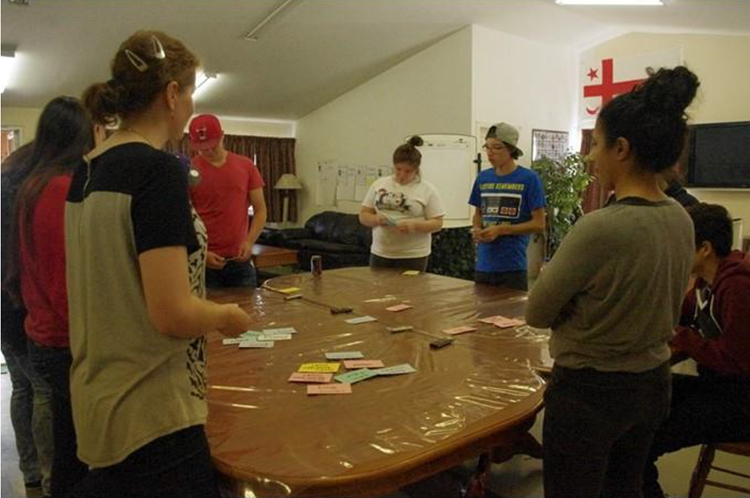
Coding card game.
Identify Themes
To move from codes to themes, we developed a card game that would allow youth to identify the codes most relevant to their data and categorize codes in order to generate themes. The code game mirrors the methods commonly used by researchers but in a fun interactive manner. While the game and related activities facilitated the identification of overarching categories and patterns in the data, it also helped youth in the early identification of important relationships within and between patterns and contextual considerations that would further our understanding of the findings.
With the youth all gathered around a large table, we shuffled the “deck” of code cards and dealt six to each participant. Collaborators arranged their cards in the order that they felt was of most importance to them. Working around the table, each youth then placed one card on the table, starting with the code they felt was most important (see Figure 4). The process was repeated 3 times after which each youth passed their remaining cards to the person on their left. We dealt three more cards to each youth who again sorted the cards in order of personal importance before repeating the process of setting the cards out on the table. We repeated the process until the youth felt they had identified all codes that were important to them.
While placing individual cards on the table, youth positioned their cards with other codes they felt belonged together. As they did this, youth explained why they felt it belonged to a particular group. The other youth could then discuss this positioning, resulting in a collective debate of where the code actually belonged and why it belonged there:
Video games should be in social.
That’s what I was thinking.
Unless you’re playing single player.
Which means you’re socializing with the television.
I’m a single player mostly.
But there are single players on Facebook games.
I don’t play Facebook games.
I know, but some people do.
Why don’t we do this? Move it kind of close, not totally with social. So it could be social but maybe not?
As youth discussed which card belonged to which group, names for each of the categories of cards began to emerge. Once all the cards were sorted, collaborators decided on the best name for the group, and in this way began developing themes:
Okay, so if…we had to come up with a name for each of these groups what would you call that if you had to just…
Education.
Education? (youth agree) Does that work? Does education work is there a word that fits that group better?
Just education.
Yeah? Okay, so what about this one? So I heard visiting, I also heard respect, anything else that you would name that group?
Family.
Family?
And respect, when you’re hanging out with family them. Like visiting family, parents, elders, grandparents.
Okay, so respect. Does that work? Do you think that’s the best option?
Yeah!
Identify Relationships Between Codes and Themes
Theory develops from our understanding of the relationships between codes, and how they explain themes, as well as our understanding of the relationships between themes themselves. The process of coding and generating themes described above provided a lot of information about the relationships between codes and how in their categories, they interact to form a theme. However, we still needed to deepen our understanding of the relationships between themes and how code categories inform these relationships. To do this, we began discussing how the themes related to one another. As youth discussed the relationships between themes, colored string was used to connect the themes to each other (see Figure 5). Where necessary, connections were also made between specific codes. The various colors of the strings were used to represent different types of relationships (i.e., causal, correlations, tensions, contradictions).

Developing themes.
So, we were talking about identity [and how it is linked to community], and saying that identity is how you see yourself and how others see you. But then Carrie raised the point, that sometimes people have a problem with how they see themselves in the community because of how other people see them. Did I get that right Carrie?
Yeah…
So, in a sense what you are saying is that identity is…also impacted by that stuff over there…things like gossip and judgment, those are the things that impact identity negatively?
Yeah!
What else do you think about identity, and identity being part of [Community], and maybe other things that may impact it?
It can be those features of a successful person [pointing to the category]…So it would be like with how you are with volunteering and stuff, and how you are with your family and elders…
So, if you do things like that, it can have a good impact on your identity?
Yes!
How do things like PowWows, OUR [Community], winter carnival, summer games, all that kind of stuff, how do they link in with identity?
Cause they’re cultural; cultural identity.
And they tie in with identity, because they show what people are good at like, baseball, and basketball. And winter carnival has stuff like the princess pageant, and people see those girls and they show their talents…
And so that’s what all of you were saying yesterday as well: a successful person finds out what they’re good at because of opportunities and resources in the community…. . So, a lot of those activities [in the community category] inform your identity, but also link back in here with [the category of] being a successful person. Is that correct?
Yes!
Paying close attention throughout to what is being said is crucial to developing the analysis. Conversations about why a certain code goes here and not there, provide valuable opportunities to begin understanding the relationships between codes, between themes, and between codes and themes. Relationships and contextual information can emerge from additional anecdotes shared by collaborators as the codes are grouped and themes are identified.
We also found it useful to include energizer activities throughout the process. Our initial intention with these activities was to keep energy levels up and in doing so increase youth engagement. We found, however, that through these activities, youth shared additional anecdotes and stories that added to our understanding of the data. For example, we tangled pairs of youth together using liquorish laces. While doing this, we asked them to discuss who they would go to if they are “in a tangle”: if they are in a difficult situation and need help. Their discussion highlighted the importance of how service providers relate to youth and what service providers can do to increase their efficacy when working with youth. This was an important part of understanding the integrated and holistic ways in which resources work together to support youth well-being. Because of this, we made sure to document the entire data analysis weekend using digital voice recorders, video recordings, and photographs. We also made detailed reminder notes that could constantly be referred to as the analysis progressed and especially as themes were being developed.
Discussion
Including youth in the data analysis process ensures their collective voice remains central to findings, repositioning, and possibly even subduing the voice of the researcher(s). This is in large part because it is the framework of the collaborators rather than the researcher that drives and shapes the findings framework. Perhaps more importantly, the process creates the opportunity to consider in more depth the social constructions and positioning of their voices. This occurs through the analytical discussion of what has been shared in the data gathering process. Critical here is the analytical discussion that occurs in a group format, where youth are able to unpack each other’s perspectives and explore in more detail the positioning of their respective understanding of socially embedded experiences.
Importantly, youth bring the knowledge of their own data (i.e., their photographs, video footage, and what they have said in their individual interviews) with them to the analysis. They then generate codes and themes as a group, drawing on the various activities to both develop these codes and themes, and find agreement with each other on codes and themes, as well as how they relate to one another. Energizer activities (including regular posts on their analogue Facebook pages) promote further reflection on the process. Simultaneously, the research team could use statements made by youth in the discussion of coding activities like the body mapping and community mapping, to generate additional discussion among youth on various codes and themes and to encourage youth to reflect more deeply in the analysis process. Furthermore, the process can complement and enhance inter-coder agreement, ultimately resulting in findings that more accurately reflect the reality of young people’s lives. Inter-coder agreement was achieved through multiple approaches: the development of codes as a group, the group discussion of code meanings, code categories and the themes they reflect, as well as the relationships and tensions between codes, categories, and themes—all with youth collaborators at the center of this analysis work.
Reconsidering the ways in which youth analyze data in PAR projects has important implications for the dissemination components and by implication the action components of this work. As researchers, we have an ethical responsibility to ensure that we contribute to knowledge and disseminate findings to policy makers and service providers in ways that honor participant experiences and in ways that ensure their knowledge will be taken seriously (Liebenberg, 2018; Michell et al., 2017). This is especially true when we ask collaborators to engage in a process specifically focused on knowledge development and knowledge sharing for social change (C. Mitchell, 2015; Nykiforuk et al., 2011). Indeed, more thoughtful approaches to participant-engaged data analysis align well with the growing focus on knowledge mobilization: addressing the gap between what we know in terms of research findings and what we do in terms of policy and practice.
Drawing on our experience across three different sites, we recognize the importance of maintaining flexibility in the approach to analysis. When preparing for the analysis workshops, we designed a set of activities based on the research focus, our exposure to the data via interviews with youth, as well as cultural and contextual factors that we had been exposed to through the course of the fieldwork. This final consideration was specific to each group of youth and their context. Furthermore, we included a lot of visual and kinesthetic exercises and used arts-based activities and metaphors in keeping with local Indigenous ways of knowing and communicating. Importantly, rather than having a rigid plan for each site, we compiled a loose agenda of activities more structured at the beginning but looser toward the end. Agendas were accompanied by a variety of activities that we could take from whenever they were useful. This allowed us to work in ways that aligned with the group’s energy level and interest from moment to moment and enabled us to probe into interesting ideas, or clarify confusing concepts, as they emerged.
For example, when we asked youth to “draw a map of the places and people in your community that make you feel safe,” they had a hard time thinking this through (evident in the time they took to draw the maps and the sparse context of maps). We knew from the interviews that this was not due to a lack of safe spaces. Consequently, we inserted a kinesthetic activity—the tangled exercise using licorice strings. This prompted a much richer discussion that could be elicited from the spatial map alone.
Finally, our approach responds to several of the issues raised by Coad and Evans (2008). First, youth were working with their own data and not that of other youth. Additionally, youth themselves selected which aspects of their data to share with the larger group. In this way, the ethical concerns identified by Coad and Evans pertaining to confidentiality were avoided. Second, by reflecting on their own interviews and not reading the transcripts of others, issues of distress linked to hearing other people’s stories were avoided. And where these issues may have been raised, this occurred in a safe and contained group setting where all youth were supported. The safety of the group context emerged from earlier activities such as an introductory Bar-B-Q, where everyone on the team got to know each other. During the fieldwork, youth would spend additional time at the youth center from which the fieldwork was being conducted. They often spent this time with each other in smaller groups, just “hanging out,” strengthening relationships. In addition to these opportunities for connection, we made it clear to youth who would be attending the data analysis workshops what they would be asked to do. Fourth, our approach provided youth with a solid yet fun introduction to data analysis that did not require previous experience to more accurately understand the process and intended outcomes. And finally, the approach accounted for the time demands that analysis activities such as line-by-line coding would make on collaborators. Rather, youth were included as coresearchers in ways that respected their contribution to the process as experts on their own lives and experiences, yet simultaneously acknowledged that they were not experts as researchers. Supports were therefore built around youth to facilitate their full involvement in research activities, acknowledging that they were part of a team of experts, each bringing an important component to the process (see also Liebenberg et al., 2017).
Conclusion
Including children and youth in the analysis process provides another avenue by which to consider the positioning of voice in the research process. Consequently, we can better account for the social contexts that shape that voice and, with YPAR in particular, advance the aims of authentic participatory processes that are at once engaging and empowering for the end goal of social change for social justice.
Findings developed from Spaces & Places stem from an analysis process that retains the rigor demanded of qualitative research, ensuring validity of findings (Cho & Trent, 2006; Lincoln, 1995; Lincoln & Guba, 1985, 2000). Consequently, youth dissemination products are built on reliable and rigorous findings (see, e.g., Wood et al., in press). Furthermore, supported by the resources of the larger team, youth are able to produce high-quality products that reflect clearly and succinctly those findings of the study that are of key importance to them (Liebenberg et al., 2017; Reich et al., 2017) impacting the ways in which audiences “hear” what youth have to share.
Youth elected to make posters that reflected their pervasive need for their culture in their lives and the embodied nature of culture (Wood et al., in press). They painted murals that drew attention to the importance of including youth in community decision making (Wall et al., in press). In the Mi’kmaw site, the youth painted a mural that explains the holistic and integrated components of the four core themes that emerged from their analysis: family (including friends and other supportive adults), culture (which should be threaded through the fabric of everyday life), self-esteem (that should be cultivated through everyday activities, supported by opportunities and resources), and education (both formal and informal). Their choice of imagery highlights the expansive nature of each of these themes, emphasizing that we cannot consider any of these aspects of youth lives narrowly. Moreover, the mural underscores the ways in which these four themes work together and that effective supports of positive youth outcomes need to ensure that all four components are drawn on collectively.
These community-based dissemination activities have extended into service provision policy and practice. In one community, cultural activities, including language, have been significantly integrated into service delivery across service sectors. Similarly, in the Mi’kmaw community, findings have been used to shape service delivery as provided by the local health board, including how funding is sought and administered. Moreover, findings have literally shaped resource development. Specifically, findings have been used to design a youth space as well as the activities being implemented there.
To conclude, youth in the Spaces & Places project have engaged in a process of deep and critical reflection on their positioning in their communities, what they require from their communities to do well, and the ways in which communities can better support them and their cultural engagement. They have done this by utilizing relevant data gathering techniques, engaging in a thorough data analysis process, and giving focused attention to who needs to hear their findings and how best this can be achieved. Through this process of critical reflection, youth have been able to contribute to our knowledge base on youth and their psychosocial outcomes and engage in a process of knowledge mobilization aimed at bringing about resource change where necessary and/or amplifying existing supports that are required. Because of our application of the photovoice approach, irrespective of the questions posed to these young researchers, they are well-positioned to provide astute and rigorous answers that honor their wisdom, knowledge, and efforts.
Footnotes
Declaration of Conflicting Interests
The author(s) declared no potential conflicts of interest with respect to the research, authorship, and/or publication of this article.
Funding
The author(s) disclosed receipt of the following financial support for the research and/or authorship of this article: Social Sciences and Humanities Research Council of Canada (Grant 890-2011-0023).

References
Supplementary Material
Please find the following supplemental material available below.
For Open Access articles published under a Creative Commons License, all supplemental material carries the same license as the article it is associated with.
For non-Open Access articles published, all supplemental material carries a non-exclusive license, and permission requests for re-use of supplemental material or any part of supplemental material shall be sent directly to the copyright owner as specified in the copyright notice associated with the article.
