




Abstract
Internationally, lead agencies and consumer movements emphasise the need for high-level research participation in mental health. However, evidence suggests that people with lived experience tend to be recruited as subjects rather than as active agents in research, or are consulted in tokenistic ways. Although participatory research has the potential to rectify epistemic disparities, few studies have grappled with how to move from exclusion and tokenism to high-level research participation. This paper describes a qualitative co-evaluation of a co-produced model of research partnership, Raising the Bar, which involved deliberate establishment and facilitation of six participatory research teams, comprising 28 lived experience and ‘conventional' mental health researchers. Findings indicate that the theoretical elements of the model set the bar high from the outset, supporting research teams to address inconsistencies in knowledge about participation. It also provided researchers with the competencies and resources to undertake participatory research in egalitarian team structures, and to negotiate new forms of non-traditional research outputs - thereby challenging whom research might be for and how it might be made accessible. Finally, the model shifted collective meanings about research, lending credibility to participatory practices, which came to be seen as essential for meeting the needs of affected communities. Nonetheless, systemic barriers to participatory research remain, and need to be recognised and acted upon to promote a culture that supports high-level research participation.
Keywords
Background
Internationally, government agencies recommend inclusion of people with lived experience (LE) throughout all stages of the research process (National Institute for Health Research [NIHR] 2015; National Health and Medical Research Council [NHMRC] 2018). In mental health research, commitment to partnering with people with LE has risen, in part, from calls from Consumer/Survivor movements and recognition of human rights violations against people with LE (Campbell & Rose, 2010; Epstein, 2013). Partnering with people with LE in research can increase the relevance of research priorities and outcomes, and enhance the quality of knowledge translation (Brett et al., 2012). The systemic marginalising of people with LE in knowledge production has also been described as an ‘epistemic injustice’ (LeBlanc & Kinsella, 2016). Fricker (2007) defines this as the wrong done to people in their capacity as knowers, whereby their ways of knowing are discredited, leading to a lack of collective interpretive resources to render their experiences intelligible. As LeBlanc and Kinsella (2016) and others (e.g., Jones, 2022) have argued, engagement with LE knowledge(s) rectifies historic “epistemic disparities” related to the exclusion of people with LE from research and will likely become the “new normal” in research-informed services and policy (Jones, 2022, p. 125).
In this paper, ‘people with lived experience’ is used to refer to people with experiences of mental health challenges and/or substance use, who have had contact with mental health services. When referring to lived experience researchers (LE researchers), we are referring to researchers in an identified LE role, or those who intentionally and consistently position themselves as an LE researcher in their work, regardless of whether or not they have traditional research training or credentials (Bellingham et al., 2023). When discussing mental health researchers, we use the term ‘conventional researchers’ to distinguish those who draw on educational expertise, from ‘LE researchers’, who draw on ‘lived’ expertise.
Despite commitments to LE participation, people with LE still tend to be recruited as subjects rather than as active agents in research, or are consulted in tokenistic ways (Scholz et al., 2019). Participation of people with LE sits on a continuum from “non-participation”, where people with LE are excluded or are recruited as subjects only (Bellingham et al., 2022, p. 4); to mid-level participation, where people with LE are heard without influence – described by Arnstein [1969, p217] as “tokenism”; through to high-level participation, involving genuine partnership or leadership of people with LE in research (e.g., co-design and co-production) (Bellingham et al., 2022, 2023). Co-production has been described as the “gold standard” of participatory research (Happel et al., 2019, p. 50), as it lays out a deliberate process of paid and equitable participation of people with LE through all stages of the research process, including co-planning, co-design, co-conducting, and co-disseminating findings (Bellingham et al., 2022).
This paper describes a qualitative evaluation of a co-produced model of research partnership, known as Raising the Bar (RtB), which aimed to build the knowledge, skills and capacity of researchers to successfully partner with people with LE in mental health research. The RtB team included experienced LE researchers and conventional researchers, who came together to grapple with how to get from here – exclusion and tokenism – to there – co-production as the ‘gold standard’ of LE participation in mental health research.
Co-producing the raising the bar model
The overarching aim of the RtB model was to ‘raise the bar’ in research collaborations, and support people with LE and conventional researchers to move towards higher levels of research participation. A higher level of research participation was defined as continuous participation and equitable decision-making power throughout all stages of the research process, including co-planning, co-design, co-conducting, and co-dissemination (Bellingham et al., 2023). The RtB model was developed by LE and conventional researchers in the RtB team over a series of three co-production phases commencing in 2017. The phases comprised: • Phase 1. Research training for people with lived experience • Phase 2: Development of the Raising the Bar model • Phase 3: Implementation and co-evaluation of the Raising the Bar model
Each of the three phases is outlined below.
Phase 1: Research training for people with lived experience
In Phase 1, the RtB team initially developed research training for people with LE. People with LE are often less oriented to, and confident in, research methods (Happell & Roper, 2007; Martineau et al., 2020), and research training has been a long-term request within research communities (Morrell-Bellai & Boydell, 1994). However, internationally, training programs for people with LE have largely focused on project requirements, e.g., qualitative interviewing skills, with little opportunity to learn about participatory research or connect with LE researchers (Saunders et al., 2008; Wright et al., 2006). A few research training programs have been developed with LE input. For example, Hancock et al. (2012) developed and evaluated training modules with LE collaborators. These modules were delivered by a conventional researcher over a 10-week period, and data indicate they increased the confidence of people with LE to understand research language, but did not increase their confidence to undertake research (Marshall et al., 2010).
Building on the work of Hancock et al., the RtB team co-produced a ‘Lived Experience Research Training’ program. The program was co-designed and co-delivered with LE researchers, and incorporated visible LE leadership, training in research methods, and paid work in participatory research teams. Details of this program are reported elsewhere (Bellingham et al., 2021). Findings indicated that the program increased the research knowledge and skills of people with LE, providing them with a clear understanding of the levels of research participation. It also increased their confidence to challenge the legitimacy of conventional researcher dominance, and to recognise and value the expertise, or “authoritative insider” standpoint, of people with LE (Bellingham et al., 2021). However, the program was not sufficient to tackle systemic exclusionary practices facing people with LE in mental health research. In the paid research aspect of the program, people with LE reported that their contributions were mostly reduced to tokenism, with conventional researchers often assuming power over LE researchers in a way that could re-inscribe, rather than attend to, epistemic disparities (Bellingham et al., 2021).
Phase 2: Development of the raising the bar model
In Phase 2, the RtB team determined that moving towards parity in research participation required conventional researchers, as well as people with LE, to have the necessary competencies and resources to shift practice. This was held to include training in high-level participatory research approaches and facilitated experience in participatory research teams (Bellingham et al., 2021). Additionally, LE researchers required payment for participation and support to navigate the day-to-day difficulties of power-differentials in research teams. The RtB team of LE and conventional researchers engaged in a second cycle of co-production (co-planning, co-designing, co-delivering, and co-evaluating), developing a supported model of research partnership which became known as the Raising the Bar model, and was supported with funding from the Mental Health Commission of NSW.
The design of the RtB model was guided by community development principles and practices, which centre social justice, participation, and empowerment of disenfranchised groups (Baum, 2015). This supported a strategy of LE-led problem identification; mobilisation of local LE leadership; and attention to community capacity building to ensure collective and empowered action beyond the project timeframe (Baum, 2015; Minkler & Wallerstein, 2012). Social practice theory (Blue et al., 2016; Kippax, 2003) was also used to theorise a process by which changes in collective research practice might be achieved. This allowed the RtB team to conceptualise research practice as constituted through dynamic social relations (and therefore amenable to change) with collective meanings about practice contested and re-negotiated within a social milieux (Blue et al., 2016; Kippax, 2003). Through this lens, the RtB team determined that the training program needed to promote opportunities for collective dialogues that centred marginalised meanings, for example the idea that co-production is the ‘gold standard’, rather than merely one option in participatory research practice.
The training design also incorporated adult education theory. Drawing on the work of Freire (1970), the RtB team sought to generate critical consciousness raising through dialogue and praxis that would support high-level participation and LE empowerment, and provide opportunities to ‘try out’ co-production in a facilitated research team. Additionally, the team drew on Palmer’s (1998) notion of “embodied connectedness”, which posits that educators not only teach ideas, but also who they are and their embodied connectedness to the knowledge being taught (p. 11). This provided a framework for envisaging visible LE leadership - as well as visible collaboration between LE and conventional researchers - as a vehicle for embodying leadership and collaboration.
Finally, to provide additional supports for LE researchers in the program, a co-learning space was devised that drew on intentional peer support and reflexive peer supervision (Mead, 2010; Mead et al., 2001; Paré et al., 2014). Intentional peer support seeks to enact equal partnership in peer relationships to create meaning and connection through co-reflection, and mutual, transparent, and transformative dialogue (Mead, 2010; Mead et al., 2001). Reflexive supervision supports reflective processes of self-examination, acknowledgement, and meaning making (Pare et al., 2014).
Raising the Bar Model Elements and Activities.

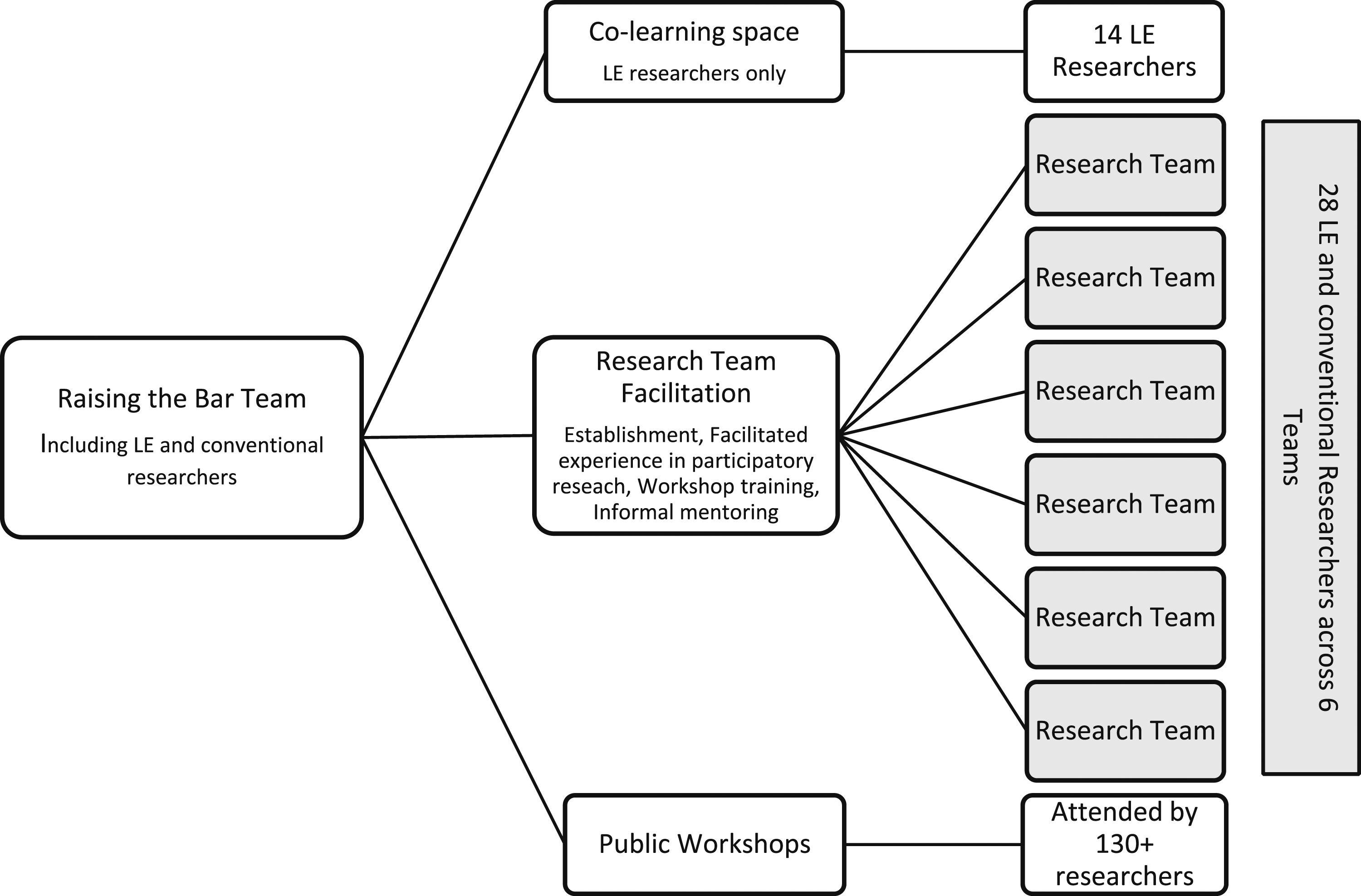
Raising the bar model overview.
Phase 3: Implementation and Co-Evaluation of the Raising the Bar model
The RtB model was delivered over a one-year period, from July 2020 to July 2021, by a team of LE and conventional researchers. Six teams, consisting of 28 researchers, engaged in the RtB model. Teams comprised equal numbers of LE researchers (n14) and conventional researchers (n14). The Rtb team recruited conventional researchers who had an expressed interest in participatory research and were seeking to commence, or were in the early stages of, a new program of research. They were from diverse disciplines, including public health, nursing, psychology, psychiatry, social work, and the humanities. LE researchers, with lived experience pertinent to each project, were recruited and employed via expressions of interest through community networks. Research teams engaged in diverse qualitative research projects, including projects focused on: mental health stigma; living with a psychosocial disability; physical health of people with lived experience; mental health service experiences of LGBTQIA+ people; de-institutionalisation; and drug and alcohol training for mental health professionals.
The qualitative co-evaluation of the RtB model is described below. It explores the experiences of participants engaged in the RtB model, including the perceived value and impact of the RtB model for enhancing LE and conventional researchers’ knowledge, skills, and capacity to engage in participatory research.
Methods
Co-Evaluation Strategy
Two LE researchers and one conventional researcher undertook the co-evaluation of the RtB model, which focused on LE and conventional researchers engaged in facilitated research teams. The study was approved by the University of Sydney Human Ethics Research Committee, and all participants consented to interviews.
The co-evaluation strategy drew on Rychetnik et al.’s (2002) evaluation criteria, which lays out “best quality” evidence relevant to the development stage of a program (p. 126), including: a focus on priorities of “disenfranchised groups”; and exploration of anticipated and unanticipated outcomes (p. 122-3). This led to prioritising research questions of LE RtB team members with first-hand experience of subjugation in research practice, as well as exploring aspects of the RtB model that were perceived as “beneficial or otherwise” (Rychetnik et al., 2002, p. 122).
LE researchers within the RtB team wished to determine whether the RtB model actually ‘raised the bar’ for those who were engaged in it, and whether it enhanced participants perceived knowledge, skills, and capacity for collaboration, including capacity for power-sharing, equitable decision-making, and LE leadership. RtB team members also sought to explore whether LE participants engaged in the RtB model experienced a sense of relational resilience within participatory research teams. Relational resilience is defined as a collective rather than personal endeavour, that situates growth and support within mutually empowering environments (Jordan, 2004). The RtB evaluation team specifically sought to understand whether team dynamics supported people with LE to express diverse, and potentially disruptive, perspectives, and to navigate disagreements if they occurred.
Examining anticipated and unanticipated impacts was deemed particularly relevant to an evaluation of the RtB model. People with LE report experiences of stigma and discrimination in research teams (see Beresford, 2020; Happell et al., 2019; Martineau et al., 2020; Patterson et al., 2014), as well as experiences of being silenced due to employment precarity (Bellingham et al., 2021; MacKinnon et al., 2021). It was uncertain what impact, if any, the RtB model might have on these experiences. In addition to the criteria set out by Rychetnik et al. (2002), the RtB team also wished to determine overall endorsement of the RtB model, as well as exploring any unmet needs of participants to inform future refinement of the model.
The question for the co-evaluation was whether the RtB model enhanced LE and conventional researchers’ perceived knowledge, skills, and capacity for collaboration in mental health research. If so, how did it enhance these? Other questions of interest included: i. Did the model enhance LE and conventional researcher capacity for power-sharing and equitable decision-making, including supporting people with LE to express diverse and potentially disruptive perspectives? If so, how was power-sharing and decision-making enhanced and navigated? ii. Did the model promote LE leadership in research? If so, how was leadership promoted and discussed? iii. Did LE and conventional researchers endorse the RtB model? If so, what did they endorse and what needs, if any, were unmet?
A descriptive qualitative research methodology was chosen (Sandelowski, 2000, 2010), underpinned by a ‘thinking with theory’ framework (Jackson & Mazzei, 2012). Descriptive qualitative methods allow in-depth exploration of experiences, while remaining close to the intended meanings of participants (Colorafi & Evans, 2016; Sandelowski, 2000). A thinking with theory framework inspired and supported a second layer of analysis, allowing the RtB team to critically explore the meanings of findings from their respective theoretically and epistemically informed positions (Jackson & Mazzei, 2012). This represents an approach used previously in co-production research (Bellingham et al., 2021).
Co-Evaluation Participants and Data collection
Of the 28 people engaged in facilitated research teams, nine agreed to participate in the co-evaluation. Six LE researchers and three conventional researchers were recruited from across the six facilitated research teams. Data was collected in semi-structured interviews by an LE researcher who was not involved in the design or delivery of the RtB model. Evidence suggests that interviews undertaken by an LE researcher are more likely to elicit frank responses from people with LE (Hancock et al., 2012). This was seen as a priority for the research evaluation. Interviews lasted 30–60 minutes and were audio-recorded and transcribed verbatim. Data was de-identified prior to analysis.
Data Analysis
Interview data was analysed using a critical thematic content analysis. Content analysis (Burnard et al., 2008) has been used previously in descriptive qualitative studies (Larsen et al., 2021). Applying a critical frame enabled an “alertness to issues of power” in the analysis (Eakin & Gladstone, 2020), which was pertinent to the question of whether the RtB model promoted parity in research participation. In this study, this was supported by a ‘thinking with theory’ framework (Jackson & Mazzei, 2012), which allowed LE and conventional researchers in the RtB co-evaluation team to analyse data from their diverse theoretical and epistemic positions. In practice this meant that conventional researchers drew on feminist (Allen, 1998Allen) and social practice theory (Blue et al., 2016), and LE researchers drew on theory from Consumer/Survivor and ‘mad studies' scholarship (Chamberlin, 1978; LeFrancois et al., 2013; Tomes, 2006). The analysis was also shaped by their respective positionality as LE or conventional researchers. These theoretical and epistemic frames allowed critical reflection on norms and shifts in research practice, and examination of how power was exercised and mitigated in research teams. Furthermore, LE and conventional researchers in the co-evaluation team reflected on their respective sociocultural position as white, middle-class researchers, who identified as cisgender and heterosexual, or transgender and queer.
Initially, one LE and one conventional researcher familiarised themselves with the data, engaging in coding of the transcribed interviews. They then met to examine interview data line-by-line to clarify codes and identify categories. Categories were tabulated, with data collated under each category. In the secondary analysis, the co-evaluation team reviewed and discussed the emergent categories as supported by a ‘thinking with theory’ framework (Jackson & Mazzei, 2012). Through reflective cycles of discussion and analysis, the team reviewed each tabulated category and resolved inconsistencies, and reached consensus on the identification, analysis, and naming of themes.
Results
Four themes were identified in participants’ accounts of their experience within the RtB model. Participants in the co-evaluation interviews (participants) noted that team workshops were instrumental in ‘Setting the bar high’ and supporting teams to understand expectations around high-level research participation. Participants indicated that putting theory into practice, and being facilitated to engage in high-level research participation, was experienced as, ‘Doing it right’. It also led to ‘Delivering diverse outputs and outcomes’ that were relevant to both academic audiences and affected communities. Participants also indicated challenges in navigating system pressures and offered suggestions for ‘Raising the bar higher’ in future iterations of the RtB model. In each theme, data is attributed to LE researchers (LER) or conventional research (CR) participants.
Setting the Bar High
Data indicate that the workshops supported participants to distinguish between levels of research participation, including the requirements for co-design and co-production research. Interview participants indicated that the RtB model was instrumental in “setting the bar high”, and addressing inconsistencies in understanding got team members “on the same page” and allowed them to avoid the “big risk of tokenisation”. As one LE researcher participant explained: It’s [participatory research] just full of potential mishaps, as well. So just having a construct we’re working together from, I think, it leads to not fucking it up as much. (LER)
Inter-team dialogue in workshop sessions was experienced as “powerful” for conventional researchers as it lent credibility to participatory research practices: For me it was around being able to, I guess, know an approach to participation that was authentic, and to have that supported, was kind of really helpful. (CR)
In workshops, conventional researchers found it particularly meaningful to hear the “point of view” of LE researchers, as this shifted their understanding of the value of research participation for addressing the challenges faced by people with LE in community settings and health services.
Participants noted the value of informal mentoring and LE co-learning spaces (detailed in Table 1). They indicated that informal mentoring, which included access to members of the RtB team for phone or in-person consultations to discuss practice issues, supported them to navigate the day-to-day challenges of undertaking participatory research. As one researcher described: I always felt that I could ask them [RtB team] questions. I think that knowing where they’re coming from and their commitment to the process, but also their critical thinking around these processes, I always felt that the project was being held in a way that was very supportive. Just that you could go back, and you could say, “This isn’t working”, or “I don’t know about this”, and know that no one was going to think you’re an idiot or – that they’d understand, yeah. (CR)
The dedicated LE co-learning space, which included regular monthly meetings led by an established LE researcher to discuss methodology and practice issues, was described as valuable for providing a “buffer zone or bumper bar” for LE researchers. The LE co-learning space supported LE researchers to “feel less alone and more empowered” to navigate the challenges of doing participatory research with conventional researchers. As one LE researcher noted, conventional researchers did not fully comprehend the emotional labour involved in being an LE researcher, or as they put it, “understand or appreciate how much it is to wear your lived experience on your sleeve”. A dedicated space to navigate working from an LE position was described as “essential”. The struggles of being an LE researcher, and the need for an LE-specific space, were particularly emphasised by LE researchers who were new to working from an LE position. As LE researchers described: It fucking hurts, putting myself on the line, and saying, ‘I have engaged in behaviours that are criminal, but I want you to hear me anyway. And I have mental health as well’. So I walk out of there and I'm like, ‘Oh my god, what are they going to think of me?’ That’s me exaggerating it a bit. Inside it feels much worse. Raising the Bar provides security and safety in that space of coming out. (LER) I struggled with it at the start. ‘Hang on a minute. You want me to talk about my struggles, and you want me to break down that barrier?’ So yeah, I can’t imagine how daunting it would have been, not having that [co-learning space] because there’s more for us to lose and to give up. Some days, speaking truth to power is really hard. (LER)
LE researchers reported that the co-learning space provided them with a sense of “solidarity”, “acceptance and validation”, and was helpful for “building our capacity, building our skills, building our ability to advocate for ourselves and our community”. This aligns with the intentions of peer support and reflexive supervision, which seek to engage peers in mutual dialogue to support reflection and meaning making (Mead, 2010, Pare et al., 2014). The LE co-learning space also supported LE researchers to “demystify” academic systems and research methods, which, in turn, supported them to establish and maintain a sense of “professionalism” within research teams.
Doing it Right
Data indicate that participants appreciated the opportunity to apply theory about co-production/co-design in practice (praxis) within facilitated research teams. As one participant stated, praxis allowed them to practice “doing it right”, which was “powerful and extremely satisfying”. As another participant explained: It got enhanced because of the project that we were attached to. I think, in a theoretical construct by itself, it wouldn’t have as much power as it did. We were actually walking through it, being apprenticed through a project with it. Then it had huge power. So that’s what changed, it became more real, and we could actually have something to work towards as a group using that [co-production] as a construct. That sort of moved it to a living practice and living idea, as well. (LER)
For many participants, doing it right included disrupting “usual structures of power” and creating a “two-way” relationship where conventional and LE researchers were on an “even keel”. Efforts to mitigate power not only benefited LE researchers, but also supported early-career conventional researchers with limited power within teams due to seniority, gender, and race: We have a non-hierarchical structure, at least in theory. The hierarchy still exists, because you can't actually smash the hierarchy, as much as you want to, especially when the people at the top are older, white males. But, as much as possible, we have a flat hierarchy. So, we’re treating each other with equal respect and – yeah, I find that quite a useful environment to be in. (CR)
In a more egalitarian team structure, LE researcher participants reported taking on leadership roles. This included leading team discussions where they engaged in a deliberate process of “humanising” research relationships to “create safe spaces” for LE researchers to express more personal, or potentially stigmatising, perspectives. As two LE researchers explained: Leading with vulnerability, it’s just a good way to centre things in the personal and you get to know people a bit better. You’re a bit more vulnerable and you’re a bit more comfortable, as well. If we didn’t get to know everyone really well, and it was just like, “All right, this is a meeting, this is the agenda,” like boom. Sometimes things organically come up when you’re in conversation with people that wouldn’t come up in a very strict agenda meeting. (LER) [We were] really careful to create those safe spaces where your big feelings were welcome and that we didn’t have to be all there, all ready, as it were. That was really crucial. If I didn’t, then I’d feel shamed, or I’d feel like this isn’t a place for me, or I would be just going through the motions of something that would be meaningless. (LER)
Conventional researchers indicated that they took their cue from LE researchers and adopted a less detached and more relational approach to the research process: I think we learn to kind of – like, formalise everything we say and distance ourselves from things. Working with the consumers has reminded me to just not do that all the time. (CR)
In the space of relational connection, LE researchers noted that they were able to bring more diverse perspectives to the research team: I felt heard and validated and really excited by the angles that [the team] was willing to explore with me, in terms of the intersections of gender and institutional harm and systemic factors as being an integral part of my experience through the health system. (LER)
Engaging with diverse perspectives could also lead to conflict. Nonetheless, participants described feeling supported through informal mentoring and co-learning spaces to navigate conflict and tensions, and even came to see them as generative – an opportunity to explore divergent perspectives rather than a failure of team dynamics. As one conventional researcher explained: So, [conventional] researchers in our research group are kind of fast and loose with their terminology. They're used to speaking about them [people with LE] as if they're an abstract entity that they're studying. One of the senior academics used the term ‘presentations of disorders’, as opposed to, I don't know, people who have specific experience. And the consumers called him on it – ‘So, I'm not a presentation of something. Even if I agree with the diagnosis that’s given to me, I'm not a presentation of it. I'm a person who’s experiencing something’. And, having the consumers in our group just reminds us constantly that we’re actually talking about real people with real lives’. (CR)
However, for LE researchers, conflict could still feel risky. As one LE researcher put it, conventional researchers were still “somehow in charge of a project” and could become “defensive and hurt” when LE researchers raised an issue that disrupted the status quo. This was supported by study data, with some conventional researchers stating that they were “using consumers” or “getting the voice” of people with LE. This idea of using people with lived experience runs contrary to the ethos of collaboration in participatory research. Additionally, LE researchers could feel essentialised to their lived experience, and that some conventional researchers failed to notice other skills they brought to the research team.
Delivering Diverse Outputs and Outcomes
Participants reported multiple research outputs and outcomes. Outputs included traditional publications, presentations, and grant applications. As one conventional researcher remarked, the RtB model supported them to produce “good quality research” that was focused on the “priorities of people [with LE] who experience this day-in and day-out”. For LE participants, research outputs not only represented an opportunity to change clinical practice, but also to honour communities of people with LE: Our work is, in part, to be changing medical structures. But it’s also, I think, to be speaking and honouring our community and their experiences, and particularly because people have shared their life and really vulnerable life stories with us. And so, that’s part of what we owe them. (LER)
Data indicate that LE researchers were more likely to note the limits of traditional research outputs for creating change, and to advocate for grassroots community engagement to translate research knowledge for the benefit of affected communities: At the end of this labour of love and energy, we’re producing a paper that’s hopefully going to go into a journal that hopefully will be discussed at a conference. And then, what happens then? Is there going to be change? That sole document isn’t going to create widespread change, but it’s going to be part of something. The lived experience, the researchers need to have a really strong commitment and involvement in the grassroots community, because I think that’s where knowledge transferral and translation of the research is really vital. (LER)
LE researchers also questioned traditional research formats. As one conventional researcher explained: I found there's some interesting kind of questioning of what appropriate outputs are. It doesn't just have to be journal articles that only academics can read. One of the consumers doesn’t recommend lots and lots of written form information [for people with LE]. They're recommending YouTube videos and podcasts and stuff like that - something that’s more easily digestible. (CR)
These kinds of dialogues led to many teams producing non-traditional research outputs, including: a manifesto for mental health services; podcasts and vodcasts to promote community engagement; a health professional training program; and a “witness seminar” that involved community members ‘bearing witness’ to research findings as part of a process of community recognition and accountability.
In addition to research outputs, participants commented on the process of connection and collaboration within research teams as a key outcome of the RtB model: The project became incidental to the power of the connection with each other. We could have been in any project, really, that we agreed on. And I think, wow, that for me, that would be the true measure of something, the quality and the growth in the relationships within the project would be what you go away with. (LER)
LE researchers also spoke of the power of the process for changing mental health research practice, which they viewed as a move towards a more collaborative and just research culture: I think, obviously, there’s a benefit to conventional researchers about changing their mindsets and changing their way of doing practice. I don’t think that should be a key consideration, though. But hopefully, it forms part of giving meaning to these words that’s being shoved around a lot, ‘lived experience’, ‘coproduction’. It’s the start of a restoring of dignity, both for us as individual lived-experience researchers, but hopefully our broader community, because we’re starting to set a new scene for the standard of research. (LER)
For LE researchers, besides a focus on change for affected communities, research participation was viewed as a means of changing the norms of research practice, to make inclusion of people with LE the ‘new’ norm in mental health research.
Raising the Bar Higher
Overall, participants endorsed the RtB model, describing it as “vital” for ensuring high-level collaboration, and a “minimum standard” of support for LE researchers. All those interviewed requested expansion of the model. As one person stated: I just hope to see the principles of it are embedded as best practice in order to make sure that it continues to fight against things like the tokenisation. This sort of capacity building is really vital. (LER)
Participants did however recommend a more deliberate process of “mapping” power and political perspectives within and across research teams to support “continuous conversations” about hierarchy, decision-making, and LE diversity: Naming and mapping power dynamics is really important [and] mapping of people’s political and ideological perspectives, just because in the lived-experience team, there’s some tension over how we each theorize our condition. And that hasn’t been named, and I think that would have been a good addition. (LER)
An Indigenous LE participant reflected on the cultural resonance of participatory research for rectifying the “cultural shame” of exclusion: I see great connections and with my own Indigenous culture about creating a space where everybody can be heard and then that there is a willingness to grow. The problem we’re trying to solve would be at the middle of that. It’s a collective pain and it’s a collective responsibility. And when there’s no space to do that, or no listening people to do that, then there’s a cultural shame. (LER)
This participant’s comment points to the need for explicit acknowledgement within the RtB model of existing cultural participatory practices, as well as more deliberate discussions about how co-production/co-design research might support, rather than replace, Indigenous ways of knowing and doing in knowledge production.
Participants also expressed concern about “systemic pressures” which continued to shape research practice. For example, one LE participant described how navigating academic structures and discourses created additional labour for LE researchers: We’re entering structures and discourses that are not designed for us, and a lot of the onus is on us to be changing them, and that’s a huge burden. I think a lot of academia is a lot of optics and a lot of ritual and a lot of tradition, that a lot of it is – excuse my French – bullshit. (LER)
Although the RtB model provided initial funds to establish and commence collaborative research, conventional and LE researcher participants also spoke of the difficulty of obtaining ongoing funding as a barrier to the equitable and continuous participation of LE researchers: There are systemic pressures, as well, that create inequity within these relationships, particularly around time and money. I think the big disadvantage, and I think this is what happens in a lot of co-design and co-produced research, is how much time and funds are devoted to lived experience co-researchers on a team. I think what that created for me was that whole dilemma of wanting to do everything together, but at the same time not wanting people doing unpaid hours. (CR)
For LE researchers, the prospect of having no further funding for ongoing involvement in a project not only created dilemmas regarding personal involvement and pay, but also compromised their commitments to their community: I would work for free on this project because I believe in it. But I also feel like we don’t have a lot of agency in that decision, because the other alternative is that the work doesn’t get published. And then, I think we’ve done a huge disservice, and let down and not honoured what we said we’d do for the people that really generously shared their lived experience with us over several days, often at the adverse effect of their health. (LER)
To address these issues, most participants advocated for “more money, and more hours” to support LE researcher involvement in all aspects of research: Getting more funding, it’s really important because so much has been done [in the RtB model] with little money and so many outputs, and I think there has been an impact. I think it will be a real shame if we just stop here, because we’ve done so much, and we’ve created so much potential. (CR)
Some participants went further, indicating that permanent, ongoing positions for LE within research institutions were necessary to avoid tokenism: I would like more lived experience academic roles embedded within the university system. [It’s] not just getting people in on a contract basis when they’re needed as an add-on to a, “Oh yeah, we’re doing this project, so now we’ll get that lived experience researcher.” But how is lived experience research as a discipline kind of upheld within the whole institution, and not a tick a box? Or, “yeah, we can say we did that now”. (CR)
However, even in teams where there were sufficient and ongoing funds, power asymmetries within academic systems still impacted on collaboration. Research funds were often controlled by conventional researchers who were securely employed and named on a research grant. This could lead to tensions for both LE researchers and early career conventional researchers, who were precariously employed and unnamed on research grants, and found it difficult to raise issues about the budget. One early career researcher participant described the tensions this raised in their research team: One of the things that’s come up in our research team recently is about navigating discussions about budget, money and where finances should be spent. It’s hard because everyone feels tenuous in the group - other than the senior researchers - and are on a casual contract. So, for instance, in one of our meetings, one of the senior academics – actually, it was in relation to the budget – they made a joke about, “At the end of the day, I make the final decisions.” And it was meant to be a joke. I just said, “I don't think that’s a joke you should make. [They said] “sorry, I'm just trying to be funny.” And I was, like, “But it’s not funny. Because we are lower in the hierarchy, so, all that joke does is remind us that we are”. (CR)
Based on these critiques, participants indicated a need for structural supports to acquire more funding, including through funding bodies. As one conventional researcher noted, there was little support or incentive to include people with LE on grants: The names on the grant couldn't be consumer names, the Australian Research Council wouldn't give money for that. And, also, you have no money to pay people [LE researchers] to even write grants in the first place. Unfortunately, it’s not a sexy part of research that is well-funded because still, for the last 40 years or so, the consumer voice has been coming into research, but it’s been quite tokenistic. So, getting funding is a lot harder. Also, the recognition for it. I wouldn't do that for my academic career. It means nothing for my academic career, unfortunately. (CR)
Conventional researchers also noted that they could feel isolated and “exhausted” in research settings where high-level participation was not valued. This was particularly due to institutional pressure to “do stuff fast and now”, which ran contrary to the need for slower participatory processes that were more “labour intensive” and required additional time and resources.
Discussion
The qualitative co-evaluation of the co-produced RtB model indicates that it promoted high-level research participation between LE and conventional researchers. While key organisations recommend training for people with LE to increase research participation (INVOLVE, 2012), LE research training alone is unlikely to lead to high-level research participation, due to entrenched practices of exclusion and tokenism within research communities (Bellingham et al., 2021). This represents a significant impasse. High-level participation is associated with improving the relevance and quality of research (Brett et al., 2012), and has the potential to rectify epistemic disparities (Jones, 2022; LeBlanc & Kinsella, 2016). Advancing meaningful involvement is, therefore, arguably, what Tracy (2010) would call, a “worthy topic” for qualitative researchers to grapple with (p. 840). However, few studies to date have explored how to get from exclusion and tokenism to high-level research participation.
In this qualitative study, the co-production methodology, which was informed by a thinking with theory analytical framework (Jackson & Mazzei, 2012), supported critical analysis of norms and shifts in research practice that were made possible by the novel RtB model of research partnership. Findings suggest that the model, which provided competencies and resources for participatory research – as well as promoting collective meanings that supported high-level participation – offers a potential means of breaking the current impasse, with data indicating it was effective in promoting research partnership between LE and conventional researchers.
Data suggest that theoretical elements of the RtB model set the bar high from the outset, supporting researchers to address inconsistencies in team members' knowledge about what constituted high-level research participation. Putting theory into practice enabled researchers to “do it [participatory research] right”. The RtB model not only provided researchers with practice opportunities, but team facilitation also offered them an ongoing reflexive space to consider how theory could be operationalised in practice, and an opportunity to go back and test ideas in real-world settings. As Freire (1970) and others (e.g., White, 2007) have argued, praxis – where theory, action, and reflection are integral – is transformative, as it has the power to raise critical awareness and promote “responsive and accountable action” (White, 2007, p. 226).
Findings indicate that the RtB model promoted a more egalitarian team structure that supported LE researcher participants to take leadership roles. This included leading discussions about intersectional experiences, institutional harms, and the value of non-traditional research outputs. This finding highlights some mechanisms by which, as Brett et al. (2012) note, meaningful LE participation can improve the relevance of research priorities, outcomes, and knowledge translation. Our data also suggest that the RtB model supported LE researchers to adopt an explicit strategy of humanising language and relationships within research teams, which was essential for supporting disclosure of personal LE knowledge. As Bell and Pahl (2018) have previously argued, LE knowledge is not only conceptual, but also personal, tacit, embodied, and emotional. Our findings support Jordan’s (2004) assertion that resilience is a relational endeavour enhanced through mutual support. As Martineau et al. (2020) note, partnering with people with LE is more than just a matter of method, it is a deliberate practice of “relational ethics”, of fostering relational connection as an entry point for dialogue about lived or living experiences which might be difficult or potentially shameful to speak.
Data in this study also indicate that articulating LE perspectives was not without risks. While much has been said about ‘empowering’ people with LE to be involved in research (Simmons, 2021), little has been said about the costs to LE researchers of working from this position. Our findings show that, for LE researchers, using experiential knowledge for the purpose of advancing research involves considerable “emotional labour”. Hochschild (1993) defines this as the process of deliberately evoking and suppressing emotions to achieve a particular outcome in the workplace. As Williams (2003) asserts, emotional labour can be costly to some professional groups, particularly in the context of unequal power relations. Extending Williams (2003) point, we argue that, within the context of sanism (Perlin, 1992), LE researchers’ emotional labour is not only costly, but also relationally risky, due to the potential for stigma and discrimination. As participants in this study indicate, this is even more likely if LE perspectives are met with resistance from conventional researchers, whose views are privileged in academic discourses.
Our data show that the co-learning space for LE researchers, which drew on intentional peer support and reflexive peer supervision, was vital for supporting LE researchers to manage the potential risks of ‘coming out’ and working from an LE position in a professional setting. The peer dialogue created a place of solidarity and connection, which reduced feelings of isolation, and promoted peer-learning and the strength to navigate the challenges of working from an LE position. It also supported LE researchers to develop research skills, deconstruct entrenched academic discourses and traditions of research practice, and maintain a professional identity within research teams.
Unexpectedly, the egalitarian team structure promoted in the RtB model also supported early career conventional researchers (ECR) to articulate disruptive perspectives within teams with senior academics. Research indicates that many ECRs report dissatisfaction with workplace culture, with limited opportunities for advancement (Christian et al., 2021). Within this context, the RtB model has the potential to contribute to an improved research culture for ECR as well as LE researchers. This might mitigate against what Unerman (2020) has called “self-referential echo chambers” in research communities, where the socialisation of researchers into particular ideologies and assumptions, and lack of disruptive perspectives, can hinder research advancement.
Findings suggest that the RtB model shifted meanings about research practice among conventional researchers. Participants reported that team dialogue lent credibility to participatory research practice, which came to be seen as essential for meeting the needs of affected communities. This aligns with Blue et al.’s (2016) assertion that recruitment to new forms of social practice requires more than resources and competency. Rather, practices are negotiated in social relations through “communicative acts” (Becker, 1953, p. 241), where experiences are continuously redefined and promoted in collective dialogues (Kippax, 2003). The findings highlight that, although vital, training for conventional researchers and resourcing of co-production is not sufficient to shift research culture. Research communities also need to engage in deliberate dialogues – as well as being provided with the necessary competencies and resources to take action – in order to shift collective meanings, so that high-level participation becomes the new norm, or ‘gold standard’ of participatory research practice.
Data show that the RtB model also supported teams to negotiate new forms of non-traditional research outputs. For LE researcher participants, traditional dissemination strategies, although welcomed, were considered inadequate to drive meaningful change for affected communities. This finding is critically important from a knowledge translation perspective, as the research community requires new and innovative strategies to disseminate findings and evoke and provoke social change (Boydell et al., 2017; Hodgins & Boydell, 2014). It also supports Beresford’s (2020) argument that people with LE, although concerned with rectifying epistemic disparities, are more likely to be focused on enacting social and political change for affected communities. As Bell and Pahl (2018) argue, this includes challenging what research “might be and who it might be for, and how it might operate” to transform social life, and how it might be made “accessible to those outside the walls” of academia (p.108-9). Indeed, dialogues about epistemic justice in research outputs and translation might be considered a key outcome of the RtB model, which supported a process of connection and collective re-envisaging of a more just research culture and research community.
Despite overall endorsement of the RtB model by participants in this study, who considered it a ‘minimum standard’ of support for promoting genuine research collaboration, recommendations for refinement were suggested. An important recommendation for future iterations of the RtB model related to mapping power and political/ideological perspectives within collaborative teams. This supports and extends Roper et al.’s (2018) recommendation for deliberate power-mapping exercises in co-production teams. However, further research is required to understand whether and how mapping ideologies and power is beneficial for promoting participation or mitigating epistemic disparities. We would also caution against teams engaging in ideological mapping exercises that seek to demonstrate that conventional and LE researchers are alike, which risks overlooking the “peculiarities and specificities” of LE and conventional positions (Stryker & Whittle, 2006, p. 12), and how LE perspectives are harnessed in research to generate new ways of seeing and doing. LE and conventional researchers could examine overlaps in ideological perspectives while remaining aware of important differences in regard to how perspectives are shaped by lived and living experiences.
It is possible that mapping ideologies might also support conventional researchers to move beyond essentialising LE researchers to their lived experience. As Voronka (2016) argues, LE identity is not fixed or homogenous and needs to be understood as a “strategic essentialism” (p.196) used by LE researchers - who have been historically excluded from knowledge production - for the specific purpose of gaining access to knowledge resources. LE researchers might, therefore, engage in dialogue around “critical edges and differences” among people working from an LE position (Voronka, 2016, p. 196). This may include discussions about diverse explanatory frameworks for mental distress and intersecting experiences in the community and health services, as well as other differences in political and ideological perspectives.
Beyond specific recommendations for the RtB model, data indicate that systemic barriers to collaborative research, including grant funding priorities and short funding cycles, remain. This not only results in insufficient training and employment opportunities for LE researchers, but it also makes participatory research less attractive to conventional researchers, who are often isolated, time poor, and put off by the labour-intensive requirements. While systemic issues are beyond what training and facilitation can fix, in future iterations of the RtB model a co-learning space for conventional researchers may be trialled to determine its value, including for: promoting conventional researchers’ reflection on power asymmetries in participatory research; and enabling conventional researchers to share knowledge and resources for navigating research cultures and systems that are often unfavourable to participatory practice. However, the RtB team envisage that, given historical power-dynamics and the possibility for conventional researchers to justify entrenched practices, a co-learning space would need to be accountable to the needs of people with LE. Co-facilitation by LE and conventional researchers experienced in participatory research and reflexive supervision might offer this accountability.
More broadly, epistemic disparities faced by LE researchers need to be recognised and acted upon across research institutions and organisations to promote a culture that supports high-level participation. While this would necessarily involve funding training initiatives that promote genuine partnership. It would also involve: employment opportunities for LE researchers; establishment of research metrics that support participatory research; recognition of LE expertise in funding initiatives; and development of criteria for LE track records, including factors such as experience and expertise in participatory or LE-led research.
Limitations
This study explores the important topic of how research communities might attend to norms and practices that prevent meaningful engagement of people with LE in research. A major strength of the study is in the methodology, which is reflective of the aim of promoting parity in research, and employs a co-production approach through a phased design, delivery, and co-evaluation of the novel RtB model. Although participant numbers were small – and largely determined by the availability of respondents within facilitated teams – as demonstrated in previous small qualitative studies of ‘user’ experiences (Baker et al., 2015; Morell-Bellai & Boydell, 1994Morrell-Bellai & Boydell, 1994), the qualitative methodology allowed for “new and richly textured understanding” of the phenomenon of study (Sandelowski, 1995, p. 183). The thinking with theory analytical framework (Jackson & Mazzei, 2012) also supported a critical inquiry (Eakin & Gladstone, 2020) into norms of research practice, and particularly how power was exercised and mitigated in research teams. As such, while qualitative findings do not claim to be representative (Vasileiou et al., 2019), they may have resonance and transferability (Tracy, 2010) to other research settings where meaningful lived experience engagement is sought. Arguably, the findings also have a “catalytic validity” (Tracy, 2010, p. 846), with the potential to raise critical consciousness about entrenched power dynamics in research practice and propose a way forward for the research community that fosters relational resilience and can catalyse actions for change.
Conclusions
Despite calls for LE participation through all stages of the research process, to date, few studies have explored how the research communities might shift entrenched practices of exclusion and tokenism to achieve genuine research partnerships with people with LE. The findings from this study indicate that the RtB model, which provided resources and competencies for high-level participatory research, offers a potential means of breaking the current impasse. Data indicate that the model not only supported LE and conventional researchers to successfully engage in high-level participatory research, but it also promoted LE leadership in research teams. Additionally, the RtB model supported relational resilience in research teams, and co-learning spaces supported LE researchers to find solidarity and deconstruct entrenched discourses and traditions of academia, and to develop a professional LE researcher identity.
Footnotes
Declaration of Conflicting Interests
The author(s) declared no potential conflicts of interest with respect to the research, authorship, and/or publication of this article.
Funding
The author(s) disclosed receipt of the following financial support for the research, authorship, and/or publication of this article: This work was supported by the Mental Health Commission of NSW, Lived Experience Framework Grant. The Mental Health Commission of NSW did not participate in the design of the intervention or study, including the data collection, analysis, interpretation or dissemination.
