




Abstract
Counterstorytelling, a methodology that is rooted in critical race theory, is undergirded by principles that are beneficial to understanding the experiences of lesbian, gay, bisexual, transgender, and queer-identified (LGBTQ) young people from an intersectional perspective. Counterstorytelling holds promise as a method that creates opportunities for individual transformation and resistance to dominant narratives among young people facing systemic oppression. This article outlines the design and implementation of a counterstorytelling study with LGBTQ youth and reflects on the value and associated challenges of counterstorytelling as a participatory research method.
Keywords
What Is Already Known?
This article builds on existing knowledge about the use of counterstorytelling as a qualitative methodology. It is known that counterstorytelling contributes to insight about the ways in which populations of young people who face societal marginalization make sense of the dominant narratives about their lives, as well as the ways in which they create their own counternarratives as a form of resistance.
What This Paper Adds?
This article extends the application of counterstorytelling as a qualitative research methodology to explore its value in understanding the lives of lesbian, gay, bisexual, transgender, and queer-identified (LGBTQ) young people at the intersections of multiple identities. In particular, the article outlines the design of such a study, identifying lessons learned from a specific study conducted with LGBTQ youth in the United States. Much of the existing counterstorytelling literature is missing depth in its description of the method.
“Words have the power to encourage and inspire, but also to demean and dehumanize. I know now that epithets are meant to game us into not being ourselves, to encourage us to perform lies, and to be silent about our truths.”
Counterstorytelling is a qualitative research methodology grounded in principles of critical race theory and intended as a process for telling the lived experiences of people who are silenced and made invisible by existing dominant narratives (Delgado, 1989; Solórzano & Yosso, 2001, 2002). Through counterstorytelling, taken-for-granted assumptions and dominant norms are made visible (Solórzano & Yosso, 2001). Story reclamation can be used as a form of resistance that calls into question the existing practices of narrative reproduction (Costa et al., 2012). This article describes an exploration of the theoretical and methodological parallels between counterstorytelling and the concept of queer world-making (Duong, 2012) that has emerged from queer theory.
Queer world-making is a process of utopian thinking and being that engages in resistance to that which is normative (Warner, 2002). The term “queer,” as it is used in queer theory, is “…conceptually elastic, unrestrained, and open-ended” (Yep, 2003, p. 35), which theoretically opens up all possibilities for a future world (Jagose, 1996). In the case of LGBTQ+ people, it is a process of envisioning a world in which heterosexuality is not normalized in every aspect of society (Halperin, 1995; Kumashiro, 2002). And for some, queer world-making involves the practice of living into that envisioned world through such behaviors as identity assertion, language use, and more (Jagose, 1996).
While counterstorytelling has been primarily used as a methodology to centralize race in the experiences and narratives of people of color, it also has value as a methodology to centralize other aspects of identity through an intersectional lens (Solórzano & Yosso, 2002). This article explores the application of counterstorytelling—putting theory into practice—to gauge the impact and value of counterstorytelling as a methodology that supports the interruption of dominant social narratives for LGBTQ youth.
The authors designed and implemented a counterstorytelling study with LGBTQ young people. What follows is a description of the design and implementation of this study, including the guiding principles that served as a design framework. Included are reflections on the challenges and value of applying this methodology in research with LGBTQ youth and other populations of youth who experience marginalization and systemic oppression.
LGBTQ Youth
The landscape for LGBTQ youth in the United States is shifting socially and politically. In recent years, we have witnessed increased rights related to marriage and family and dramatically increased transgender visibility. Youth have been at the forefront of movements to increase safety and inclusion in schools (Russell, Muraco, Subramaniam, & Laub, 2009) and ensure that LGBTQ advocacy efforts consider the intersectional experiences of LGBTQ-identified people (Wagaman, 2015). Despite these changes, LGBTQ youth still face a number of systemic barriers to achieving their full potential in adulthood. Research has consistently documented the impact of discrimination and marginalization faced by LGBTQ youth on their well-being (Saewyc, 2011). It is this impact—high risk of suicide (Liu & Mustanski, 2012), homelessness (Durso & Gates, 2012), mental health concerns (Almeida, Johnson, Corliss, Molnar, & Azrael, 2009)—that is most reflected in the dominant social narrative about LGBTQ youth (Goltz, 2013; Hillier & Harrison, 2004). For LGBTQ youth, dominant narratives “inform cultural and societal values about gender and sexual identities that render some expressions normative and others illegitimate” (Owens, 2010, p. 43). Such narratives also create a social expectation for how LGBTQ youth should respond to their environments. For example, a U.S.-based media campaign launched by Dan Savage sent the message to LGBTQ youth that “It Gets Better,” suggesting that LGBTQ youth experience bullying and suicidality and that if they can “hang on” until adulthood, then things will turn around and be better for them (Savage & Miller, 2011). While this narrative resonated with many LGBTQ youth, the response from youth who created a countercampaign called “Make It Better” suggests that the narrative of waiting until adulthood for things to be better did not resonate with young people who felt compelled to engage in change efforts (Majkowski, 2011). This broader narrative of risk and suicide for LGBTQ youth establishes a social expectation for how youth should generally respond to a hostile environment.
Compounding the risks associated with experiences of discrimination, rigid social categories such as gender rely on binaries that limit a full expression of identity among youth (Markman, 2011). Similarly, many of the systems and supports that are in place to nurture and guide youth into adulthood unfairly monitor or sanction LGBTQ youth, including schools (Kosciw, Greytak, Palmer, & Boesen, 2014) and the juvenile justice system (Himmelstein & Brückner, 2011; Majd, Marsamer, & Reyes, 2009). These systems are often guided by research that has limited our understanding of the breadth and depth of experiences within this diverse population and replicated the oppressive role that other institutions and systems play in the lives of LGBTQ youth.
Rather than re-creating knowledge that encourages responses requiring LGBTQ youth to adapt to or cope with existing oppressive structures, alternative research methods are required in order to access knowledge that reflects the reality of their experiences in all of its complexity (Burrell & Morgan, 1979; Lincoln, Lynham, & Guba, 2011; O’Connor & Netting, 2009) and interrupts the dominant narrative(s) of risk that limit our ability to imagine a world defined by those who exist outside of accepted structures of gender and sexuality (Duong, 2012; Owens, 2010).
LGBTQ Youth and Narratives
Ungar and Teram (2000) found that youth facing risk use personal narratives to construct identities that are outside of the social discourses that define them. Storytelling has been used with LGBTQ youth as a tool for empowerment (Llera & Katsirebas, 2010). LGBTQ youth are aware of the dominant narratives that exist about them and able to reject the aspects of these narratives they do not perceive as helpful (Hillier & Harrison, 2004; McEntarfer & McVee, 2014). As such, storytelling may be a useful tool to understand resilience and resistance strategies among LGBTQ youth.
Queer theorists have identified the concept of “queer world-making” as a process that occurs through the everyday expressions of LGBTQ-identified people as they push the boundaries of the gender binary or claim their sexual and gender identities in places where they are silenced or encouraged to be invisible (Duong, 2012). Duong (2012) posits that LGBTQ young people are using their lives to create a world in which queerness is no longer in the margins. Rather than waiting for the world to change around them, they are creating the kind of world they want to see in the future. In this way, their lives are shaping a new narrative—as they simultaneously resist the narrative that has been established for them. Counterstorytelling is a methodology that creates an opportunity for LGBTQ youth to put their narratives—both those that they live and those that they envision—in conversation with existing dominant narratives that stifle them.
Counterstorytelling and LGBTQ Youth
Counterstorytelling is a methodology that has promise for use with LGBTQ youth, given the shifting nature of the environmental context, intersectional experiences, and dominant narratives that frame LGBTQ youth through a risk framework taking for granted the existence of a status quo that normalizes a hostile environment (Solorzano & Yosso, 2001). The process of counterstorytelling seeks to “listen less for stories of healing and recovery and more for stories of resistance and opposition” (Costa et al., 2012, p. 96). By creating the spaces for youth to tell a different story about themselves and to contextualize it within the dominant narratives, youth can begin to identify ways that they have power to create change in the institutions that impact them (Solorzano & Yosso, 2002).
Current Study
Counterstorytelling has not been used often in research with LGBTQ young people. Little is known about its application and implementation with this population. This article will outline the development and implementation of a 6-week counterstorytelling study with a diverse group of nine LGBTQ-identified youth. Participants were intentionally recruited to equalize power related to racial and gender identities. Study participants attended six 2-hr, counterstorytelling focus groups once each week during which time they participated in a series of activities that included naming the dominant narratives in their lives, countering those narratives, telling individual stories, and identifying outlets to present their stories. Prior to detailing the study design, it is important to understand the principles that provided the design framework. These principles were identified through the underlying theoretical framework of critical race theory, queer theory, intersectionality, and participatory action research (PAR) philosophy.
Guiding Principles
The following guiding principles were established to serve as a framework for the design of the study. The first principle is that there is value in creating and occupying shared space (Delgado, 1989). We knew that some voices and experiences had been privileged in the dominant narratives about queer youth over others and that it would be important to create a space where youth could come together from various identities and experiences. The second guiding principle was that we would honor one another’s truths, which is an acknowledgment that we were approaching this from a paradigm that acknowledges there are multiple truths (Burrell & Morgan, 1979). This principle was important because we wanted to design a study that did not aim to distill the stories or identify value in some stories over others. The third guiding principle was that we would work to keep privileged voices from dominating. This guiding principle was particularly important as we thought about the inclusion of participants at the intersections of identities around ability, race, and class in addition to sexual orientation and gender identity. Finally, the fourth guiding principle was to avoid “othering.” “Othering” occurs when a preestablished norm is used to compare people against thereby emphasizing those who differ from it rather than calling the norm itself into question. “Othering” can occur when the master or dominant narrative is established as the norm, which puts all other narratives into a deficit framework (Solorzano & Yosso, 2001).
PAR, which is a methodology and philosophy grounded in the belief that traditional research participants are the experts in their lives and experiences (Barbera, 2008), was used to inform the development of this study as well. PAR and counterstorytelling are aligned theoretically (Brydon-Miller, Kral, Maguire, Noffke, & Sabhlok, 2011) and given the limited use of counterstorytelling with queer youth in the literature, and the fact that counterstorytelling as a method has been used in a variety of ways (Griffin, Ward, & Phillips, 2014; Munoz & Maldonado, 2012), it was imperative in this study that the participants also serve in an active role around shaping and designing the research methods and the “space” within which the study took place. As such, PAR principles and methods were threaded throughout the emergent design of this study. More specifically, the youth participatory action research (YPAR) principles as defined by Rodriguez and Brown (2009) helped to frame the implementation of this study. Those principles include inquiry-based, participatory, and transformative. It is important to note here that this was not a PAR or YPAR study. Rather, the principles were used to inform aspects of the study design and implementation to enhance (1) relevance of the study to the lives and concerns of the young people involved, (2) participation in creating the pedagogical and methodological space, and (3) the potential for transformation at an individual, group, or community level (Rodriguez & Brown, 2009). The ways in which these principles were applied will be highlighted in the study description.
The principles as outlined above were used to design a counterstorytelling study that took place between April and May 2014. When we were uncertain about decision-making related to design and process, we went back to these principles and the guiding theories. The details of the design are described below.
Researcher Reflexivity
Given the decision-making power that was held by the researchers who designed and implemented the study, it is important to understand the lens through which decisions were made. The primary researcher is a middle-aged, White, cisgender woman who is a PhD-educated faculty member at a university. Her experience in social work practice is largely in the area of youth and community organizing, which informs her approach to academic research. The second researcher is a Filipino, transgender man who was within the same age range as the target age for the participants at the time of the study. He was studying social work at the time that the study was being conducted. The researchers engaged in reflexive meetings before and after each focus group session and engaged in reflexive journaling throughout the study.
Study Design
The counterstorytelling study received institutional review board approval through the university. The time parameters that were established for the study included weekly focus group meetings for 6 weeks. Each meeting was 2 hrs in length and was audio-recorded. Participants were paid a cash incentive at the end of each focus group that they attended, and a meal was provided.
Based on the guiding principles, we knew that attention would need to be paid to both the “space” that was created for this study to occur within and the data collection protocol that was used to carry out the study. By “space,” we are referring to the physical space as well as the environment that was created through the representation of people involved in the study, and the guidelines we established for how those involved would engage with one another. By data collection protocol, we mean the activities, questions, and procedures used to guide how the time was spent in the study for the purposes of generating and collecting data. The protocol was preplanned but had emergent qualities as will be described below, which reflected a participatory nature. The study space and data collection protocol are not clearly delineated—they are, in fact, fairly interconnected. However, we will describe each component separately below. Within each, we will give examples of the ways in which the guiding principles were incorporated into the design.
Space
Recruitment and participant selection
An important aspect of the intentional creation of a space was the participant recruitment and selection process. An outreach and recruitment plan was developed with the goal of reaching a diverse group of LGBTQ youth ages 18–24. Young people who expressed interest in the study participated in a screening process during which they responded to questions about various aspects of their identities, including age, sexual orientation, gender identity, racial and ethnic identity, (dis)ability, education level, and current attendance in school. The screening tool was developed without preselected categorical options within each aspect of identity. Young people self-defined their identities. This created a process within which the participants could be selected to reflect diversity but also reflect the complexity of identity and difference that exists when people are given space to self-define. This was a component of the study that reflected the YPAR principle of being inquiry-based (Rodriguez & Brown, 2009) because it enhanced the relevance of the study for the participants by centering their lives/identities as they defined and described them from the very beginning—the screening process. Similarly, it helped to set the tone for avoiding “othering.”
Once a diverse pool had been screened, the researchers created a matrix to select the most diverse group possible. Attention was paid to balance within the group around key identities, such as race, in order to minimize the dominance of privileged voices. The number of participants was kept within the bounds of a productive focus group to support the potential for deep engagement. A total of 10 young people were selected from the sample pool; 9 of whom participated. In addition to the diversity of participants, the researchers represented diverse perspectives and made intentional use of this in the study.
Journals
Another aspect of the study space was the inclusion of journals. The researchers purchased a journal for each participant as a way of acknowledging that some people prefer to internally reflect prior to engaging in dialogue. It was also intended as a tool for story development. However, the journals became a much more prominent tool in the group’s process than was originally intended. The journals were used in multiple ways: (1) to write down things that were said that sparked thought or were inspirational, (2) to channel reactions to what others said in the group and to encourage group members to refrain from interrupting, and (3) to make notes about points of connection with other group members. During the first meeting when the journals were distributed, the participants asked that the researchers not look at the journals in between meetings. The researchers agreed to comply with the request but collected the journals at the end of each meeting, so that they would not be misplaced or forgotten. Each week, they were redistributed at the beginning of the meeting. At the end of the 6 weekly sessions, participants were asked to tear out any pieces of their journals that they were willing to share or leave behind for the researchers to include as data. The journals were an important tool to uphold the principle of not allowing privileged voices to dominate. Early in the study, it became clear that the white participants were more assertive about participating verbally, at times talking over participants who identified as people of color. The journals helped to minimize that pattern of communication after the group explicitly identified that the dynamic was inhibiting participation. The group-developed norms (described below) supported the group’s capacity to directly address this issue through collective discussion and identify the journals as a tool for resisting the urge to speak as soon as a thought came to mind.
Group-developed norms
The third aspect of space that was important to the effective implementation of the counterstorytelling study was the collective development of group norms. During the first meeting, the group was introduced to the idea of counterstorytelling and the general plan for the 6-week study. Based on that understanding, the group worked together to develop a set of norms for how they could interact with one another in order to maximize inclusion and comfort with the storytelling process. As a part of these norms, one participant also recommended a ritual for checking in and out with one another each week that involved a one word description of how each person was feeling or doing in that moment. This ritual was agreed to by the group and helped to set the tone for knowing what each participant was bringing into the group with them from the day or the week, as well as where they were emotionally as the group came to a close. Again, this reflected the YPAR principle of being participatory, as the group members took ownership over the space and articulated what their needs were in order to fully participate. This ritual reinforced the value of occupying shared space. Similarly, it supported the YPAR principle of transformation. Participants were able to create a space that allowed for their own exploration of the ways in which dominant social messages affected them and, in some cases, identify the ways that they unintentionally reinforce unhealthy messages with themselves and one another—indicating group-level transformation. The participants began to build insight into and relationships with one another that supported a level of comfort that would have differed in, for example, an interview setting.
Upon development of a set of norms, it was emphasized by the researchers that the norms should be considered flexible and that norms could be added or edited as needed by the group. Through the discussion, it was made clear that the group may not be able to fully anticipate what their needs are for future aspects of the process and that was alright. As a result of this discussion, one participant asked if the group could have a norm that “edits and re-dos” would be allowed. The group agreed that a norm that supported each other’s ability to see their stories as works in progress was valuable, which reflected their ability to create a space that honored one another’s truths as being in process.
Emergent Design: Data Collection Methods
The study design had six primary components. Figure 1 illustrates the relationship between the components, all of which were planned prior to implementation with room for emergence in and between them. In the figure, an asterisk denotes those components that had an emergent, participatory nature to them. The components are described in greater detail below in a way that merges the planned and emergent to illustrate the resulting design and the factors that impacted it.
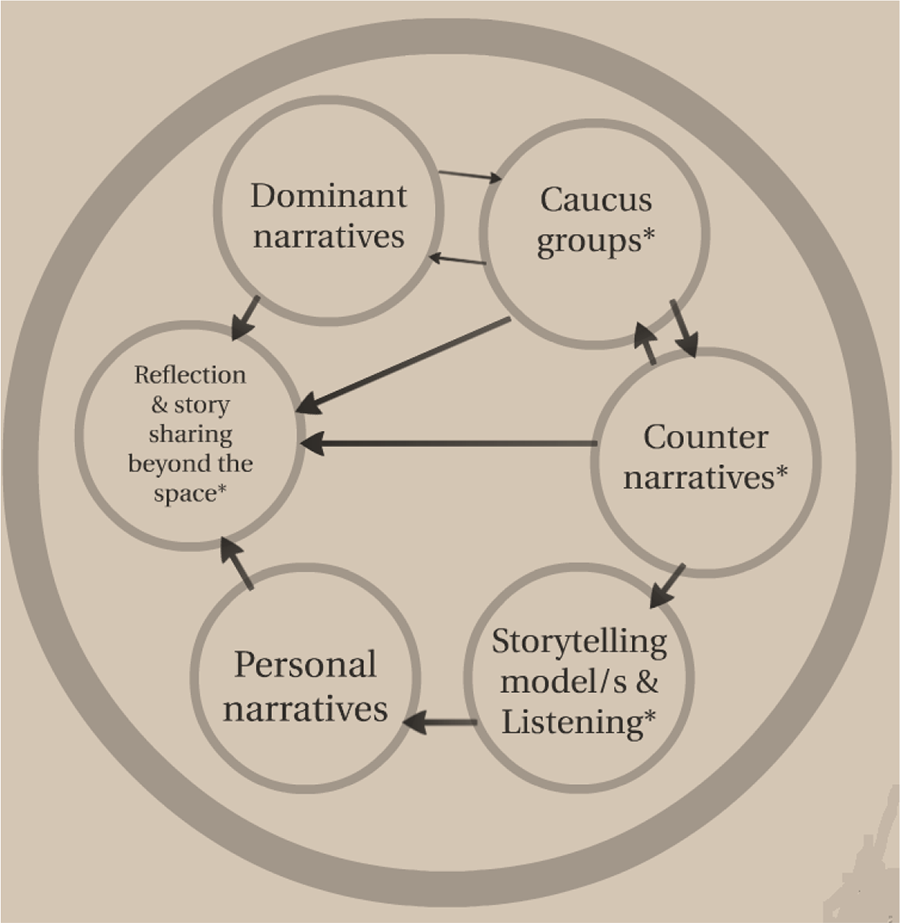
Counterstorytelling design components with iterative relationships and participatory aspects.
Iterative Nature of the Process
The components of the research design were interconnected and iterative. The three rounds of narrative development reflected back on what had come before in the study’s process. Similarly, the process of story sharing was iterative and was adapted over time as the group worked to identify what they needed from one another and how to best support each other’s individuality. The process allowed the participants to come to a deep understanding of the uniqueness of each storyteller and each listener. Reflective dialogue is a process that allows participants to discuss their reflections on what they heard, what thoughts or feelings were generated during both the listening and the telling, and what they witnessed in the process. Incorporation of reflective dialogue was an important aspect of the iterative process.
Similarly, the design components and space were intimately connected to one another. For example, the storytelling and sharing process impacted the space by creating a level of intimacy, trust, and comfort. However, that comfort level sometimes resulted in participants slipping into essentialist language or making statements that caused offense in other participants. These instances required a looping back to revisit what the space should look and feel like (such as refining the norms) in order to allow for a deeper level of comfort without forgetting the vast differences in identity and experiences within the room.
Design Components
Dominant narratives
Once the concept of counterstorytelling was introduced, the researchers facilitated a discussion about the concept of a dominant narrative in the second session. This began with a dialogue about the use of stories in our own lives and in society. The group related to the idea that there were messages in society about LGBTQ young people that were either explicitly or implicitly conveyed. The participants were asked to individually write these messages on separate pieces of paper—one message on each sheet of paper. The researchers put the messages up on a wall in the room. This allowed for the group to visually examine and discuss the messages together. Examples of messages that were identified by the participants included: Coming out leads to either: COMPLETE ACCEPTANCE or COMPETE REJECTION You can’t use “they” because my view of grammar is more important than your feelings and existence. “MAN GETS PREGNANT” Oh, those poor gay/queer folks in the South, everything must be so horrible there. Too pretty to be a lesbian It’s “easier” to be gay now “Last night, a <LGBTQ> person was killed!” “Wow you’re from (country that is not in the west) it must be so hard to be gay there. I’m glad you left.”
Once the messages were placed on the wall, the participants talked about the messages they had written. They were encouraged to ask for clarification about a message that someone else had written if it was unclear to them. The discussion was then directed toward an analysis of the messages and the dominant narrative(s) that they create. This included questions related to (1) reactions to the messages, (2) points of similarity and contradiction in the messages, (3) how and where the messages are communicated and learned, and (4) what stories and groups seem to be missing from the messages. The following quote from the discussion reflects the ways in which the participants compared the dominant narratives to their own lives.
I feel like these stories are exposed from media…are heavily edited to be very compelling and…entertaining. But for me, if I am literally trying to tell someone the story of my life a part of it is not going to be all that entertaining, it’s not going to be like bam, bam, bam, it’s not going to be exciting like that. It’s going to be all full of confusion and personal…stuff. I feel like the more a story becomes really catchy the less close it is to the truth.
Caucus groups
Caucus groups was a design component intended to create space for people to talk within identity groups in order to identify common experiences, build confidence in giving voice to experiences that may not otherwise be represented, and acknowledge that there are differences in experience within the group. The idea of caucus groups was introduced in the first session of the study. Participants were encouraged to request caucus group time whenever it felt like something that they needed. Going into the third session, the request had not been made of the group. The researchers decided, based on the discussion in the previous session about the dominant narrative(s), that caucus space would be beneficial to the group prior to the development of counterstories.
The group was asked by the researchers what identities were important to them to have intragroup time with. Three different caucus spaces were chosen around race, gender identity, and sexual orientation. During the first caucus group, participants self-identified as either white or as a person of color and went with the corresponding small group. For the second caucus group, participants self-identified as either transgender (including binary and nonbinary trans identities) or cisgender. And for the third caucus group, participants self-identified as either monosexual or “multi”sexual (including bisexual, pansexual). The group recognized the challenges associated with breaking these identities into binary groups, but given the number of participants and their perception of common experience, these groups were selected. The group-driven selection of identities to shape caucuses reflected the participatory and emergent nature of the research design.
The groups were given time to discuss the following questions, or anything that they determined was important for them to discuss while together. Caucus groups were not audio-recorded. In what ways are the stories we have been talking about different for us? What stories or groups of people are missing from the stories we hear or see being told? What is the impact of all of this on us?
Once all three caucus group times were done, the group was brought back together. Participants were asked to share whatever seemed important or relevant for the rest of the group. This component was used to directly transition into the development of the individual counterstories.
Counterstories
Reflecting on the messages from the dominant narrative(s) and the discussions that followed, the participants were asked to consider the stories or aspects of the LGBTQ youth experience that were missing from the dominant narrative. Participants were asked to imagine that they were in charge of telling the story and to develop a (re)telling of what we had generated thus far. These counterstories were not intended to be the participants’ personal narratives, but the group discussed the ways in which they might use the aspects of their own experiences in the counternarratives. Creativity was encouraged. The creative aspect of the counterstory development and telling reflected participatory principles, and as will be illustrated below, the participants used poetry or other forms of expression to tell their counterstories. Time was given within the session to work on the stories. Many of the participants also worked on them in between the session meetings. Participants were told that they would be sharing their counter narratives at the next meeting and were asked to aim to keep their counterstories to 5 min or less.
Before telling each other the counterstories, the researchers facilitated a discussion about listening and its importance in the process of storytelling. The group engaged in a dialogue about the various ways that they listen to others and what makes them feel listened to. It became clear that different people had different needs and expectations. So, the group decided that prior to each story sharing, the storyteller would communicate with the group about how they wanted to be listened to—what would make them feel heard. It was also decided that there would not be questions or discussion after each story but rather that the group would collectively discuss after all of the counterstories had been told. Excerpts of a few of the counterstories that resulted are quoted below.
Counterstory 1
The person in this story is just Name. Name is a disabled, black, trans, young, poor and undocumented person living in the United States, may have both physically disabled and have been diagnosed with a learning disorder. Name is brilliant though, self-taught, library, the public library is a haven. Society doesn’t know what to do with Name, cast her out, tell him he’s unemployable, not eligible, too deviant. Name is the untouchable. Name exists primarily between the margins, but because Name is lighter skinned and generally attractive, they do own some of the aesthetic privilege. They own it. They use it, fire it at will to get what they need and want. Name is unapologetically fierce, unapologetically genuine. They live in their self because that’s what margin source people like Name need to do. If there were systems set up to help Name stop struggling, because Name does struggle, and start flourishing, most people marginalized or not would also flourish. And I just drew a little triangle and that’s where Name would be on the bottom.
Counterstory 2
They told me that God made me beautifully. He painted my eyes and built the curves in my body. My aunt tells me that God made me this way so I could grace a man with my humble smile and my presence and one day, I will tell God that, I’ve fallen in love and wow, God, you made her beautifully too.
Counterstory 3
Hmm. Okay, so basically, I don’t feel comfortable filling in the blanks for someone else. For me, a story that should be told is plain, yet very idealistic. The story or the format is vague and noncommittal or not existent at all or yeah. It is accepting of other stories and recognizes there will never be replicas. Understanding, inclusive. Like, “Hey, this is me and whether you’re similar or not, it’s okay. I’m still okay and valid. You’re still okay and valid.” Because the story’s open and comforting while remaining comfortable, all details would be shared. Nothing’s held back. It’s a story where the reality shapes the language, not vice versa. As knowledge expands, lives expand and develop, language expands and develops to match. Are gone the present limitations, unwanted superimposed boundaries found when relying on words that fall short. My reality is not complete with a vocabulary at disposal of most—at the disposal of most. Customized—customizable combinations of lesser that haven’t been used or are made to explain every unique experience and still have it be understood. The story that must be told is one where someone successfully dismantles assumptions and accepted the abstract or whatever had been presented. The story should have its own language and should be asked to share it. Language shouldn’t limit our reality or our want to speak it. Anyway, that’s it. That’s all I wrote.
Storytelling model(s)
The fourth component of the research design created an opportunity for the group to step outside of the individual stories and to think about the role and structure of stories in society. To begin this discussion, the researchers presented a storytelling model that is used by the New Organizing Institute, adapted from the work of Marshall Ganz at Harvard University, to teach activists about how to tell their story in public settings to engage others in a particular effort or movement. The model has three primary components: (1) a challenge that is faced by the teller; (2) a choice that has to be made, often in response to the challenge; and (3) an outcome that is a result of the choice. The model was presented to the group, and a facilitated discussion followed that included the participants’ reactions to the model and other models for telling one’s story. The following quotes were selected to illustrate the nature of this discussion. The first two quotes are from participants who were speaking about their ability to fit their own story into the model that was presented. In their assessment, this would be difficult to do.
But, um—but you know for like here like I just had some ideas floating around my head like I wanted to talk about like cross-dressing and stigma and shame and stuff, and like I don’t know how I could like shoehorn that into a narrative that involves like challenge, choice and outcome, you know? It’s just more like all this stuff happened and I felt bad, and now it’s like I don’t care, you know?
Um, on top of that—because this is a personal narrative—I don’t know that we necessarily know like the full outcome…
The following quotes are from participants’ discussion about the model and how it compares with other ways of telling stories. The idea that there might be both dominant narratives and a dominant narrative structure emerged in this dialogue, which created an important bridge to the fifth component of the design, the personal narrative.
Oh gosh. Um, I—I remember that there’s, uh, like this like snowflake model of the story: I just can’t remember like what it means. It’s like you—you have like a central idea and then you like build it all outward from—and then like you put it altogether in the story.
I feel like a storytelling model doesn’t necessarily take into account all of the different stories that we have because we don’t just have like one thing going on. So how can we talk about something that’s like all of these things?
I think risk—if we’re all restricted to one model of storytelling it would marry our stories too much, in trying to maybe feel like, ‘Oh well, I didn’t have it as hard as that person,’ and so—like their story is more important or some kind of feelings like that. When really—like everything is really complicated and there’s so much going on at once.
Personal narratives
The personal narratives were completely within the control of the participants. There were no guidelines or expectations about content, but the researchers did ask that they be kept to 5 min each. Participants were encouraged to follow whatever narrative format they felt made most sense for them, and creativity in the telling was encouraged. Participants had time in the session to prepare their narratives.
Prior to sharing their narratives, the group revisited its story sharing structure and expectations for the listeners and the teller. It was agreed that the process would be similar to that used during the counter-story sharing. However, because the listeners often felt compelled to respond in some way after a story had been told, the group agreed that they would all say “yo” or “I hear you” after each story. This was identified as a way to limit verbal responses that might result in a discussion or feel like an assessment of the story’s value. This process of revisiting the process and adapting it to meet the needs of the group is another aspect of the design that reflected the participatory and emergent nature of the design.
Once ready, the stories were told one by one in the group. The following quotes are excerpts from selected personal narratives to reflect the range of stories.
Personal narrative 1
The story is not about the times that I’m gay. The story is about the times I’m not. I told my mother when I was 18. I spent a few weeks living out of my car afterwards and my college library before she found me and asked me to come home. We haven’t talked about it. My father made a disparaging comment about a gay celebrity and I told him. He said God was disappointed in my choices and we haven’t talked about it. The deafening silence doesn’t apply only to the friend I’ve been dating for three years or my rainbow bumper sticker. It gets the same conversational traction as my father’s decade of secret alcoholism, the bruises he left under my hair the night before he went into treatment, the scars on my left forearm, the night I emptied every pill bottle in the bathroom, and my grandmother’s declining mental health.
Personal narrative 2
…How do I measure the force of how my father, uh, hugged me while in tears when he found out that I was not straight and that my existence was not enough to justify their journey to the West? How do I measure the speed at which I broke my parents’ heart and put that into a quantifiable mass that is meant to be carried by a hyphen? Is there a way to measure the immense burden that comes with hyphenated identities? If an ant is strong how strong am I and how long have I been strong because I’ve been living under the weight of these hyphenated identities all of my life and I am tired of being strong.
Personal narrative 3
…. And it’s like all of these—all of these labels that they throw at you—but they never really want to talk about and learn about things like Asperger’s and things like non-gender binary people—that they just want to put these labels on you and say all these things but never really learn about it and never really learn that, you know, these are humans that they’re talking to, not just a word, not just a label, not just a sticker they can stick up.
Personal narrative 4
Um, everything I wrote is very disjointed, which I guess is part of the struggle in trying to tell a story—and one that’s been the—has been my whole life. Um, I’m trying to decide which part to start on. I’ll just start kind of chronologically. So I was born in [city, state], and I lived there until I was seven. And a lot of my family lives in—extended family—lives in [state]. And it’s—extended family is very important to us as southerners and just us—our individual family; and so I spent a lot of time going back and forth visiting my extended family. And then in second grade—just before second grade—we moved to [state] for my dad’s job, and that was a big, fun adventure to me. And I remember—I was there until I was 12 and I have a few different memories that I guess one could understand as being kind of queer or gender events like trying to demand when I was playing with my friends that I was going to be the dad when we were playing house, like, “I’m going to be the dad,” and my other friend was like, “I want to be the dad. And there was another time that one of them—my best friend was like, “You know how me and you just kind of like play pretend,”—and we’d pretend we’re lesbians sometimes, “Well, like are you a lesbian because it seems like you like it.” And I was like, “No, I like boys. It doesn’t—I can’t be a lesbian.” Like, it didn’t—I didn’t know about in between-ness, and that like bisexuality or pansexuality was an option. And I had been attracted to boys and dated them since middle school and so for a long time I didn’t think that was really an option for me. I thought like, “Well, it’s confirmed. I’m straight and I guess I’m cis because I can just be a tomboy,” and that’s—I didn’t know the word cis or trans—I knew about sex changes. Once I remember I was talking to one of my best friends and I said—and I had just learned about sex changes and I said, “I’d do that.” And everyone was like, “What? You would?” “I’d do that. Sure."
Reflection and Sharing Beyond the Study Space
The sixth and final component of the design was a collective reflection on the counterstorytelling study overall, which included both the space and the curricular components. Participants were asked to identify the value of such a process, if any, in other contexts, as well as any interest they had in taking initiative to extend the story sharing process beyond the confines of the study, as is often reflected in studies with a participatory methodology. Participants identified individual-level benefits to engaging in counterstorytelling as well as community-level benefits. For some, the therapeutic value of sharing a space with other LGBTQ-identified young people was identified as valuable. This sentiment aligns with one of the guiding principles identified by the researchers. The following quote from a participant illustrates this point.
I felt safe to open up in here and like to—like, in feelings, you know. I felt safe to feel feelings just because I know that this was a safe space, you know. And I think that in other settings when I try and share, like, a personal story, I’m just kind of worried that the listeners won’t see the value in the story just ‘cause they’re not part of one of the oppressed groups that I’m talking about. So that creates a lot of anxiety. Like, okay, I’m sharing this personal thing, but, like you’re part of the majority group. So do you understand how I feel? And even if you don’t, are you empathizing? Like, what does this mean for you, you know?
For others, the potential power of making visible stories and experiences that are invisible was identified as valuable. The latter was seen as a source of power that the participants had to use their stories to impact others. A small group of participants decided to voluntarily work together to share their own stories with others who may benefit from hearing them after the study had ended.
Discussion
Counterstorytelling is a qualitative research methodology that derives from critical race theory and is used to give voice to groups who are not often heard. Solórzano and Yosso (2002) state that critical race theory “challenges the traditional claims that educational institutions make toward objectivity, meritocracy, colorblindness, race neutrality, and equal opportunity” (p. 472). It is through this means of challenging dominant ideology that counterstorytelling aims to validate all lived experiences through empowering the respondents to become the authors. It aims to develop an inclusive narrative that builds on the power of the story to increase resiliency and sway social justice movements. In essence, counterstorytelling uses the power of narrative as a form of resistance.
Value of Counterstorytelling
Through the design and implementation of this study, the researchers identified ways that counterstorytelling has value as a research methodology with LGBTQ youth, as well as other groups or populations of youth who face marginalization and stigmatization. These were shared with a group of participants as a form of member checking almost 1 year after the study had been completed. The participants gave feedback, which is incorporated into the aspects described in the following.
First, counterstorytelling creates an opportunity within research to support self-definition among participants. This process can be particularly important in cases where traditional research methods have a reductionist lens that minimize the breadth of experiences and complexity of intersecting identities within a population. Similarly, counterstorytelling allows for contextualized representation. For example, the group who participated in this study identified specific narratives that exist about LGBTQ young people in the United States as well as those that are specific to the southern United States
Another value that counterstorytelling holds as a research methodology as it was carried out in this study was the identification and collective analysis of dominant narrative(s) and their impact on the population. By making these narratives visible, the participants were able to deconstruct their meaning, contradictions that exist within them, and the emotional toll that they take on young people. Dominant narratives are often taken for granted assumptions that go unquestioned. By intentionally bringing them to the forefront and naming them, participants were better equipped to counter them with their own narratives, rather than devaluing their personal experiences because they did not fit the dominant narratives.
Another benefit of this research methodology, particularly for groups of young people who face marginalization, is the prolonged engagement between researchers and participants. Based on the feedback from the young people who participated in this study, both the amount of time that interactions took place and the participatory strategies that incorporated their ideas and needs supported relationship building that enhanced authenticity in the research. There was a sense of empowerment that was expressed by the participants who resulted from an ability to reclaim one’s story and identity, as well as from a connection and identification with others. Even in cases where the stories differed drastically, the process of telling one’s story in a space that was created to honor and value it was meaningful. In this sense, counterstorytelling as a research methodology that supports resistance may hold transformational value at the individual, collective, and community levels. Such value should be explored further in future research.
Finally, counterstorytelling—as it was implemented in this study—allows for the generation of multiple forms of data. In this study, data were generated by the participants in the form of dominant narrative messages, counterstories, personal narratives, and journal reflections. These data were both visual and textual. In addition, the study generated data from the reflective dialogue about the previously described data sources. These various data sources and perspectives allow for the counterstorytelling methodology to be used to answer a number of kinds of qualitative research questions and to use various forms of data analysis. For example, thematic analysis of the narrative data could be used to identify themes and concepts that emerge in the data, or narrative analysis could be used to explore the ways in which participants develop and deliver their narratives, either in relationship to or distinct from the dominant narratives and messages.
Challenges in Implementing Counterstorytelling as a Research Methodology
Through the development and implementation of this counterstorytelling study with LGBTQ young people, the researchers faced a number of challenges, a few of which are presented here as opportunities for learning. The first challenge was experienced in the recruitment and participant selection process. In the community context within which the researchers were aiming to recruit a diverse group of participants, it became apparent that race and class divisions with regard to access to LGBTQ programs would create a barrier to recruiting specific subpopulations. This is a common challenge to conducting research, particularly with LGBTQ people of color (DeBlaere, Brewster, Sarkees, & Moradi, 2010). Both researchers were new to the community and were limited in terms of relationships and established trust in groups that had traditionally experienced marginalization. In future applications of this research method, the researchers would encourage teams to consider the representation of the researchers involved and aim to reflect groups who they hope will be involved in the study to the extent possible. When/if this is not possible, the time line for recruitment should factor in a need for community-based relationship building that supports the researchers’ ability to gain entrance to these harder to reach subpopulations.
A second challenge that was unanticipated by the researchers was the balance of roles with regard to maintaining accountability for the space based on the established norms. In the beginning, the researchers took on the primary role of norm accountability that hindered the group’s ability to establish ownership and learn how to hold one another accountable. Once the researchers reflected on the notion that “safety” in the space would require the entire group to be engaged in the process of reflection and adaptation of norms, then the researchers felt more comfortable stepping back to make space for participants to step forward into this role, which was more effective.
A third challenge that the researchers faced in the implementation of this study was the balance of attending to both the process and the product. As the attention to the space and project design was iterative, time management and planning were not static but in flux. At times, this created challenges to our ability to plan for how long aspects of the research design would take. For example, the caucus groups took longer than expected, which pushed the personal narrative development into the following week’s session. In the future, researchers should plan to attend to the unexpected and build in time to do so.
Conclusion
Based on the experience of designing and implementing a counterstorytelling research study with LGBTQ young people, this method holds value for other groups of marginalized young people whose experiences often are unvoiced in the research literature. As described, attention must be paid to the design and process that support sensitivity and participation among those involved. Counterstorytelling holds potential as a research method that supports empowerment of participants and authenticity of the data collected.
Footnotes
Declaration of Conflicting Interests
The author(s) declared no potential conflicts of interest with respect to the research, authorship, and/or publication of this article.
Funding
The author(s) received no financial support for the research, authorship, and/or publication of this article.
