




Abstract
The global increase in and prevalence of social media is stimulating interest in the utilisation of blogs for research purposes. There is, however, a significant lack of information about the manner and scope of blog use in health research. In this scoping review, we aimed to identify how blogs are being used in health research to date and whether blogging has potential as a useful qualitative tool for data collection. Our purpose was to summarize the extent, range, and nature of research activity using blogs. In our scoping review key search terms were developed and applied to selected databases with 44 relevant studies identified. Studies were examined for the inclusion of blog use in their methods and descriptions of the manner in which they were used. While blogs were used in a variety of ways, the majority of identified studies used blogs for data collection, mostly as one method within a set of data collection methods and primarily for gathering information about experiences, perceptions, and feelings. We identified themes related to the blog’s function, the health issue or topic focus, and sampling categories. Our review demonstrated that blogs have potential as a qualitative health research tool for a range of purposes, including data collection. Blogs have particular application for researchers accessing populations beyond their physical reach. Given the global commitment to research for improvements to health and health equity, this review is an essential first step to embark on future qualitative health research using blogs.
This article reports on a scoping review of peer-reviewed literature that describes the use of blogs in health research. As the use of social media becomes commonplace, interest in the utilization of blogs for research is growing. The extent to which blogs are being used as a research tool by health researchers is, however, unclear. Our interest is in understanding how blogs are being used in health research and whether blogging has potential as a useful qualitative tool for data collection. By summarizing the extent, range, and nature of research activity using blogs, our aim is to identify what is known about the use of blogs in qualitative health research. This review is an essential first step from which to embark on future qualitative health research using blogs.
Background
New and emerging communication technologies offer a multitude of opportunities for researchers undertaking qualitative research (Rathi & Given, 2010). Qualitative research methods that have developed from new technologies include email and instant messaging interviews and on-line focus groups using Voice Over Internet Protocol (VoIP) such as Skype™ (Karpf, 2012; Redlich-Amirav & Higginbottom, 2014). Examples of recent studies that have utilised emerging web based technologies include a study exploring lifestyle factors using email interviews with five participants (Bowden & Galindo-Gonzalez, 2015), conducting instant messaging interviews on menopausal transition with 20 participants (Pearce, Thøgersen-Ntoumani, & Duda, 2014), using Skype™ to interview 15 mental health nurses about their mental health and wellbeing (Oates, 2015), and live video conferencing software to conduct interviews for triangulation of data (Glassmeyer & Dibbs, 2012). In other studies focus groups were conducted using an on-line bulletin-board style website with eighty participants on the topic of sexual decision making among gay and bisexual men (DuBois et al., 2015) and an online password-protected discussion board was used with thirty-three participants with Multiple Sclerosis to document their needs and experiences in relation to health information (Synnot, Hill, Summers, & Taylor, 2014).
There is increasing interest in the use of another new technology in research, that is, social media. Lupton (2014) describes the use of social media in recruiting study participants, disseminating study findings, conducting ethnographic research and recording information within wide-ranging discourses. Recent studies that use social media in qualitative research include online forums using Twitter©, for example, to capture the eating behaviours of young adults (Hingle et al., 2013) and utilising Facebook© as a fieldwork site where geographers undertook collaborative story telling with participants (De Jong, 2015).
The Development of Blogs as Social Media
Within an evolving array of qualitative methods using social media there are increasing numbers of studies using Blog technology. A blog is a type of social media within the Web 2.0 platform. Having developed from the more static, one-way communication of its precursor, Web 1.0, and with similar underlying technology as a website, the distinguishing features of Web 2.0 are interactivity and constant change with an emphasis on the centrality of users (Ackland, 2013; Hamm et al., 2013; Snee, 2008). Technically, there is little difference between a static webpage and a blog, other than the way the site is used (Ackland, 2013). Blogs can be created and authored by individuals who have relatively basic Internet skills using blogging platforms such as WordPress© and Blogger© (Hookway, 2008).
Blogs provide a medium for incorporating various forms of content for use in different ways and purposes. They provide a “fluid” format for participating in the public sphere (Siles, 2011). A blog author “posts” a written passage or graphic on a blog, with readers leaving a comment on the same page within a space designated for this purpose (Hookway, 2008; Poore, 2014). The entries are listed in reverse chronological order and can be archived allowing researchers to map the development of a theme through the conversations surrounding it (Ackland, 2013; Harricharan & Bhopal, 2014; Hookway, 2008).
In 2015, some recent examples of blog use in research include:- a study of women’s experiences of surfing culture through a blog produced for the research in which data collected from the blog (published posts and stories) were used to supplement field notes (Olive, McCuaig, & Phillips, 2015); and a study utilising blogs for data collection and as a structured space for prompted reflections where 55 undergraduate research students recorded their thoughts and experiences about their research (Wilson, Howitt, & Higgins, 2015).
Blogging emerged in the 1990s in response to communities of Internet users who used the Internet for recording information in three different ways: online diaries, journals for personal publishing, and the weblog. The term ‘weblog’ was coined in 1997 by a computer programmer, Barger, who used the term to compile a library of frequently updated URLs (uniform resource locators) (Siles, 2011; Walker-Rettberg,2013). Early weblog users were focused on results of online exploration: technological developments in Internet and web design, and discussion about the weblog as a website (Siles, 2011; Walker-Rettberg, 2013).
An early interface design feature was the posting of most recent updates above previous ones, creating a reverse chronological order (Siles, 2011). This feature distinguished weblogs from online diaries and personal publishing websites. In the early 2000s, diaries and personal publishing combined with blogs, leading to a marked increase in entries related to personal issues (Siles, 2011). The popularity of blogs was reflected in the drop in United States daily readership of newspapers from 52.6% of adults in 1990 to 37.5% in 2000 (Goldman, 2008). Blogs continued to evolve from a medium for passive online reading to the activity of writing, making their way into the researcher’s repertoire of research methods to explore daily life in new and interesting ways (Chenail, 2011; Goldman, 2008; Snee, 2008).
The Use of Blogs in Research
Much of the use of blogs in research has involved the collection of data through the use of web crawlers to track permalinks and blogroll links (Ackland, 2013). Permalinks are made when a blogger refers to, or comments on another blog or website, while blogroll links sit to one side of a blog page and not within a blog post. Permalinks are more useful to researchers because they reflect up-to-date reading habits of the blogger pointing out connections between bloggers (Ackland, 2013). One of the aims of blog research is to identify linkages made in a specific time period to track, for example, how an issue moves from its origin to the wider blogosphere (Ackland, 2013). There are several aspects of blogs and blogging that could be beneficial for use in research such as accessibility of mobile technology (smartphones, smart watches, tablets, and laptops) that enable populations otherwise geographically or socially removed from the researcher to be accessible anywhere, any time. There is the potential for individuals to communicate in previously inaccessible spaces (Goldman, 2008; Hookway, 2008). The majority of blogs are characterised by reflective, descriptive, interpretive and exploratory content and therefore align with common qualitative methodologies (Denzin & Lincoln, 2011). Blogs can enable participant voices to be captured and disseminated close to their vernacular intent. There is an added advantage for those wishing to be totally anonymous in their writing or responses.
Researchers have identified transparency as a potential benefit of blogging (Moravcsik, 2014; Tracy, 2010) with blogs contributing to an audit trail. They can provide clarity about the research process and enable challenges and shifts in the study over time to be easily documented. Researchers argue that the diary style of blogs might be conducive to spontaneous and candid writing about participant experiences, and the facility for archiving entries might enable the examination of social processes over time (Hookway, 2008).
Blog entries have been described as naturalistic data in textual form, enabling the creation of substantial amounts of instant text, plus images and links without the resource intensiveness of tape recording and transcription (Hookway, 2008). Blog site statistics, offered by the blog-hosting site, enable researchers to track blogging activity over time and across geographical areas (Hookway, 2008).
Problematic aspects of blogs for research include ethical considerations around data use and anonymity, consent, privacy, authenticity, and sampling (Ackland, 2013; Rathi & Given, 2010). It has been argued that blogging can be disorientating, time-consuming and overwhelming as people learn to navigate and interact in the blogging environment (Hookway, 2008). Establishing a blog site can be time consuming and does require some level of skill. Researchers have highlighted limitations of using blogs for research when seeking to recruit participants with specific demographic or personality traits (Hookway, 2008; Rathi & Given, 2010). For instance, response rates may be low, and prolonged engagement time with participants may be difficult (Hookway, 2008; Rathi & Given, 2010). Questions have arisen around privacy of blog data and informed consent for its use in research (Ackland, 2013). It can be argued that blog posts are private content in the public domain and are therefore “fair game” (Ackland, 2013). However, the ethical issue of informed consent for use of publicly available private material remains, particularly as the division between the two domains is obscure (Ackland, 2013; Lunnay, Borlagdan, McNaughton, & Ward, 2014).
Anonymity of blogging can raise issues about whether material is authentic and true as a consequence of deliberate identity manipulation and deception (Ackland, 2013). Although, as Hookway (2008) points out, these circumstances are not unique to online research and manipulating the truth can occur in other research scenarios such as surveys and face-to-face interviews or focus groups. The lack of geographic points of reference to guide researchers can lead to complications in establishing a sampling framework (Li & Walejko, 2008). A major issue in blogging research identified by Agarwal and Liu (2009) is the presence of spam blogs or “splogs” which pose a risk to the quality of blog search results. The importance of minimizing risk is emphasized, particularly the ability to filter splogs (Agarwal & Liu, 2009; Li & Walejko, 2008). Sampling issues can be compounded by access to private blogs requiring permission from the blog author, and the presence of a large number of abandoned blogs (Li & Walejko, 2008).
Internet users globally have increased 10-fold between 1999 and 2013 reaching three billion in 2014, and in early 2015, 40% of the population had access to the Internet (Internet Live Stats, 2015). When the number of Internet users globally is considered alongside the asynchronous nature of blogging, the participation potential increases, with participation being at the convenience of the research participant. Researchers argue that blogging could serve as a low-cost, global and instantaneous data collection tool for health research capturing data either at a certain point in time or across space and time (Hookway, 2008; Webb & Wang, 2013). With over two million blog posts written each day (Internet Live Stats, 2015), and the global aim of research committed to contributing to improving health and health equity (World Health Organization, 2013), we believe it is important to better understand the place of blogs in health research.
Study Design
In this study, we utilized Arksey and O’Malley’s (2005) five stage scoping review framework for its rigor and suitability for answering our research question (Daudt, Van Mossel, & Scott, 2013; Kastner et al., 2012). The five stages include identifying the research question, identifying relevant studies, study selection, charting the data and collating, and summarizing and reporting the results.
Our broad research question to maximise the scope of our mapping was: “What is known about the use of blogs in health research?” In defining health research, we used the definition of the World Health Organization’s Health Systems Research Analysis, “… the advancement of scientific knowledge and utilization of knowledge to improve health and health equity” (World Health Organization, 2014). We used the search terms “health research” AND (blog* OR weblog OR “Web 2.0”) in six databases; ProQuest Central, Ovid, Scopus, Web of Science, CINAHL, and PubMed. We were interested in peer-reviewed publications written in English and published between 2000 and 2014. The year 2000 was chosen because it was not until 1999 that user-friendly, automated blogging software became accessible (Siles, 2011). We included literature that describes the use of blogs for health research in any health discipline or topic area in any country.
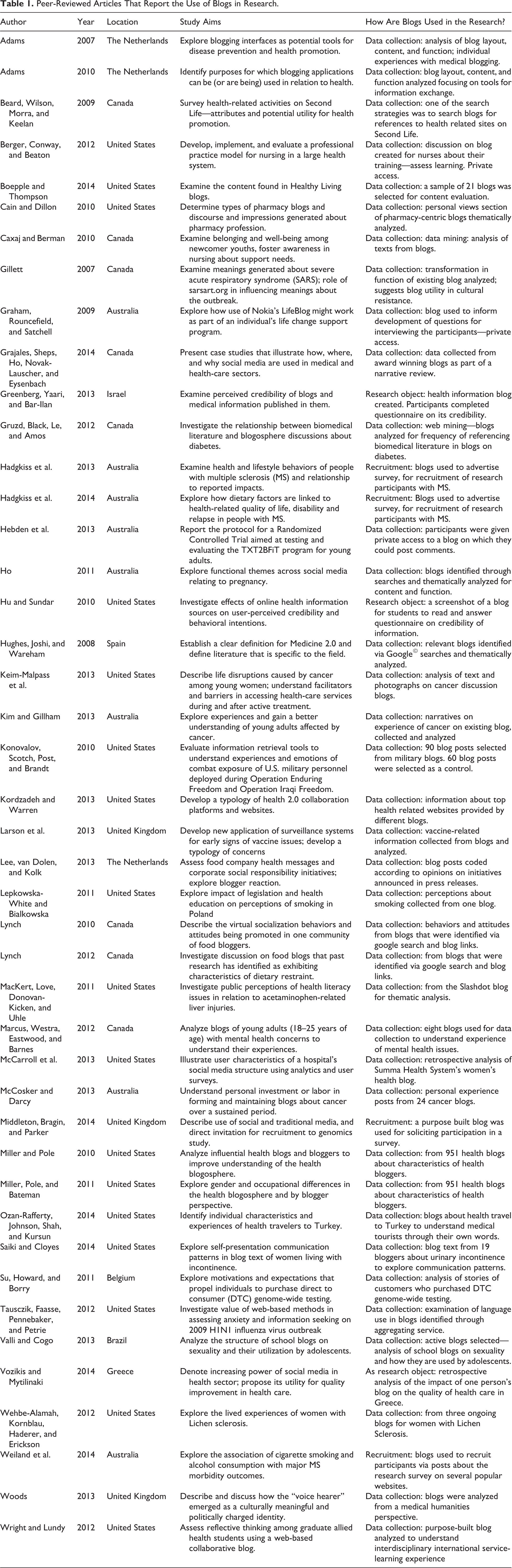
The initial search resulted in 672 articles. After 96 duplicates were removed, 576 articles remained. The abstracts of the 576 articles were screened against the inclusion/exclusion criteria. Articles were removed if they did not relate to health, they described the use of blogs for purposes other than research and emphasized the Web 2.0 platform without specific reference to blog use. The full texts of 67 articles were identified and read, and a further 23 articles were excluded because their emphasis lay outside our focus criteria or the abstract had been written in English but the full text had not. A total of 44 articles were selected for review. This process is represented in the PRISMA flowchart (Fig.1). Consistent with the Arksey and O’Malley’s (2005) framework, we charted the data drawn from reviewed articles summarized in Table 1.

Study selection process.
Peer-Reviewed Articles That Report the Use of Blogs in Research.
Findings
The final stage in Arksey and O’Malley’s (2005) framework is to collate, summarize, and report the results of the charted literature. Themes were drawn from the reviewed studies to provide a narrative overview. Of the 44 articles that met our inclusion criteria the majority (n = 39) were published in the last five years of our search inclusion dates (2000–2014). The greatest numbers of articles were from the United States (n = 17) followed by Canada (n = 8) and Australia (n = 8). There were three (n = 3) articles from the Netherlands and the United Kingdom, and one article each from Israel, Spain, Brazil, Belgium, and Greece.
How Blogs Were Used
In 38 of the studies reviewed, researchers used blogs for data collection. In 11 of the included studies, data were collected from blogs in conjunction with another data source, specifically interviews (n = 3), surveys (n = 2), focus groups (n = 1), and a miscellany of sources we categorized as “Other” (n = 6). This latter category included sources such as press releases, papers and reports accessible online, websites, ranking services, wikis, and other social media types. In 21 of the 38 studies, researchers collected data about experiences, feelings, and perceptions of blog contributors while the remaining 17 investigated blogger behavior. The data about blogger behavior, such as self-presentation patterns, topics written by health bloggers, blog user patterns, and blogger health–related activities, were described in 16 of the studies. In two studies, blogs were used to collect data about websites for use in the next step in the research. The type of data collected for analysis in 36 of the 38 studies was text, one collected text plus artworks, and one other collected text plus photos.
In all studies using blogs for recruitment to a survey (n = 5), blogs were not used alone but were one of a suite of social media recruitment tools. In one study (Middleton, Bragin, & Parker, 2014), a WordPress blog was designed specifically for recruiting people to a survey. Brief posts relating to the topic were written on the blog and on other websites and included links to the survey both within and alongside the text. Each blog post was advertised on LinkedIn©, Twitter©, and Facebook© where the researcher “chatted” about the blog to encourage people to link to it and then to the survey.
An online survey was distributed to subscribers of a women’s health blog in one study (McCarroll et al., 2013) and taking a different approach, another research team (Hadgkiss et al., 2013) contacted moderators of popular multiple sclerosis (MS) blogs and requested that information about a survey be posted to their websites. Two further articles, Weiland et al. (2014) and Hadgkiss et al. (2014), are derived from the Hadgkiss et al. (2013) study and relate to the same recruitment strategy.
In two studies, blogs were used as the object being researched and involved administering a questionnaire to collect data from participants related to their perceptions about the particular blog. In one of the studies, the blog was purposely created for access by research participants who were later asked to complete a questionnaire to measure their perceptions about the credibility of the blog, its author, and its message (Greenberg, Yaari, & Bar-Ilan, 2013). In the other study, researchers aimed to measure psychological effects of various online sources of health information. Screenshots of a blog and other online sources were shown to participants who then completed a questionnaire about their perceptions of the blog’s message attributes, credibility, and information completeness (Hu & Sundar, 2010).
Blog Function
In addition to understanding the use of blogs in research, we found it useful to examine the function of the blogs in each study. Function was not specified in 20 of the 44 studies reviewed. We categorized the function of the blogs used in research within the remaining 24 studies. The blogs’ functions included provision of health information (n = 7), a place for support and support groups (n = 6), as personal health blogs (n = 3) and to provide education (n = 1). The blog function described in the remaining studies, we categorised as ‘other’. They included a blog developed as a Virtual Journal Club for nurse education and discussion about a professional practice model for nursing (Berger, Conway, & Beaton, 2012). Pharmacy-centric blogs functioned as news, personal views, and information provision on the profession of pharmacy with the personal views blogs being analyzed to determine the impression that pharmacy websites made on the reader (Cain & Dillon, 2010). Some researchers utilized blogs whose function related to a specific topic or website. An example was the blog initiated to collect oppositional representations of the SARS (severe acute respiratory syndrome) outbreak and its social impact (Gillett, 2007) and the blog, Slashdot, which was used to investigate public perceptions regarding health literacy, within the context of discussion of proposed government regulations on acetaminophen, to guide future research in this area (MacKert, Love, Donovan-Kicken, & Uhle, 2011).
Some blogs functioned as a type of diary, that is, a place to record reflections about personal experience. Research data collected from the blogs included reflections on personal cancer experience and mental health experiences (McCosker & Darcy, 2013) and experiences of military personnel deployed to Afghanistan and Iraq (Konovalov, Scotch, Post, & Brandt, 2010). The personal blog by Amalia Klyvinou was written to document her personal malpractice experience within the Greek national health system and to show resistance (Vozikis & Mytilinaki, 2014). The associated research was a retrospective analysis of the impact of one person’s blog on the quality of health care in Greece (Vozikis & Mytilinaki, 2014).
Blogs also functioned as recruitment tools where posts were written to opportunistically direct potential research participants to a survey (Middleton et al., 2014) and as photography-based food blogs for healthy lifestyle promotion and data collection about the relationship between food and exercise (Lynch, 2012).
Health Issue or Topic
The health issue most represented in the studies reviewed was related to weight and healthy eating (n = 7) followed by emotional and mental health (n = 4), online health information (n = 4), and Web 2.0 in health (n = 4). Weight and healthy eating issues included unhealthy weight gain in young adults (Hebden et al., 2013), obesity and corporate social responsibility (Lee, van Dolen, & Kolk, 2013), dysfunctional eating attitudes and behaviors, or dietary restraint (Adams, 2007, 2010; Boepple & Thompson, 2014; Lynch, 2010, 2012).
Four studies focused on emotional and mental health relating to personal experience and the impact on mental health care access for young adults (Marcus, Westra, Eastwood, & Barnes, 2012), voice hearers as a meaningful identity (Woods, 2013), mental health impacts of experiences related to belonging in migrant and refugee youth (Caxaj & Berman, 2010), and experiences and emotions of combat exposure of U.S. military service members deployed during two separate Iraqi operations (Konovalov et al., 2010).
Online health information featured as the topic in four studies. These relate to understanding how people manage their personal health information in the online environment (Adams, 2007, 2010) and measuring perceptions of credibility of health information provided on blogs (Greenberg et al., 2013; Hu & Sundar, 2010).
Web 2.0 in health was the focus topic in another four studies that related more precisely to discussions about health activities on Second Life (Beard, Wilson, Morra, & Keelan, 2009), use of Health 2.0 websites as health collaboration platforms (Kordzadeh & Warren, 2013) establishing a clear definition of Medicine 2.0 (Hughes, Joshi, & Wareham, 2008) and the use of social media in the medical and health-care sectors (Grajales, Sheps, Ho, Novak-Lauscher, & Eysenbach, 2014).
Sampling Categories
Two discernible sampling categories within our study selection were youth and women, with seven studies in each category. The studies which focused on youth, related to specific health issues, that is, sexuality (Valli & Cogo, 2013), mental health (Caxaj & Berman, 2010; Marcus et al., 2012), weight gain (Hebden et al., 2013), and cancer (Kim & Gillham, 2013). Health topics including allied health education (Wright & Lundy, 2012) and credibility of online health information (Hu & Sundar, 2010). Among the studies focusing on women, health issues discussed related to weight and healthy eating (Lynch, 2010, 2012), urinary incontinence (Saiki & Cloyes, 2014), lichen sclerosis (Wehbe-Alamah, Kornblau, Haderer, & Erickson, 2012), pregnancy (Ho, 2011), cancer (Keim-Malpass et al., 2013), and women’s health (McCarroll et al., 2013).
Country-specific sampling was used in some studies, such as smokers in Poland (Lepkowska-White & Bialkowska, 2011); people living with cancer in Australia, Canada, the United Kingdom, and the United States (McCosker & Darcy, 2013). Studies described health bloggers in the United States (Miller & Pole, 2010; Miller, Pole, & Bateman, 2011); U.S. pharmacy profession bloggers (Cain & Dillon, 2010); the Greek blogging community protesting against the Greek health system (Vozikis & Mytilinaki, 2014); people living in the Netherlands with either rare diseases or who want to lose weight (Adams, 2007, 2010); Hebrew speakers in Israel (Greenberg et al., 2013); and U.S. military service members blogging about combat experiences (Konovalov et al., 2010).
Samples in other research within the studies reviewed were targeted at topic-specific groups. The groups included people who were active in the Hearing Voices movements (Woods, 2013); people traveling to Turkey for health care (Ozan-Rafferty, Johnson, Shah, & Kursun, 2014); a United States discussion on a science blog about banning acetaminophen-based painkillers (MacKert et al., 2011); and people blogging about genomics (Middleton et al., 2014), swine flu (Tausczik, Faasse, Pennebaker, & Petrie, 2012), vaccines (Larson et al., 2013), and diabetes (Gruzd, Black, Le, & Amos, 2012).
Further samples included nurses at Norton Healthcare in the United States (Berger et al., 2012), smokers in Australia wishing to give up smoking (Graham, Rouncefield, & Satchell, 2009), people who have purchased a genome-wide test from a direct to customer genetic testing company (Su, Howard, & Borry, 2011), people with MS (Hadgkiss et al., 2013, 2014; Weiland et al., 2014), blogs in the Medicine 2.0 community (Hughes et al., 2008), people blogging about food companies’ press releases on health and obesity issues (Lee et al., 2013), contributors to the SARS Art Project blog (Gillett, 2007), and bloggers from the Healthy Living blogs community (Boepple & Thompson, 2014).
The use of blogs in qualitative health research
Our scoping review yielded 44 articles describing how blogs were used in health research. Although our search date range started at the year 2000, the 44 articles comprising our study selection were published between 2007 and 2014, suggesting that articles describing the use of blogs in health research were not published until 8 years after user-friendly, automated blogging software became accessible in 1999. Studies originated from a total of 10 countries, with the majority of studies from the United States. Most studies did not purposely create a blog for research use but used pre-existing blogs.
A common theme in the reviewed studies was the use of blogs for data collection. Rather than using blogs as a single method of collecting data, researchers are making use of blogs as one method within a suite of data collection methods and are mostly gathering information about experiences, perceptions, and feelings. A small number of studies used blogs for recruiting participants to online surveys and others used blogs as the research object, asking questions about perceived credibility of information presented in the blogs.
Some limitations of blogs were identified. The fluid and changeable nature of the “blogosphere” was recognized as a limitation that rendered the research as only a snapshot in time (Cain & Dillon, 2010; Miller & Pole, 2010; Miller et al., 2011), while sampling was seen as constrained by the impracticality of accessing large numbers of blogs and the limitations of the Google Blog© search facility (Gruzd et al., 2012; Ho, 2011). Further limitations to using blogs for research were the reliance on self-reported diagnoses and information that cannot be externally validated (Keim-Malpass et al., 2013; Miller & Pole, 2010; Miller et al., 2011; Ozan-Rafferty et al., 2014), the exclusion of people without access to the Internet (Konovalov et al., 2010; Ozan-Rafferty et al., 2014), the inability to ascertain author authenticity, unreliable assessment of temporality in relation to describing experiences, and search terms retrieving irrelevant media (Konovalov et al., 2010). None of the studies commented on the usefulness of using blogs in the research.
Despite the identified limitations of researching with blogs, successful qualitative research using blogs is described in articles within our study selection. Blog characteristics align with common qualitative methodologies for gathering information about experiences, perceptions and feelings over time (Denzin & Lincoln, 2011;Hookway 2008) making blogging a useful qualitative tool for researchers (Hookway, 2008; Rathi & Given, 2010). The use of blogs as a research tool enables researchers to gain instantaneous access to distant populations (Hookway, 2008), provides research clarity and transparency with the benefit of a built-in audit trail (Moravcsik, 2014; Tracy, 2010) and circumvents the need for lengthy transcription (Hookway, 2008). For the participants, their voices can be captured and disseminated through blogs, close to their vernacular intent, with the added advantage of the choice to remain anonymous in their writing or responses.
Evolutions in qualitative methods should encourage researchers to push the boundaries by using innovative approaches that keep pace with global transformation. New communication technologies such as blogs, are a central part of contemporary global transformation, and should be considered as important in emerging qualitative research methods (Redlich-Amirav & Higginbottom, 2014). In an era characterised by new and evolving technologies, qualitative health researchers are called to capitalise on the opportunities these technologies present for local and global connection. The emergence of blogs in the broader qualitative research arena provides vast opportunities for conducting qualitative health research globally to collect richly detailed research data across a multitude of boundaries (Kenny, 2005; Redlich-Amirav & Higginbottom, 2014). Global transformation and emerging and persisting global health burdens require a research response with global capacity. In order for qualitative health research to move into this space, the knowledge and skills of researchers must progress to include blogs and other communication technologies in the design, production, management and dissemination of their research.
Conclusion
The literature examined in this scoping review suggests that the use of blogging has broadened from a social media tool to a research tool. Our review demonstrated that blogs have the potential for use as a tool for researchers in a variety of ways, including data collection, with particular application for researchers accessing populations beyond their physical reach. In health research particularly, we consider that blogs have a place within the global aim to have research making a significant contribution towards the improvement of health and health equity. The identified current repertoire of blog use in qualitative health research demonstrates its adaptive qualities and the promise that blogs hold for trialing further innovative uses for blogs in empirical qualitative health research at an international level.
Footnotes
Declaration of Conflicting Interests
The author(s) declared no potential conflicts of interest with respect to the research, authorship, and/or publication of this article.
Funding
The author(s) disclosed receipt of the following financial support for the research, authorship, and/or publication of this article: This article was written as part of a PhD study supported by a scholarship funded by Heathcote Health (Victoria, Australia).