




Abstract
This paper discusses the use of photo ranking exercises together with qualitative interview data to study migrants’ perception of social status. It draws on data from a mixed-method study, involving in-depth interviews with migrants from different socio-economic backgrounds and mobility experiences in Germany. The paper focuses on how photo ranking exercises can be combined with more traditional interviewing techniques in order to elicit peoples’ subjective perceptions of status mobility in transnational spaces. It demonstrates that ranking exercises can be helpful in the effort to design data collection methods which are combining substantialist and relational approaches to the study of social class and social positions.
Introduction
This paper explores the benefits and challenges of employing photo ranking exercises together with qualitative interview data to study migrants’ perception of social status and status mobility. The discussion draws on photo ranking exercises that were conducted with migrants during in-depth interviews. The interviews were part of a larger mixed-methods study, involving migrants from different socio-economic backgrounds and mobility experiences in Germany 1 .
In difference to research in the fields of education, psychology or development studies, ranking exercises are rarely used in migration research to date. This article demonstrates that photo ranking could be a useful adition to conventional interview techniques in qualitative social science research with migrants. In particular, it focuses on the benefits of ranking exercises for gathering data about migrants’ subjective perceptions of social hierarchies and social mobility. However, the paper also signals that the methodological challenge consists in adapting open and closed elements of the exercise to the desired research questions and the research context.
Ranking exercises are closely related to picture sorting techniques, which aim to elicit peoples mental concepts through the use of visual material (Lobinger & Brantner, 2020). In contrast to traditional scoring techniques, which are aiming to assess the weight or prominence people assign to different items, ranking can be defined as placing or putting something in order (Narayanasamy, 2009, p.231). In general, ranking involves the handing over of various items (such as objects, pictures, photographs or statements) to the participants who will then sort and order them into groups or hierarchies, always depending on the tasks at hand. They can be performed as group activities or as one to one interaction with the research participants. They may involve the drawing of maps or charts, and generally include some sorting elements. Often, ranking exercises are accompanied by subsequent in-depth interviews or group discussions, in order to find out more about participants’ underlying sense-making processes and mental concepts regarding the ranking task.
The article demonstrates that the potential benefits of the use of ranking exercises for research on social hierarchies are conceptual, epistmeological and practical in nature: For one, photo ranking exercises are useful to gather qualitative data that combine substantialist and relational approaches to social class. By substantial approaches I mean here those which treat class and social status as realistic objects with essential properties, whereas the relationalist approach understands them in terms of their relational contexts (Grenfell, 2014). This is particularely important if researchers are interested in understanding how objective criteria of social class (such as occupation, wealth or gender) impact on peoples’ subjective understanding of social positioning and class, and on the reproduction and transformation of class habitus (Bourdieu, 1996).
The article also shows that the incorporation of visual clues and the spacial ordering of photos can impact positively on the interview process when studying social hierarchies that are operating beyond the nation state in transnational spaces-as is the case for many migrants whose lives are socially embedded in more than one country. In interview situations, people generally shy away from direct questions about their own social class and its importance for their identity formation or tend to either overstate or understate the importance of their social status in relation to others (Aries & Seider, 2007). The visual and spacially ordered images generated in the ranking exercise discussed in this article, however, successfully promted respondents to engage in narrations about their efforts to self-position themselves favourably in the middle classes in origin and destination countries. They therefore provided an innovative approach to investigate transnational dimensions of class (Stock & Fröhlich, 2021).
In order to develop my arguments, I start by reviewing how photo ranking exercises have been used to date in different disciplines and discusses how they may be epistemologically and ontologically fruitful for the study of social hierarchies in migration research more generally. In the subsequent section, I summarise the research projects’ objective and its approach to studying social hierarchies, as well as the methods that were used to gather quantitative and qualitative data. Then, I describe the design of the ranking exercise in more detail. The remainder of the paper analyses the advantages and disadvantages of the photo ranking technique by putting specific emphasis on the choice of open and closed elements of photo ranking exercises. By open and closed elements, I mean here the degree to which the researcher imposes restrictions on respondents regarding the choice of photos or the permitted ranking orders when they complete the exercise. In the conclusion, I propose potential future uses of ranking exercises and visual aids in research on social mobility.
The Benefits of Ranking Exercises for Qualitative Research on Social Hierarchies
A part from their use in qualitative social development planning and research (Chambers, 1994; Russell, 1997), ranking exercises have also been employed in educational research (Clark, 2012) and general card sorting techniques are frequently used in psychology or also in research on communication technologies (Lobinger, 2016).
Ranking exercises have been employed in both quantitative and qualitative research designs, either focusing on eliciting meanings of ranking tasks or else on frequencies and patterns of distributions of different ranking items. This makes them an interesting tool in mixed methods designs, because they have the potential to bridge the gap between qualitative and quantitative approaches (Rugg & McGeorge, 1997). In addition, they can constitute a reliable yet quick form of collecting quantitative and qualitative data in an effort to triangulate them (Chambers, 2007).
In this context, it is important to differenciate ranking techniques by the relative openess of the ranking tasks (Lobinger & Brantner, 2020). This means that researchers can decide, if respondents are free to design and choose the items that are to be ranked or instead are asked to rank particular items/statements or objects that are given to them by the researcher. Additionally, some ranking exercises may give respondents clear instructions as to how the ranking process should be done, whereas more open designs leave it in the hand of the respondents to define how relationships between different objects are established by grouping items freely on the basis of individual choice (Chollet et al., 2014). The way this is done can take many different forms and is usually adapted to the specific question at hand, the surroundings or the capacities and skills of the people involved.
Ranking exercises have been proven a useful tool to complement traditional interview methods because they are designed to bring respondents quickly to make decisions of priority in relation to a series of alternative possibilities of action or worth (Narayanasamy, 2009; Russell, 1997). This makes them a potentially relevant research tool in qualitative interviews that aim to find out about peoples’ opinions on social hierarchies and the relevant criteria for upward or downward social mobility. Similar to other card-sorting techniques, ranking exercises are designed to gain insights into the mental maps of participants and into the ways in which users group, categorise and label information (Rosenfeld & Morville, 2002). Therefore, they promised to be interesting data collection methods for uncovering peoples’ perspections of the constitutive aspects of social hierarichies in different social contexts. When ranking tasks are followed by discussions about how people justified the ranking of different social groups, they are able to enrich qualitative interview dinamics on abstract and politically charged issues such as class, ethnicity and gender. In this sense, ranking exercises may be also useful to find out about social comparisons, which are beginning to be recognised as a useful conceptual tool to research social inequalities and their reproduction (Stock, 2021). This is related to the fact that the use visual aids and the spatial distribution of objects during the discussion can help respondents to sharpen their thoughts and ideas about specific social phenomena that they experience every day without consciously thinking about them. In this way, ranking exercises can be useful in establishing frames of reference for comparison of social groups because ranking is inherently based on comparing different elements in a ranking scale with each other (Stock, 2021).
Ranking exercises have been used very rarely in migration research and even less often in research on subjective perceptions of social status hierarchies. This is striking, considering that visual, graphic and participatory methods have enjoyed increased popularity in qualitative research on migration in recent years (Martiniello, 2017). There are interesting examples of such initiatives in studies with migrant children (Den Besten & Olga, 2010) migrant mothers (Erel et al., 2017), and also with marginalized, urban migrant populations in the Global South (Oliveira & Vearey, 2017). Often, these methods include the taking of photos or the drawing of maps and diagrams during group activities and discussions. These tendencies suggest that it is timely to discuss the usefulness of including ranking exercises into the repertoire of visual and graphic methods used in qualitative migration research.
This is also particularely relevant in migration research because researchers find that visual and spatial methods are useful in uncovering aspects and narratives in migrants accounts which are rarely visible when ordinary interview techniques are used, as language is often a barrier for many migrant populations to participate in interview research (Oliveira & Vearey, 2017). In educational research, visual exercises have been applied for similar reasons successfully in work with children and young people (Clark, 2012; Niemi et al., 2015). They have therefore a participatory and empowering function, which helps to make visible knowledge and voices of those migrants who are generally not taken into account (Chambers, 2007; Erel et al., 2017) In addition, visual clues help to convey to participants abstract concepts which are usually difficult to describe in simple language and are able to build a common emotional ground from which both researcher and researched are then able to start a conversation and build rapport (Copeland & Agosto, 2012, p.514).
Because of these already existing positive experiences with visual methods, it is likely that photo ranking exercises can become a promising method for studying migrants’ perception of social class and social hierarchies in transnational spaces. In the following, I will discuss the experiences of using such an approach.
The Research Design Used to Investigate Subjective Views on Social Status
The ranking exercises I am focusing on here were conducted as part of in-depth interviews with migrants and constituted only one of a number of data collection tools in a larger mixed-methods project.
The project aimed to investigate how structural factors, such as class, nationality and gender impact on people’s subjective assessment of their own social positions in origin and destination countries and their class-making strategies in transnational spaces. The study draws on Bourdieu’s (1996) approach to class analysis which stipulates that peoples’ own perception of their social status mobility is conditioned by their structural position within existing and socially relevant socio-economic, gendered and ethicized class hierarchies. In order to understand how social stratification patterns are produced and recognised by social actors, the study thought to combine both structural and interpretive approaches to the study of social class dinamics, drawing on existing approaches in cultural sociology (Lamont, 1992; Sachweh, 2013).
The strategy to combine both quantitative and qualitative approaches to the study of social hierarchies was grounded in the need to uncover how structural inequalities (such as income, education, gender and citizenship status) may influence peoples’ subjective evaluations of their own social standing, their social positioning strategies and the value they accord to migration and mobility. The research relied on the premise that peoples’ own perception of their position in social hierarchies and their possibilities for status mobility is conditioned by the position they are asigned within existing and socially relevant socio-economic, gendered and ethicized class hierarchies. Thus, in a bourdieu-inspired approach, structural approaches to class are used to explain stratification patterns, but are combined with interpretive approaches in addressing how these are reproduced and recognised by social actors (Bourdieu, 1996, p. 468). In other words, the mixed methods design was chosen to understand the interplay between social positions (quantitative analysis) and positioning strategies (qualitative analysis).
The qualitative part of the study was designed to investigate migrants’ sense-making processes of social status and status mobility by focusing on the social and symbolic boundaries that respondents draw between themselves and others in order to evaluate their position in social hierarchies (Jarness, 2017; Lamont & Molnár, 2002; Sachweh, 2013) 2 . The boundary making approach was used to investigate how migrants from different socio-economic backgrounds would deal with the fact that social boundaries could be shifting in origin and destination countries. In particular, the research inquired if migrants are using transnational frames of reference to determine their social status and that of others, and how this was visible in their boundary making practices and the use of social comparisons.
Respondents for qualitative interviews were drawn from the German Socio-Economic-Panel Migration Sample (the IAB-SOEP Migration Sample), a nationwide panel study involving people with migration experience in Germany (Brücker et al., 2014). For further background information about the projects’ methodological design, please consult Fröhlich et al. (2021). 3
Selected Socio-Economic Characteristics of the Six Contrast Groups Sampled for the Qualitative Part.

In order to study people’s own perception of status mobility in transnational contexts, episodic, narrative interviews were conducted, structured loosely around issues relating both to peoples’ migratory history and their perceptions of social mobility and social status. A very loosely structured interview technique was used. In the first part, respondents were asked about their migration history and foreseeable future movements. In the second part of the interview, a photo-based ranking technique was integrated into the iterview to discuss the respondent’s views on socio-economic social positions and hierarchies in their country of origin and in Germany. The third part of the interview involved asking respondents to draw a graph showing the development of their own social position during their life course and in the different countries they have lived in. In this article, the focus lies particularly on the photo ranking exercises that took place during the second part of the interview.
A constructivist and critical realist approach to social science guided the enquiry, based on the premise that peoples’ narrations about their own positioning strategies will reveal also the hidden social, economic or cultural structures that condition them to evaluate themselves and others in certain ways (Mueller, 2019).
Concretely, the aim of the interviews was to find out in which ways people would attempt to transcend and transform nationally relevant social hierarchies through symbolic boundary making processes which were rooted in the social orders relevant in their origin country. One of the guiding questions of the research was if and how migrants recognize economic indicators for social class (like professions and income) as determining aspects of social status across different nations and how other aspects, such as gender, age or ethnic origin were incorporated into their social status evaluations in different national contexts. A second guiding question asked if migrants’ subjective criteria for status evaluation and boundary making were influenced by their class, gender or nationality.
The Design of the Ranking Exercise
The visual photo ranking method used in the study is adapted from the diamond ranking method using photos as cues (Clark, 2012). The diamond ranking method has been employed most prominently by researchers and community workers who work with children and young people (Niemi et al., 2015; O’Kane, 2000; Percival & Rockett, 2002). In this method, respondents are usually provided with nine statements which are written out on cards. The statements represent different perspectives or opinions on a specific topic of discussion. Then, usually working in groups of two or three, the participants have the task to sort and rank the statements in a diamond formation. Clark (2012) adapted the method in education research with young adolescents by asking respondents to rank photos instead of statements in order of priority. Clark points out that the photos were not used as data per se but as a means to create research data (2012, p.225). This distinguishes this method from other participatory visual methods in which, for example, participants are asked to take photos themselves or draw maps or pictures, which are then interpreted and analyzed as data within the research context (Hubbard, 1994; Thomas, 2005)
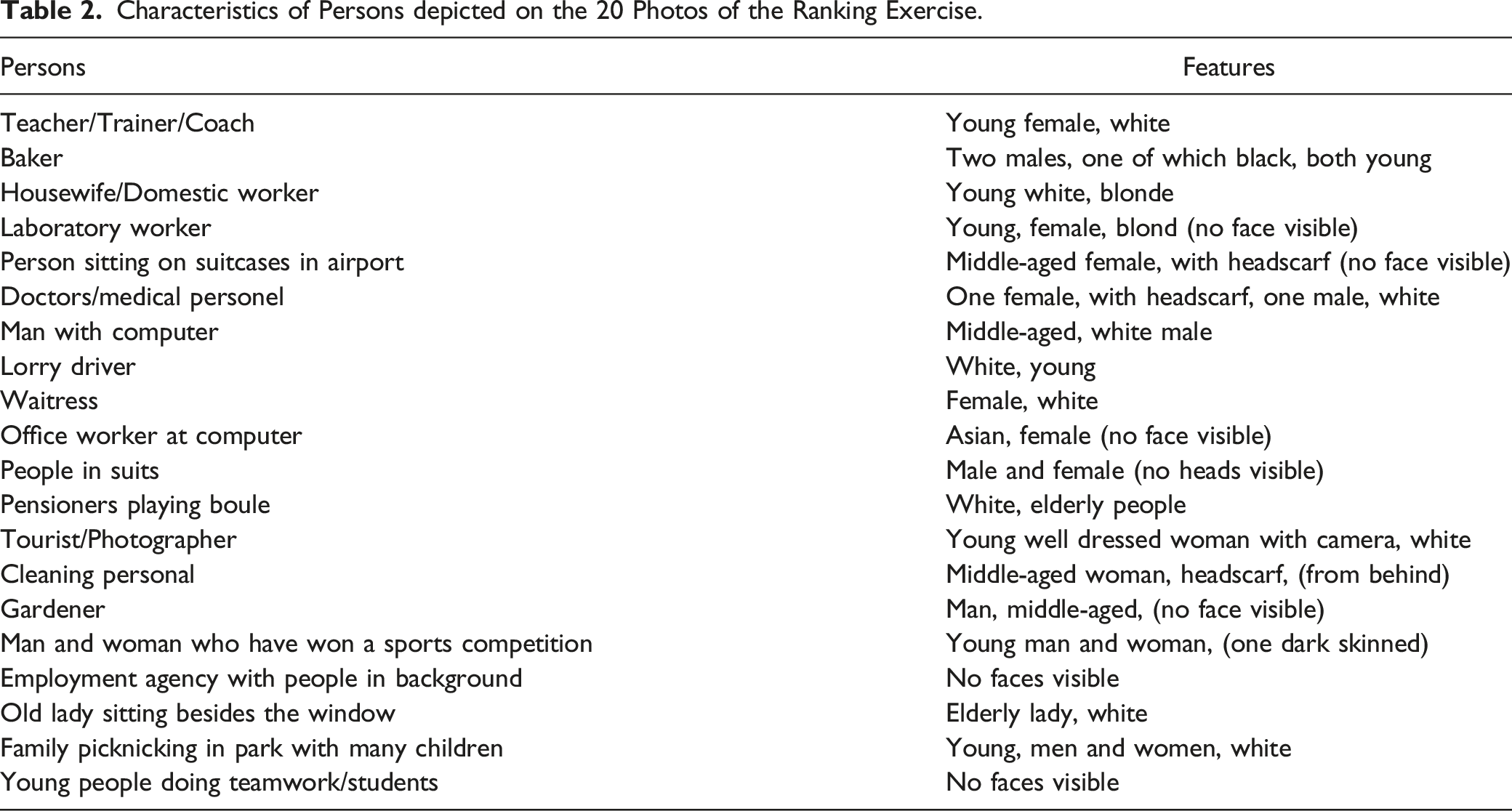
Characteristics of Persons depicted on the 20 Photos of the Ranking Exercise.
The interviewer asked respondents to rank and order the photos according to their social position (from high to low). Respondents were free to choose the way they wanted to depict the order of social positions. Respondents were then asked to place themselves within the order that they had created. Afterwards, they were asked if the order of the photos would be different if they had done the exercise in the context of their origin country. The respondents did the ranking once for Germany and once for their country of origin and discussed the differences in ranking subsequently with the interviewer. Respondents also had to indicate where they would place themselves in the social hierarchies they had created for the two countries. Figures 1 and 2 show examples of how photos were finally ranked by respondents. Examples of how photos were finally ranked by respondents in different ways. Examples of how photos were finally ranked by respondents in different ways.

Respondents were free to choose how to rank the photos. In other words, a diamond shape of representation in the final rank visualization was not mandatory. This decision was taken in order to give respondents the possibility to use space as well as the visual cues in ways they thought best fitted their conceptualization of hierarchies. In this way, respondents were given the liberty to express their own understanding of social hierarchies.
A further difference in our ranking method compared to other methods involving photos was that it did not rely heavily on photo elicitation techniques (which have a long tradition in visual anthropology and sociology (Clark-Ibañez, 2004; Collier & Collier, 1986; Harper, 2002; Woolner et al., 2010). This was intentional because the main aim of the exercise and the topic of the subsequent discussion was the photo-sorting process and not respondents’ interpretation of what they saw in the pictures. This decision was based on the fact that the main research interest was in eliciting the use of social comparison and the establishment of frames of reference for comparison by respondents. However, during the process of ranking and sorting, respondents would routinely also talk about what they saw in the photos and about the meaning these images conveyed to them.
Challenges and Advantages of Combining Visual and Textual Data in the Analysis: Treating Visual Data in Its Own Right?
While there is evidence to suggest that combined techniques for data collection such as semi–structured interviews and visual or graphical methods may facilitate triangulation and help to establish internal consistency of data (Copeland & Agosto, 2012, p.513), there is still quite limited literature on appropriate analysis procedures for combining visual data and textual data through traditional interpretative analysis methods (Bohnsack, 2010; Silverman, 2006). Inspired by Clarke’s (2005, pp. 224–228) situational analysis I adapted elements of it in order to analyse both visual and spatial elements of the ranking exercise. The ranking exercises of almost all interviewees were photographed or reproduced as graphs on paper and used in the coding process. In addition, all interviews were transcribed in full. I then used Atlas-TI for coding and analysing the transcripts.
I analyzed the text and ranking constructs of the photo ranking exercise with the intention of identifying the frames of reference for comparisons which participants were referring to and which constituted respondents’ ideas of the social world. Furthermore, I then also analysed if similar patterns of comparisons were used by respondents from similar socio-economic groups, gender or origin.
In the analysis, the photo ranking construction which participants created through the exercise was treated as one image to be analyzed. In this way, the ranking exercise became “auxiliary material” which supported the interpretation of the textual data (Konecki, 2011, p. 137) rather than alone standing data. The analysis consisted of three steps: a) Locating the ranking exercise: I identified the personal characteristics of the participant producing this type of spatial and visual “image” of social positions, for which national/transnational context he/she was doing the ranking and from which perspective/social world view this image was created (from the perspective of “society” or his/her own subjective viewpoint on social positions) b) The Big Picture: I then looked at “the big picture” by noting the first impressions of the visual and spatial distribution of the photos and the changes that were made when participants were asked to reproduce the same ranking exercise for their country of origin. c) Deconstruction of the image by looking at the process of creation: In the last step, I deconstructed the spatial and visual parts of the image by looking more closely at the ways in which individual photos were placed in the overall ranking order and combining this with an analysis of the textual material in which respondents were talking about why and how they placed the photos. This allowed me to look outside the frame with which I was supposed to view the ranking, trying to uncover underlying ideas and features which were otherwise hidden from view. I then further coded the passages in which people were talking about their ranking strategies, attempting to identify common categories, criteria and connections between them (Konecki, 2011).
Apart from providing visual data in its own right that was worthwhile for analysis together with text, the ranking exercise also proved to be an excellent means for data condensation and ordering in the process of analysis (Copeland & Agosto, 2012, p. 529). As a large body of text in the form of transcripts was generated by the interviews, the visual and spatial interpretation of the ranking exercises enabled us to group data into smaller individual subsets for each participant and subsequently compare these in order to, for example, find similarities and differences in frames of reference for comparisons. These findings then guided further analysis of interview material of participants and helped in choosing specific sequences for in depth coding and analysis.
While this way of proceeding has helped to order, classify and categorize the data, it also meant that I had to find ways to reconcile the meaning of both textual and visual elements of the data in one coherent way of interpretation. The ways in which the ranking exercise was integrated into the flow of the interview meant that I had to rely more heavily on the textual analysis of the material because the visual elements had been designed only as auxiliary materials to facilitate the interview process.
Challenges and Opportunities of Closed Sorting Techniques for Assessments of Social Hierarchies
As mentioned above, the ranking exercise was designed in a relatively closed manner, in that it did not allow respondents to formulate or select the criteria for social positions that had to be ranked. Instead, they were presented with a range of photos which were representing structural social inequalities that are visible through gender, ethnicity or professions. In the following, I want to discuss in how far this decision may have conditioned our respondents to focus particularely on these criteria when evaluating social status, and what that meant for the findings of the study.
Harper (2002) has shown that the way in which the photo is taken influences its ability to break the “normal viewpoint” that participants have on a specific issue. He termed this “breaking the frame” (Harper, 2002, p. 10). By choosing photos of professions, we conditioned participants to relate social status to objective indicators of social position, such as profession and education. However, in order to “break the frame” of socially acceptable norms and common perceptions on social positions, we also introduced elements which were thought to disturb participants’ general images of professions. Accordingly, we chose photos in which people of different phenotype, religious background, gender and age were shown to enact different types of professions. We also included people who were not working outside the home, such as pensioners, housewives, families with children, people winning sports competitions or people looking for a job.
This strategy was sucessful in that it showed that people did consider other social inequalities than class as relevant for social positioning strategies, such as gender, for example. However, the fact that all photos primarily showed professions did condition our respondents to focus on the role of occupations and income for social positioning. This caused an analytical problem that had to be addressed through the subsequent interview guideline, in order to make sure that respondents had the possibility to express their disagreement with the importance that the ranking exercise accorded to professions as a guiding principle of social stratification.
One situation that frequently occurred at the beginning of the exercise was that people showed reluctance to rank people socially according to their professional training or occupation. In the subsequent discussion, they would often clarify that they would not be ranking “according to their own views” but “according to the view society had” if they would use the photos with the professions as a basic underlying principle of social stratification. When asked subsequently which criteria they would use to classify social hierarchies, respondents would then take stock of other social markers, which were depicted in the photos, such as gender, ‘race’, religion or age in order to construct frames of reference for comparisons between people. In this way, respondents were often distinguishing two frames of references for comparison: That of “society” and their own subjective viewpoints. In this way, the interview process could reveal that socio-economic criteria that differnciate between people from different classes, such as professions and income were only partially recognised by our respondents as relevant criteria for social status evaluations. However, they did recognise them as relevant social boundaries for the ways they were “labeled” into social groups by others.
For the interviewer, the established hierarchies proved interesting starting points for further questions like: “Why did you place these people above of the others?” or “What do you think makes these people having a higher position than these people?“ Often, respondents then offered fascinating explanations, which related symbolic boundaries to social boundaries. In the example given below, a respondent attempted to show how her own symbolic moral boundaries regarding work, education helped to construct women’s important roles as carers and were used to justify women’s superior position in social hierarchies. At the top of the hierarchy she had ranked the following cards: an elderly woman, a housewife, pensioners (among them a woman) playing boule, a female cleaner, a female doctor with a headscarf and a family with several children that were picnicking in a park. All the main characters on the photos were women.
Other photos depicting people with a visibly higher income (such as managers, people in offices and working at computers, working in a laboratory or as craftspeople) - who were all males - were placed lower down in her hierarchy.
When asked why, she explained: “All these people, they are on top for me. For me. This is in my view. They are doing a good job. I cannot think something different. The harder a job, the more value it has for me. This woman (points to the female cleaner) she had to fight hard to get this job. She had to fight a lot…I know some cases like that. She is not doing this job because she was lazy when she was young (…..) And women educate society. Educate children. A woman is the producer of people.”
In the later discussion, the respondent also made clear that she was aware that in contrast to her own personal view, “society” would assign different social positions to the people in the photos. So when she was asked to rank the positions as “society” would look at them, she changed the position of the photos and said: “ok (the family) comes down here, far down. They have four children! They have not been careful, you see….? I mean: in the eyes of society. And this one (pointing at the doctor with the headscarf) she has a headscar (and puts her down into the last row). These ones (points to the pensioners) their time is up. And this one (cleaner) she is earning too little. And this one (points to the housewife) this one is not working. And the people with the suits…they are at the top”
In this particular case, gender roles (mother, housewife, foreign woman) were used to categorize some people in society at the bottom of social hierarchies, in addition to economic indicators. Men in suits were placed at the top of the hierarchy, symbolizing the power of gender and capital as objective social boundaries which were dividing people socially.
This is just one example to show how talking with the respondents about the ranking of the photos gave them the opportunity to actually engage in discussions about the criteria which were important to them at the moment of establishing social hierarchies on the basis of structural indicators (which were cultural, social and economic in nature) on the one hand and on the other hand to distinguish those from the criteria they thought they would be judged against by others, which were thus often more relational aspects of social status. By doing this, they provided useful frames of reference for social comparison of social hierarchies in different places, which they themselves created but which were built only on limited pre-established criteria provided by the researchers.
It is true that discussions on social hierarchies most likely often centred on the importance of work, professions and income because professions where the main topic depicted in the photos. This also meant that the photos may have conditioned the topics of the evolving conversations, leaving less room for respondents’ opinions on the relative importance of other structural status markers, such as gender and race relations. It is likely that the exercise would have been different if respondents could have taken photos by themselves, because in this way, the relative importance of professions, income and education in relation to other structural inequalities, such as gender, religion, race, citizenship or age, could have been explored more in detail. However, given that the project sought to focus particularely on the importance of socio-economic indicators for subjective assessments of social positions, this methodological shortcoming could be factored in without endangering this particular research design. The ranking exercise demonstrated, however, that the value of the generated data in this project was particularely evident as an auxiliary tool in the interview process, rather than as stand-alone data.
The Benefits of Open Elements in the ranking Exercise: Locating Status Paradox in Transnational Spaces through the Spacial Depiction of Hierarchies
While the methodology was rather “closed” in terms of the choice of photos that had to be ranked, it was a lot more “open” than the original diamond ranking model in the choice given to participants with regards to how they wanted to represent their ranking model spatially and visually. The spatial order in which respondents chose to represent the social positions of different people depicted on the photos gave important clues about the structure of their “mind maps” regarding the composition of social hierarchies. Whereas some people established three neat groups of photos (high, middle, low status), others chose a more complex, circular form of representing social positions, or also diagonal step-like forms (see images 1 and 2).
Often, asking the respondents about the reasons for their spatial arrangements led to interesting discussions about the existence of a “middle class” and what that actually meant and how it distinguishes itself from higher and lower positions. In this way, not only the visual elements of the exercise, but also their spatial representation presented interesting elements for understanding peoples’ thought processes and brought up issues of conversation that were not initially planned or thought of as relevant for a discussion of social hierarchies by the researchers. In fact, the spatial representations helped the researchers to see how people who would be classed objectively on the bottom of social class hierarchies in terms of income, education or social standing were able to subjectively position themselves in the “middle classes” by adapting criteria of social worth according to this effect.
Here, it was particularly the transnational dimension of peoples’ own frames of references for assessing their subjective social position which often became a focus of the discussion, because it was able to explain their justifications for ranking orders. By asking respondents to reproduce the social hierarchies they had been representing through the ranking of the photos for their country of origin and for Germany, most of them chose to change the position of certain photos or also of the entire spacial assamblage of the hierarchy. By doing this, they had to explain why certain people were in a different social position in their home countries and the reasons for this. One respondent from Nepal, for example, chose a triangular-shaped representation of social hierarchies for Nepal, whereas the one in Germany resembled more of a diamond-shape. He explained this by referring to the caste system in his home country, and in the process indicating the shifting of social boundaries which this implied for people like himself who was considered in the upper strands of caste system in Nepal but in Germany located very far down the social hierarchy. Refering to his social position in Nepal, the respondent considered himself to be part of the middle classes in Germany, even though he knew that “society” would label him as member of the working class.
These discussions also led to interesting data about status paradoxes, meaning contradictory social positions in origin countries and destination countries (Nieswand, 2008). Often, migrants have to accommodate the fact that they are considered well off by their peers in the origin countries, while simultaneously being rather disadvantaged in the destination country. Similar to the respondent from Nepal, the respondent referred to earlier in the text, for example, believed that she had a relatively low social status in Germany, because of her being Muslim, foreign and a housewife with many children. However, when asked about social hierarchies in Iraq, her home country, and her place within them, she was able to identify herself as being in a middle or upper social class position. Interviewer: So that would mean that in Iraq, you would probably be in the middle or in the upper parts of this hierarchy? Because you have many children, a stable family, a good family? Respondent: And a good university degree. And I would also have a good job there. I: Yes, and you would probably have a good position in society? R: Yes. I: Okay R: But it is more important for us (now) that our children are ok and that we can have freedom to speak our opinions. We are sacrificing a lot for that.
The above example also demonstrates that the photo exercise actually worked as a trigger element for discussions about issues that would not have occurred in the same way without the use of visual aids as cues. In the case of the woman mentioned above, we were able to talk about “the middle class” because the photos helped the respondent to identify and name characteristics of people who were literally “above,” “below” and “sideways” to the person on the photo. The images made her reflect on specific people or attributes of “the middle class” in her country of origin and in Germany, which she might not have associated with that idea without the trigger of the photo in front of her.
During these discussions, people sometimes used cultural, social and economic frames of reference from their country of origin and applied them to Germany in order to compare people from different social positions or vice versa, often with the intention to increase their own social position in this process. In this way, they created transnational frames of reference, whose shape and dinamics depended in part on their pre-migratory habitus, their class background and the contexts in which they were socialized and now living in (see also Author et al., 2019). In the example above, the respondent continued to place herself in the middle of her own social hierarchy because, according to her own judgement, she fullfilled the criteria according to her pre-migratory habitus in Iraq-as explained earlier (an educated woman, respected wife and mother) even though she was very aware that she was not seen like that by “society” because she did not fullfill the criteria for middle-class status in Germany.
Conclusion
This article has shown that ranking exercises that use photos as visual cues can be used effectively alongside narrative interview techniques to investigate transnational dimensions of social class and social mobility.
On the basis of empirical research with migrants, the paper demonstrates how ranking exercises are useful when trying to trace the connections between structural and relational aspects of social status considerations that migrants take account of when positioning themselves socially. The visual and spacial components of ranking exercises are able to overcome some of the limitations of traditional interview methods in this respect, because they are able to compensate for migrants’ often limited language skills when it comes to describe the complicated trnasnational mind-maps of social status constellations that they are navigating in their every day lives.
However, the article also signals some pitfalls in using visual methods together with interview techniques, which point to the fact that careful preparation of the exercises is needed. In particular, it is the difficulty of finding the right balance between open and closed ranking tasks which determines up to which point the ranking exercise is able to support or hinder people to express their subective viewpoints and mental maps of social hierarchies. If too many conceptual clues are predetermined through the choice of the photos by the researcher, it leaves respondents with limited possibilities to express their possibly different conceptual maps. At the same time, the paper shows how the confronting respondents with particular ideas and concepts of social class in the form of visual clues can also lead to interesting discussions about their particular use and understanding of these concepts, and how dominant discursive uses of class and social mobility are appropriated and/or adapted by research participants.
The paper has also signaled some of the challenges regarding the analytic process of coding visual and textual data obtained in this way. The discussion shows that there appears a need to develop further analytical procedures for the combined qualitative analysis of visual and textual data derived from this kind of method. The present article has provided some ideas of how grounded theory inspired coding processes can be used effectively in such an endeavor. In the future, more discussion and exchange between researchers on the analytical tools required to use visual and narrative data can advance this process.
Footnotes
Acknowledgments
I would like to thank Christine Barwick, Rosa Brandhorst, Magdalena Suerbaum, Nicole Kirchhoff and Thomas Faist for helpful comments on earlier versions of this paper. Special thanks go to Ingrid Tucci, Joanna Fröhlich and Anica Waldendorf for providing sounding boards for my initial ideas.
Declaration of Conflicting Interests
The author(s) declared no potential conflicts of interest with respect to the research, authorship, and/or publication of this article.
Funding
The author(s) disclosed receipt of the following financial support for the research, authorship, and/or publication of this article: I am grateful for the financial support from the German Research Foundation (DFG) for the TRANSMOB project (FA 284 10-1; PI Thomas Faist, post-doctoral researchers Inka Stock and Joanna Fröhlich), which has been the basis for the data used in this article. I further acknowledge support for the publication costs by the Open Access Publication Fund of Bielefeld University.
