




Abstract
Walking/go along interviews are increasingly used in qualitative research studies to explore various phenomena, including the experience of disability. The method involves a researcher walking or travelling alongside a participant in their local neighborhood and asking questions along the way. It enables researchers to generate data about a person’s relationship with themselves and others, as well as the place in which they live. Scholars acknowledge that this method may pose risks and challenges for both participant and researcher, and so the rationale for using walking/go along interviews must be clarified. Further, qualitative researchers need to keep abreast of how the method is used with different participant groups, so methodological lessons can be shared within the research community. Therefore, the aim of this synthesized review was to identify, collate and analyse current evidence related to the use of walking/go along interviews with adults in a vulnerable situation, defined as those ‘at risk’ of discrimination, harm, or abuse due to disability and/or age. As such, the article combines, for the first time, the collective methodological knowledge of scholars working across disability, ageing, and dementia studies. The 23 articles included in the review were analyzed using the thematic synthesis method. Five themes were identified; (1) shifts in power dynamics (2) making things known and knowable (3) revealing barriers in the environment (4) embodied knowledge (of place), and (5) being one. An overall synthesis of these themes culminated in the methodological insight that walking interviews are broadly aligned with applied phenomenological research. Having studied how and why researchers deploy walking/go along interviews with people in a vulnerable situation, we conclude that it is a tool favored by scholars who wish to advance knowledge of the connection between micro-experiences, meso-movements, and macro-change.
Keywords
Introduction
Walking/go along interviews were first introduced as a qualitative research method 20 years ago (Kusenbach, 2003). At that time, the method – that is, walking or travelling alongside a person (in a car, for example) while interviewing them - was used by ethnographers and human geographers to extend the parameters of fieldwork and examine socio-spatial relations (Anderson, 2004). Since then, walking/go along interviews have become an integral part of the wider ‘mobility turn’ within the social sciences; a paradigm that foregrounds issues of movement, including walking (Sheller & Urry, 2006). As such, the method has become a popular mode of data generation in a wide range of research disciplines, including critical disability studies, gerontology, urban studies, leisure studies, archaeology, migration studies, health sciences, public health, human geography, education, sociology, and social policy. Walking/go along interviews are often hailed as innovative by researchers and routinely incorporated into research designs that prioritize participation and place-based approaches. As more qualitative work that uses this method is conducted, it is important to keep abreast of this literature and consider the reasons why walking/go along interviews are chosen, particularly for persons in a vulnerable situation, as there may be ethical principles to consider, and opportunities to refine the technique (Clark, 2017).
For the purposes of this review, persons in a vulnerable situation are defined as those at risk of discrimination, harm, or abuse due to any grounds specified by the European Charter of Human Rights, such as sex, race, colour, ethnic or social origin, genetic features, language, religion, or belief, political or any other opinion, birth, disability, age, or sexual orientation (Official Journal of the European Union, 2012). We recognize that ‘at risk’ is contentious, as vulnerability is part of the human condition: we are all vulnerable (Shildrick, 2000). Nonetheless, it is a useful way to draw attention to a particular group. Of special interest in this review are persons with disabilities. Persons with disabilities is the term used by the United Nations for those ‘who have long-term physical, mental, intellectual, or sensory impairments, which in interaction with various barriers may hinder their full and effective participation in society on an equal basis with others’ (Article 1, CRPD). Persons with disabilities are often underrepresented in qualitative research. Arguably, this is because the data-generation technique most often used by qualitative researchers (i.e., sit-down, face to face interviews) is unsuitable for people with certain mental, intellectual, and sensory impairments. Thus, it is important to consider other options for data generation.
Many countries have national plans in place to increase the involvement of persons with disabilities in knowledge and policy-making processes, in accord with the United Nations Convention on the Rights of Persons with Disabilities (CRPD). Creating opportunities for persons with disabilities, including people with dementia, to shape the research and policy agenda is a political priority in many countries. For example, Norway’s Dementia Plan highlights the importance of involving people with dementia in the planning and implementation of research (Norwegian Minsitry of Health and Care Services, 2022) and the UK government plan to consult with persons with disabilities on a new Disability plan for 2023 (UK Parliament, 2023). Therefore, by focusing on the value of using walking/go along interviews with persons with disabilities we can provide insights for policymakers, as well as qualitative researchers.
Using Walking/Go Along Interviews in Qualitative Research
As we discovered from this review, terms used to describe walking/go along interviews in qualitative research are multiplying and include ‘narrative walk in real-time’ (Miaux et al., 2010) ‘go-alongs, or go-along interview’ (Bell & Bush, 2021) (Burns et al., 2020) (Castrodale, 2018) (Duedahl & Stilling Blichfeldt, 2020) (Garcia et al., 2012)’walking interview’ (D’Errico & Hunt, 2019) (Lynch & Mannion, 2016) ‘walking field-work approach’, ‘qualitative mobile research methodology’, ‘mobile methods’, ‘wheeling interview’ (Parent, 2016); ‘ride-alongs’ (Harris, 2016) and, ‘bimbling’ (Adekoya & Guse, 2020) – this is when the route is not necessarily known to either the participant or researcher (Kinney, 2021). Another term used is ‘docent method’ - a docent is someone who guides a researcher on a three-stage walking interview to and around specific ‘sites of interest’ (Chang, 2017: 610). The eclecticism of terms used to describe the walking/go along interview method reflects the extent to which it has been appropriated by different researchers, working in a range of areas. Further, it shows how scholarly conversations about walking/go along interviews are burgeoning and diversifying, making a review of the current literature vital.
While it is beyond the scope of this article to provide a complete account of walking/go along interviews, (see Evans & Jones, 2011 for a useful overview) there are important matters to highlight in relation to using this method with persons in a vulnerable situation. First, a ‘walking interview’, and many researchers use this term, rather than walking/go along interviews, takes for granted the ability to walk. As one researcher with a physical disability notes, walking (unlike wheeling a wheelchair) is a valued human activity, and it is often assumed that everyone can walk; as this researcher says, the ‘conceptualization of walking is based on the ideal of able bodiedness’ (Parent, 2016). In effect, then, walking interviews exclude people who cannot walk. Advocates of walking interviews recognize the method has its limitations and have called for more work ‘to refine the technique and test its potential applications’ (Evans & Jones, 2011). The focus of this review is to understand what factors are contributing to how and why walking/go along interviews are being used with persons with disabilities, including people with dementia, and the ethical considerations required when using the method with these groups. Our review question was: how and why are walking/go along interviews used with persons with disabilities?
A second critical matter is the visibility of the method: participants are seen. This could be problematic in studies involving people who feel stigmatized and/or are marginalized. For example, through their research involving walking interviews with people with dementia, Brannelly and Bartlett (2020) found that there can be awkward encounters with neighbours (if they are unaware that the person had dementia). Another researcher noted, while conducting a walking interview with a patient on the grounds of a psychiatric hospital, the participant did not want to be seen crossing the boundary of the hospital (Kinney, 2021). Other researchers working in urban planning highlight the Eurocentric secular assumptions that often underpin the rationale for conventional urban walking interview’ (Warren, 2017); for example, publicly walking along the street may feel less of a liberatory experience for a Muslim woman in a hijab or a young Black man wearing a hoodie, than it does for a white person in a business suit. Clearly it is important to incorporate intersectionality into research studies (Clark, 2017); overlapping disadvantages and discrimination related primarily, but not only to, race and ethnicity, disability, dementia, and age, (i.e., intersectionality) have implications for the security, anonymity, and privacy of research participants during data collection, especially when the research is conducted outside, in public.
A third matter to highlight is that walking/go along interviews can be an emotional experience, for both the participant and researcher. Travelling to and through a place that is meaningful to the participant might be upsetting for the participant and distracting for the researcher. For example, in one walking interview study involving survivors of an earthquake in Italy, participants revisited the ruins of the place where they were when the earthquake struck and understandably became very distressed during the interview (D’Errico & Hunt, 2019). As the researchers concluded, the method has both advantages and disadvantages. On the one hand, the ‘intensity of the emotions (including anger at the authorities) felt by the interviewer enabled a greater degree of empathy, but on the other, it meant that the researcher needed extra time for fieldwork, as they had to take a break between interviews and required supervision (D’Errico & Hunt, 2019). Of course, sit-down interviews can be an emotional experience too, but when a researcher is out and about with a participant there are more ‘unknowns’ and ‘unpredictable dimensions’ (Duedahl & Stilling Blichfeldt, 2020), which add to the potential risks involved when using this method.
In sum, walking/go along interviews are increasingly used in qualitative research studies to investigate various phenomena, including for example, social difference and peoples’ responses to natural disasters. However, normative assumptions about walking can make it potentially exclusionary for persons with disabilities and the visibility of this method might be off-putting for marginalized groups, as might the emotional intensity of engaging in this type of research interview.
Method
A qualitative systematic review was considered the most appropriate method to use in this review of the evidence, as there are a considerable number of qualitative studies that use walking/go-along interviews. Qualitative systematic review is ‘a method for integrating or comparing the findings from qualitative studies (Grant & Booth, 2009). The review followed the steps of a qualitative systematic review, namely - planning the review, scoping the search, searching databases, screening titles and abstracts, obtaining papers, selecting full text articles, data extraction, quality assessment, and analysis and synthesis (Boland, 2017). However, it was not a linear process, as we moved back and forth between steps to ensure that all relevant data were included and decisions were approved by the whole author team (Flemming & Noyes, 2021).
Databases Screened
We screened five major databases: Medline, EMBASE, PsycINFO, Web of Science, and CINAHL in July 2021 using the search terms ‘mobile interviews’ OR ‘walking interviews* OR ‘go along interview’. We included peer-reviewed qualitative research studies written in English and published between 2000 and 2021. To ensure rigor and quality, we performed a paired screening, that is, two authors read the articles in full text and came to a consensus for further inclusion. Potential pair disagreements were discussed with the whole author team.
Selection Criteria and Quality Assessment
Articles were included if: the sample comprised of people in a vulnerable situation, as previously defined; data were collected using go-along/walking interviews; and the article contained text about the use of go-along/walking interviews. The primary focus of the review was to gain a holistic understanding of why walking/go along interviews were used with people in a vulnerable situation. As such, our main quality assessment was whether there was an adequate description of how go-along/walking interviews were used with participants. Only articles that included statements about the method were included in the review.
Analysis and Synthesis
In line with a qualitative review, relevant studies were analyzed using the thematic synthesis method (Thomas & Harden, 2008). Thematic synthesis is an ‘interpretative approach to reviewing based on the methods of thematic analysis’ used in empirical research; the approach enables ‘new insights, interpretations, and theory to be developed not seen in individual primary studies’ (Flemming & Noyes, 2021: 5). Thematic synthesis involves three stages, which overlap to some degree (Thomas & Harden, 2008): (a) the free line-by-line coding of the findings of primary studies; (b) the organisation of these 'freecodes' into related areas to construct ‘descriptive’ themes; (c) and the development of ‘analytical’ themes (p. 4). To facilitate stages one and two, and because we were predominantly interested in methodological findings, we devised a template to extract the following data: general information about the study (e.g., setting, discipline, aim); population and sample sizes; why walking/go along interviews were used; how and when were walking/go along interviews used; strengths and limitations of using walking/go along; key discussion and concluding points related to the method. The development of analytical themes (i.e., stage 3) arose from inferences that two authors (RB & IH) drew from these extracted data, and dialogue with the whole author team. Given the relatively small amount of data, the analytical process was managed in word processing software.
Articles Included in the Review.
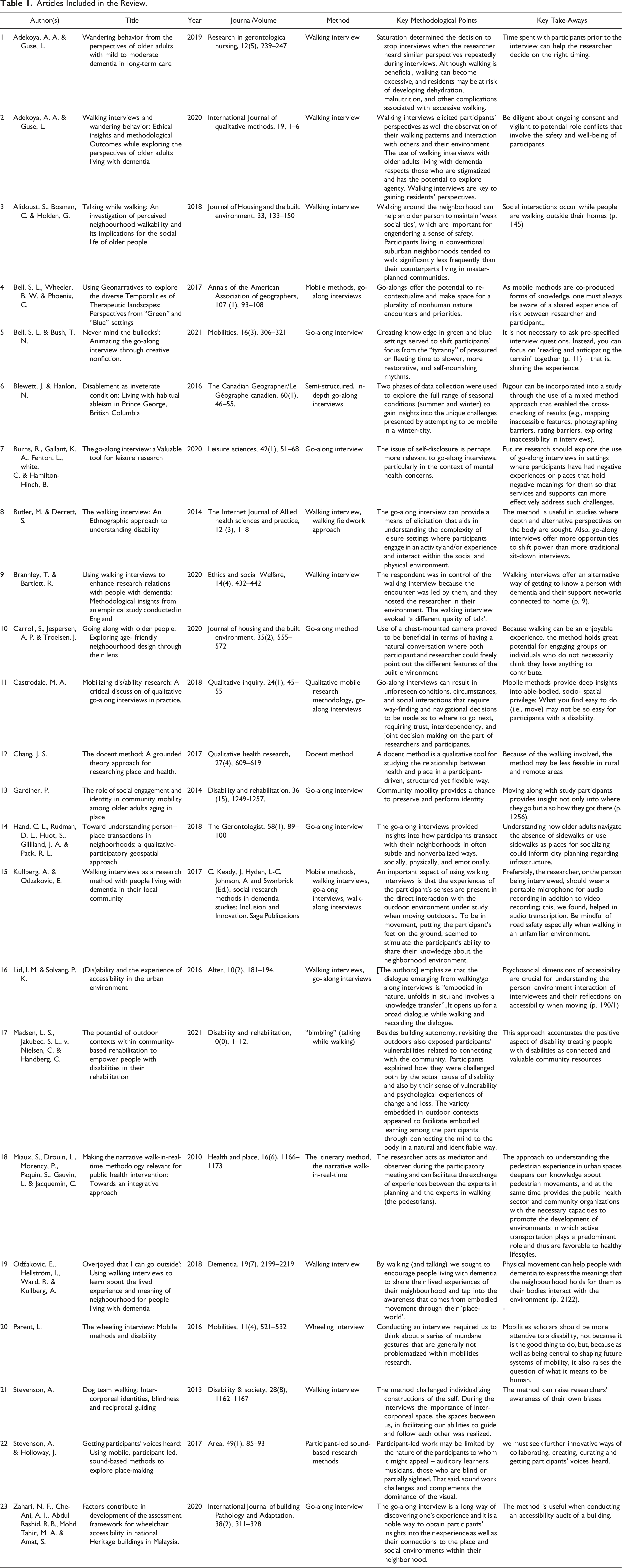
Findings
Five key themes were identified. (1) shifts in power dynamics (2) making things known and knowable (3) Revealing barriers to inclusion (4) embodied knowledge (of place), and (5) being one.
Shifts in Power Dynamics
When considering why and how walking go/along interviews were used with people in a vulnerable situation, we found a shift in power dynamics was noted by many authors. 11 of the included studies contained a statement on how walking-interviews involved a shift in power dynamics between the researcher and participant compared to a traditional sit-down interview, and that was why the method was used (Brannelly & Bartlett, 2020; Bell & Bush, 2021; Butler & Derrett, 2014; Carrol et al., 2020; Castrodale, 2018; Chang, 2017; Kullberg & Odzakovic, 2017; Miaux et al., 2010; Parent, 2016; Stevenson & Holloway, 2017). For example, Miaux et al. claimed that the walking interview-situation ‘empowered participants’ (p. 1171) and Parent (2016: 530) considered the practice of wheeling alongside a participant a worthwhile alternative to the ‘uneven methods and inequalities and power relations’ that typically underpin mobility research. Moreover, findings suggest that these shifts were intended by the researcher and occurred at both macro/societal and micro/situational levels.
Macro/societal level shifts of power occurred during the research design process. This means that researchers consciously opted for walking/go along interviews as a method of data generation to empower participants. Nine of the 23 studies had the stated aim of engaging or including vulnerable groups, including people with physical disabilities (Castrodale, 2018; Madsen et al., 2021; Stevenson, 2013; Stevenson & Holloway, 2017), people with dementia (Brannelly & Bartlett, 2020; Kullberg & Odzakovic, 2017; Odzakovic et al., 2018), older people (Carroll et al., 2020) and people with mental health conditions (Burns et al., 2020). These authors used walking/go along interviews because they regarded the method as enabling (rather than disabling) for persons with disabilities; one researcher went further still and considered the approach ‘political’ as it ‘opens up new spaces, places, and platforms for the often-subjugated voices’ (Castrodale, 2018). Such perceptions indicate the weight given to walking/go along interviews as a potential method for bringing about structural/societal change.
In studies informed by the social model of disability, the walking interview was consciously used by researchers to help change the long-standing oppression of disabled persons in research contexts, where they have only been included in research as objects; here it was considered an ethical responsibility for the researcher to cease using research methods that can (continue to) disempower disabled persons (Castrodale, 2018). Similarly, one of the studies with people with dementia used walking/go along interviews to challenge the biomedical model of dementia (Adekoya & Guse, 2019; 2020). Other studies were designed to include walking/go along interviews because researchers wanted to engage groups of people who are usually not included in research. For example, because they considered it easier for a person with dementia to participate in the research process, as there is less focus on verbal speech in this type of interview, compared to a more formal sit-down interview. Others stressed the memory-trigging qualities of a walking/go along interview, believing that walking in and around one’s neighbourhood makes it easier for a person with dementia to start a conversation (Madsen et al., 2021) and contribute to research (Carroll et al., 2020).
Micro/situational shifts of power occurred during the actual process of conducting a walking/go along interview. Several studies included reflections on the commanding benefits of this method for participants. For example, in one article it was suggested that ‘go-alongsoffer participants greater control over the topics to focus on in an interview (Burns, et al., 2020). Other researchers emphasized how walking/go along interview were used to create a more equal power dynamic between the researcher and researched (Bell & Bush, 2021; Burns, et al., 2020; Carrol et al., 2020; Stevenson & Holloway, 2017). One way of achieving this, evident in most of the included studies, was to organize the walk/go along interviews in such a way that the researcher followed participants on the route the participant had chosen; participants led the way, reversing the traditional role where the researcher is the expert and in control (Brannelly & Bartlett, 2020; Miaux, et al., 2010; Stevenson, 2013). Although, in the study by Parent (a wheelchair user) this was not always possible as one participant (a student with visual impairment) took a route that was not accessible for the researcher. This highlighted for the researcher how powerful and normative one’s perceptions of space can be when you can see (p. 528).
Making Things Known and Knowable
When examining the reasons for using walking go/along interviews with people in a vulnerable situation, findings suggest that one rationale is because the method makes things known and knowable. In studies involving people living with dementia, these things were often person’s skills. For example, Kullberg and Odzakovic (2017) explain how people with dementia will often act more purposively in a walking/go along interview than in a sit-down interview (e.g., by telling the researcher which way to go) thus making a person’s navigational skills known and knowable. Further, Adekoya and Guse (2020) argue that the walking interview ‘has the potential to explore agency in relation to older people with dementia because walking is a more active process than sitting down (p. 5). The same observation was made by a participant with dementia in Madsen’s study (2021), who said: ‘sitting and watching and looking at each other around the table [indoors]- that’s not very interesting after all’. These data show how walking interviews can draw attention to the strengths of a person with dementia therein challenging the idea of people with dementia as passive. Moreover, they show the epistemic role of this method in the scientific process.
In other studies, there was less focus on a person’s impairment, and more on how the method enabled participants to show a stronger, healthier side to themselves. For example, an informant in one of the included studies who used to be an athlete, explained whilst walking that the reason why he “wanders” is: “…it keeps your legs in shape. ...As an athlete you’re used to walking a lot and yeah…I like keeping in shape” (Adekoya & Guse, 2020: 242). Walking is an activity commonly pathologized in dementia discourse and labelled as ‘wandering (see, for example, Lin et al., 2012). Therefore, deploying the method with this group can help others to see walking in a different way. Odzakovic et al., (2019) found this and argue that walking interviews can help to demonstrate to care partners of people with dementia the need to understand the walking of people with dementia in a biographical context, rather than problematic or symptomatic of the condition. Similarly, in the studies by Adekoya and Guse (2019, 2020) and (Odzakovic et al., 2018) the method was considered empowering for people with dementia as it provided a context for understanding walking as a positive action. For other researchers, the walking interview helped to show the connection participants had with the outdoors and to nature, which many of the participants explained gave a much-needed break from a constant focus on impairment (Madsen et al., 2021). Together these data show how walking interviews can help to not only make a person’s capacities known and knowable, but also challenge some of the negative stereotypes associated with dementia (such as weak and passive).
In studies involving people with physical disabilities, there was an emphasis on how the process of walking/go along interviews can challenge negative stereotypes, by making the disabled body known and knowable. As one researcher notes, walking makes not only the body present, but also the disability and the challenges associated with it (Butler & Derrett, 2014). For example, one researcher who interviewed a woman with visual impairment with her guide dog, writes that ‘the concept of inter-corporeal generosity jars against discourses of individual tragedy and self-reliance that often prevail in discussions of visual impairment (guided partner cast as grateful recipient of assistance)’ (Stevenson, 2013, p. 1166). Similarly, Castrodale (2018) writes that the walking interview can ‘offer counternarratives that challenge the ways Mad and disabled persons are often pathologized, labelled, and individualized through biomedical understandings of disability and mental health’ (p. 46), and argues that ‘there is a need to critically (re)consider space and place in research practices in ways that value the often-subjugated voices and socio-spatial knowledge(s) of Mad and persons with disabilities’. In these instances, walking/go along interviews are considered an empowering tool for participants, as they ‘represent a means for identifying processes of disablement and able-bodied privilege in situ’ (Castrodale, 2018, p. 47) – they make the disabling process known and knowable.
Revealing Barriers in the Environment
When examining why walking/go along interviews were used with people in a vulnerable situation, some studies aimed to explore barriers in the environment and the method was intentionally deployed to reveal these (Blewett & Hanlon, 2016). In studies involving people with physical disabilities these barriers were mainly material in nature and often culturally specific. For example, in the study with wheelchair users conducted in Norway, environmental barriers included cobblestones and tram rails (Lid & Solvang, 2016). In the study by Parent (2016) conducted in Montreal and New York, mention was made of the ‘uneven sidewalks’ that he and his participants encountered while wheeling (p. 527). Whereas in the study with wheelchair users in Malaysia, barriers included steps and the architectural style of old ‘protected’ buildings (Zahari et al., 2020). In each case, barriers were in the built environment and the walking/go along interview method uncovered them relatively easily. This is why the method was used, to explore the barriers that persons with physical disabilities face everyday.
In some studies, the method revealed barriers in the environment brought about normative ideals of the human body, which the researcher was often unaware of. For example, one of the informants of Castrodale (2018) was a woman who identified as ‘death-fat’, which she did to ‘counter biomedical terms such as obese and the biomedical gaze that devalues fat bodies and to speak back to biomedical knowledges where death is always perceived at her doorstep’ (p. 49). During the walking/go along interview, the interviewee made Castrodale increasingly aware of his own able-bodiness as she pointed out that the furniture in the university seem to have been made with a ‘certain Vitruvian body in mind’ (p. 51) – that is, an architecturally perfect figure. Other interviewees in this study, highlighted the ‘inaccessible washrooms, areas with too much pedestrian traffic, and doors without accessible push-button openers’ (Castrodale, p. 52). Such barriers were collectively referred to as ‘oppressive structures’, as the researcher viewed them through the lens of the social model of disability (Castrodale, p. 51).
Embodied Knowledge (of Place)
Findings show that an important reason for using walking/go along interviews is to gain access to the participants embodied knowledge. Some researchers in our review describe the concept in terms ‘embodied experience’ and regard it as the ‘locus of situated knowledge’ (Lid & Solvang, 2016, p. 190). A recurring argument is that both the act of walking, or the body in movement, and place can give the researcher access to the lived experience of the participants, and a walking/go along interview is therefore seen as more suitable than a sit-down interview. Lid and Solvang (2016, p. 190) note how ‘person–environment interactions are difficult to express in simple terms’; it is much easier for a participant to show the researcher how the environment ‘can support or hamper self-esteem’ rather than try to describe it in a sit-down interview (p. 191). For example, in his study on people’s mobility in their city, Parent (2016) describes how wheeling with participants with different disabilities while navigating the city together, gave him information of the lived experience of the participants that would otherwise probably not have been reflected upon by neither him nor the participants. As Butler and Derrett (2014) concludes: walking interviews are useful in disability research because they have the inherent capacity to emphasize embodiment-they make the body present (p. 6).
Embodied knowledge is closely linked to the five familiar senses (i.e., sight, touch, smell, taste, hearing) (Stevenson & Holloway, 2017) as well as the oft ‘forgotten sixth sense’ proprioception or kinesthesia – that is, the body’s sense of space (Yardımcı-Lokmanoğlu et al., 2020, p. 42). Given the sensoriality of experiential knowledge, it is more likely to be stimulated and/or observed as a person moves through the outdoor environment. For example, one of the participants in the study by Madsen et al., (2021) who was recovering from a back injury, found the smell of the gardens and grass during her interview, restorative; other participants in this study commented on the sights and sounds of the surroundings they were exploring. One study focused exclusively on sound (Stevenson & Holloway, 2017). This study of place-making used ‘neither standardized soundwalks, nor routine walking interviews, but negotiated methodological permutations derived from a preference for walking, talking and listening’ (p. 91). The project involved two women, both of whom used a guide dog and prioritized sound. The researcher found that a sound-based walking interview method has huge potential as it can lead to the researcher re-sensing a place ‘through the sensory preferences of the participant and their participatory role in the research design’s construction’ (p. 88). In sum, walking/go along interviews were used because they provided researchers with rich data on how persons with disablities experience and interact with the world around them.
Being One
When examining why and how walking go/along interviews were used findings indicate that researchers valued the chance of ‘being one’with a participant – that is, sharing the same practice or experience (of walking/going along). Several authors referred to this phenomenon and reflected on it in some detail. Parent (2016) described it in terms of ‘maintaining togetherness’, as he said: ‘I did not learn so much about how participants move in their city as much as I learned about how we move together (our emphasis) (p. 528). Similarly, Bell & Bush (2021) write that the walking interview required a form of ‘whole body listening’ (p. 12) in that a ‘more-than-human presence’ seemed to ‘flow in and out of the interview frame en-route’ (p. 2). Bell & Bush (2021) therefore concludes that walking interviews should be treated as something more than an interview while walking. They refer to Vannini and Vannini (2017) who write that ‘we should rather go somewhere to feel a place, sense a landscape and its weather, and encounter a human being with whom we choose to walk’ (p. 193). In effect, then, the walking/go along interview method was used to allow for more than mere observation of the participant’s everyday life, but to share an experience.
Others described the being one experience in terms of ‘inter-corporeality’- individual barriers are erased as two people tune-in on each other (Stevenson, 2013). Stevenson explains, “as we walked along Oxford Road as a three-in-one entity, we crossed ontological and sensory borders. I grew used to moving as part of a threesome, wherein my sightedness did not necessarily offer a clearer perspective on the places we moved through” (p. 1164) (the three-in-one refers to the author, the participant, and her guide dog). In their arguments of this, both Bell & Bush (2021) and Stevenson (2013) underlines the more-than-verbal qualities of the walking interview; it is an interview where all the senses of the researcher are as important, and at time being-with is a form of listening that can be more important than the actual words being said. The term being one can also relate to what Castrodale (2018) writes about the amount of trust needed between the researcher and the participant for the walking interview to succeed. Compared to a traditional sitting-down interview, the walking interview often entails both interdependency and joint decision making.
Overall Methodological Insight
An overall synthesis of these themes culminated in the methodological insight that walking interviews are broadly aligned with applied phenomenological research – that is, the contribution of phenomenology to various disciplines (Zahavi, 2012) with phenomenology understood to be the study of essences (Merleau-Ponty & Bannan, 1956) and ever-evolving ‘way to educate our vision, to define our posture, and broaden the way we look at the world’ (Mortari & Tarozzi, 2010: 10). Two studies explicitly use the term phenomenological; one describing it as the approach taken in the research design (Lid & Solvang, 2016) and the other stating that the walking interview method enhances the credibility of the phenomenological approach (Odzakovic et al., 2018). In other studies, the alignment is more implicit, evidenced by the focus on the first-person perspective and/or the language used to describe the method, such as ‘lived experience’ (e.g., Kullberg & Odzakovic, 2017), ‘embodied knowledge’ (e.g., Bell & Bush, 2021), ‘showing’ (Miaux et al., 2010) and ‘place data’ (Chang, 2017) – all of which are integral to phenomenological research (Zahavi, 2012).
Discussion of Using Walking/Go Along Interviews Aith People in Vulnerable Situations
As French phenomenological philosophers Merleau-Ponty and Bannan (1956) pointed out ‘the world is not what I think, but that which I live’ (p. 66). Walking/go along interviews tap into this insight and possibly provide qualitative researchers with the fundamental rationale for using the technique. With a ‘phenomenological attitude, it is important to pay attention to not only how public objects (e.g., trees, buildings, streets, social relations) appear’, but also how the subjective side of consciousness becomes aware of, and make sense of such objects (Zahavi, 2012:3). Further, subjective perceptions of the world are ‘multisensorial’ and inextricably linked to the ‘cultural categories used to give meaning to sensory experiences’ (Pink, 2009: 28). In the context of this review, such categories, include ‘disability’, ‘dementia’, and ‘vulnerability’; these are what underpinned participants’ accounts of their outdoor experiences. As such, walking/go along interviews, provide researchers with an empirical tool to investigate the whole gamut of human experience.
Our review has usefully revealed two specific reasons for using walking/go along interviews with people in a vulnerable situation. One is that it allows researchers to engage with research participants on equal terms, most of the studies emphasized this aspect of the method. Researchers value how walking/go along interviews enable participants to express themselves in their own way, and in their own time. Such dynamics highlight the enabling and facilitative nature of this method. The second reason is the natural reversal of roles that seems to happen with this method; specifically, a walking/go along interview creates a unique opportunity for participants to take control during the data generation process. Both reasons are valid and important considerations given the history of the marginalization of persons with disabilties by researchers. There is an ambivalence here, though, which is that although participants might decide where and how to walk, the researchers decide why to walk. Only three of the included studies, involved persons with disabilities in the research design process (Castrodale, 2018; Hand et al., 2018); (Stevenson & Holloway, 2017); in one study, it was not clear whether persons with disabilities had been involved or not (Stevenson, 2013).
For people with a cognitive disability like dementia, this is an important consideration as qualitative researchers must try to understand a topic by accessing a person’s unique lived experience of it, not just their beliefs, views, opinions, or perceptions. Given that ‘our bodily experiences of the world are typically movement experiences (Naukkarinen, 2005), it makes epistemological sense for researchers to use a mobile method like a walking/go along interview. Significantly, our review indicates that this realization has only reached researchers in dementia studies relatively recently, compared to those working in other fields. The earliest study we found involving people with dementia was published in 2017 (Kullberg & Odzakovic, 2017). Yet, as already mentioned, the method has been available to researchers for over 20 years. We would therefore argue that there is great potential for dementia researchers to employ this method when exploring the views and experiences of people with dementia.
Another important methodological difference we found between studies involving participants with a physical disability, and those with participants living with dementia, related to how researchers explained the relationship between disability and the walking interview method. Most authors writing from a disability studies perspective highlighted how the walking interview led to an increased understanding of ‘disablement’ for participants - usually because of the physical barriers encountered while getting around. Whereas dementia scholars put a stronger emphasis on how the walking interview method allowed for an appreciation of ‘ablement’: cognitive deficits were less noticeable as the method enabled participants with dementia to exercise agency. One possible reason for this disparity is that the researchers in this review come from different disciplinary traditions. Disability scholars have arguably been more mindful of disabling barriers over the years than dementia care researchers. Another possible explanation is that physical barriers are more likely to be encountered in a walking/go along interview with a person with a physical disability, as steps, uneven surfaces and such like are often unavoidable. While the disabling barriers for people with dementia, such as taking the bus and other cognitively-taxing situations like shopping, can be circumvented in a walking interview. In the past, dementia care researchers have said that noise is a barrier for people with dementia in the same way as steps are for people with a physical disability (Marshall, 2005). Our review suggests that walking or wheeling for people with a physical disability can be compared to interviewing a person with dementia while they perform tasks that require logical or abstract thinking.
Currently, much of the literature on walking/go along interviews focuses on the methodological advantages and limitations of using this technique, rather than any potential risks or burdens to the participant. It is a method that involves going out in public and ‘talking on the move’ (Parent, 2016) activities that someone in a vulnerable situation might find challenging to do or experience. For example, some disabled participants have reported concerns about a ‘heightened exposure to surveillance’ whilst out talking to a researcher (Castrodale, 2018). Others, including persons with dementia, ask that researchers consider a person’s physical and emotional safety when involving people with this disability in empirical research (Scottish Dementia Working Group, 2014). International codes of research ethics emphasize how ‘the security, anonymity and privacy of research subjects and informants’ should be paramount during any data collection procedure (The International Sociological Association’s (ISA), 2001). Thus, it is important for qualitative researchers to consider how the process of generating data could adversely affect a participant, especially someone who is at risk of discrimination, harm, or abuse.
Strengths and Limitations
The main strength of this qualitative synthesized review is that (1) by combining studies we have investigated the methodological rationale for using walking/go along interviews with a relatively large and diverse sample of persons with disabilities, including people with dementia (2) it included studies which used walking/go along interviews as both the primary and complementary method of data generation. The main limitation is that by only including peer-reviewed articles written in English we may have excluded other relevant works.
Conclusion
We conducted a qualitative synthesized review of the evidence on walking/go along interviews that included 23 studies to examine why this method is used with persons in a vulnerable situation. Our synthesis of this evidence base has contributed to knowledge on walking/go along interviews studies by showing how the method is epistemologically aligned to applied phenomenological research; a hallmark of which is that research ‘offers an account of human existence, where the subject is understood as an embodied and socially and culturally embedded being-in-the-world’ (Zahavi, 2019:132). Fundamentally, walking/go along interviews were used to understand and share peoples’ subjective experiences of the world. Further, the method can enrich researcher’s reflexive awareness of their ideas about disability. As one of the researchers in our review stated, the method can ‘provide deep insights into able-bodied, socio-spatial privilege’ (Castrodale, 2018; 52). Not least because the act of walking or moving along with a disabled participant can help a researcher to understand that their spatial perceptions of the world, are not necessarily universal or shared by others.
Footnotes
Declaration of Conflicting Interests
The author(s) declared no potential conflicts of interest with respect to the research, authorship, and/or publication of this article.
Funding
The author(s) disclosed receipt of the following financial support for the research, authorship, and/or publication of this article: This work was funded by VID Specialized University, Norway, as part of The Citizens Project (CitPro): Everyday Citizenship for Persons in Vulnerable Situations.
