




Abstract
Interpretative phenomenological analysis (IPA) is a qualitative thematic approach developed within psychology underpinned by an idiographic philosophy, thereby focusing on the subjective lived experiences of individuals. However, it has been used in focus groups of which some have been critical because of the difficulties of extrapolating the individual voice which is more embedded within the group dynamics and the added complexity of multiple hermeneutics occurring. Some have adapted IPA for use with focus groups, while others provide scant regard to these philosophical tensions. This raises the question whether IPA should be used with focus group data. To address these concerns, this article will set out a step-by-step guide of how IPA was adapted for use with focus groups involving drug using offenders (including illustrative examples with participants’ quotes). A rationale of why it was important to use both focus groups and an IPA approach will be covered including the value, merits, and challenges this presented. An overview of how participants’ idiographic accounts of their drug use, relapse, and recovery were developed will be provided. This article will conclude with a suggested way forward to satisfy the theoretical tensions and address the question raised in the title.
Keywords
Introduction
Interpretative phenomenological analysis (IPA) is a qualitative thematic approach rooted within the philosophies of phenomenology, hermeneutics, and idiography. It was developed within the field of health psychology by Jonathan Smith and colleagues over 20 years ago and is now an established approach which has gained popularity within qualitative psychology (Smith, 2004; Smith et al., 2012). Key principles of phenomenological psychology are peoples’ subjective experiences and the meanings they ascribe to their lived world and how they relate to it (Langdridge, 2007). Hermeneutics can be understood in terms of how experience is interpreted from language and text. Smith et al. (2012) believed that understanding a phenomenon or experience involved the researcher attempting to understand the participants who in turn are trying to make sense of their own experiences (termed the “double hermeneutic”). The researcher is considered part of the co-creation of participants’ meaning-making. An idiographic approach pertains to a detailed focus on a person’s subjective lived experience of a particular topic. As such, the analytical process of IPA is concerned with an inductive analysis of each individual’s account, which has reached some level of Gestalt (which means complete) first before moving onto the wider group analysis (Smith, 2004). The approach favors a small homogenous sample who share a similar experience, whereby the idiographic accounts of individuals can be illuminated while accommodating commonalities across the group (Smith et al., 2012). The interview method has therefore been the most feasible and favored approach by which to capture idiographic accounts (Smith, 2004) and is the approach that overwhelmingly features in published IPA work (Brocki & Wearden, 2006).
However, IPA has been used in focus group settings which some have criticized (Blake et al., 2007; Dunne & Quayle, 2001; Flowers et al., 2001). Such criticisms have centered on the difficulty of extrapolating the idiographic accounts, which are more embedded within the shared experience of a focus group setting (Palmer et al., 2010) and that the collective group voice dominates the individual’s account (Tomkins & Eatough, 2010). Furthermore, multiple hermeneutics are occurring adding to this complexity; the researcher is trying to understand the participants’ meaning-making who in their turn are trying to understand each other’s meaning-making in a group (Tomkins & Eatough, 2010). Others have adapted IPA for use in focus groups to ease these philosophical/theoretical tensions (Palmer et al., 2010; Tomkins & Eatough, 2010). Other criticisms of such studies include a lack of detail about how modifications to IPA were made and that the focus group dynamic was ignored (Tomkins & Eatough, 2010). More recent IPA studies using focus groups (Githaiga, 2016; Makin, 2012; Phillips et al., 2016) illustrate that these tensions still exist, and the criticisms outlined above still apply. This raises the question of whether IPA should be used with focus group data.
To address these concerns, this article will set out a detailed account of how IPA was adapted for use with focus groups involving current offenders and ex-offenders who use drugs (including illustrative examples with participants’ quotes). A rationale of why it was important to use both focus groups and an IPA approach will be covered including the value, merits, and challenges this involved and the modifications required in facilitating the groups. The use of the IPA approach to show how participants’ idiographic accounts of their drug use, relapse, and recovery were illustrated will be provided. This article will conclude by revisiting the question posed in the title.
The Focus Group Study—Introduction
A series of focus groups with community-based ex- and current offenders who used drugs, who had been part of the UK Government’s Home Office’s Drug Interventions Program (DIP), were conducted to explore how they experienced and made sense of their journey of relapse and recovery in relation to their significant life events and relationships. Community-based offenders who used drugs represent a group which is difficult to access and engage in research (Rhodes, 2000). Their highly politicized and stigmatized status as both drug user and offender on a government-led strategy meant their voice had largely remained unheard within published research. The lead author had also been employed by the Home Office and had helped to develop and implement the DIP over many years. The aim of the DIP was to provide support to community-based current and ex-offenders who used Class A drugs (crack, heroin, and cocaine) and whose drug using behaviors were considered to be driving their criminal behavior in order to fund their substance use. Support included help with their Class A substance use dependency problems, access to education, employment opportunities, support with financial management, and access to housing and accommodation (for further information on the DIP, see LeBoutillier & Love, 2010). It was important to use a phenomenological approach to permit this group’s voices to be heard and to use an IPA approach, which employs methods through the process of reflexivity to recognize and manage the preconceptions from the unique political positioning of the lead author. The focus group study aimed to explore the value and merit of the research questions with the participant group. The aim of the research, which included this study, was to inform policy development and practice. This study received ethical approval from the University of Surrey and the National Health Service (NHS) Ethics Board.
Focus Groups, Cards Sort Tasks, and Phenomenology
Focus groups offer flexibility in that they are not necessarily bound to a particular epistemological positioning (Wilkinson, 1998). While Smith et al. (2012) are open to the use of focus groups with IPA, Smith (2004) is cautious about the feasibility of extrapolating an individual’s experience from the group, adding that doing so is dependent on the topic, the facilitator’s skill, the participants themselves (such as a participant dominating the group to the detriment of others voicing their accounts), and modifications during the analysis. Focus groups can, however, enhance personal accounts (Flowers et al., 2001) by capitalizing on the peer-to-peer interactions and rapport, especially in an homogeneous sample with shared experiences on sensitive and stigmatizing topics such as drug use.
There is a gap in the research field involving community-based offenders who use drugs, who form part of the UK Government (England and Wales) criminal justice strategies (Senker & Green, 2016), in the use of qualitative methods (Hucklesby & Wincup, 2010). Although the wider body of literature on relapse and recovery might have some relevance, it was important to understand whether this resonated with the experiences of this specific participant group. The overall aim of the research was to help inform policy and practice for this group of people.
Focus groups have been used extensively to develop questionnaires for survey data and offer the opportunity to verify whether the questions convey the researcher’s intended meaning (Morgan, 1997). Focus groups were therefore considered suitable to explore the value and merit of the questions with the participant group and to help develop a semistructured interview schedule for a further study. Where participants share experiences and are emotionally invested in the same topic of exploration, smaller numbers of participants are deemed adequate (Morgan, 1997). Furthermore, this can facilitate helping to capture individual responses. A group dynamic still exists, including multiple hermeneutics, even in groups that contain two or three participants. For example, in this study, group discussions, which involved two or three participants, included agreements, disagreements, and lengthy discussions, as evidenced in the transcript extracts.
A card sort task was considered to offer an engaging means to foster co-operation, interaction, to build trust quickly among members, and to place the ownership for the discussion with the group members. Card sort tasks vary but usually involve participants sorting items on cards in relation to a set of questions and have been used in phenomenological research to offer a creative and novel means to help engage participants in the research (Shinebourne, 2009; Shinebourne & Adams, 2007a, 2007b). The participant group, due to their severe drug addictions, can be difficult to engage in research (Rhodes, 2000). For example, they present with complex needs (such as mental health problems) which means they can struggle with attention and concentration as others have suggested (Neale et al., 2005). Smith (2004) suggests that some participant groups, such as those with learning disabilities, might need a more guided approach by the researcher.
The card sort items were developed from the DIP policy, the wider relapse, and recovery literature and from developmental psychological theories such as Flores (2012), Khantzian (2012, 2014), and Van der Kolk (2008). However, many of the items were open-ended to offer participants their own interpretations, for example, “family” and “friends.” Furthermore, participants were encouraged to discuss the meaning and importance of the card sort items to help engage participants and foster rich discussion. The discussion was the unit of analysis, not the categories of importance that participants were asked to sort the cards into (i.e., the data were not quantified). The exploratory aim of the study and the need to encourage and enhance personal accounts on sensitive topics among a group who can be difficult to engage in research were the clear rationales for using focus groups (with a card sort design) over an interview method.
Considerations to Help Privilege Idiographic “Journeys”
Using larger numbers of participants in a focus group might prove especially difficult to extrapolate an individual’s account from the group and weaken the idiographic commitment of an IPA approach. Githaiga (2016) found focus groups of 13 were too onerous to manage, thus reducing subsequent focus groups to less than 5, permitting participants to talk more in depth on their own accounts. Making notes on group dynamics and interactions (to help extrapolate idiographic accounts during the analytical stage) with smaller numbers of participants in a group would also be more feasible and practical. This could be aided further if video recording of the groups is permitted or more researchers are available. More focus groups with smaller numbers would seem a valid and sensible option over one large focus group. Morgan (1997) supports the use of smaller numbers in a focus group, where the group is homogenous and participants are emotionally connected to the research topic (such as drug use). In the research reported here, four focus groups with a maximum of five per group were considered feasible to satisfy this recommendation. Due to a high dropout rate, there were two to three participants per group.
Facilitating the group to ensure that all participants were able to provide their accounts was possible by carefully constructing the design of the focus group. The card sort task design placed the ownership for the discussion on members who were given roles such as reading the card sort items, placing the items in terms of importance on a poster, and discussing among themselves what they thought about each item in relation to a set of questions. The role of the facilitator in this research also involved managing group dynamics that might hinder individuals voicing their accounts and/or the flow of the discussion (such as interjecting and/or redirecting questions from dominant group members to quieter members). Managing group dynamics with current and ex-offenders who use drugs presented particularly challenging moments, for example, easing tensions between a participant who had a previous conviction for murder and a participant who was a victim of an attempted murder (see section—Procedure for Interpretative Phenomenological in Group Analysis: A Step-by-Step Guide, Step 4a, for further detail). Some of these potentially challenging dynamics were anticipated and where possible measures were taken to minimize conflicts prior to recruitment. For example, during recruitment, participants’ criminal histories were checked to ensure that rival criminal gang members were not part of the same group, no court-mandated restrictions were in place in relation to other group members, and no Multi-Agency Public Protection Arrangement status sex offenders were allowed to take part (these were also important safeguarding measures and are reported on in another paper, see Love et al., 2019).
Participants
Participants were current or past DIP’s adult men and women clients who were community-based current or ex-offenders. Primarily they had Class A drug use problems (crack, heroin, and cocaine) and were at various stages of relapse and recovery. There were four focus groups with two to three participants in each group with a total of N = 10. Two focus groups were the same gender (two men and two women), and two focus groups were different genders.
Procedure
The focus group schedule was developed into two card sort tasks addressing two questions (Questions 1 and 2) and two further questions (3 and 4) to elicit participants’ experiences of their journey of drug use, relapse, and recovery. Due to ethical considerations raised by the NHS Ethics Board, the questions were constructed in a manner which allowed participants to choose to speak from their own personal experiences or more generally—all participants spoke from their own personal experiences.
Card Sort Task 1
Question1: What do you think might cause someone to relapse from Class A drugs?
Card Sort Task 2
Question 2: What do you think is helpful in sustaining a person’s recovery from Class A drugs?
The card sort items were developed from the substance use relapse and recovery literature, relevant psychological developmental theories, the DIP drugs policy, drug workers, and the researchers’ knowledge of the participant group (“drug worker” was the term used to refer to staff in the DIP services who provided assessments, referrals, and support to the client group). They were piloted with a drug worker and a person who used drugs, which led to some minor changes in wording and terminology that would be more familiar to the participants.
The first card sort task (Question 1) had 16 items which included “being a parent,” “family when growing up,” and “friends”; the second task (Question 2) had 18 items which included “partner,” “not committing crime,” “somewhere to live,” and “feeling able to cope when upset, without using drugs.”
Participants were asked to read an information sheet about the research and consent to taking part and to being audio recorded. This included agreeing to the limitations of confidentiality which was based on the National Treatment Agency guidelines and the rehabilitation organization’s own policy. For example, participants were not permitted to speak in detail about any crimes that they had committed and of which the police were not aware (i.e., charged, convicted, or arrested). All participants completed a short demographic questionnaire that also sought information about their drug use and status as a current or former DIP client.
Participants were asked to discuss the importance of each card sort item when addressing Questions 1 and 2 and decide among themselves whether each card sort item was “not important,” “quite important,” or “most important.” They were encouraged to discuss the items as much as possible (they were informed there were no right or wrong answers and they did not have to agree with each other). Some participants chose to create new categories of importance.
The first focus group was given the card sort task, and participants were given the option to write anything down on Post It Notes which they felt had not been covered, although in subsequent focus group, participants were asked Questions 1 and 2 prior to completing the card sort tasks. This allowed participants to think about the questions independently of the card sort items to help reduce researcher bias. However, they raised the same topics which were included on the card sort items.
Participants were offered a short comfort break before being asked to discuss two final questions: Question 3: What do you think are the reasons for some people to start taking Class A drugs? Question 4: What do you think might be the reasons for some people to use a lot of Class A drugs, frequently, over a long period of time, and become addicted to drugs?
Participants were provided a debrief by the researcher and offered a counseling session with a trained counselor if they felt the research had raised any issues for them which they wanted to talk about further. They were made aware that this was confidential and did not form part of the research findings. One participant chose to have the counseling afterward. Participants were then thanked for their time and offered lunch and reimbursement of their travel for taking part in the research.
Procedure for Interpretative Phenomenological (in Group) Analysis—A “Step-by-Step Guide” for Adapting IPA for Focus Groups
A step-by-step guide was developed in this research to adapt IPA for use with focus groups by incorporating steps from Palmer et al. (2010), Smith et al. (2012), and Tomkins and Eatough (2010) and the researchers’ own suggestions. Table 1 provides a summary. Seven superordinate themes were developed from the analysis (see Figure 1), and an example of how one of these superordinate themes was developed using the adapted IPA approach is provided (see Figures 2 –8). Credibility checks to strengthen the quality of the research included the first author presenting the main superordinate themes, themes, and supporting extracts of participants’ quotes to an IPA research network group. Participants’ names have been changed to help protect their identities.
Procedure for Interpretative Phenomenological (in Group) Analysis: A Step-by-Step Guide.

Note. IPA = interpretative phenomenological analysis.

Taxonomy of superordinate themes (in upper case), organized in a “logical sequence” based on participants’ lives from childhood to adulthood involving substance use, relapse, and recovery. Note. Lowercase (gray boxes) demonstrates the interrogative questioning of the data to help form the “logical sequence” of the superordinate themes. Arrows show hypothetical links between superordinate themes.

Focus Group 1 analysis relating to relationships, showing superordinate themes, themes, and the development of themes (depicted in lower case).

Focus Group 2 analysis relating to relationships, showing superordinate themes, themes, and the development of themes (depicted in lower case).

Focus Group 3 analysis relating to relationships, showing superordinate themes, themes, and the development of themes (depicted in lower case).

Focus Group 4 analysis relating to relationships, showing superordinate themes, themes, and the development of themes (depicted in lower case).
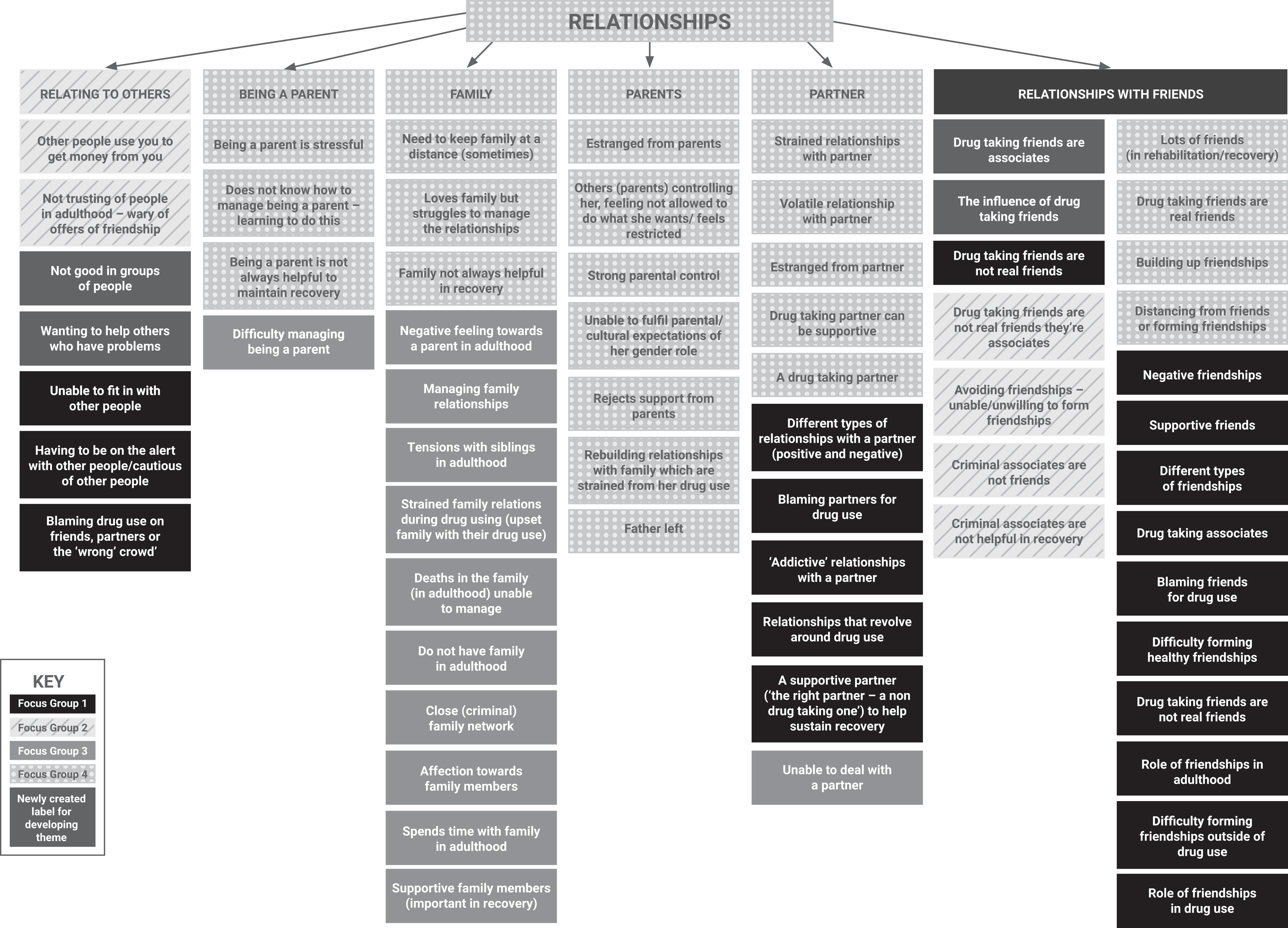
First draft of amalgamated superordinate themes, themes, and the development of themes (depicted in lower case) across all focus groups.

Second draft of amalgamated superordinate themes, themes, and the development of themes (depicted in lower case) across all focus groups.

Version of amalgamated superordinate themes and themes across all focus groups before and after credibility checks.
Step 1: Immersion in the Data
The focus group discussions were transcribed verbatim by the lead author to help immersion in the data.
Step 2: Identifying the Researcher’s Orientation and Potential Bias
Before the focus groups were conducted, the lead author undertook a self-reflexive interview to identify any preconceptions she might hold about the research, which could influence the research process and data analytical stages (Dallos & Vetere, 2005). The phenomenological approach adopted considers that the researcher forms part of the participant’s meaning-making process, therefore reflective research diary notes after each focus group and during the analytical interpretative stages were also captured (Smith et al., 2012). This process helped the first author to understand her political positioning in relation to the participant group and is expanded on in Step 4a in the example of the participant called Kevin. Further information is also provided in Love et al. (2019).
Steps 3(a) and (b): Identifying Significant Life Experiences and Relationships
The transcripts were read twice, and significant life experiences and relationships that had phenomenological relevance encapsulating participants’ meaning were noted using descriptive, linguistic, and conceptual commentating and “similarities, differences, echoes, amplifications and contradictions” (Smith et al., 2012, p. 83, see Table 1, Step 3a). How participants discussed a topic (and card sort item) also signified important experiences. This was achieved by following suggestions by Palmer et al. (2010, p. 104, see Table 1, Step 3b) to explore instances where group members agreed or disagreed, their “positionality,” “stories,” and their use of “language.”
Example of how this was achieved in the research
Significant life events included bereavement, abusive childhoods, mental health problems, criminality, severe addiction to Class A drugs (crack and heroin), and difficult relationships. These were identified by members returning to talk about events, speaking emotively (upset, angry, and distressed), fluctuations in their tone of voice, stuttering, pausing, repetition, interrupting, agreeing or disagreeing, digressing from the topic, changing the topic, returning to a topic, lengthy discussion on a topic, talking loudly or quietly, and using humor. Participants also used elaborate metaphors (Shinebourne & Smith, 2010) and gesticulations to convey significant experiences. Some of these are illustrated in the extract below where Ellen, David, and Kevin discuss their reasons for drug use. Each provides their own nuanced account but agree on using drugs to cope with emotions, thoughts, and feelings. (“-” indicates where participants interrupted each other; “[” indicates where participants talk over each other; underlined word illustrates the participant’s emphasis on a word; “PI” is the lead author facilitating the focus group).
(Extract from Focus Group 3)
To block out feelings. People too. To me personally to block out feelings to how I felt basically–
Is that how you felt from? –
How I was before on drugs then from when I was using drugs. I’ll be truthful like if it weren’t addictive we would most probably all be on it now. I think the whole world would because it’s the best mind blocker going, I don’t care what anyone says right –
So it blocks emotions and thoughts?
It blocks everything out when you’re on it you don’t think, you don’t care about nothing, you ain’t got no care in the world. The only thing you care about is getting your next fix, because you don’t want that feeling to go away it gives you that warm glow –
The Ready Brek glow –
This discussion continued for some time, below it is rejoined at the point when Ellen and Kevin use metaphors and dramatic displays of body language such as gesticulations to illustrate their accounts.
(Extract from Focus Group 3)
And then bring in the
What Ellen said, what Ellen said there it took me two years to get an habit, right it took me two years and I was down in two years but when I did get it, I’d be truthful like before the crack came along I used to enjoy the gear. I’ll be straight with you, yeah I used to like it, I don’t like what anyone says it’s the best memory blocker going in the world, you got no cares, worries in the world –
Did you find that’s why you were using too?
Oh yes for a memory blocker, comfort, warmth, life doesn’t matter – (Ellen wraps her arms around herself).
-You get that glow –
Like I can be a real worrier and I’ve got a real conscience too, it was like nothing mattered, [nothing mattered –
I know what Ellen, you know who, a thing, the way I’d explain it to you is, say if you have a bit of gear (heroin) a rainbow comes over and it’s like glow, you know with like a rainbow with all them bright colors, that’s like how it feels inside. (Kevin demonstrates with his hands moving in the shape of a rainbow radiating outward from his stomach).
David would you say?-
Like the, like the wound heals –
So you carry on taking because you? -
Yeah because didn’t have to deal with it -
With what happened? -
Because the effects would wear off and it would be like argh (Ellen makes a painful distressing sound). I’d get the fear and panic -
I fell in love with it and I thought it loved me but it didn’t, it loved money.
Step 4a: Identifying Emerging Themes
The focus of the analysis is based on the researcher’s notes and interpretations to identify patterns and links across the focus group data. The hermeneutic process whereby the micro-level data (which remain close to the transcript) are linked with more macro-level interpretation (meanings and context across the focus group). Self-reflective annotation is important at this stage to capture the researcher’s own bias, emotions, and thoughts about the evolving interpretative process (Smith et al., 2012). Self-reflections also include how the researcher interprets group members’ reactions and dynamics toward each other, known as multiple hermeneutics (Tomkins & Eatough, 2010).
Example of how this was achieved in the research
Kevin disclosed that he had been convicted of murder during his younger years. As the lead author facilitating the focus groups, I was shocked at this level of violence, which made me more vigilant of his temperament during the focus group. However, this was further compounded because David disclosed that he had been the victim of an attempted murder. There was friction between Kevin and David during the first half of the group. David was seated next to Kevin but with his back toward him. Kevin had literacy problems which he had mentioned at the beginning of the group. David was given the task of reading the card sort items aloud but did not do so and had to be prompted by myself. David avoided eye contact with Kevin and directed his conversation toward Ellen, often excluding Kevin from the conversation by avoiding lengthy discussions or interrupting Kevin. Kevin was tall and well built, dominated the group, and was very loud. David was physically smaller, slender, and quietly spoken, which might have contributed toward David’s protective body language and excluding behavior. During the analytical process, I reflected on the group dynamics and how I felt. I was intimidated by Kevin’s demeanor and past violent history. I therefore turned my focus to consider why Kevin might have committed murder and what might have contributed toward his violent disposition. I consciously tried to put his label of “murderer” to one side. This helped me to see the child he had once been. He spoke about a disturbing childhood which included memories of his father and wider family’s criminality; he struggled to trust adults during his youth, which still affected him. I discussed these reflections and interpretations with the second and third authors who helped me to see the vulnerable child once within, which further helped me to make links across the focus group to other participants’ vulnerable childhoods and the impact these continued to have on them in their adulthood and in their journeys of drug use, relapse, and recovery.
Step 4b: Adaptations to IPA for Identifying Emergent Themes
While emerging themes are being considered, Palmer et al. (2010) suggest exploring how the group manages and makes sense of the experiences being shared. For example, How is conflict dealt with? Is it resolved? How is it resolved? Does it create tension? How is the tension expressed? Points of agreement/disagreement provide opportunities to further help identify and develop themes. See Table 1 for a list of Palmer et al. (2010) guiding questions.
Example of how this was achieved in the research
The role of friendships was an important area of discussion in all focus groups. However, this meant different things to different group members. In the extract below, Samuel and Clare have a lively conversation about what friendships mean to them. This was punctuated by disagreements, animated speech, and lots of humor. Looking at patterns and links across the other focus groups revealed that for some, friendships during their drug use were not real friendships and could pose a risk to their recovery. However, for others, such friendships were considered to be an important part of their social network. Further macro-level analysis suggested that those experiencing more sustained recovery were more wary of having ties to their past drug using networks or friendships. (‘’ indicates the card sort item topic; underlined word illustrates the participant’s emphasis on a word).
(Extract from Focus Group 2)
Erh, “not having friends.” (Contemplative tone)
(Laughs loudly when she looks at Samuel).
I would question that. You know why? I haven’t got friends. But then again all my friends are not friends they’re associates.
Associates?
(Nods his head in agreement).
So not having friends are right…the true meaning of not having friends means…
Mean you don’t have…Yeah man.
Yeah.
Erh. “Friends.” Argh, you see now again, when you say friends if I’ve got my friends and they are around I don’t even thinking about it coz I’m my, we’re just on a different vibe. True friends I’m talking about. So when I’m around my friends its…
But the thing is I haven’t got any friends. (Long pause) I haven’t got any friends. That’s the honest truth. I’ve got acquaintances and, and a sort of my Mrs, you know and an
Yeah, yeah].
Steps 5(a–c): Clustering Themes and Identifying Emerging Superordinate Themes
Step 5a: Organizing the data: PowerPoint and Word files
Figures 2 –8 illustrate Steps 5, 6, 8, and 9. PowerPoint was used to organize superordinate themes and themes developed from each focus group. Each focus group was given a color code (the color codes are depicted in gray scale in Figures 2 –7), so the lead author could identify from which focus group the themes originated during the amalgamation stage (see Step 6). An audit trail was established using Word files, which included participants’ supporting quotes from the transcripts cataloged against each theme and superordinate theme for each focus group. This also included the researcher’s reflections. This PowerPoint and Word file audit process was also used for when themes and superordinate themes were amalgamated to produce the final taxonomy. These processes helped during the iterative and hermeneutic stages and also when themes were checked for their recurrence (see Step 7).
Step 5b: Clustering themes and identifying and developing superordinate themes for each focus group
Abstraction, subsumption, polarization, contextualization, numeration, and function were used to cluster similar themes together (Smith et al., 2012). No adaptations to the Smith et al. (2012) suggestions were necessary to achieve Step 5a. This involved creating superordinate theme labels to describe themes or a theme being developed into a superordinate theme. This was completed for each focus group before moving onto Step 6.
In IPA, the aim is to capture a participant’s experience in the analysis, as completely as possible (to reach a level of Gestalt, Smith et al., 2012). In the focus group (IPA approach) analysis, a useful way to determine this is to ask yourself whether you can summarize each participant’s experience in a couple of paragraphs and how does each participant’s experience “map” onto the superordinate theme and themes you have developed for the focus group. Step 5c below will also help with this.
Step 5c: The “additional iterative loop”
Tomkins and Eatough (2010, p. 250) suggest the multiple hermeneutics which occur in focus groups means that an additional iterative loop should be utilized. In practice, this involved assessing how each participant was represented by each group-level superordinate theme. This helped to ensure the idiographic element was not excluded, for example, checking the transcripts using the “find” function in Word which captures the meaning of themes (such as bereavement, death, dying, loss, grief) against each participant for supporting quotes. Any newly emerging quotes were analyzed by contextualizing them across the data set (the rest of the transcript for that focus group) and using the researcher’s notes to determine whether the participant was currently represented in that theme or if they should be included. This process was facilitated by establishing a clear audit trail as described in Step 5a.
Steps 6(a–b): Amalgamating Themes and Superordinate Themes From All Focus Groups
It is strongly recommended that multiple focus groups with smaller numbers of participants are used with the adapted IPA approach. Therefore, superordinate themes and themes will need to be amalgamated across all focus groups, once the analysis for each focus group has been completed.
Step 6a—Integration of multiple focus groups
This step followed suggestions for successful integration by Palmer et al. (2010), which involved looking for similarities and differences for themes and superordinate themes across all focus groups using the iterative and hermeneutic process and the processes outlined in Step 5b (Smith et al., 2012). This developed an overall taxonomy of superordinate themes and themes.
Example of how this was achieved in the research
All four focus groups had themes and superordinate themes that were broadly about relationships. Figures 2 –5 were printed out in hard copy and then cut up by hand and grouped together, which produced Figure 6. Duplications were deleted, and some theme names were developed to provide further detail (see Figure 7). The iterative and hermeneutic process helped to develop the themes further (see Figure 8). This also included rechecking transcripts to ensure participants were represented in the newly developed taxonomy (as in Step 5c, “the additional iterative loop”). One means by which this was achieved was by using the “find” facility in Word to search for terms to pin point accounts of potential relevance. Such as “mum,” “dad,” “sister,” “brother,” “family,” and “childhood,” to identify points in the transcripts where relationships with family members might be discussed. Some themes were discarded where there was little supporting evidence of their importance or where it was not prevalent across all of the focus groups.
Step 6b—Consider the importance of the stand-alone theme
Tomkins and Eatough (2010), however, suggest that sometimes a stand-alone theme (where it is represented by one participant) should be included if it holds particular importance for just one or two participants. In this research, only three participants represented the theme “managing mental health in a healthier way.” In Focus Group 4, Zoe and Tina discussed this at length which was mostly instigated by Tina who was trying to encourage Zoe to attend mental health therapy groups. Tina had recently discovered how helpful these groups were in helping her to manage her mental health. It therefore held particular importance for her. Samuel from Focus Group 2 was also learning to manage his mental health through counseling sessions he was attending. This theme was presented for credibility checks at an IPA research network group, where group members considered that the theme was important for these individuals. This helped the first author to bring forward and make relevant the importance of this stand-alone-theme for these participants. The authors further considered that mental health can be a sensitive topic that not everyone in a focus group might be comfortable discussing; therefore, this was a topic that warranted further investigation in a second study involving one-to-one interviews. For these reasons, this theme was kept in the final results. Smith et al. (2012) recommend that analysis of the data always requires consideration of the aims and purpose of the research project.
Steps 7: Checking the Recurrence of Superordinate Themes and Themes
Smith et al. (2012) suggest that at least a third of participants should be represented in each theme for it to warrant inclusion in the final taxonomy of themes. Tomkins and Eatough (2010) suggest checking should be conducted at the superordinate theme level. To remain close to the idiographic ethos of IPA, checking of recurrent themes was conducted at the participant level as well as at the focus group level. The iterative analytical loop was revisited here by a refocus on the transcripts for participants’ involvement in the superordinate themes and themes. In the research reported here, this was achieved by exploring participants’ involvement across four identifiable dialogue typologies in relation to the themes: (1) participants’ individual dialogue where no obvious group influences were apparent; (2) participants’ dialogue where it was apparent it had been influenced by group members such as prompts, encouragement, revisiting, or referring back to topics of conversation; (3) participants’ dialogue that was clearly part of an ongoing conversation with other members in relation to a theme; and (4) the group collective voice where all participants agreed or disagreed.
The stand-alone theme was also considered in this stage of the analysis. There was high support for all of the superordinate themes (8–10 participants were represented in each superordinate theme) and between low to high support for the corresponding themes, with the majority of themes being represented by 7–10 of the participants.
Step 8: Conduct Credibility Checks
The research followed suggestions by Neale et al. (2013), Smith (2011), and Yardley (2008) to ensure the process was robust and followed high-quality standards. For example, the first author undertook extensive training in IPA. Credibility checks were conducted during the interpretative and analytical stages to check for validity. This included discussing the development and interpretation of themes with IPA specialists, an IPA research network group, and others involved in the research (such as in Steps 4a and 6).
Step 9: Organizing the Superordinate Themes Into a Hierarchy
Seven superordinate themes were developed and ordered into a “logical sequence” (Smith et al., 2012). In this research, this was achieved by considering the overall research questions (the influence of developmental psychological theoretical approaches) and the “story” presented by the overall findings, which included a chronology of participants’ lives from childhood to adulthood around their drug use, relapse, and recovery. This chronological presentation of participants’ lives that was evident in the themes presented an obvious logical sequence that was then used to develop an interview schedule for a further study. Figure 1 illustrates this thought process.
Discussion
Using the Tomkins and Eatough (2010), “additional iterative loop” alongside suggestions by Palmer et al. (2010), in particular “positionality,” “stories,” and “language,” were key in helping to extrapolate participants’ idiographic journeys of their drug use, relapse, and recovery during the analytical process. The additional iterative loop facilitated bringing forward participants’ idiographic accounts while also holding in mind commonalities and divergences across the focus groups. However, this was aided by the small number of participants in the focus groups, facilitating the group to encourage all participants to voice their accounts, making extensive notes about group dynamics/interactions and the design of the focus group (including the card sort) to encourage discussion on sensitive topics to enhance personal accounts. As a result of the focus group design and facilitation, participants challenged each other in ways that I (the first author) as someone who was not a peer with those shared experiences sometimes felt uncomfortable with and unable to share. The peer-to-peer interaction and rapport helped to keep the conversation flowing and developed it further and in directions I would not have considered. The data were expansive and rich and produced unanticipated themes that emerged inductively (Smith, 2004).
Key to using an IPA approach is to ensure that the unit of analysis remains at the individual level and that the group does not become the sole unit of analysis (Tomkins & Eatough, 2010). It might well be that the best use of a focus group when being used with an IPA approach is to use the group dynamic as a tool to enhance personal accounts. This might be best suited to topics in which participants are heavily emotionally invested (e.g., drug use and addiction) and including other vulnerable groups with complex needs where shared experiences of sensitive topics are the focus. These are both critical issues that need consideration in future research using this approach.
Conclusion: Interpretative Phenomenological (in Group) Analysis
Palmer et al. (2010) used the terminology an IPA approach in recognition that they were including critical psychological and narrative discursive approaches to cater for the interactive and socially situated elements of the focus group dynamics. They argued that “hermeneutic phenomenology can accommodate such work because the defining quality of being in the world, its central concept, is relatedness” (Palmer et al., 2010, p. 102). However, their article has been misunderstood by some to assume that IPA can be used with focus group data in an unadulterated manner. Palmer et al. (2010) effectively developed a methodology based on IPA but from which it also departed. Tomkins and Eatough (2010) were more doubtful that IPA could be used with focus groups, again favoring heavy modifications but concluded that “phenomenological methods can bridge [such epistemological] gaps.” In this research, IPA was heavily adapted based on suggestions by Palmer et al. (2010) and Tomkins and Eatough (2010) and the researchers’ own research experience with qualitative methodology. The use of an IPA approach in the research permitted an in-depth analysis, capturing a range of understandings such as role, positioning, discourse, and narrative and directing the researcher toward key areas in a further study. Furthermore, individuals’ idiographic accounts were captured. The focus group setting capitalized on the group dynamics such as peer-to-peer challenges and rapport building which produced rich and detailed data. Moreover, the card sort design permitted unanticipated topics and themes to surface and therefore remained close to the phenomenological epistemology of IPA (Smith, 2004). This article has demonstrated how IPA can be adapted for use with focus groups, including modifications to facilitate focus groups, by offering a complete seamless step-by-step guide, which it is hoped offers researchers an effective and efficient option. However, a new name might need to be adopted for methodologies which are based on an IPA approach but which take into account other approaches to cater for the philosophical tensions that focus groups present. “Interpretative Phenomenological in Group Analysis” might lend itself to such incorporations and distinguish it from “pure” IPA providing clarity for those wishing to embark on focus group data analysis using an IPA approach.
Footnotes
Authors’ Note
Any such political opinions contained within this article and not specifically referenced or accredited to others are those of the authors and do not necessarily reflect UK government policy or opinion.
Declaration of Conflicting Interests
The author(s) declared no potential conflicts of interest with respect to the research, authorship, and/or publication of this article.
Funding
The author(s) disclosed receipt of the following financial support for the research, authorship, and/or publication of this article: The Society for the Study of Addiction (Grant 11221).
